
Life, 1906-11-01 · page 32 of 56
Life — November 1, 1906 — page 32: what you’re looking at
What you’re looking at
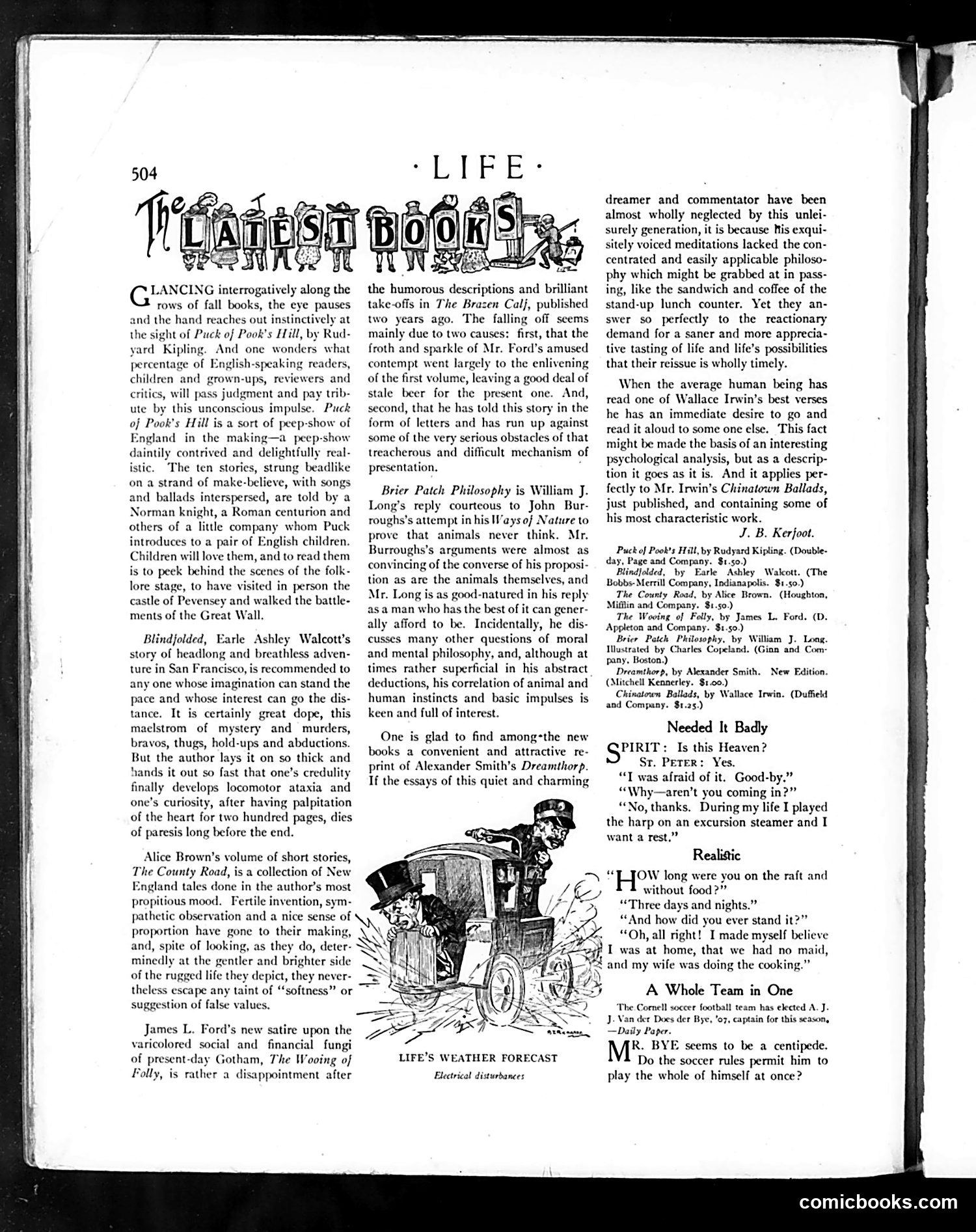
This is a book review section from Life magazine featuring literary criticism of contemporary works. The main cartoon, captioned "LIFE'S WEATHER FORECAST: Electrical Disturbances," depicts a man in a vehicle being struck by lightning or electrical discharge—a visual metaphor for the chaotic, turbulent nature of modern urban life. The reviews discuss Rudyard Kipling's *Puck of Pook's Hill*, a children's fantasy; adventure fiction set in San Francisco; New England short stories; and James L. Ford's social satire about New York ("Gotham"). The critic notes Ford's satirical takeoffs are witty but argues the work declines in quality compared to his earlier *Brazen Calf*. The cartoon's "electrical disturbances" likely satirizes the frenetic pace and instability of contemporary American life—a common Life magazine theme. The vehicle suggests modern technology as both enabler and source of chaos.
📄 Transcribed text from this page (OCR, searchable)
Machine-transcribed from the original scan — historical spelling and the odd misread are preserved.
NCING interrogatively along the rows of fall books, the eye pauses and the hand reaches out instinctively at the sight of Puck of Pook's Hill, by Rud- yard Kipling. And one wonders what percentage of English-speaking readers, children and grown-ups, reviewers and itics, will pass judgment and pay trib- ute by this unconscious impulse. Puck of Pook's Hill is a sort of peep-show of England in the making—a pecp-show contrived and delightfully re The ten stories, strung beadliki ona strand of make-believe, with songs and ballads interspersed, are told by a Norman knight, a Roman centurion and others of a little company whom Puck introduces to a pair of English children. Children will love them, and to read them is to peek behind the scenes of the folk- lore stage, to have visited in person the castle of Pevensey and walked the battle- ments of the Great Wall. Blindfolded, Earle Ashley Walcott’s story of headlong and breathless adven- ture in San Francisco, is recommended to any one whose imagination can stand the pace and whose interest can go the dis- tance. It is certainly great dope, this maelstrom of mystery and murders, bravos, thugs, hold-ups and abductions. But the author lays it on so thick and hands it out so fast that one’s credulity finally develops locomotor ataxia and one’s curiosity, after having palpitation of the heart for two hundred pages, dies of paresis long before the end. Alice Brown’s volume of short stories, The County Road, is a collection of New England tales done in the author’s most propitious mood. Fertile invention, pathetic observation and a nit proportion have gone to their makin; and, spite of looking, as they do, deter- minedly at the gentler and brighter side of the rugged life they depict, they never- the escape any taint of “softness” or suggestion of false values James L. Ford's new satire upon the varicolored social and financial fungi of present-day Gotham, The Wooing of Folly, is rather a disappointment after the humorous descriptions and brilliant take-offs in The Brazen Calj, published two years ago. The falling off seems mainly due to two causes: first, that the froth and sparkle of Mr. Ford's amused contempt went largely to the enlivening of the first volume, leaving a good deal of stale beer for the present one. And, second, that he has told this story in the form of letters and has run up against some of the very serious obstacles of that treacherous and difficult mechanism of presentation, Brier Patch Philosophy is William J. Long’s reply courteous to John Bur- roughs’s attempt in his Ways of Nature to prove that animals never think. Mr. Burroughs’s arguments were almost as convincing of the converse of his proposi- tion as are the animals themselves, and Mr. Long is as good-natured in his reply as a man who has the best of it can gener- ally afford to be. Incidentally, he dis- cusses many other questions of moral and mental philosophy, and, although at times rather superficial in his abstract deductions, his correlation of animal and human instincts and basic impulses is keen and full of interest. One is glad to find amongsthe new books a convenient and attractive re- print of Alexander Smith's Dreamthorp. If the essays of this quiet and charming ¢ dreamer and commentator have been almost wholly neglected by this unlei- surely generation, it is because his exqui- sitely voiced meditations lacked the con- centrated and easily applicable philoso- phy which might be grabbed at in pass- ing, like the sandwich and coffee of the stand-up lunch counter. Yet they an- swer so perfectly to the reactionary demand for a saner and more appreci: tive tasting of life and life’s possi! that their reissue is wholly timely. When the average human being has read one of Wallace Irwin’s best verses he has an immediate desire to go and read it aloud to some one else. This fact might be made the basis of an interesting psychological analysis, but as a descrip- tion it goes as it is. And it applies per- fectly to Mr. Irwin’s Chinatown Ballads, just published, and containing some of his most characteristic work. J. B. Kerjoot. Puck o} Pook's Hill, by Rudyard Kipling. (Double- day, Page and Company. $1.50.) Blindjolded, by Earle Ashley Wakott. (The Bobbs- Merrill Company, Indianapolis. $1.50.) The Courty Road, by Alice Brown. (Houghton, Mifflin and Company. $1.50.) The Wooing of Folly, by James L. Ford. (D. Appleton and Company. $1.50.) Brier Patch Philosophy, by William J. Long. Mlustrated by Charles Copeland. (Ginn and Com- pany, Boston.) Dreamthorp, by Alexander Smith. (Mitchell Kennerley. $1.00.) Chinatown Ballads, by Wallace Irwin. (Duffield and Company. $1.25.) Needed It Badly PIRIT: Is this Heaven? St. PETER: Yes. “T was afraid of it. Good-by.” “Why—aren’t you coming in?” “No, thanks, During my life I played the harp on an excursion steamer and I want a rest,” New Edition. Realistic “HOW Jong were you on the raft and without food?” “Three days and nights.” “And how did you ever stand it?” “Oh, all right!” I made myself believe a4} I was at home, that we had no maid, * St and my wife was doing the cooking.” A LIFE’S WEATHER FORECAST Electrical disturbances A Whole Team in One ‘The Cornell soccer football team has eketed A. J. J. Van det Does der Bye, '07, captain for this season, —Daily Paper. R. BYE scems to be a centipede. Do the soccer rules permit him to play the whole of himself at once? comicbooks.com