
Life, 1906-11-01 · page 31 of 56
Life — November 1, 1906 — page 31: what you’re looking at
What you’re looking at
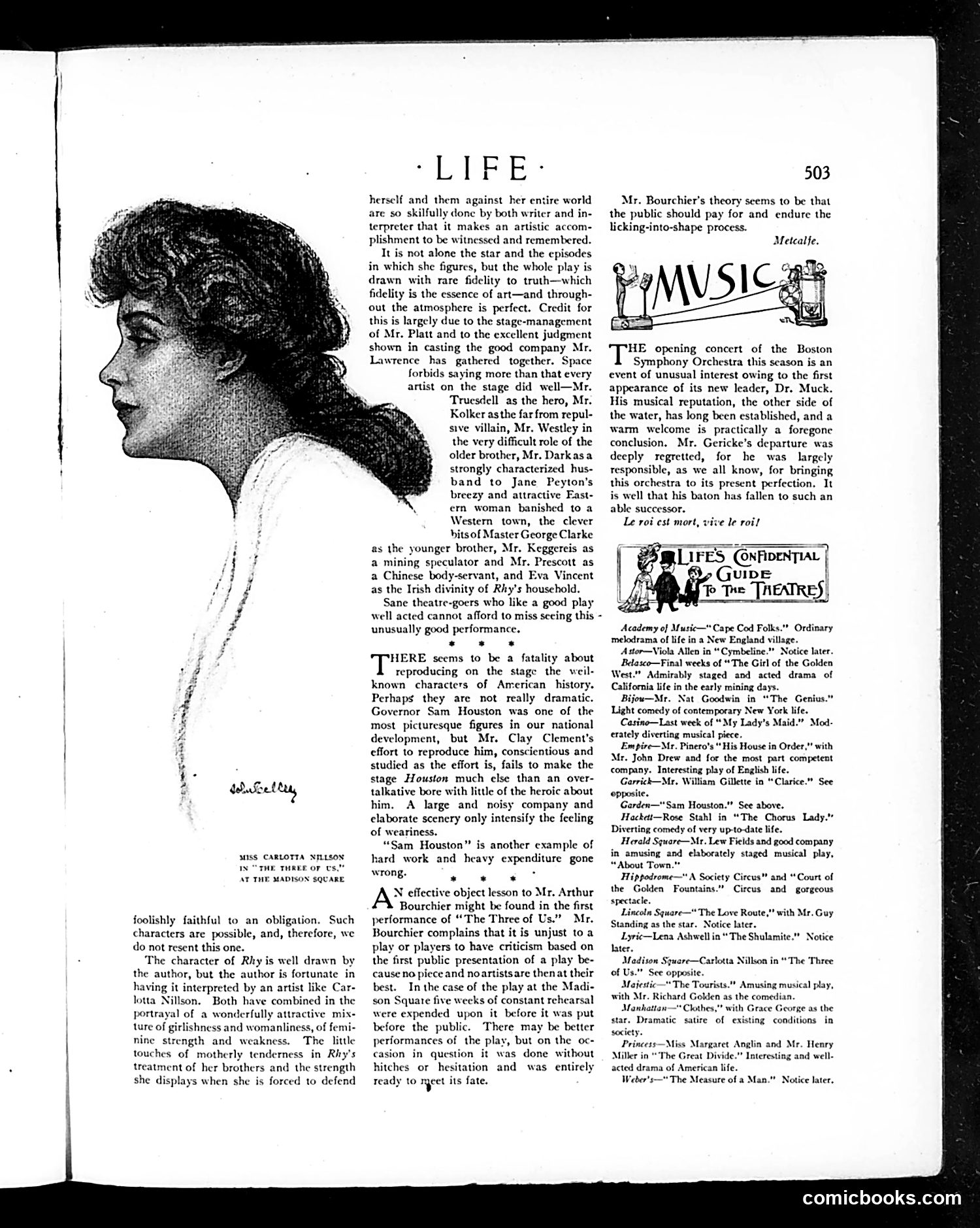
This page contains theater criticism and a music review, not political cartoons. The prominent illustration is a profile portrait of **Miss Carlotta Neilson**, an actress performing in the play "The Three of Us" at Madison Square Theatre. The reviews discuss stage productions: "The Three of Us" receives high praise for its faithful portrayal of American characters and Neilson's nuanced performance. By contrast, "Sam Houston" is criticized as a well-intentioned but tedious failure—despite elaborate scenery and a large cast, the historical figure emerges as an "over-talkative bore." The page also notes a comment by theater director **Arthur Bourchier**, who complains that first-night reviews are unfair. The critic responds that "The Three of Us" had five weeks of rehearsal before opening, so criticism of its opening performance is justified—Bourchier shouldn't expect audiences to pay for plays still being "licked into shape." The final section briefly announces Dr. Muck's debut conducting the Boston Symphony Orchestra.
📄 Transcribed text from this page (OCR, searchable)
Machine-transcribed from the original scan — historical spelling and the odd misread are preserved.
duet uy MISS CARLOTTA NFLLEON IN “THE THREE oF Us." arr MADISON SQUARE foolishly faithful to an obligation. Such characters are possible, and, therefore, we do not resent this one. The character of Rhy is well drawn by the author, but the author is fortunate in having it interpreted by an artist like Car- lotta Nillson, Both h combined in the portrayal of a wonderfully attractive mix- ture of girlishness and womanliness, of femi- nine strength and weakness. The little touches of motherly tenderness in Rhy’s treatment of her brothers and the strength she displays when she is forced to defend *LIPE: herself and them against her entire world are so skilfully done by both writer and in- terpreter that it makes an artistic accom- plishment to be witnessed and remembered. It is not alone the star and the episodes in which she figures, but the whole play is drawn with rare fidelity to truath—which fidelity is the essence of art—and through- out the atmosphere is perfect. Credit for this is largely due to the stage-management of Mr. Platt and to the excellent judgment shown in casting the good company Mr. Lawrence has gathered together. Space forbids saying more than that every artist on the stage did well—Mr. Truesdell as the hero, Mr. Kolker asthe far from repul- sive villain, Mr. Westley in the very difficult role of the older brother, Mr. Darkasa strongly characterized hus- band to Jane Peyton's breezy and attractive East- erm woman banished to a Western town, the clever bitsof Master George Clarke as the younger brother, Mr. Keggereis as a mining speculator and Mr. Prescott as a Chinese body-servant, and Eva Vincent as the Irish divinity of Rhy’s household. Sane theatre-goers who like a good play well acted cannot afford to miss seeing this - unusually good performance. * 8 6 HERE scems to be a fatality about reproducing on the stage the weil- known characters of American history. Perhaps they are not really dramatic. Governor Sam Houston was one of the most picturesque figures in our national development, but Mr. Clay Clement's effort to reproduce him, conscientious and studied as the effort is, fails to make the stage Houston much else than an over- talkative bore with little of the heroic about him. A large and noisy company and elaborate scenery only intensify the feeling of weariness. “Sam Houston” is another example of hard work and heavy expenditure gone wrong. : TONE * * * effective object lesson to Mr. Arthur Bourchier might be found in the first performance of “The Three of Us.” Mr. Bourchier complains that it is unjust to a play or players to have criticism based on the first public presentation of a play be- cause no piece and noartistsare thenat their best. In the case of the play at the Madi- son Square five weeks of constant rehearsal were expended upon it before it was put before the public. There may be better performances of the play, but on the oc- casion in question it was done without hitches or hesitation and was. entirely ready to rycet its fate, 503 Mr. Bourchier's theory scems to be that the public should pay for and endure the licking-into-shape process. Metcalfe. HE opening concert of the Boston Symphony Orchestra this season is an event of unusual interest owing to the first appearance of its new leader, Dr. Muck. His musical reputation, the other side of the water, has long been established, and a warm welcome is practically a foregone conclusion. Mr. Gericke’s departure was deeply regretted, for he was largely responsible, as we all know, for bringing this orchestra to its present perfection. It is well that his baton has fallen to such an able successor. Le roi est mort, vive le roit wy oo | AF fe Toe THEATRES, Academy of Music—" Cape Cod Folks." Ordinary melodrama of life in a New England village. Astor—Viola Allen in “Cymbeline.” Notice later. Belasco—Final weeks of “The Girl of the Golden West.” Admirably staged and acted drama of California life in the early mining days. Bijou—Mr. Nat Goodwin in “The Genius. Light comedy of contemporary New York life. Casino—Last week of “My Lady's Maid.” Mod- erately diverting musical piece. Em pire—Mtr. Pinero's “His House in Order," with Mr. John Drew and for the most part competent company. Interesting play of English life. Garrich—Mr, William Gillette in “Clarice.” See opposite. Garden—"'Sam Houston."" See above. Heckett—Rose Stahl in “The Chorus Lady.” Diverting comedy of very up-to-date life. Herald Square—Mr. Lew Fields and good company in amusing and elaborately staged musical play, “About Town."* Hippodrome—" A Society Circus” and “Court of the Golden Fountains.” Circus and gorgeous spectacle, Lincoln Square—" The Love Route," with Mr. Guy Standing as the star. Notice later. Lyric—Lena Ashwell in “The Shulamite.” Notice later. Madison Square—Carlotta Nillson in “The Three of Us."” See opposite. Majestic—" The Tourists.” Amusing musical play, with Mr. Richard Goklen as the comedian. Manhattan—" Clothes,"* with Grace George as the star. Dramatic satire of existing conditions in society. Princess—Miss Margaret Anglin and Mr. Henry Miller in “ The Great Divide.” Interesting and well- acted drama of American life. Weber's—"The Measure of a Man." Notice later. comicbooks.com