
Life, 1906-11-01 · page 40 of 56
Life — November 1, 1906 — page 40: what you’re looking at
What you’re looking at
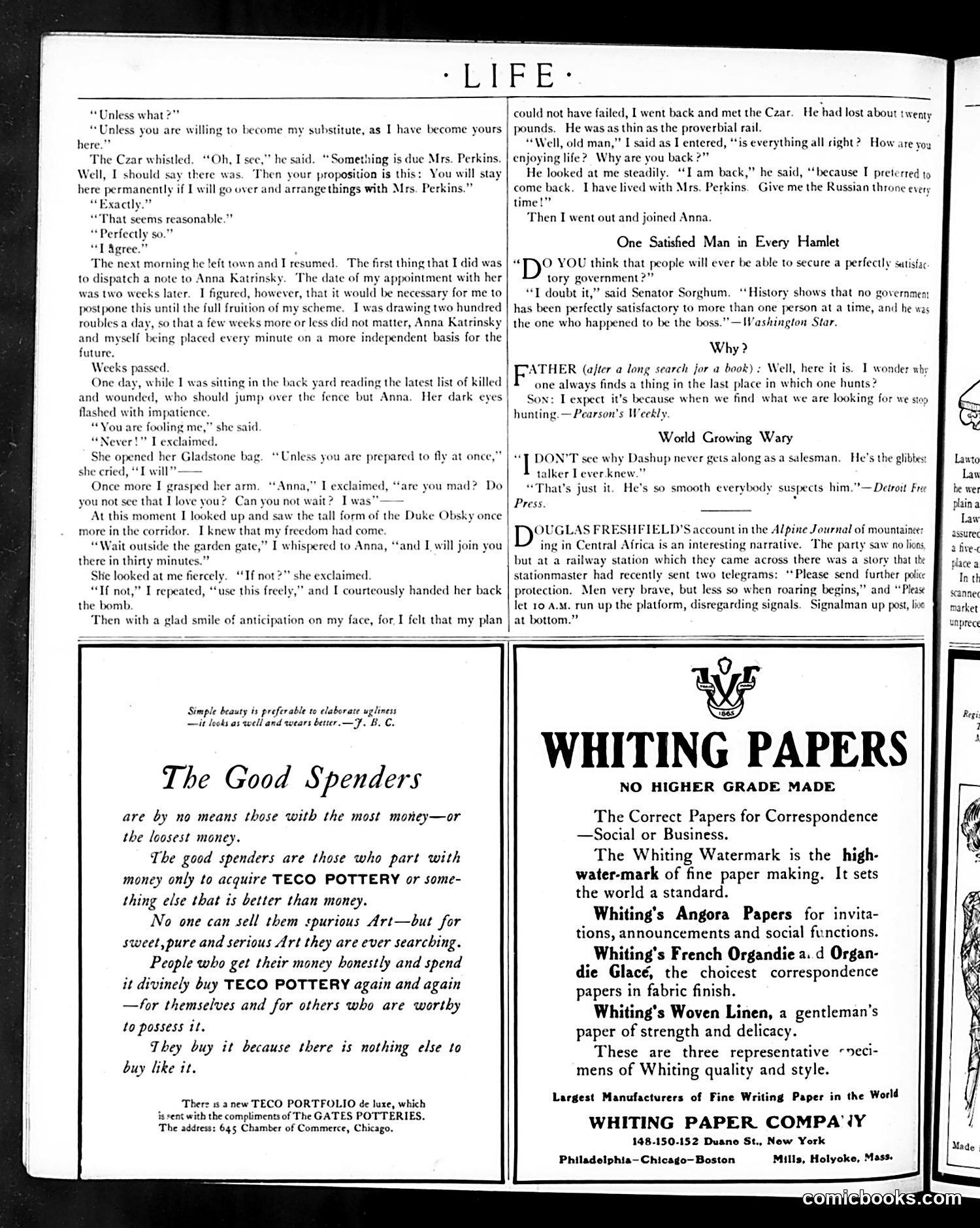
This page contains **narrative fiction and humor pieces**, not political cartoons. The main content is a serialized story about a man who impersonates a Russian Czar and arranges a wife-swap with him—a absurdist comedy playing on themes of identity and romantic entanglement. The humor sections below include: - **"One Satisfied Man in Every Hamlet"**: Senator Sorghum jokes that no government satisfies everyone except whoever holds power—political satire on the impossibility of universal contentment. - **"Why?"**: A mild observational joke about finding lost items. - **"World Growing Wary"**: Quips about salesmanship and suspicious behavior, plus a anecdote about African railway workers and a lion threat. The page is primarily **entertaining fiction and light social commentary** rather than hard political satire. The advertisements for Whiting Papers and Teco Pottery occupy significant space, indicating this is mid-20th century consumer-focused content aimed at educated, middle-class readers.
📄 Transcribed text from this page (OCR, searchable)
Machine-transcribed from the original scan — historical spelling and the odd misread are preserved.
“Unless what?” “Unless you are willing to become my substitute, as I have become yours here. The Czar whistled. ‘Oh, I sce,’ he said. “Something is due Mrs. Perk: Well, I should say there was. Then your proposition is this: You will here permanently if I will go over and arrange things with Mrs. Perkins.” “Exactly,” “That seems reasonable: “Perfectly “TAgr The next morning ke left town and I resumed. The first thing that I did was to dispatch a note to Anna Katrinsky. ‘The date of my appointment with her was two weeks later. I figured, however, that it would be necessary for me to postpone this until the full fruition of my scheme. I was drawing two hundred roubles a day, so that a few weeks more or less did not matter, Anna Katrinsky and myself being placed every minute on a more independent basis for the future. Weeks passed. One day, while I was sitting in the back yard reading the latest list of killed | and wounded, who should jump over the fence but Anna. Her dark eye flashed with impatience. “You are fooling me “Never!” T exclaimed. She opened her Gladstone bag. ‘Unless you are prepared to fly at once,” she cried, “I will” — Once more I grasped her arm. “Anna,” I exclaimed, “are you mad? Do you not sce that I love you? Can you not wait? I was” —— At this moment I looked up and saw the tall form of the Duke Obsky once more in the corridor. I knew that my freedom had come “Wait outside the garden gate,” I whispered to Anna, “‘and I will join you there in thirty minut Ske looked at me fiercely. “If not?” she exclaimed. “If not,” I repeated, ‘use this free and I courteously handed her back the bomb. Then with a glad smile of anticipation on my face, for. I felt that my plan | | could not have failed, I went back and met the Czar. He had lost about twenty pounds. He wasas thin as the proverbial rail. “Well, old man,” I said as I entered, “is everything all right? How are you enjoying life? Why are you back ?” i He looked at me steadily. “I am back,” he said, “because I preterred to come back. I have lived with Mrs. Perkins. Give me the Russian throne every | time!” : ‘Then I went out and joined Anna. One Satisfied Man in Every Hamlet “‘D° YOU think that people will ever be able to secure a perfectly satisfac tory government?” “TI doubt it,” said Senator Sorghum. ‘‘History shows that no government has been perfectly satisfactory to more than one person at a time, and he was the one who happened to be the boss.” —Washington Star. Why? PraATHER (ajter a long search jor a book) ; Well, here it is. 1 wonder wby one always finds a thing in the last place in which one hunts? LT expect it’s because when we find what we are looking for we hunting. — Pearson's Weekly. World Growing Wary DON’T see why Dashup never gets along as a salesman. He's the glibles talker Lever: knew.” “That's just it. He’s so smooth everybody suspects him."—Deiroit Fre Press OUGLAS FRESHFIELD’S account in the Alpine Journal of mountaineer ing in Central Africa is an interesting narrative. The party saw no lions but at a railway station which they came across there was a story that the pace a stationmaster had recently sent two telegrams: ‘Please send further police In th protection. Men very brave, but less so when roaring begins,” and “Pleas let 10 A.M. run up the platform, disregarding signals. Signalman up post, live at bottom.” nec Simple beauty is preferable to elaborate ugliness sit leoks a1 well and wears better.—J. B.C. The Good Spenders are by no means those with the most money—or the loosest money. The good spenders are those who part with money only to acquire TECO POTTERY or some- thing else that is better than money. No one can sell them spurious Art—but for sweet, pure and serious Art they are ever searching. People who get their money honestly and spend it divinely buy TECO POTTERY again and again —for themselves and for others who are worthy to possess it. They buy it because there is nothing else to buy like it. There 1s anew TECO PORTFOLIO de luxe, which is sent with the compliments of The GATES POTTERIES. The address: 645 Chamber of Commerce, Chicago. WHITING PAPERS NO HIGHER GRADE MADE The Correct Papers for Correspondence —Social or Business. The Whiting Watermark is the high- water-mark of fine paper making. It sets the world a standard. Whiting’s Angora Papers for invita- tions, announcements and social functions. Whiting’s French Organdie a. d Organ- die Glacé, the choicest correspondence papers in fabric finish. Whiting’s Woven Linen, a gentleman’s paper of strength and delicacy. These are three representative -neci- mens of Whiting quality and style. Largest Manufacturers of Fine Writing Paper in the World WHITING PAPER COMPA /Y 148-150-152 Duano St., New York Philadelphia—Chicago- Boston Mills, Holyoke, Mass.