
A complete issue · 48 pages · 1906
Judge — December 22, 1906
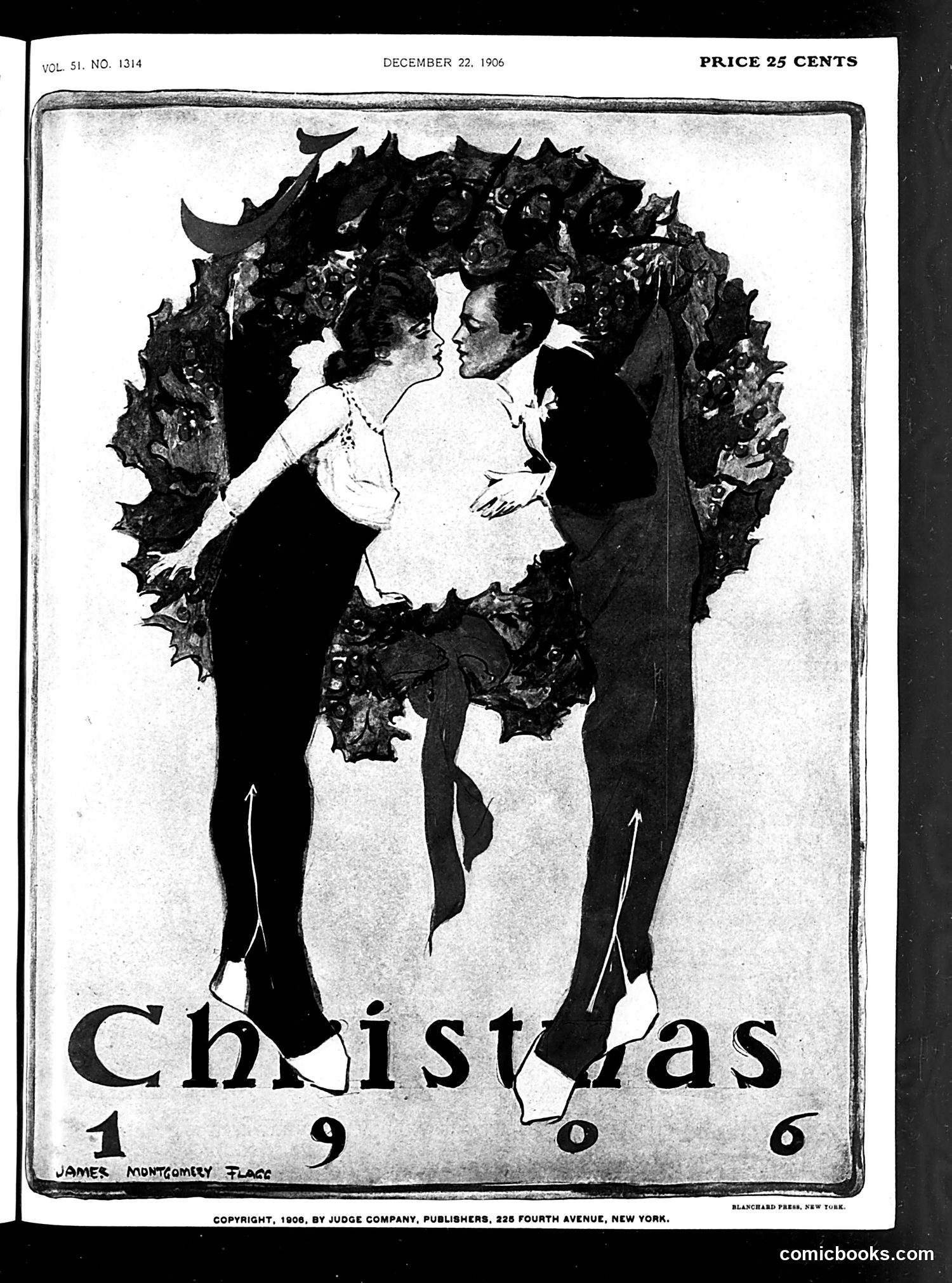
This Judge magazine cover from December 22, 1906 presents a silhouette illustration for the Christmas issue. Two figures in formal attire (a woman and man) face each other intimately within a decorative wreath frame, with the year "1906" integrated into the lettering of "Christmas" below. The image appears to be a romantic holiday greeting rather than political satire—typical of Judge's seasonal covers. The silhouette technique was popular for Christmas imagery in this era. Without additional context or identifying marks, the specific figures cannot be definitively identified. The cover functions as festive decoration and holiday sentiment rather than commentary on contemporary events or public figures. The 25-cent price reflects Judge's standard cost for premium illustrated issues.
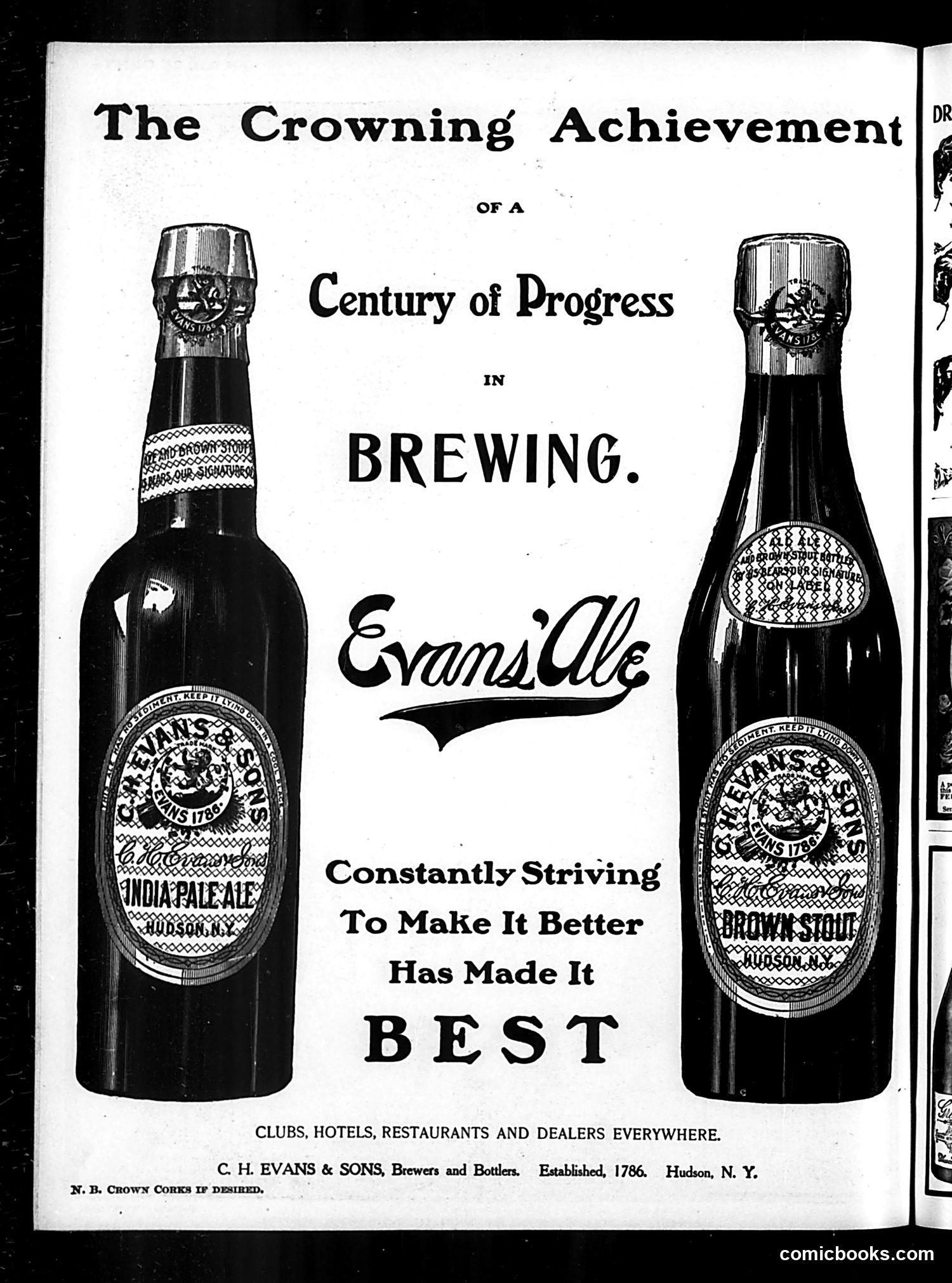
This is **not a political cartoon or satire** — it's a **straightforward advertisement** for Evans Ale, a beer brand brewed in Hudson, New York since 1786. The page promotes Evans Ale's "century of progress" in brewing quality. Two beer bottles are displayed: India Pale Ale (left) and Brown Stout (right), each with detailed period labels. The central text claims the company's commitment to improvement has made their product "BEST." The phrase "Constantly Striving To Make It Better Has Made It BEST" is the core sales message—a quality-focused pitch targeting "clubs, hotels, restaurants and dealers everywhere." There is no satire or political commentary here. Judge magazine, while primarily satirical, also contained period advertisements alongside editorial content.
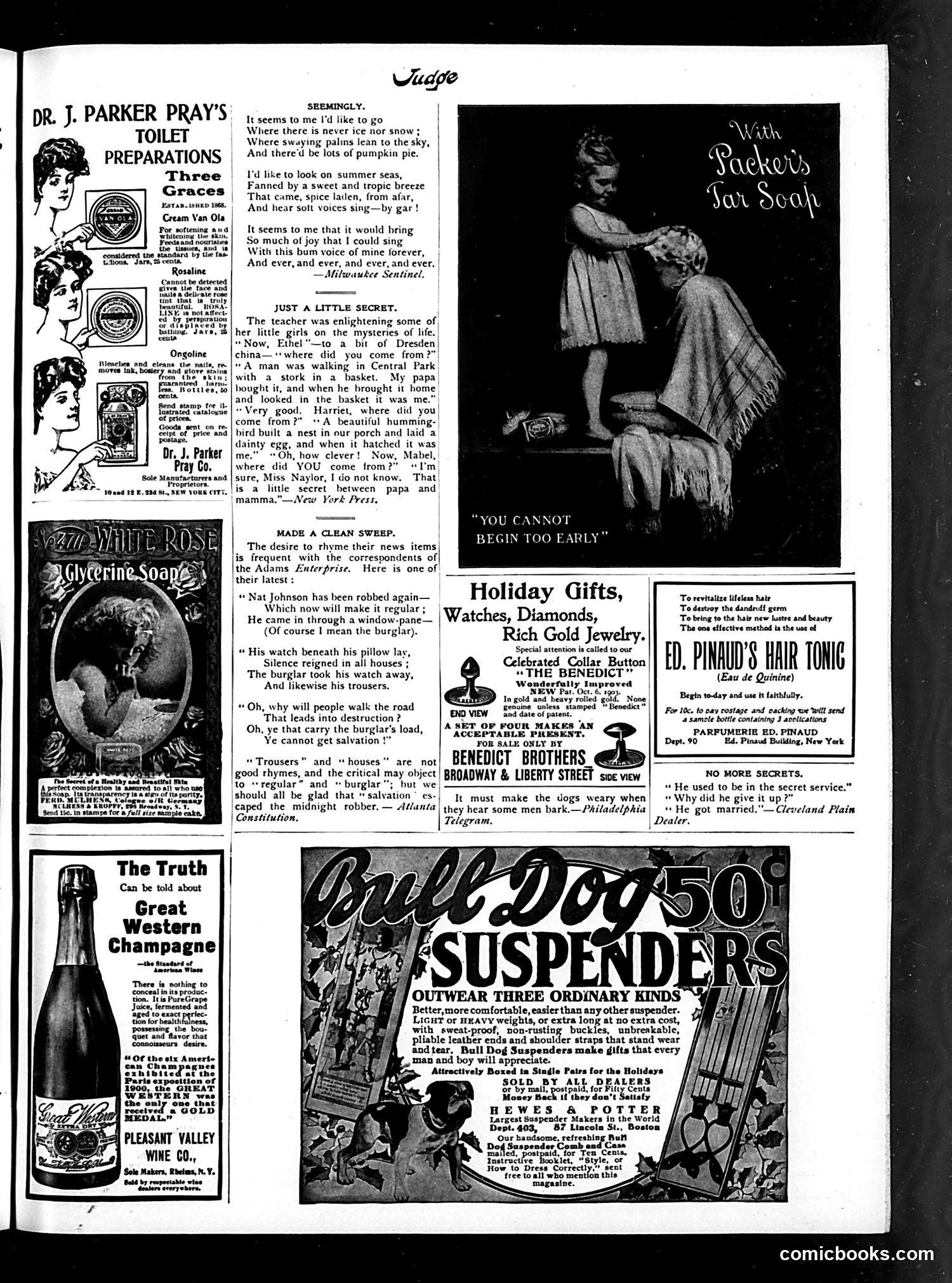
This page is primarily **advertising**, not political satire. The main content includes: - Dr. J. Parker Pray's Toilet Preparations (cosmetics ads) - White Rose Glycerine Soap advertisement - Pleasant Valley Wine Company ad - Packer's Tar Soap advertisement - ED. Pinaud's Hair Tonic ad - Bull Dog Suspenders prominent large advertisement The only non-advertising content appears to be brief poems/verses at the top ("Seemingly") and a short story titled "Just a Little Secret" about a schoolteacher's origins. There is **no identifiable political cartoon or social satire** on this page—it functions as a commercial advertising vehicle typical of early-20th-century magazines, where *Judge* magazine sold space to product manufacturers while filling remaining space with light humor and short fiction.
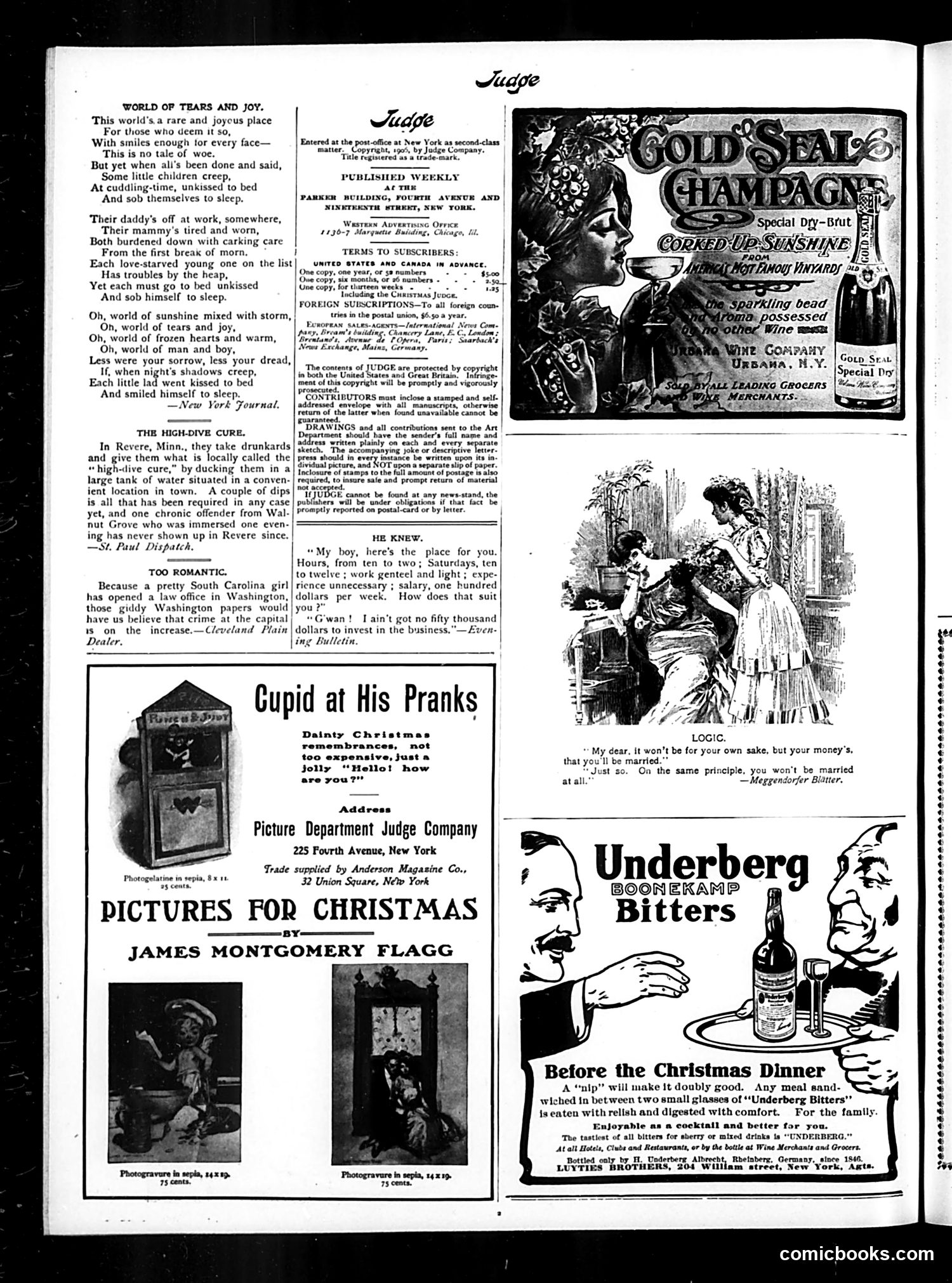
This page is primarily **advertising and light humor** rather than political satire. The main content includes: **"Cupid at His Pranks"** by Dainty Christman—a comic strip about romantic misunderstandings, appearing standard for the era. **Advertisements dominate**: Gold Seal Champagne, Underberg Bitters (promoting digestive benefits before Christmas dinner), and Picture Department Judge Company promoting James Montgomery Flagg's Christmas photographs. **Minor humor sections** include "The High-Live Cure" (about a drunk), "Too Romantic" (about a Washington lawyer), and "Logic" (a brief joke about marriage and money). The page reflects early 20th-century American consumer culture and domestic comedy rather than political commentary. The advertising-to-content ratio suggests this was a commercially-driven publication mixing entertainment with commercial interests.
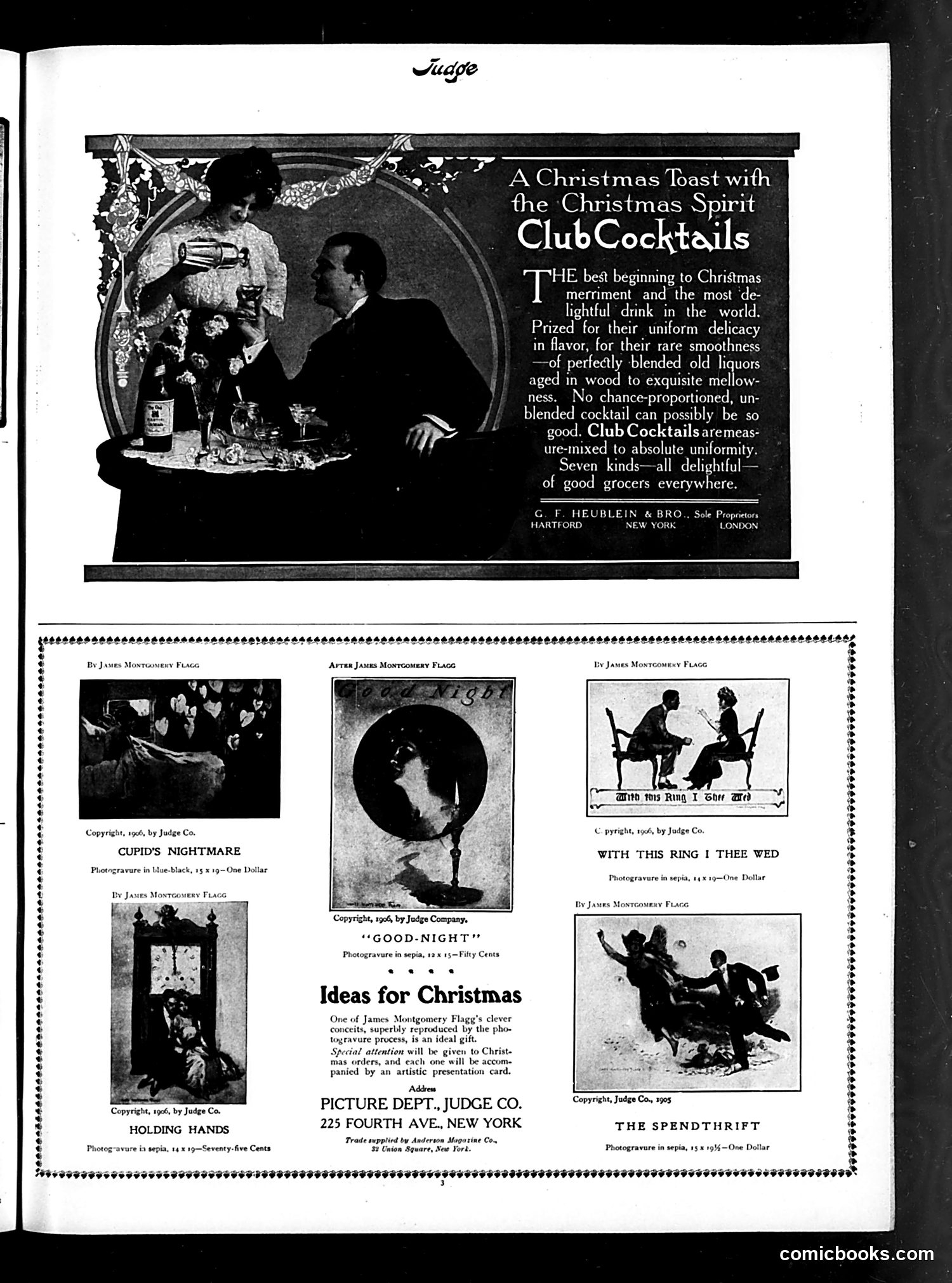
This page is primarily **advertising and entertainment content** rather than political satire. The top half features a Club Cocktails advertisement celebrating Christmas drinking culture, showing two men toasting with various spirits. The copy emphasizes the uniformity and quality of pre-mixed cocktails as an ideal gift. The bottom half showcases film stills from James Montgomery Flagg productions available through Judge Company's Picture Department. These appear to be **silent film advertisements** featuring titles like "Cupid's Nightmare," "Good-Night," "With This Ring I Thee Wed," "Holding Hands," and "The Spendthrift"—typical early cinema domestic comedies and romantic scenarios. The page reflects **1910s-1920s consumer culture**, promoting both alcohol and entertainment as holiday gift options.
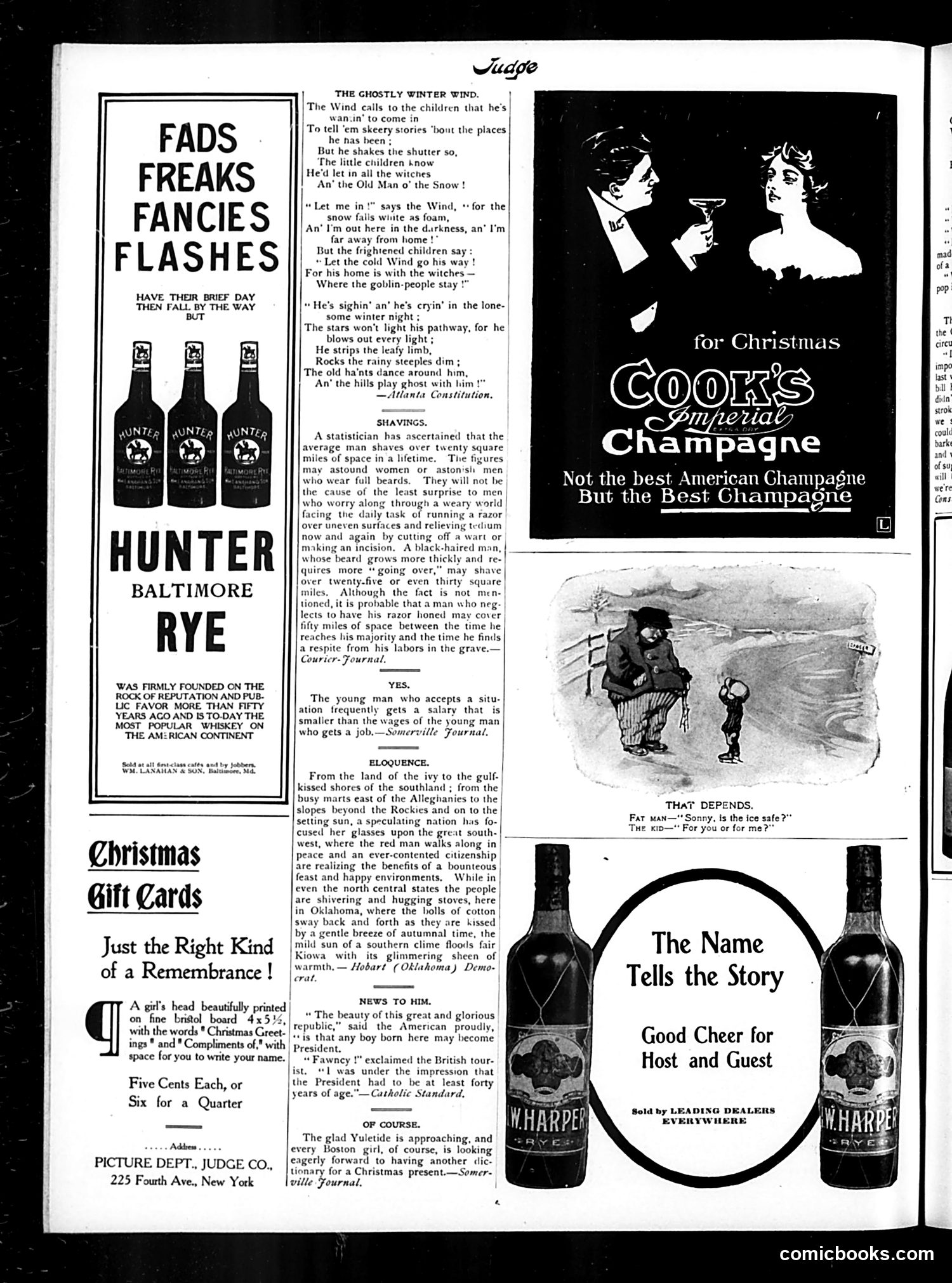
This page is predominantly **advertising**, with minimal satirical content. The left side features ads for Hunter Baltimore Rye whiskey (emphasizing its 50-year reputation) and Christmas gift cards. The right displays Cook's Imperial Champagne and W. Harper whiskey ads. The editorial content includes brief humorous pieces: "The Ghostly Winter Wind" (a poem about winter folklore), "Shavings" (a statistical joke about men shaving 20+ square miles of facial hair over lifetimes), and "News to Him" (a joke where a British tourist is surprised that American presidents must be 40 years old—implying any boy *theoretically* could become president, but practically cannot due to age requirements). These items represent typical Judge fare: light social commentary and wordplay rather than hard political satire. The page reflects early-20th-century consumer culture and genteel humor aimed at middle-class readers.
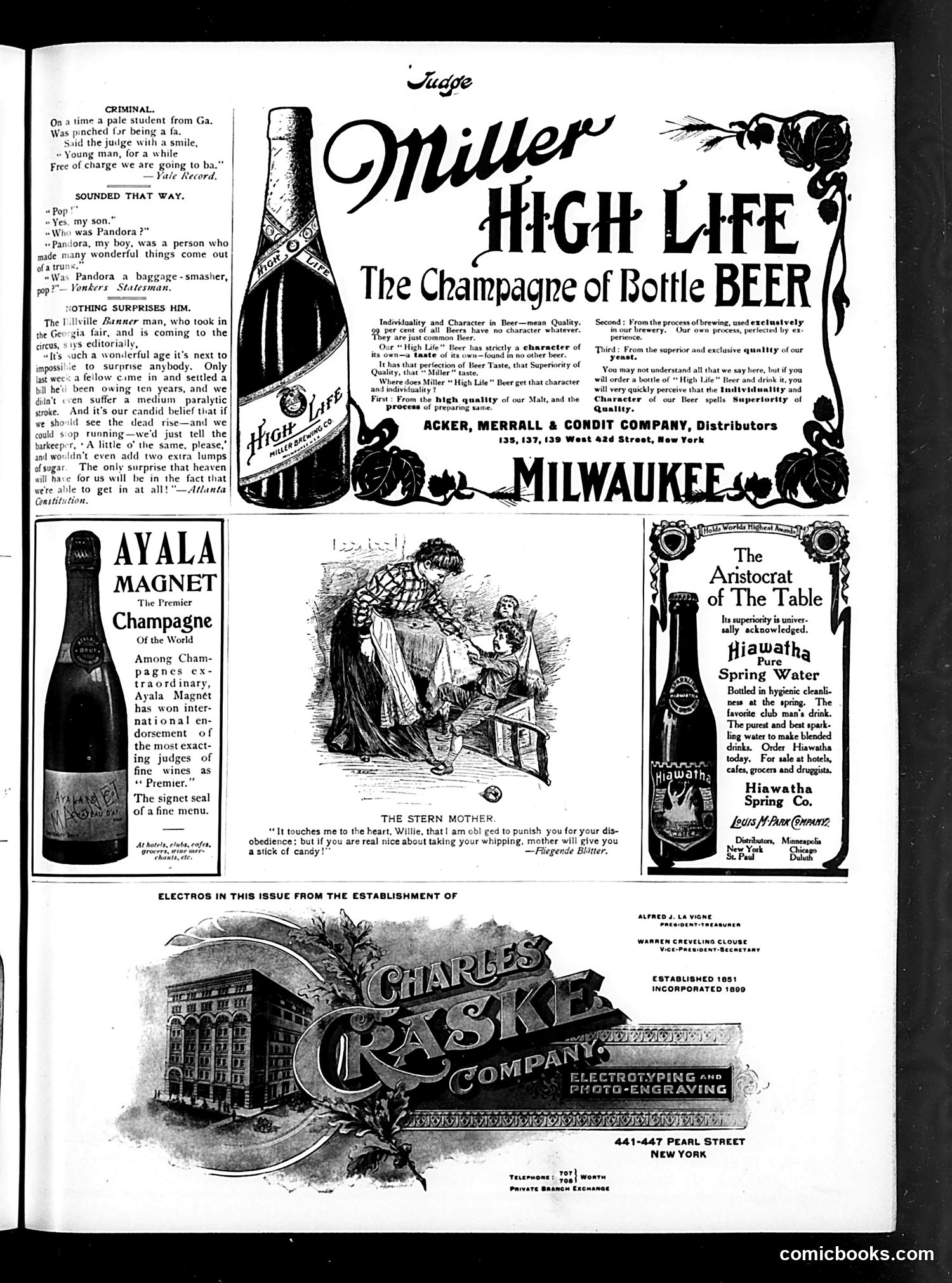
This page is primarily **advertising**, with brief comedic filler material. The main content consists of: **The Jokes:** Three short, mild gags about puns and wordplay—a student arrested for being a "fa" (presumably "fade"), confusion about Pandora as a "baggage-smasher," and a jaded newspaper editor unimpressed by miracles. These are generic humor fillers typical of Judge's format. **The Advertisements:** The dominant feature is a large Miller High Life beer ad emphasizing the beer's distinctive character and quality. Surrounding it are ads for Ayala Magnet champagne, Hiawatha Spring Water, and Charles Craskey Company (electrotyping/photo-engraving services). **The Single Cartoon:** "The Stern Mother" depicts a parent offering candy to a child in exchange for accepting punishment—dark humor about parenting through bribery and physical discipline, reflecting early 20th-century attitudes. The page reflects pre-Prohibition advertising and period humor conventions rather than political satire.
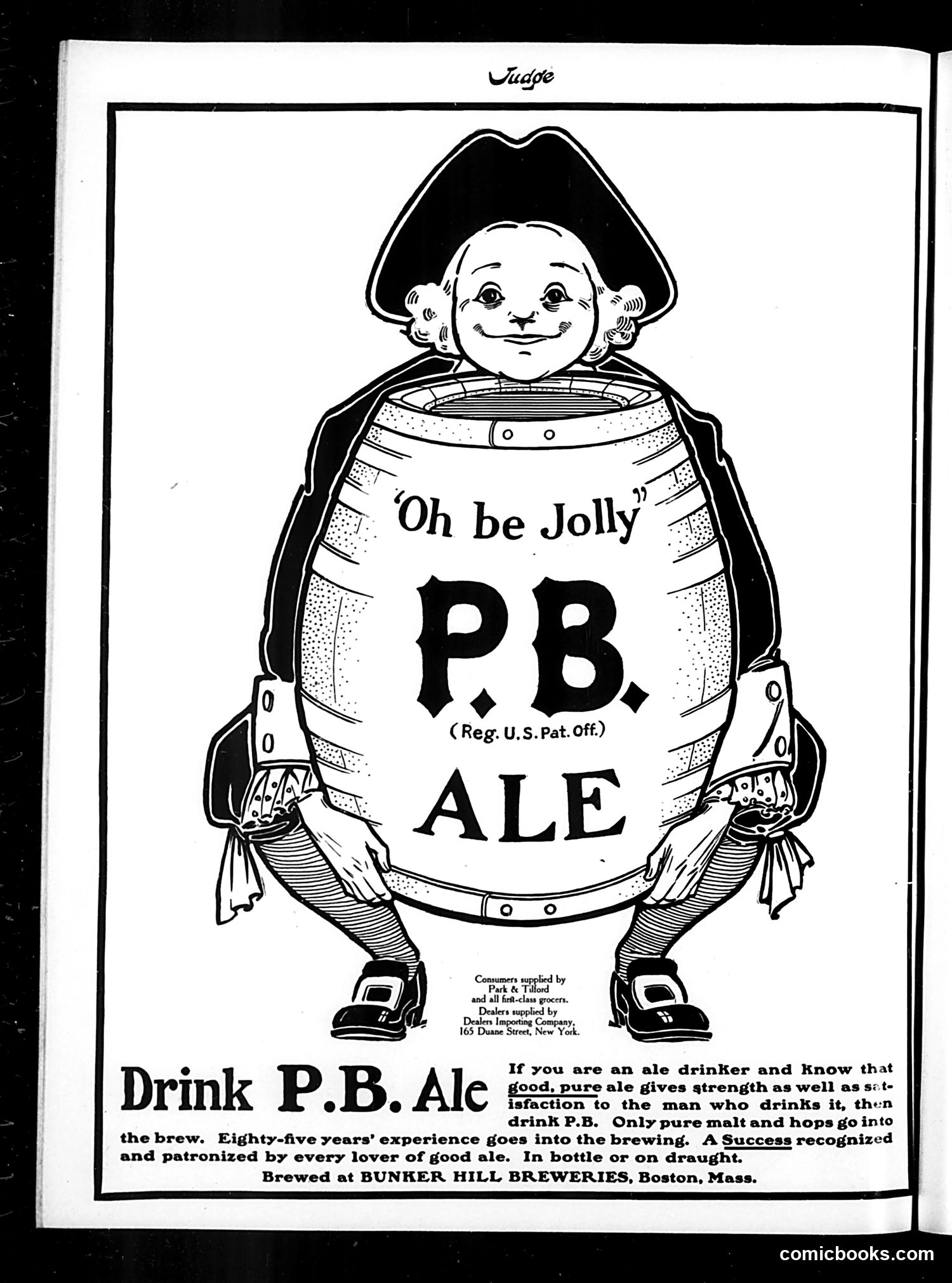
This is a full-page advertisement for P.B. Ale, brewed by Bunker Hill Breweries in Boston, Massachusetts. The imagery features a jolly, rotund character dressed in colonial-era clothing (tricorn hat, breeches) who is literally depicted as a large barrel of ale. The character's cheerful expression and the phrase "Oh be Jolly" emphasize conviviality and pleasure. The ad appeals to ale drinkers by claiming eighty-five years of brewing experience and emphasizing "pure malt and hops." The colonial costume likely references Boston's historical significance and tradition, suggesting established quality and American heritage. This is straightforward product advertising rather than political satire—common in Judge magazine, which featured both humor and paid advertisements.
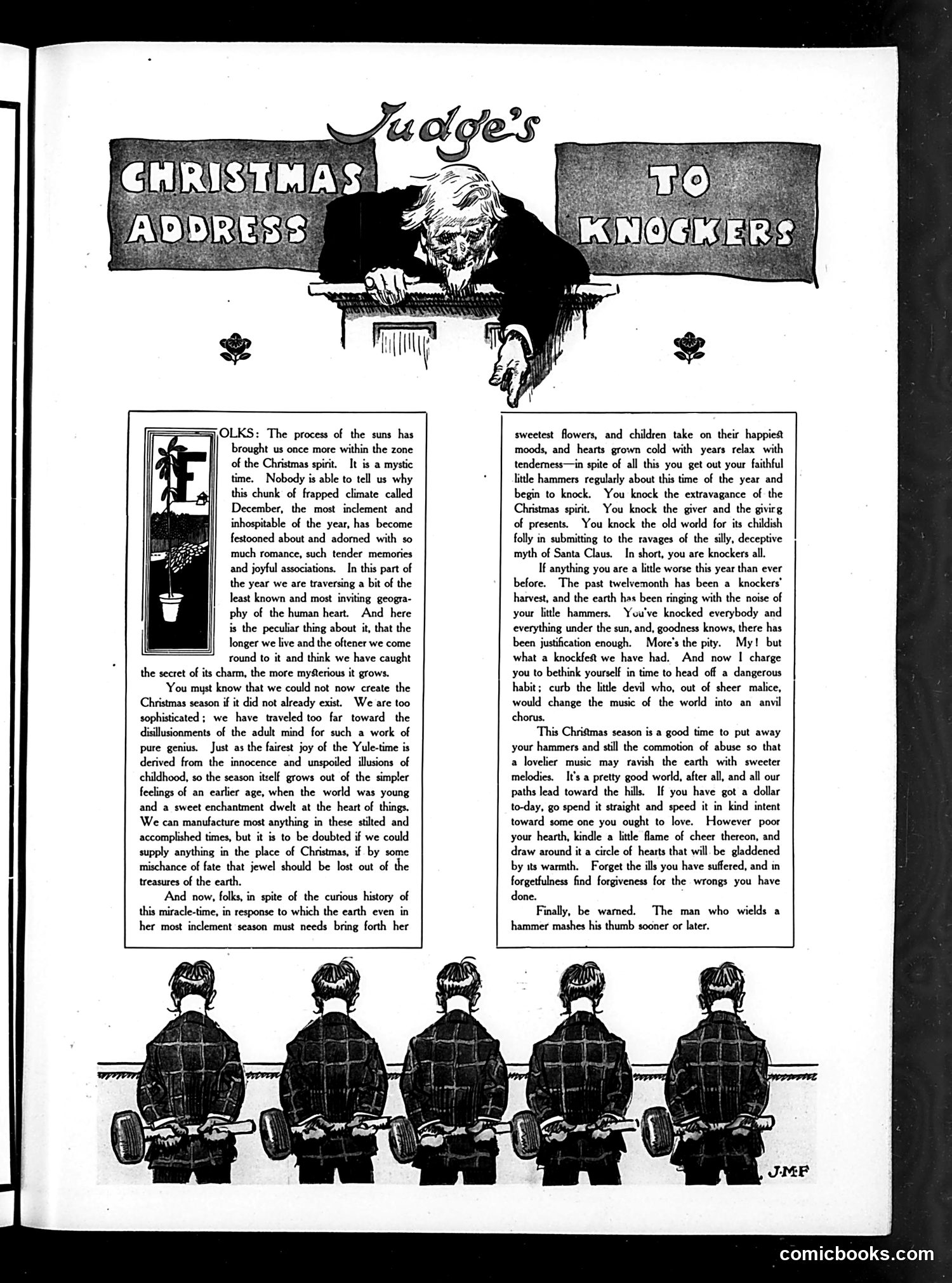
This is a satirical editorial attacking cynics and chronic complainers during the Christmas season. The cartoonist personifies "Knockers"—people who habitually criticize everything—as literal figures with hammers (shown at bottom, facing away while holding mallets). The text argues that while 1920s society has legitimate grievances ("The past twelvemonth has been a knockers' harvest"), Christmas represents a rare moment to abandon cynicism and embrace the gentleness of the season. The author exhorts readers to stop their constant "knocking" (complaining) and instead practice charity and forgiveness. The skeleton figure at top represents Death or Fate presiding over this moral lesson. The final line is a pun: literal hammers cause thumb injuries, but metaphorical hammers (constant criticism) wound the spirit. The appeal is for seasonal goodwill over relentless fault-finding—a common early 20th-century editorial theme.
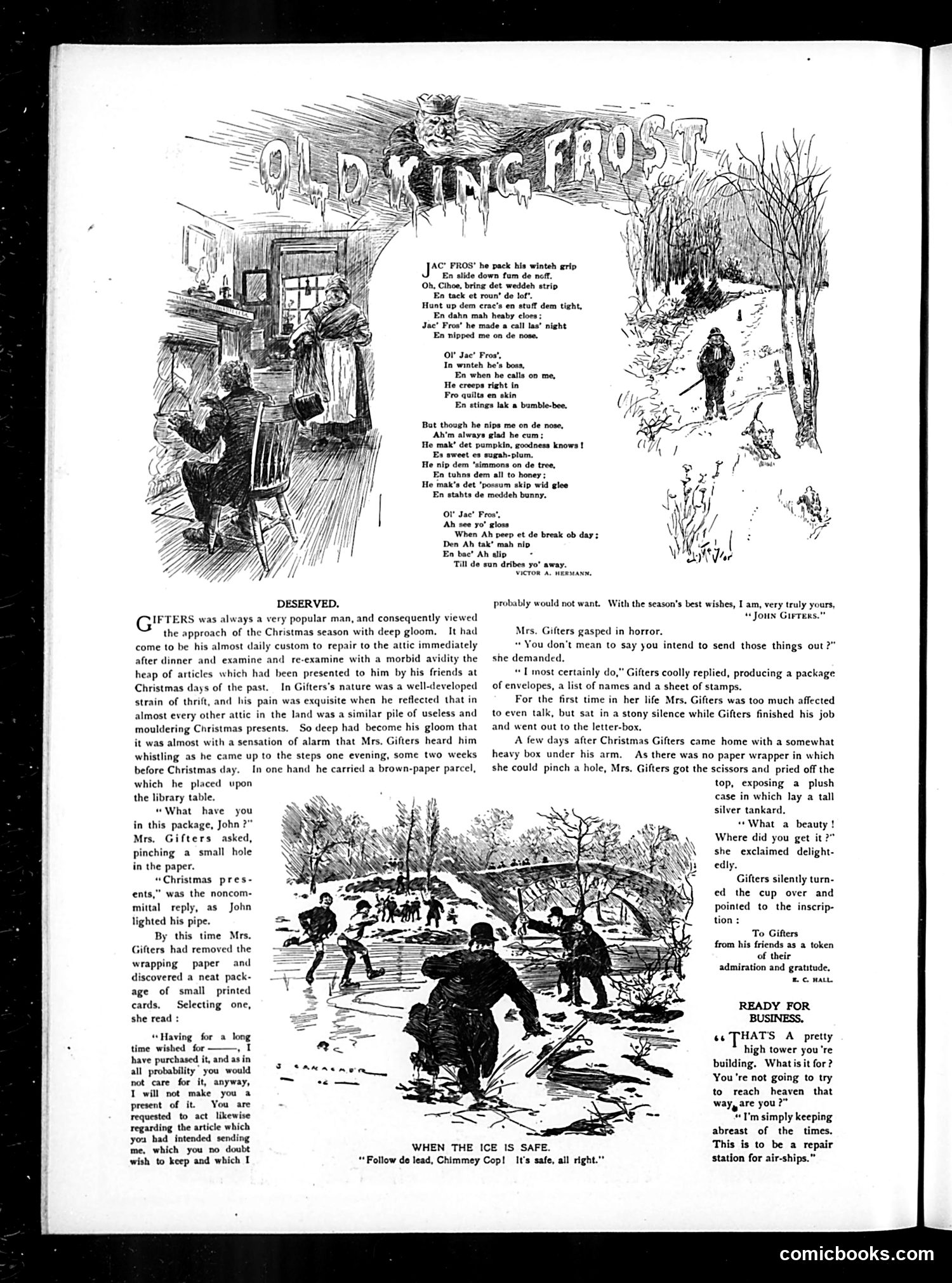
This story mocks the social convention of obligatory Christmas gift-giving. John Gifters, tired of accumulating useless presents he doesn't want, prints cards announcing he won't give gifts to people who wouldn't appreciate them anyway—essentially calling out the pretense of the tradition. The joke: his friends respond by sending him an elegant silver tankard inscribed with false praise ("admiration and gratitude"), which Gifters interprets as proof his cynicism was justified. The irony is that even when explicitly rejecting gift-giving hypocrisy, social pressure forces people to participate anyway—and recipients still receive unwanted items. The top poem about "Jack Frost" appears unrelated, likely filler content in this Judge magazine page.
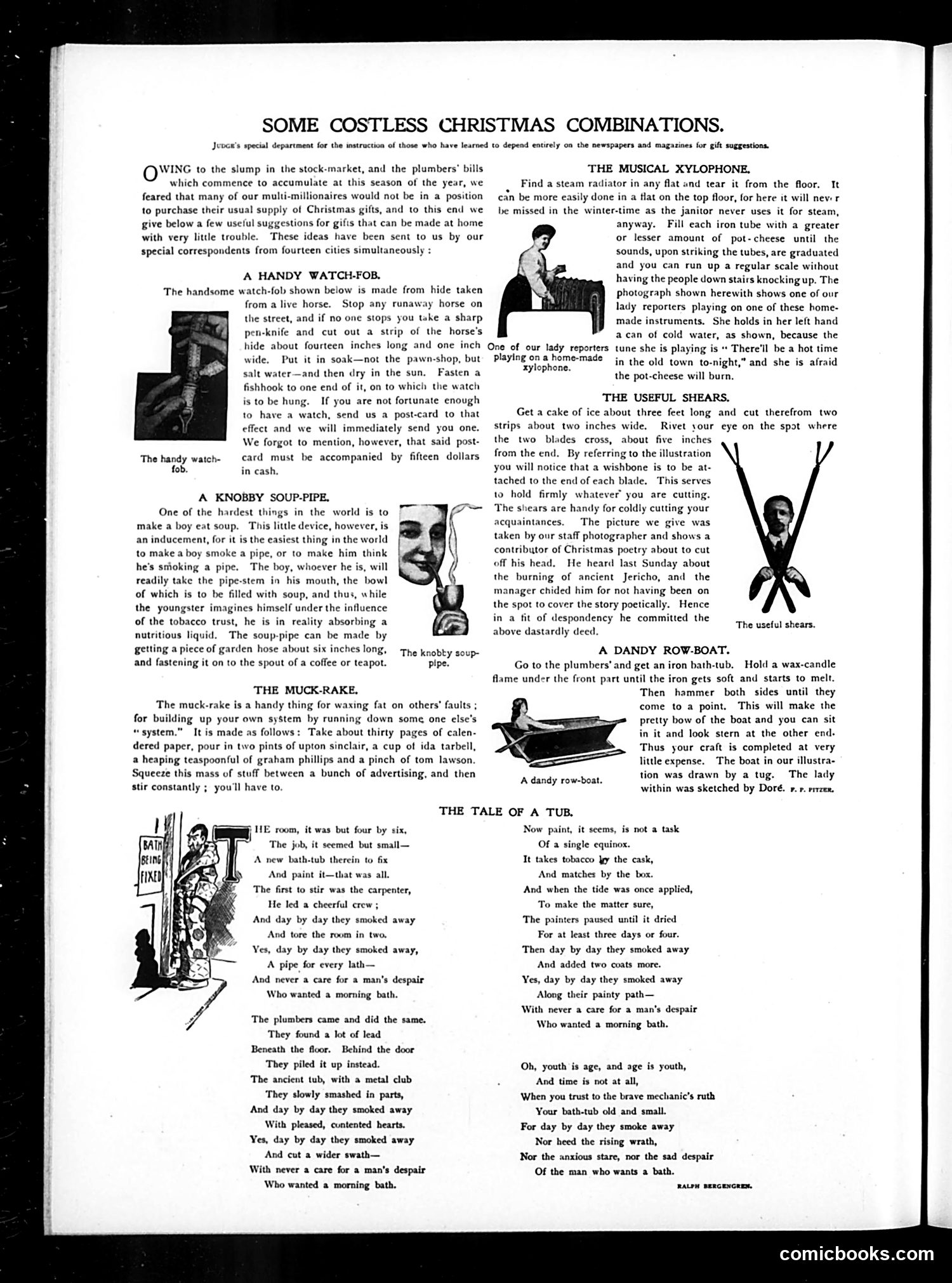
This is a satirical gift guide from Judge magazine mocking both poverty-stricken wealthy people and contemporary muckraking journalism. The opening frames the premise humorously: due to stock market collapse and plumber bills, even millionaires need cheap homemade gifts. The "gifts" are deliberately absurd and impractical. Most notably, the **"Muck-Rake"** section satirizes famous muckraking journalists of the Progressive Era. It instructs readers to combine "two pints of upton sinclair, a cup of ida tarbell, a heaping teaspoonful of graham phillips and a pinch of tom lawson"—all real investigative journalists famous for exposés. The joke: mixing their work creates something to "wax fat on others' faults" while hiding one's own "system" (corruption). This ridicules both muckrakers' methods and their moral grandstanding. The other "gifts" (watch-fob from stolen horse hide, soup-pipe, xylophone from radiator guts) are equally ridiculous, maintaining the satirical tone throughout. The page targets both wealthy misers and self-righteous progressive critics.
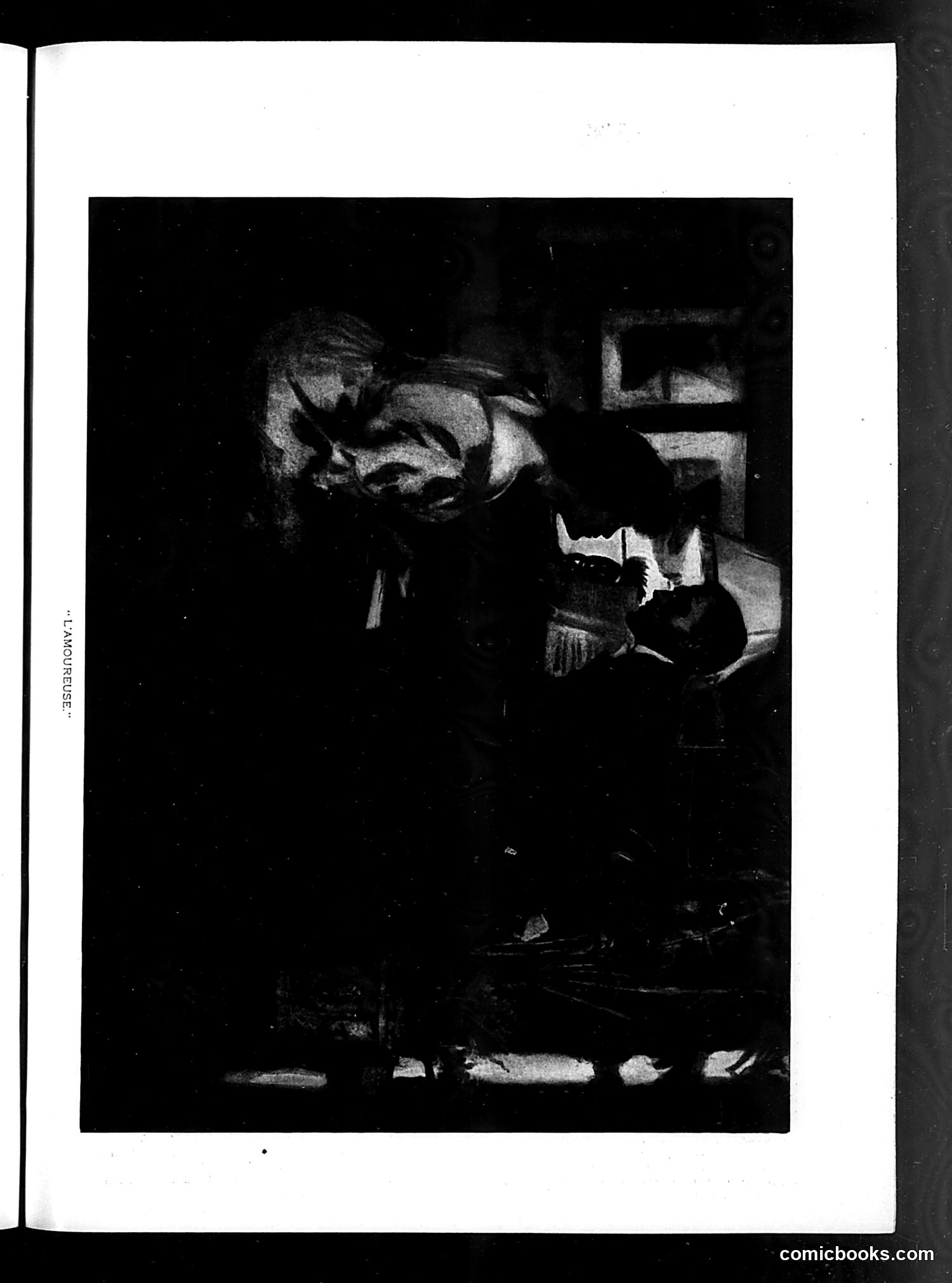
I can see this is a black and white photograph or illustration from Judge magazine, but the image quality and contrast make it difficult to discern specific details with confidence. The OCR text appears corrupted or incomplete, providing only scattered letters without coherent words. What's visible is a dramatic scene with figures in what appears to be an interior setting with strong lighting contrasts typical of early-to-mid 20th century photography or rotogravure printing. However, without legible text or clearer details, I cannot reliably identify the specific figures, political references, or satirical point this cartoon was making. To accurately explain this page's meaning to a modern reader, I would need either a clearer image or legible OCR text providing context about the subject matter.
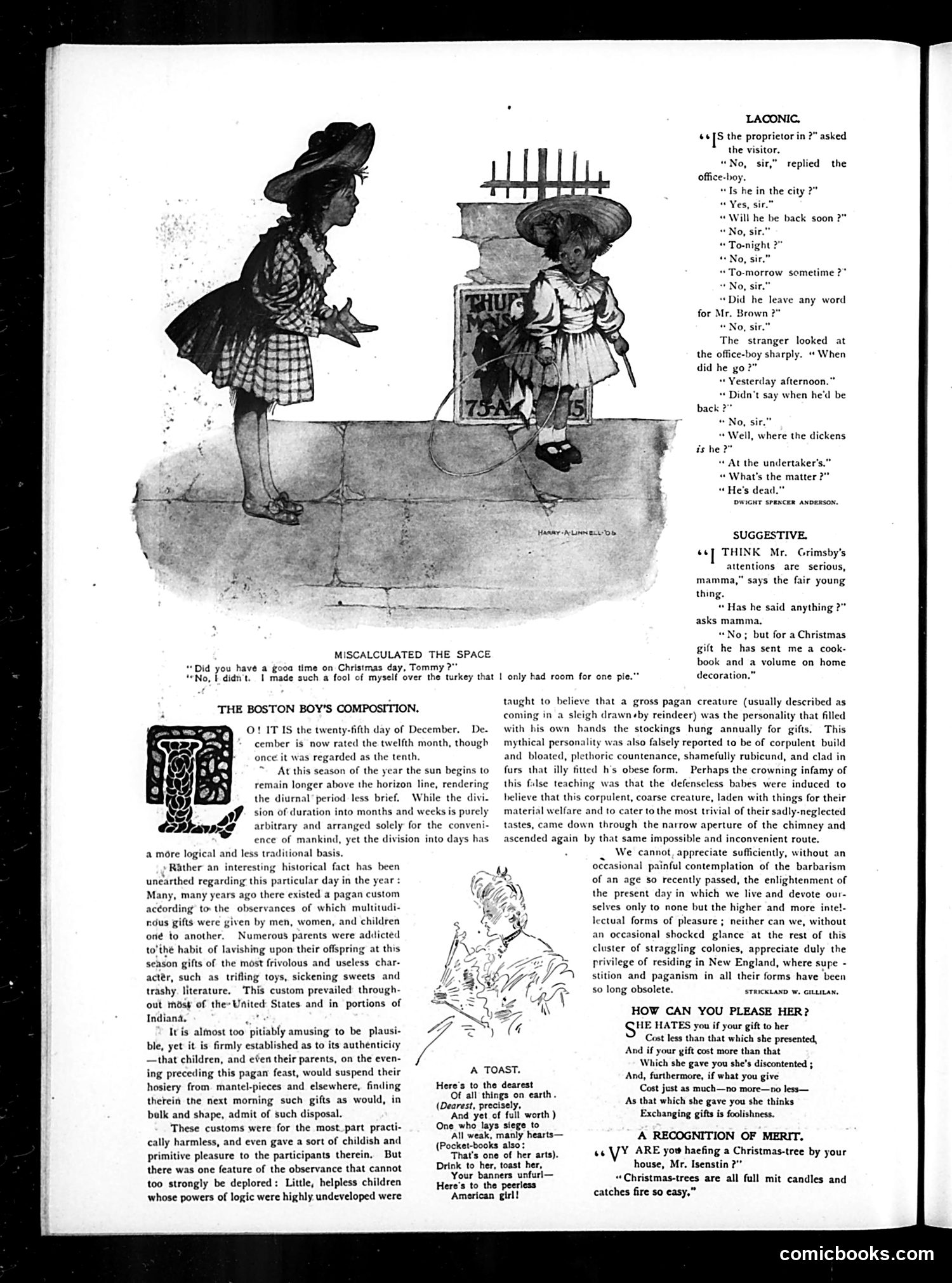
This page contains multiple short humorous pieces typical of early 20th-century American satirical magazines. **"Laconic"** depicts an office boy delivering deadpan responses to a visitor's questions, with the punchline revealing the proprietor is dead—the boy's minimal answers become darkly ironic in retrospect. **"Miscalculated the Space"** jokes about a boy who ate so much turkey at Christmas dinner he had room for only one pie instead of multiple desserts—poking fun at American holiday excess and gluttony. **"The Boston Boy's Composition"** satirizes overly pedantic writing. A student's essay about December uses unnecessarily complex vocabulary and formal structure while discussing the absurdity of Santa Claus mythology—mocking both pompous student writing and the persistence of Christmas folklore despite its logical inconsistencies. The other brief pieces ("Suggestive," poetry sections) offer light romantic and domestic humor. Together, these represent Judge's characteristic blend of wordplay, social observation, and gentle mockery of American customs and pretensions.
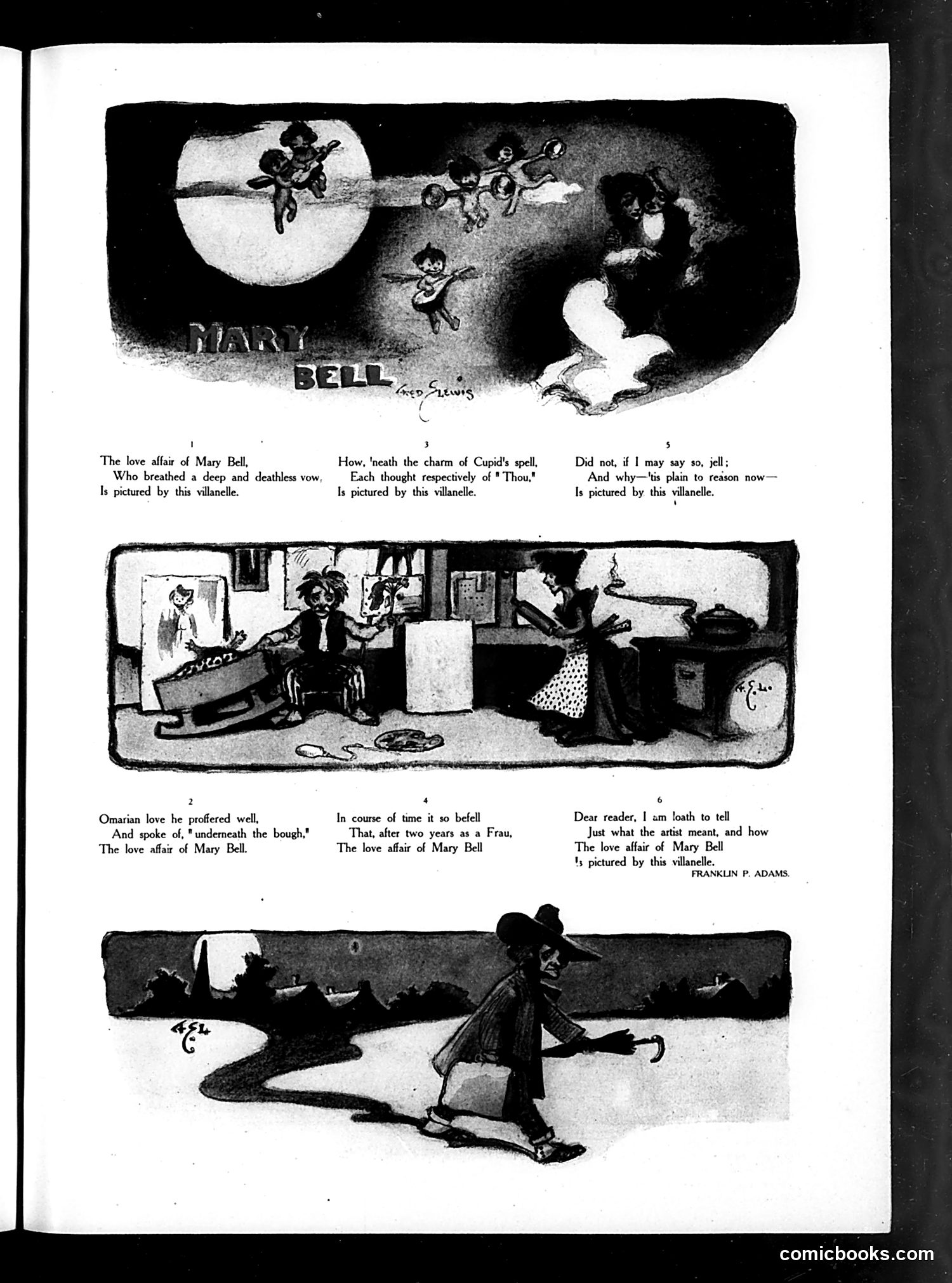
This is a humorous illustrated poem by Franklin P. Adams about a failed romance. The narrative follows Mary Bell through a romantic courtship (shown in the dream-like top panel with cherubs and moonlight) to domestic disappointment (the middle panel showing a couple in an ordinary home setting) to her solitary departure (bottom panel). The satire mocks Victorian romantic ideals—the gap between love's poetic promises ("breathed a deep and deathless vow") and mundane reality. The poem is structured as a villanelle, a formal poetic constraint, which underscores the irony: high literary form applied to a banal domestic letdown. The "Frau" reference suggests she married a German, possibly satirizing cross-cultural marriages or suggesting she fled to Europe to escape her disappointment. The final line admits the artist (or Adams) cannot adequately explain what went wrong—implying marriage's mysteries are beyond explanation.
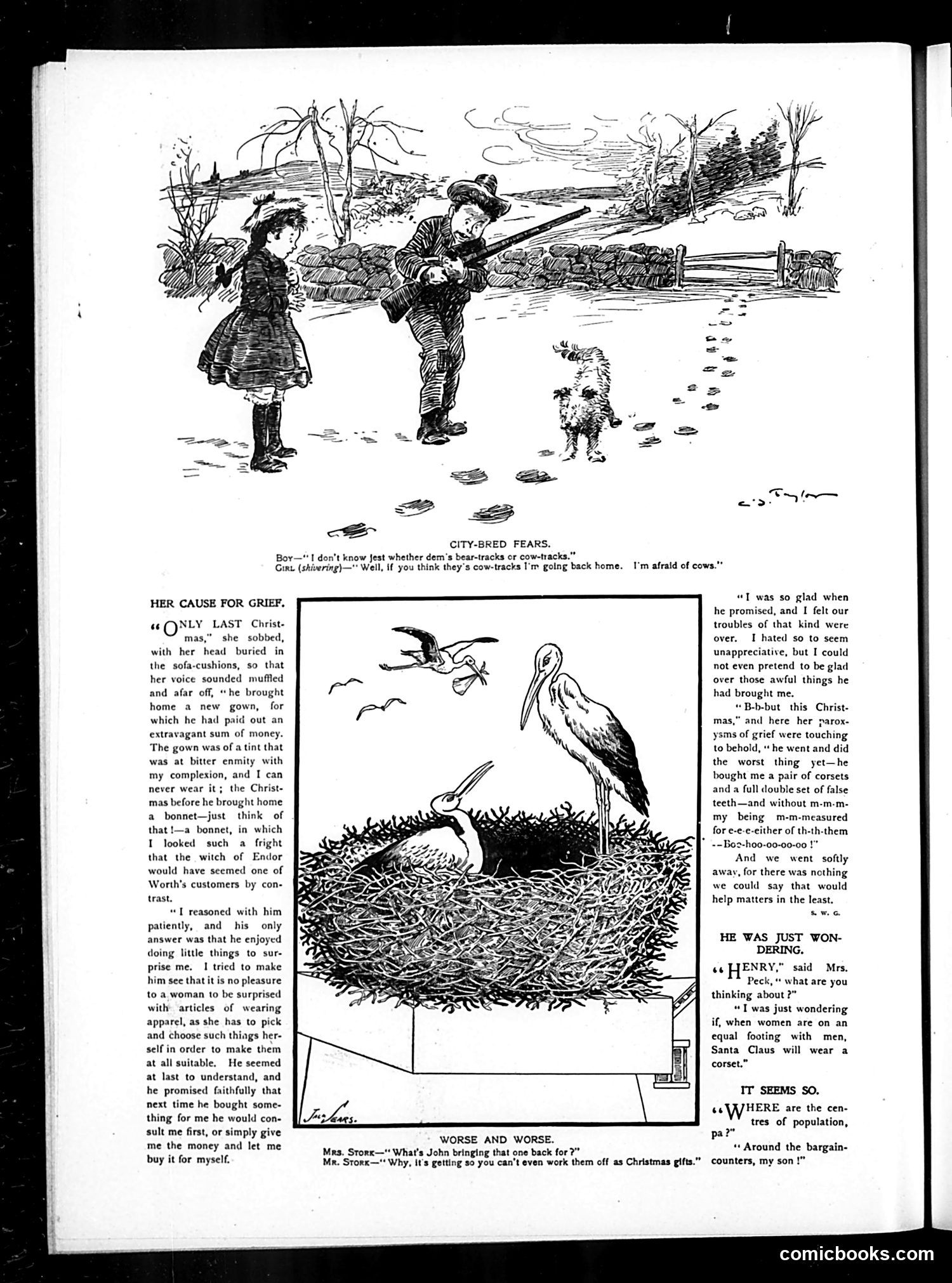
This page contains three satirical pieces mocking gender relations and consumer culture in the Gilded Age: **"City-Bred Fears"** (top): A boy and girl encounter animal tracks; the girl fears cows, humorously suggesting urban-bred women lack practical knowledge. **"Her Cause for Grief"** (center): A woman complains her husband bought her an unflattering gown and bonnet as Christmas gifts despite her preferences. The satire targets both husbands who ignore women's input on appearance and women's apparent ingratitude for expensive gifts—a common domestic comedy trope of the era. **"Worse and Worse"** (bottom): A dialogue suggests returning gifts, implying people resell unwanted presents as new gifts—commentary on consumer excess and insincerity. **"He Was Just Wondering"**: A husband jokes that if women achieve equality with men, Santa Claus will wear a corset—satirizing both women's rights debates and fashion absurdity. **"It Seems So"**: A quip that population centers exist at bargain counters, mocking women's shopping habits. The overall theme: contemporary anxieties about changing gender roles, consumerism, and marriage tensions.
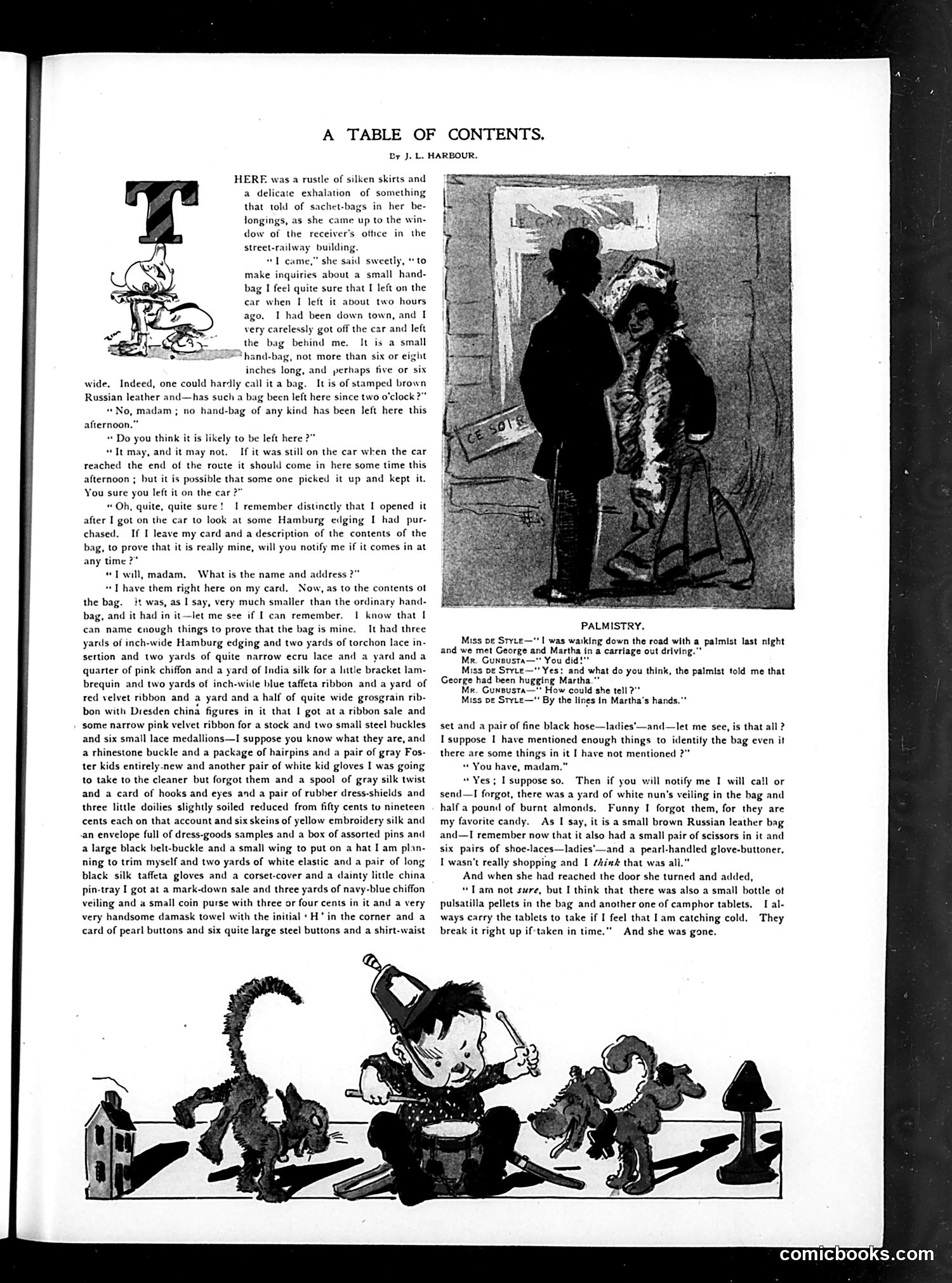
This piece satirizes Victorian women's tendency toward elaborate, excessive accumulation of domestic goods and notions. A woman reports a lost handbag to a railway office, then proceeds to list its contents in exhaustive, almost absurd detail—Hamburg edging, lace insertions, ribbons, steel buckles, embroidery silk, dress shields, and on and on, culminating in a "very handsome damask towel." The satire targets both female consumerism and the verbose, ornamental speech patterns associated with genteel women of the era. Her meticulous cataloging reveals how much of her identity and daily concerns centered on accumulated textile goods and sewing supplies. The small accompanying cartoon "Palmistry" offers a separate joke: a palmist reveals he knew a man was "hugging" a woman simply by reading his palm—a cheeky double-entendre playing on fortune-telling's dubious claims to hidden knowledge.
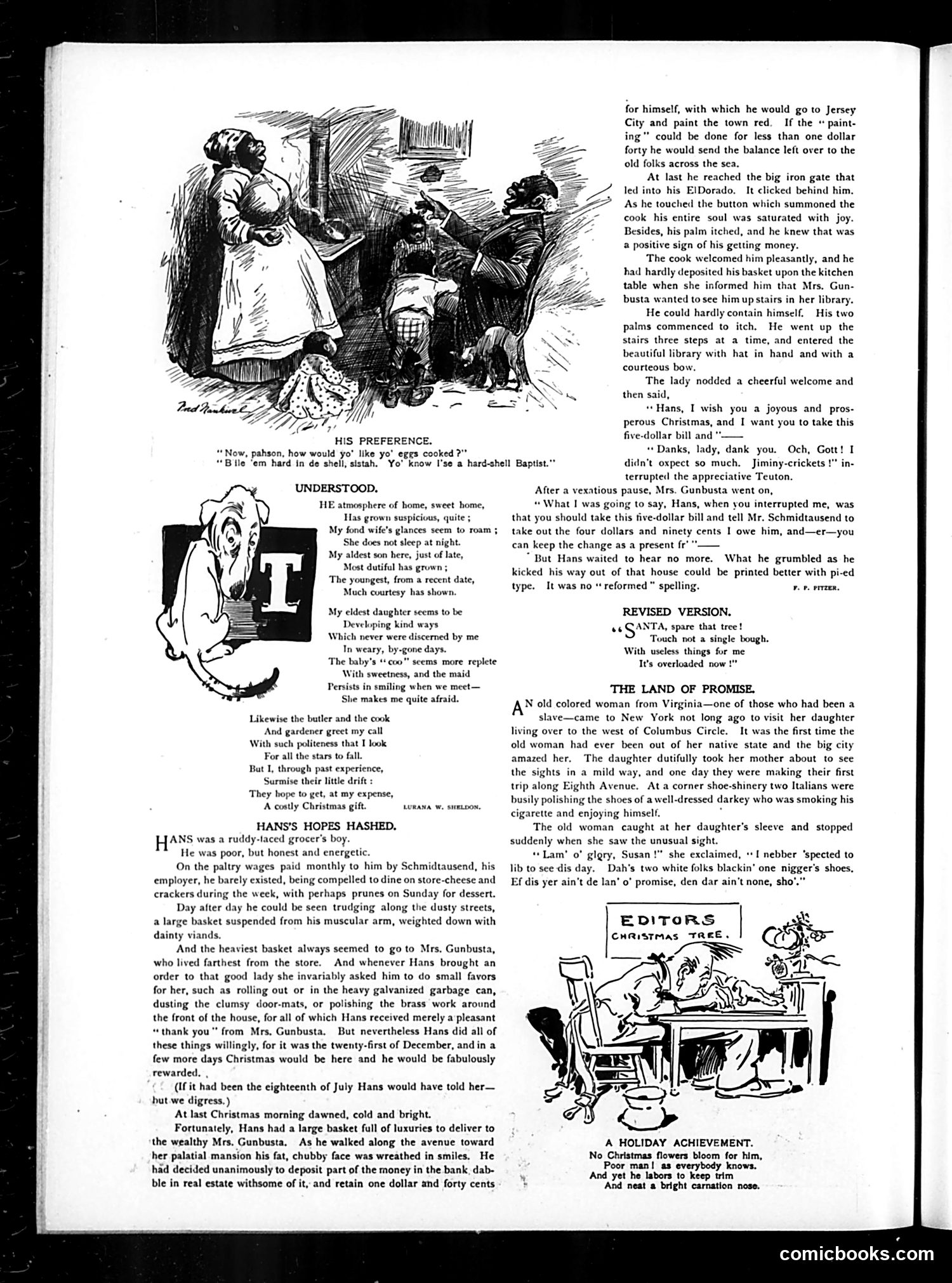
This is a satirical story about class expectations and disappointment. Hans, a poor grocer's boy of German/immigrant background (indicated by his dialect), performs extra unpaid labor for wealthy Mrs. Gunbusta throughout the year, believing Christmas will bring a substantial reward—he fantasizes about depositing money in the bank and "painting the town red." On Christmas morning, his hopes peak when Mrs. Gunbusta summons him to her library and begins offering him a five-dollar bill. Hans interrupts her gratefully, expecting this is his reward. **The satire's point**: The setup implies Mrs. Gunbusta will disappoint Hans—she likely intends the five dollars as a Christmas *gift* rather than payment for his labor, or possibly something else entirely. The story satirizes both working-class desperation and wealthy people's casual exploitation of servants' hopes. The page also includes poems mocking middle-class hypocrisy ("Understood") and other holiday-themed content typical of Judge magazine's class-conscious humor.
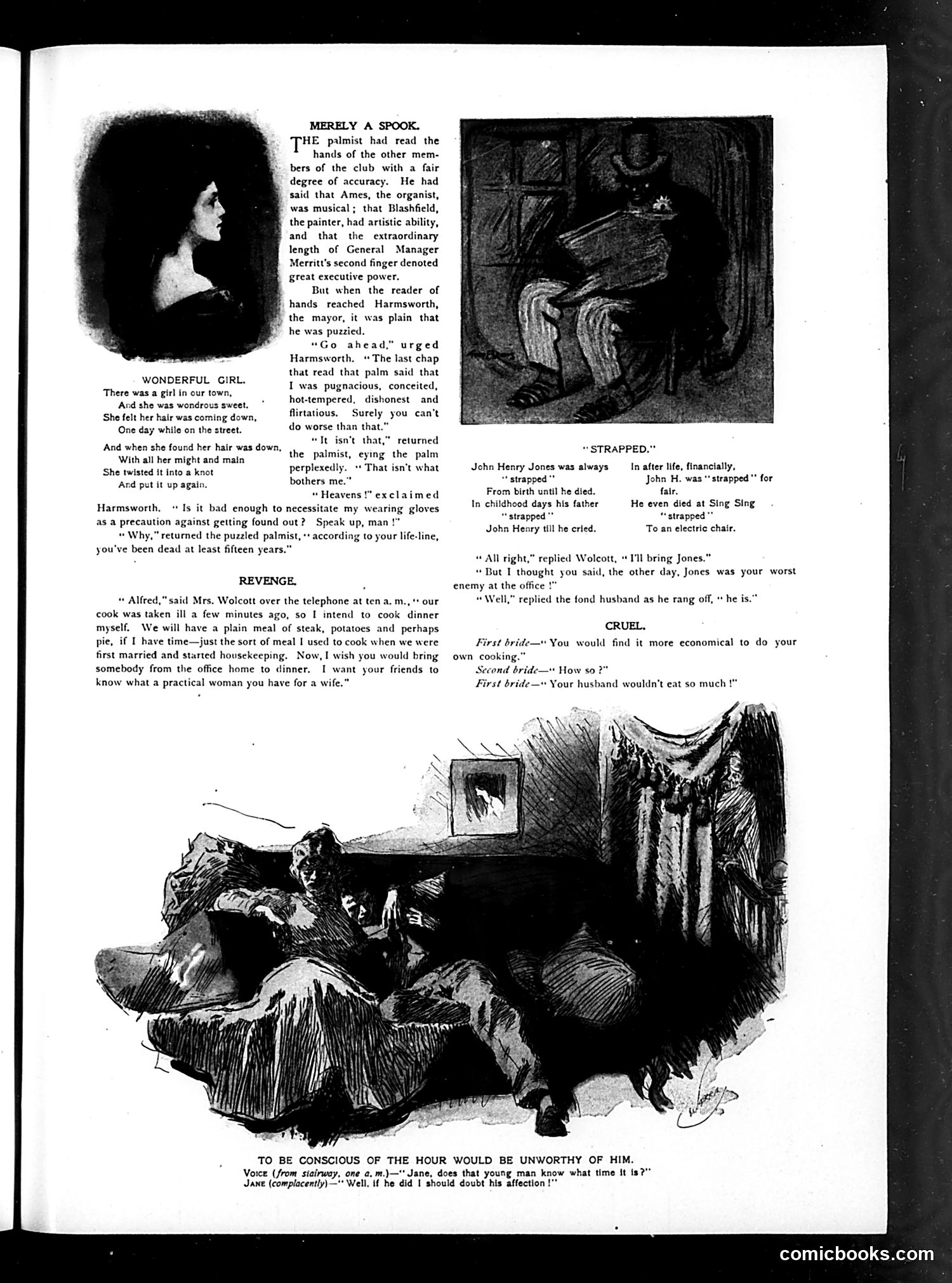
This page contains several brief satirical pieces typical of early 20th-century American humor: **"Merely a Spook"** mocks Mayor Harmsworth. A palmist reads club members' hands accurately, but when examining the mayor's palm, discovers his "life-line" indicates he's been dead for fifteen years—suggesting Harmsworth is a ghost or phantom figure, likely a jab at his political irrelevance or lack of actual power despite his position. **"Wonderful Girl"** is a light verse about a woman who fixes her fallen hair on the street—unremarkable humor about feminine vanity. **"Revenge"** presents a wife threatening to cook dinner and invite her husband's coworker, revealing the coworker is actually his worst enemy. The "revenge" appears to be subjecting the enemy to her cooking. **"Cruel"** and the final untitled piece are brief joke exchanges about marriage, using "strapped" (lacking money) and staying out late as punchlines about romantic relationships. The overall tone is genteel domestic satire targeting gender relations and municipal politics.
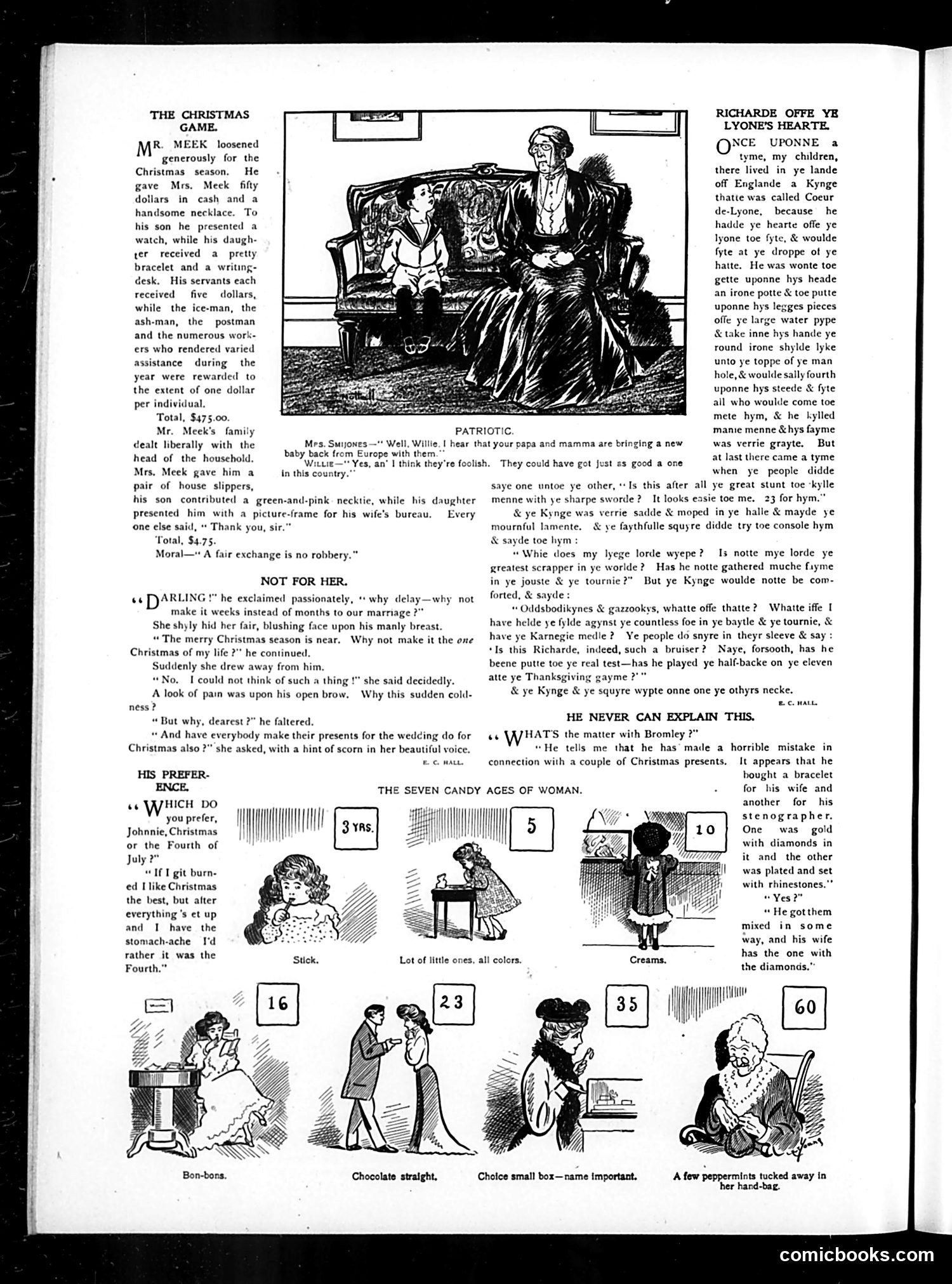
This page satirizes Christmas gift-giving disparities and social attitudes of the era. **"The Christmas Game"** mocks Mr. Meek's ostentatious generosity: he spends $470.25 on family and servants, yet receives only $4.75 in return—a stark reversal exposing class hypocrisy and ingratitude. **"Not For Her"** jokes about a woman rejecting her suitor's marriage proposal timed for Christmas, fearing guests will give combined wedding-Christmas gifts rather than separate ones—satirizing women's materialism and penny-pinching concerns. **"His Preference"** features a child choosing Christmas over Fourth of July because stomach-aches follow both, but he prefers the holiday's timing of digestive discomfort. **"Patriotic"** jokes about importing a European baby as patriotic, with unclear satirical intent. **"The Seven Candy Ages of Woman"** uses women's candy preferences across life stages (3-60 years) as crude stereotyping humor. **"Richarde Offe Ye Lyone's Hearte"** parodies medieval romance, where King Richard the Lionheart loses purpose when modern society dismisses his warrior achievements, demanding he prove himself at football instead—mocking contemporary celebrity culture replacing traditional heroism.
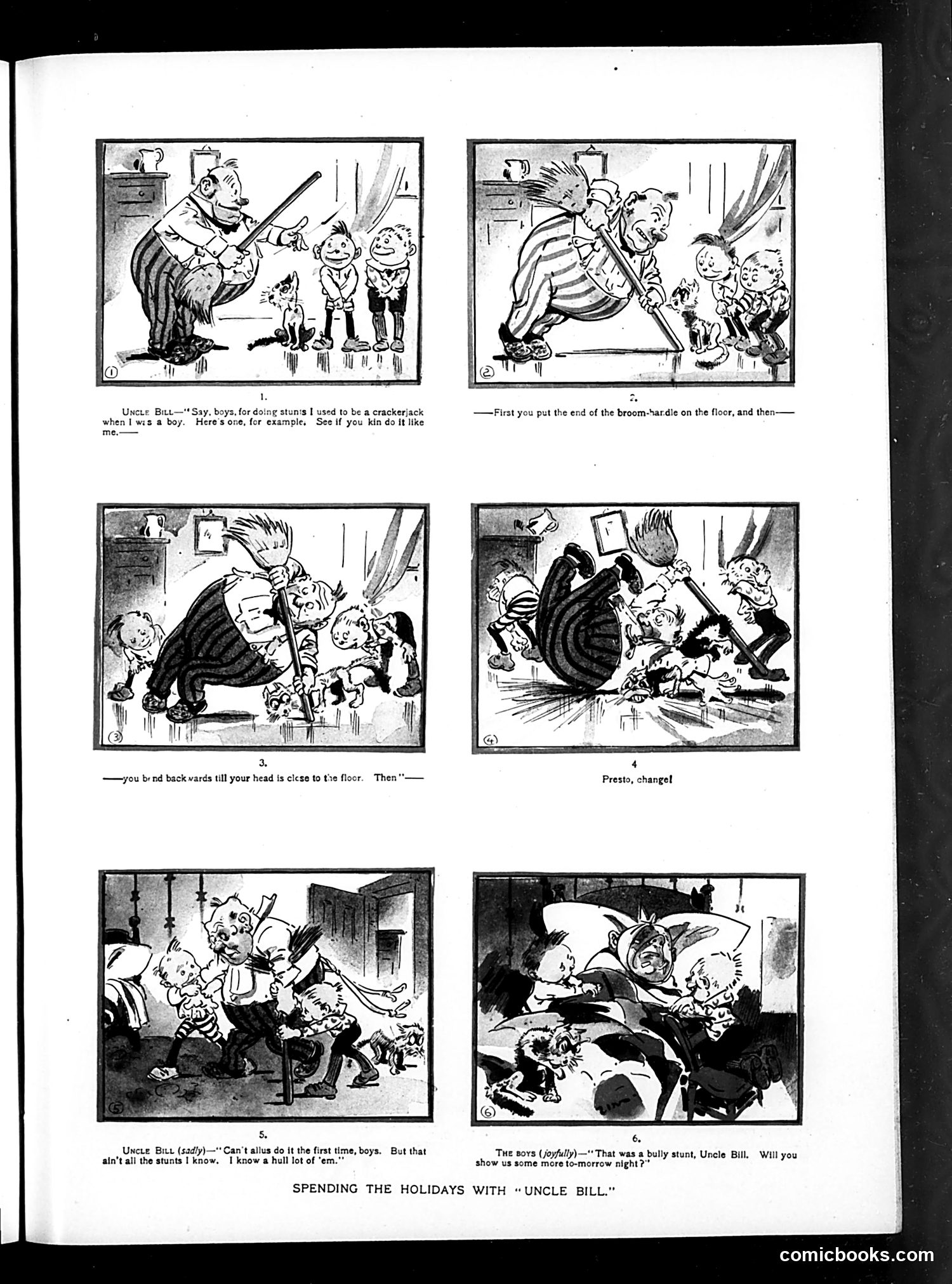
This is a humorous comic strip showing an older man ("Uncle Bill") attempting to demonstrate acrobatic stunts to children during the holidays. The joke involves physical comedy and generational contrast: Uncle Bill, nostalgic for his youth, tries to perform a dramatic backbend using a broomstick as a prop—a stunt he claims to have mastered as a boy. The humor comes from the inevitable failure (panel 4: "Presto, changed!") as his aged body cannot execute what his memory insists he could do. The final panels show him recovering dignity by suggesting he knows "a hull lot of" other stunts, while the boys appear skeptical or amused by his mishap. The satire gently mocks aging adults who overestimate their physical capabilities and try to relive youthful feats for entertainment, a relatable domestic humor theme common to *Judge* magazine's comedy.
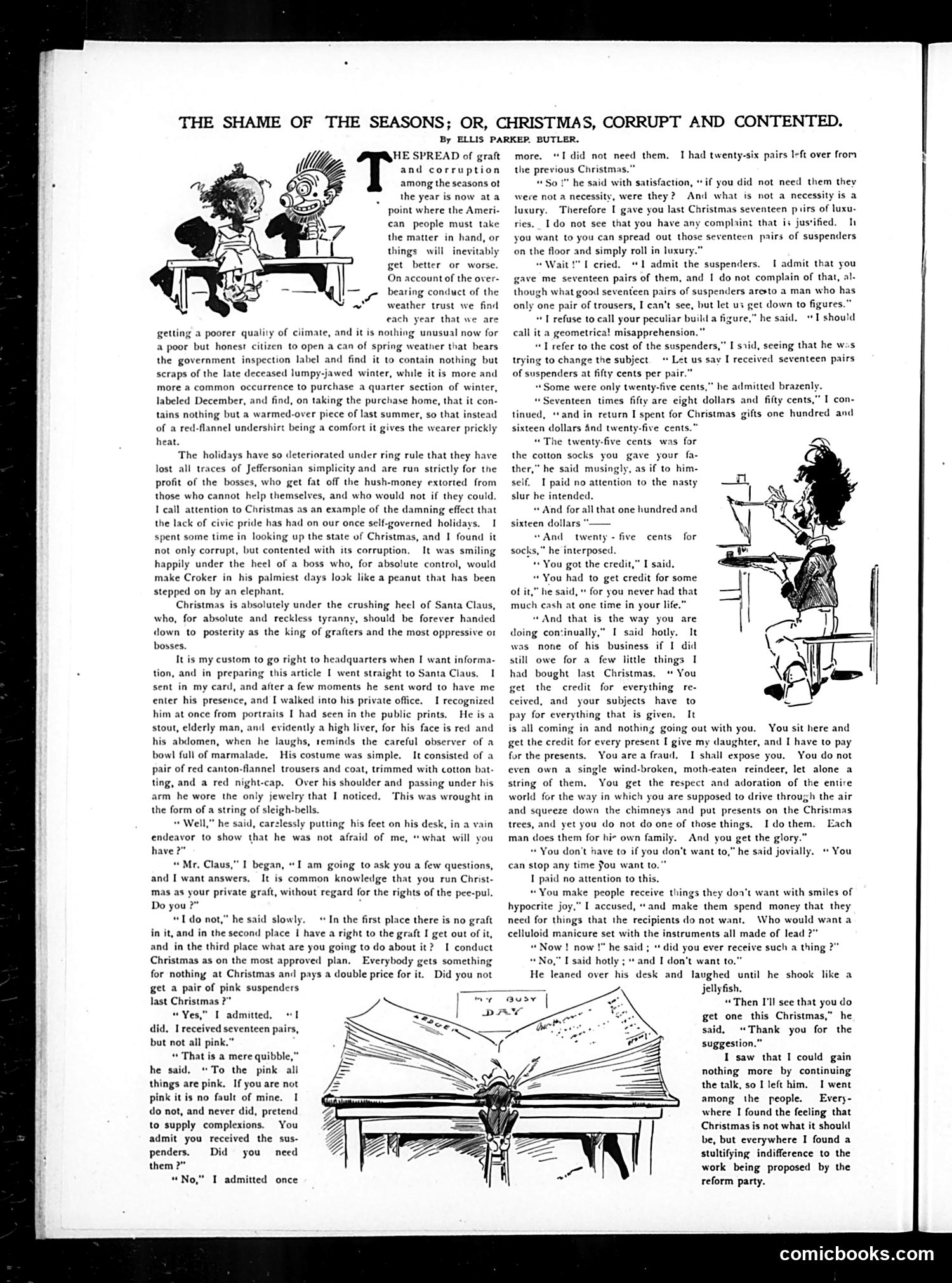
This Ellis Parker Butler essay uses **Christmas and Santa Claus as metaphors for political corruption** during the Progressive Era (early 1900s). The satire targets **machine politics and graft**—the systematic theft and bribery that plagued American governance. Santa Claus represents a corrupt political boss who controls Christmas like a "ring" (political machine), extracting wealth while claiming to provide services. The narrator interviews Santa, who brazenly admits running Christmas as personal "graft" but insists this is legitimate—everyone "gets something for nothing...and pays a double price." The larger metaphor extends to **seasonal deterioration as symbol of civic decay**: poor-quality winter and spring represent how corruption degrades public goods. References to "Croker" (likely Richard Croker, Tammany Hall boss) and "Jeffersonian simplicity" ground this in real political debates about machine rule versus democratic ideals. The joke: **corruption persists because people accept it**, happily receiving cheap gifts while overpaying—a commentary on voters' apathy toward political theft.
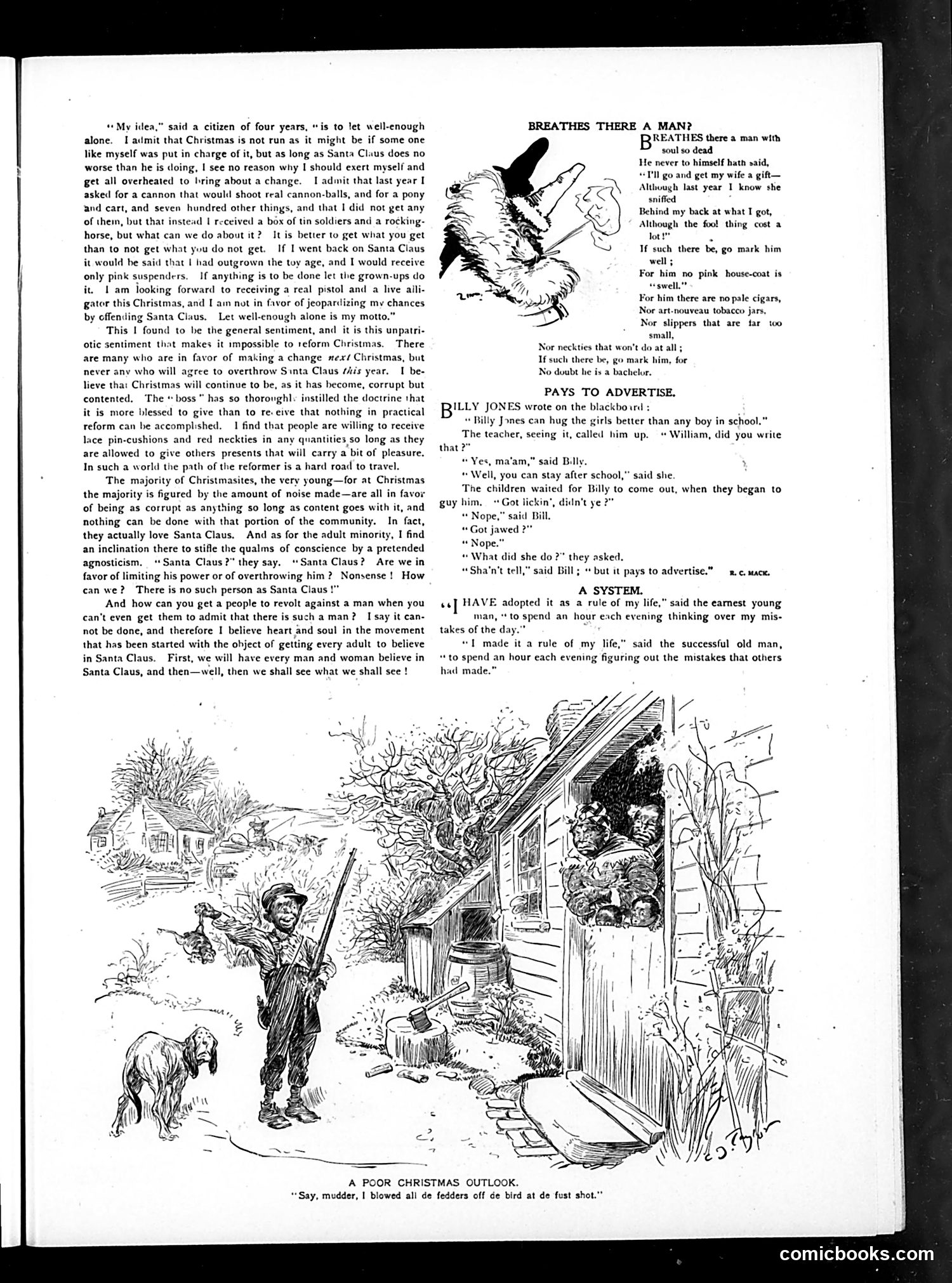
This page contains satirical commentary on Christmas reform and gift-giving customs in early American culture. **Main Satire**: The lengthy editorial criticizes Americans' complacency about Christmas commercialism. A young child argues for maintaining the status quo with Santa Claus because reform might jeopardize future gifts—he'd rather accept disappointing presents than risk offending Santa. The author uses this to mock adult apathy toward social reform generally, noting that people accept corruption if it comes with "content" and small pleasures. **Supporting Elements**: - "Breathes There a Man?" parodies patriotic verse to mock husbands reluctantly buying obligatory Christmas gifts for wives - "Billy Jones Pays to Advertise" is a brief joke about a boy publicly claiming he's the best at hugging girls - The illustration depicts rural poverty ("A Poor Christmas Outlook"), contrasting with the consumer-focused articles above The page critiques both holiday consumerism and broader American reluctance to demand meaningful change.
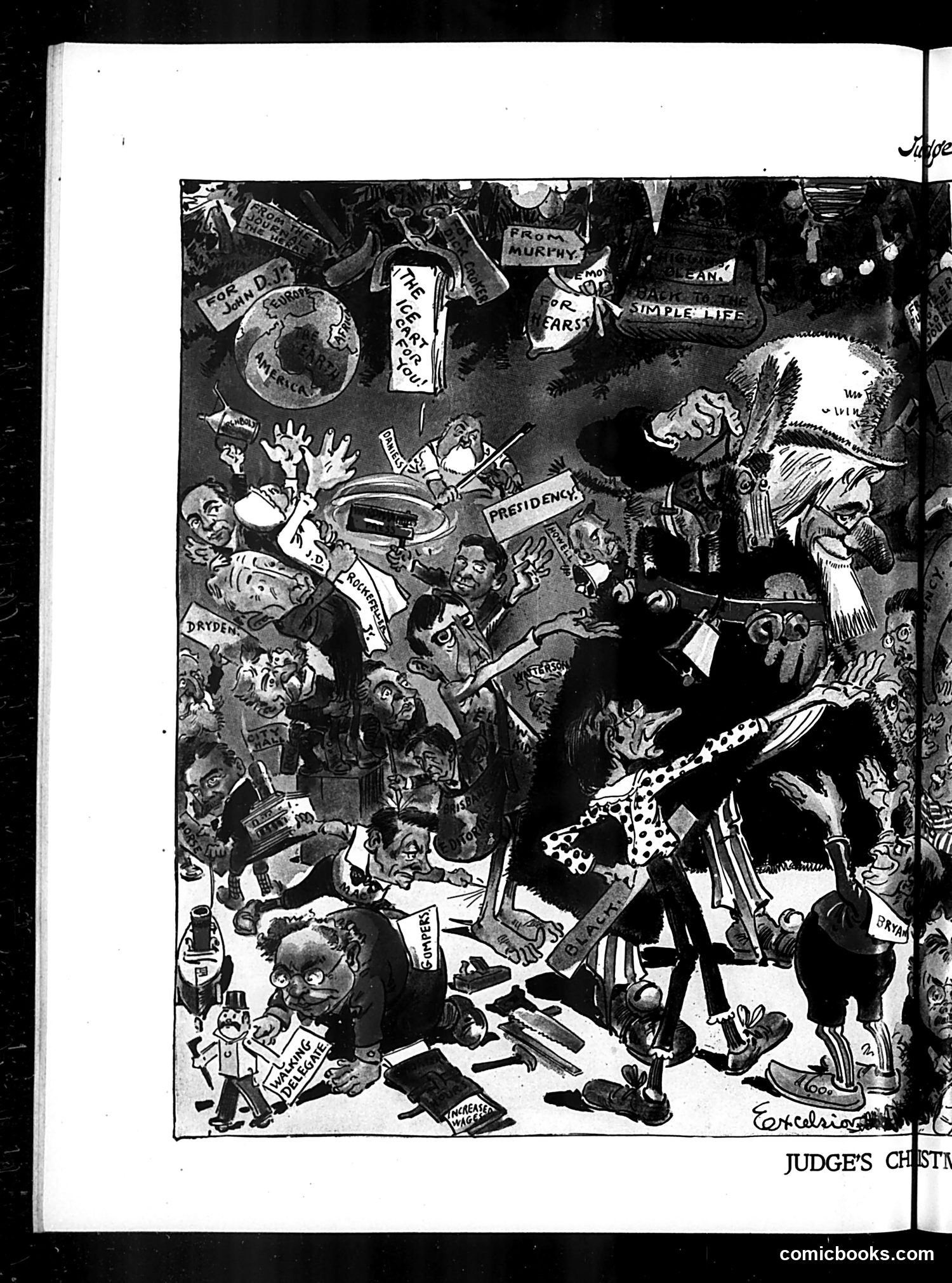
This appears to be a satirical Judge magazine cartoon critiquing American consumer culture and materialism around the Christmas season. The chaotic scene shows numerous figures (appearing to be caricatured Americans) engaged in frenzied shopping and gift-giving, surrounded by commercial goods, advertisements, and holiday decorations. Visible labels reference "Murphy," "Simple Life," and "From Murphy," suggesting commentary on the contrast between idealized simplicity and actual commercial excess. The carnival-like disorder—with figures seemingly overwhelmed by products and desires—satirizes how the holiday has become dominated by consumption rather than spiritual meaning or genuine simplicity. The cartoon's central point appears to be mocking American materialism and the commercial hijacking of Christmas traditions, a theme Judge magazine frequently addressed.
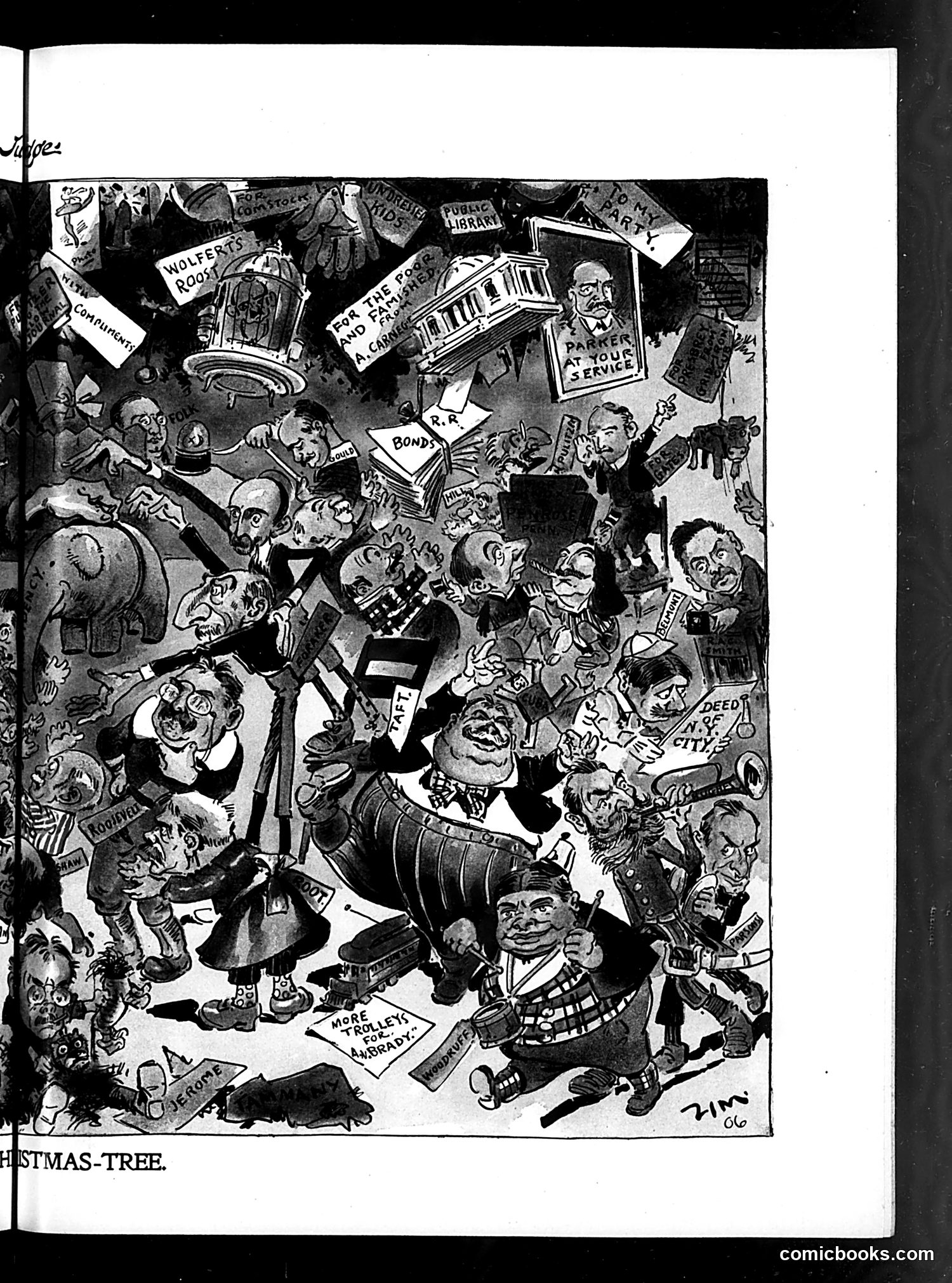
This satirical cartoon depicts a chaotic Christmas tree decorated with various symbols of corruption and excess rather than traditional ornaments. The tree is laden with labeled items including "Bonds," "Parker Service," "Public Library," "Wolferth's Roost," and other institutional references, suggesting these institutions or officials are being treated as ornamental prizes or spoils. The numerous caricatured figures surrounding the tree appear to be politicians or businessmen engaged in a frenzied scramble, depicted with exaggerated features typical of early 20th-century satirical cartooning. The overall message critiques institutional corruption and self-interested competition among officials who treat public resources and services as personal gain—essentially mocking how Christmas gift-taking mirrors the year-round appropriation of public goods by those in power.
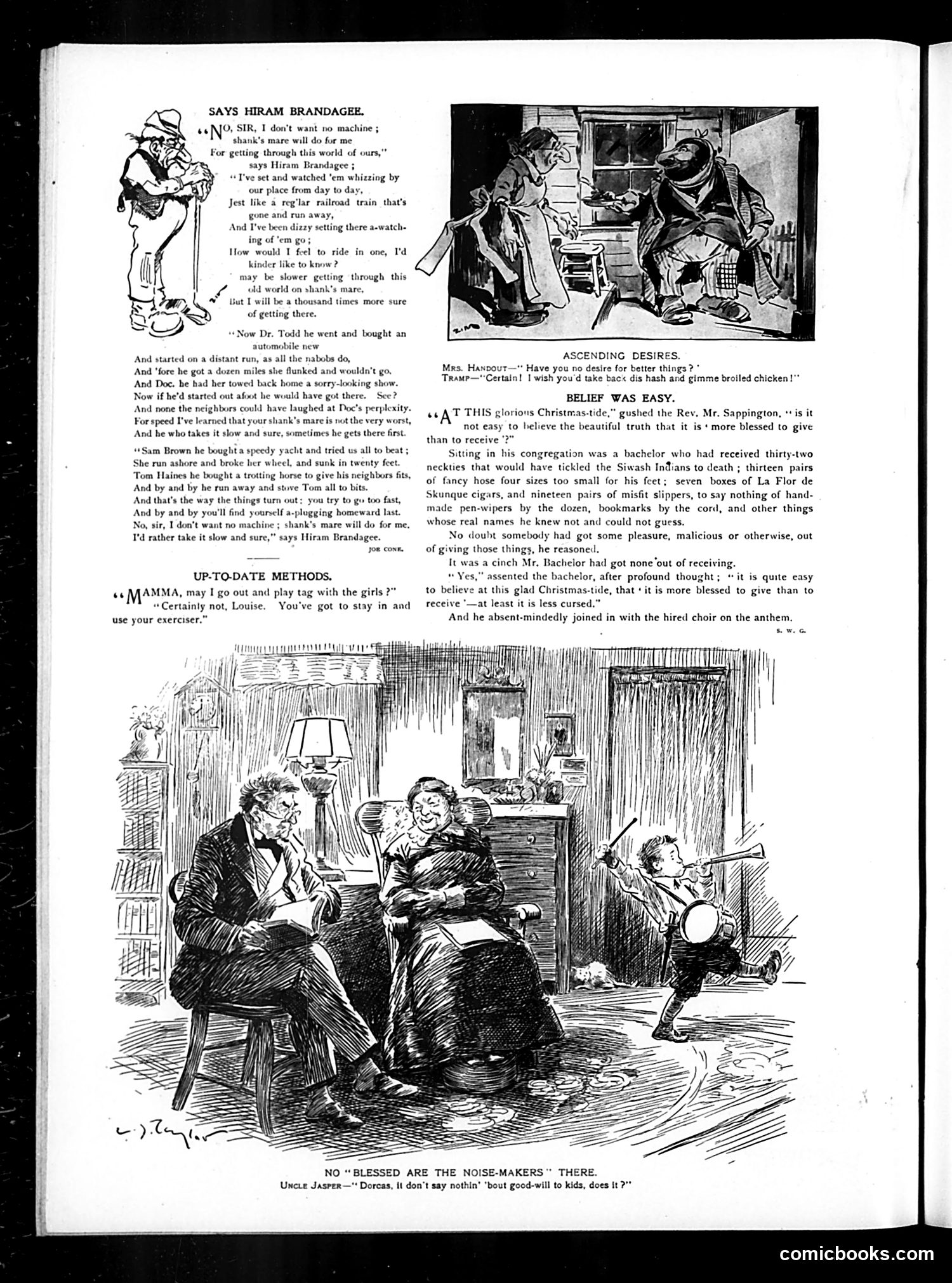
This page contains three satirical pieces mocking turn-of-the-century American attitudes: **"Says Hiram Brandagee"** (main poem): A rural character defends walking ("shank's mare") over automobiles, citing cautionary tales of neighbors whose new machines failed spectacularly—Dr. Todd's car broke down, Sam Brown's yacht sank, Tom Haines's horse ran away. The satire targets both rural skepticism of modern technology AND the wealthy's reckless adoption of unreliable automobiles and gadgets. **"Up-to-Date Methods"**: A mother forbids her daughter outdoor play, insisting she use an "exerciser" instead—mocking the era's obsession with mechanical exercise devices as replacements for natural activity. **"Belief Was Easy"**: A clergyman preaches "more blessed to give than receive" while a bachelor in the congregation mentally catalogs the useless Christmas gifts he received (ill-fitting clothes, bad cigars, homemade items). The irony: giving brought *others* pleasure; receiving brought him only frustration. **"No 'Blessed Are the Noise-Makers'"**: Uncle Jasper humorously disputes Biblical blessings applying to noisy children. All pieces satirize contemporary American life through gentle, folklsy humor.
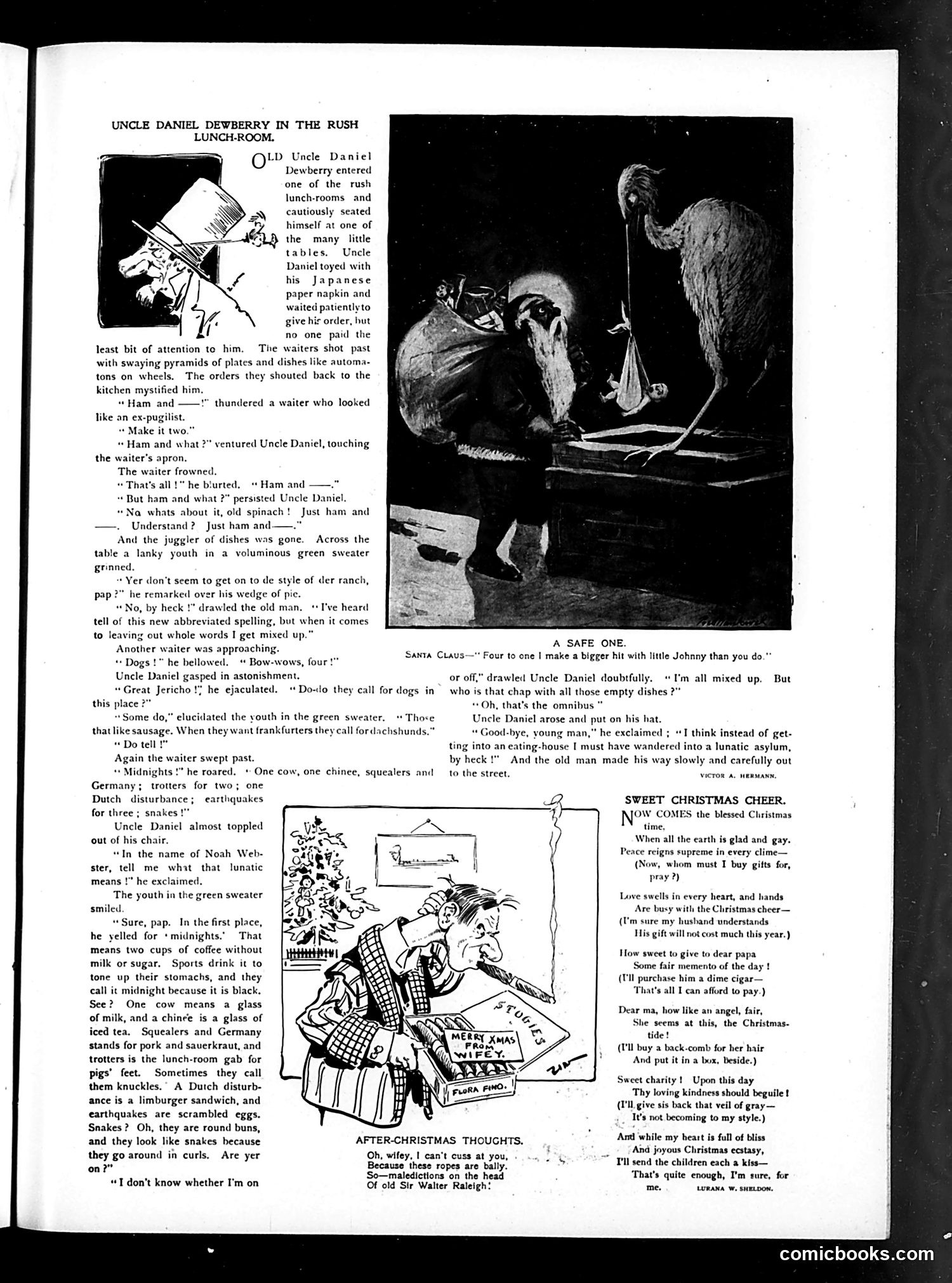
This page contains two satirical pieces mocking American social customs of the era. **"Uncle Daniel Dewberry in the Rush Lunch-Room"** depicts an elderly, seemingly rural man (Uncle Daniel) bewildered by fast-food diner culture and its slang. Waiters shout abbreviated orders—"ham and ——," "dogs," "midnights" (black coffee), "one cow" (milk), "chinee" (iced tea), "squealer" (pork), "trotters" (pig's feet)—which confuse the old-fashioned patron. A youth in a green sweater explains this jargon, illustrating the cultural gap between traditional and modern American life. The satire targets both the incomprehensible efficiency of rush-hour dining and the generational confusion it creates. **"Sweet Christmas Cheer"** is a poem with parenthetical asides mocking the commercialization and cheapness underlying holiday sentiment. While the text celebrates Christmas generosity, the asides reveal stingy reality: a dime cigar as a gift, a back-comb in a box—undermining the poem's professed sentimentality.
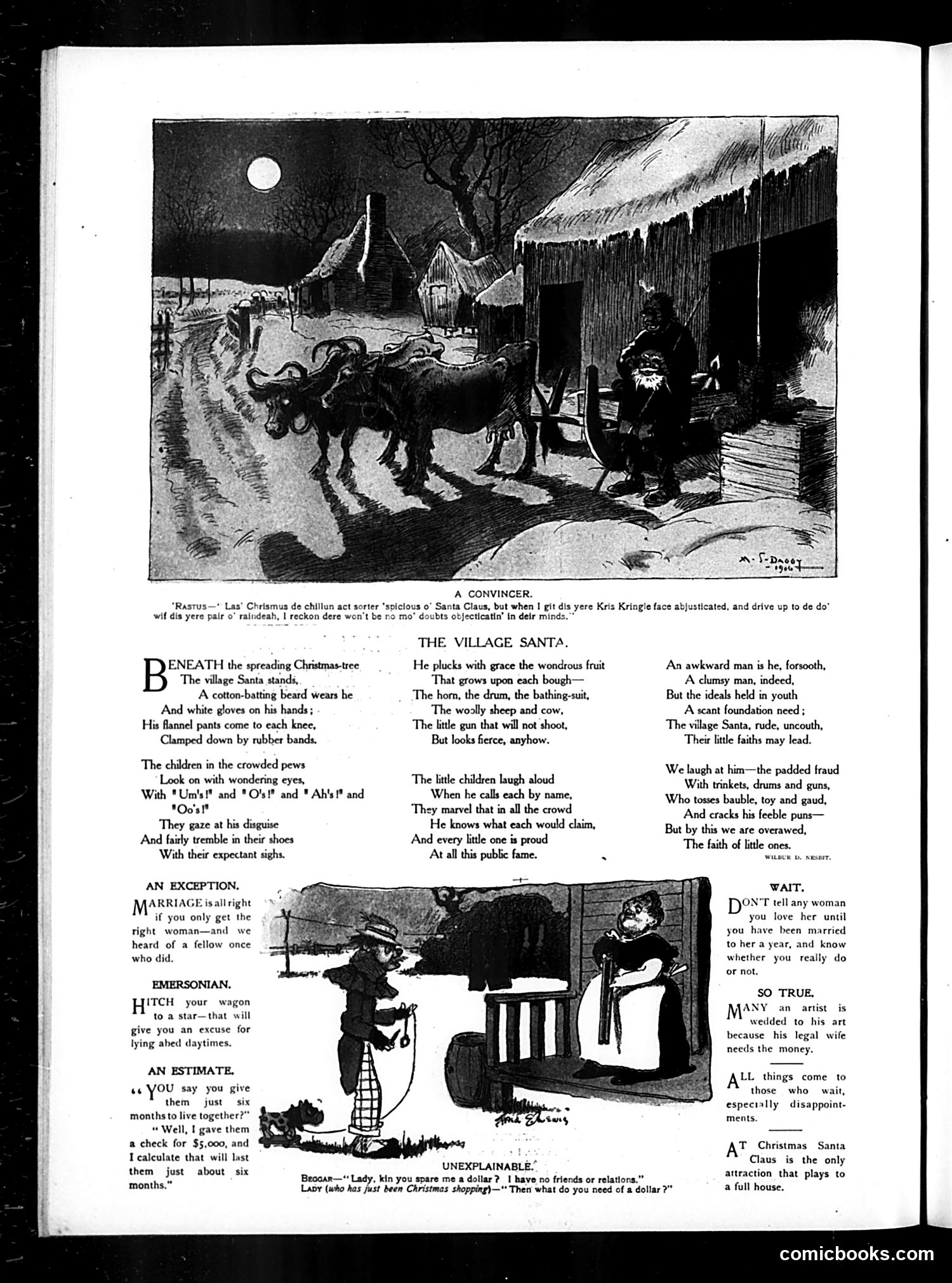
This page presents Christmas-themed humor and social commentary typical of early 20th-century American satire. **"The Village Santa"** is the main piece—a nostalgic poem celebrating a humble, poorly-dressed Santa who delights children despite his obvious artificiality (cotton-batting beard, rubber bands). The satire works on two levels: it gently mocks the transparent fraud, yet celebrates how children's faith transcends the deception. The accompanying illustration shows this ragged Santa in a snowy village scene. **"A Convincer"** (top) uses dialect humor featuring a Black character convincing skeptical children of Santa's authenticity by adding reindeer to his appearance—suggesting that visual props matter more than actual evidence. **Scattered aphorisms** mock contemporary attitudes about marriage (don't claim love prematurely), artistic pretension (artists marry art because wives need money), and class dynamics (a homeless beggar asks for a dollar from a Christmas shopper). The page satirizes American materialism, romantic delusion, and social hypocrisy through holiday imagery—the gap between commercial fantasy and reality.
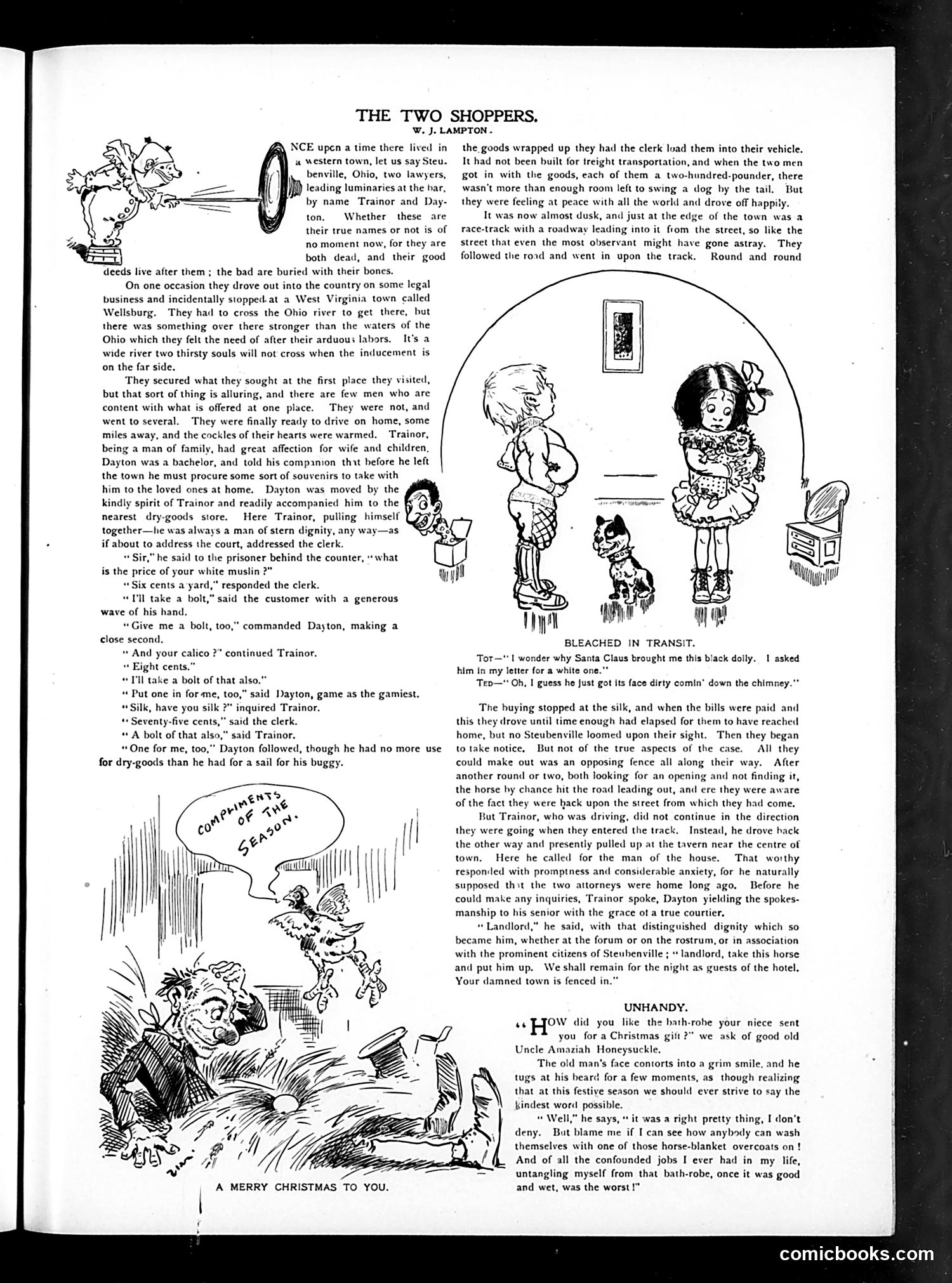
This is a humorous story about two Ohio lawyers, Trainor and Dayton, who become intoxicated while on a business trip to Wellsburg, West Virginia. After purchasing goods at a dry-goods store (buying bolts of muslin, calico, and silk in progressively escalating quantities), they drive home but accidentally enter a race-track instead of the main road. They circle repeatedly, confused by the fence surrounding the track, unable to find the exit. The joke lies in their inebriation and poor judgment—they're too drunk to recognize they're driving in circles on a race-track rather than a normal road. The accompanying cartoons illustrate their befuddlement. The satirical point mocks the behavior of respectable professional men (lawyers) who lose their dignity and common sense after drinking, a common theme in period humor about the dangers of alcohol.
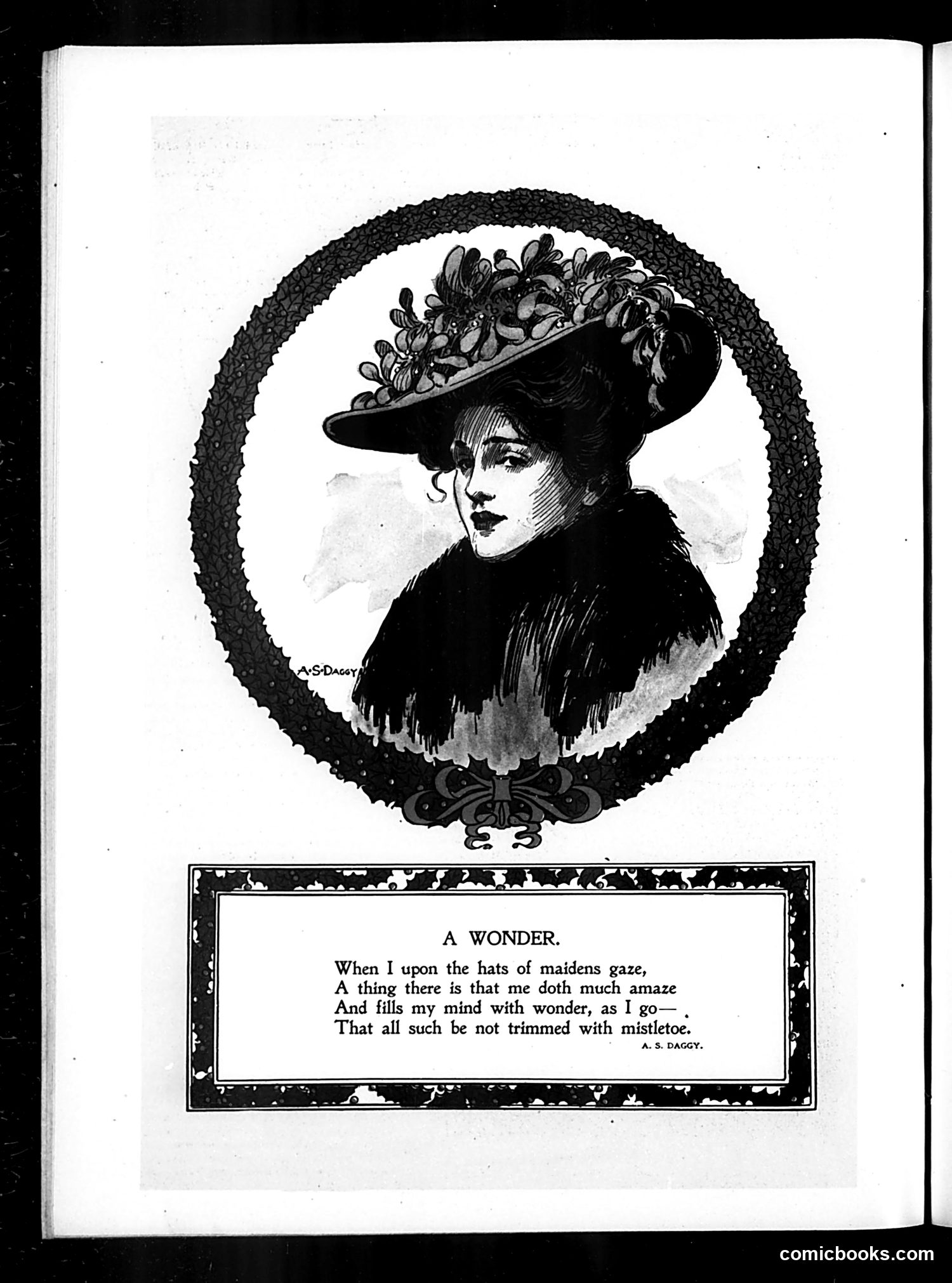
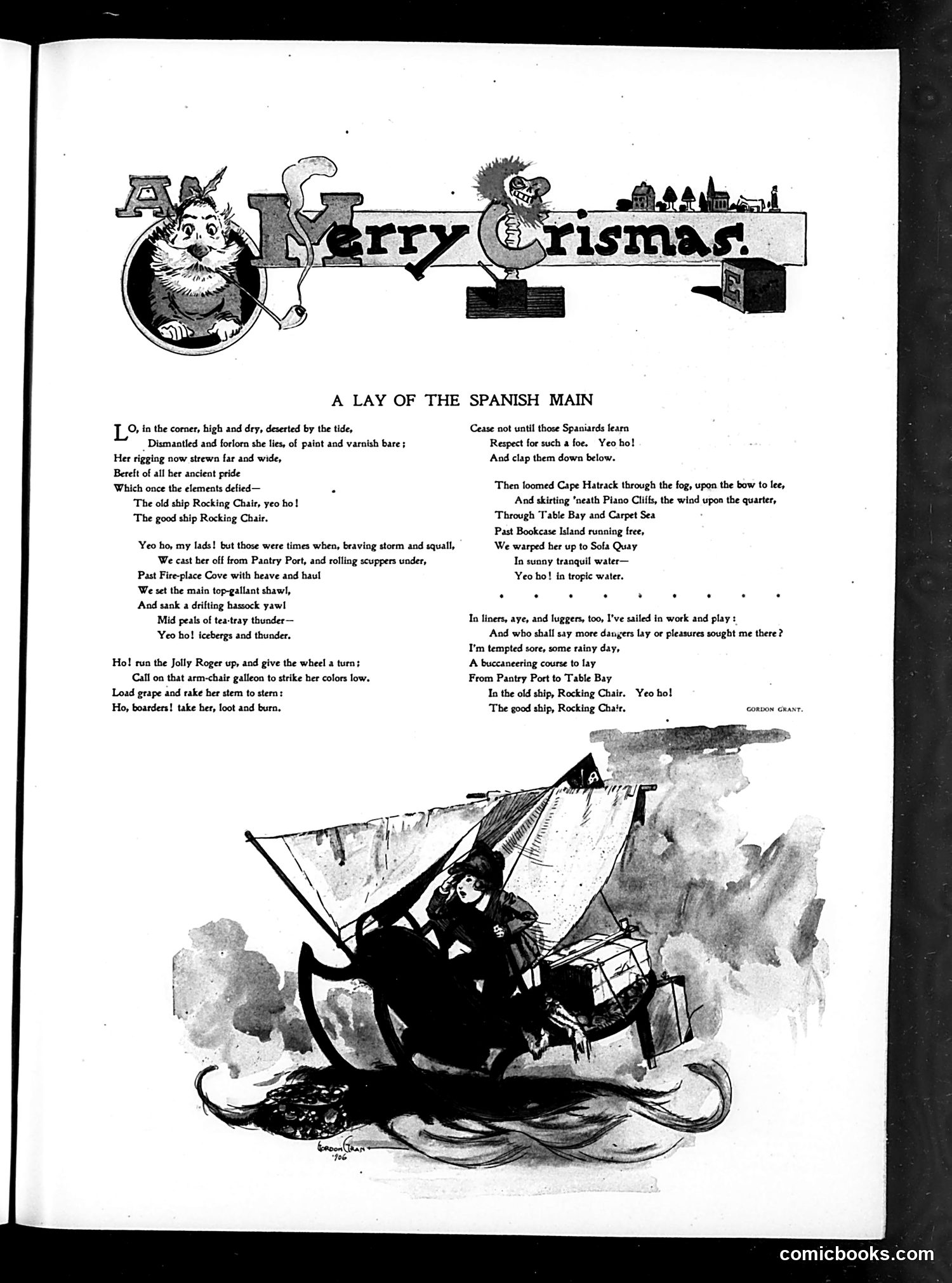
This is a satirical poem by A.S. Daggy mocking the excessive ornamentation of women's hats in the early 20th century. The illustration shows an elaborately decorated hat crowned with large flowers or plumes, framed in an ornate oval border. The satire works by suggesting that if hat-makers were truly committed to over-decoration, they would include mistletoe—which carries romantic/kissing associations. The poem implies women's hats have become so ridiculously overdone that adding mistletoe would be a logical next step. The humor targets both the fashion industry's relentless embellishment of millinery and society women's willingness to wear increasingly impractical, decorated headwear as status symbols.
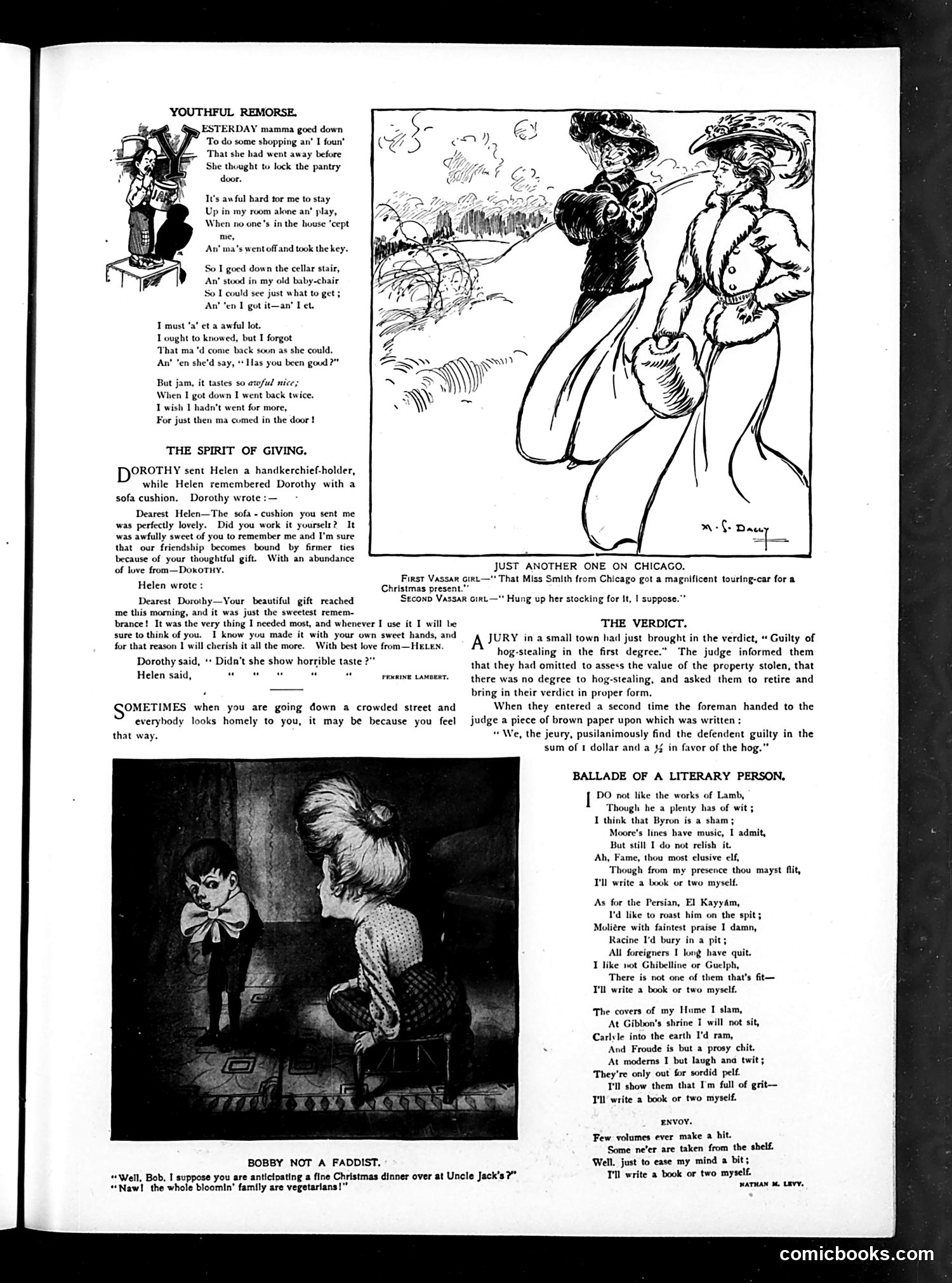
This page contains several satirical pieces lampooning American social customs and literary pretension circa early 1900s. **"Youthful Remorse"** depicts a child's guilty confession about raiding the pantry—a gentle humor about childhood disobedience and the contradiction between rules and temptation. **"The Spirit of Giving"** mocks insincere gift-exchanging between friends. Both women give cheap, perfunctory gifts (handkerchief-holder, sofa cushion) yet write elaborate, gushing thank-you notes praising each other's thoughtfulness. The satire captures the hypocrisy of obligatory social rituals where recipients privately judge each other's taste while publicly expressing gratitude. **"Bobby Not a Faddist"** jokes about the "vegetarian fad"—a dietary trend apparently trendy enough that even Uncle Jack's family has adopted it, disappointing young Bobby's Christmas dinner expectations. **"Ballade of a Literary Person"** ridicules a self-important would-be author who dismisses all canonical writers (Lamb, Byron, Moore, etc.) as overrated, yet confidently plans to write his own books—satirizing literary pretension and unwarranted self-confidence among aspiring writers.
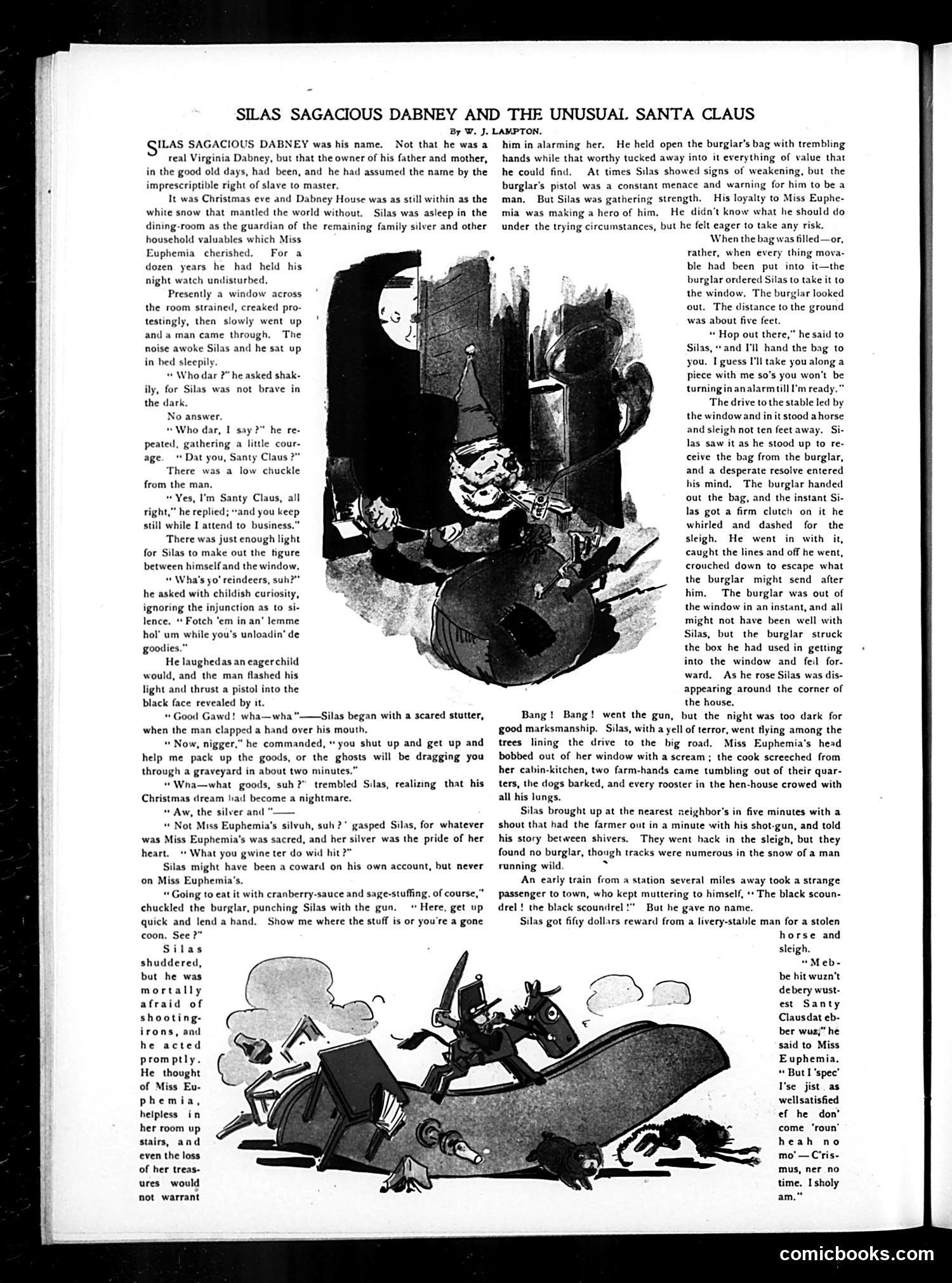
This is a short story (not a political cartoon) titled "Silas Sagacious Dabney and the Unusual Santa Claus" by W. J. Lampton, appearing in *Judge* magazine. The narrative depicts a Christmas Eve burglary at a Southern mansion. Silas, an African American servant who guards the family silver, awakens to find a burglar entering through a window claiming to be Santa Claus. The burglar forces Silas at gunpoint to help pack valuables—specifically Miss Euphemia's prized silver—into a bag. The story plays on racial stereotypes of the era: Silas speaks in exaggerated dialect, initially mistakes the burglar for Santa, and shows fear of firearms. However, his character also demonstrates loyalty to his employer that "makes a hero of him," suggesting complexity beneath the stereotyping. The "unusual Santa" twist—a criminal posing as Father Christmas—provides dark comedic irony typical of *Judge's* satirical humor. The text breaks mid-sentence, indicating the page continues elsewhere.
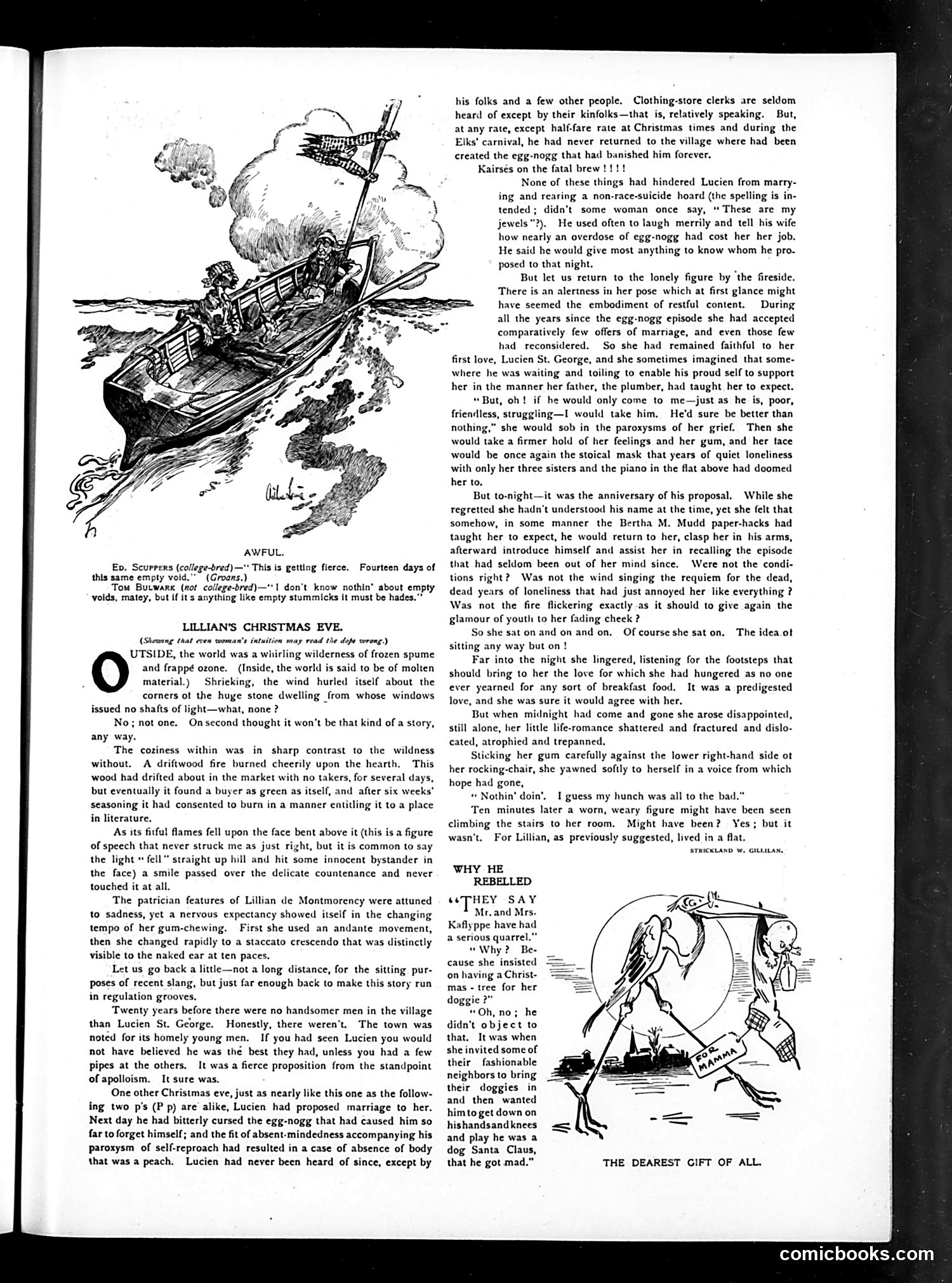
This page contains a satirical short story titled "Lillian's Christmas Eve" with accompanying illustrations. The narrative mocks sentimental Victorian romance fiction through exaggerated, self-aware prose. The story concerns Lillian de Montmorency, who sits by a fire on Christmas Eve waiting for her lost love, Lucien St. George. Twenty years prior, Lucien proposed to her while drunk on "egg-nogg," then disappeared from the village, eventually marrying someone else. The satire targets the melodramatic conventions of period romance literature—the overwrought descriptions ("patrician features," "delicate countenance"), the author's self-interrupting commentary ("this is a figure of speech that never struck me as just right"), and the implausible plot contrivances. The headnote joke about college-educated versus working-class men discussing "empty voids" adds social commentary typical of Judge's humor. The overall effect ridicules both sentimental literary conventions and the passivity of idealized female characters in popular fiction.
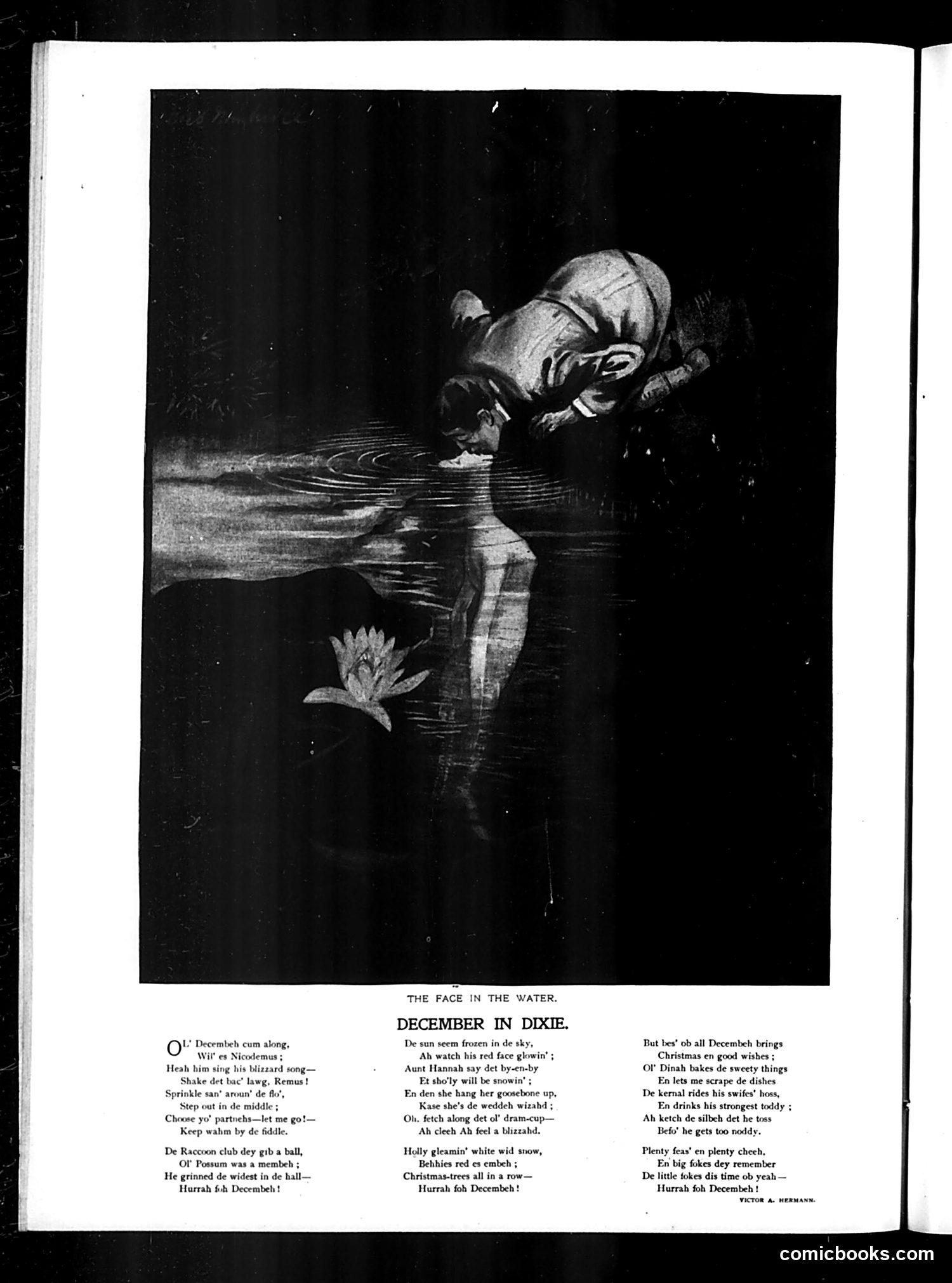
This page features a nostalgic, dialect-heavy poem about December celebrations in the antebellum South, paired with an illustration titled "The Face in the Water" showing a figure bending toward water with a water lily visible. The poem romanticizes enslaved life during Christmas season—describing festive gatherings ("Raccoon club...ball"), food preparation, and gift-receiving, all rendered in exaggerated African American vernacular dialect. The imagery presents slavery's holiday periods as joyful occasions. The accompanying illustration's meaning is unclear from the image alone, though the title suggests it may depict a reflection or contemplative moment. This represents *Judge* magazine's editorial approach: using stereotypical dialect and sentimental imagery to present a whitewashed, paternalistic view of the pre-Civil War South. For modern readers, this reveals how period publications normalized and aestheticized slavery through nostalgic "Lost Cause" rhetoric popular in late 19th-century America.
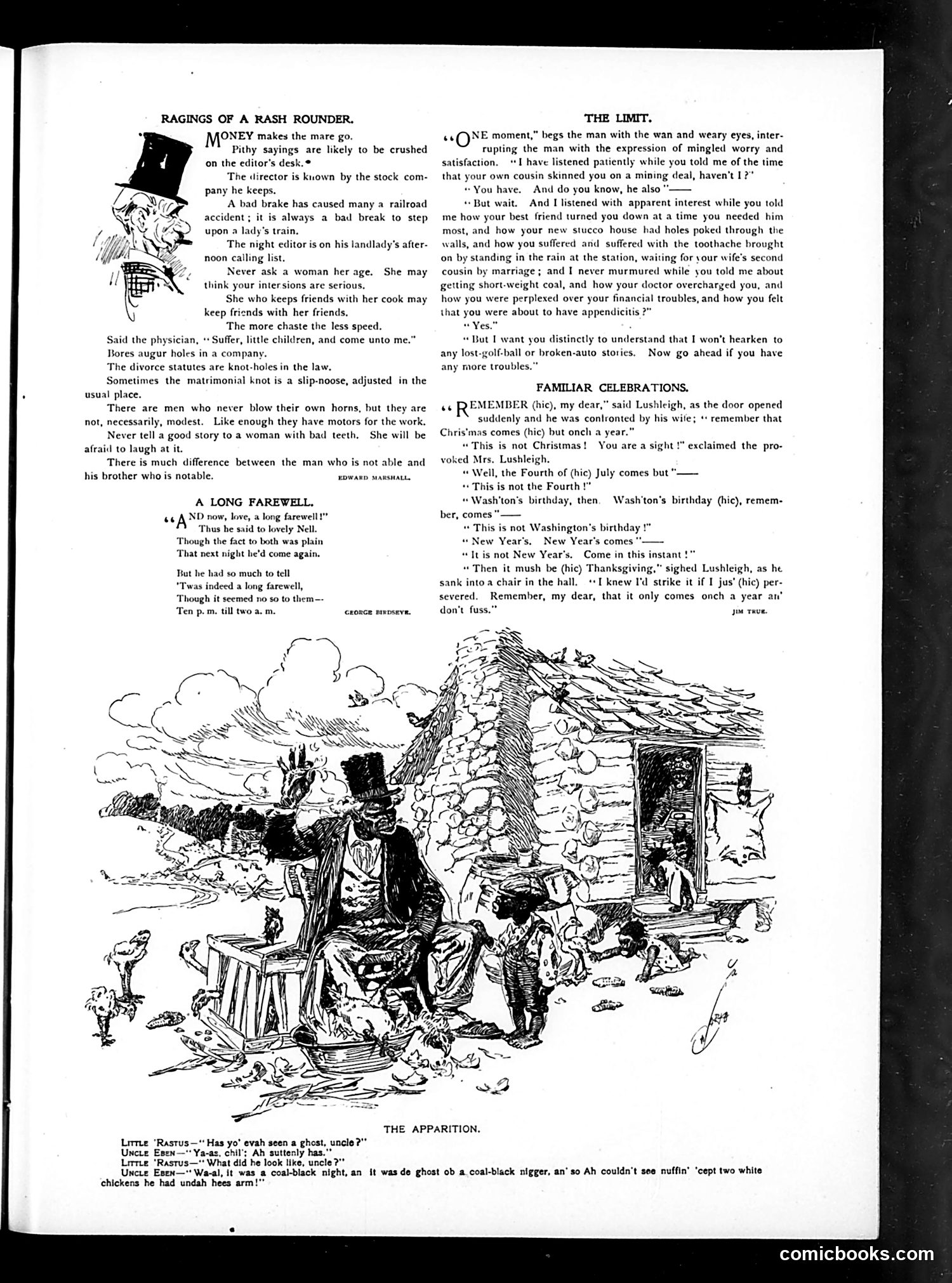
This page contains three distinct humorous pieces typical of early 20th-century satirical journalism: **"Ragings of a Rash Rounder"** presents cynical observations about social behavior—marriage, divorce, gossip—in aphoristic form, poking fun at human folly and hypocrisy. **"A Long Farewell"** jokes about a man's melodramatic goodbye to his girlfriend, which proves insincere since he'll return the next evening anyway. The humor lies in the gap between his theatrical farewell and the mundane reality. **"Familiar Celebrations"** depicts a drunk husband (Lushleigh) trying to justify arriving home late by claiming various holiday excuses—Christmas, Independence Day, Washington's birthday—to his exasperated wife. Each excuse fails until he accidentally lands on Thanksgiving. **"The Apparition"** uses dialect humor (common but now offensive) depicting African American characters discussing a ghost sighting, with the punchline being that the ghost was invisible except for two white chickens it carried—a play on racial caricature. These pieces reflect period attitudes toward marriage, drinking, and racial stereotypes typical of Judge's satirical approach.
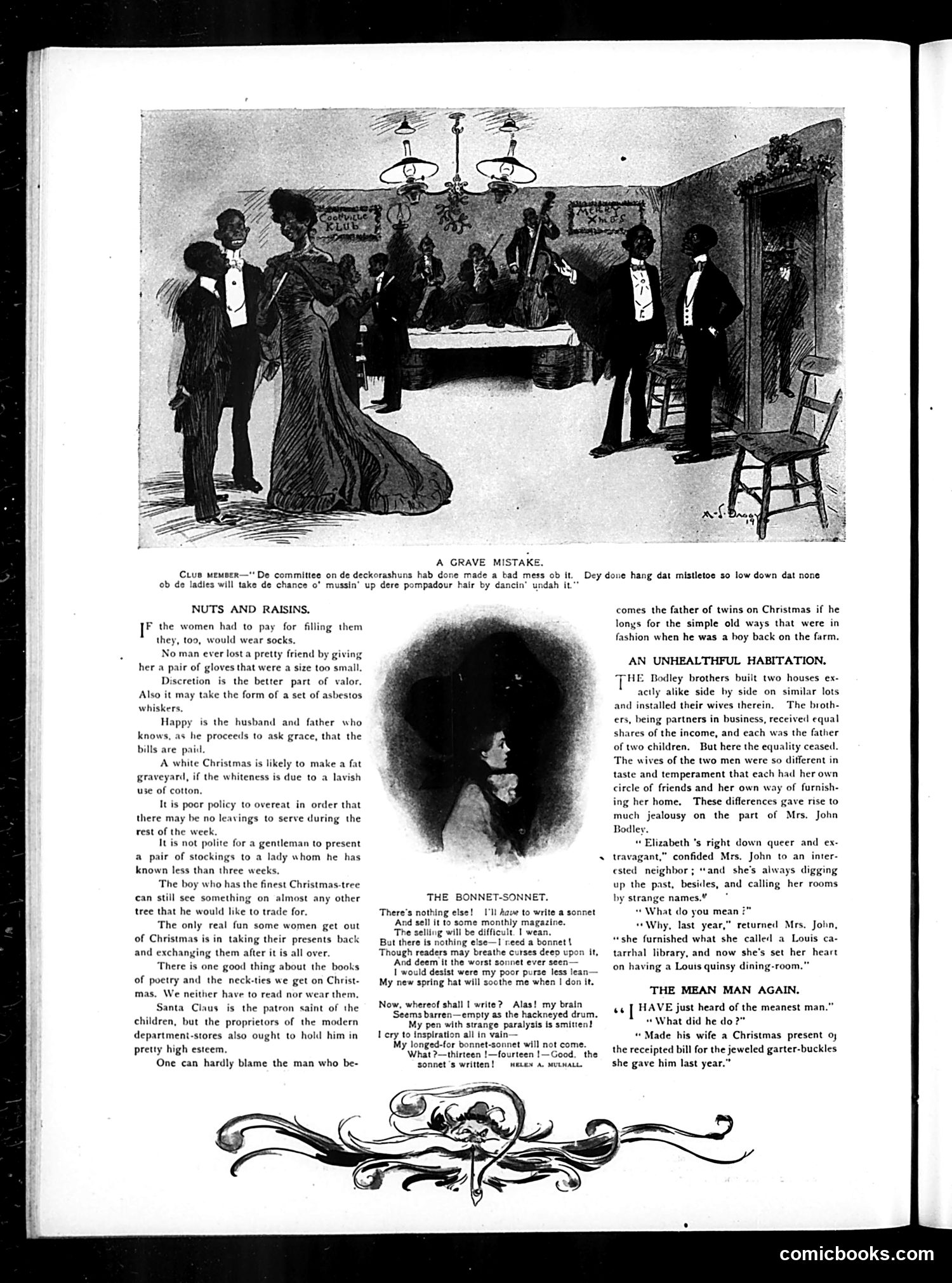
The top cartoon, "A Grave Mistake," satirizes poor event planning. A committee member complains that decorators hung mistletoe so low that women attending a dance risk mussing their elaborate "pompadour" hairstyles—a reference to the high, swept-up hairstyle fashionable in the early 1900s. The satire mocks both the incompetence of the decoration committee and the vanity of women prioritizing hairstyles over festive tradition. Below are brief humorous pieces typical of Judge's "Nuts and Raisins" column—witty observations on Christmas customs, gift-giving etiquette, and holiday behavior. The "Bonnet-Sonnet" humorously depicts a woman forced to write poetry to afford a new hat, with the joke that inspiration finally strikes at line thirteen—only because she needs the money desperately. "An Unhealthful Habitation" satirizes class anxiety: Mrs. John Bodley envies her sister-in-law's furnishings and mocks her taste by deliberately mispronouncing room names ("Louis catarrhral library"). The final item mocks a stingy husband who gifts his wife a receipt for jeweled garters she previously gave *him*.
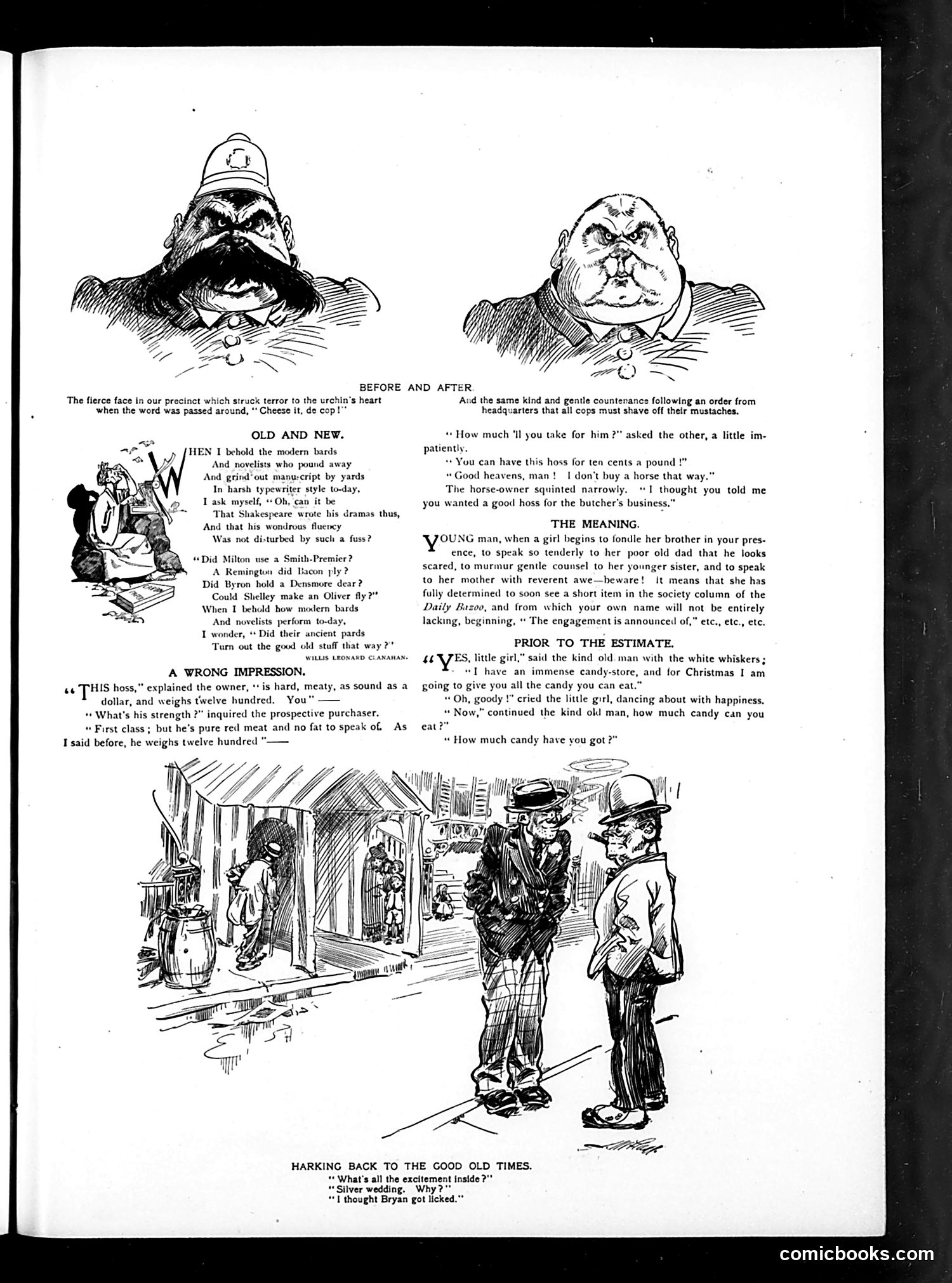
This page contains four separate satirical pieces typical of late-19th/early-20th century American humor: **"Before and After"**: Contrasts a fierce, mustachioed police officer with one freshly shaved. The caption references a police order mandating mustache removal—mocking both the regulation's pettiness and how it softens the cop's intimidating appearance that once frightened street children ("Cheese it, de cop!"). **"Old and New"**: Satirizes modern typewriter-dependent writers by questioning whether Shakespeare, Milton, and Shelley could have produced great works using mechanical devices rather than handwriting. The joke mocks contemporary authors' reliance on technology while romanticizing classical literary genius. **"A Wrong Impression"**: A horse-seller confuses a buyer seeking a quality mount with one seeking meat for butchering—a straightforward comedic misunderstanding exploiting the ambiguity of "good hoss." **"Prior to the Estimate"**: An older gentleman offers unlimited candy to a girl, who shrewdly asks "how much candy have you got?"—suggesting she'll eat everything available rather than show restraint. The final item "Harking Back" appears incomplete but references Bryan (likely William Jennings Bryan) and an election loss.
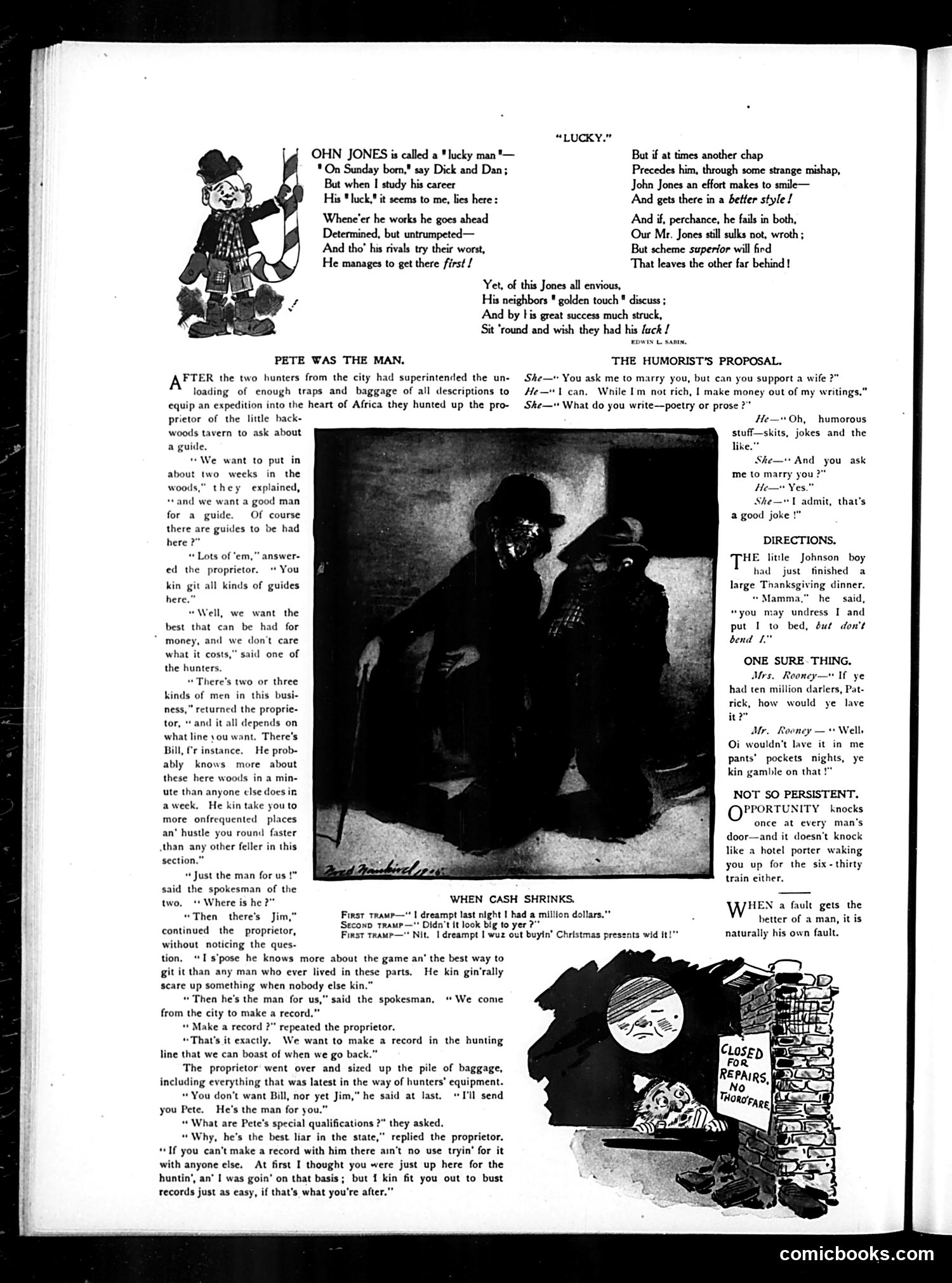
This page contains several satirical pieces typical of early Judge magazine: **"Lucky"** (top left): A poem-cartoon mocking the notion of "luck." John Jones succeeds not through fortune but through persistent effort and superior schemes—the satire suggests that what people attribute to luck is actually determination and cunning planning. **"Pete Was the Man"** (center): A humorous hunting story where city hunters seeking to make a hunting "record" are advised to hire Pete, "the best liar in the state." The joke: to fabricate impressive hunting stories, you need a skilled liar, not an experienced guide. It's satire on wealthy urban sportsmen's vanity and their desire to boast falsely. **"When Cash Shrinks"** (bottom): A joke about wealth and Christmas spending—dreaming of a million dollars seems grand until you imagine actually *spending* it on gifts. **"The Humorist's Proposal"** and **"Directions"** are brief comic sketches about marriage proposals and parenting. The overall theme: satire of human nature—vanity, dishonesty, and the gap between appearance and reality.
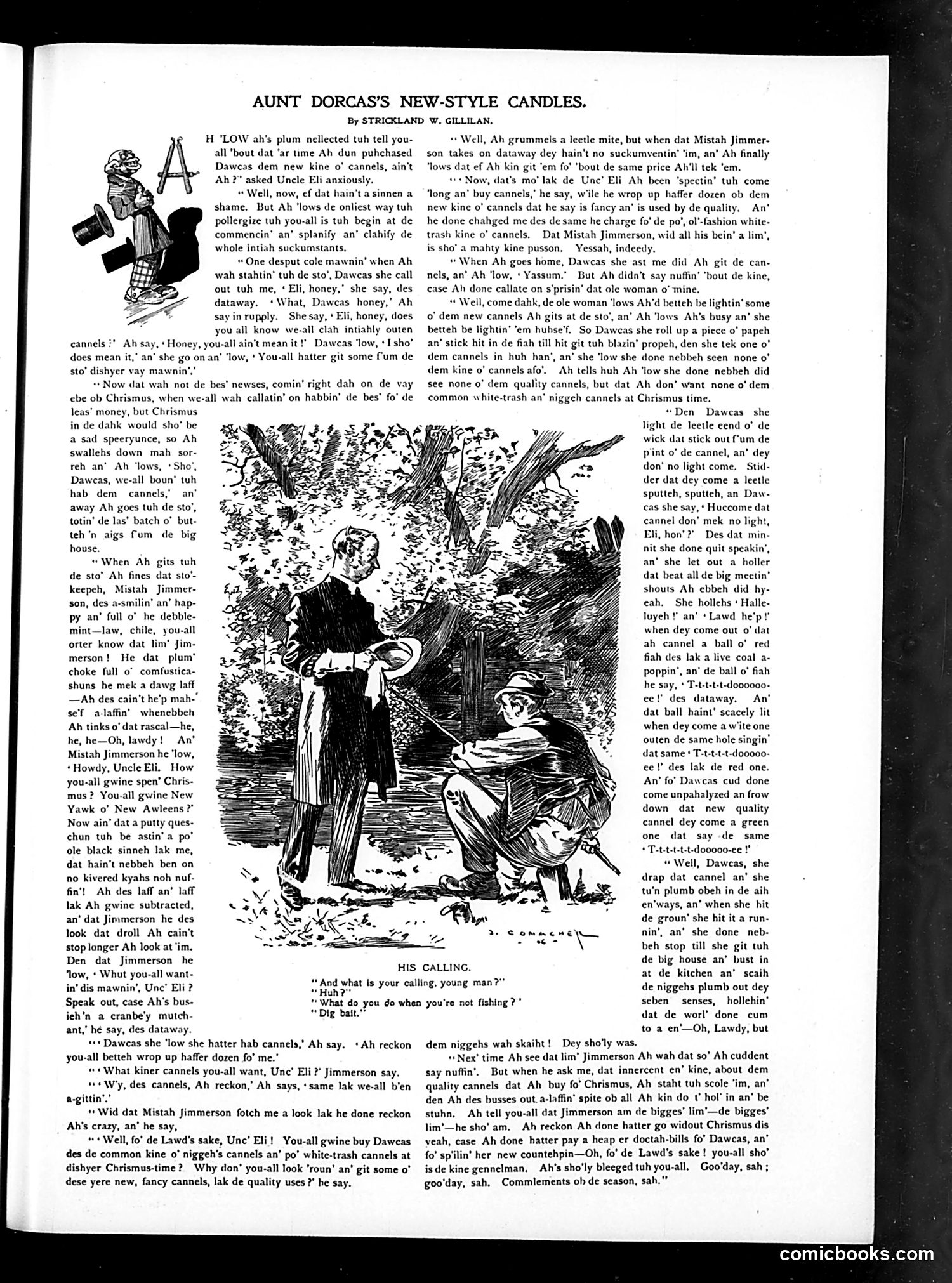
This is a humorous dialect story by Strickland W. Gillilan, not primarily a political cartoon. It depicts a rural African American character, Uncle Eli, recounting how a clever shopkeeper (Mistah Jimmerson) tricks him into buying expensive "fancy" candles by appealing to his pride and social aspiration. The satire targets both characters: Jimmerson exploits Uncle Eli's desire to appear respectable ("quality"), while Uncle Eli admits he deceives his wife Dawcas about the purchase's true cost. The "new-style candles" are identical to cheaper ones—Jimmerson simply repackages and reprices them. The piece trades on period stereotypes of African American dialect and rural gullibility for comedic effect, while ultimately mocking consumer manipulation and social pretension. The humor relies on the reader's presumed superiority to the characters' naïveté.
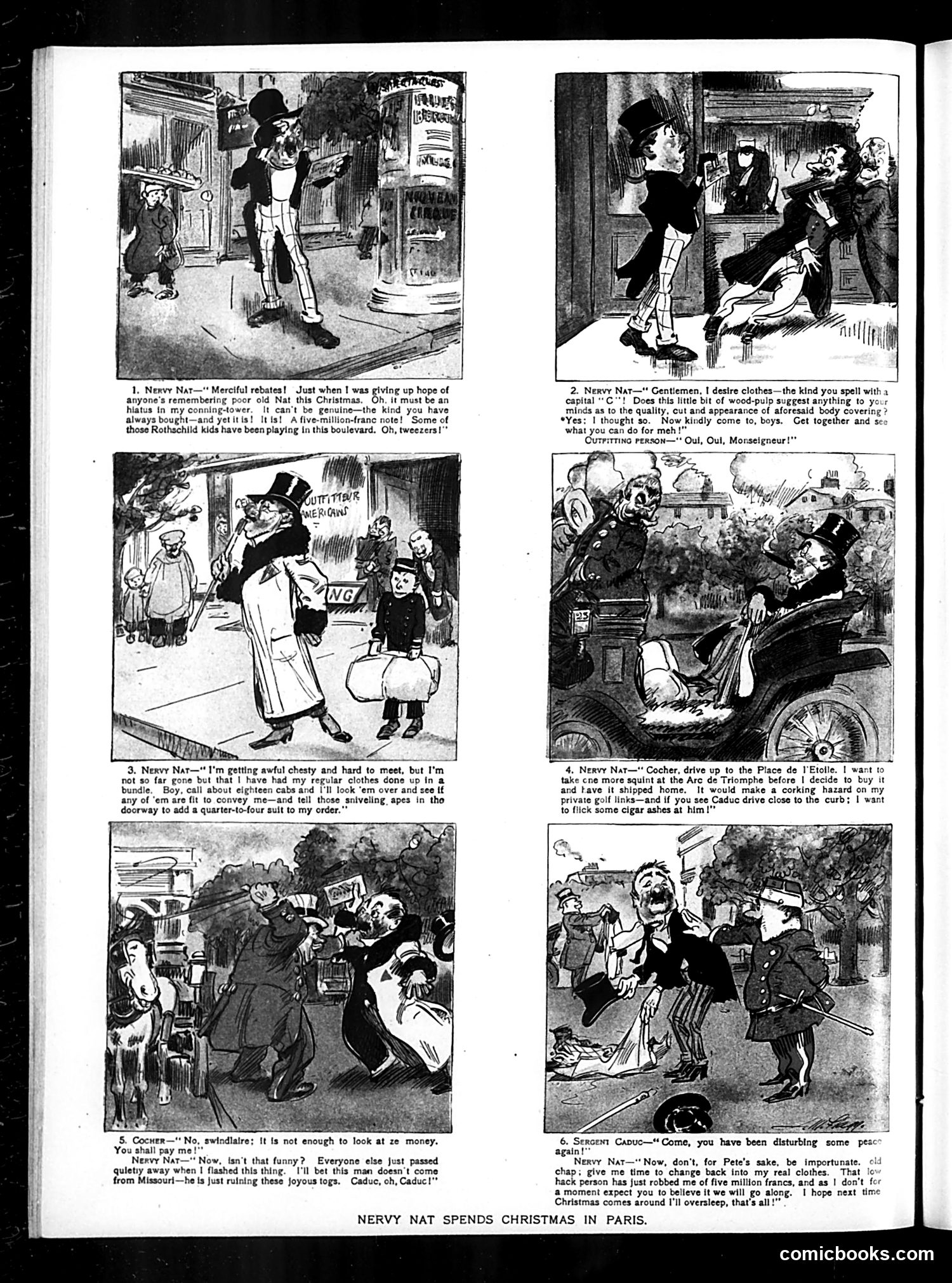
This six-panel comic follows an American character ("Nervy Nat") through Paris, satirizing American wealth and gauche behavior abroad. Nat, apparently wealthy but crude, finds a five-million-franc note and uses it to commission expensive clothing. The satire targets American tourists: his ostentatious spending, his casual attitude toward massive sums of money, his assumption that money solves all problems, and his complete lack of cultural respect (wanting to buy the Arc de Triomphe as a golf hazard, flicking cigar ash at locals). French characters respond with exasperation—tailors and taxi drivers exploit or mock him. The humor lies in contrasting American presumption with European sophistication. The reference to "Rothschild kids" and the five-million-franc note suggest this mocks nouveau-riche American industrialists (echoing Gilded Age stereotypes) visiting Paris, a recurring Judge magazine theme about American cultural inferiority abroad.
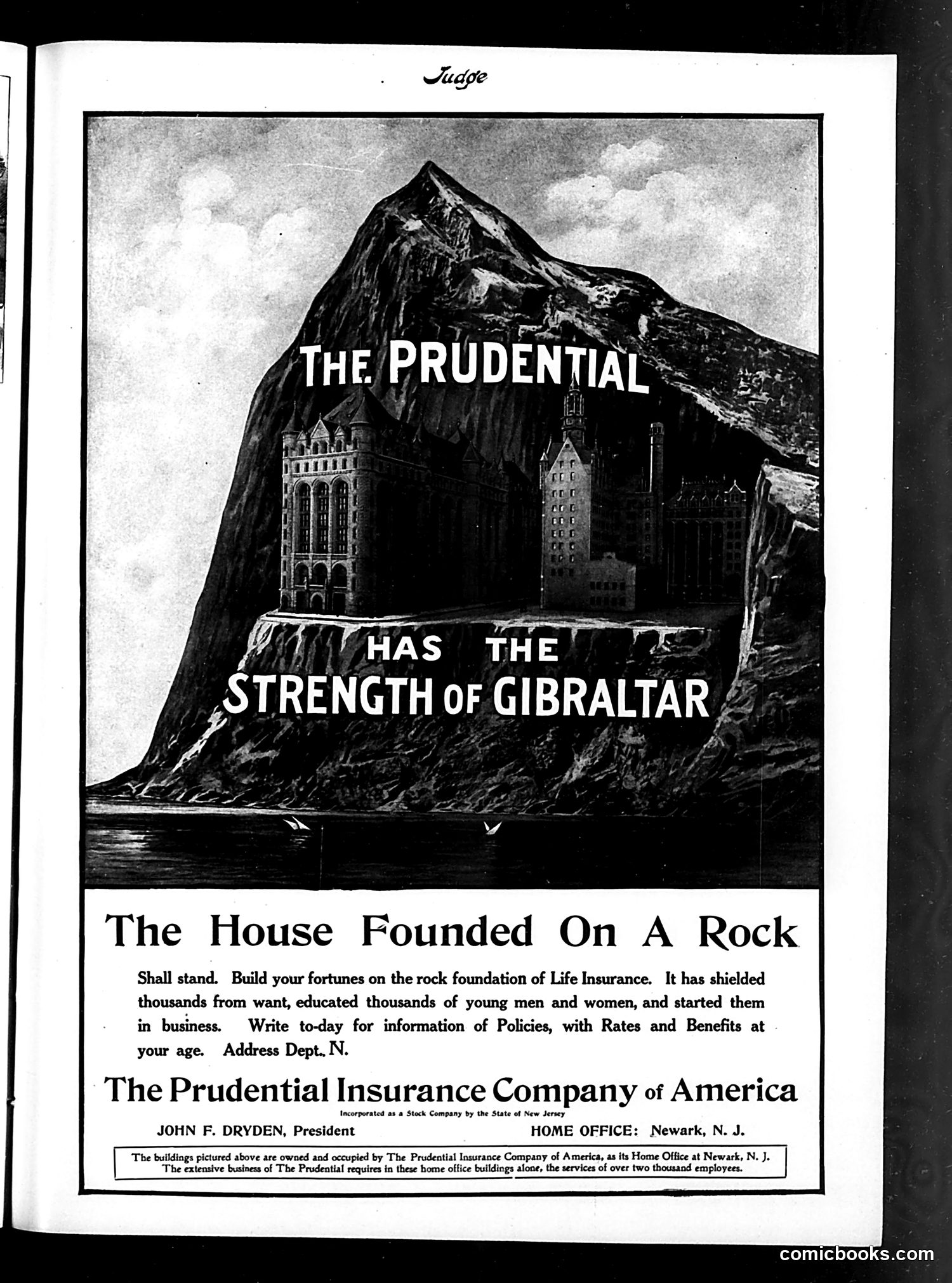
This is a **full-page advertisement**, not political satire. The Prudential Insurance Company uses a religious metaphor—"The House Founded on a Rock"—referencing Matthew 7:24-25, where Jesus compares faith to building on solid rock rather than sand. The image shows Gibraltar (a famous, impregnable fortress) topped with Prudential's Newark office buildings, equating the company's stability with an unshakeable natural stronghold. The advertisement promises that life insurance provides financial security and has helped thousands of young people avoid poverty and start businesses. This represents **early 20th-century corporate advertising** that emphasizes institutional permanence and trustworthiness—key selling points when life insurance was still relatively new. The patriotic/monumental imagery was typical marketing strategy for financial companies seeking customer confidence.
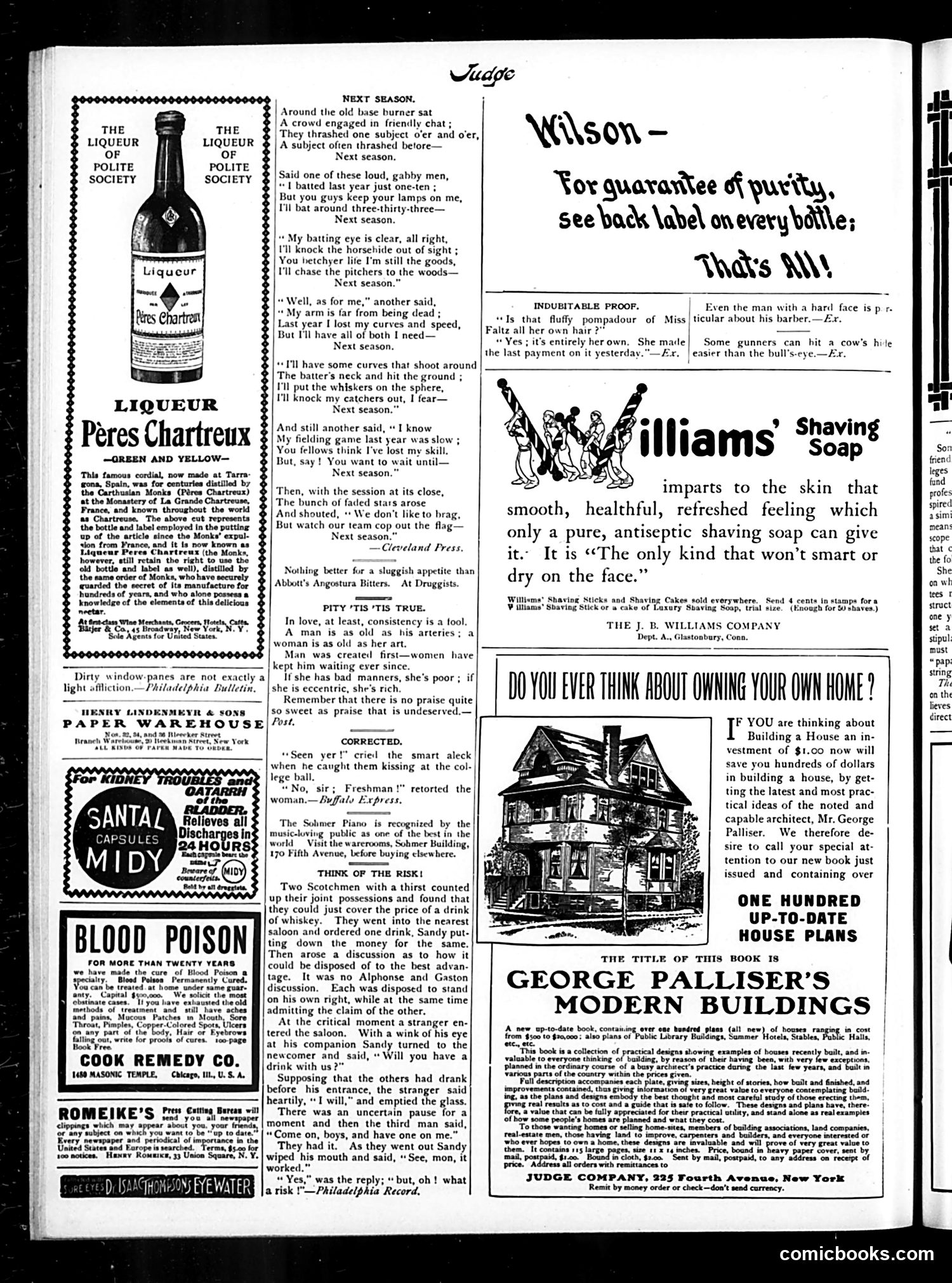
This page is primarily **advertising**, with one substantial satirical cartoon about baseball. ## "Next Season" Cartoon The main content is a dialogue cartoon mocking **baseball players' empty boasting**. A group of aging ballplayers sit around a stove, each claiming they'll dramatically improve their performance—batting averages, pitching curves, fielding skills—but always with the qualifier "Next season." The joke satirizes professional athletes' perennial optimism and excuses, suggesting they perpetually promise future greatness while delivering mediocrity. The final panel shows them collectively bragging about winning the championship "next season," with the caption "PITY 'TIS 'TIS TRUE"—implying this cyclical delusion is genuinely pathetic. The humor relies on readers' familiarity with baseball culture and the predictable nature of players' seasonal promises. ## Supporting Content The page includes advertisements for liqueur, shaving soap, home building plans, and medical treatments—typical Judge advertising. Several brief jokes appear, including one about a college kiss and remarks on marriage.
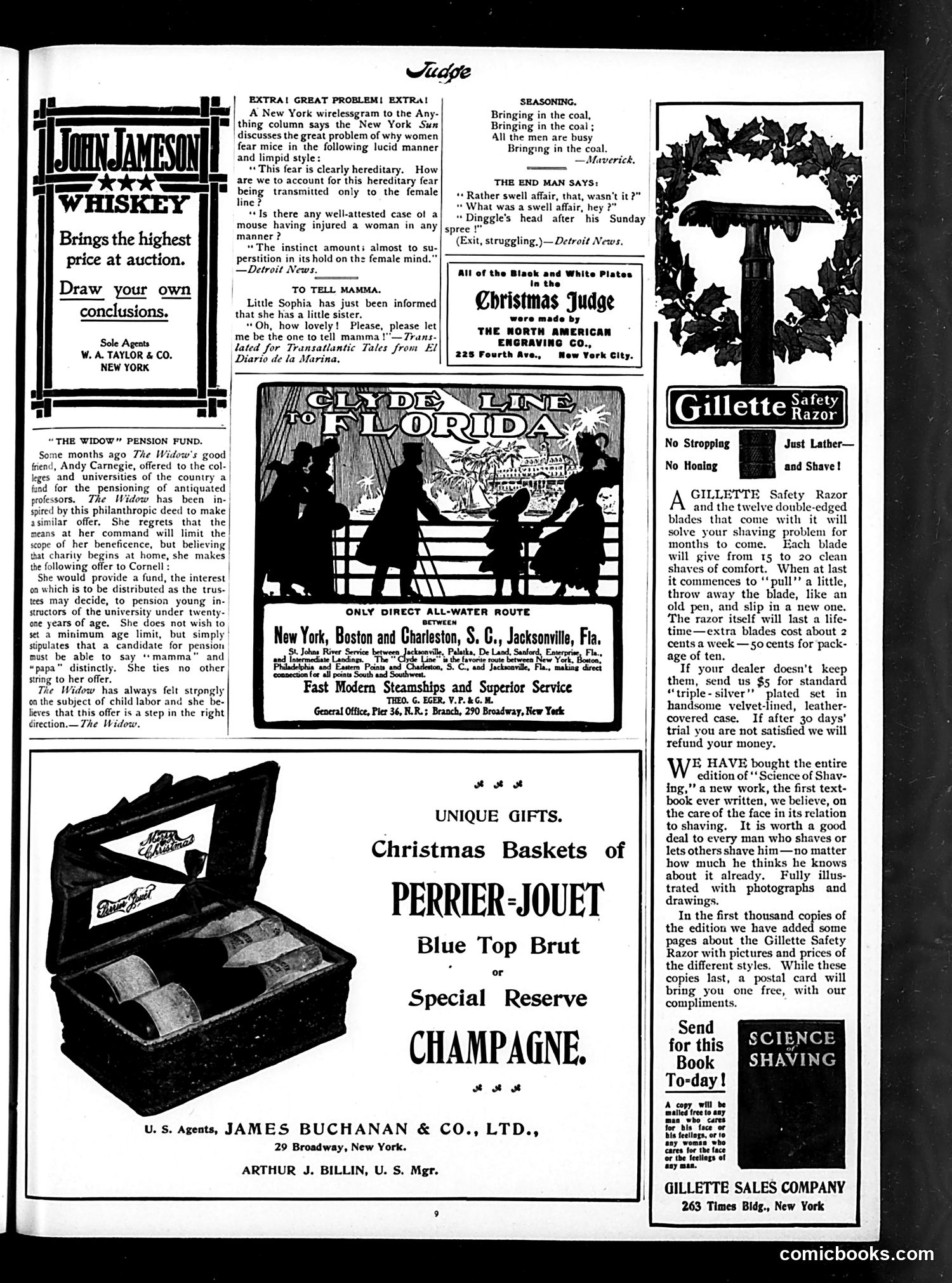
This page from Judge (a satirical weekly) contains several distinct pieces: **"The Widow's Pension Fund"** satirizes Andrew Carnegie's recent charitable donation of professorship pensions by having "The Widow" (Judge's recurring character) propose an absurdly patronizing counter-offer: a pension fund for young instructors under 21 who can distinctly say "mamma" and "papa." The joke mocks both Carnegie's philanthropy as performative and reveals contemporary attitudes about intellectual maturity and childishness. **"Extra! Great Problem!"** ridicules a New York Sun article attempting to explain why women fear mice. Judge presents the Sun's pseudo-scientific hereditary explanation as laughably circular logic, satirizing both the newspaper's pseudo-intellectualism and period gender stereotypes. The remaining content is primarily **advertisements** (Gillette razors, Perrier-Jouet champagne, steamship lines) and **light comic bits** about coal-delivery and a drunk man's swollen head—typical filler content for the era's magazines. The page overall demonstrates Judge's mix of pointed social satire and commercial material.
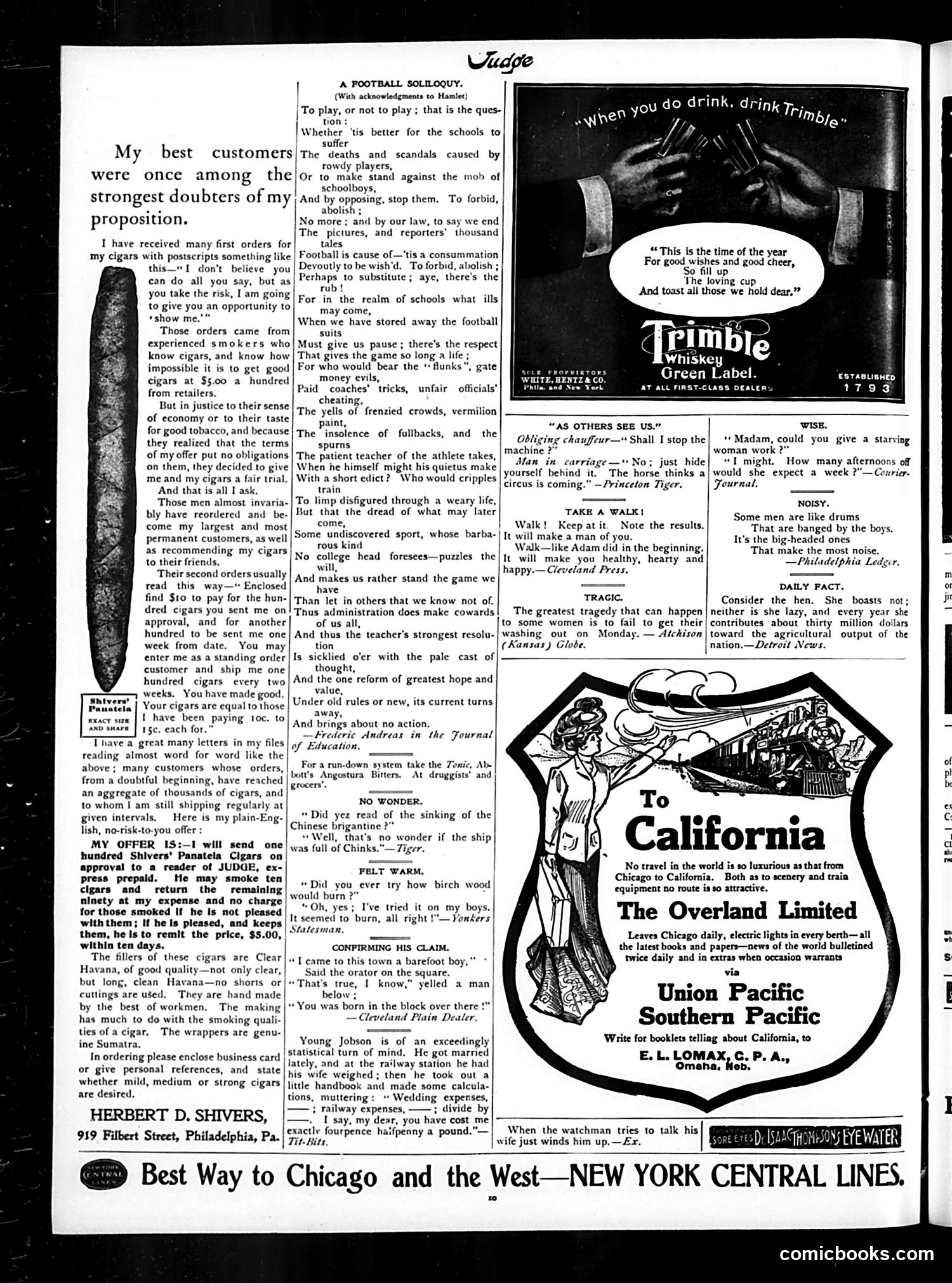
This page primarily consists of **advertising and satirical commentary on American college football**, not political cartooning. The main content is Herbert D. Shivers's cigar advertisement (left), offering cigars on approval to skeptical customers—a sales pitch wrapped in testimonial claims. The cartoon (center-right) is a "Football Soliloquy"—a parody of Hamlet's "To be or not to be" speech, applied to whether colleges should ban football. It satirizes the sport's widespread problems: player injuries ("cripples"), scandals, rowdy behavior, coaching corruption, and the commercial pressures (gate money) driving its continuation despite these harms. The satire reflects **early 1900s anxieties** about college football's danger and moral influence. Rather than defending the sport, the Hamlet parody argues that colleges *should* abolish it—mocking how institutions tolerate obvious evils because they fear losing revenue or an exciting alternative entertainment will emerge. The page itself is a period advertisement/humor magazine layout typical of *Judge*.
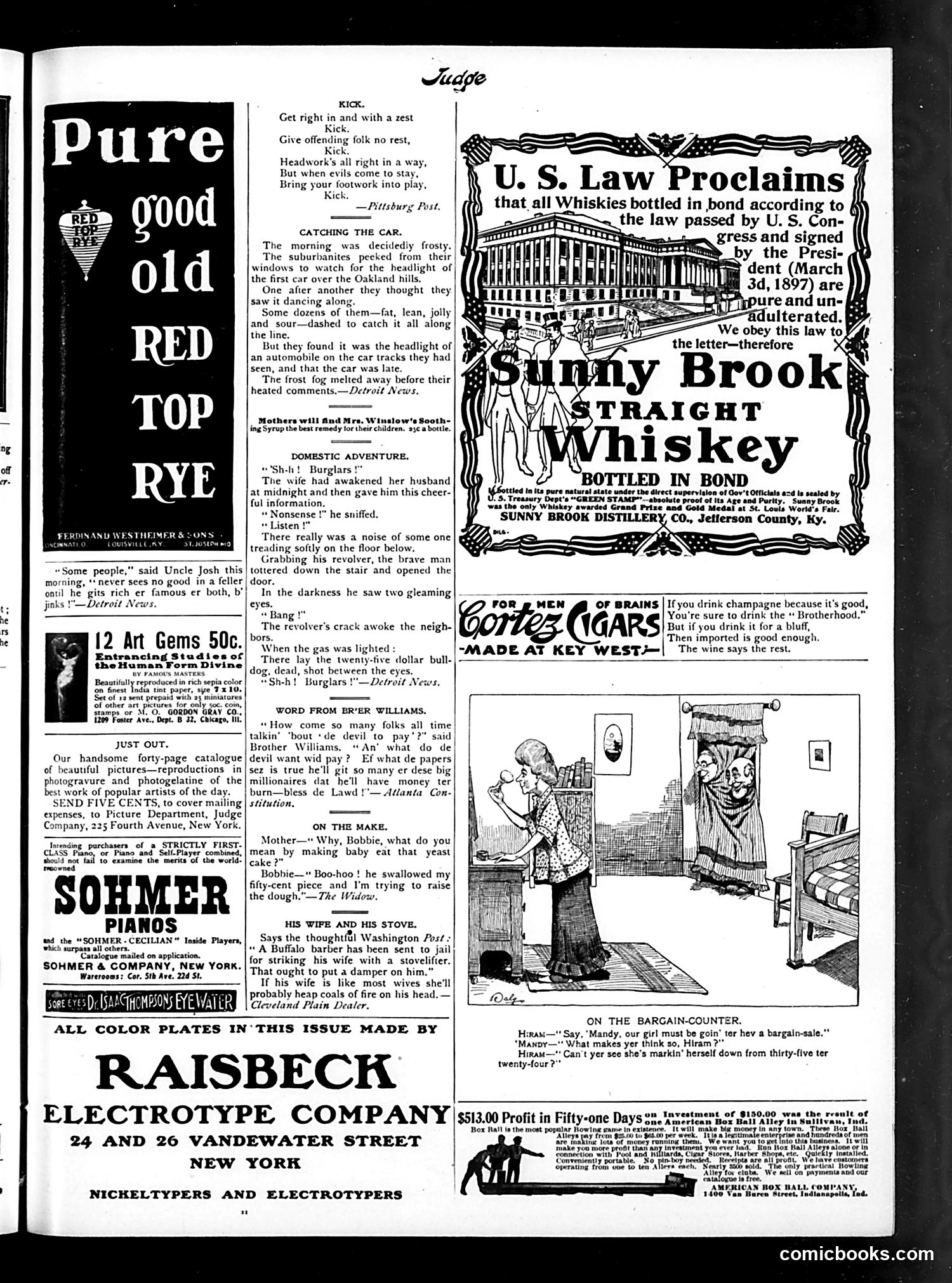
This is primarily an **advertising and humor miscellany page** from an early 1900s issue of Judge magazine, a satirical weekly publication. **The cartoons/humor pieces** are brief anecdotes rather than visual political cartoons: - **"Kick"** is an inspirational poem about taking action against wrongdoing - **"Catching the Car"** mocks suburban commuters mistaking an automobile's headlight for their streetcar in the fog - **"Domestic Adventure"** is a dark comedic tale where a nervous husband shoots his own bulldog, thinking it's a burglar - **"Word from Br'er Williams"** uses an African American dialect character to joke about the devil having plenty of wealthy targets The humor reflects early 1900s concerns: urban transit confusion, home security anxieties, and racial stereotyping (common in period publications). **The advertisements** tout art reproductions, pianos, and notably, **Sunny Brook Whiskey**, emphasizing its legal "bonded" status—referencing federal whiskey regulations passed in 1897 to guarantee purity and prevent adulteration.
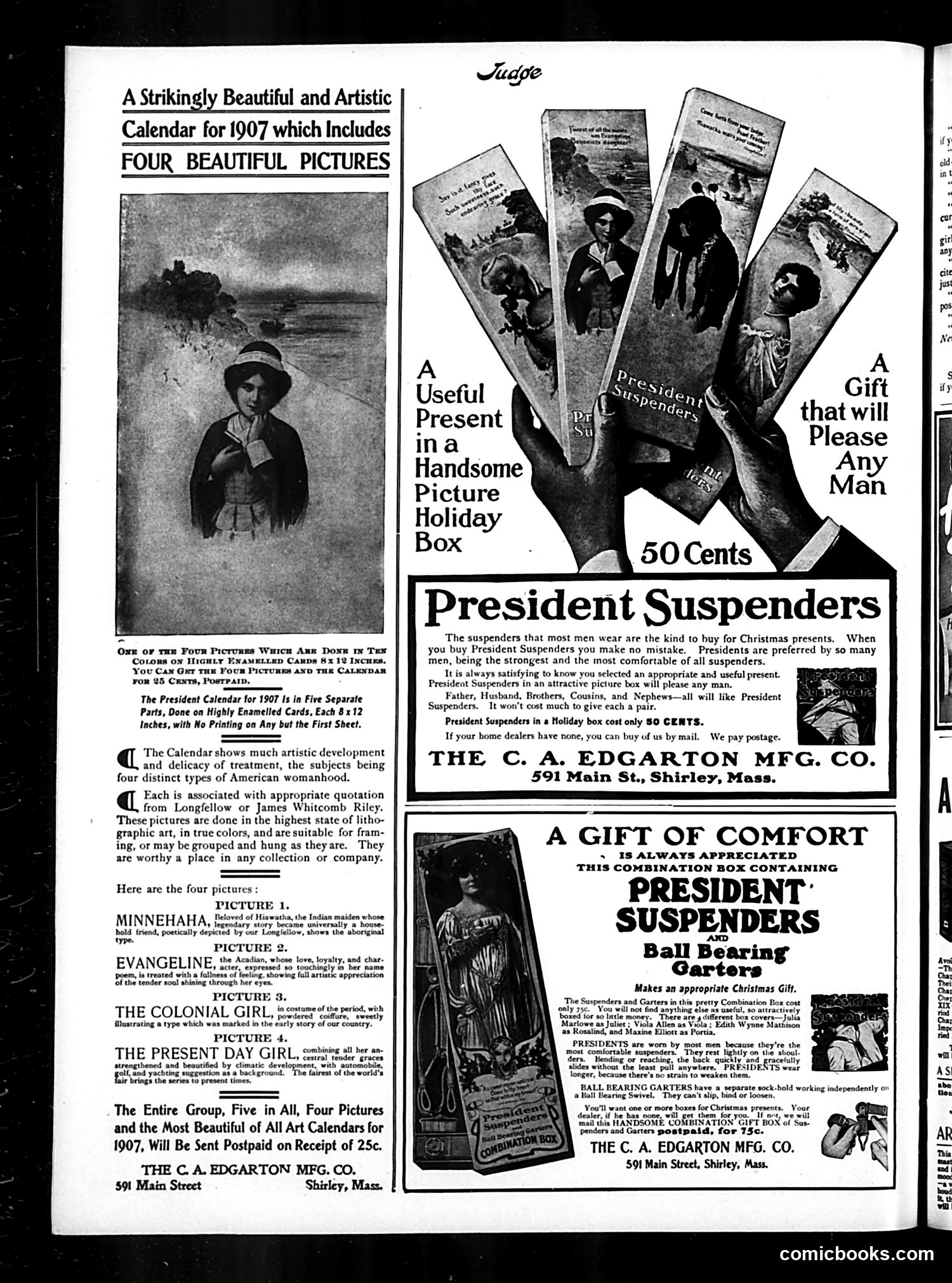
This page is primarily **advertising**, not political satire. It showcases two product campaigns from the C.A. Edgarton Manufacturing Company of Shirley, Massachusetts. **The Calendar Advertisement** (left) promotes an 1907 art calendar featuring four idealized images of American womanhood: Minnehaha (Native American), Evangeline (Acadian), "The Colonial Girl," and "The Present Day Girl." Each is paired with literary quotations (Longfellow, Whitcomb Riley). This reflects early 1900s aesthetic marketing—positioning products through association with refined art and literature. **The President Suspenders Advertisement** (right) dominates the page, marketing men's suspenders as Christmas gifts. The copy emphasizes comfort, durability, and appropriateness as presents for "Father, Husband, Brothers, Cousins, and Nephews." A complementary box combines suspenders with ball-bearing garters, featuring cover art depicting famous actresses (Julia Marlowe, Viola Allen, etc.) in Shakespearean roles. The page demonstrates how *Judge* monetized its pages through targeted advertising to middle-class consumers, mixing genteel cultural references with practical merchandise pitches.
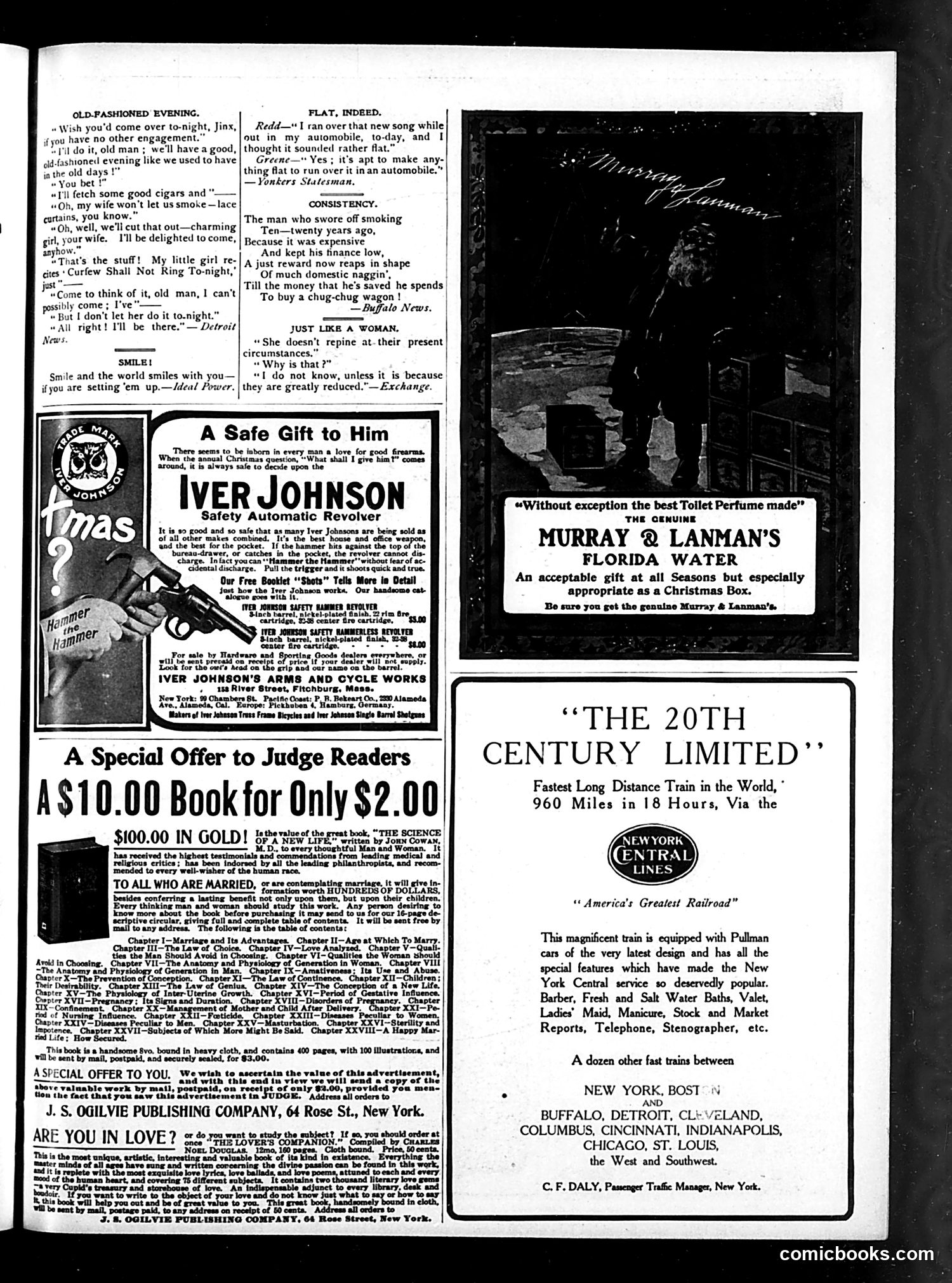
This page consists primarily of **advertisements and short humorous items** rather than political cartoons. The brief jokes comment on early-20th-century domestic life: one depicts a husband unable to enjoy a traditional evening with a friend because his wife forbids smoking indoors ("lace curtains"); another satirizes automobiles as so rough they flatten musical notes; a third mocks a man who quit smoking to save money but now spends savings on a car instead. **Main advertisements** include: - An Iver Johnson revolver marketed as a safe Christmas gift for men - A $10 book on marriage and reproduction ("The Science of Marrying") - The "20th Century Limited" train (NYC Central) The satire is gentle and domestic—poking fun at changing social conventions (wives' increasing domestic authority), new technology (automobiles), and masculine contradictions (self-denial undermined by new consumer desires). No specific political figures or events are referenced; the humor targets universal middle-class anxieties of the era.
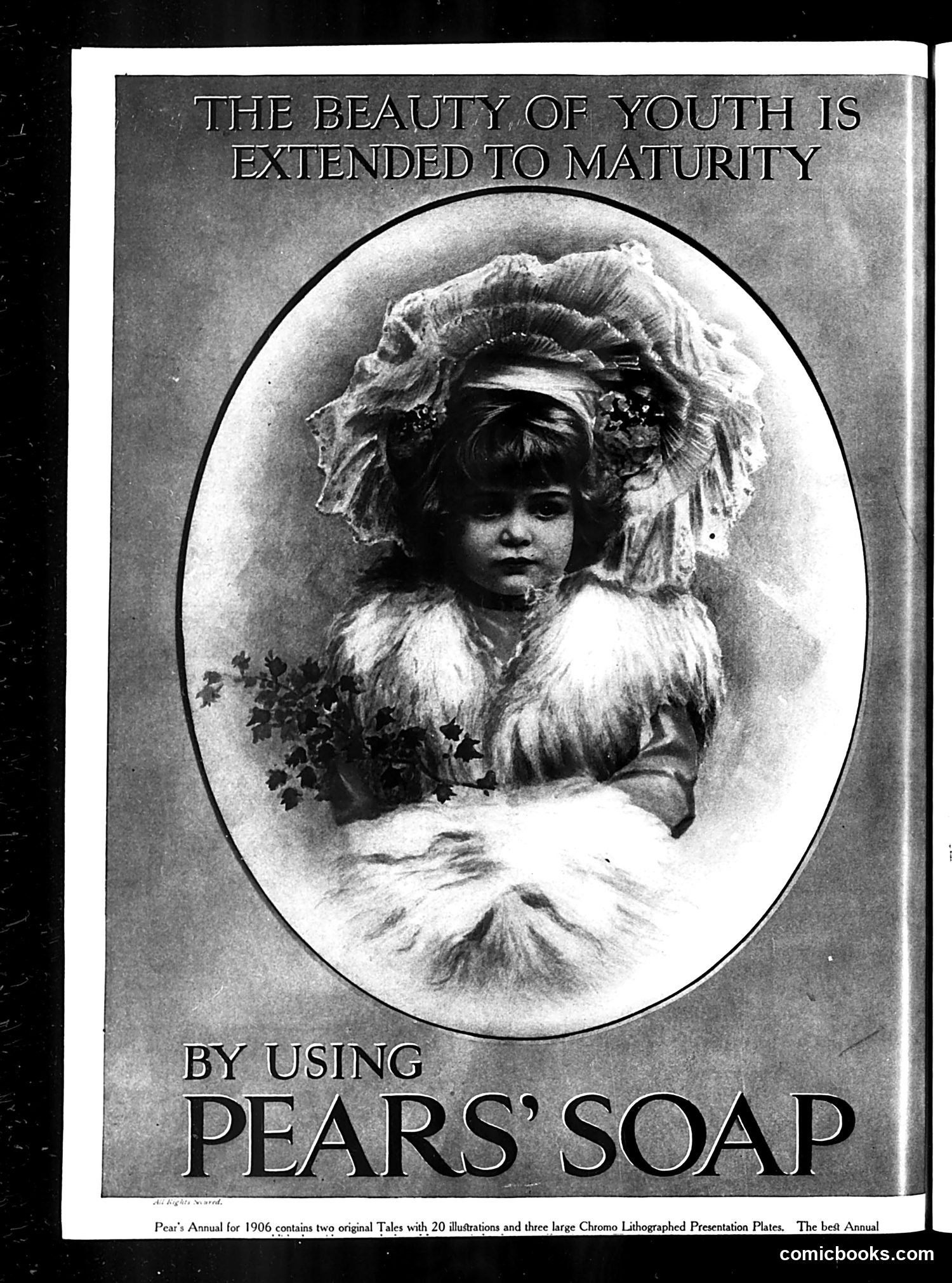
This is a **Pears' Soap advertisement**, not political satire. The page promotes Pears' Annual for 1906, a product catalog or gift book containing stories and colored illustrations. The image shows a young woman in elaborate Edwardian dress with an ornate hat and feathered collar, holding flowers. The headline claims "The Beauty of Youth Is Extended to Maturity By Using Pears' Soap"—a common advertising trope suggesting the product preserves youthful appearance. The advertisement exploits period anxieties about aging and female beauty, marketing soap as a anti-aging solution. This reflects early 1900s beauty culture where women's value was heavily tied to youth and appearance. The refined, fashionable styling appeals to middle-class aspirations and consumer desire.