
Judge, 1906-12-22 · page 28 of 48
Judge — December 22, 1906 — page 28: what you’re looking at
What you’re looking at
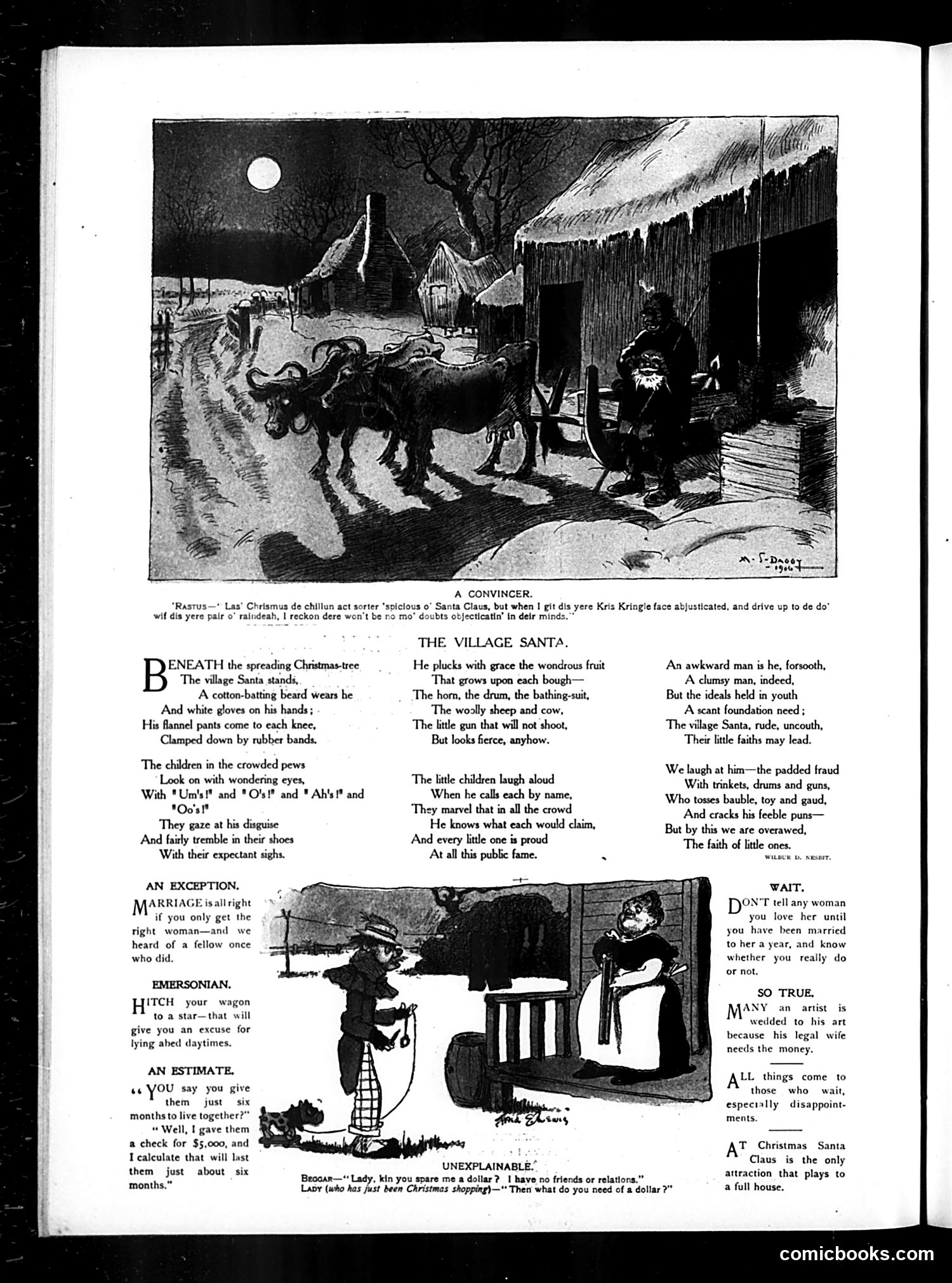
This page presents Christmas-themed humor and social commentary typical of early 20th-century American satire. **"The Village Santa"** is the main piece—a nostalgic poem celebrating a humble, poorly-dressed Santa who delights children despite his obvious artificiality (cotton-batting beard, rubber bands). The satire works on two levels: it gently mocks the transparent fraud, yet celebrates how children's faith transcends the deception. The accompanying illustration shows this ragged Santa in a snowy village scene. **"A Convincer"** (top) uses dialect humor featuring a Black character convincing skeptical children of Santa's authenticity by adding reindeer to his appearance—suggesting that visual props matter more than actual evidence. **Scattered aphorisms** mock contemporary attitudes about marriage (don't claim love prematurely), artistic pretension (artists marry art because wives need money), and class dynamics (a homeless beggar asks for a dollar from a Christmas shopper). The page satirizes American materialism, romantic delusion, and social hypocrisy through holiday imagery—the gap between commercial fantasy and reality.
📄 Transcribed text from this page (OCR, searchable)
Machine-transcribed from the original scan — historical spelling and the odd misread are preserved.
ENEATH the spreading Christmas-tree The village Santa stands, A cotton-batting beard wears he And white gloves on his hands; His flannel pants come to each knee, Clamped down by rubber bands. The children in the crowded pews Look on with wondering eyes, With "Um's!" and "O's!" and " Ah's!" and "Oo's!* They gaze at his disguise And fairly tremble in their shoes With their expectant sighs. ARRIA if you only get the right woman—and we heard of a fellow once who did. EMERSONIAN. HITCH your wagon to a star—that will give you an excuse for lying abed daytimes. AN ESTIMATE. + YOU say you give them just six months to live together?” “ Well, I gave them a check for $5,000, and I calculate that will last them just about six A CONVINCER. “Rastus—" Las’ Chrismus de chillun act sorter ‘spicious o” Santa Claus, but when I git dis yere Kris Kringle face abjusticated, and drive up to de do’ wif dis yere pair 0’ raindeah, | reckon dere won't be no mo’ doubts objecticatin’ in deir minds.”* THE VILLAGE SANTA. He plucks with grace the wondrous fruit That grows upon each bough— The horn, the drum, the bathing-suit, The woolly sheep and cow, The little gun that will not shoot, But looks fierce, anyhow. The little children laugh aloud When he calls each by name, They marvel that in all the crowd He knows what each would claim, And every litle one is proud At all this public fame. UNEXPLAINABLE.” oe Beocar—‘' Lady, kin you spare me a dollar? I have no friends or relations.” months. Lapy (who has just been Christmas shopping}—"* Then what do you need of a dollar?” An awkward man is he, forsooth, A clumsy man, indeed, But the ideals held in youth A scant foundation need ; The village Santa, rude, uncouth, Their little faiths may lead. ‘We laugh at him—the padded fraud With trinkets, drums and guns, ‘Who tosses bauble, toy and gaud, And cracks his feeble puns— But by this we are overawed, The faith of little ones. WAIT. ON’T tell any woman you love her until you have been married to her a year, and know whether you really do or not. SO TRUE. MAs¥ an artist’ is wedded to his art because his legal wife needs the money. LL things come to those who wait, especially disappoint ments. AT Christmas Santa Claus is the only attraction that plays to a full house. comicbooks.com