
Judge, 1906-12-22 · page 33 of 48
Judge — December 22, 1906 — page 33: what you’re looking at
What you’re looking at
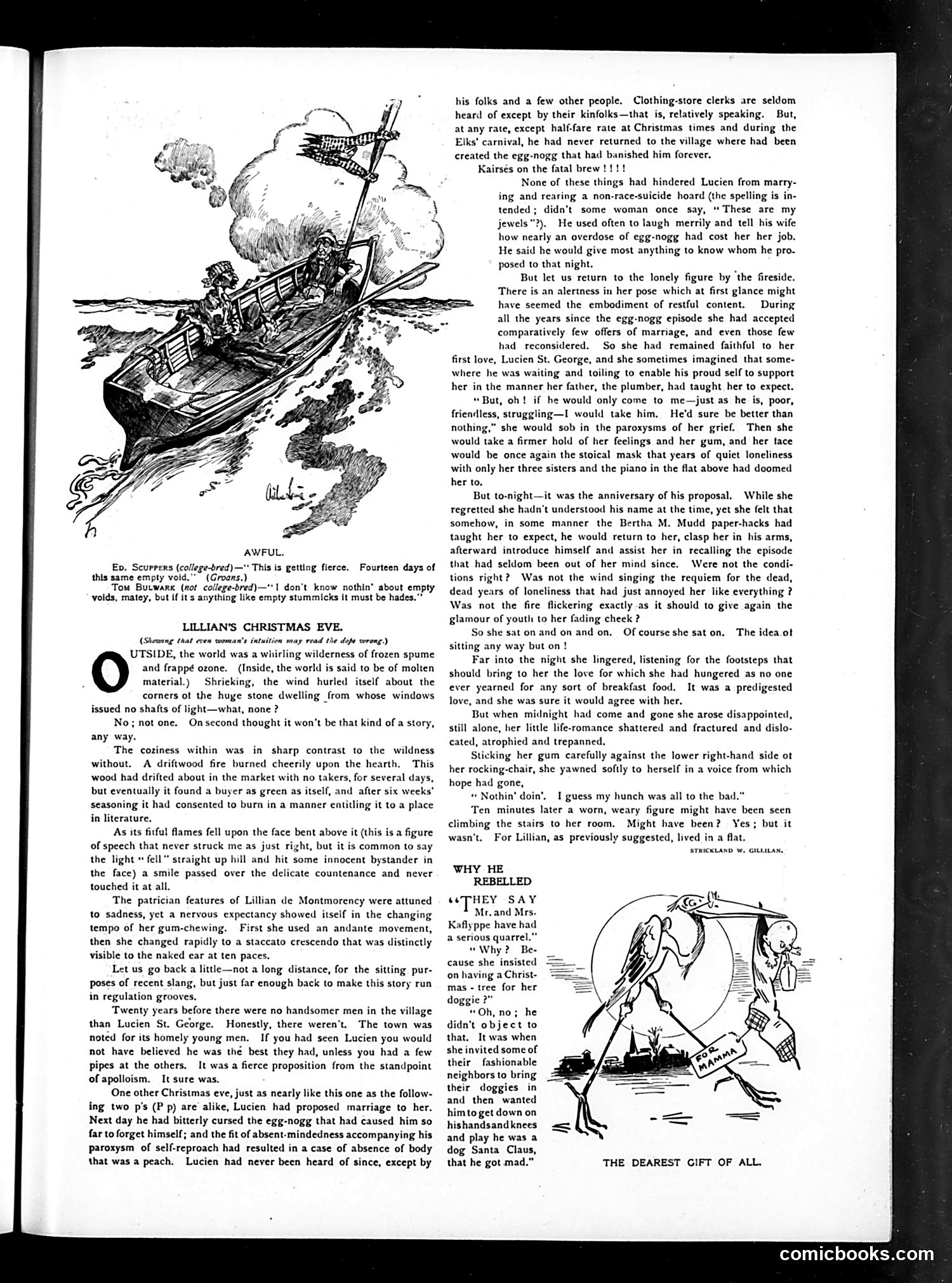
This page contains a satirical short story titled "Lillian's Christmas Eve" with accompanying illustrations. The narrative mocks sentimental Victorian romance fiction through exaggerated, self-aware prose. The story concerns Lillian de Montmorency, who sits by a fire on Christmas Eve waiting for her lost love, Lucien St. George. Twenty years prior, Lucien proposed to her while drunk on "egg-nogg," then disappeared from the village, eventually marrying someone else. The satire targets the melodramatic conventions of period romance literature—the overwrought descriptions ("patrician features," "delicate countenance"), the author's self-interrupting commentary ("this is a figure of speech that never struck me as just right"), and the implausible plot contrivances. The headnote joke about college-educated versus working-class men discussing "empty voids" adds social commentary typical of Judge's humor. The overall effect ridicules both sentimental literary conventions and the passivity of idealized female characters in popular fiction.
📄 Transcribed text from this page (OCR, searchable)
Machine-transcribed from the original scan — historical spelling and the odd misread are preserved.
Ep. Scurrers (college-bred)—"" This is getting fierce. this same empty void.” (Groans.) Tom Butwarx (not college-bred)—"*| don't know nothin’ about empty voids, matey, but if it's anything like empty stummicks it must be hades.”* Fourteen days of LILLIAN'S CHRISTMAS EVE. (Showing that even woman's intuition may read the dope wrong.) UTSIDE, the world was a whirling wilderness of frozen spume and frappé ozone. (Inside, the world is said to be of molten material.) Shrieking, the wind hurled itself about the corners of the huge stone dwelling from whose windows issued no shafts of light—what, none ? No; not one. Onsecond thought it won't be that kind of a story, any way. The coziness within was in sharp contrast to the wildness without. A driftwood fire burned cheerily upon the hearth. This wood had drifted about in the market with no takers, for several days, but eventually it found a buyer as green as itself, and after six weeks’ seasoning it had consented to burn in a manner entitling it to a place in literature. As its fitful flames fell upon the face bent above it (this is a figure of speech that never struck me as just right, but it is common to say the light «fell straight up hill and hit some innocent bystander in the face) a smile passed over the delicate countenance and never touched it at all. The patrician features of Lillian de Montmorency were attuned to sadness, yet a nervous expectancy showed itself in the changing tempo of her gum-chewing. First she used an andante movement, then she changed rapidly to a staccato crescendo that was distinctly visible to the naked ear at ten paces. Let us go back a little—not a long distance, for the sitting pur- poses of recent slang, but just far enough back to make this story run in regulation grooves, Twenty years before there were no handsomer men in the village than Lucien St. George. Honestly, there weren't. The town was noted for its homely young men. If you had seen Lucien you would not have believed he was thé best they had, unless you had a few pipes at the others. It was a fierce proposition from the standpoint of apolloism. It sure was, One other Christmas eve, just as nearly like this one as the follow- ing two p's (P p) are alike, Lucien had proposed marriage to her. Next day he had bitterly cursed the egg-nogg that had caused him so far to forget himself; and the fit of absent-mindedness accompanying his paroxysm of self-reproach had resulted in a case of absence of body that was a peach. Lucien had never been heard of since, except by his folks and a few other people. Clothing-store clerks are seldom heard of except by their kinfolks—that is, relatively speaking. But, at any rate, except half-fare rate at Christmas times and during the Elks’ carnival, he had never returned to the village where had been created the egg-nogg that had banished him forever, Kairsés on the fatal brew!!! 1! None of these things had hindered Lucien from marry- ing and rearing a non-race-suicide hoard (the spelling is in- tended; didn't some woman once say, “These are my jewels "?). He used often to laugh merrily and tell his wife how nearly an overdose of egg-nogg had cost her her job. He said he would give most anything to know whom he pro- posed to that night. But let us return to the lonely figure by ‘the fireside. There is an alertness in her pose which at first glance might have seemed the embodiment of restful content. During all the years since the egg-nogg episode she had accepted comparatively few offers of marriage, and even those few had reconsidered. So she had remained faithful to her first love, Lucien St. George, and she sometimes imagined that some- where he was waiting and toiling to enable his proud self to support her in the manner her father, the plumber, had taught her to expect. “But, oh! if he would only come to me—just as he is, poor, friendless, struggling—I would take him, He'd sure be better than nothing,” she would sob in the paroxysms of her grief. Then she would take a firmer hold of her feelings and her gum, and her tace would be once again the stoical mask that years of quiet loneliness with only her three sisters and the piano in the flat above had doomed her to, But to-night—it was the anniversary of his proposal. While she regretted she hadn't understood his name at the time, yet she felt that somehow, in some manner the Bertha M. Mudd paper-hacks had taught her to expect, he would return to her, clasp her in his arms, afterward introduce himself and assist her in recalling the episode that had seldom been out of her mind since. Were not the condi- tions right? Was not the wind singing the requiem for the dead, dead years of loneliness that had just annoyed her like everything ? Was not the fire flickering exactly as it should to give again the glamour of youth to her fading cheek ? So she sat on and on and on. Of course she sat on. sitting any way but on! Far into the night she lingered, listening for the footsteps that should bring to her the love for which she had hungered as no one ever yearned for any sort of breakfast food. It was a predigested love, and she was sure it would agree with her. But when midnight had come and gone she arose disappointed, still alone, her little life-romance shattered and fractured and dislo- cated, atrophied and trepanned, Sticking her gum carefully against the lower right-hand side ot her rocking-chair, she yawned softly to herself in a voice from which hope had gone, “ Nothin’ doin’, I guess my hunch was all to the bad.” Ten minutes later a worn, weary figure might have been seen climbing the stairs to her room. Might have been? Yes; but it For Lillian, as previously suggested, lived in a flat. The idea ot wasn't. WHY HE REBELLED 6sTHEY SAY Mr. and Mrs. Kaflyppe have had a serious quarrel.” “Why? Be- cause she insisted ‘on having a Christ- mas - tree for her doggie ?” “Oh, no; he didn't object to that. It was when she invited some of their fashionable neighbors to bring their doggies in and then wanted himtoget down on hishandsandknees and play he was a dog Santa Cla that he got mad. THE DEAREST GIFT OF ALL. comicbooks.com