
Judge, 1906-12-22 · page 22 of 48
Judge — December 22, 1906 — page 22: what you’re looking at
What you’re looking at
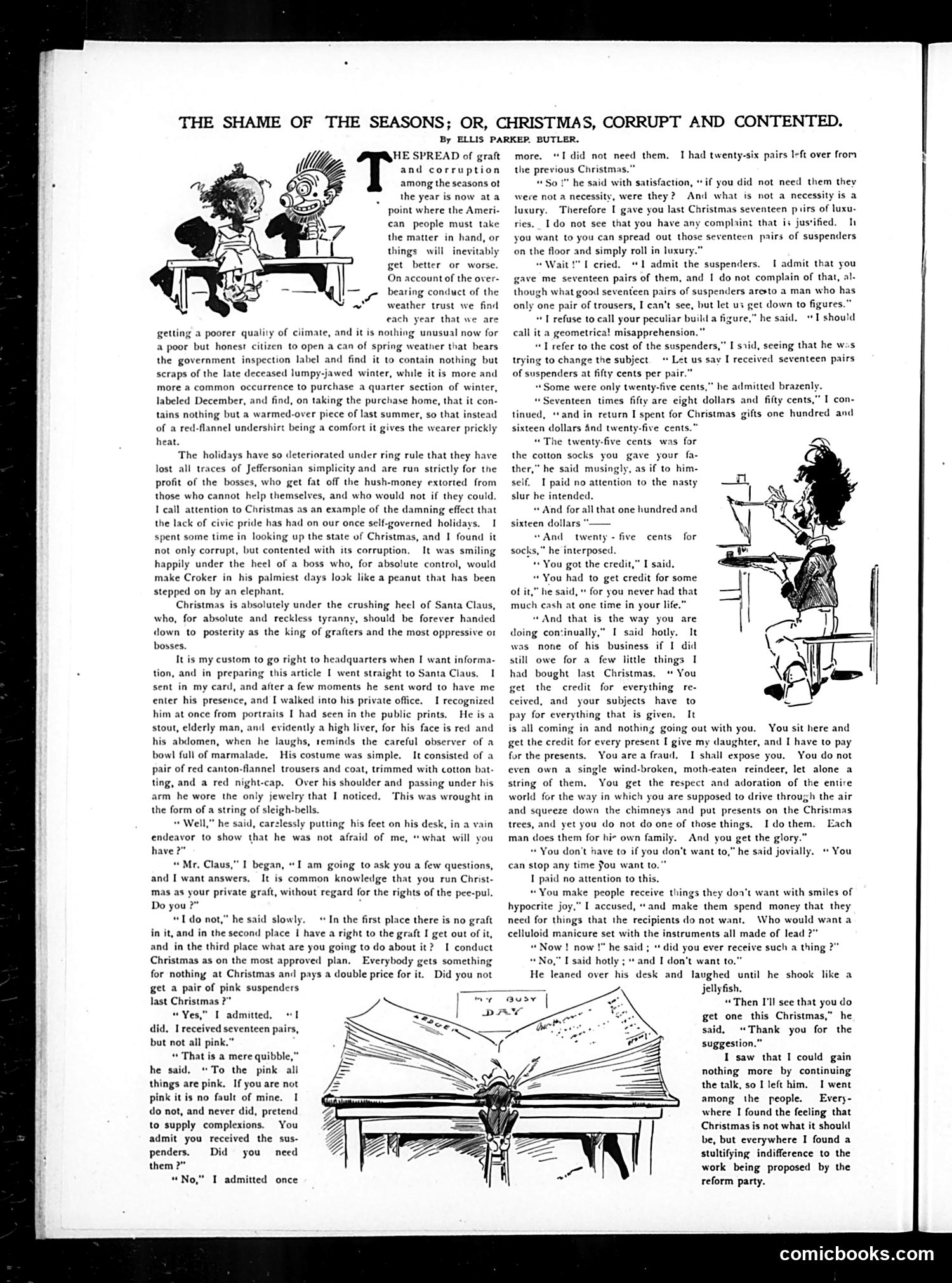
This Ellis Parker Butler essay uses **Christmas and Santa Claus as metaphors for political corruption** during the Progressive Era (early 1900s). The satire targets **machine politics and graft**—the systematic theft and bribery that plagued American governance. Santa Claus represents a corrupt political boss who controls Christmas like a "ring" (political machine), extracting wealth while claiming to provide services. The narrator interviews Santa, who brazenly admits running Christmas as personal "graft" but insists this is legitimate—everyone "gets something for nothing...and pays a double price." The larger metaphor extends to **seasonal deterioration as symbol of civic decay**: poor-quality winter and spring represent how corruption degrades public goods. References to "Croker" (likely Richard Croker, Tammany Hall boss) and "Jeffersonian simplicity" ground this in real political debates about machine rule versus democratic ideals. The joke: **corruption persists because people accept it**, happily receiving cheap gifts while overpaying—a commentary on voters' apathy toward political theft.
📄 Transcribed text from this page (OCR, searchable)
Machine-transcribed from the original scan — historical spelling and the odd misread are preserved.
SEASONS; OR, CHRISTMAS, CORRUPT AND CONTENTED. By ELLIS PARKEP. BUTLER. HE SPREAD of graft and corruption among the seasons ot the year is now at a point where the Ameri can people must take the matter in hand, or things will inevitably get better On account of the over- bearing conduct of the weather trust we find each or worse. year that we are getting a poorer quality of climate, and it is nothing unusual now for a poor but honest citizen to open a can of spring weather that bears the government inspection label and find it to contain nothing but scraps of the late deceased lumpy-jawed winter, while it is more and more a common occurrence to purchase a quarter section of winter, labeled December, and find, on taking the purchase home, that it con- tains nothing but a warmed-over piece of last summer, so that instead of a red-flannel undershirt being a comfort it gives the wearer prickly heat. The holidays have so «leteriorated under ring rule that they have lost all traces of Jeffersonian simplicity and are run strictly for the profit of the bosses, who get fat off the hush-money extorted from those who cannot help themselves, and who would not if they could. I call attention to Christmas as an example of the damning effect that the lack of civic pride has had on our once self-governed holidays. | spent some time in looking up the state of Christmas, and I found it not only corrupt, but contented with its corruption. It was smiling happily under the heel of a boss who, for absolute control, would make Croker in his palmiest days look like a peanut that has been stepped on by an elephant. Christmas is absolutely under the crushing heel of Santa Claus, who, for absolute and reckless tyranny, should be forever handed down to posterity as the king of grafters and the most oppressive ot bosses. It is my custom to go right to headquarters when I want informa- tion, and in preparing this article 1 went straight to Santa Claus. | sent in my card, and after a few moments he sent word to have me enter his presence, and I walked into his private office. I recognized him at once from portraits I had seen in the public prints. stout, elderly man, ani evidently a high liver, for his face is red and his abdomen, when he laughs, reminds the careful observer of a bowl full of marmalade. His costume was simple. It consisted of a pair of red canton-flannel trousers and coat, trimmed with cotton bat- Over his shoulder and_ passing under his ‘This was wrought in He isa ting, and a red night-cap. arm he wore the only jewelry that I noticed. the form of a string of sleigh-bells. + Well," he said, carzlessly putting his feet on his desk, in a vain endeavor to show that he was not afraid of me, “what will you have 2” “Mr, Claus," I began, “I am going to ask you a few questions, and I want answers, It is common knowledge that you run Christ- mas as your private graft, without regard for the rights of the pee-pul. Do you “1do not,” he said slowly. «In the first place there is no graft in it, and in the second place I have a right to the graft I get out of it, and in the third place what are you going to do about it? [ conduct Christmas as on the most approved plan. Everybody gets something for nothing at Christmas and pays a double price for it. Did you not get a pair of pink suspenders last Christmas ?” “Yes,” I admitted. «1 did. I received seventeen pairs, but not all pink.” “ That is a mere quibble,” he said, “To the pink all things are pink. If you are not pink it is no fault of mine. 1 do not, and never did, pretend to supply complexions. You admit you received the sus- penders. Did you need them ?" “No,” I admitted once more. “I did not need them, I had twenty-six pairs left over from the previous Christmas.” “So !" he said with satisfaction, “if you did not need them they were not a necessity, were they? And what is not a necessity is a luxury. Therefore I gave you last Christmas seventeen piirs of luxu- Ido not see that you have any complaint that is justified. Ih n pairs of suspenders ries. you want to you can spread out those sevent on the floor and simply roll in luxury.” “ Wait!" [ cried. “1 admit the suspenders. ve me seventeen pairs of them, and I do not complain of that, al- though what good seventeen pairs of suspenders areto a man who has only one pair of trousers, I can’t see, but let us get down to figures.” “ T refuse to call your peculiar built a figure,” he said. “I should call it a geometrica! misapprehension. “I refer to the cost of the suspenders,” I stid, seeing that he was trying to change the subject.“ Let us sav I received seventeen pairs of suspenders at fifty cents per pair. “Some were only twenty-five cents,” he admitted brazenl Seventeen times fifty are eight dollars and fifty cents, tinued, “and in return I spent for Christmas gifts one hundred and sixteen dollars And twenty-five cents.” “The twenty-five cents was for the cotton socks you gave your fa- ther,” he said musingly, as if to him- I paid no attention to the nasty [admit that you I con- self. slur he intended. “And for all that one hundred and sixteen dollars” And twenty - five socks,” he interposed. + You got the credit,” I said. “You had to get credit for some of it,” he said,“ for you never had that much cash at one time in your life.” “And that is the way you are doing con:inually,” [ said hotly, It was none of his business if I did still owe for a few little things I had bought last Christmas. “ You get the credit for everything re- ceived, and your subjects have to pay for everything that is given. It is all coming in and nothing going out with you. get the credit for every present I give my daughter, and I have to pay for the presents. You area fraud, I shall expose you. You do not even own a single wind-broken, moth-eaten reindeer, let alone a string of them, You get the respect and adoration of the entire world for the way in which you are supposed to drive through the air and squeeze down the chimneys and put presents on the Christmas trees, and yet you do not do one of those things, Ido them. Each man does them for hit own family. And you get the glory.” “ You don’t have to if you don’t want to,” he said jovially. * You can stop any time Jou want to.” I paid no attention to this. “You make people receive things they don’t want with smiles of and make them spend money that they Who would want a cents for You sit here and hypocrite joy,” I accused, need for things that the recipients do not want. celluloid manicure set with the instruments all made of lead ?” “Now ! now !" he said; “did you ever receive such a thing ?” No,” [ said hotly ; * and I don't want to. He leaned over his desk and laughed until he shook like a jellyfish. “Then I'll sce that you do get one this Christmas,” he said. “Thank you for the suggestion 1 saw that I could gain nothing more by continuing the talk, so I left him. I went among the people. Every- where I found the feeling that Christmas is not what it should be, but everywhere I found a stultifying indifference to the work being proposed by the reform party. comicbooks.com