
Judge, 1906-12-22 · page 37 of 48
Judge — December 22, 1906 — page 37: what you’re looking at
What you’re looking at
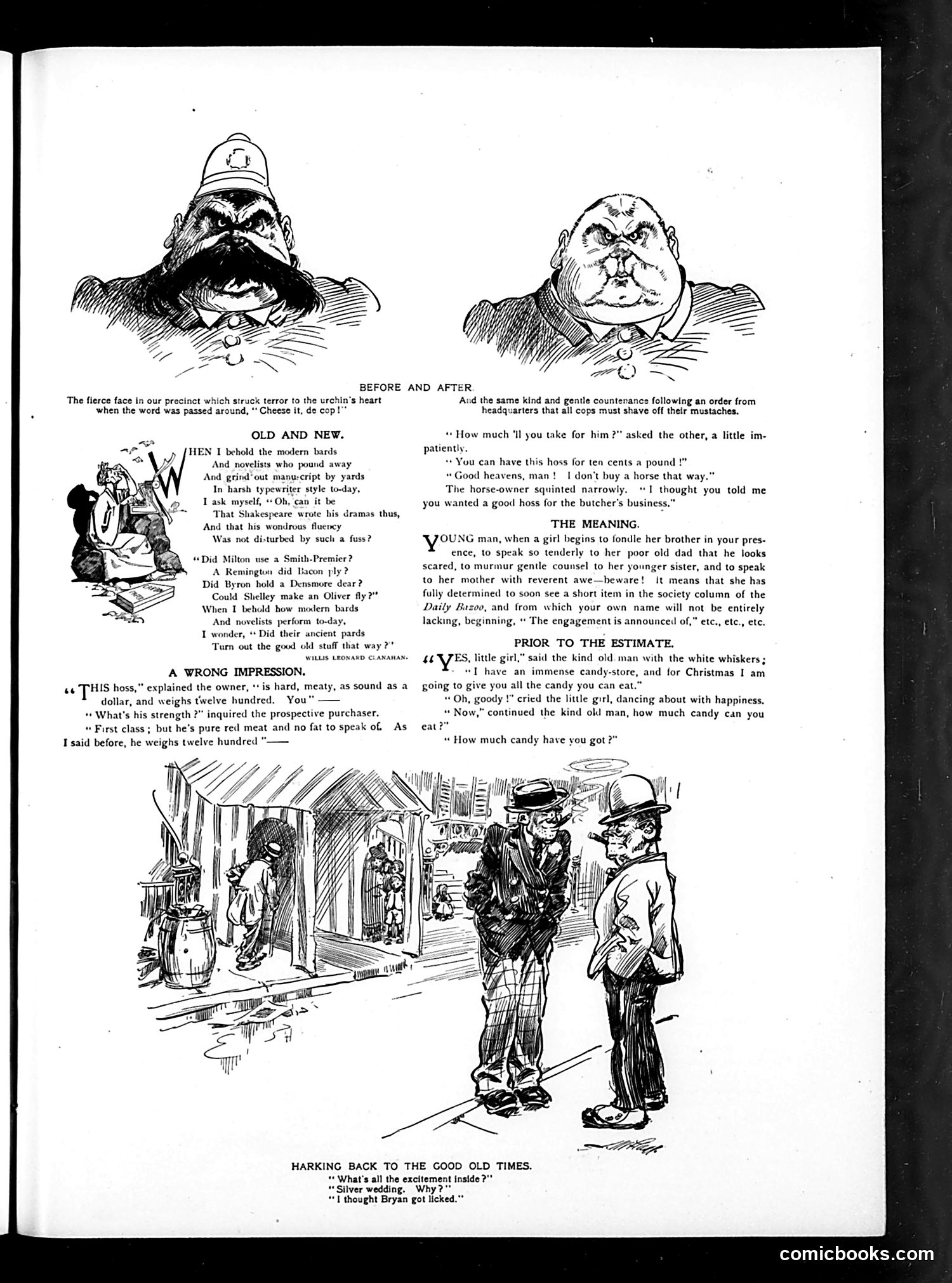
This page contains four separate satirical pieces typical of late-19th/early-20th century American humor: **"Before and After"**: Contrasts a fierce, mustachioed police officer with one freshly shaved. The caption references a police order mandating mustache removal—mocking both the regulation's pettiness and how it softens the cop's intimidating appearance that once frightened street children ("Cheese it, de cop!"). **"Old and New"**: Satirizes modern typewriter-dependent writers by questioning whether Shakespeare, Milton, and Shelley could have produced great works using mechanical devices rather than handwriting. The joke mocks contemporary authors' reliance on technology while romanticizing classical literary genius. **"A Wrong Impression"**: A horse-seller confuses a buyer seeking a quality mount with one seeking meat for butchering—a straightforward comedic misunderstanding exploiting the ambiguity of "good hoss." **"Prior to the Estimate"**: An older gentleman offers unlimited candy to a girl, who shrewdly asks "how much candy have you got?"—suggesting she'll eat everything available rather than show restraint. The final item "Harking Back" appears incomplete but references Bryan (likely William Jennings Bryan) and an election loss.
📄 Transcribed text from this page (OCR, searchable)
Machine-transcribed from the original scan — historical spelling and the odd misread are preserved.
BEFORE AND AFTER The fierce face in our precinct which struck terror to the urchin’s heart when the word was passed around, “* Cheese it, de cop!"* OLD AND NEW. HEN I behold the modern bards And novelists who pound away And grind’out manu:cript by yards In harsh typewriter style to-day, I ask myself, “Oh, ‘can it be That Shakespeare wrote his dramas thus, And that his wondrous fluency Was not disturbed by such a fuss? “Did Milton use a Smith-Premier? A Remington did Bacon ply ? Did Byron hold a Densmore dear? Could Shelley make an Oliver fly?" When I behold how modern bards And novelists perform to-day, I wonder, “Did their ancient pards ‘Turn out the good old stuff that way ?” A WRONG IMPRESSION. 64 THIS hoss,” explained the owner, *+is hard, meaty, as sound as a dollar, and weighs twelve hundred. You" ++ What's his strength ?” inquired the prospective purchaser. © First class; but he’s pure red meat and no fat to speak of As I said before, he weighs twelve hundred ” And the same kind and gentle countenance following an order from headquarters that all cops must shave off their mustaches. + How much ‘Il you take for him?" asked the other, a little im- patiently. + You can have this hoss for ten cents a pound !" “Good heavens, man! I don’t buy a horse that way.” The horse-owner squinted narrowly. “1 thought you told me you wanted a good hoss for the butcher's business.” THE MEANING. YOUNG man, when a girl begins to fonulle her brother in your pres- ence, to speak so tenderly to her poor old dad that he looks scared, to murmur gentle counsel to her younger sister, and to speak to her mother with reverent awe—beware! It means that she has fully determined to soon see a short item in the society column of the Daily Bazoo, and from which your own name will not be entirely lacking, beginning, “ The engagement is announced of,” etc., etc., etc. PRIOR TO THE ESTIMATE. “said the kind old. man with the white whiskers ; ind for Christmas I am “y . little gir “IT have an immense candy-store going to give you all the candy you can eat. “Oh, goody !" cried the little girl, dancing about with happiness, “ Now,” continued the kind old man, how much candy can you eat “ How much candy have you got 2” HARKING BACK TO THE GOOD OLD TIMES. What's all the excitement inside ?”” iver wedding. Why? I thought Bryan got licked."* comicbooks.com