comicbooks.com Join Free

A complete, restored issue of Pulp Fiction from 1953 — all 116 pages of painted-cover fiction magazines that launched science fiction, horror, and hardboiled crime, free to page through at comicbooks.com.

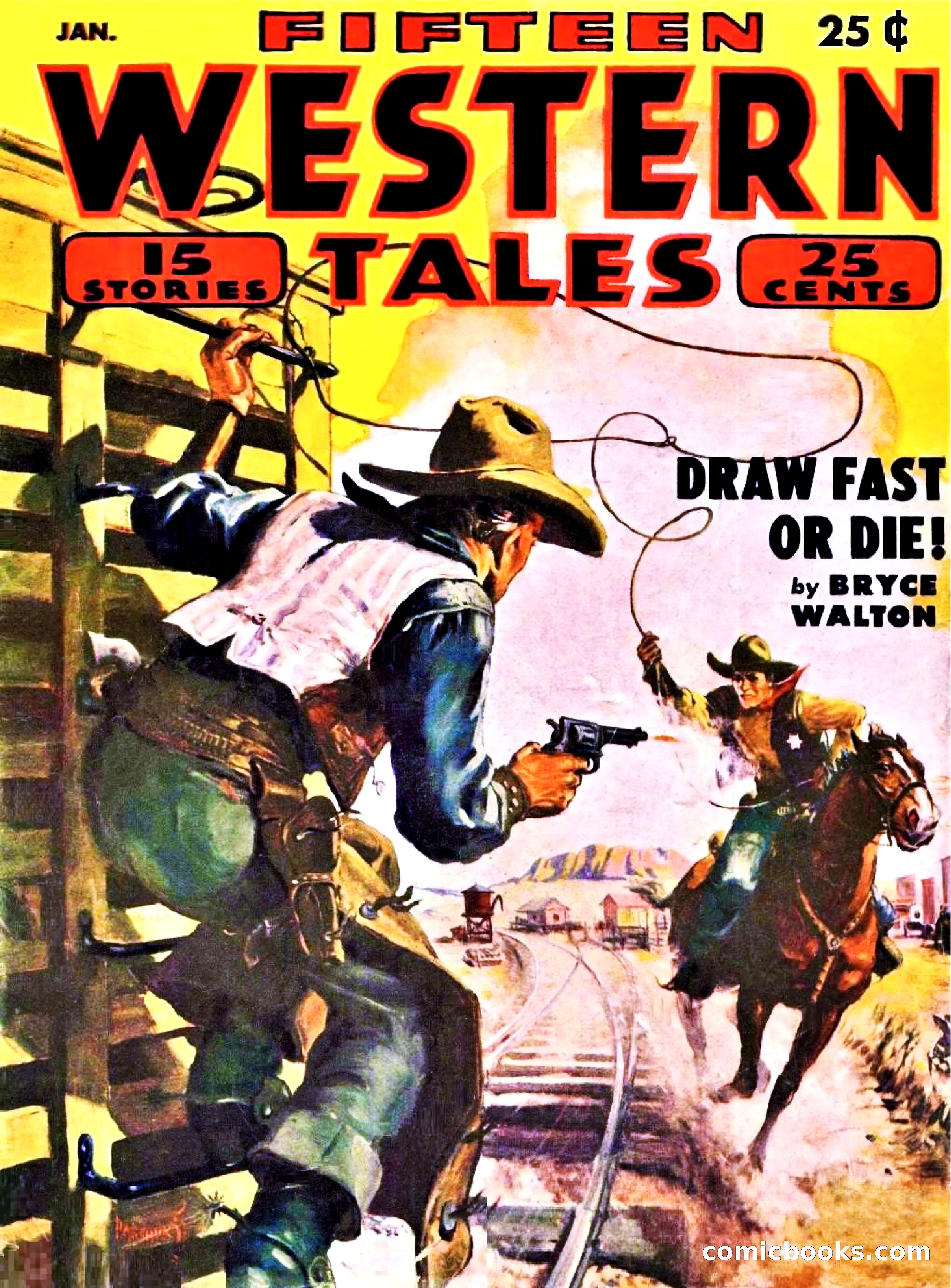
On the cover: # Fifteen Western Tales Cover (January issue, 25 cents) This is the cover of a pulp magazine featuring an action-packed Western illustration. The main story advertised is "Draw Fast or Die!" by Bryce Walton, depicted in the artwork showing a gunfight scene. A cowboy in a hat and pink shirt draws his revolver while another armed man appears on horseback in the distance, with a railroad and buildings visible in the background. A figure on a telegraph pole is also shown. The cover promises 15 stories for the 25-cent price, typical of early pulp magazine marketing aimed at readers seeking quick Western adventure narratives.

🖼️ Every page has a plain-English note on what you’re looking at — the figures, the references, the point of the satire.

← Back to Pulp Fiction All exhibitions

HomeExhibitionPulp FictionRead

A complete issue · 116 pages · 1953

Fifteen Western Tales, January 1953
1953 · Free to read

Fifteen Western Tales, January 1953 — page 1 of 116
1 / 116
What you’re looking at · open this page on its own ↗

# Fifteen Western Tales Cover (January issue, 25 cents) This is the cover of a pulp magazine featuring an action-packed Western illustration. The main story advertised is "Draw Fast or Die!" by Bryce Walton, depicted in the artwork showing a gunfight scene. A cowboy in a hat and pink shirt draws his revolver while another armed man appears on horseback in the distance, with a railroad and buildings visible in the background. A figure on a telegraph pole is also shown. The cover promises 15 stories for the 25-cent price, typical of early pulp magazine marketing aimed at readers seeking quick Western adventure narratives.

Fifteen Western Tales, January 1953 — page 2 of 116
2 / 116
What you’re looking at · open this page on its own ↗

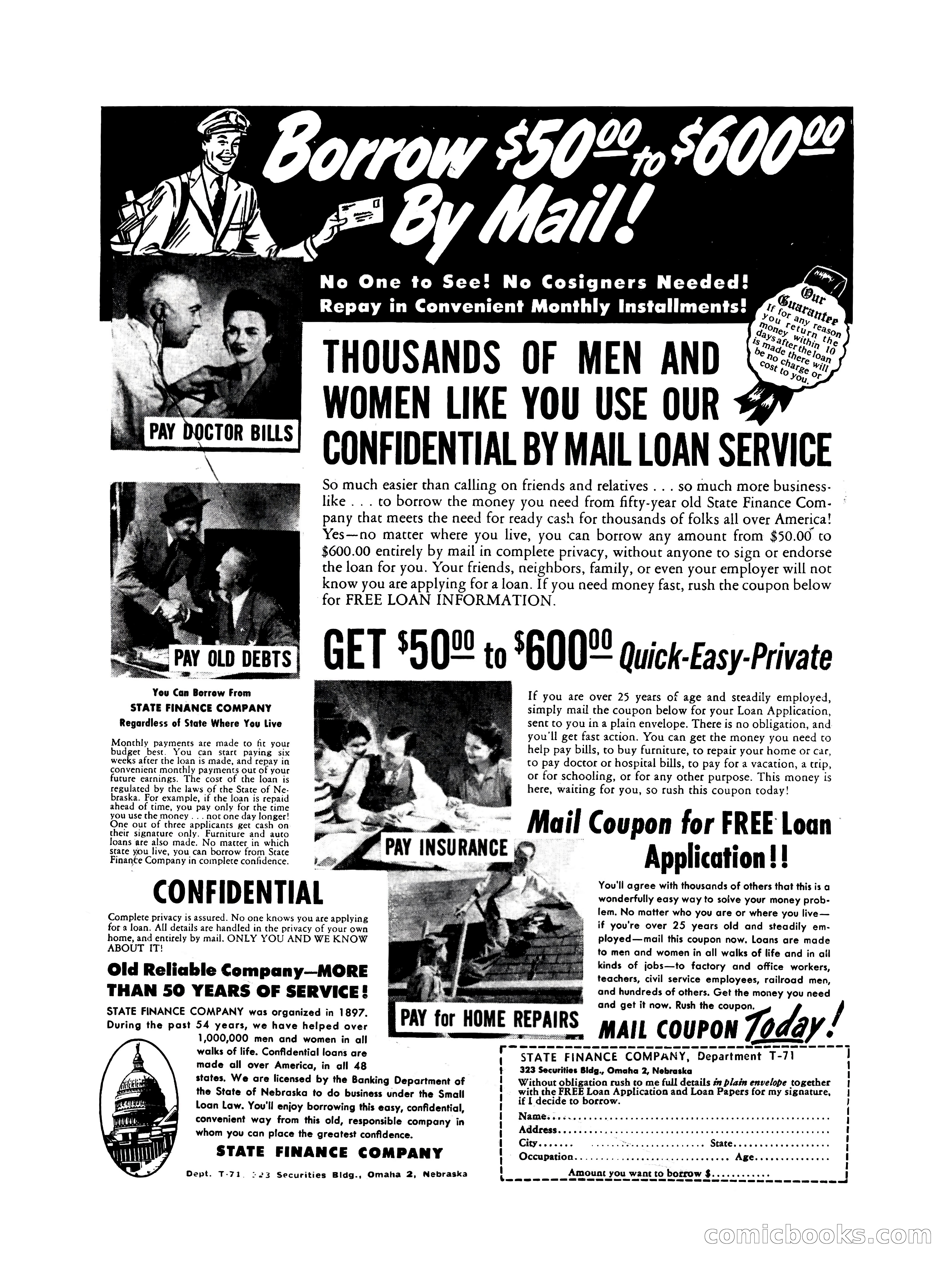
# Analysis of Advertisement Page This is a full-page advertisement, not story content or illustration. The page promotes State Finance Company's mail-order loan service, offering borrowers $50 to $600 with purported privacy and no cosigners required. The ad emphasizes the company's fifty-four-year history (organized in 1897) and claims to have served over one million customers. Multiple photographs show example uses—paying doctor bills, settling old debts, paying insurance, and funding home repairs. A mail-in coupon appears at the bottom for loan applications. The advertisement targets readers over 25 years old with steady employment, promising discretion and convenient monthly repayment terms.

Fifteen Western Tales, January 1953 — page 3 of 116
3 / 116
What you’re looking at · open this page on its own ↗

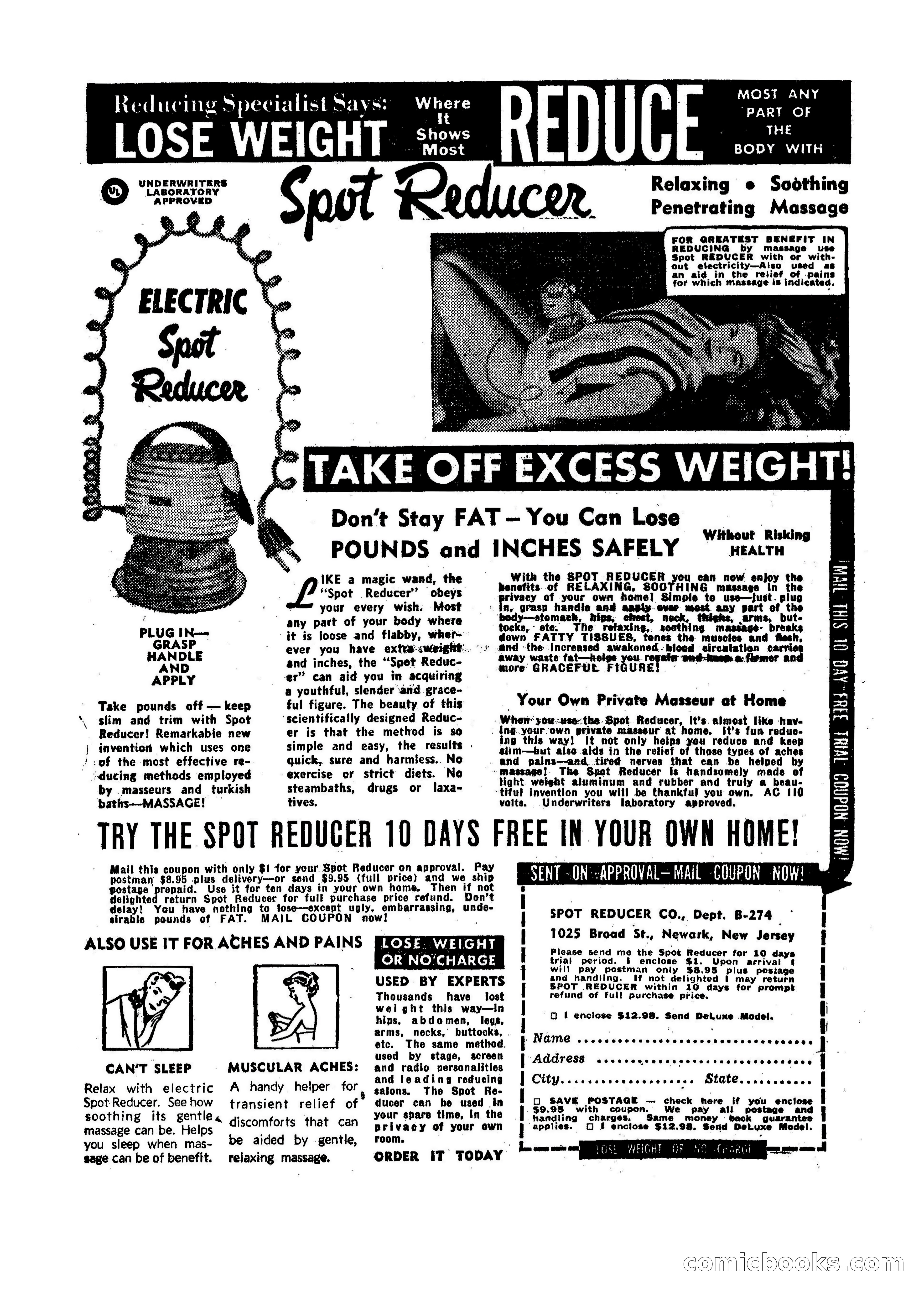
# Analysis of This Page This is a full-page advertisement, not a story or editorial content. The page promotes the "Electric Spot Reducer," a plug-in massage device marketed as a weight-loss and pain-relief tool. The ad claims the device can reduce fat in specific body areas through electrical massage, targeting problem zones like the abdomen, hips, and thighs. It emphasizes safety, ease of use ("no exercise or strict diets"), and offers a ten-day free trial. The page includes testimonial claims from stage and radio personalities, usage instructions for various ailments (insomnia, muscular aches), and a mail-in coupon for ordering. The device cost $9.95 or could be tried on approval for $1 down plus $8.95 postage.

Fifteen Western Tales, January 1953 — page 4 of 116
4 / 116
What you’re looking at · open this page on its own ↗

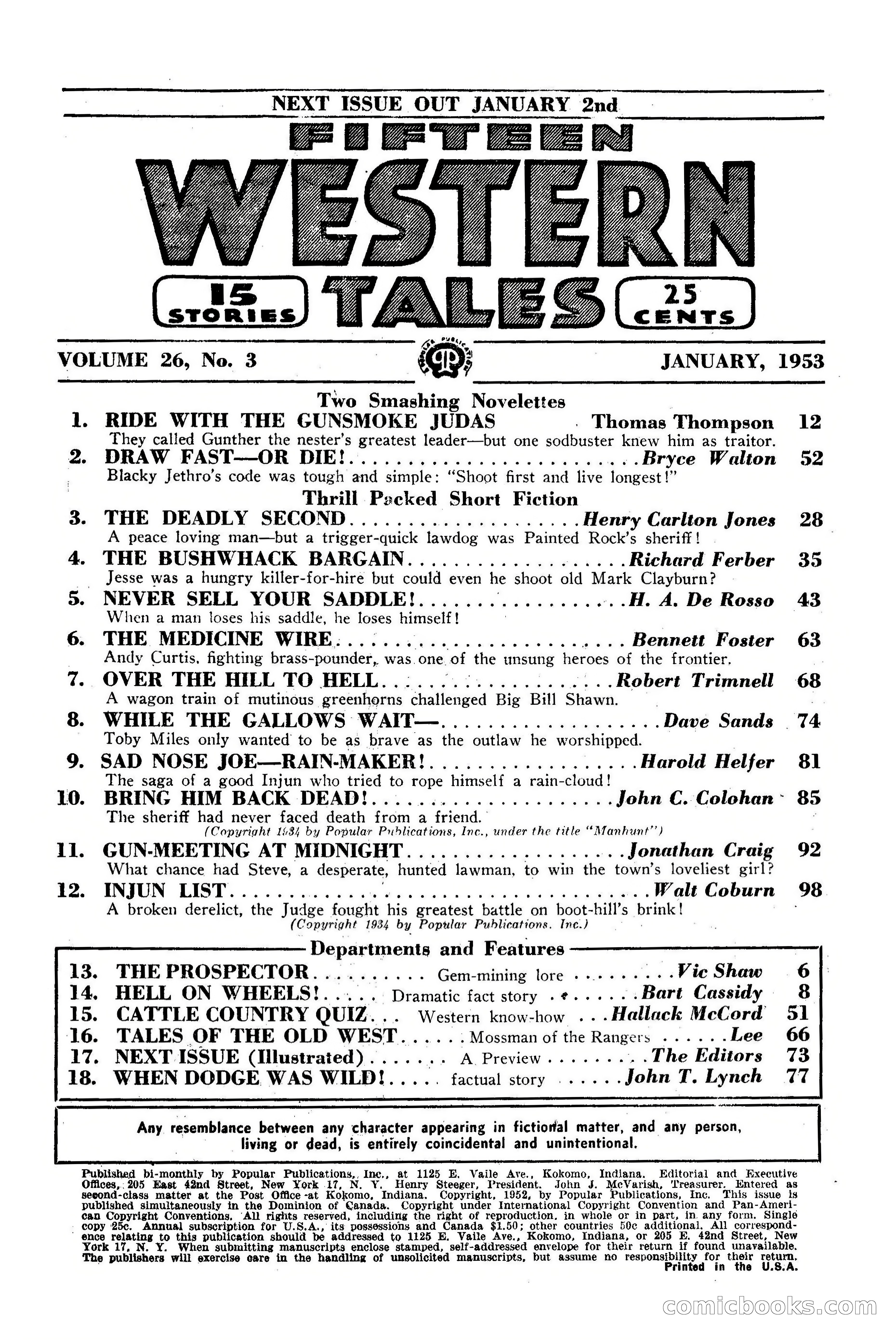
This is a table of contents page from *Fifteen Western Tales*, Volume 26, No. 3 (January 1953). The page lists eighteen stories and features, predominantly Western fiction tales with titles like "Ride with the Gunsmoke Judas," "Draw Fast—or Die!," and "Never Sell Your Saddle!" by authors including Thomas Thompson, Bryce Walton, and Henry Carlton Jones. The magazine cost 25 cents and contained fifteen stories across approximately 98 pages. Publisher information and copyright notices appear at the bottom.

Fifteen Western Tales, January 1953 — page 5 of 116
5 / 116
What you’re looking at · open this page on its own ↗

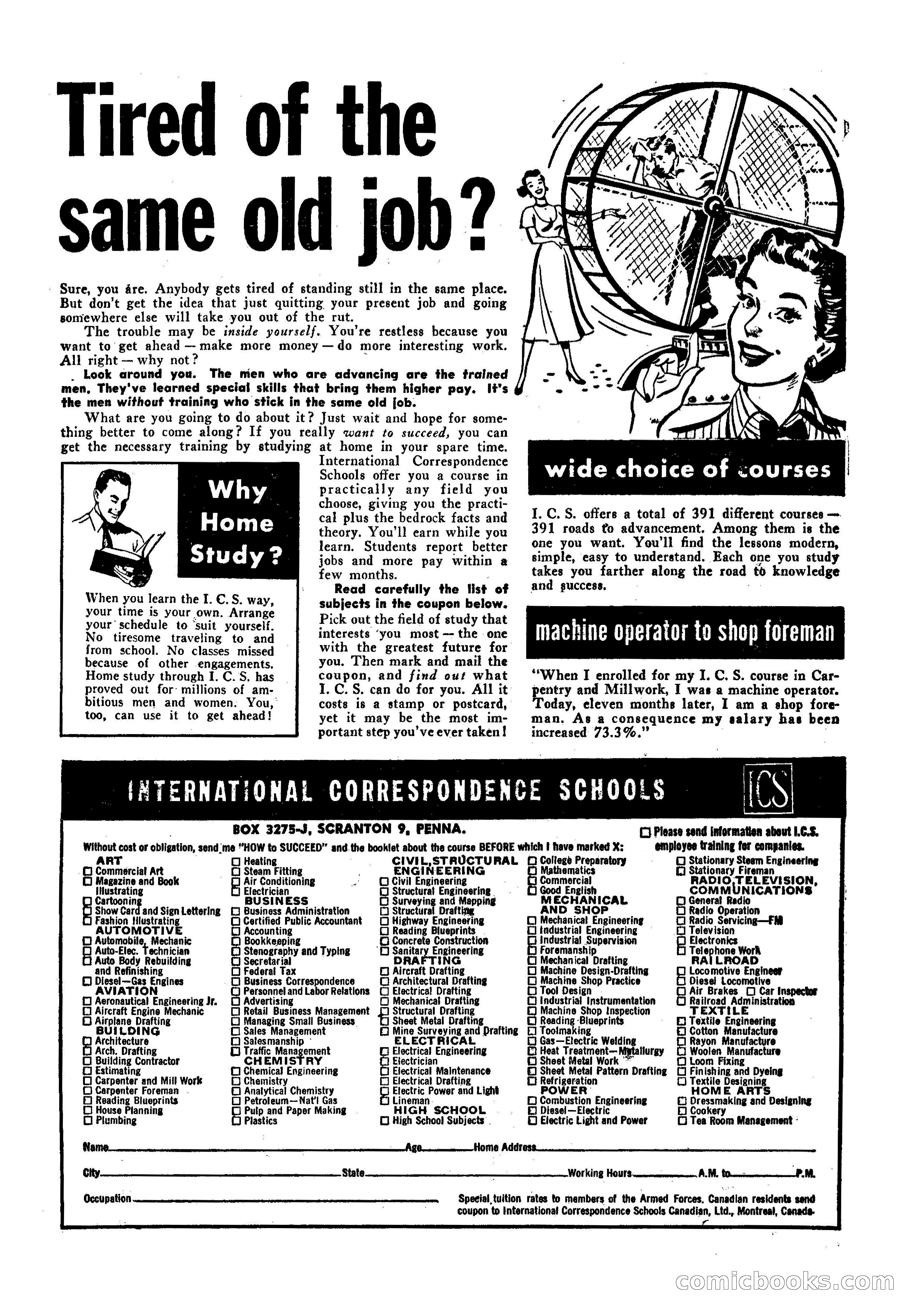
# What This Page Shows This is an advertisement page from a pulp magazine promoting International Correspondence Schools (I.C.S.), a correspondence education company. The page features promotional text encouraging readers tired of their current jobs to pursue home-based vocational training, along with a testimonial from a machine shop operator who claims a salary increase of 73.3% after completing an I.C.S. carpentry course. The bulk of the page consists of a coupon listing 391 available courses across various trades and professions, from automotive repair to textile engineering, which readers can mail in to receive information.

Fifteen Western Tales, January 1953 — page 6 of 116
6 / 116
What you’re looking at · open this page on its own ↗

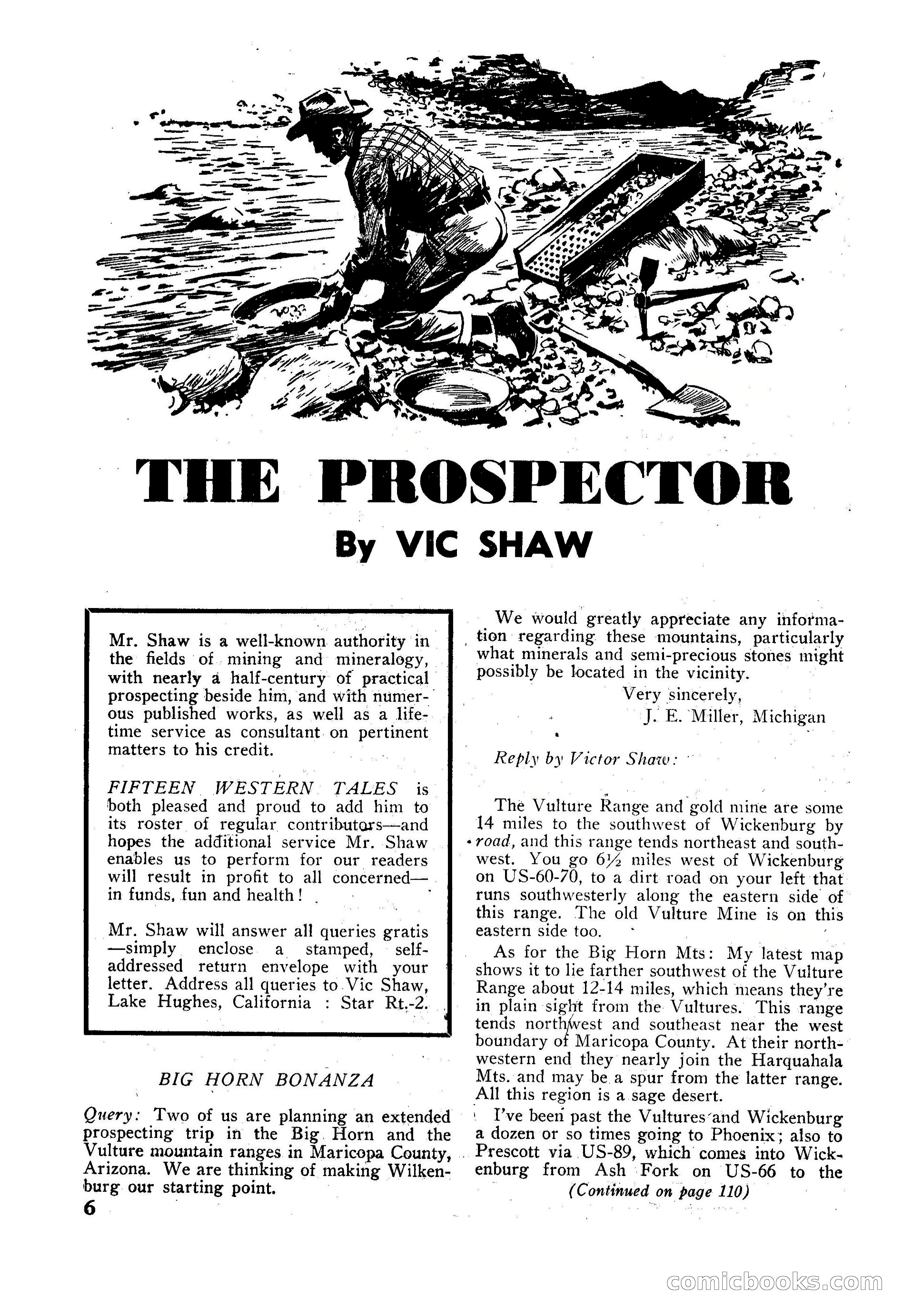
This page presents the opening of a nonfiction advice column titled "The Prospector" by Vic Shaw, a mining and mineralogy expert. The page includes an illustration of a prospector at work with tools and equipment, biographical information about Shaw, and the magazine's introduction of him as a regular contributor. Below this are two reader queries about prospecting in Arizona's Big Horn and Vulture mountain ranges, with Shaw's detailed replies providing geographical and practical information about locating these areas near Wickenburg.

Fifteen Western Tales, January 1953 — page 7 of 116
7 / 116
What you’re looking at · open this page on its own ↗

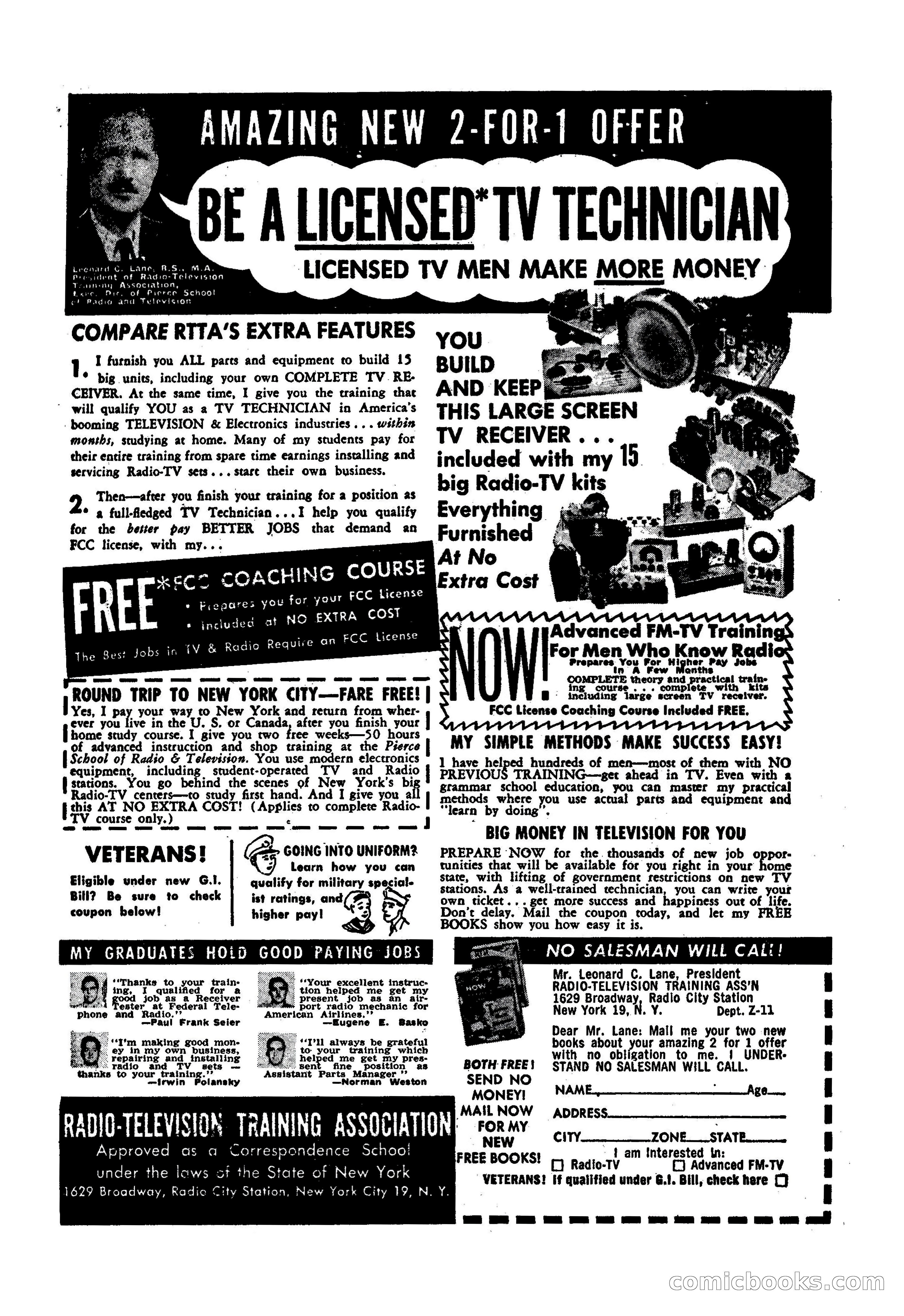
This is an advertisement page from a pulp magazine promoting correspondence school training to become a licensed TV technician. The ad emphasizes practical hands-on training with complete radio and television kits, a free trip to New York for advanced instruction, free FCC license exam coaching, and job placement assistance. It includes testimonials from graduates claiming employment success, and features special information about G.I. Bill eligibility for veterans.

Fifteen Western Tales, January 1953 — page 8 of 116
8 / 116
What you’re looking at · open this page on its own ↗

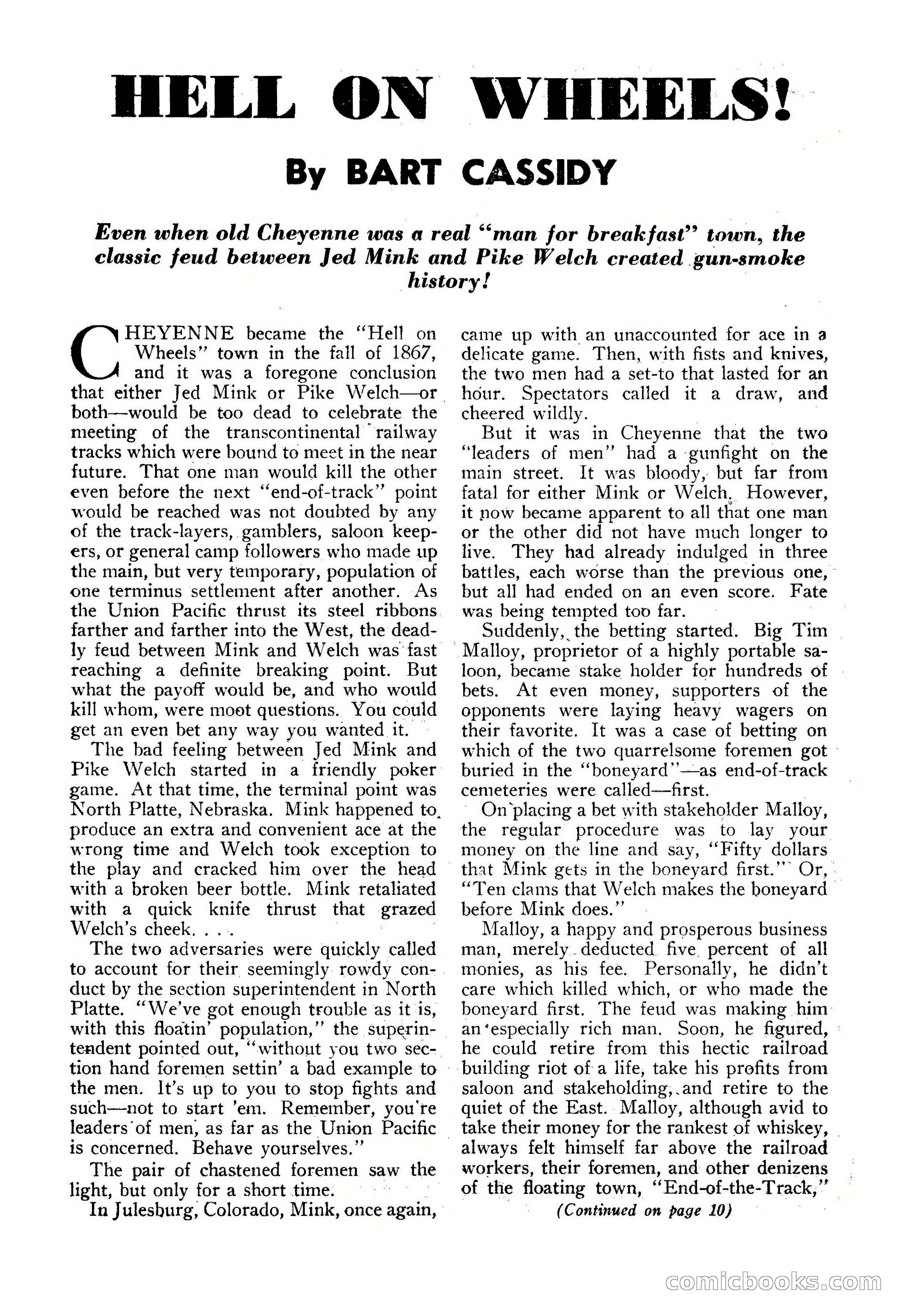
# "Hell on Wheels!" by Bart Cassidy This page contains the opening of a Western pulp fiction story. The text describes a deadly feud between two railroad foremen, Jed Mink and Pike Welch, during the construction of the transcontinental railroad at Cheyenne in 1867. The narrative explains how their rivalry began in a poker game, escalated through violent encounters, and eventually spawned widespread betting among railroad workers on which man would die first, with a saloon owner serving as stakes holder for the wagers.

Fifteen Western Tales, January 1953 — page 9 of 116
9 / 116
What you’re looking at · open this page on its own ↗

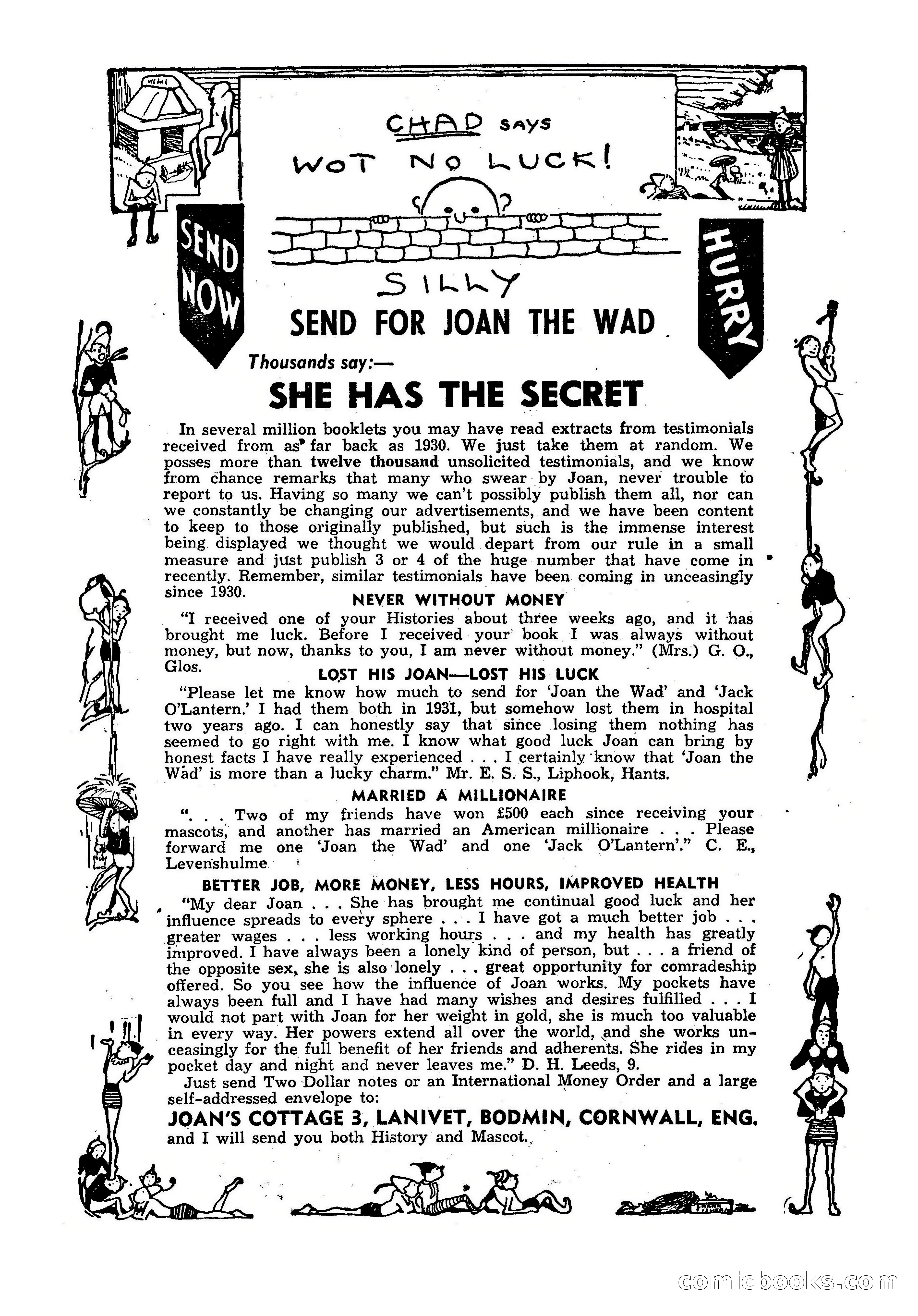
# What This Page Shows This is an advertisement page from a pulp magazine promoting "Joan the Wad," a mail-order lucky charm or mascot. The page features testimonial letters from purported customers claiming the item brought them financial luck, romantic success, and improved health and employment. The ad includes a heading "CHAD says WOT NO LUCK!" and decorative illustrations of figures climbing or dancing along the margins. At the bottom is an address in Cornwall, England where readers can send money to receive the mascot.

Fifteen Western Tales, January 1953 — page 10 of 116
10 / 116
What you’re looking at · open this page on its own ↗

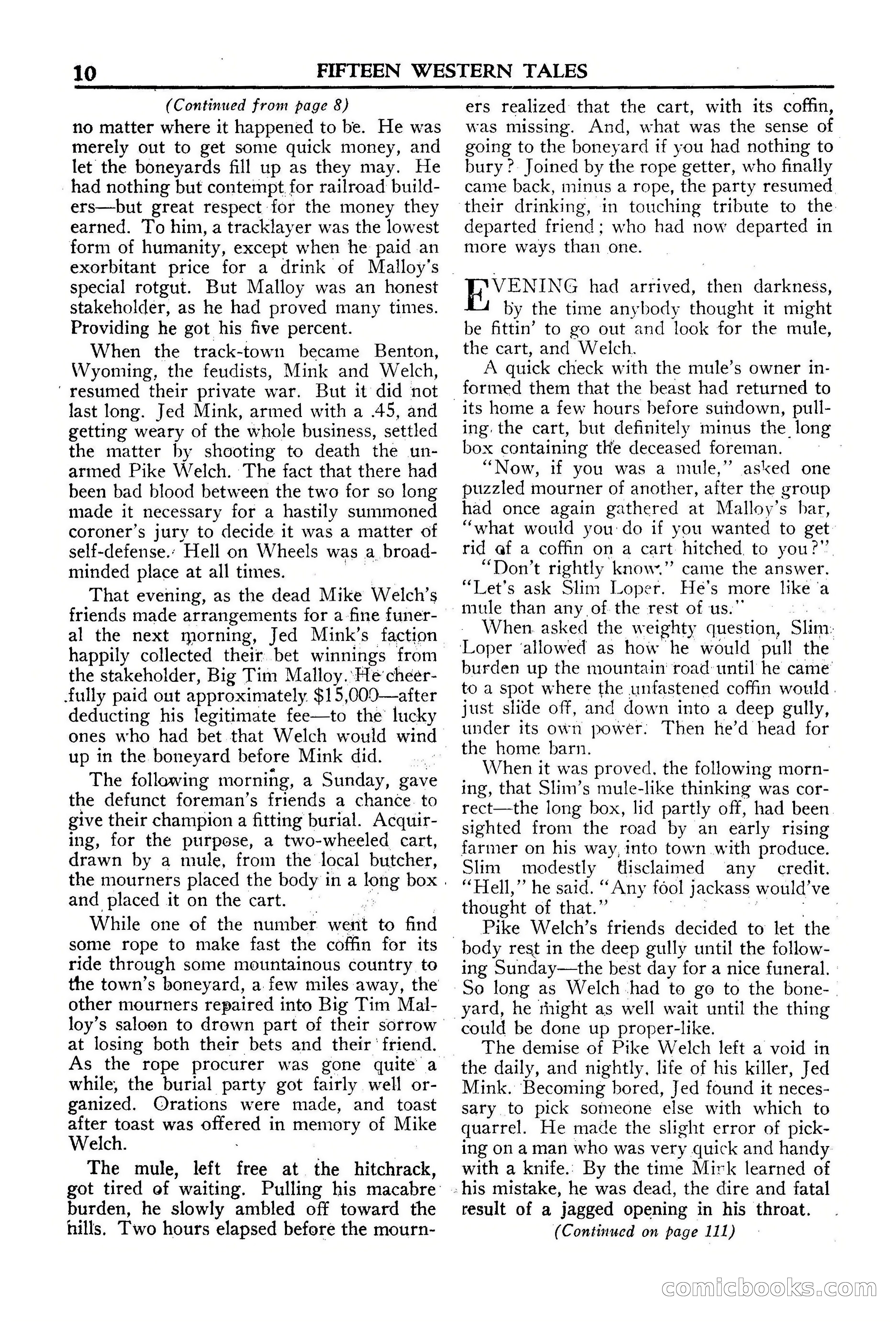
# Page Analysis This is **story prose** from a Western pulp fiction magazine titled "Fifteen Western Tales." The page continues a narrative about a feud in a railroad town called Benton, Wyoming. The text describes how Jed Mink fatally shoots his rival Pike Welch, after which Mink's friends collect substantial betting winnings. The following day, mourners attempt to transport Welch's body in a coffin by mule-drawn cart to the town boneyard, but the mule wanders off during their drinking celebration. They later discover the empty cart has returned—the coffin having apparently fallen into a gully, which a character named Slim Loper theorizes the mule deliberately caused by heading uphill.

Fifteen Western Tales, January 1953 — page 11 of 116
11 / 116
What you’re looking at · open this page on its own ↗

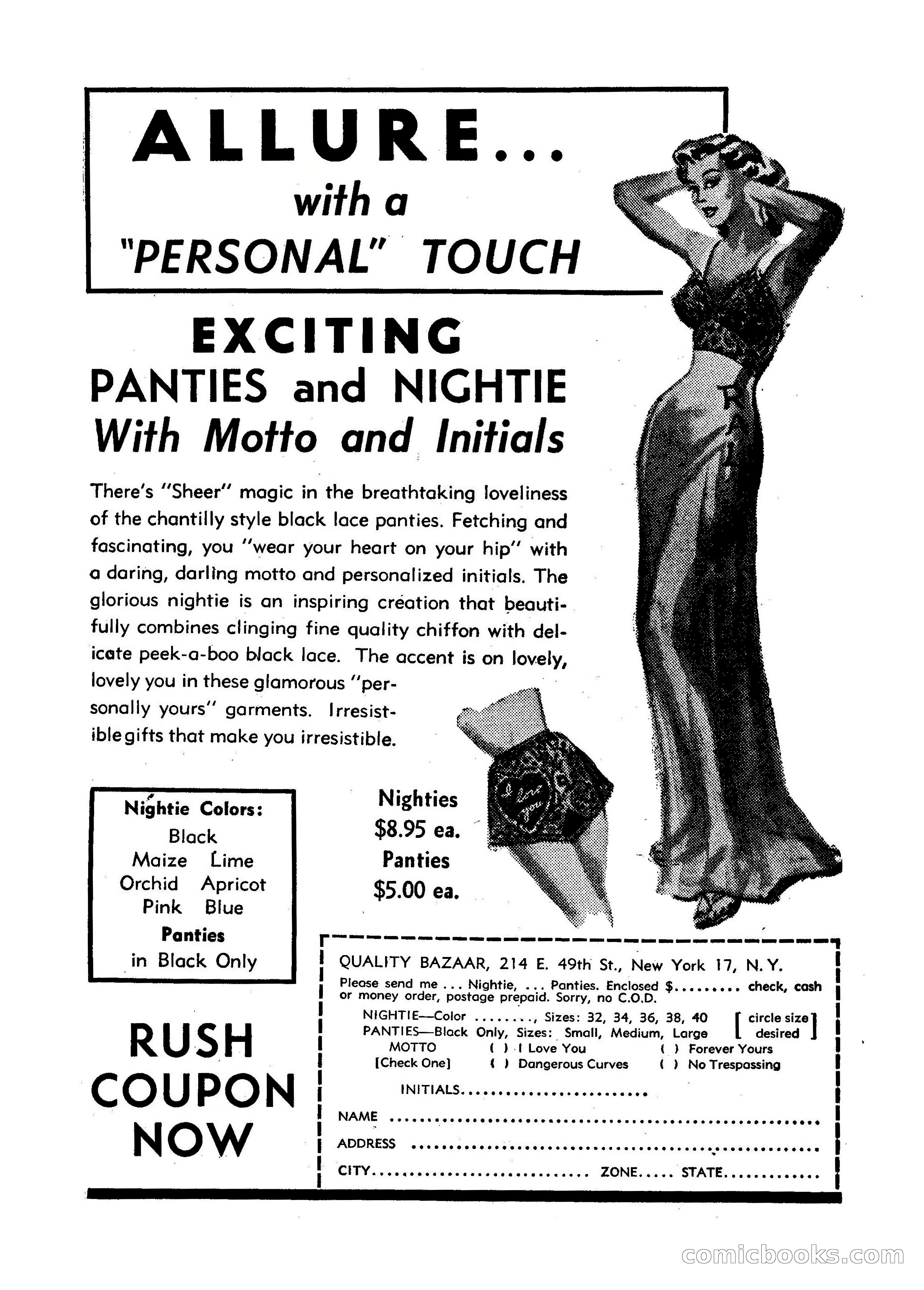
# Advertisement Page This is an advertisement page from a pulp magazine featuring lingerie products. The page promotes personalized panties and nighties sold by Quality Bazaar (a New York retailer), with prices of $5.00 for panties and $8.95 for nighties. The ad includes an illustration of a woman modeling the merchandise, available colors and sizes, and a mail-order coupon allowing customers to select options like custom mottoes ("I Love You," "Dangerous Curves") or initials to be embroidered on the garments.

Fifteen Western Tales, January 1953 — page 12 of 116
12 / 116
What you’re looking at · open this page on its own ↗

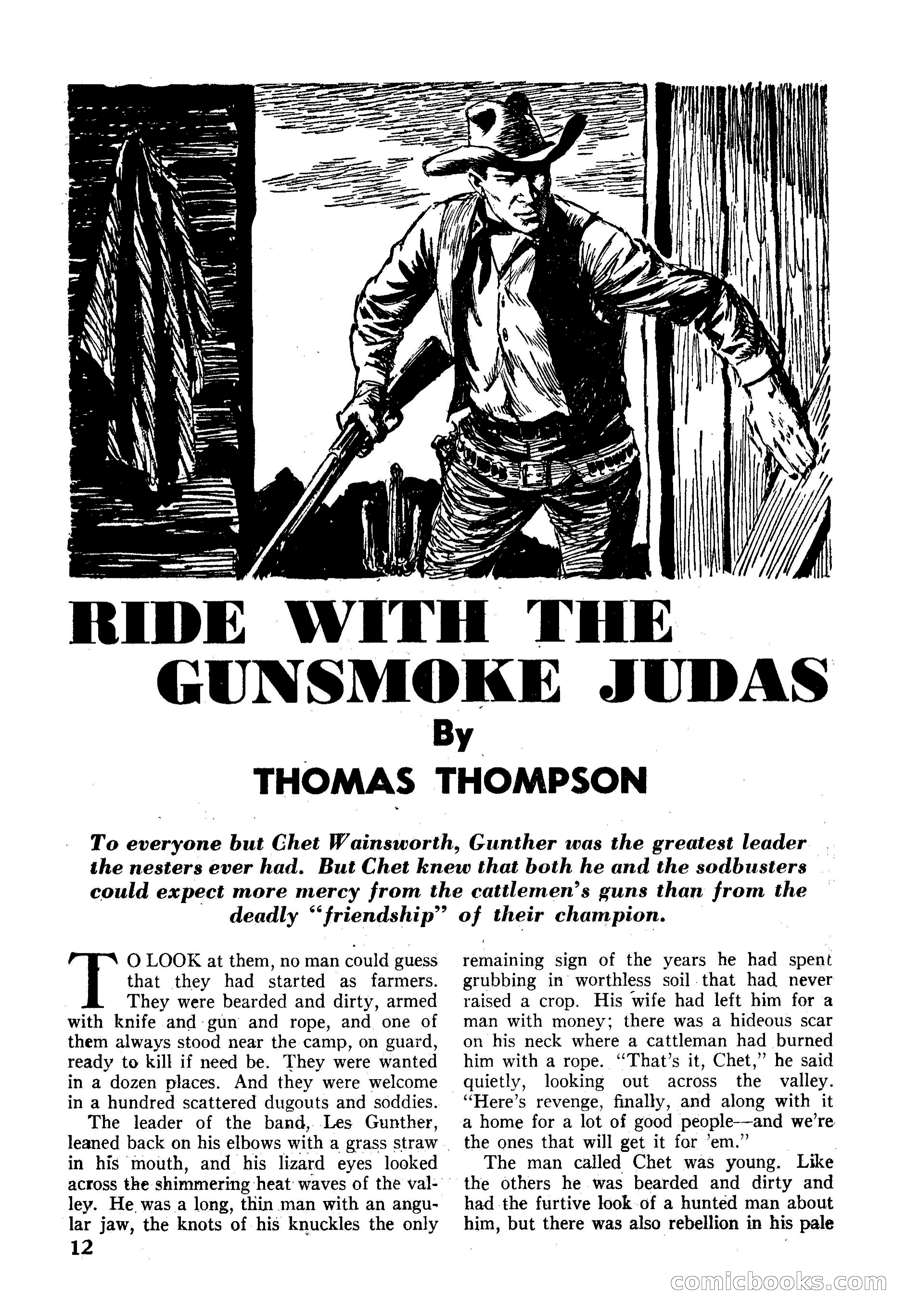
# Page Analysis This is the opening page of a Western pulp fiction story titled "Ride with the Gunsmoke Judas" by Thomas Thomson. The page features a dramatic woodcut-style illustration of an armed cowboy in a hat at the top, followed by a dedication and the story's opening prose. The text introduces a band of outlaws led by Les Gunther, describing their appearance and background as former farmers turned desperados. The narrative establishes tension between Gunther and a younger gang member named Chet, hinting at conflict over motives regarding revenge and leadership.

Fifteen Western Tales, January 1953 — page 13 of 116
13 / 116
What you’re looking at · open this page on its own ↗

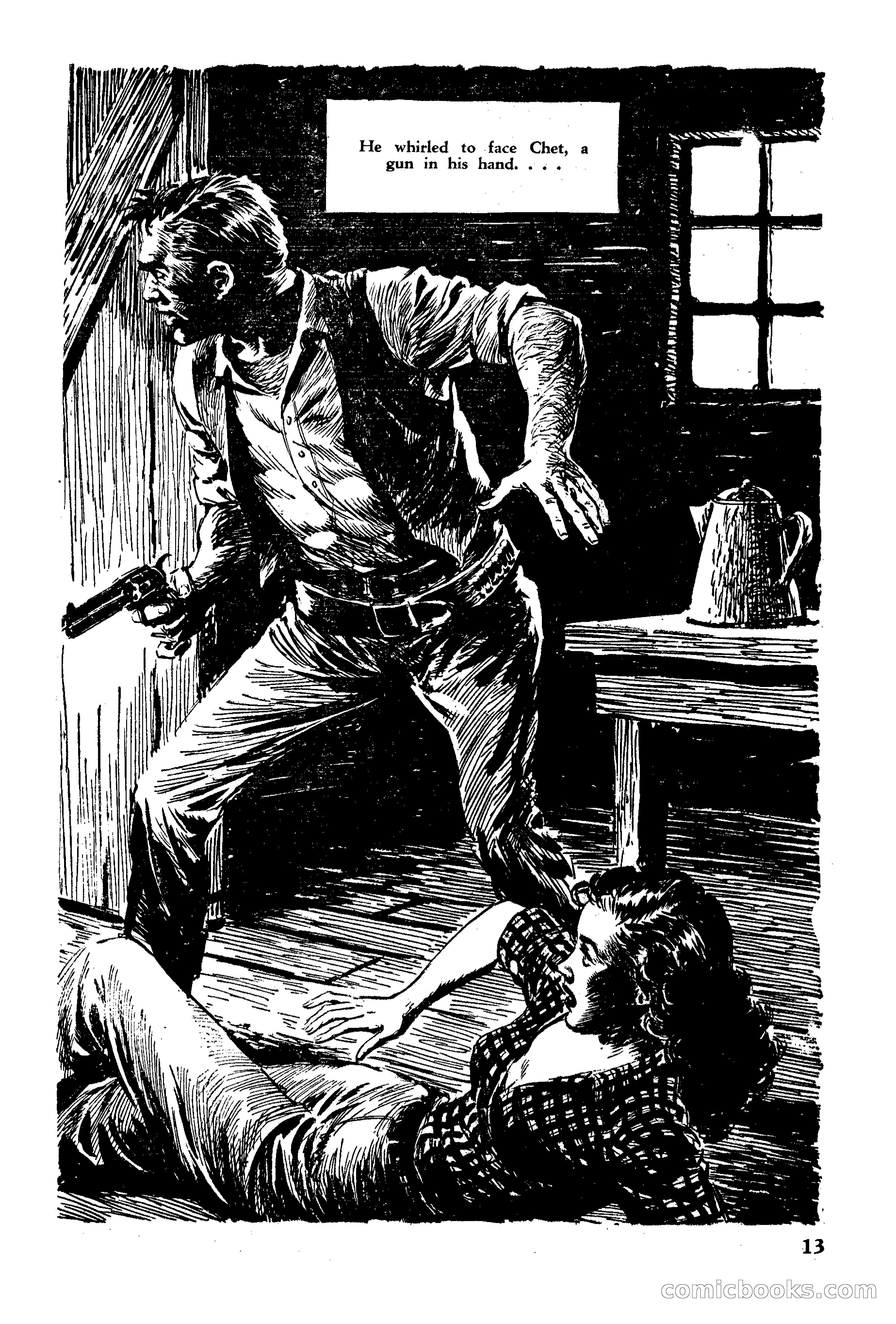
This is an interior illustration from a pulp fiction story, rendered in bold black-and-white ink. The image depicts a dramatic confrontation scene: a man standing with a gun in his hand whirls around to face someone named Chet, while a woman lies on the floor below. The setting appears to be an interior room with a window and what looks like a coffee pot on a table. The illustration uses heavy cross-hatching and dynamic linework typical of early pulp magazine art. The caption reads: "He whirled to face Chet, a gun in his hand...." suggesting this is a moment of action or conflict in what appears to be a hardboiled crime or adventure narrative.

Fifteen Western Tales, January 1953 — page 14 of 116
14 / 116
What you’re looking at · open this page on its own ↗

# Page Analysis This is **story prose** from a Western pulp fiction magazine titled "Fifteen Western Tales" (page 14). The passage depicts a tense scene where Chet Wainsworth confronts his moral doubts about joining Les Gunther's gang in a scheme involving settlers and disputed land claimed by someone named Pete Bryan. Gunther rallies his men with rhetoric about free land and divine justice, while Chet recognizes the operation as theft and plunder disguised as noble purpose. The narrative explores Chet's internal conflict between his religious upbringing and his involvement in Gunther's criminal enterprise.

Fifteen Western Tales, January 1953 — page 15 of 116
15 / 116
What you’re looking at · open this page on its own ↗

# Page Analysis This is **story prose** from a Western pulp fiction tale titled "Ride with the Gunsmoke Judas" (page 15). The text depicts a confrontation between Chet Wainworth and Les Gunther, leader of an outlaw band ostensibly fighting for farmers' land rights during the Homestead Act era. Chet accuses Gunther of hypocrisy—using noble ideals as a cover for robbery and violence—and threatens to leave. Gunther, revealing his true manipulative nature, allows Chet to depart. The passage explores themes of betrayal, idealism corrupted by greed, and the dissolution of the gang's original mission.

Fifteen Western Tales, January 1953 — page 16 of 116
16 / 116
What you’re looking at · open this page on its own ↗

# Page Analysis: Story Prose from "Fifteen Western Tales" This page contains story prose from a Western pulp fiction tale. The narrative follows a character named Chet as he rides into a canyon, having been warned by an older man named Nate that an ambush awaits him—likely from a former companion named Breckinridge. The plot involves Chet's conflict with a gang leader named Les Gunther and his raiders who are using settlers as cover for their own criminal operations. Chet is forced to confront a former friend, though he struggles morally with the necessity of violence in this situation.

Fifteen Western Tales, January 1953 — page 17 of 116
17 / 116
What you’re looking at · open this page on its own ↗

# Page Content: Story Prose This page contains the middle section of a Western pulp fiction story titled "Ride with the Gunsmoke Judas." The text follows protagonist Chet Wainsworth as he regains consciousness after being shot, discovering he's been found by a girl named Jane and a man named Sam. The narrative alternates between Chet's memories of religious upbringing and a violent Kansas community, and his present situation where Jane tends to his injuries while Sam questions whether he's a raider or a settler. The story emphasizes themes of frontier justice, religious morality, and revenge.

Fifteen Western Tales, January 1953 — page 18 of 116
18 / 116
What you’re looking at · open this page on its own ↗

# Page Analysis: Story Prose from "Fifteen Western Tales" This page contains printed story prose from a Western pulp magazine. It shows the end of an opening scene where protagonist Chet Wainsworth awakens in a cabin after being injured, meeting Sam, Doctor Acton, and Jane Bryan—a cattleman's daughter who saved his life. Chapter Two begins with Chet sitting outside while Jane shaves him, during which he learns that the Bryan family (whom he's grateful to) are connected to the cattleman who killed his parents, creating dramatic tension. The narrative focuses on Chet's internal conflict and growing attraction to Jane.

Fifteen Western Tales, January 1953 — page 19 of 116
19 / 116
What you’re looking at · open this page on its own ↗

# Page Analysis This is **story prose** from a Western pulp fiction magazine titled "Ride with the Gunsmoke Judas." The page depicts a tense confrontation where an injured protagonist, hiding in a cabin, watches armed riders approach. The lead rider is a red-bearded man named Pete Bryan who appears to be the father of Jane, a young woman the protagonist has been sheltering. Bryan demands Jane return home, and orders a brutish man named Stinson to forcibly place her on a horse. The protagonist, equipped with a rifle, observes from the window as the situation escalates toward violence.

Fifteen Western Tales, January 1953 — page 20 of 116
20 / 116
What you’re looking at · open this page on its own ↗

# Page Analysis This page contains **story prose** from a Western pulp fiction tale titled "Fifteen Western Tales." The narrative depicts a tense confrontation at a cabin between Pete Bryan and his raiders against Chet Wainworth, who defends the cabin with a rifle. The plot involves a dispute over "nesters" (settlers), with Jane Bryan (Pete's daughter) caught between her father's vendetta and her loyalty to those he opposes. After an emotional standoff where Jane chooses to side with the defenders, Pete Bryan withdraws his men. The passage explores themes of honor, loyalty, and moral conflict in the Old West setting.

Fifteen Western Tales, January 1953 — page 21 of 116
21 / 116
What you’re looking at · open this page on its own ↗

# Page Analysis This is **story prose** from page 21 of a pulp western titled "Ride with the Gunsmoke Judas." The passage depicts an intense confrontation between Chet Wainworth and a woman (apparently Jane) who urges him to abandon his vengeful obsession with killing her father. She reveals that her father's guilt over a past atrocity—a lynching he participated in—torments him endlessly. The scene climaxes with Jane throwing Chet's weapons outside and fleeing into a cabin, sobbing, while Chet grimly collects his gun belt, rifle, and ammunition to depart toward the corral where a horse awaits him.

Fifteen Western Tales, January 1953 — page 22 of 116
22 / 116
What you’re looking at · open this page on its own ↗

# Page Analysis This is **story prose** from a Western pulp fiction magazine titled "Fifteen Western Tales" (page 22). The text depicts a dramatic moment where the protagonist Chet Wainworth rides away from a cabin, internally conflicted between seeking revenge against cattlemen and following his parents' example of turning the other cheek. Big Sam, a sympathetic character, warns Chet that he'll kill him if Chet doesn't know what he's doing. Chet rides to a canyon where he was previously wounded, experiencing an existential crisis about violence, belief, and mortality.

Fifteen Western Tales, January 1953 — page 23 of 116
23 / 116
What you’re looking at · open this page on its own ↗

# Page Analysis This page contains story prose from a Western pulp fiction narrative titled "Ride with the Gunsmoke Judas." The text depicts a dramatic confrontation between a character named Chet Wainworth and members of a settlement group, followed by an intimate conversation between Chet and Lorraine Pettigrew. The passage reveals that the group's leader, Les Gunther, whom they trusted as a liberator, actually intended to rob their town rather than help them—information Chet struggles to convey to the disillusioned Lorraine, who finds the truth emotionally devastating. The narrative explores themes of betrayal, idealism, and conflicting loyalties typical of Western pulp fiction.

Fifteen Western Tales, January 1953 — page 24 of 116
24 / 116
What you’re looking at · open this page on its own ↗

# Page Analysis: Story Prose from "Fifteen Western Tales" This page contains story prose—specifically the continuation of a Western narrative titled "Fifteen Western Tales" (visible at the top). The text depicts settlers debating leadership after what appears to be a recent battle, then shifts to focus on a character named Chet and his awkward romantic interaction with Lorraine Pettigrew. The passage explores Chet's internal conflict about kissing Lorraine while harboring feelings for someone named Jane Bryan, culminating in a romantic moment between Chet and Lorraine near the camp.

Fifteen Western Tales, January 1953 — page 25 of 116
25 / 116
What you’re looking at · open this page on its own ↗

# Page Analysis: Story Prose This page contains story prose from "Ride with the Gunsmoke Judas," a Western pulp fiction narrative. The text depicts the climactic discovery of a mortally wounded character named Nate Williams and subsequent dialogue between Chet Wainworth and Luke Pettigrew about the whereabouts of someone named Les Gunther. The passage then follows Chet as he tracks Nate's horse to pursue Gunther, apparently to confront him about unspecified matters. The narrative emphasizes themes of individual moral choice versus group pressure, with Chet reflecting on how people allow others to dictate their actions.

Fifteen Western Tales, January 1953 — page 26 of 116
26 / 116
What you’re looking at · open this page on its own ↗

# Page Analysis This is story prose from a Western pulp magazine titled "Fifteen Western Tales" (page 26). The text depicts a violent gunfight at a remote cabin where the protagonist Chet attempts to rescue a woman named Jane Bryan from antagonists including Les Gunther, Kraft, and Metzger. The passage describes intense action—Big Sam, a large man helping Chet, is shot multiple times while trying to reach a rifle in the corral, ultimately collapsing across the fence, while Chet returns fire from the ground. The scene appears to be climactic, with unclear resolution.

Fifteen Western Tales, January 1953 — page 27 of 116
27 / 116
What you’re looking at · open this page on its own ↗

# Page Analysis This page contains **story prose** from a Western pulp fiction narrative titled "Ride with the Gunsmoke Judas." The text depicts the aftermath of a violent confrontation: wounded protagonist Chet Wainworth regains consciousness in a cabin where Jane, a woman who loves him, has been caring for him. Doc Acton explains that settlers have arrived and learned the truth about the antagonist Les Gunther (apparently through Big Sam's account). The passage culminates with Lorraine Pettigrew appearing, revealing she and Chet share romantic history, before cutting to an exterior scene where Gunther's body hangs from a tree, with settlers standing silently nearby. The narrative explores themes of frontier justice, conflicting loyalties between cattlemen and settlers, and romantic entanglement.

Fifteen Western Tales, January 1953 — page 28 of 116
28 / 116
What you’re looking at · open this page on its own ↗

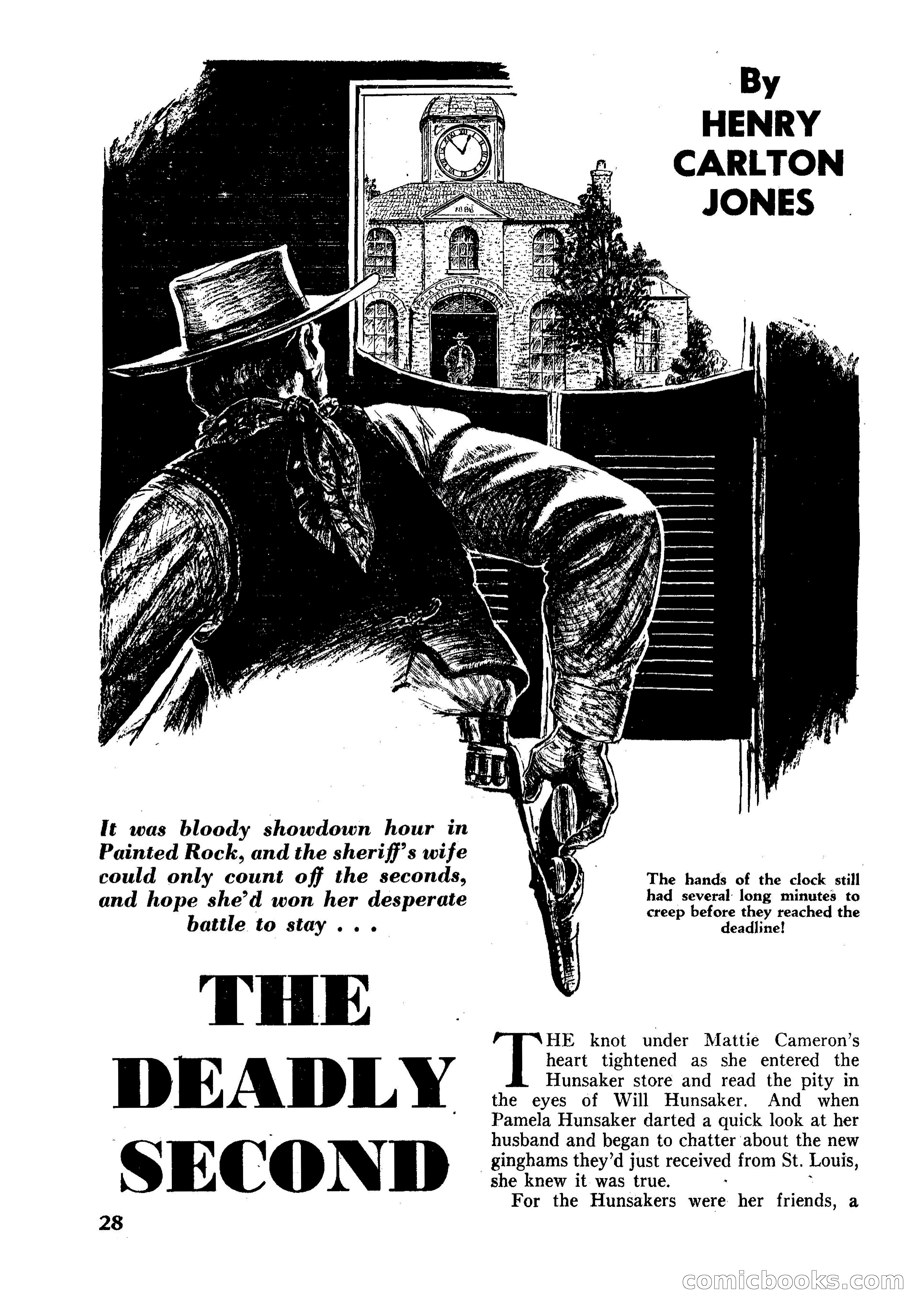
# Page Analysis This is an interior story page from a pulp magazine, featuring the opening of a Western fiction story titled "The Deadly Second" by Henry Carlton. The page combines a dramatic illustration of a cowboy on horseback with a clock tower building in the background, alongside prose text. The story concerns Mattie Cameron, the sheriff's wife in a town called Painted Rock, who enters the Hunsaker store and senses pity in their eyes, suggesting some impending conflict or crisis tied to an approaching deadline marked by a clock. The narrative emphasizes tension and suggests a desperate situation unfolding in real time.

Fifteen Western Tales, January 1953 — page 29 of 116
29 / 116
What you’re looking at · open this page on its own ↗

# Page Analysis This is story prose from a pulp-fiction Western, page 29 of "The Deadly Second." The narrative follows Mattie, wife of Sheriff Andrew, as she learns that her husband—whose gun arm remains stiff from an injury—will face off against Bob Dell, a dangerous gunfighter who has refused to leave town. Mattie desperately tries to convince the Hunsakers (store owners) that someone must prevent the confrontation, fearing Andrew cannot win despite his weakened condition. The passage depicts escalating tension as the showdown approaches, with the clock in the courthouse tower showing ten minutes before the hour.

Fifteen Western Tales, January 1953 — page 30 of 116
30 / 116
What you’re looking at · open this page on its own ↗

# Page Analysis This page contains story prose from a Western pulp fiction tale titled "Fifteen Western Tales." The narrative depicts a woman (Mattie Cameron) visiting the sheriff's office in a frontier town called Painted Rock to confront Deputy Zack Burnside about an impending gunfight. She learns that her husband (Sheriff Andrew Cameron) has given a man named Bob Dell until one o'clock to leave town, after which a confrontation will occur. The passage emphasizes the "Western code"—an unwritten rule that prevents anyone from stopping a fated gunfight once it's been declared. Mattie desperately seeks alternatives, asking about Mr. Cameron's whereabouts and whether Judge Musgrove might help prevent the violence.

Fifteen Western Tales, January 1953 — page 31 of 116
31 / 116
What you’re looking at · open this page on its own ↗

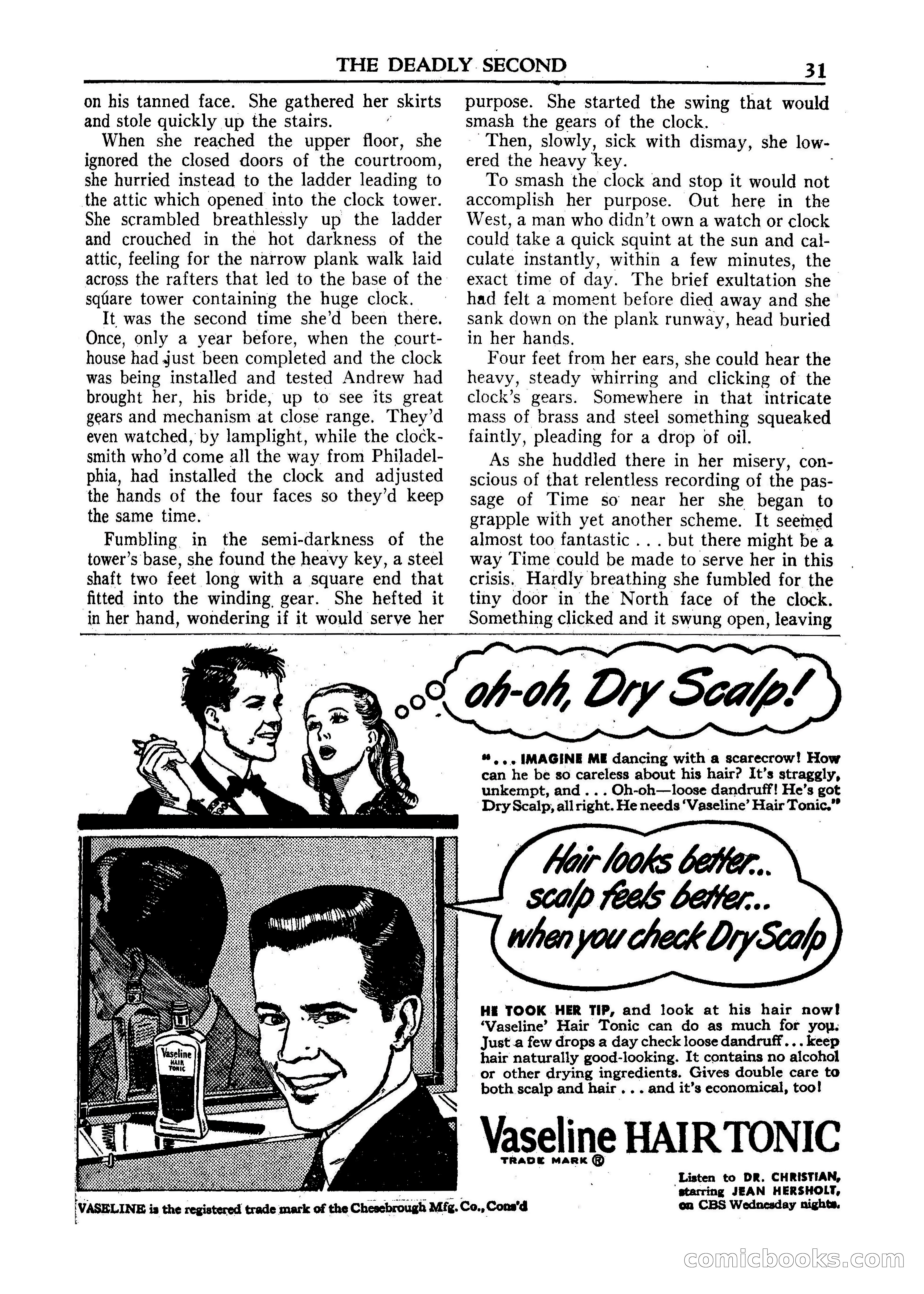
# Page Analysis This page contains story prose from a pulp fiction narrative titled "The Deadly Second" (page 31), interrupted by a vintage advertisement. The story text describes a woman climbing into a courthouse clock tower, apparently planning to interfere with the clock's mechanism as part of some scheme, though she realizes simply breaking it won't achieve her purpose. The narrative emphasizes her desperation and the ticking clock's relentless presence. Below the prose runs a full-page advertisement for Vaseline Hair Tonic, featuring illustrated dialogue between a couple discussing dandruff problems, with product claims about controlling loose dandruff and promoting healthy hair. The ad includes a CBS radio program reference.

Fifteen Western Tales, January 1953 — page 32 of 116
32 / 116
What you’re looking at · open this page on its own ↗

# Page Description This page contains story prose from a Western pulp fiction magazine titled "Fifteen Western Tales." The narrative follows a woman who has manipulated a courthouse clock by adjusting its hands at different faces to show different times—apparently as part of a scheme involving a man named Dell and a character named Andrew Cameron, who appears to be her husband. The text describes her anxiety about the plan, her observation of a horse tied outside a bar, and her return home to prepare Andrew Cameron's noon meal, where he arrives carrying a gun. The page is primarily dense text with no illustrations visible.

Fifteen Western Tales, January 1953 — page 33 of 116
33 / 116
What you’re looking at · open this page on its own ↗

# Analysis of Page 33 from "The Deadly Second" This page contains story prose from what appears to be a hardboiled crime or Western pulp fiction narrative. The text depicts an intimate domestic scene between Andrew, apparently a sheriff, and his wife Mattie. Andrew has taken a dangerous job as sheriff and is awaiting a confrontation (likely with someone named Bob Dell) scheduled for one o'clock. The passage emphasizes the emotional tension between the couple—Mattie's concern and Andrew's reluctance to discuss the impending danger. The narrative focuses on their quiet meal together, Andrew's watchful gaze, and Mattie's awareness that this may be their last hour together, creating a sense of foreboding throughout the scene.

Fifteen Western Tales, January 1953 — page 34 of 116
34 / 116
Fifteen Western Tales, January 1953 — page 35 of 116
35 / 116
What you’re looking at · open this page on its own ↗

# Page Analysis This is an interior story page from a pulp Western magazine. It presents the opening of a short story titled "The Bushwhack Bargain" by Richard Ferber, featuring an illustration of armed men in a saloon confrontation. The visible text introduces Jesse Harder, a desperate gunman who enters a saloon seeking the sheriff, apparently hired to commit murder for a hundred dollars. The narrative establishes tension as Harder, nearly broke, pursues what appears to be a contract killing of an unarmed lawman named Clayburn.

Fifteen Western Tales, January 1953 — page 36 of 116
36 / 116
What you’re looking at · open this page on its own ↗

This page contains story prose from a Western pulp fiction magazine titled "Fifteen Western Tales." The narrative follows a gunslinger named Jesse (apparently Jesse Harder) who enters a saloon and sends word to the sheriff that he wants to kill him. The text depicts the tense atmosphere as Jesse calmly prepares for a confrontation, making a cigarette and ordering a drink while the bartender nervously positions himself near a shotgun. The passage establishes Jesse's cold, methodical nature and hints at his past encounters with the Tolman brothers.

Fifteen Western Tales, January 1953 — page 37 of 116
37 / 116
What you’re looking at · open this page on its own ↗

# Page Analysis: "The Bushwhack Bargain" This page contains story prose from a pulp Western fiction titled "The Bushwhack Bargain" (page 37). The narrative follows Jesse, a gunslinger, meeting with brothers Cole and Jack Tolman and a Mexican named Ramos in a saloon. They attempt to hire Jesse to assassinate a sheriff in Beeker's Gulch for one hundred dollars—a price Jesse considers too low. The page ends with Jesse reaching for tobacco from his nearly-empty shirt pocket. The page also includes three period advertisements for Wildroot Cream-Oil hair tonic positioned at the bottom, featuring comic-strip style illustrations promoting the product as "America's Favorite Hair Tonic" at 29 cents.

Fifteen Western Tales, January 1953 — page 38 of 116
38 / 116
What you’re looking at · open this page on its own ↗

This page contains story prose from a Western pulp fiction magazine titled "Fifteen Western Tales." The narrative depicts a hired killer named Jesse negotiating a contract with the Tolman brothers to murder an old sheriff named Mark Clayburn in Beeker's Gulch for one hundred dollars. The text shows Jesse's detached professionalism—he deliberately avoids learning why the killing must be done, viewing such knowledge as a complication. The passage follows Jesse from the initial transaction through his arrival in the target town, emphasizing his emotional indifference and practiced methodology as a contract murderer.

Fifteen Western Tales, January 1953 — page 39 of 116
39 / 116
What you’re looking at · open this page on its own ↗

# Page Analysis This is **story prose** from page 39 of a pulp western titled "The Bushwhack Bargain." The text depicts a tense confrontation in a saloon between Jesse (an apparent hired killer) and Sheriff Mark Clayburn, who arrives unarmed. After their confrontation, Clayburn leaves peacefully, frustrating Jesse, who is troubled by the prospect of killing an unarmed man. Jesse then exits the saloon and leads his horse to an alley beside a hotel, the narrative suggesting escalating tension in what appears to be a showdown scenario.

Fifteen Western Tales, January 1953 — page 40 of 116
40 / 116
What you’re looking at · open this page on its own ↗

# Page Analysis This is **story prose** from a Western pulp fiction tale titled "Fifteen Western Tales." The page depicts a conversation between a drifter named Jesse and Mary Clayburn, who owns a cafe in Beeker's Gulch. Jesse trades his watch for a meal, and when he asks about two brothers named Cole and Jack Tolman, Mary's demeanor shifts dramatically—she reveals her father is the sheriff who has given the Tolmans two weeks to leave town, and she fears they've sworn to kill him. The scene establishes tension and suggests Jesse may become entangled in the conflict.

Fifteen Western Tales, January 1953 — page 41 of 116
41 / 116
What you’re looking at · open this page on its own ↗

# Page Analysis This page contains story prose from a Western pulp fiction titled "The Bushwhack Bargain" (page 41). The narrative follows a gunman named Harder (or Jesse) who has come to town apparently to confront or kill someone. After a tense encounter with a young woman at a store counter, Harder is ambushed by townsmen in an alley. Mark Clayburn, the town sheriff and the woman's father, intervenes, disarming the mob and confronting Harder directly. The scene depicts classic pulp-fiction Western tension: gunplay, moral ambiguity, and a lawman asserting his authority over vigilante justice.

Fifteen Western Tales, January 1953 — page 42 of 116
42 / 116
What you’re looking at · open this page on its own ↗

This page contains story prose from "Fifteen Western Tales," a pulp fiction magazine. The text depicts a gunfight scene in which a character named Jesse, who has failed to kill an old man named Clayburn as hired by the Tolman brothers, instead turns on his employers. The passage describes the tense confrontation in a dark clearing, the exchange of gunfire, and Jesse shooting down one of the Tolman men. The narrative emphasizes action, gunplay, and moral conflict in a Western setting.

Fifteen Western Tales, January 1953 — page 43 of 116
43 / 116
What you’re looking at · open this page on its own ↗

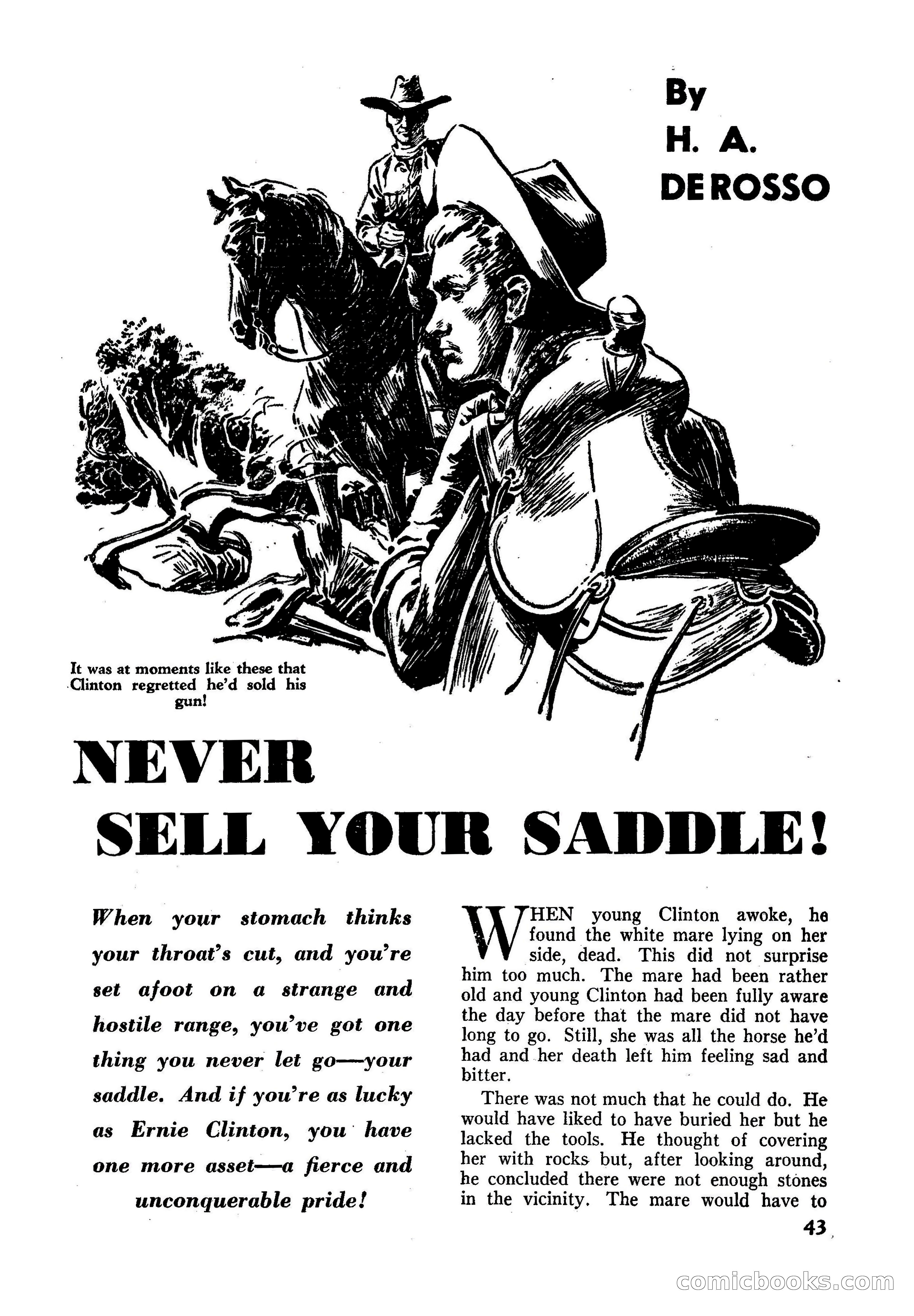
# Page Analysis This is an interior story page from a pulp magazine, featuring an illustration at the top and the beginning of a Western story titled "Never Sell Your Saddle!" by H. A. DeRosso. The page shows a dramatic pen-and-ink illustration of a cowboy on horseback alongside another figure, accompanying an opening about a character named Clinton who has just discovered his white mare dead on the range. The text emphasizes the importance of never parting with one's saddle—a cowboy's most essential possession—as a matter of survival and pride on the frontier.

Fifteen Western Tales, January 1953 — page 44 of 116
44 / 116
What you’re looking at · open this page on its own ↗

# Page Analysis This is **story prose** from page 44 of *Fifteen Western Tales*, a pulp western magazine. The text depicts a destitute cowpuncher named Clinton walking along a desert road carrying his saddle after his horse dies. A mysterious rider on horseback approaches from behind and reveals he has buried Clinton's dead mare, then offers Clinton employment as a rider, provided with a horse. The passage emphasizes Clinton's poverty, pride, and desperation as he struggles across the landscape on foot with worn-out boots.

Fifteen Western Tales, January 1953 — page 45 of 116
45 / 116
What you’re looking at · open this page on its own ↗

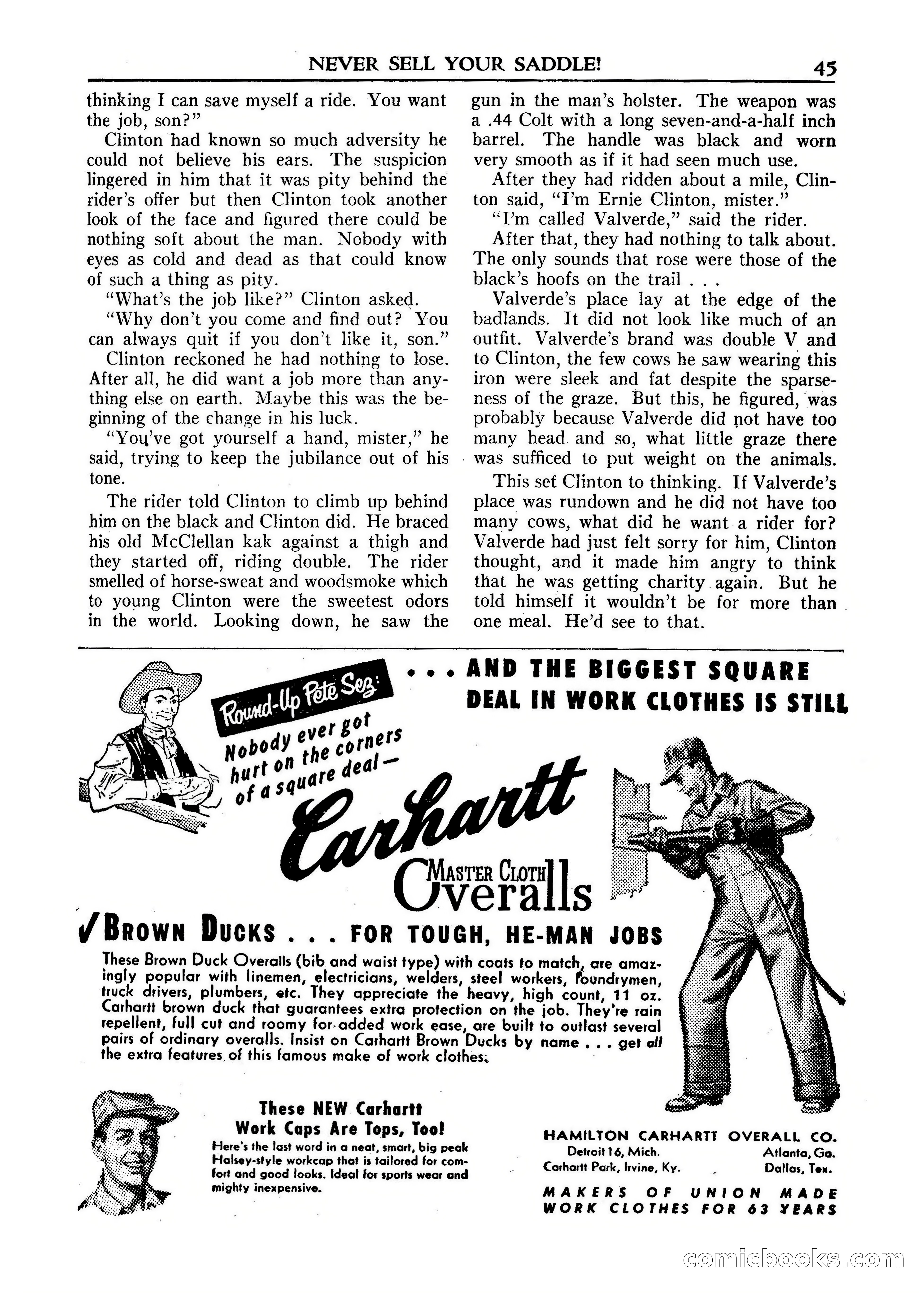
# Page 45: Story and Advertisement This page contains Western pulp fiction prose alongside period advertising. The story narrative—titled "Never Sell Your Saddle!"—follows a character named Ernie Clinton who accepts a job offer from a man named Valverde, riding double to Valverde's sparse ranch in the badlands. The text describes Clinton's cautious optimism about employment and his observations of Valverde's modest operation. The lower half features a full-page Carhartt work clothes advertisement promoting Brown Duck overalls and work caps for laborers, emphasizing durability and union-made quality.

Fifteen Western Tales, January 1953 — page 46 of 116
46 / 116
What you’re looking at · open this page on its own ↗

This page contains story prose from a Western pulp fiction magazine titled "Fifteen Western Tales." The narrative depicts young Ernie Clinton arriving at a ranch owned by Valverde, who offers him work. When Valverde's slovenly partner Duke Bedford openly objects to hiring Clinton, tension erupts—Clinton takes offense at Bedford's contempt and nearly walks away, but Valverde persuades him to stay, asserting his authority as ranch owner. The passage establishes conflict between the characters and Clinton's pride.

Fifteen Western Tales, January 1953 — page 47 of 116
47 / 116
What you’re looking at · open this page on its own ↗

# Page Analysis This is **story prose** from page 47 of a Western pulp fiction magazine titled "Never Sell Your Saddle!" The visible text depicts a confrontation between young ranch hand Ernie Clinton and two neighbors, Fred Aderhold and Bruce Partridge, who accuse Clinton's employer Valverde of cattle rustling in the badlands. Aderhold warns Clinton that if he's smart, he'll leave the ranch. The scene develops tension around Clinton's new clothes (purchased with earned wages) and escalates into implied threats about stolen livestock and hidden operations, establishing a conflict central to the story's plot.

Fifteen Western Tales, January 1953 — page 48 of 116
48 / 116
What you’re looking at · open this page on its own ↗

# Page 48 from "Fifteen Western Tales" This page contains story prose from a Western pulp fiction narrative. The text depicts a confrontation between three ranch workers: Valverde, Duke Bedford, and young Clinton. Valverde discovers that Bedford manipulated Clinton into illegally rebranding calves belonging to a neighboring ranch (Rafter A), deliberately compromising Clinton's integrity to blackmail him into criminal activity. When Valverde learns of this betrayal, he challenges Bedford to a gunfight. The passage culminates in a violent physical brawl after both men discard their gun belts, with Bedford initially striking Valverde before a brutal fight ensues.

Fifteen Western Tales, January 1953 — page 49 of 116
49 / 116
What you’re looking at · open this page on its own ↗

# Page 49: Story Prose This page contains prose fiction from a western or crime narrative titled "Never Sell Your Saddle!" The text describes a violent confrontation where a character named Valverde brutally beats Duke Bedford, followed by a later scene where an injured Valverde arrives at night on horseback to find Clinton. Valverde reveals he has been shot and explains that Duke Bedford betrayed their group to Aderhold and others, resulting in hangings. The passage focuses on dialogue and character reactions as Clinton tends to the wounded Valverde.

Fifteen Western Tales, January 1953 — page 50 of 116
50 / 116
What you’re looking at · open this page on its own ↗

# Page Analysis **Type:** Story prose from a western pulp magazine **Content:** This page contains the conclusion of a dramatic scene from "Fifteen Western Tales." A dying man named Valverde urges young Ernie Clinton to escape on horseback before attackers arrive, revealing he has secretly raised Clinton as a son-figure to give his life meaning. Clinton departs on the blue roan, and from a distance witnesses gunfire at Valverde's ranch as armed men (apparently led by someone named Aderhold) attack. The passage concludes with Clinton riding away into the night, his heart heavy with the knowledge of Valverde's sacrifice.

Fifteen Western Tales, January 1953 — page 51 of 116
51 / 116
What you’re looking at · open this page on its own ↗

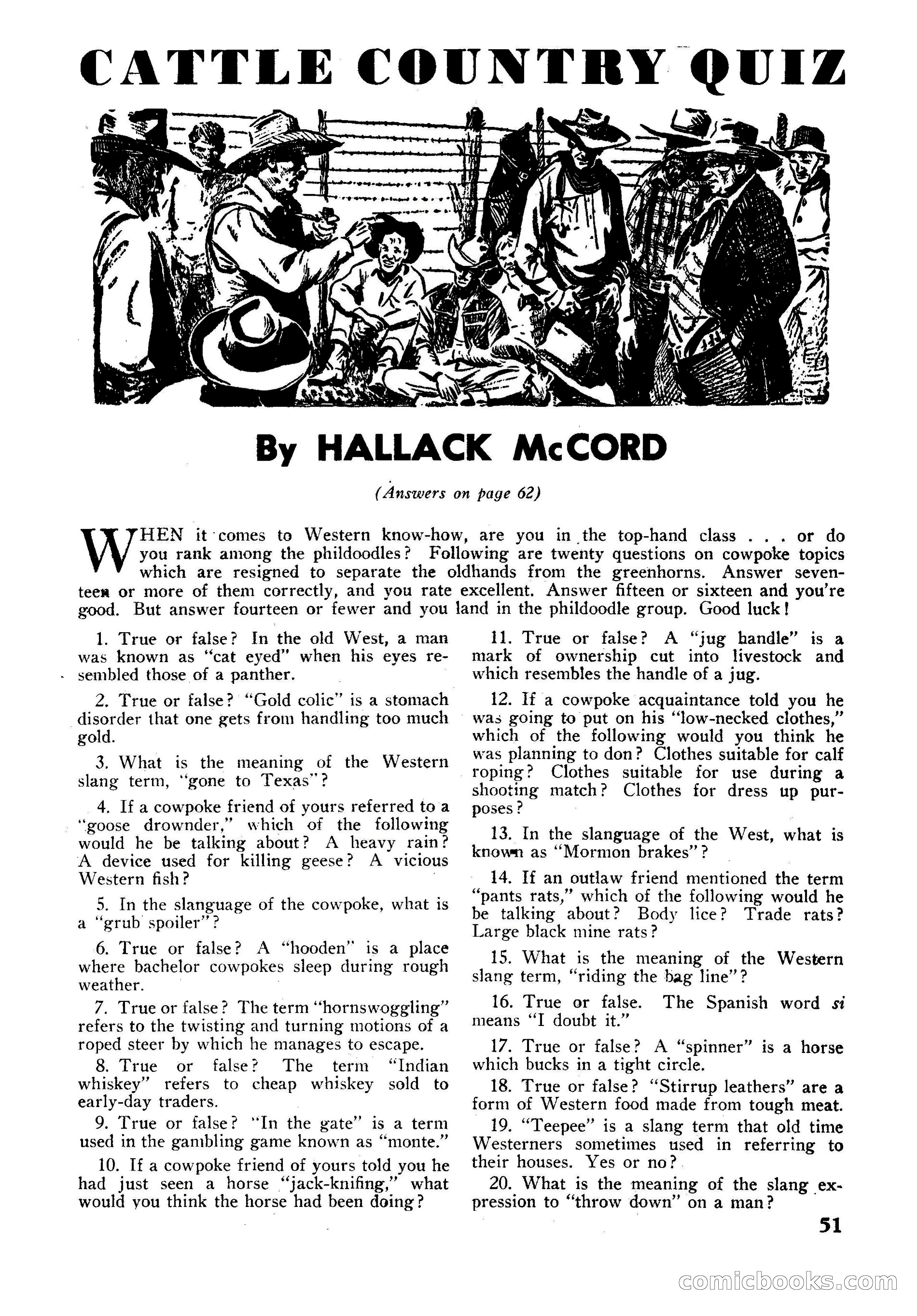
# Page Content Description This is a quiz page from a pulp magazine featuring "Cattle Country Quiz" by Hallack McCord. The page displays a woodcut-style illustration at the top showing cowboys and ranchers gathered around a fence, and below it presents twenty true-or-false and multiple-choice questions testing readers' knowledge of Old West cowboy slang, ranch terminology, and cattle country culture. The quiz promises answers on page 62 and rates readers' Western expertise based on how many questions they answer correctly. Questions cover topics like cattle brands, cowboy slang terms, horse behavior, and frontier practices.

Fifteen Western Tales, January 1953 — page 52 of 116
52 / 116
What you’re looking at · open this page on its own ↗

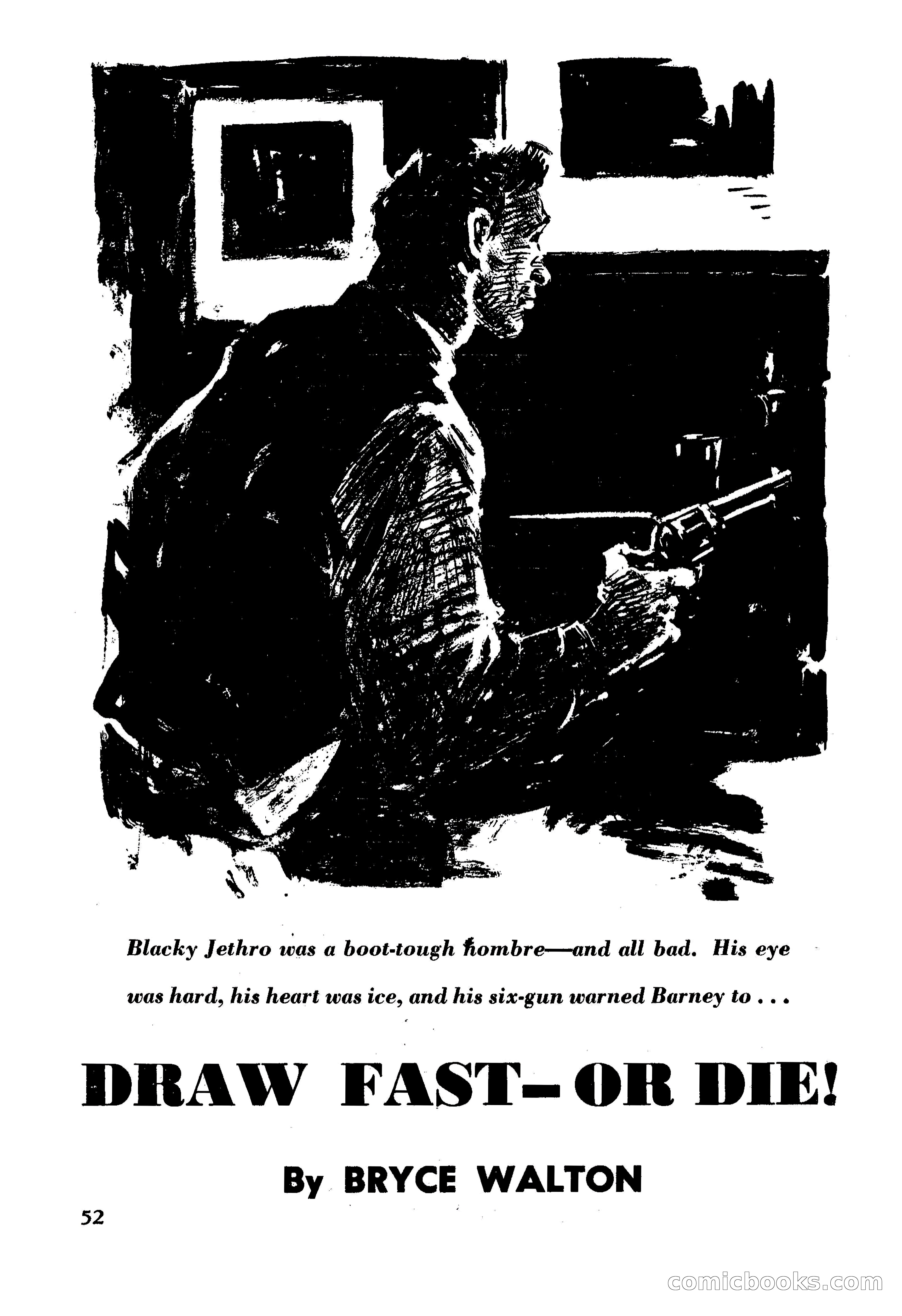
This is a story opening page from a pulp magazine featuring a hardboiled crime narrative. The dramatic illustration shows a man with a revolver in what appears to be an indoor confrontation scene, rendered in stark black-and-white woodcut or similar high-contrast style. The visible text introduces the antagonist Blacky Jethro as a ruthless, cold-hearted gunman whose six-gun poses a threat to a character named Barney. The story is titled "Draw Fast—or Die!" and is authored by Bryce Walton. This appears to be page 52 of the publication, marking the beginning of the story.

Fifteen Western Tales, January 1953 — page 53 of 116
53 / 116
What you’re looking at · open this page on its own ↗

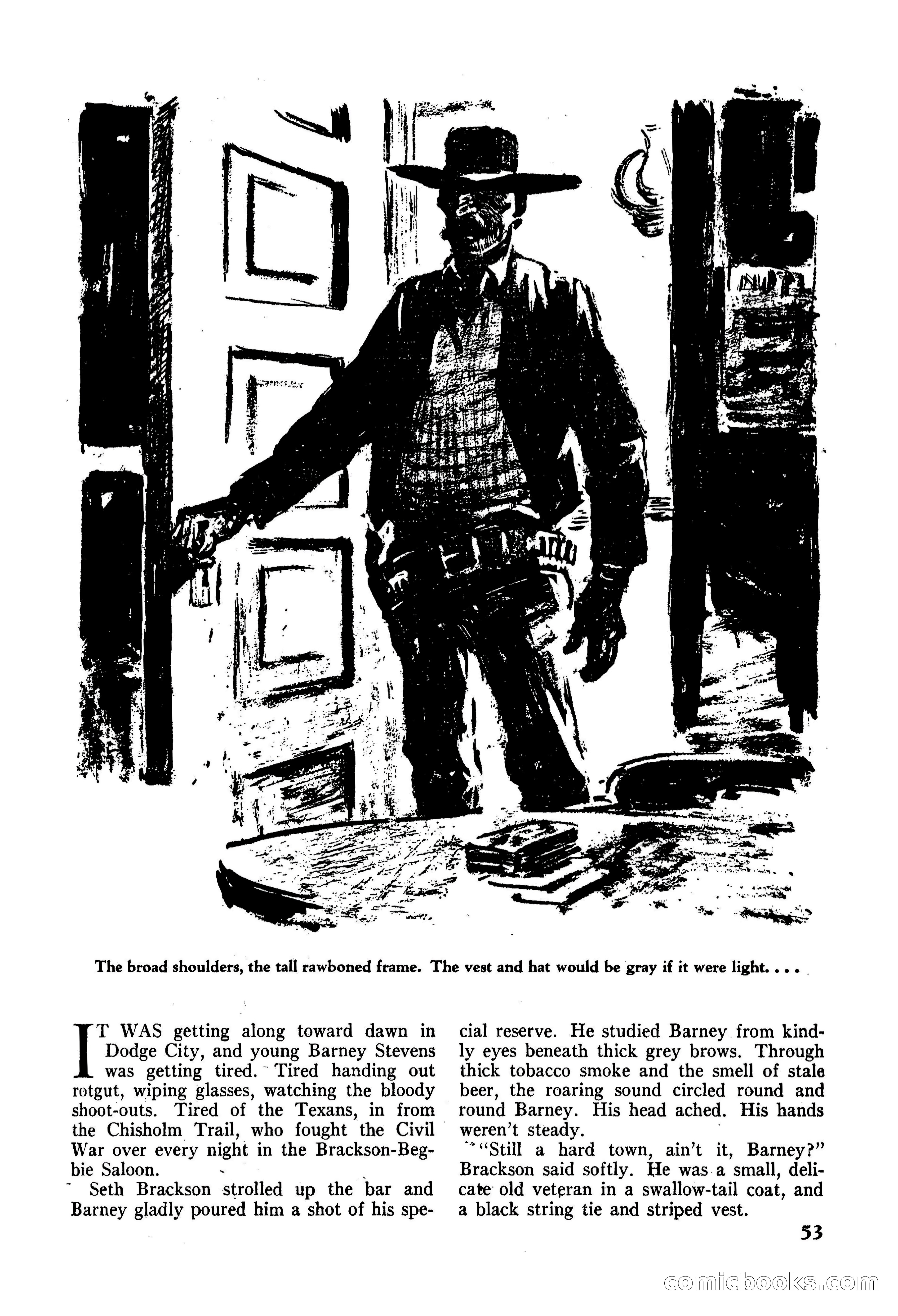
This page contains an illustration and story prose from a pulp-fiction magazine. The black-and-white illustration depicts a tall, broad-shouldered man in a cowboy hat and vest standing in what appears to be a saloon doorway. The prose below describes a scene in Dodge City at dawn, where a tired young bartender named Barney Stevens serves drinks to rough Texans and Civil War veterans at the Brackson-Begbie Saloon. An older man named Seth Brackson approaches the bar, and the two men exchange dialogue about the town's rough nature.

Fifteen Western Tales, January 1953 — page 54 of 116
54 / 116
What you’re looking at · open this page on its own ↗

# Page 54 of "Fifteen Western Tales" This page contains prose fiction from a Western pulp magazine. The narrative follows Barney, a struggling bar-hopper in Dodge City whose invalid wife Clara is deteriorating from the harsh frontier conditions. His employer Seth Brackson tries to persuade him that he needs courage rather than money to help her, while Barney recounts how Texas cattlemen terrorized him months earlier, destroying his wagon and supplies. The passage explores Barney's shame, his failed attempt at farming, and his mounting resentment toward the unnamed Texan leader who humiliated him—all while suggesting that Brackson believes Barney's real problem is lost resolve rather than financial hardship.

Fifteen Western Tales, January 1953 — page 55 of 116
55 / 116
What you’re looking at · open this page on its own ↗

# Page Analysis **Type:** Story prose (page 55 of what appears to be a hardboiled Western pulp fiction magazine titled "Draw Fast—or Die!") **Content:** This page depicts an escalating confrontation in a saloon between Seth Brackson (the saloon owner) and a belligerent gambler, observed by Barney, a bartender. After the gambler insults Barney, Brackson strikes him with a diamond ring. The gambler, named Anson, responds by reaching for his six-shooter, prompting Brackson to reveal his own derringer. The page captures the tense moment as the saloon goes quiet, with Barney conflicted about whether to intervene, remembering Brackson's past kindness toward him.

Fifteen Western Tales, January 1953 — page 56 of 116
56 / 116
What you’re looking at · open this page on its own ↗

# Page 56: Prose from a Western Pulp Story This page contains story prose from "Fifteen Western Tales," a Western pulp fiction magazine. The narrative depicts a violent confrontation in what appears to be a Dodge City saloon, where a gunfighter named Blacky Jethro shoots and brutally beats a man named Anson on orders from saloon owner Brackson. The protagonist Barney Stevens witnesses this display of hired gunslinger muscle and is troubled by it. The scene ends with Barney leaving the saloon, his mind turning toward his wife Clara and fantasies about the substantial money flowing through Brackson's establishments.

Fifteen Western Tales, January 1953 — page 57 of 116
57 / 116
What you’re looking at · open this page on its own ↗

# Page Analysis This is **story prose** from a pulp fiction magazine titled "Draw Fast—or Die!" (page 57). The page contains two sections: the conclusion of Chapter One, depicting an intimate scene between a man named Barney and a sick woman named Clara in a hotel room, and the beginning of Chapter Two titled "Barney Calls a Bluff," which shows Barney returning to work in a saloon. The narrative suggests a Western setting involving gambling, violence, and financial desperation.

Fifteen Western Tales, January 1953 — page 58 of 116
58 / 116
What you’re looking at · open this page on its own ↗

This is a prose page from a hardboiled Western pulp story titled "Fifteen Western Tales." The narrative follows a character named Barney, a bartender who appears implicated in the murder of Seth Brackson, a safe-keeper found dead at his desk with a gunshot wound. A mysterious gambler named Begbie confronts Barney with evidence—a button from Barney's shirt found at the crime scene—while a lawman (apparently Bat Masterson) arrives to investigate the theft of approximately one hundred thousand dollars from the now-open safe.

Fifteen Western Tales, January 1953 — page 59 of 116
59 / 116
What you’re looking at · open this page on its own ↗

# Page Analysis This is story prose from a hardboiled Western pulp magazine titled "Draw Fast—or Die!" (page 59). The text depicts a tense scene where protagonist Barney discovers a sack of stolen money hidden in a darkened card room following a murder. When Begbie confronts him with a drawn pistol, Barney attempts to explain his presence, claiming he found the money while fleeing suspicion for a killing he didn't commit. The passage emphasizes Barney's desperation and moral conflict as he weighs using the money to escape with a woman named Clara against his predicament.

Fifteen Western Tales, January 1953 — page 60 of 116
60 / 116
What you’re looking at · open this page on its own ↗

# Page Analysis: Pulp Fiction Story Prose This page contains story prose from a Western pulp fiction tale. The narrative follows a character named Barney Stevens waiting in a darkened room for a confrontation with a gunman named Jethro. The text depicts Barney's internal anxieties about an impending shootout—his nervous gripping of his Colt revolver, memories of his fiancée Clara, recalled advice from an older mentor named Seth Brackson, and his ultimate psychological preparation as Jethro enters the room. The passage emphasizes the psychological tension and moral weight of the moment before violence, with Barney ultimately finding unexpected calm as the confrontation begins.

Fifteen Western Tales, January 1953 — page 61 of 116
61 / 116
What you’re looking at · open this page on its own ↗

This is a page of story prose from what appears to be a hardboiled crime or western pulp magazine titled "Draw Fast—or Die!" The visible text depicts the climax of a shootout between characters named Barney and Begbie, followed by Barney's recovery and the reading of a will by a lawyer named Mike Barlow. The narrative involves gunplay, murder, and double-crosses, with famous historical figures like Bat Masterson and U.S. Marshal Earp appearing as characters in the story.

Fifteen Western Tales, January 1953 — page 62 of 116
62 / 116
What you’re looking at · open this page on its own ↗

# Page 62: Story Prose and Answer Key This page contains the conclusion of a Western story titled "Fifteen Western Tales," depicting a romantic scene between characters named Barney and Clara in Dodge City at dawn. The narrative describes Barney and Clara's decision to stay and build a life together, selling the saloon to buy land, with vivid sensory details of the frontier town's smells and sounds. The lower half provides an "Answers to Cattle Country Quiz," offering definitions and explanations of twenty cowpoke slang terms and Western expressions, including "cat-eyed," "gold colic," "hornswoggling," and "Mormon brakes."

Fifteen Western Tales, January 1953 — page 63 of 116
63 / 116
What you’re looking at · open this page on its own ↗

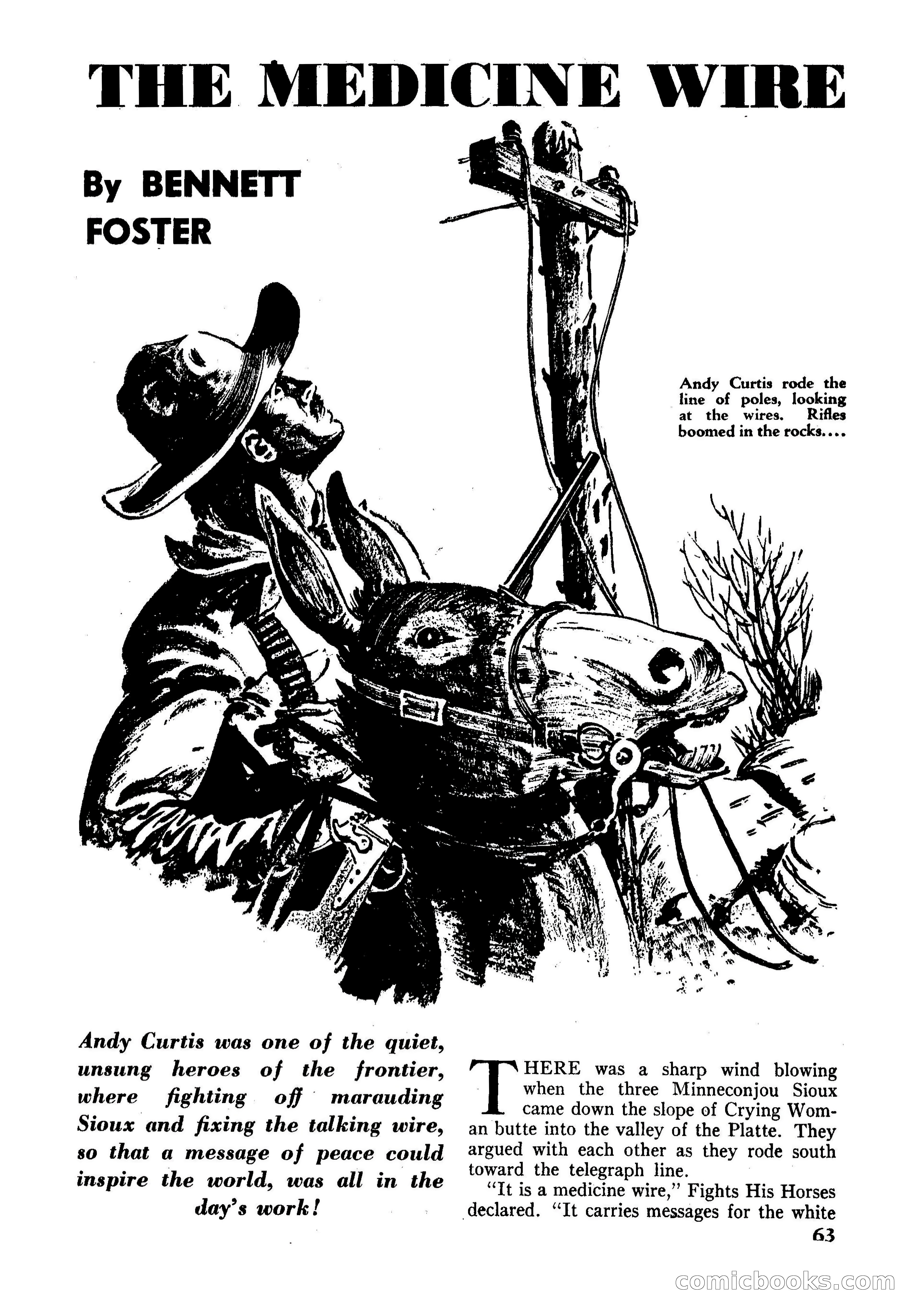
This is a story page from a pulp fiction magazine titled "The Medicine Wire" by Bennett Foster. The page opens a frontier adventure story about Andy Curtis, described as an unsung hero who maintains telegraph lines while defending against Sioux raids. The visible text introduces the setup: three Minneconjou Sioux warriors ride toward the Platte valley telegraph line, with one character calling it a "medicine wire" that carries messages for white settlers. The illustration depicts a mounted frontiersman on horseback near a telegraph pole.

Fifteen Western Tales, January 1953 — page 64 of 116
64 / 116
What you’re looking at · open this page on its own ↗

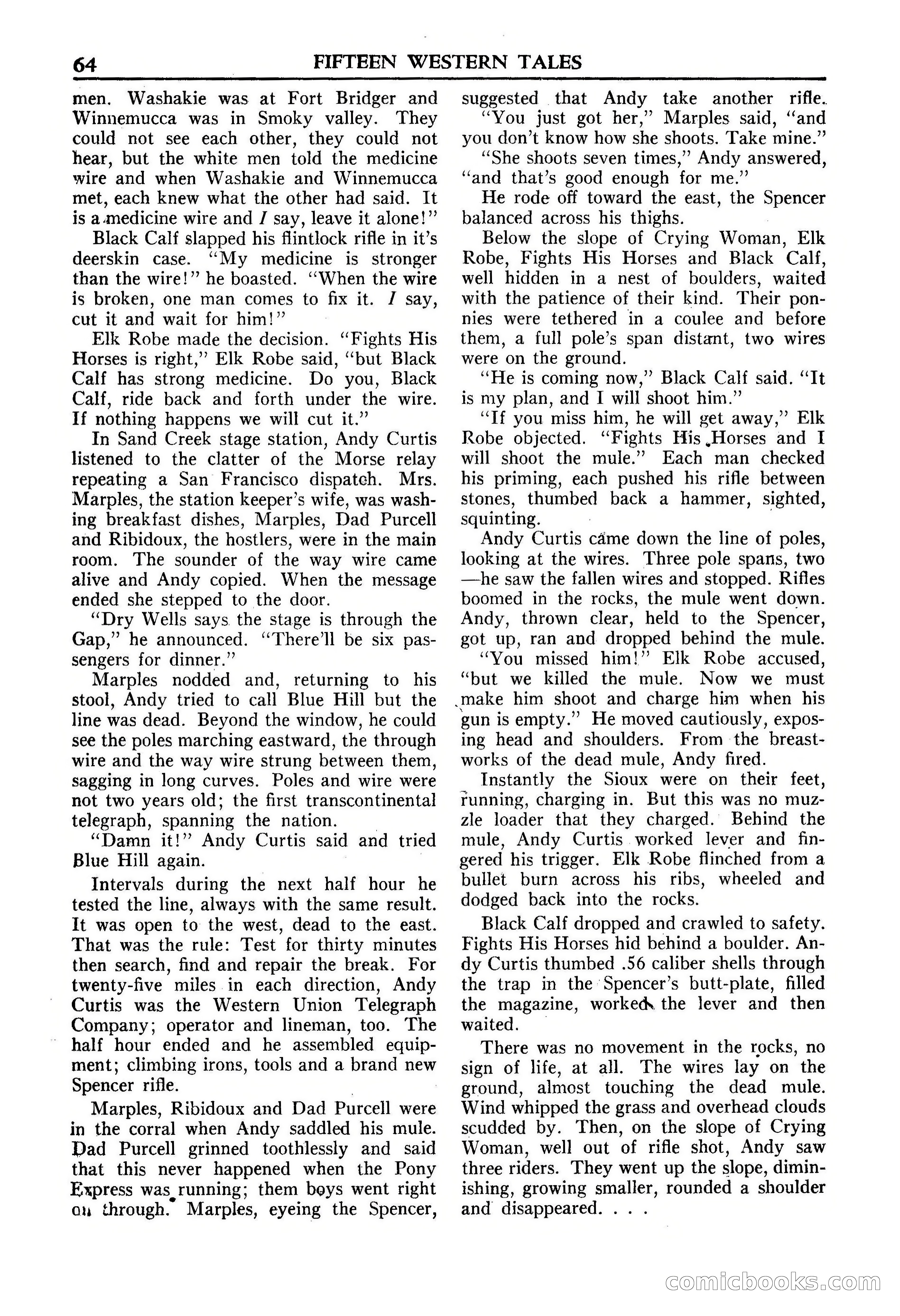
# Page Analysis This is **story prose** from a Western pulp fiction magazine titled "Fifteen Western Tales." The page depicts a dramatic confrontation unfolding in two locations: at a telegraph station where operator Andy Curtis learns the transcontinental telegraph line is dead, and in the rocks near Crying Woman where Native American warriors (Elk Robe, Fights His Horses, and Black Calf) have deliberately cut the telegraph wires and now ambush Curtis as he arrives to repair them. The narrative builds tension as Curtis discovers the downed wires and comes under rifle fire from hidden attackers.

Fifteen Western Tales, January 1953 — page 65 of 116
65 / 116
What you’re looking at · open this page on its own ↗

This page of prose fiction from "The Medicine Wire" depicts a scene at Sand Creek telegraph station in 1863, where operator Andy Curtis receives a dispatch about the dedication of the Gettysburg battlefield as a national cemetery, including a passage from Lincoln's Gettysburg Address. Meanwhile, Native American characters (Elk Robe, Fights His Horses, and Black Calf) debate a mysterious "medicine wire"—apparently the telegraph itself—which they believe enabled a distant white man to summon help. The page includes a separate feature titled "Practical Pioneer" quoting a Texas rancher's folksy philosophy about plowing.

Fifteen Western Tales, January 1953 — page 66 of 116
66 / 116
What you’re looking at · open this page on its own ↗

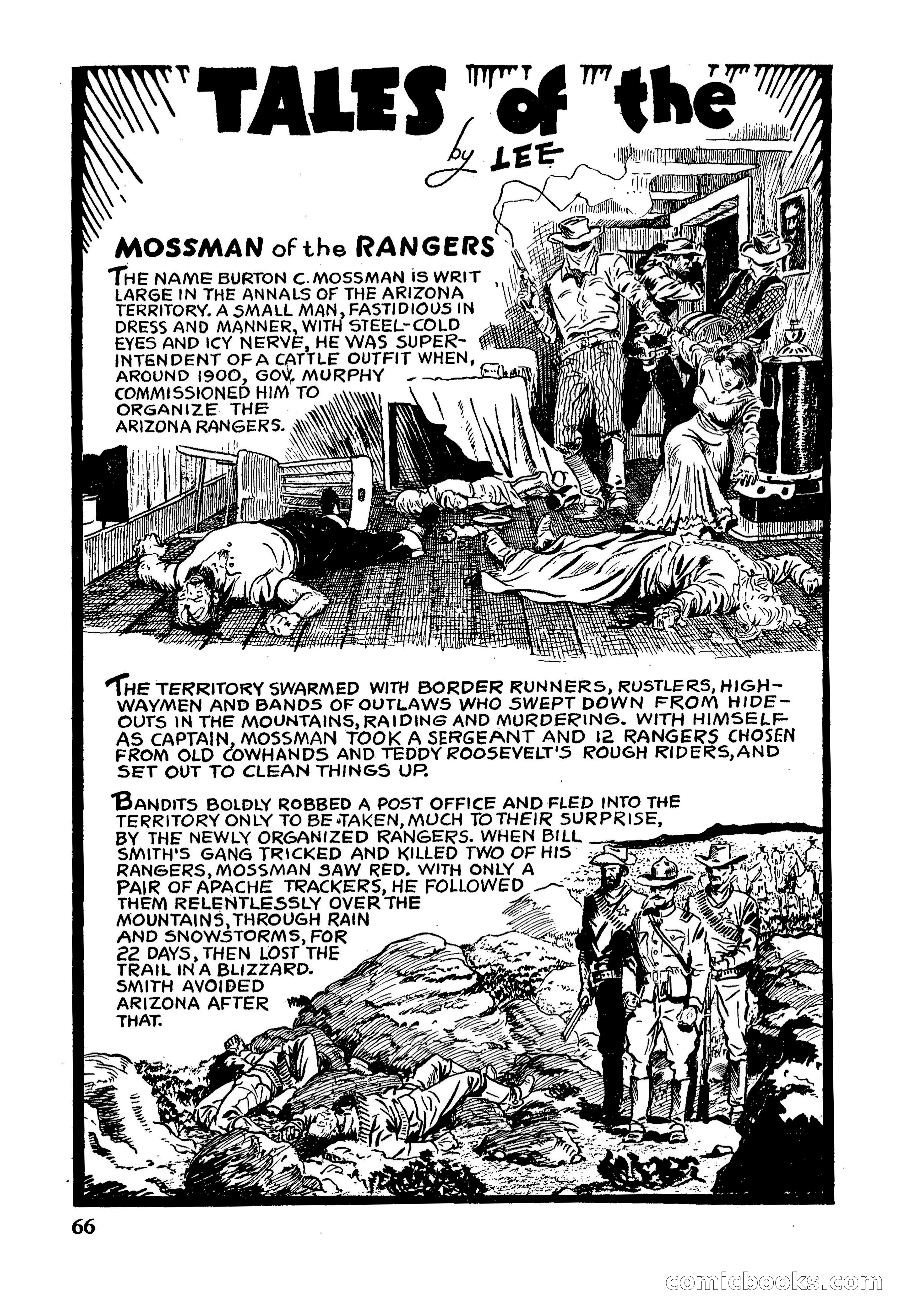
# Page Analysis This is an interior story page from a pulp magazine featuring "Tales of the" by Lee. The page combines illustrated panels and prose text to tell the story of Burton C. Mossman, a historical figure who organized the Arizona Rangers around 1900. The narrative describes how Mossman, a small but steely lawman, was commissioned by Governor Murphy to establish the Rangers using cowhands and Rough Riders to combat border outlaws, rustlers, and murderers plaguing Arizona Territory. It recounts how the Rangers captured bandits who robbed a post office, and how Mossman pursued Bill Smith's gang for 22 days through mountains and snowstorms after they killed two of his rangers, losing their trail in a blizzard.

Fifteen Western Tales, January 1953 — page 67 of 116
67 / 116
What you’re looking at · open this page on its own ↗

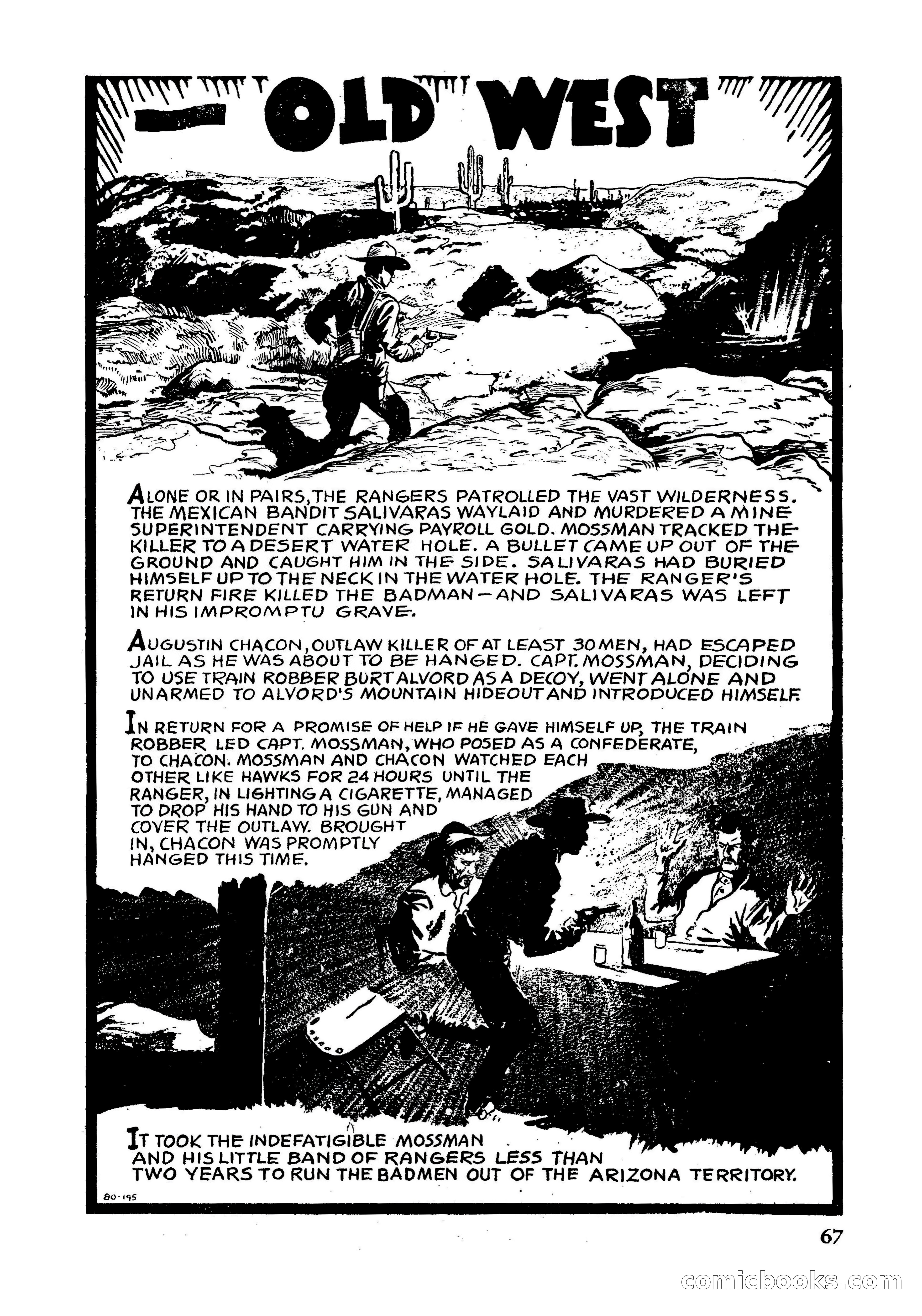
# Page Analysis This is a story prose page (likely from a pulp Western magazine) with accompanying illustrations. The text recounts historical anecdotes about Captain Mossman and Arizona Rangers pursuing outlaws in the Arizona Territory. The narratives describe three incidents: the tracking and killing of Mexican bandit Salivaras near a water hole; the capture of outlaw killer Augustin Chacon through an elaborate ruse using train robber Burt Alvord as bait; and a summary statement that Mossman's ranger force eliminated badmen from Arizona in under two years. The page includes woodcut-style illustrations depicting these frontier law-enforcement scenes.

Fifteen Western Tales, January 1953 — page 68 of 116
68 / 116
What you’re looking at · open this page on its own ↗

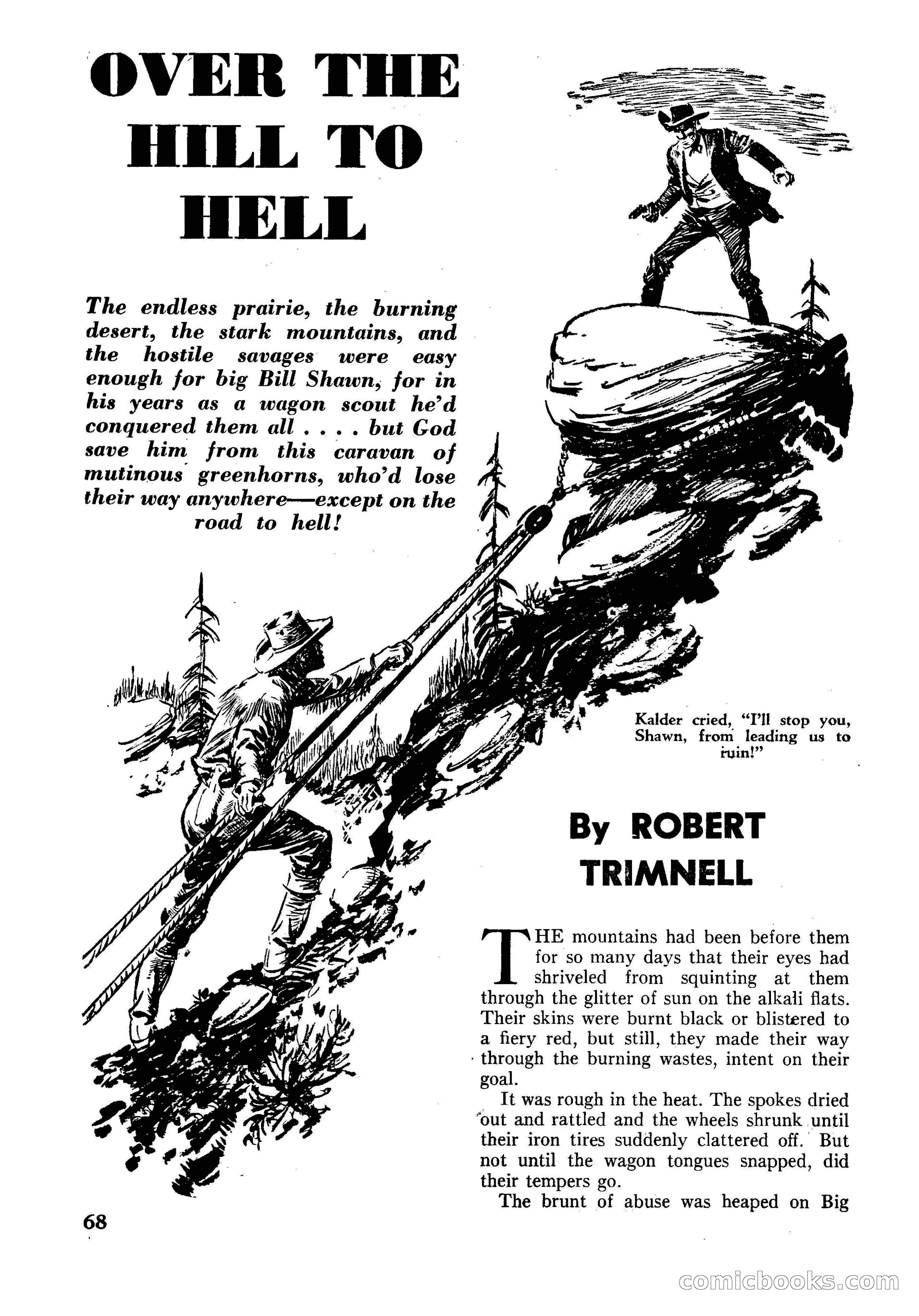
# Page Analysis This is an interior story page from a pulp magazine, featuring the beginning of a Western fiction story titled "Over the Hill to Hell" by Robert Trimmell. The page includes dramatic black-and-white illustrations of men on a mountainous terrain alongside the story's opening prose. The narrative follows a wagon scout named Big Bill Shawn leading a caravan through harsh desert and mountain conditions, where tensions escalate among his inexperienced, mutinous crew members. A character named Kalder threatens to stop Shawn from leading them to ruin, suggesting conflict ahead.

Fifteen Western Tales, January 1953 — page 69 of 116
69 / 116
What you’re looking at · open this page on its own ↗

# Page Analysis This is **story prose** from a pulp fiction magazine titled "Over the Hill to Hell" (page 69). The text depicts a dramatic scene in which Bill Shawn, an experienced wagon master in buckskins, directs his crew in hauling wagons up a steep hillside using ropes and pulleys. As they work, lawyer Joel Kalder ominously notes an approaching rain cloud that threatens to turn the hillside into a river. Shawn responds with characteristic determination, rallying his men to pull harder and warning them of the danger if they slip. The narrative emphasizes the conflict between Shawn's seasoned judgment and the skepticism of inexperienced immigrants on the wagon train.

Fifteen Western Tales, January 1953 — page 70 of 116
70 / 116
What you’re looking at · open this page on its own ↗

# Page Analysis This is story prose from "Fifteen Western Tales," a pulp western magazine. The page depicts a dramatic scene in which a wagon team attempts to haul loaded wagons up a steep mountain slope using ropes and pulleys. The operation goes catastrophically wrong when the rope system fails; the wagon careens downslope, crashes into a giant pine tree, and kills or injures workers below. The protagonist, Bill Shawn, watches helplessly as disaster unfolds, his hands bloodied from the rope. A character named Kalder later berates Shawn for the reckless plan, though Shawn remains silent, standing by the fire.

Fifteen Western Tales, January 1953 — page 71 of 116
71 / 116
What you’re looking at · open this page on its own ↗

# Page Analysis: Story Prose from "Over the Hill to Hell" This is a text page from a pulp fiction story titled "Over the Hill to Hell" (page 71). The page contains narrative prose depicting a conflict during what appears to be a wagon train journey to Oregon. A character named Shawn confronts a manipulative lawyer, Joel Kalder, who is trying to undermine Shawn's leadership and stir up distrust among the travelers. After the confrontation, Shawn later sits by the fire with Hannah Dailey, a widow, suggesting a developing romantic relationship. The passage explores themes of leadership, suspicion, and frontier life, typical of early-20th-century pulp Western fiction.

Fifteen Western Tales, January 1953 — page 72 of 116
72 / 116
What you’re looking at · open this page on its own ↗

# Page Analysis This page contains **story prose** from a Western pulp fiction magazine titled "Fifteen Western Tales." The narrative follows Bill Shawn, a wagon train leader, as he deals with interpersonal conflict and a dangerous mountain crossing. A woman suggests that rival Kalder may have sabotaged their operation by causing a rockslide. Shawn, angered, rallies his men with shouts of "Oregon!" and inspects the pulley system rigged for hauling wagons up the mountain, suspicious it might have been tampered with. The passage describes the grueling assembly of men and equipment for the crossing attempt.

Fifteen Western Tales, January 1953 — page 73 of 116
73 / 116
What you’re looking at · open this page on its own ↗

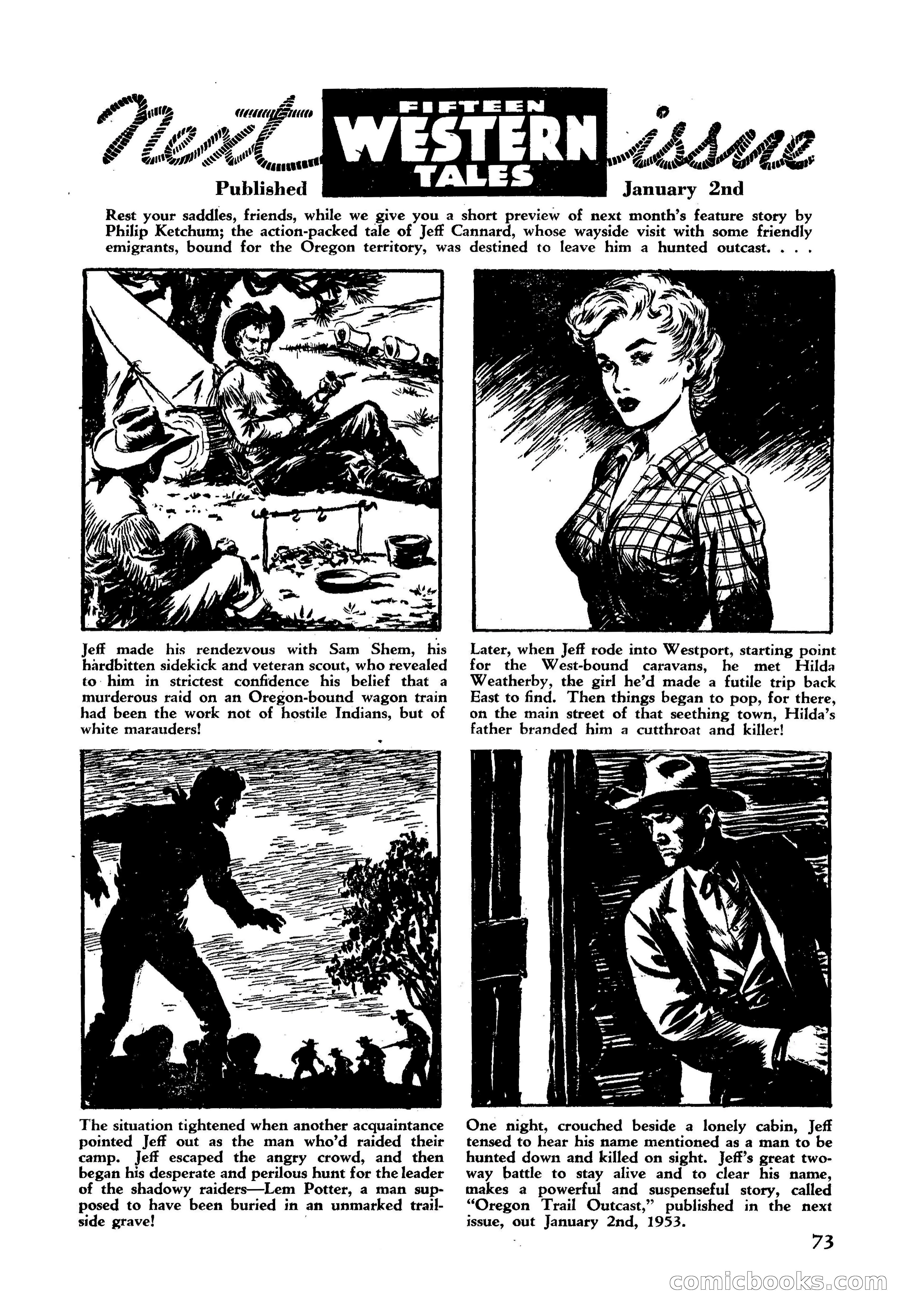
# Pulp Magazine Preview Page This is a preview page from *Fifteen Western Tales*, published January 2nd, featuring four black-and-white illustrations with accompanying text blocks. The page previews Philip Ketchum's next month's western story about Jeff Cannard, a man falsely accused of raiding an Oregon-bound wagon train. The narrative follows Cannard as he flees an angry mob, hunts for the real culprit (supposedly-dead outlaw Lem Potter), and encounters a woman from his past in Westport—her father then brands him a criminal. The full story, titled "Oregon Trail Outcast," will apparently appear in the January 2nd, 1953 issue.

Fifteen Western Tales, January 1953 — page 74 of 116
74 / 116
What you’re looking at · open this page on its own ↗

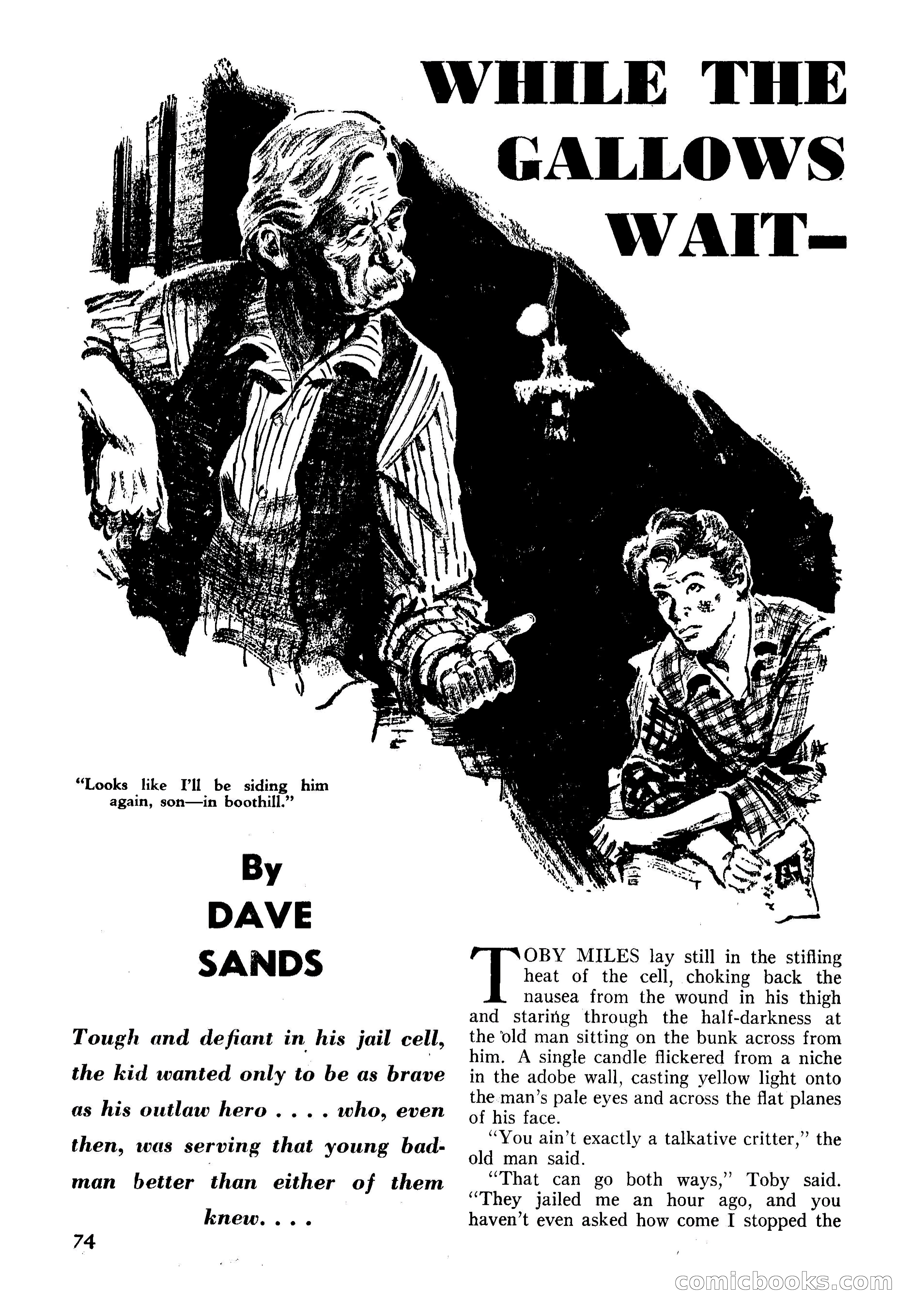
# Page Analysis This is an interior story page from a pulp fiction magazine, likely Western genre. It presents the opening of a short story titled "While the Gallows Wait" by Dave Sands, illustrated with a dramatic pen-and-ink drawing showing two figures in a jail cell—an older man on a bunk and a younger wounded man (Toby Miles) lying down. The visible prose describes Toby, jailed an hour prior with a thigh wound, conversing with a cellmate in an adobe jail cell lit by candlelight. The narrative suggests themes of crime, outlawry, and youthful admiration for a criminal mentor.

Fifteen Western Tales, January 1953 — page 75 of 116
75 / 116
What you’re looking at · open this page on its own ↗

This page contains story prose from a pulp fiction magazine titled "While the Gallows Wait" (page 75). The text depicts a dialogue between two prisoners in a cell: Toby, a young man jailed for attempting to steal a gun, and Bonner, an older inmate. Bonner tries to persuade the cynical Toby toward an honest life on farmland, while Toby remains fixated on a criminal path, apparently interested in the outlaw Cole Mallory. The scene explores their contrasting philosophies as dawn breaks outside their cell window.

Fifteen Western Tales, January 1953 — page 76 of 116
76 / 116
What you’re looking at · open this page on its own ↗

This page contains story prose from a Western pulp fiction tale titled "Fifteen Western Tales." The narrative depicts a pivotal moment in a jail cell where a wounded character named Toby Miles witnesses the execution by hanging of an older man named Bonner, who had attempted to inspire Miles with talk of honest living and freedom. The text describes Miles's physical struggle to reach the barred window and his emotional devastation upon seeing Bonner's body swaying from the gallows, realizing the older man's idealistic words about free creeks and rolling land were merely aspirational dreams, not the harsh reality of their situation.

Fifteen Western Tales, January 1953 — page 77 of 116
77 / 116
What you’re looking at · open this page on its own ↗

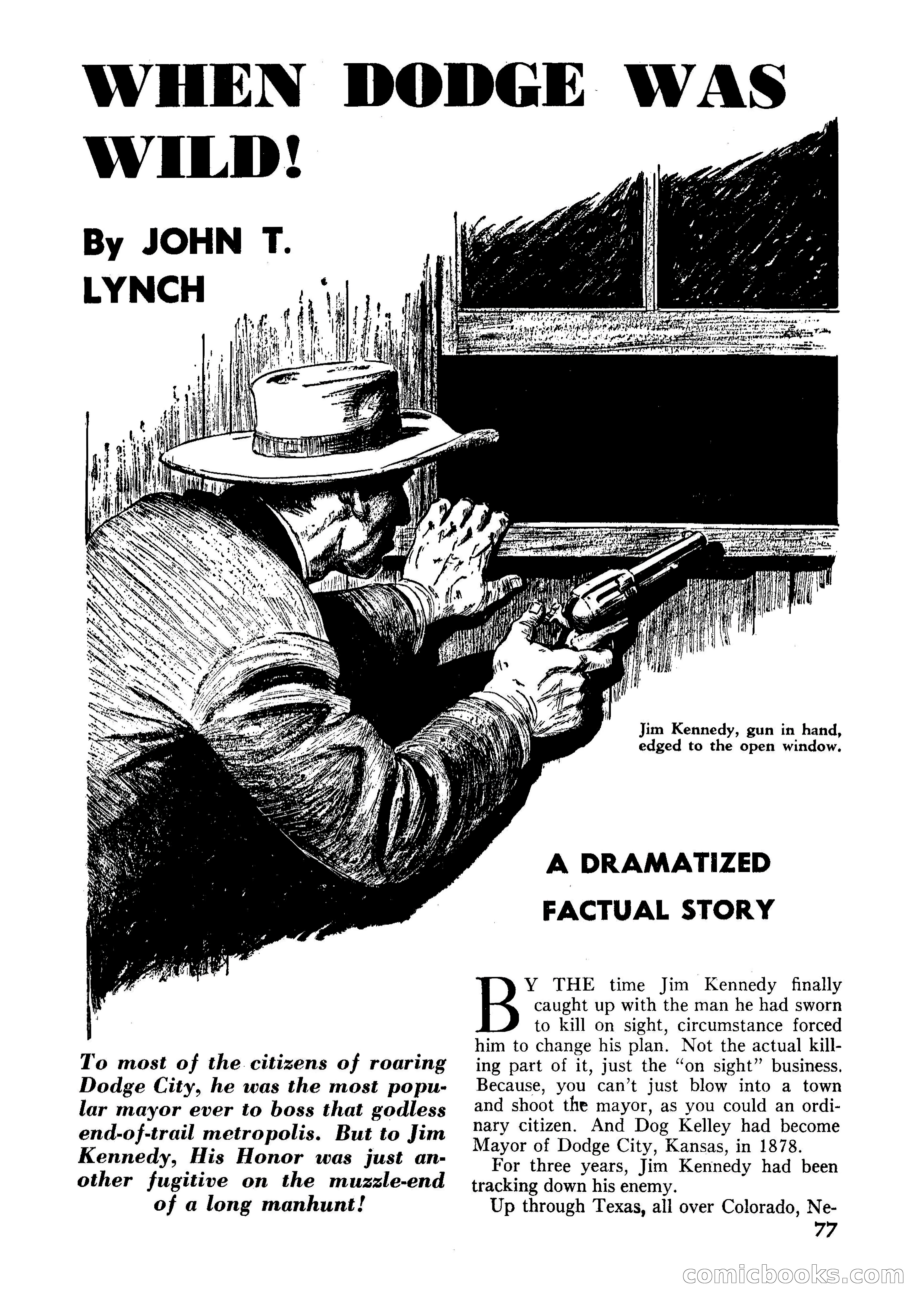
# Page Analysis This is an **interior story page** from a pulp magazine featuring an illustration and the opening of a Western fiction story. The page shows a dramatic pen-and-ink drawing of a man named Jim Kennedy positioned at a window with a revolver, apparently stalking his quarry. The story, titled "When Dodge Was Wild" by John T. Lynch, is described as "a dramatized factual story" about Kennedy's three-year pursuit of Dog Kelley, who has become Mayor of Dodge City, Kansas (in 1878). The narrative tension centers on Kennedy finally locating his target, only to face the complication that shooting the mayor requires different tactics than shooting an ordinary citizen.

Fifteen Western Tales, January 1953 — page 78 of 116
78 / 116
What you’re looking at · open this page on its own ↗

# Page Analysis This page contains story prose from a Western pulp fiction magazine titled "Fifteen Western Tales." The text depicts a revenge narrative: Jim Kennedy, who was shot and left for dead by his former crime partner Pitch Willser during a stagecoach robbery in 1875, has spent years tracking him down. Kennedy finally spots Willser in Dodge City on the Fourth of July—now living respectable as the town's mayor, riding in a parade. Kennedy reaches for his gun to shoot Willser but hesitates, realizing the townspeople revere their mayor and that Dodge City residents are known for violently resisting violence against strangers.

Fifteen Western Tales, January 1953 — page 79 of 116
79 / 116
What you’re looking at · open this page on its own ↗

# Page Analysis: Story Prose from "When Dodge Was Wild!" This is a text-only story page (page 79) from a pulp western fiction magazine. The narrative follows Jim Kennedy, who falls in love with Dora Hand, a beautiful singer at a Dodge City saloon. Learning that Mayor "Dog" Kelley also pursues her and considers her "private property," Kennedy decides to kill the Mayor. After surveilling Kelley's residence and avoiding his sight for days, Kennedy approaches the Mayor's house at midnight, gun in hand, moving toward the bedroom window. The story combines romantic interest with frontier vigilante violence typical of early pulp westerns.

Fifteen Western Tales, January 1953 — page 80 of 116
80 / 116
What you’re looking at · open this page on its own ↗

# Page 80: Story Prose from "Fifteen Western Tales" This page contains text-only story prose (no illustrations or advertisements visible). It depicts a Western narrative involving Jim Kennedy, who has accidentally killed Dora Hand while apparently intending to shoot the Mayor. After learning of his mistake, Kennedy confesses to famous lawman Bat Masterson and begs to be executed. Masterson, however, counsels Kennedy to flee to Texas instead, arguing that lynching is inevitable if Kennedy stays and that living with guilt is adequate punishment. The passage ends with Masterson watching Kennedy ride away.

Fifteen Western Tales, January 1953 — page 81 of 116
81 / 116
What you’re looking at · open this page on its own ↗

This is an interior story page from a pulp magazine, showing the opening of a short story titled "Sad Nose Joe—Rain-Maker!" by Harold Helfer. The page features a dramatic illustration of a Native American man with a lasso on the left side, and the story text presented as a letter to the "Great White Father in Washington." The narrative, written in stereotypical dialect, describes Sad Nose Joe's predicament: his Chippewa tribe is suffering from drought and demands he make rain, but he blames the town of Gunsmoke for interfering with rain clouds using aircraft.

Fifteen Western Tales, January 1953 — page 82 of 116
82 / 116
What you’re looking at · open this page on its own ↗

# Page Analysis This is **story prose** from a pulp fiction magazine titled "Fifteen Western Tales." The visible text presents a humorous narrative written in broken English, apparently from the perspective of Native American characters (Chippewa tribe members) addressing the "Great White Father in Washington" about a drought problem. The story involves characters named Long Tail Feathers, Sad Nose Joe, and One Eyebrow Sam discussing how the nearby town of Gunsmoke's activities are stopping rain clouds from reaching their territory, and debating solutions—including an idea involving lassooing clouds from "Mountain of the Big Snoot." The narrative employs heavy dialect and comedic tone typical of early-20th-century pulp fiction.

Fifteen Western Tales, January 1953 — page 83 of 116
83 / 116
What you’re looking at · open this page on its own ↗

# Page 83: Story Prose and Advertisement This page contains the conclusion of a humorous Western story titled "Sad Nose Joe—Rain-Maker!" The prose recounts Sad Nose Joe's arduous climb up the Mountain of the Big Snoot to lasso a cloud, with his perspective narrated through letters to the "Great White Father in Washington." The text employs comedic dialect and describes Joe's physical exhaustion as he ascends higher and higher. Below the story is an advertisement for an upcoming Western novelette titled "No Man's Guns" by William E. Vance, featuring an illustration of armed figures in action. The ad promotes it as a "stirring novelette" forthcoming in an upcoming January issue, along with other Western stories.

Fifteen Western Tales, January 1953 — page 84 of 116
84 / 116
What you’re looking at · open this page on its own ↗

# Page 84: "Fifteen Western Tales" — Story Prose This page contains story prose from a pulp western tale featuring a character named Sad Nose Joe. The narrative describes Joe's misadventure atop a sacred mountain, where he attempts to lasso rain by swinging a rope, falls down the mountainside with rocks following him, loses consciousness, and awakens in a hospital. The story concludes with Joe recovering and receiving visits from friends, including Long Tail Feathers, who explains that Joe's fall actually benefited the tribe by bringing down many stones and rocks—apparently validating the mountain's sacred status to the Chippewa people.

Fifteen Western Tales, January 1953 — page 85 of 116
85 / 116
What you’re looking at · open this page on its own ↗

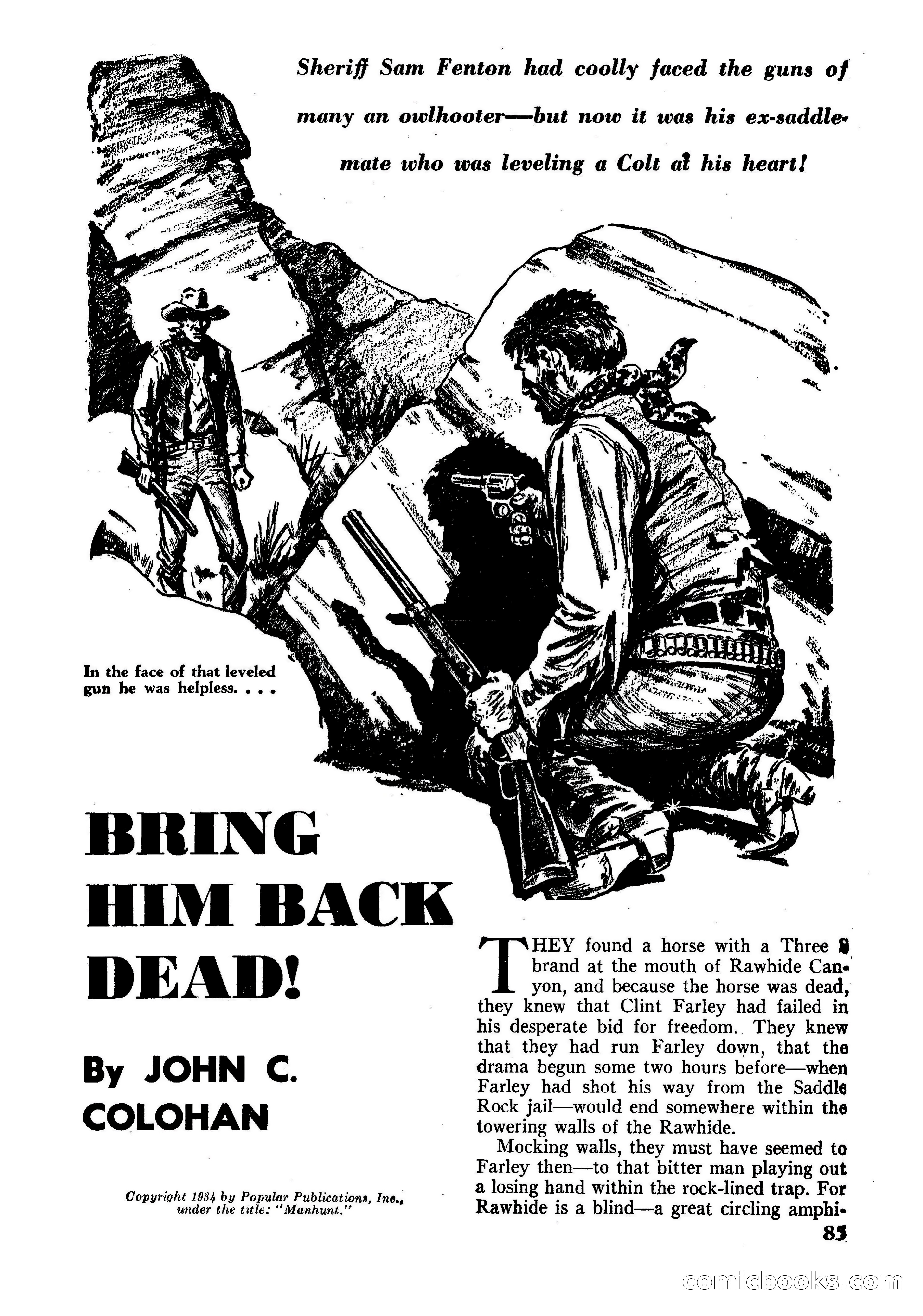
# Page Analysis This is a **story illustration and opening page** from a 1934 pulp western fiction magazine. The dramatic ink illustration shows Sheriff Sam Fenton confronted by his ex-saddle mate drawing a Colt revolver at him. The accompanying prose describes how a posse has tracked escaped prisoner Clint Farley after he shot his way out of Saddle Rock jail; finding a dead horse branded with the Three 9 signals Farley's failed escape attempt. The story, titled "Bring Him Back Dead!" by John C. Cologhan, appears to concern a desperate manhunt that will conclude at Rawhide Canyon.

Fifteen Western Tales, January 1953 — page 86 of 116
86 / 116
What you’re looking at · open this page on its own ↗

# Page Analysis This page contains **story prose** from a Western pulp fiction narrative titled "Fifteen Western Tales." The text depicts Sheriff Leonard organizing a posse to pursue fugitive Clint Farley into Rawhide Canyon. The sheriff discovers clues at a crime scene—a dead horse and a dropped silver dollar—then briefs his assembled posse members (named Hugh Miller, Anse Larson, Art Siminole, Riley Hatch, and deputy Sam Fenton) on their strategy to corner Farley, who was convicted of murder and is now escaped. The passage emphasizes Farley's dangerous, reckless nature and the posse's grim determination to capture him before nightfall.

Fifteen Western Tales, January 1953 — page 87 of 116
87 / 116
What you’re looking at · open this page on its own ↗

# Page Analysis This is **story prose** from a hardboiled crime/Western pulp magazine. The page depicts a tense confrontation in a canyon between Deputy Sam Fenton and his former partner Clint Farley, a fugitive whom Fenton has been hunting with a posse. Farley, cornered and disheveled, suddenly appears with drawn weapons and threatens Fenton, who realizes he's relieved to be held at gunpoint rather than having to arrest his old partner and bring him to jail. The scene explores the conflicted loyalty between the two men.

Fifteen Western Tales, January 1953 — page 88 of 116
88 / 116
What you’re looking at · open this page on its own ↗

# Page 88: Story Prose from "Fifteen Western Tales" This page contains story prose from a western pulp fiction magazine. The narrative depicts a tense confrontation between Deputy Sam Fenton and fugitive Clint Farley in a canyon. Fenton attempts to persuade the desperate Farley to surrender peacefully, claiming he'll investigate Farley's murder conviction. When Jim Blaney—Farley's apparent enemy—appears above them with a gun, Fenton realizes Blaney intends to shoot Farley from behind. Fenton draws his own weapon and shoots Blaney, causing him to fall into the gulley below. The passage emphasizes the sudden violence and moral complexity of the situation, with Fenton acting to prevent cold-blooded murder despite Farley's gun trained on him.

Fifteen Western Tales, January 1953 — page 89 of 116
89 / 116
What you’re looking at · open this page on its own ↗

# Page Analysis This page is story prose from a pulp-fiction Western, page 89 of what appears to be "Bring Him Back Dead!" The text depicts a crucial plot discussion between deputy Sam Fenton and fugitive Clint Farley, who is hiding in a canyon. Fenton notices a fresh bullet-burn scar on Jim Blaney's arm and begins suspecting Blaney, rather than Farley, may have killed Jess McCaulley. The two men analyze evidence—McCaulley's gun had two empty shells, suggesting McCaulley fired before dying—and discuss how someone may have framed Farley for the murder. Fenton is determined to find the real killer before other posse members arrive.

Fifteen Western Tales, January 1953 — page 90 of 116
90 / 116
What you’re looking at · open this page on its own ↗

# Page Analysis This is story prose from a Western pulp magazine titled "Fifteen Western Tales." The page depicts an intense gunfight scene in which Deputy Sam Fenton shoots at a man named Seminole who is pinned behind a boulder. Fenton fires repeatedly, forcing Seminole to stay hidden. Fenton then sends Clint Farley away and calls out to Seminole, claiming he has shot someone named Blaney. When the wounded Seminole emerges, he discovers it's actually Blaney—not Farley—lying unconscious nearby, leading to confusion about what has actually occurred.

Fifteen Western Tales, January 1953 — page 91 of 116
91 / 116
What you’re looking at · open this page on its own ↗

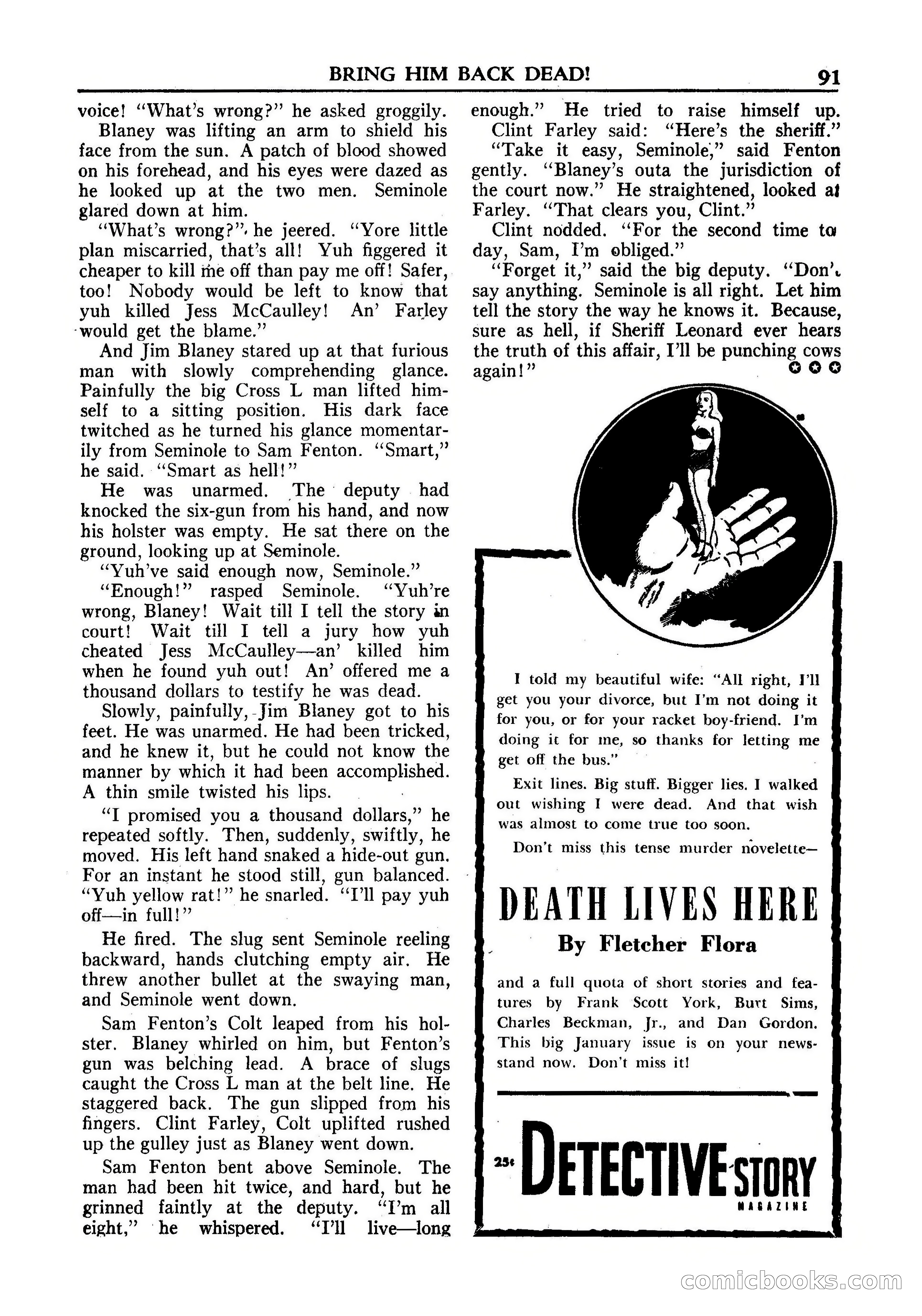
# Page Analysis: Detective Story Magazine This is page 91 of a hardboiled crime story, showing prose narrative text concluding a violent confrontation. The passage depicts a gunfight between characters named Blaney, Seminole, and Sam Fenton, ending with Blaney's death. Below the story text is an advertisement for *Detective Story Magazine*, promoting a January issue featuring a murder novelette titled "Death Lives Here" by Fletcher Flora, alongside short stories by other authors. The page includes a small circular illustration showing a hand holding ammunition or bullets. The layout is typical pulp-magazine format with dense text and promotional content.

Fifteen Western Tales, January 1953 — page 92 of 116
92 / 116
What you’re looking at · open this page on its own ↗

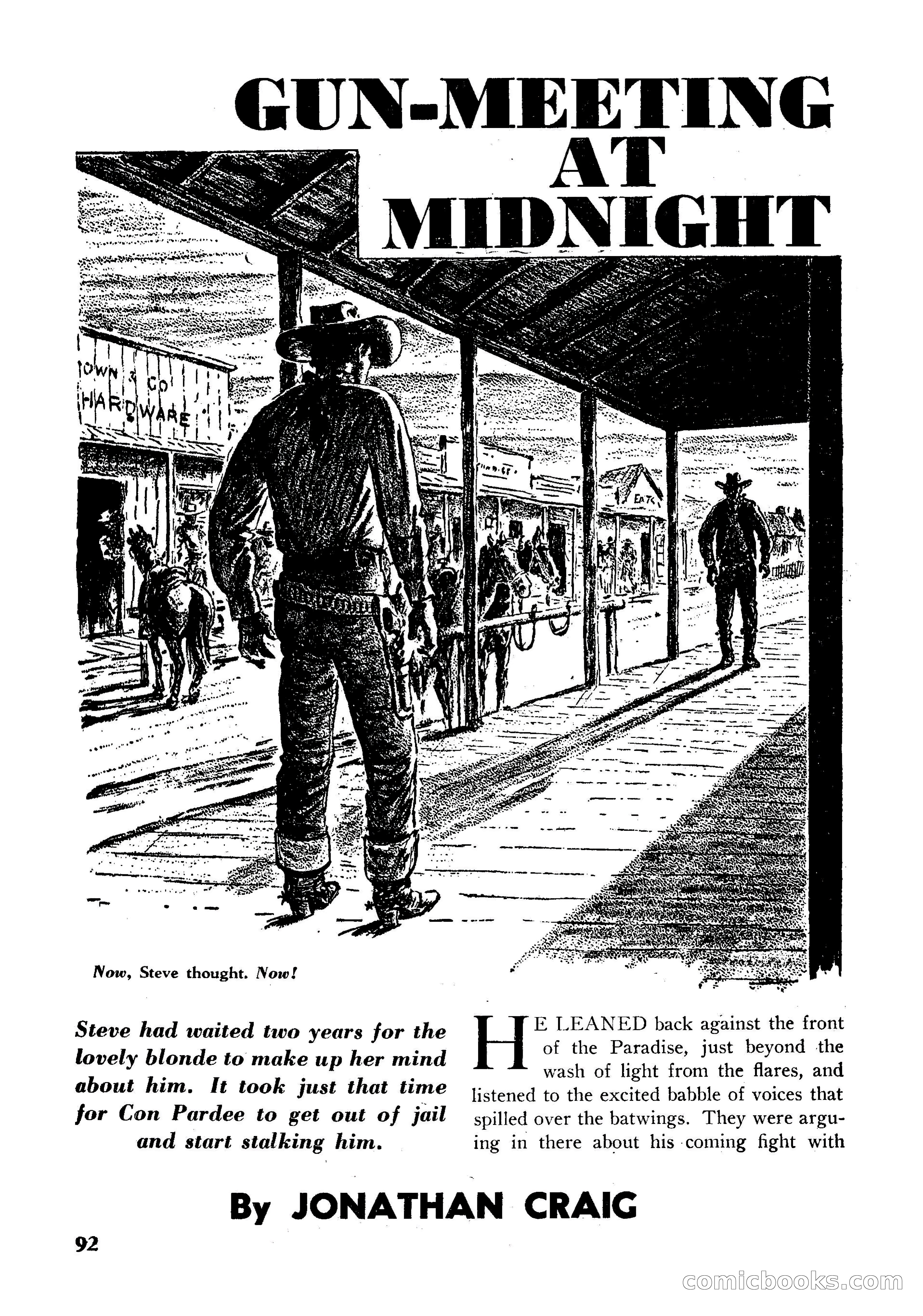
# Page Analysis This is a story opening page from a pulp fiction magazine featuring the title "Gun-Meeting at Midnight" by Jonathan Craig. The page includes a dramatic black-and-white illustration of a cowboy standing in a Western town street at night, with a hardware store visible and other figures in the background. Below the illustration is the story's opening prose, which introduces a character named Steve who has waited two years for a blonde woman to decide about him, only to have criminal Con Pardee released from jail and begin pursuing her. The narrative mentions Steve listening to voices from a saloon discussing an upcoming fight.

Fifteen Western Tales, January 1953 — page 93 of 116
93 / 116
What you’re looking at · open this page on its own ↗

# Gun-Meeting at Midnight This page contains story prose from what appears to be a Western pulp fiction magazine (page 93). The narrative follows Steve Jordan, a marshal in the town of Fever Wells, as he enters a saloon on the eve of a gunfight with the quick-draw artist Con Pardee. The townsfolk anticipate the duel, while a dying man named Lou taunts Steve at the bar, suggesting Steve framed Pardee for a crime to clear the way with a woman named Iris Manning. Steve struggles to maintain composure as Lou baits him, knowing he cannot fight a terminally ill man.

Fifteen Western Tales, January 1953 — page 94 of 116
94 / 116
What you’re looking at · open this page on its own ↗

# Page Analysis: Pulp Western Fiction This page contains story prose from "Fifteen Western Tales," a pulp western magazine. The narrative follows a character named Steve as he leaves a saloon and visits Iris Manning's millinery shop after a two-year separation. Steve catches Iris when she nearly falls from a chair, and they reunite emotionally, though tension emerges when Steve mentions Con Pardee—apparently a rival connected to a recent gunfight. The passage emphasizes Steve's physical attraction to Iris and his internal conflict about their relationship, culminating in Steve asking if she's "gotten over" someone (presumably Con Pardee).

Fifteen Western Tales, January 1953 — page 95 of 116
95 / 116
What you’re looking at · open this page on its own ↗

# Page Analysis This is story prose from a pulp fiction magazine, specifically page 95 of "Gun-Meeting at Midnight." The text depicts an emotionally charged confrontation between Steve and Iris, a woman torn between her feelings for Steve and another man named Con Pardee. Steve has arranged a midnight gunfight with Con, seemingly over Iris. The scene progresses from their argument about her divided loyalties to an intimate farewell embrace, as Steve appears resigned to his likely death in the coming duel. The passage captures classic pulp fiction themes of doomed romance, male honor, and violent conflict.

Fifteen Western Tales, January 1953 — page 96 of 116
96 / 116
What you’re looking at · open this page on its own ↗

This page contains story prose from a Western pulp fiction narrative titled "Fifteen Western Tales." The text depicts a confrontation between a man named Steve and a woman named Iris, who attempts to dissuade him from fighting someone called Con Pardee. After Steve refuses and leaves, the narrative follows him to the Inferno Saloon at midnight, where he prepares for a gunfight. The passage emphasizes the tension and danger of the impending duel, with Steve checking his holstered weapons as he waits outside the saloon.

Fifteen Western Tales, January 1953 — page 97 of 116
97 / 116
What you’re looking at · open this page on its own ↗

# Page Analysis: Story Prose This page contains prose fiction from a story titled "Gun-Meeting at Midnight" (page 97). The text depicts a climactic gunfight and hand-to-hand combat between two characters, Steve and Con Pardee, in what appears to be a Western setting. Steve is wounded after being shot in the shoulder during their duel, and the narrative follows his desperate struggle as Pardee, having deliberately winged him, now pursues him for a brutal bare-handed finish to their promised confrontation. The action is presented in vivid, moment-by-moment detail typical of pulp-fiction storytelling.

Fifteen Western Tales, January 1953 — page 98 of 116
98 / 116
What you’re looking at · open this page on its own ↗

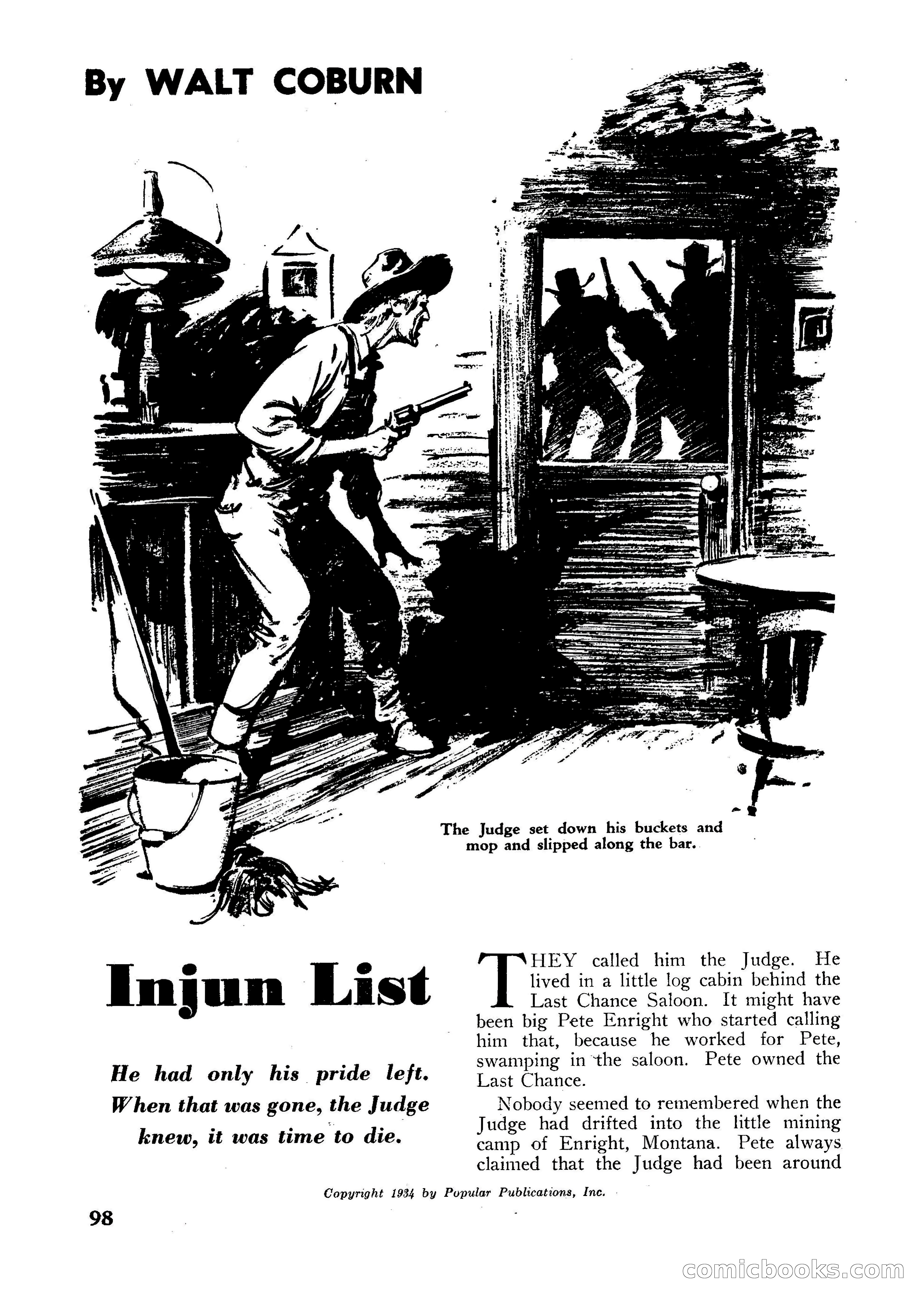
This is a story page from a 1934 pulp magazine featuring "Injun List" by Walt Coburn. The page includes an illustration showing a man with a rifle near a saloon bar, with shadowy figures visible through a doorway. The text introduces a character called "the Judge," a man living in a log cabin behind the Last Chance Saloon in Enright, Montana, where he works as a swamper for the saloon owner Pete Enright. The story's epigraph suggests the Judge has lost his pride and faces a grim fate.

Fifteen Western Tales, January 1953 — page 99 of 116
99 / 116
What you’re looking at · open this page on its own ↗

This is story prose from a pulp fiction magazine. The text describes a mining-camp setting where a saloonkeeper named Pete Enright places a fallen gentleman—referred to only as "the Judge"—on the "Injun List," a blacklist of men forbidden to drink alcohol. The passage explores the irony that Pete, a rough miner who owns the town's saloon, doesn't realize how deeply he's hurt the dignified but alcoholic Judge through this public humiliation, while also showing Pete's rough kindness toward the man.

Fifteen Western Tales, January 1953 — page 100 of 116
100 / 116
What you’re looking at · open this page on its own ↗

# Page Analysis This page contains story prose from a Western pulp fiction magazine titled "Fifteen Western Tales" (page 100). The text depicts a story set in a mining camp where Pete Enright, who has struck gold, humiliates an elderly drunken janitor known as "the Judge" by adding his name to an "Injun List" at the bar as a cruel prank. The narrative follows the Judge's devastated reaction upon discovering this humiliation, his subsequent illness and recovery, and his changed behavior afterward. The story explores themes of dignity, alcoholism, and social cruelty in a frontier mining community.

Fifteen Western Tales, January 1953 — page 101 of 116
101 / 116
What you’re looking at · open this page on its own ↗

# Page Analysis This page contains **story prose** from a hardboiled crime/western pulp fiction titled "Injun List." The visible text depicts a dramatic confrontation: a character called "the Judge" observes Pete Enright—a man who once befriended him despite putting him on the mysterious "Injun List"—being ambushed and shot by three armed robbers at the Last Chance saloon. The narrative explores the Judge's conflicted feelings toward Enright, whom he both resents and feels indebted to, while describing the violent holdup attempt unfolding before him.

Fifteen Western Tales, January 1953 — page 102 of 116
102 / 116
What you’re looking at · open this page on its own ↗

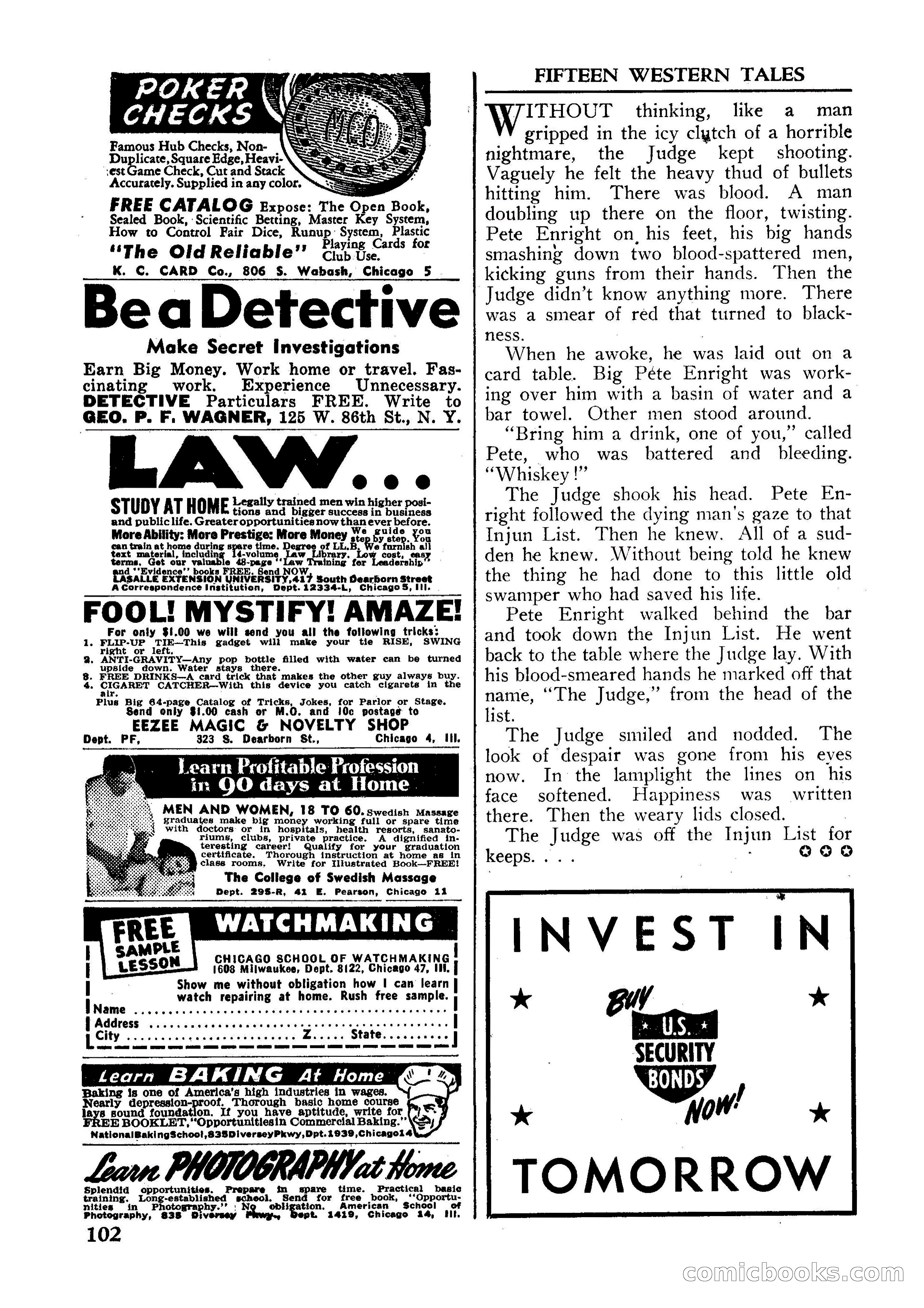
# Page Description This is a story page from *Fifteen Western Tales*, a pulp fiction magazine. The left two-thirds consists of various classified advertisements (for poker chips, detective work, correspondence courses, magic tricks, and vocational training), while the right column contains prose narrative about a violent gunfight. The story describes a judge being shot and losing consciousness, then awakening on a card table where a man named Pete Enright tends to his wounds and requests whiskey. The page number is 102.

Fifteen Western Tales, January 1953 — page 103 of 116
103 / 116
What you’re looking at · open this page on its own ↗

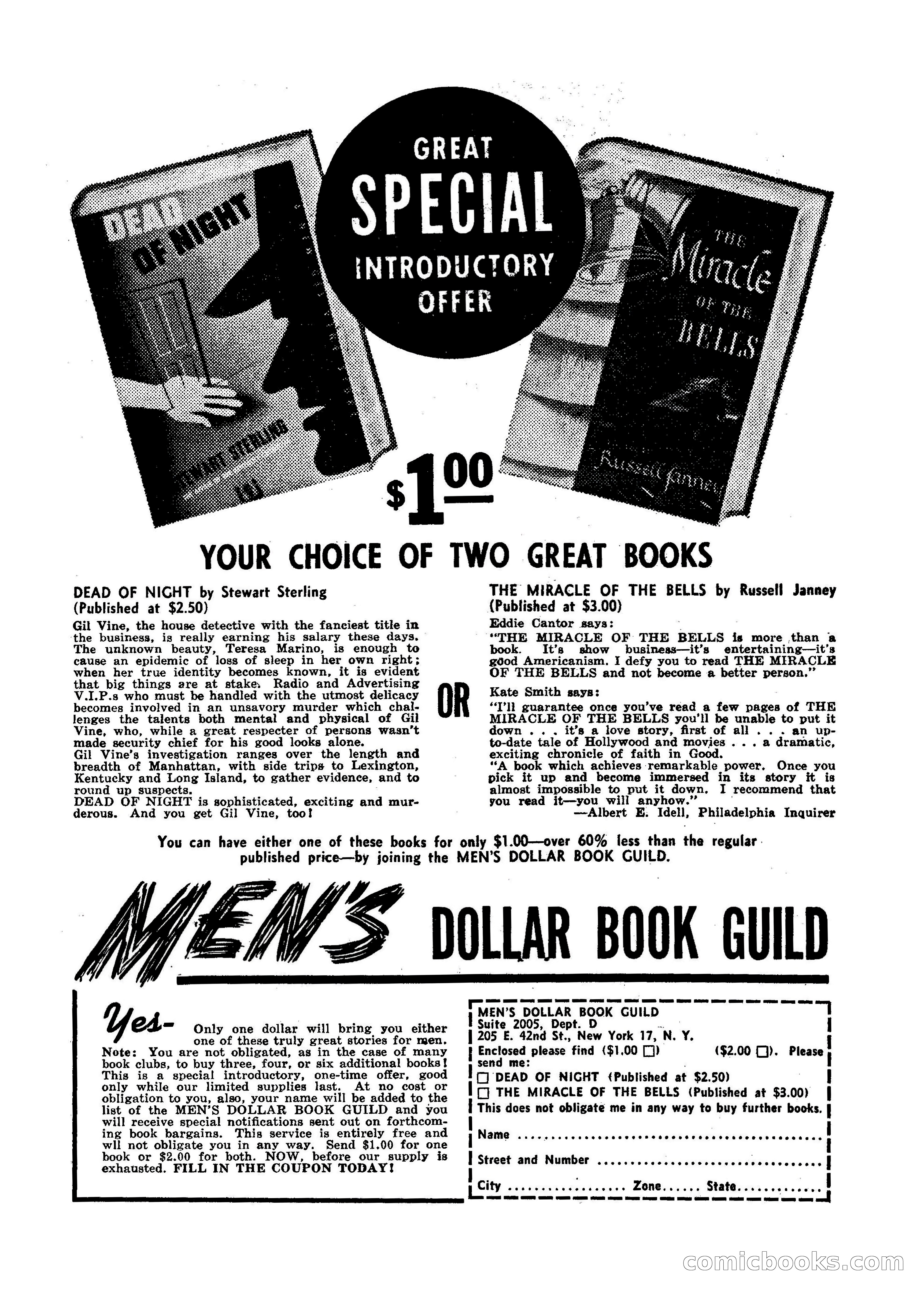
# This is an Advertisement Page This page is a full-page advertisement for the Men's Dollar Book Guild, promoting an introductory offer of two discounted hardcover novels. For $1.00, readers could choose either *Dead of Night* by Stewart Sterling (a mystery featuring detective Gil Vine investigating a murder involving radio and advertising figures in Manhattan) or *The Miracle of the Bells* by Russell Janney (a drama about faith, Hollywood, and love). The ad includes endorsements from Eddie Cantor and Kate Smith, emphasizing the books' quality and entertainment value, along with a mail-in coupon for ordering.

Fifteen Western Tales, January 1953 — page 104 of 116
104 / 116
What you’re looking at · open this page on its own ↗

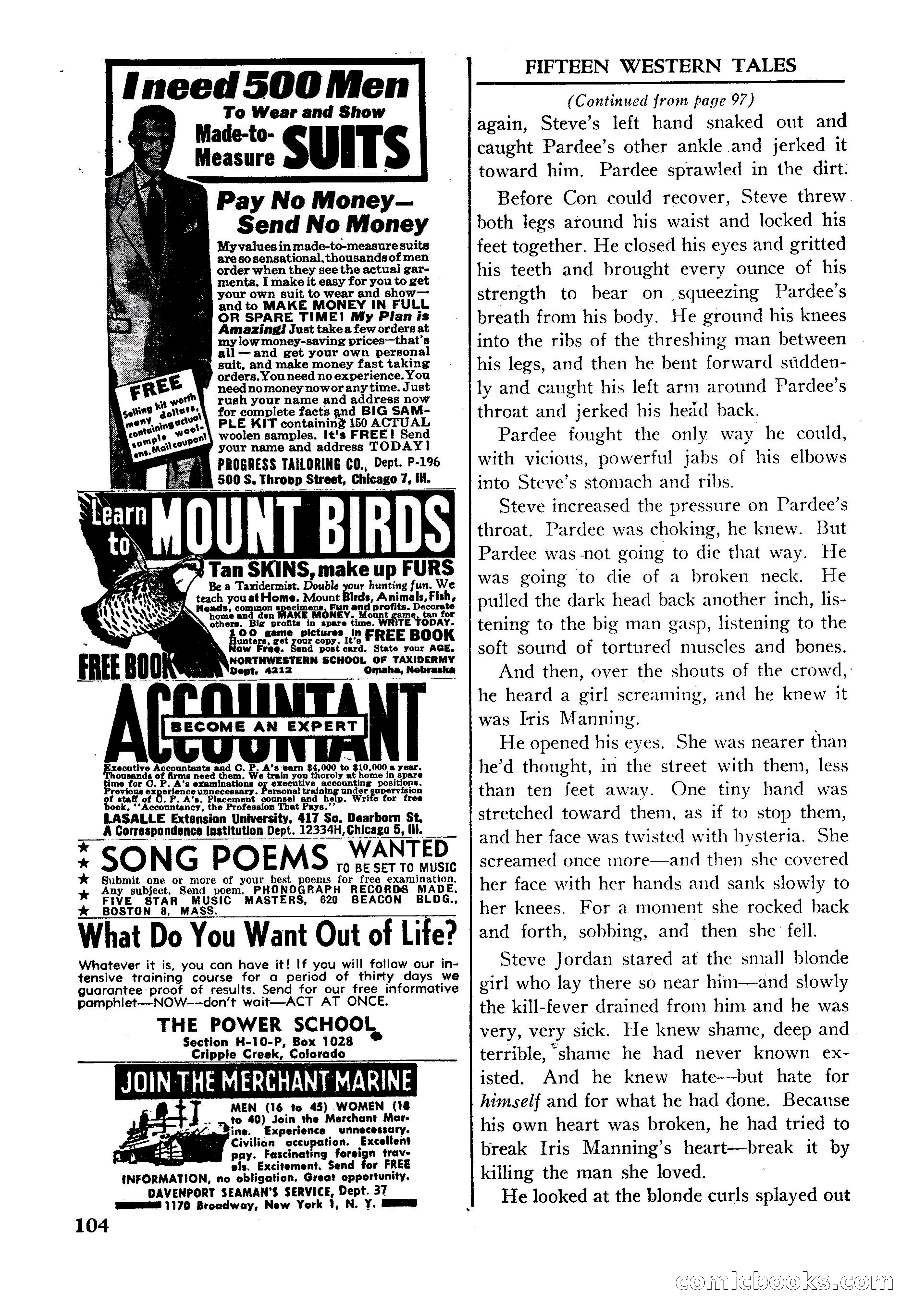
# Page Analysis: "Fifteen Western Tales" This page contains story prose (continuing from page 97) alongside period advertisements. The visible fiction text depicts a violent fight scene between characters named Steve and Pardee, with Steve applying a chokehold while Pardee attempts to escape using elbow strikes. The narrative focuses on Steve's determination to break Pardee's neck and his awareness of a blonde girl named Iris Manning nearby, apparently screaming. The left side of the page is dominated by early-20th-century classified advertisements for mail-order services including tailoring, taxidermy, accounting courses, and merchant marine recruitment.

Fifteen Western Tales, January 1953 — page 105 of 116
105 / 116
What you’re looking at · open this page on its own ↗

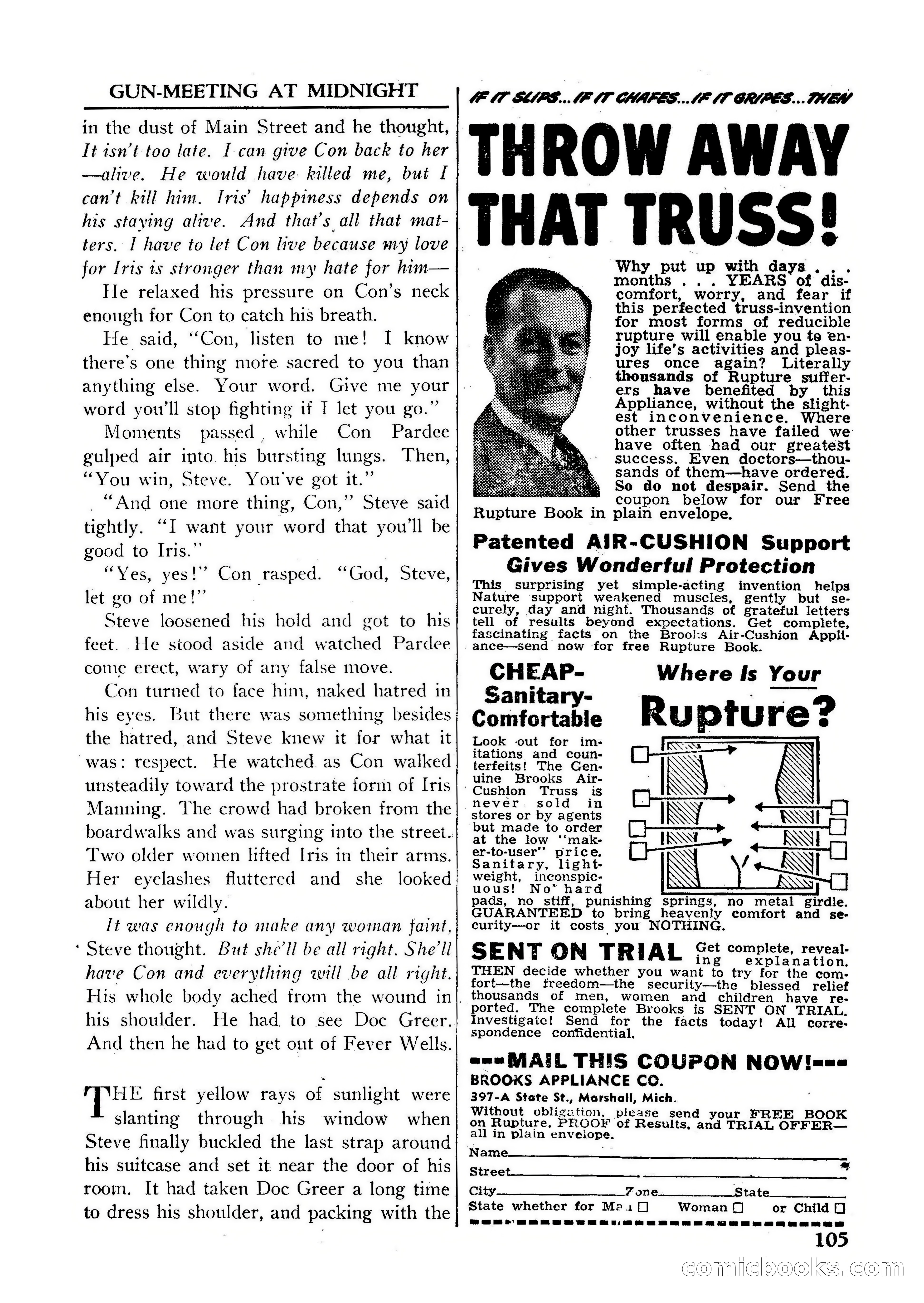
# Page Analysis This page contains the conclusion of a pulp-fiction crime or western story titled "Gun-Meeting at Midnight," alongside a full-page medical advertisement. The story prose describes a tense confrontation where a character named Steve releases his grip on Con Pardee's neck after extracting his word of honor to stop fighting and treat a woman named Iris well. The narrative then shifts to the following morning, showing Steve packing his suitcase after visiting Doc Greer to have his shoulder wound dressed. The right half of the page is dominated by an advertisement for the "Brooks Air-Cushion Support" truss—a medical device for treating rupture. The ad includes a testimonial-style header, product description, and a mail-in coupon for a free "Rupture Book."

Fifteen Western Tales, January 1953 — page 106 of 116
106 / 116
What you’re looking at · open this page on its own ↗

# Page Analysis: Pulp Magazine with Mixed Content This page contains the final portion of a Western story titled "Fifteen Western Tales" alongside several advertisements. The story prose depicts a dramatic confrontation between a man named Steve and a woman named Iris Manning, who has come to his room with a packed suitcase. She reveals that a man named Con has left town after discovering something Steve did, and she's offering to leave with Steve. The narrative emphasizes romantic tension and apparent moral conflict. The upper half of the page is dominated by various mail-order advertisements (medical booklets, book matches, high school courses, hypnotism training, and color slides), typical of pulp magazine monetization.

Fifteen Western Tales, January 1953 — page 107 of 116
107 / 116
What you’re looking at · open this page on its own ↗

# Page Content Analysis This page contains the conclusion of a pulp-fiction Western story titled "Gun-Meeting at Midnight," showing prose narrative of an emotional reunion between two characters, Steve and Iris, after a separation. The text depicts their reconciliation following Steve's injury and decision to leave his marshal position. The right half of the page features a full-page advertisement for the Rosicrucians (AMORC), an organization claiming to teach self-mastery and mental powers. It prominently features a portrait of Benjamin Franklin, identifying him as a Rosicrucian, and offers a free book titled "The Mastery of Life" via a coupon readers can mail in. The advertisement emphasizes the organization's non-profit status and lack of salesmen.

Fifteen Western Tales, January 1953 — page 108 of 116
108 / 116
What you’re looking at · open this page on its own ↗

# Page Analysis This page contains the **conclusion of a Western story** ("Fifteen Western Tales," continued from page 72) alongside **vintage advertisements** from an early-20th-century pulp magazine. The story prose describes a tense scene where characters stand on a muddy slope during threatening weather. A man named Joel Kalder confronts Bill Shawn on a high perch as wind threatens to topple them. Shawn begins climbing toward Kalder, who pulls a revolver and fires, shooting Shawn in the head. The narrative breaks off mid-sentence. The left column features period advertisements for correspondence courses and mail-order products: plastics training, hypnotism instruction, horsesmanship training, tobacco cessation treatment, a poetry contest, and a free arthritis book.

Fifteen Western Tales, January 1953 — page 109 of 116
109 / 116
What you’re looking at · open this page on its own ↗

# Page 109: Story Prose with Advertisements This page contains the conclusion of a Western adventure story titled "Over the Hill to Hell." The narrative prose describes a dramatic scene where protagonist Shawn defeats a lawyer named Kalder in a physical confrontation atop a mountain, then leads his group in hauling a wagon up a steep slope. The story continues with Shawn traveling across a plateau with a woman named Hannah and her two sons, heading toward Oregon. The page also features three vintage advertisements: a Halvorfold leather wallet with gold personalization, a rupture relief treatment offer, and a diamond loan company promotion—typical of early pulp magazine advertising.

Fifteen Western Tales, January 1953 — page 110 of 116
110 / 116
What you’re looking at · open this page on its own ↗

# Page Description This page is primarily **advertising**, with a continuation of story prose at the bottom. The advertisements promote various products: a perfume called "Temptation," surplus military parkas and jackets, ear wax drops, tooth remedies, and a refrigerator defrost attachment. The story text at the bottom, continued from page 6 of "Fifteen Western Tales," discusses the geology of Arizona mountain ranges, gold mining formations, and the history of placer mining operations near the Vulture Mine, dating from 1867 onward.

Fifteen Western Tales, January 1953 — page 111 of 116
111 / 116
What you’re looking at · open this page on its own ↗

This page contains the continuation of a pulp-fiction story titled "Hell on Wheels" alongside several period advertisements. The story prose describes a dispute over gambling bets following a character's death and burial—men who wagered that one corpse would be interred before another now demand payment from a reluctant stakeholder. The remainder of the page features vintage advertisements for auto seat covers, Miles Nervine (a nerve tonic), Union Label book matches, invisible reweaving services, and other mail-order products typical of mid-20th-century pulp magazines.

Fifteen Western Tales, January 1953 — page 112 of 116
112 / 116
What you’re looking at · open this page on its own ↗

# Page Description This page from *Fifteen Western Tales* pulp magazine contains story prose on the right side and vintage advertisements on the left. The story text describes a Western scene where Big Tim awaits confirmation that a man named Jed Mink has been buried, then receives news from a burial party that the task is complete. The left side features period advertisements for dental plates, saw-sharpening equipment, patent attorneys, voice improvement courses, lucky talismans, and rupture remedies—typical mail-order pitches from early pulp magazines.

Fifteen Western Tales, January 1953 — page 113 of 116
113 / 116
What you’re looking at · open this page on its own ↗

# Page Content Summary This page contains the conclusion of a Western pulp fiction story titled "The Bushwhack Bargain" (continued from page 42), depicting a gunfight and its aftermath. The prose describes a violent confrontation where Jesse shoots Cole Tolman, then the protagonist rides away toward the foothills, observing the distant town below with mixed emotions. The page is dominated by vintage toy advertisements from Novelty Mart, including a ventriloquist dummy cowboy doll ($2.98), an eight-piece metal toy car set ($2.98), and an electric remote-control Electra-Jeep ($3.98). Each advertisement emphasizes realistic features and action capabilities designed to appeal to children.

Fifteen Western Tales, January 1953 — page 114 of 116
114 / 116
What you’re looking at · open this page on its own ↗

# Advertisement Page from Pulp Magazine This is an advertisement page from a pulp magazine, featuring three mail-order product promotions. The page advertises a perfume gift set (12 bottles for $2), a ladies' dress watch ($9.95), and a "Taboo" brand negligee gown ($7.95). Each product includes illustrated imagery and descriptive copy emphasizing luxury and appeal to female readers. The bottom half contains a tear-away coupon for Young Products in Detroit, allowing readers to order the checked items with a ten-day trial period and money-back guarantee. The layout uses typical pulp-era advertising design with bold typography and sensationalized product descriptions.

Fifteen Western Tales, January 1953 — page 115 of 116
115 / 116
What you’re looking at · open this page on its own ↗

# Analysis This page is primarily **advertising material** from a pulp magazine, featuring three mail-order product advertisements arranged in columns. The visible ads promote: hi-power binoculars ($2.98) with American Optical lenses, a wrist watch with a "mechanical brain" that remembers the time and date ($8.95), and an electronic walkie-talkie communication system ($3.95). Each item emphasizes a "10 Day Free Trial" and "100% Money Back Guarantee." At the bottom is a mail-in order coupon for Young Products, Dept. 472 in Detroit, Michigan. The advertisements use typical pulp-era marketing language ("What a Buy!") and appeal to consumer desire for novelty gadgets and technology.

Fifteen Western Tales, January 1953 — page 116 of 116
116 / 116
What you’re looking at · open this page on its own ↗

# What's on This Page This is an advertisement page for the Dollar Book Club, a mail-order book service. The page displays six bestselling books available for selection—including *The Caine Mutiny*, *The President's Lady*, *The Gown of Glory*, and others—offering any three titles for $1 plus shipping. A large coupon at the bottom allows readers to enroll in the club and receive their first three books at this promotional price, with subsequent monthly selections available at similar discounts compared to publishers' retail prices.

Browse this issue page by page

Each page has its own page — the cartoon, who’s in it, and what the satire means.

  1. Page 1 # Fifteen Western Tales Cover (January issue, 25 cents) This is the cover of a pulp magazine featuring an action-packed Western illustration. The main story adv…
  2. Page 2 # Analysis of Advertisement Page This is a full-page advertisement, not story content or illustration. The page promotes State Finance Company's mail-order loan…
  3. Page 3 # Analysis of This Page This is a full-page advertisement, not a story or editorial content. The page promotes the "Electric Spot Reducer," a plug-in massage de…
  4. Page 4 This is a table of contents page from *Fifteen Western Tales*, Volume 26, No. 3 (January 1953). The page lists eighteen stories and features, predominantly West…
  5. Page 5 # What This Page Shows This is an advertisement page from a pulp magazine promoting International Correspondence Schools (I.C.S.), a correspondence education co…
  6. Page 6 This page presents the opening of a nonfiction advice column titled "The Prospector" by Vic Shaw, a mining and mineralogy expert. The page includes an illustrat…
  7. Page 7 This is an advertisement page from a pulp magazine promoting correspondence school training to become a licensed TV technician. The ad emphasizes practical hand…
  8. Page 8 # "Hell on Wheels!" by Bart Cassidy This page contains the opening of a Western pulp fiction story. The text describes a deadly feud between two railroad foreme…
  9. Page 9 # What This Page Shows This is an advertisement page from a pulp magazine promoting "Joan the Wad," a mail-order lucky charm or mascot. The page features testim…
  10. Page 10 # Page Analysis This is **story prose** from a Western pulp fiction magazine titled "Fifteen Western Tales." The page continues a narrative about a feud in a ra…
  11. Page 11 # Advertisement Page This is an advertisement page from a pulp magazine featuring lingerie products. The page promotes personalized panties and nighties sold by…
  12. Page 12 # Page Analysis This is the opening page of a Western pulp fiction story titled "Ride with the Gunsmoke Judas" by Thomas Thomson. The page features a dramatic w…
  13. Page 13 This is an interior illustration from a pulp fiction story, rendered in bold black-and-white ink. The image depicts a dramatic confrontation scene: a man standi…
  14. Page 14 # Page Analysis This is **story prose** from a Western pulp fiction magazine titled "Fifteen Western Tales" (page 14). The passage depicts a tense scene where C…
  15. Page 15 # Page Analysis This is **story prose** from a Western pulp fiction tale titled "Ride with the Gunsmoke Judas" (page 15). The text depicts a confrontation betwe…
  16. Page 16 # Page Analysis: Story Prose from "Fifteen Western Tales" This page contains story prose from a Western pulp fiction tale. The narrative follows a character nam…
  17. Page 17 # Page Content: Story Prose This page contains the middle section of a Western pulp fiction story titled "Ride with the Gunsmoke Judas." The text follows protag…
  18. Page 18 # Page Analysis: Story Prose from "Fifteen Western Tales" This page contains printed story prose from a Western pulp magazine. It shows the end of an opening sc…
  19. Page 19 # Page Analysis This is **story prose** from a Western pulp fiction magazine titled "Ride with the Gunsmoke Judas." The page depicts a tense confrontation where…
  20. Page 20 # Page Analysis This page contains **story prose** from a Western pulp fiction tale titled "Fifteen Western Tales." The narrative depicts a tense confrontation …
  21. Page 21 # Page Analysis This is **story prose** from page 21 of a pulp western titled "Ride with the Gunsmoke Judas." The passage depicts an intense confrontation betwe…
  22. Page 22 # Page Analysis This is **story prose** from a Western pulp fiction magazine titled "Fifteen Western Tales" (page 22). The text depicts a dramatic moment where …
  23. Page 23 # Page Analysis This page contains story prose from a Western pulp fiction narrative titled "Ride with the Gunsmoke Judas." The text depicts a dramatic confront…
  24. Page 24 # Page Analysis: Story Prose from "Fifteen Western Tales" This page contains story prose—specifically the continuation of a Western narrative titled "Fifteen We…
  25. Page 25 # Page Analysis: Story Prose This page contains story prose from "Ride with the Gunsmoke Judas," a Western pulp fiction narrative. The text depicts the climacti…
  26. Page 26 # Page Analysis This is story prose from a Western pulp magazine titled "Fifteen Western Tales" (page 26). The text depicts a violent gunfight at a remote cabin…
  27. Page 27 # Page Analysis This page contains **story prose** from a Western pulp fiction narrative titled "Ride with the Gunsmoke Judas." The text depicts the aftermath o…
  28. Page 28 # Page Analysis This is an interior story page from a pulp magazine, featuring the opening of a Western fiction story titled "The Deadly Second" by Henry Carlto…
  29. Page 29 # Page Analysis This is story prose from a pulp-fiction Western, page 29 of "The Deadly Second." The narrative follows Mattie, wife of Sheriff Andrew, as she le…
  30. Page 30 # Page Analysis This page contains story prose from a Western pulp fiction tale titled "Fifteen Western Tales." The narrative depicts a woman (Mattie Cameron) v…
  31. Page 31 # Page Analysis This page contains story prose from a pulp fiction narrative titled "The Deadly Second" (page 31), interrupted by a vintage advertisement. The s…
  32. Page 32 # Page Description This page contains story prose from a Western pulp fiction magazine titled "Fifteen Western Tales." The narrative follows a woman who has man…
  33. Page 33 # Analysis of Page 33 from "The Deadly Second" This page contains story prose from what appears to be a hardboiled crime or Western pulp fiction narrative. The …
  34. Page 34 View this page →
  35. Page 35 # Page Analysis This is an interior story page from a pulp Western magazine. It presents the opening of a short story titled "The Bushwhack Bargain" by Richard …
  36. Page 36 This page contains story prose from a Western pulp fiction magazine titled "Fifteen Western Tales." The narrative follows a gunslinger named Jesse (apparently J…
  37. Page 37 # Page Analysis: "The Bushwhack Bargain" This page contains story prose from a pulp Western fiction titled "The Bushwhack Bargain" (page 37). The narrative foll…
  38. Page 38 This page contains story prose from a Western pulp fiction magazine titled "Fifteen Western Tales." The narrative depicts a hired killer named Jesse negotiating…
  39. Page 39 # Page Analysis This is **story prose** from page 39 of a pulp western titled "The Bushwhack Bargain." The text depicts a tense confrontation in a saloon betwee…
  40. Page 40 # Page Analysis This is **story prose** from a Western pulp fiction tale titled "Fifteen Western Tales." The page depicts a conversation between a drifter named…
  41. Page 41 # Page Analysis This page contains story prose from a Western pulp fiction titled "The Bushwhack Bargain" (page 41). The narrative follows a gunman named Harder…
  42. Page 42 This page contains story prose from "Fifteen Western Tales," a pulp fiction magazine. The text depicts a gunfight scene in which a character named Jesse, who ha…
  43. Page 43 # Page Analysis This is an interior story page from a pulp magazine, featuring an illustration at the top and the beginning of a Western story titled "Never Sel…
  44. Page 44 # Page Analysis This is **story prose** from page 44 of *Fifteen Western Tales*, a pulp western magazine. The text depicts a destitute cowpuncher named Clinton …
  45. Page 45 # Page 45: Story and Advertisement This page contains Western pulp fiction prose alongside period advertising. The story narrative—titled "Never Sell Your Saddl…
  46. Page 46 This page contains story prose from a Western pulp fiction magazine titled "Fifteen Western Tales." The narrative depicts young Ernie Clinton arriving at a ranc…
  47. Page 47 # Page Analysis This is **story prose** from page 47 of a Western pulp fiction magazine titled "Never Sell Your Saddle!" The visible text depicts a confrontatio…
  48. Page 48 # Page 48 from "Fifteen Western Tales" This page contains story prose from a Western pulp fiction narrative. The text depicts a confrontation between three ranc…
  49. Page 49 # Page 49: Story Prose This page contains prose fiction from a western or crime narrative titled "Never Sell Your Saddle!" The text describes a violent confront…
  50. Page 50 # Page Analysis **Type:** Story prose from a western pulp magazine **Content:** This page contains the conclusion of a dramatic scene from "Fifteen Western Tale…
  51. Page 51 # Page Content Description This is a quiz page from a pulp magazine featuring "Cattle Country Quiz" by Hallack McCord. The page displays a woodcut-style illustr…
  52. Page 52 This is a story opening page from a pulp magazine featuring a hardboiled crime narrative. The dramatic illustration shows a man with a revolver in what appears …
  53. Page 53 This page contains an illustration and story prose from a pulp-fiction magazine. The black-and-white illustration depicts a tall, broad-shouldered man in a cowb…
  54. Page 54 # Page 54 of "Fifteen Western Tales" This page contains prose fiction from a Western pulp magazine. The narrative follows Barney, a struggling bar-hopper in Dod…
  55. Page 55 # Page Analysis **Type:** Story prose (page 55 of what appears to be a hardboiled Western pulp fiction magazine titled "Draw Fast—or Die!") **Content:** This pa…
  56. Page 56 # Page 56: Prose from a Western Pulp Story This page contains story prose from "Fifteen Western Tales," a Western pulp fiction magazine. The narrative depicts a…
  57. Page 57 # Page Analysis This is **story prose** from a pulp fiction magazine titled "Draw Fast—or Die!" (page 57). The page contains two sections: the conclusion of Cha…
  58. Page 58 This is a prose page from a hardboiled Western pulp story titled "Fifteen Western Tales." The narrative follows a character named Barney, a bartender who appear…
  59. Page 59 # Page Analysis This is story prose from a hardboiled Western pulp magazine titled "Draw Fast—or Die!" (page 59). The text depicts a tense scene where protagoni…
  60. Page 60 # Page Analysis: Pulp Fiction Story Prose This page contains story prose from a Western pulp fiction tale. The narrative follows a character named Barney Steven…
  61. Page 61 This is a page of story prose from what appears to be a hardboiled crime or western pulp magazine titled "Draw Fast—or Die!" The visible text depicts the climax…
  62. Page 62 # Page 62: Story Prose and Answer Key This page contains the conclusion of a Western story titled "Fifteen Western Tales," depicting a romantic scene between ch…
  63. Page 63 This is a story page from a pulp fiction magazine titled "The Medicine Wire" by Bennett Foster. The page opens a frontier adventure story about Andy Curtis, des…
  64. Page 64 # Page Analysis This is **story prose** from a Western pulp fiction magazine titled "Fifteen Western Tales." The page depicts a dramatic confrontation unfolding…
  65. Page 65 This page of prose fiction from "The Medicine Wire" depicts a scene at Sand Creek telegraph station in 1863, where operator Andy Curtis receives a dispatch abou…
  66. Page 66 # Page Analysis This is an interior story page from a pulp magazine featuring "Tales of the" by Lee. The page combines illustrated panels and prose text to tell…
  67. Page 67 # Page Analysis This is a story prose page (likely from a pulp Western magazine) with accompanying illustrations. The text recounts historical anecdotes about C…
  68. Page 68 # Page Analysis This is an interior story page from a pulp magazine, featuring the beginning of a Western fiction story titled "Over the Hill to Hell" by Robert…
  69. Page 69 # Page Analysis This is **story prose** from a pulp fiction magazine titled "Over the Hill to Hell" (page 69). The text depicts a dramatic scene in which Bill S…
  70. Page 70 # Page Analysis This is story prose from "Fifteen Western Tales," a pulp western magazine. The page depicts a dramatic scene in which a wagon team attempts to h…
  71. Page 71 # Page Analysis: Story Prose from "Over the Hill to Hell" This is a text page from a pulp fiction story titled "Over the Hill to Hell" (page 71). The page conta…
  72. Page 72 # Page Analysis This page contains **story prose** from a Western pulp fiction magazine titled "Fifteen Western Tales." The narrative follows Bill Shawn, a wago…
  73. Page 73 # Pulp Magazine Preview Page This is a preview page from *Fifteen Western Tales*, published January 2nd, featuring four black-and-white illustrations with accom…
  74. Page 74 # Page Analysis This is an interior story page from a pulp fiction magazine, likely Western genre. It presents the opening of a short story titled "While the Ga…
  75. Page 75 This page contains story prose from a pulp fiction magazine titled "While the Gallows Wait" (page 75). The text depicts a dialogue between two prisoners in a ce…
  76. Page 76 This page contains story prose from a Western pulp fiction tale titled "Fifteen Western Tales." The narrative depicts a pivotal moment in a jail cell where a wo…
  77. Page 77 # Page Analysis This is an **interior story page** from a pulp magazine featuring an illustration and the opening of a Western fiction story. The page shows a d…
  78. Page 78 # Page Analysis This page contains story prose from a Western pulp fiction magazine titled "Fifteen Western Tales." The text depicts a revenge narrative: Jim Ke…
  79. Page 79 # Page Analysis: Story Prose from "When Dodge Was Wild!" This is a text-only story page (page 79) from a pulp western fiction magazine. The narrative follows Ji…
  80. Page 80 # Page 80: Story Prose from "Fifteen Western Tales" This page contains text-only story prose (no illustrations or advertisements visible). It depicts a Western …
  81. Page 81 This is an interior story page from a pulp magazine, showing the opening of a short story titled "Sad Nose Joe—Rain-Maker!" by Harold Helfer. The page features …
  82. Page 82 # Page Analysis This is **story prose** from a pulp fiction magazine titled "Fifteen Western Tales." The visible text presents a humorous narrative written in b…
  83. Page 83 # Page 83: Story Prose and Advertisement This page contains the conclusion of a humorous Western story titled "Sad Nose Joe—Rain-Maker!" The prose recounts Sad …
  84. Page 84 # Page 84: "Fifteen Western Tales" — Story Prose This page contains story prose from a pulp western tale featuring a character named Sad Nose Joe. The narrative…
  85. Page 85 # Page Analysis This is a **story illustration and opening page** from a 1934 pulp western fiction magazine. The dramatic ink illustration shows Sheriff Sam Fen…
  86. Page 86 # Page Analysis This page contains **story prose** from a Western pulp fiction narrative titled "Fifteen Western Tales." The text depicts Sheriff Leonard organi…
  87. Page 87 # Page Analysis This is **story prose** from a hardboiled crime/Western pulp magazine. The page depicts a tense confrontation in a canyon between Deputy Sam Fen…
  88. Page 88 # Page 88: Story Prose from "Fifteen Western Tales" This page contains story prose from a western pulp fiction magazine. The narrative depicts a tense confronta…
  89. Page 89 # Page Analysis This page is story prose from a pulp-fiction Western, page 89 of what appears to be "Bring Him Back Dead!" The text depicts a crucial plot discu…
  90. Page 90 # Page Analysis This is story prose from a Western pulp magazine titled "Fifteen Western Tales." The page depicts an intense gunfight scene in which Deputy Sam …
  91. Page 91 # Page Analysis: Detective Story Magazine This is page 91 of a hardboiled crime story, showing prose narrative text concluding a violent confrontation. The pass…
  92. Page 92 # Page Analysis This is a story opening page from a pulp fiction magazine featuring the title "Gun-Meeting at Midnight" by Jonathan Craig. The page includes a d…
  93. Page 93 # Gun-Meeting at Midnight This page contains story prose from what appears to be a Western pulp fiction magazine (page 93). The narrative follows Steve Jordan, …
  94. Page 94 # Page Analysis: Pulp Western Fiction This page contains story prose from "Fifteen Western Tales," a pulp western magazine. The narrative follows a character na…
  95. Page 95 # Page Analysis This is story prose from a pulp fiction magazine, specifically page 95 of "Gun-Meeting at Midnight." The text depicts an emotionally charged con…
  96. Page 96 This page contains story prose from a Western pulp fiction narrative titled "Fifteen Western Tales." The text depicts a confrontation between a man named Steve …
  97. Page 97 # Page Analysis: Story Prose This page contains prose fiction from a story titled "Gun-Meeting at Midnight" (page 97). The text depicts a climactic gunfight and…
  98. Page 98 This is a story page from a 1934 pulp magazine featuring "Injun List" by Walt Coburn. The page includes an illustration showing a man with a rifle near a saloon…
  99. Page 99 This is story prose from a pulp fiction magazine. The text describes a mining-camp setting where a saloonkeeper named Pete Enright places a fallen gentleman—ref…
  100. Page 100 # Page Analysis This page contains story prose from a Western pulp fiction magazine titled "Fifteen Western Tales" (page 100). The text depicts a story set in a…
  101. Page 101 # Page Analysis This page contains **story prose** from a hardboiled crime/western pulp fiction titled "Injun List." The visible text depicts a dramatic confron…
  102. Page 102 # Page Description This is a story page from *Fifteen Western Tales*, a pulp fiction magazine. The left two-thirds consists of various classified advertisements…
  103. Page 103 # This is an Advertisement Page This page is a full-page advertisement for the Men's Dollar Book Guild, promoting an introductory offer of two discounted hardco…
  104. Page 104 # Page Analysis: "Fifteen Western Tales" This page contains story prose (continuing from page 97) alongside period advertisements. The visible fiction text depi…
  105. Page 105 # Page Analysis This page contains the conclusion of a pulp-fiction crime or western story titled "Gun-Meeting at Midnight," alongside a full-page medical adver…
  106. Page 106 # Page Analysis: Pulp Magazine with Mixed Content This page contains the final portion of a Western story titled "Fifteen Western Tales" alongside several adver…
  107. Page 107 # Page Content Analysis This page contains the conclusion of a pulp-fiction Western story titled "Gun-Meeting at Midnight," showing prose narrative of an emotio…
  108. Page 108 # Page Analysis This page contains the **conclusion of a Western story** ("Fifteen Western Tales," continued from page 72) alongside **vintage advertisements** …
  109. Page 109 # Page 109: Story Prose with Advertisements This page contains the conclusion of a Western adventure story titled "Over the Hill to Hell." The narrative prose d…
  110. Page 110 # Page Description This page is primarily **advertising**, with a continuation of story prose at the bottom. The advertisements promote various products: a perf…
  111. Page 111 This page contains the continuation of a pulp-fiction story titled "Hell on Wheels" alongside several period advertisements. The story prose describes a dispute…
  112. Page 112 # Page Description This page from *Fifteen Western Tales* pulp magazine contains story prose on the right side and vintage advertisements on the left. The story…
  113. Page 113 # Page Content Summary This page contains the conclusion of a Western pulp fiction story titled "The Bushwhack Bargain" (continued from page 42), depicting a gu…
  114. Page 114 # Advertisement Page from Pulp Magazine This is an advertisement page from a pulp magazine, featuring three mail-order product promotions. The page advertises a…
  115. Page 115 # Analysis This page is primarily **advertising material** from a pulp magazine, featuring three mail-order product advertisements arranged in columns. The visi…
  116. Page 116 # What's on This Page This is an advertisement page for the Dollar Book Club, a mail-order book service. The page displays six bestselling books available for s…