
Pulp Fiction, 1953 · page 15 of 116
Fifteen Western Tales, January 1953 — page 15: what you’re looking at
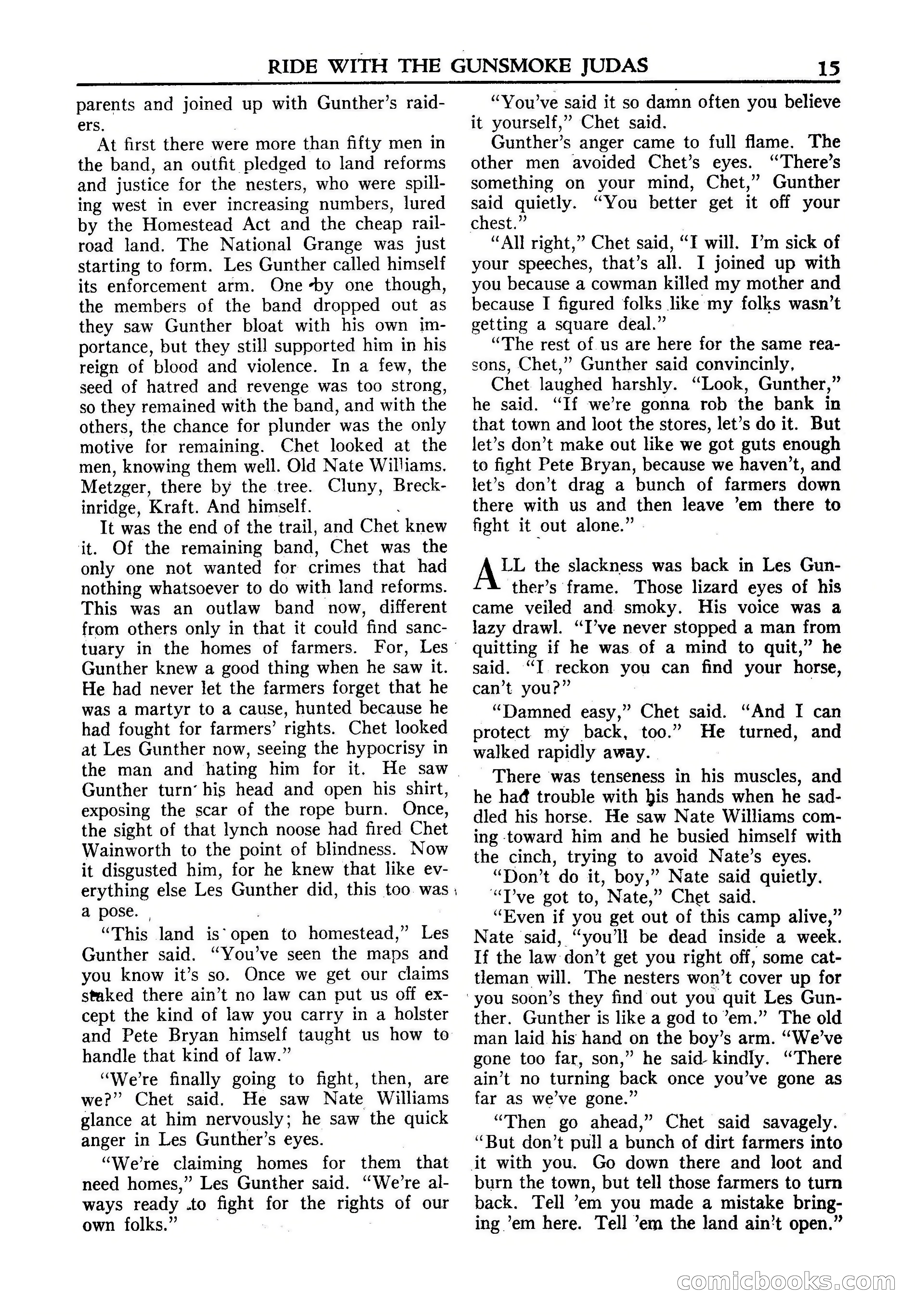
A restored page from Pulp Fiction, 1953. Page through the whole issue in the reader above.
📄 Transcribed text from this page (OCR, searchable)
Machine-transcribed from the original scan — historical spelling and the odd misread are preserved.
RIDE WITH THE GUNSMOKE JUDAS 15 parents and piace up with Gunther’s raid- ers. At first there were more than fifty men in the band, an outfit pledged to land reforms and justice for the nesters, who were spill- ing west in ever increasing numbers, lured by the Homestead Act and the cheap rail- road land. The National Grange was just starting to form. Les Gunther called himself its enforcement arm. One -by one though, the members of the band dropped out as they saw Gunther bloat with his own im- portance, but they still supported him in his reign of blood and violence. In a few, the seed of hatred and revenge was too strong, so they remained with the band, and with the others, the chance for plunder was the only motive for remaining. Chet looked at the men, knowing them well. Old Nate Williams. Metzger, there by the tree. Cluny, Breck- inridge, Kraft. And himself. It was the end of the trail, and Chet knew it. Of the remaining band, Chet was the only one not wanted for crimes that had nothing whatsoever to do with land reforms. This was an outlaw band now, different from others only in that it could ‘find sanc- tuary in the homes of farmers. For, Gunther knew a good thing when he saw it. He had never let the farmers forget that he was a martyr to a cause, hunted because he had fought for farmers’ rights. Chet looked at Les Gunther now, seeing the hypocrisy in the man and hating him for it. Gunther turn’ his head and open his shirt, exposing the scar of the repe burn. Once, the sight of that lynch noose had fired Chet Wainworth to the point of blindness. Now it disgusted him, for he knew that like ev- erything else Les Gunther did, this too. was; a pose. _ “This land is’ open to homestead,” Cass Gunther said. “You’ve seen the maps and you know it’s so. Once we get our claims staked there ain’t no law can put us off ex- cept the kind of law you carry in a holster and Pete Bryan himself taught us how to handle that kind of law.” “We're finally going to fight, then, are we?” Chet said. He saw Nate Williams glance at him nervously; he saw the quick anger in Les Gunther’s eyes. “We're claiming homes for them that need homes,” Les Gunther said. “We’re al- ways ready to nee for the rights of our own folks.” | Les © He saw | “Vou’ve said it so damn often you believe it yourself,” Chet said. Gunther’s anger came to full flame. The other men avoided Chet’s eyes. “There’s something on your mind, Chet,” Gunther said quietly. “You better get it off your chest.” “All right,” Chet said, “T will. I’m sick of your speeches, that’s all. I joined up with you because a cowman killed my mother and because I figured folks like my folks wasn’t getting a square deal.” “The rest of us are here for the same rea- sons, Chet,” Gunther said convincinly, Chet laughed harshly. “Look, Gunther,” he said. “If we’re gonna rob the bank in that town and loot the stores, let’s do it. But let’s don’t make out like we got guts enough to fight Pete Bryan, because we haven’t, and let’s don’t drag a bunch of farmers down there with us and then leave ’em there to fight it out alone.” LL the slackness was back in Les Gun- ther’s frame. Those lizard eyes of his came veiled and smoky. His voice was a lazy drawl. “I’ve never stopped a man from quitting if he was of a mind to quit,” he said. “I. reckon you can find your horse, can’t you?” “Damned easy,” Chet said. “And I can protect my back, too.” He turned, and walked rapidly away. There was tenseness in his muscles, and he had trouble with bis hands when he sad- dled his horse. He saw Nate Williams com- ing toward him and he busied himself with the cinch, trying to avoid Nate’s eyes. “Don’t do it, boy,” Nate said quietly. “T’ve got to, Nate,” Chet said. “Even if you get out of this camp alive,” Nate said, “you'll be dead inside a week. If the law don’t get you right off, some cat- tleman. will. The nesters won’t cover up for you soon’s they find out you quit Les Gun- ther. Gunther is like a god to ’em.” The old man laid his hand on the boy’s arm. “We’ve gone too far, son,” he said kindly. “There ain’t no turning back once you’ve gone as far as we’ve gone.” “Then go ahead,” Chet said savagely. “But don’t pull a bunch of dirt farmers into it with you. Go down there and loot and burn the town, but tell those farmers to turn back. Tell ’em you made a mistake bring- ing ’em here. Tell ’em the land ain’t open.” CoOMmichooOokSs.c©