
Pulp Fiction, 1953 · page 56 of 116
Fifteen Western Tales, January 1953 — page 56: what you’re looking at
A restored page from Pulp Fiction, 1953. Page through the whole issue in the reader above.
📄 Transcribed text from this page (OCR, searchable)
Machine-transcribed from the original scan — historical spelling and the odd misread are preserved.
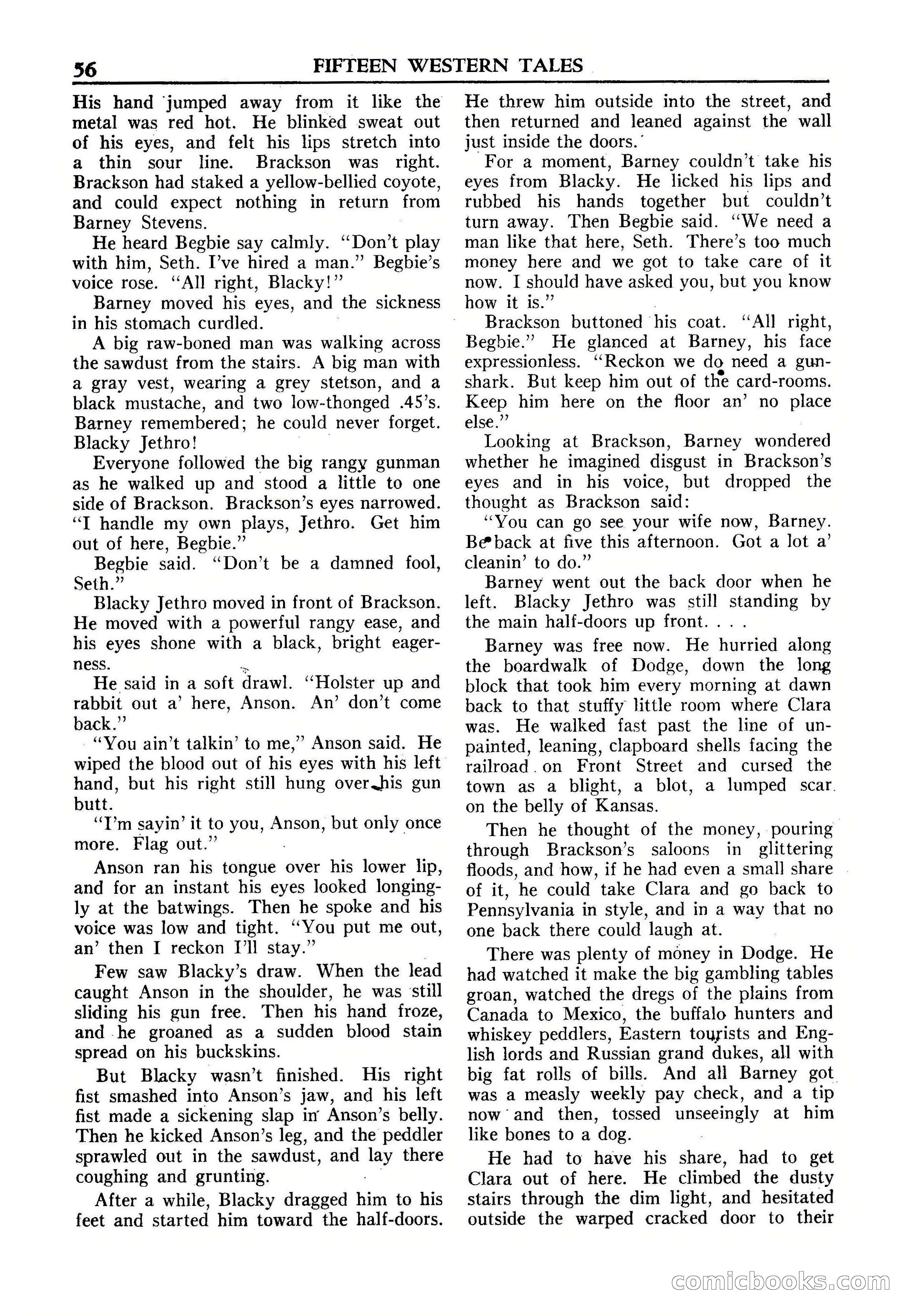
56 FIFTEEN WESTERN TALES | His hand jumped away from it like the metal was red hot. He blinked sweat out of his eyes, and felt his lips stretch into a thin sour line. Brackson was right. Brackson had staked a yellow- bellied coyote, and could expect nothing in return from Barney Stevens. He heard Begbie say calmly. ‘Don’t play with him, Seth. I’ve hired a man.” Begbie’s voice rose. “All right, Blacky!” Barney moved his eyes, and the sickness in his stomach curdled. A big raw-boned man was walking across the sawdust from the stairs. A big man with a gray vest, wearing a grey stetson, and a black mustache, and two low-thonged .45’s. Barney remembered; he could never forget. Blacky Jethro! Everyone followed the big rangy gunman as he walked up and stood a little to one side of Brackson. Brackson’s eyes narrowed. “T handle my own plays, Jethro. Get him out of here, Begbie.” Begbie said. “Don’t be a damned fool, Seth.” Blacky Jethro moved in front of Brackson. He moved with a powerful rangy ease, and his eyes shone with a black, bright eager- ness. He said in a soft drawl. “Holster up and rabbit out a’ here, Anson. An’ don’t come back.” “You ain’t talkin’ to me,” Anson said. He wiped the blood out of his eyes with his left hand, but his right still hung over.his gun butt. “T’m sayin’ it to you, Anson, but only once more. Flag out.’ Anson ran his wngue over his lower lip, and for an instant his eyes looked longing- ly at the batwings. Then he spoke and his voice was low and tight. “You put me out, an’ then I reckon I'll stay.” Few saw Blacky’s draw. When the lead caught Anson in the shoulder, he was still sliding his gun free. Then his hand froze, and he groaned as a sudden blood stain spread on his buckskins. But Blacky wasn’t finished. His right fist smashed into Anson’s jaw, and his left fist made a sickening slap in Anson’s belly. Then he kicked Anson’s leg, and the peddler sprawled out in the sawdust, and iy there coughing and grunting. After a while, Blacky dragged him to his feet and started him toward the half-doors. He threw him outside into the street, and then returned and leaned against the wall just inside the doors.’ For a moment, Barney couldn’t take his eyes from Blacky. He licked his lips and rubbed his hands together but couldn’t turn away. Then Begbie said. “We need a man like that here, Seth. There’s too much money here and we got to take care of it now. I should have asked you, but you know how it is.’ Brackson buttoned his coat. “All right, Begbie.” He glanced at Barney, his face expressionless. ‘“‘Reckon we do need a gun- shark. But keep him out of the card- -rooms. Keep him here on the floor an’ no place else.” Looking at Brackson, Barney wondered whether he imagined disgust in Brackson’s eyes and in his voice, but dropped the thought as Brackson said: “Vou can go see your wife now, Barney. Bé back at five this afternoon. Got a lot a’ cleanin’ to do.” Barney went out the back door when he left. Blacky Jethro was still standing by the main half-doors up front. . Barney was free now. He hurried along the boardwalk of Dodge, down the long block that took him every morning at dawn back to that stuffy little room where Clara was. He walked fast past the line of un- painted, leaning, clapboard shells facing the railroad.on Front Street and cursed the town as a blight, a blot, a lumped scar. on the belly of Kansas. Then he thought of the money, pouring through Brackson’s saloons in_ glittering floods, and how, if he had even a small share | of it, he could take Clara and go back to Pennsylvania in style, and in a way that no one back there could laugh at. There was plenty of money in Dodge. He had watched it make the big gambling tables groan, watched the dregs of the plains from Canada to Mexico, the buffalo hunters and whiskey peddlers, Eastern tourists and Eng- lish lords and Russian grand dukes, all with big fat rolls of bills. was a measly weekly pay check, and a tip now and then, tossed unseeingly at him like bones to a dog. He had to have his share, had to get Clara out of here. He climbed the dusty stairs through the dim light, and hesitated outside the warped cracked door to their MICLOO SS And all Barney got C©