
Pulp Fiction, 1953 · page 44 of 116
Fifteen Western Tales, January 1953 — page 44: what you’re looking at
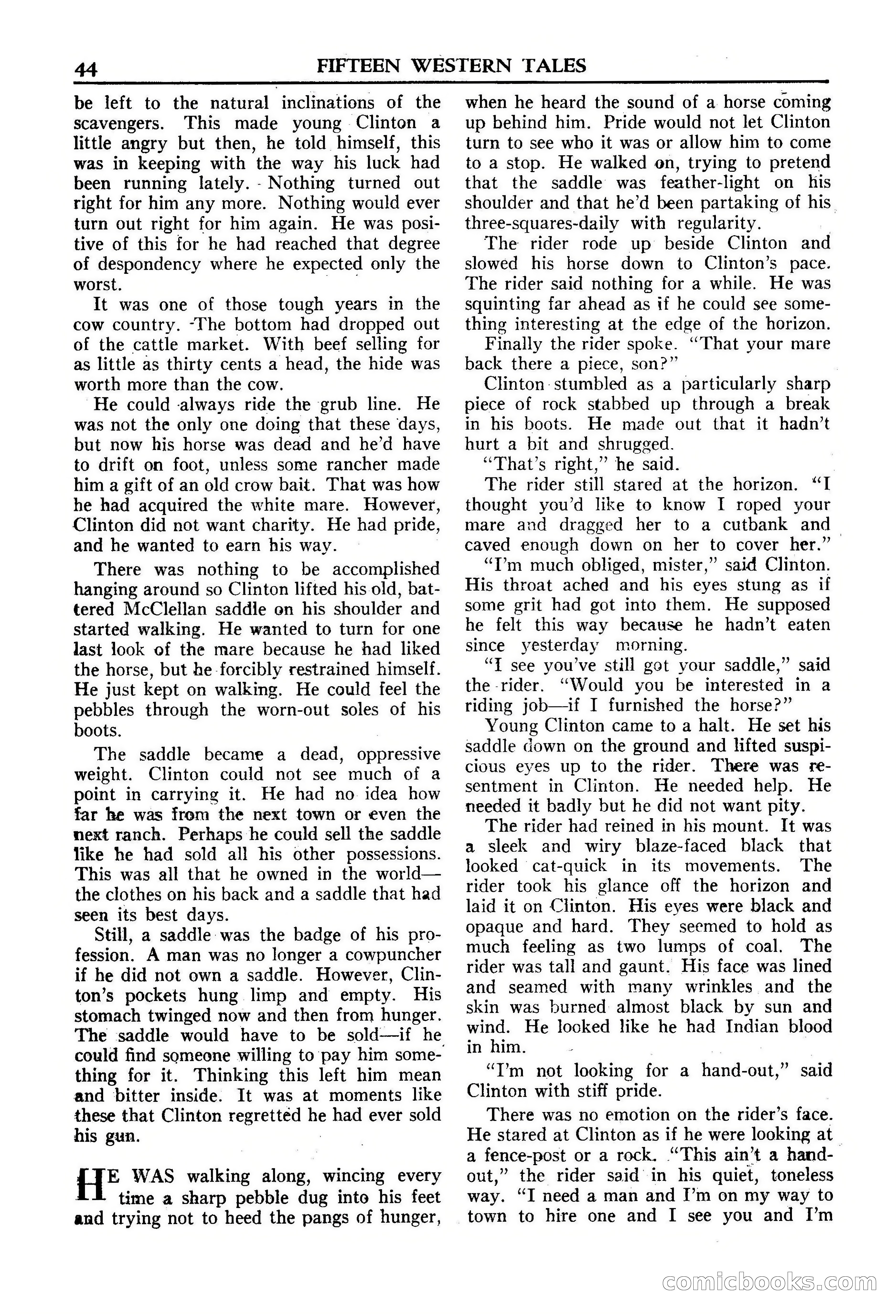
A restored page from Pulp Fiction, 1953. Page through the whole issue in the reader above.
📄 Transcribed text from this page (OCR, searchable)
Machine-transcribed from the original scan — historical spelling and the odd misread are preserved.
44 FIFTEEN WESTERN TALES be left to the natural inclinations of the scavengers. This made young Clinton a little angry but then, he told himself, this was in keeping with the way his luck had been running lately. - Nothing turned out right for him any more. Nothing would ever turn out right for him again. He was posi- tive of this for he had reached that degree of despondency where he expected only the worst. Oe It was one of those tough years in the cow country. -The bottom had dropped out of the cattle market. With beef selling for as little as thirty cents a head, the hide was worth more than the cow. He could always ride the grub line. He was not the only one doing that these days, but now his horse was dead and he’d have to drift on foot, unless some rancher made him a gift of an old crow bait. That was how he had acquired the white mare. However, Clinton did not want charity. He had pride, and he wanted to earn his way. There was nothing to be accomplished hanging around so Clinton lifted his old, bat- tered McClellan saddie on his shoulder and started walking. He wanted to turn for one last look of the mare because he had liked the horse, but he forcibly restrained himself. He just kept on walking. He could feel the pebbles through the worn-out soles of his boots. The saddle became a dead, oppressive weight. Clinton could not see much of a point in carrying it. He had no idea how far he was from the next town or even the next ranch. Perhaps he could sell the saddle like he had sold all his other possessions. This was all that he owned in the world— the clothes on his back and a saddle that had seen its best days. Still, a saddle was the badge of his pro- fession. A man was no longer a cowpuncher if he did not own a saddle. However, Clin- ton’s pockets hung limp and empty. His stomach twinged now and then from hunger. The saddle would have to be sold-——if he could find someone willing to pay him some- thing for it. Thinking this left him mean and bitter inside. It was at moments like these that Clinton regretted = had ever sold his gun. E WAS walking along, wincing every time a sharp pebble dug into his feet and trying not to heed the pangs of hunger, when he heard the sound of a horse coming up behind him. Pride would not let Clinton turn to see who it was or allow him to come to a stop. He walked on, trying to pretend that the saddle was feather-light on his shoulder and that he’d been partaking of his. three-squares-daily with regularity. The rider rode up beside Clinton and slowed his horse down to Clinton’s pace. The rider said nothing for a while. He was squinting far ahead as if he could see some- thing interesting at the edge of the horizon. Finally the rider spoke. “That your mare back there a piece, son?” | Clinton: stumbled as a particularly sharp piece of rock stabbed up through a break in his boots. He made out that it hadn’t hurt a bit and shrugged. “That’s right,” he said. | The rider still stared at the horizon. “I thought you’d like to know I roped your mare and dragged her to a cutbank and caved enough down on her to cover her.” “T’m much obliged, mister,” said Clinton. His throat ached and his eyes stung as if some grit had got into them. He supposed he felt this way because he hadn’t eaten since yesterday morning. “TI see you've still got your saddle,” said the rider. “Would you be interested in a riding job—if I furnished the horse?” Young Clinton came to a halt. He set his saddle Gown on the ground and hited suspi- cious eyes up to the rider. There was re- sentment in Clinton. He needed help. He needed it badly but he did not want pity. The rider had reined tn his mount. It was a sleek and wiry blaze-faced black that looked cat-quick in its movements. The rider took his glance off the horizon and laid it on Clinton. His eyes were black and opaque and hard. They seemed to hold as much feeling as two lumps of coal. The rider was tall and gaunt. His face was lined and seamed with many wrinkles and the skin was burned almost black by sun and wind. He looked like he had Indian blood in him. “T’m not looking for a hand- out,” said Clinton with stiff pride. There was no emotion on the rider’s face. He stared at Clinton as if he were looking at a fence-post or a rock. “This ain’t a hand- out,” the rider said’ in his quiet, toneless way. “I need a man and [’m on my way to town to hire one and I see you and I’m cCcomicbooks.c© inn