
Pulp Fiction, 1953 · page 34 of 116
Fifteen Western Tales, January 1953 — page 34: what you’re looking at
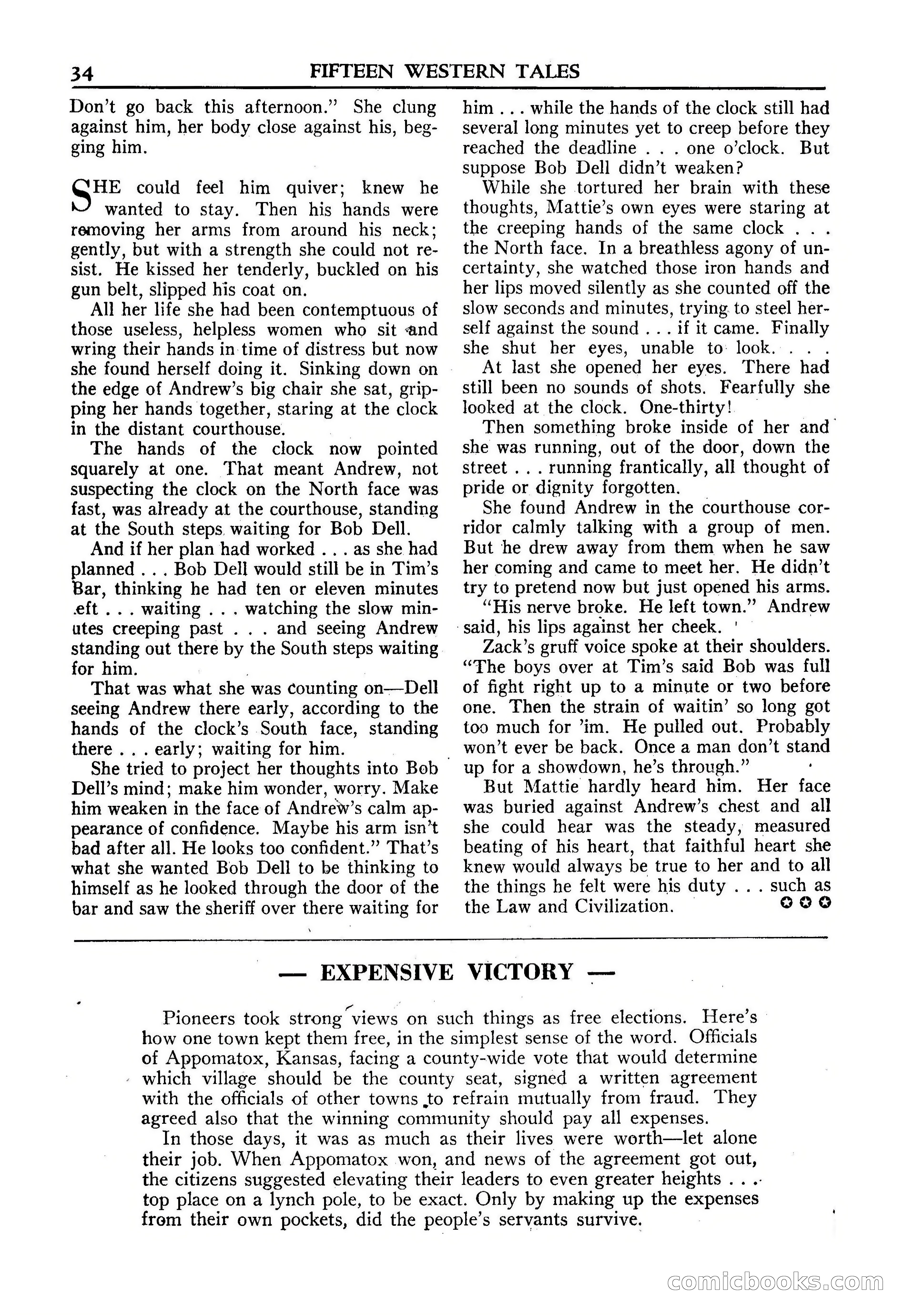
A restored page from Pulp Fiction, 1953. Page through the whole issue in the reader above.
📄 Transcribed text from this page (OCR, searchable)
Machine-transcribed from the original scan — historical spelling and the odd misread are preserved.
34 FIFTEEN WESTERN TALES Don’t go back this afternoon.” She clung against him, her body close against his, beg- ging him. HE could feel him quiver; knew he wanted to stay. Then his hands were removing her arms from around his neck; gently, but with a strength she could not re- sist. He kissed her tenderly, buckled on his gun belt, slipped his coat on. All her life she had been contemptuous of those useless, helpless women who sit and wring their hands in time of distress but now she found herself doing it. Sinking down on - the edge of Andrew’s big chair she sat, grip- ping her hands together, staring at the clock in the distant courthouse. . The hands of the clock now pointed squarely at one. That meant Andrew, not suspecting the clock on the North face was fast, was already at the courthouse, standing at the South steps waiting for Bob Dell. And if her plan had worked . . . as she had planned ... Bob Dell would still be in Tim’s Bar, thinking he had ten or eleven minutes eft... waiting ... watching the slow min- utes creeping past .. . and seeing Andrew standing out there by the South steps waiting for him. That was what she was counting on—Dell seeing Andrew there early, according to the hands of the clock’s South face, standing there... . early; waiting for him. She tried to project her thoughts into Bob Dell’s mind; make him wonder, worry. Make him weaken in the face of Andrew’s calm ap- pearance of confidence. Maybe his arm isn’t bad after all. He looks too confident.” That’s what she wanted Bob Dell to be thinking to himself as he looked through the door of the bar and saw the sheriff over there waiting for him ... while the hands of the clock still had several long minutes yet to creep before they reached the deadline . . . one o’clock. But suppose Bob Dell didn’t weaken? While she tortured her brain with these thoughts, Mattie’s own eyes were staring at the creeping hands of the same clock .. . the North face. In a breathless agony of un- certainty, she watched those iron hands and her lips moved silently as she counted off the slow seconds and minutes, trying. to steel her- self against the sound... if it came. Finally She shut her eyes, unable to: look. At last she opened her eyes. There had still been no sounds of shots. Fearfully she looked at the clock. One-thirty! Then something broke inside of her and she was running, out of the door, down the street ... running frantically, all thought of pride or dignity forgotten. | She found Andrew in the courthouse cor- ridor calmly talking with a group of men. But he drew away from them when he saw her coming and came to meet her. He didn’t try to pretend now but just opened his arms. “His nerve broke. He left town.” Andrew ‘said, his lips against her cheek. ' | Zack’s gruff voice spoke at their shoulders. “The boys over at Tim’s said Bob was full of fight right up to a minute or two before one. Then the strain of waitin’ so long got too much for ’im. He pulled out. Probably won’t ever be back. Once a man don’t stand ~ up for a showdown, he’s through.” But Mattie hardly heard him. Her face was buried against Andrew’s chest and all she could hear was the steady, measured beating of his heart, that faithful heart she knew would always be true to her and to all the things he felt were his duty .. . such as the Law and Civilization. — oo 6 — EXPENSIVE VICTORY — Pioneers took strong views on such things as free elections. Here’s how one town kept them free, in the simplest sense of the word. Officials of Appomatox, Kansas, facing a county-wide vote that would determine - which village should be the county seat, signed a written agreement with the officials of other towns to refrain mutually from fraud. They agreed also that the winning community should pay all expenses. In those days, it was as much as their lives were worth—let alone their job. When Appomatox won, and news of the agreement got out, the citizens suggested elevating their leaders to even greater heights . top place on a lynch pole, to be exact. Only by making up the expenses frem their own pockets, did the people’s servants survive. : cCoMmichboOoks.cO©