
Pulp Fiction, 1953 · page 36 of 116
Fifteen Western Tales, January 1953 — page 36: what you’re looking at
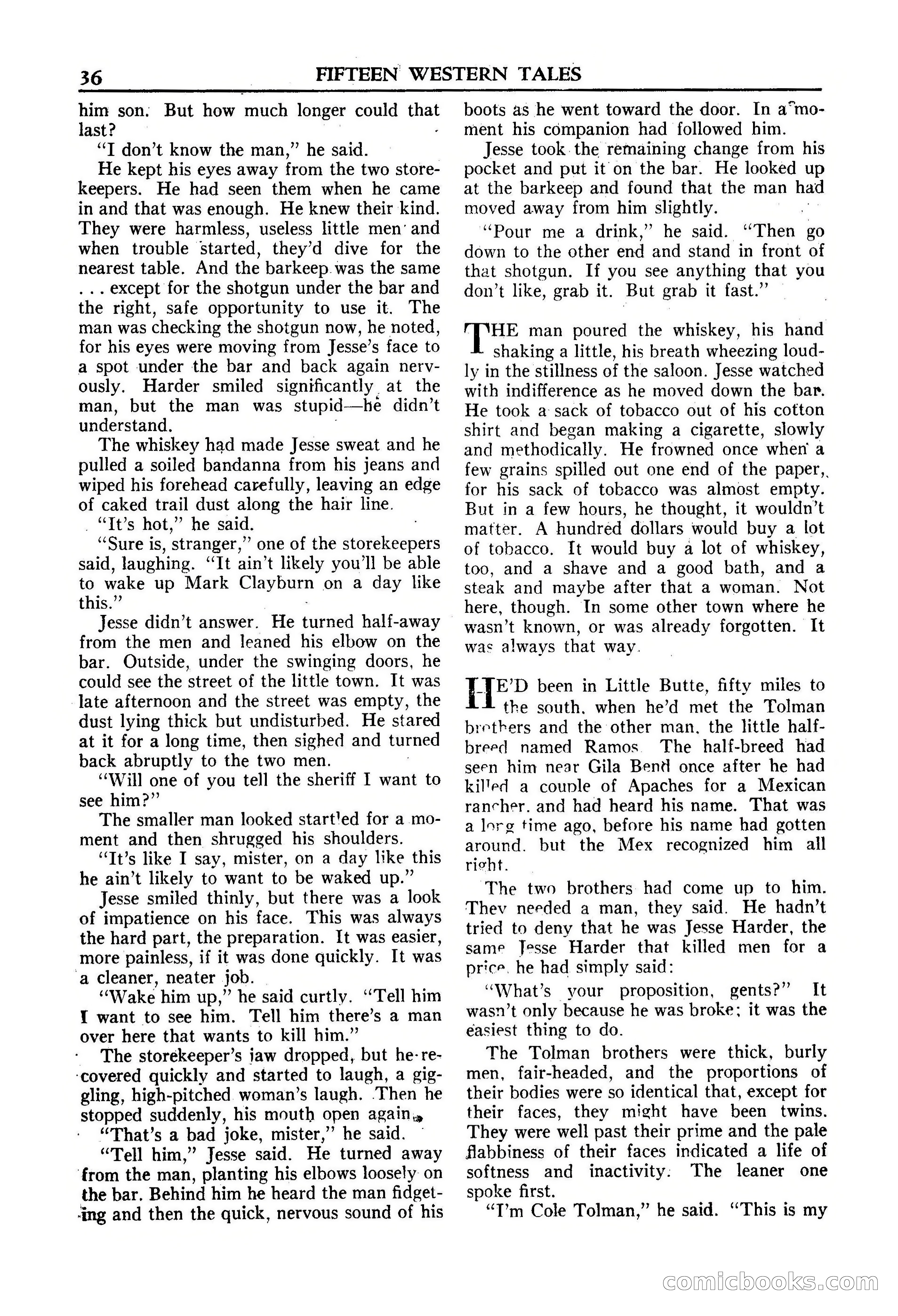
A restored page from Pulp Fiction, 1953. Page through the whole issue in the reader above.
📄 Transcribed text from this page (OCR, searchable)
Machine-transcribed from the original scan — historical spelling and the odd misread are preserved.
36 FIFTEEN’ WESTERN TALES him son. But how much longer could that last? . “T don’t know the man,” he said. He kept his eyes away from the two store- keepers. He had seen them when he came in and that was enough. He knew their kind. They were harmless, useless little men’ and when trouble started, they’d dive for the nearest table. And the barkeep. was the same . except for the shotgun under the bar and the right, safe opportunity to use it. The man was checking the shotgun now, he noted, for his eyes were moving from Jesse’s face to a spot under the bar and back again nerv- ously. Harder smiled significantly at the man, but the man was stupid—he didn’t understand, The whiskey had made Jesse sweat and he pulled a soiled bandanna from his jeans and wiped his forehead carefully, leaving an edge of caked trail dust along the hair line. _ “Tt’s hot,” he said. ‘‘Sure is, stranger,” one of the storekeepers said, laughing. “It ain’t likely you'll be able to wake up Mark a on a day like this.” Jesse didn’t answer. He — half-away — from the men and leaned his elbow on the bar. Outside, under the swinging doors, he could see the street of the little town. It was late afternoon and the street was empty, the dust lying thick but undisturbed. He stared at it for a long time, then sighed and turned back abruptly to the two men. ‘Will one of you tell the sheriff I want to see him?” The smaller man looked start'ed for a mo- ment and then shrugged his shoulders. “Tt’s like I say, mister, on a day like this he ain’t likely to want to be waked up.” Jesse smiled thinly, but there was a look of impatience on his face. This was always the hard part, the preparation. It was easier, more painless, if it was done quickly. It was a cleaner, neater job. — “Wake him up,” he said curtly. “Tell him { want to see him. Tell him there’ Ss a man over here that wants to kill him.” The storekeeper’s jaw dropped, but he-re- ‘covered quickly and started to laugh, a gig- gling, high-pitched. woman’s laugh. Then he stopped suddenly, his mouth open again “That’s a bad joke, mister,” he said. “Tell him,” Jesse said. He turned away ‘from the man, planting his elbows loosely on the bar. Behind him he heard the man fidget- ‘mg and then the quick, nervous sound of his boots as he went toward the door. In a°mo- ment his companion had followed him. Jesse took. the remaining change from his pocket and put it on the bar. He looked up at the barkeep and found that the man had moved away from him slightly. “Pour me a drink,” he said. “Then go down to the other end and stand in front of that shotgun. If you see anything that you don’t like, grab it. But grab it fast.” | [ee man poured the whiskey, his hand shaking a little, his breath wheezing loud- ly in the stillness of the saloon. Jesse watched with indifference as he moved down the bar. He took a sack of tobacco out of his cotton shirt and began making a cigarette, slowly and methodically. He frowned once when a few grains spilled out one end of the paper,, for his sack of tobacco was almost empty. But in a few hours, he thought, it wouldn’t matter. A hundred dollars would buy a lot of tobacco. It would buy a lot of whiskey, too, and a shave and a good bath, and a steak and maybe after that a woman. Not here, though. In some other town where he wasn’t known, or was already forgotten. It was always that way. t E’D been in Little Butte, fifty miles to the south. when he’d met the Tolman bretkers and the other man, the little half- breed named Ramos. The half-breed had seen him near Gila Bent! once after he had killed a counle of Apaches for a Mexican rancher. and had heard his name. That was a lorg time ago, before his name had gotten around. but the Mex recognized him all richt. The two brothers had come up to him. Thev needed a man, they said. He hadn’t tried to deny that he was Jesse Harder, the same Jesse Harder that killed men for a price, he had simply said: “What’s your proposition, gents?” It wasn’t only because he was broke; it was the easiest thing to do. The Tolman brothers were thick, burly men, fair-headed, and the proportions of their bodies were so identical that, except for their faces, they might have been twins. They were well past their prime and the pale flabbiness of their faces indicated a life of softness and inactivity: The leaner one spoke first. “T’m Cole Tolman,” he said. “This is my COMIGDIOOKSEEO