
Pulp Fiction, 1953 · page 69 of 116
Fifteen Western Tales, January 1953 — page 69: what you’re looking at
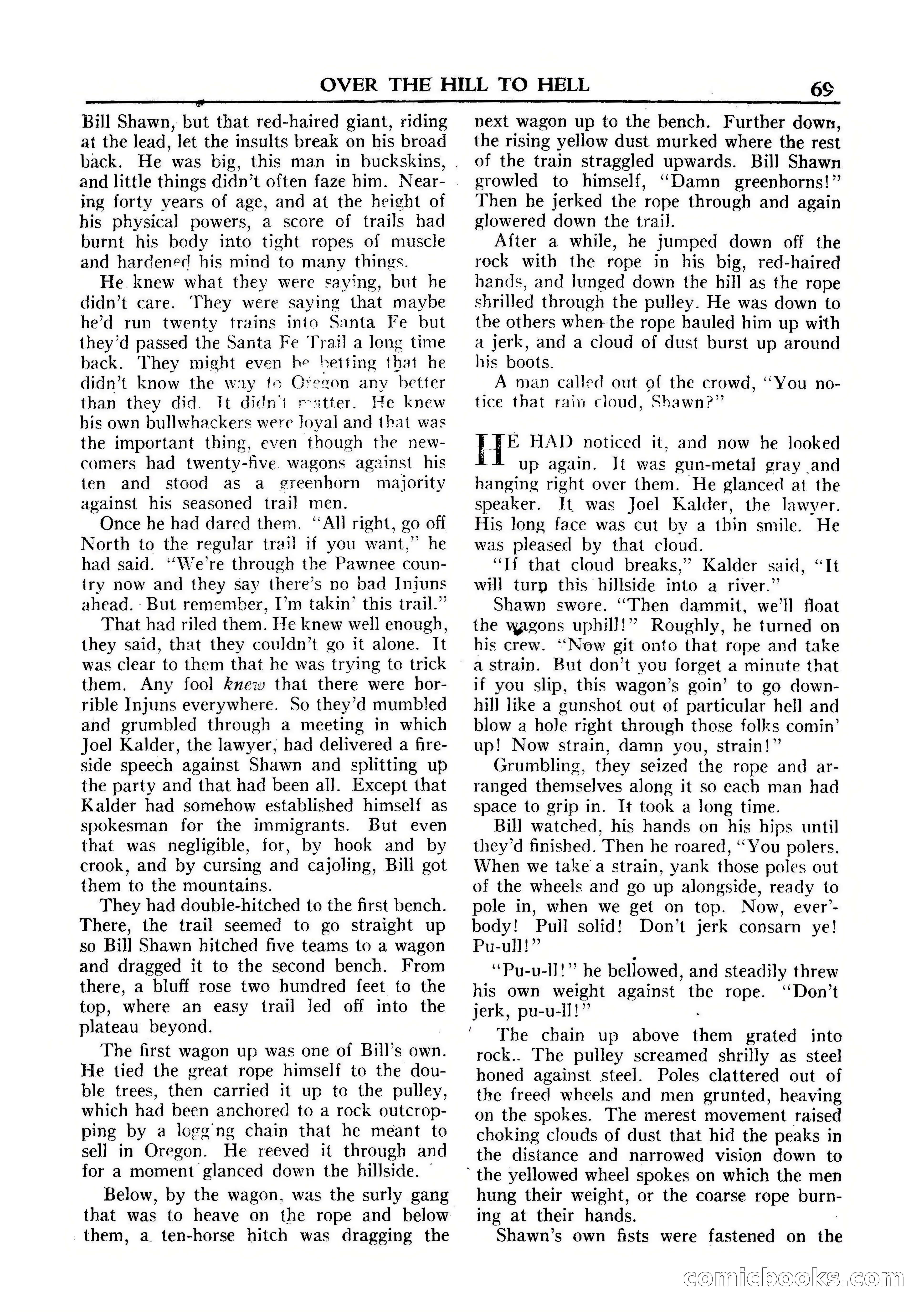
A restored page from Pulp Fiction, 1953. Page through the whole issue in the reader above.
📄 Transcribed text from this page (OCR, searchable)
Machine-transcribed from the original scan — historical spelling and the odd misread are preserved.
OVER THE HILL TO HELL 6¢ an a, A a A a a a a ae Bill Shawn, but that red-haired giant, riding at the lead, let the insults break on his broad back. He was big, this man in buckskins, and little things didn’t often faze him. Near- . ing forty vears of age, and at the height of his physical powers, a score of trails had burnt his bedy into tight ropes of muscle and hardened his mind to many things. He knew what they were saying, but he didn’t care. They were saying that maybe he’d run twenty trains into Santa Fe but they’d passed the Santa Fe Trail a long time back. They might even he betting that he didn’t know the way to Orezon any better than they did. It didn’t eatter. He knew his own bullwhackers were lova] and that was the important thing, even though the new- comers had twenty-five. wagons against his ten and stood as a greenhorn majority against his seasoned trail men. Once he had dared them. “AlJ right, Z0 off North to the regular trail if you want,” he had said. ‘““We’re through the Pawnee coun- iry now and they say there’s no bad Jnjuns ahead. But remember, I’m takin’ this trail.” That had riled them. He knew well enough, they said, that they couldn’t go it alone. It was clear to them that he was trying to trick them. Any fool knew that there were hor- rible Injuns everywhere. So they’d mumbled and grumbled through a meeting in which Joe] Kalder, the lawyer, had delivered a fire- side speech against Shawn and splitting up the party and that had been all. Except that Kalder had somehow established himself as spokesman for the immigrants. But even that was negligible, for, by hook and by crook, and by cursing and cajoling, Bill got them to the mountains. They had double-hitched to the first bench. There, the trail seemed to go straight up so Bill Shawn hitched five teams to a wagon and dragged it to the second bench. From there, a bluff rose two hundred feet to the top, where an easy trail Jed off into the plateau beyond. The first wagon up was one of Bill’s own. He tied the great rope himself to the dou- ble trees, then carried it up to the pulley, which had been anchored to a rock outcrop- ping by a loge ng chain that he meant to sell in Oregon. He reeved it through and for a moment glanced down the hillside. — Below, by the wagon, was the surly gang that was to heave on the rope and below _them, a ten-horse hitch was dragging the next wagon up to the bench. Further down, the rising yellow dust murked where the rest of the train straggled upwards. Bill Shawn growled to himself, “Damn greenhorns!”’ Then be jerked the rope through and again glowered down the trail. After a while, he jumped down off the rock with the rope in his big, red-haired hands, and Junged down the hill as the rope shrilled through the pulley. He was down to the others when the rope hauled him up with a jerk, and a cloud of dust burst up around his boots. A man called out of the crowd, tice that rain cloud, Shawn?” H E HAD noticed it, and now he looked 4 up again. It was gun-metal gray and hanging right over them. He glanced at the speaker. Jt was Joel Kalder, the lawyer. His long face was cut bv a thin smile. He was pleased by that cloud. “Tf that cloud breaks,’ Kalder said, will turp this hillside into a river.’ Shawn swore. “Then dammit, we'll float the wagons uphill!” Roughly, he turned on his crew. ‘““New git onto that rope and take “Vou no- oly —astrain. But don’t you forget a minute that if you slip, this wagon’s goin’ to go down- hill like a gunshot out of particular hell and blow a hole right through those folks comin’ up! Now strain, damn you, strain!” Grumbling, they seized the rope and ar- ranged themselves along it so each man had space to grip in. It took a long time. Bill watched, his hands on his hips until they’d finished. Then he roared, “You polers. When we take a strain, yank those poles out of the wheels and go up alongside, ready to pole in, when we get on top. Now, ever’- body! Pull solid! Don’t jerk consarn ye! Pu-ull!” ‘“Pu-u-l]!”? he bellowed, and steadily threw his own weight against the rope. ‘Don’t jerk, pu-u-Il!” The chain up above — grated into rock.. The pulley screamed shrilly as steel honed against steel. Poles clattered out of the freed wheels and men grunted, heaving on the spokes. The merest movement raised choking clouds of dust that hid the peaks in the distance and narrowed vision down to ; ’ the yellowed wheel spokes on which the men hung their weight, or the coarse rope burn- ing at their hands. Shawn’s own fists were fastened on ilie cComiclbooks CO