
Pulp Fiction, 1953 · page 14 of 116
Fifteen Western Tales, January 1953 — page 14: what you’re looking at
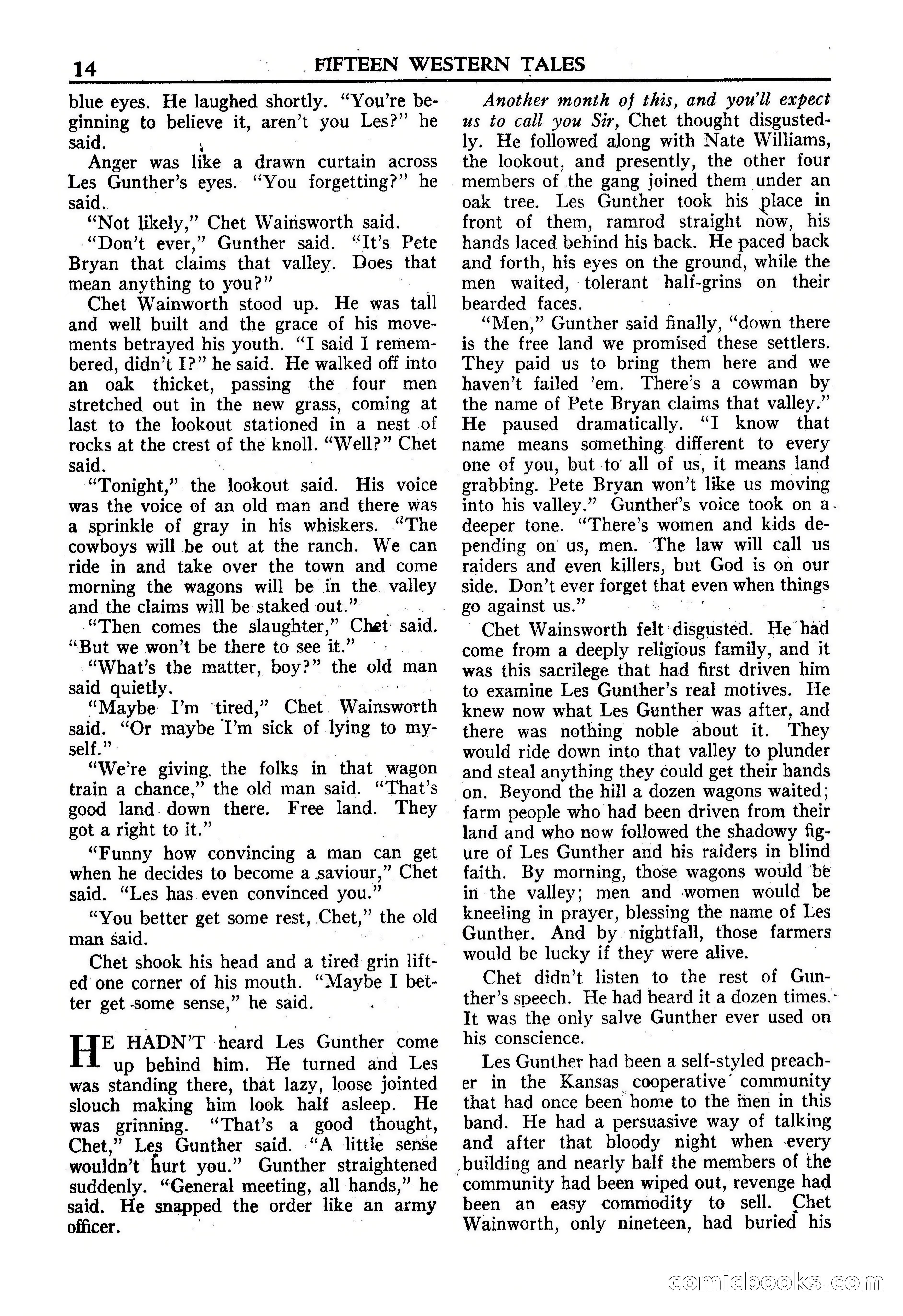
A restored page from Pulp Fiction, 1953. Page through the whole issue in the reader above.
📄 Transcribed text from this page (OCR, searchable)
Machine-transcribed from the original scan — historical spelling and the odd misread are preserved.
14 | FIFTEEN WESTERN TALES blue eyes. He laughed shortly. “You're be- : ginning to believe it, aren't you Les?” he said. , Anger was like a — curtain across Les Gunther’s eyes. “You forgetting?” he said... | “Not likely,” Chet Wainsworth said. “Don’t ever,” Gunther said. “It’s Pete Bryan that claims that valley. Does that mean anything to your” Chet Wainworth stood up. He was tall and well built and the grace of his move- ments betrayed his youth. “I said I remem- bered, didn’t I?” he said. He walked off into an oak thicket, passing the four men stretched out in the new grass, coming at last to the lookout stationed in a nest of rocks at the crest o the knoll. “Well?” Chet said. “Tonight,” tie Jookout said. His voice was the voice of an old man and there was a sprinkle of gray in his whiskers. “The cowboys will be out at the ranch. We can ride in and take over the town and come morning the wagons will be in the. valley and the claims will be staked out.” “Then comes the slaughter,” Chet said, | “But we won’t be there to see it.” -“What’s the matter, seg the old - man said quietly. “Maybe I’m tired,” Chet. Wainsworth said. “Or maybe I’m sick of lying to my- self.” “We're giving, the folks in that wagon train a chance,” the old man said. “That’s good land. down. there. got a right to it.” “Funny how convincing a man can get when he decides to become a saviour, ” Chet said. “Les has even convinced you.’ “Vou better get some rest, Chet,’ . the ald man Said. Chet shook his head and a — grin lift- | ed one corner of his mouth. “Maybe I bet- ter get some sense,” he said. o*. E HADN’T heard Les Gunther come up behind him. He turned and Les was standing there, that lazy, loose jointed slouch making him look half asleep. He was grinning. “That’s a good thought, Chet,” Les Gunther said. “A little sense wouldn’t hurt you.” Gunther straightened suddenly. “General meeting, all hands,” he said. He snapped the order like an army officer. Free land. Seni 7 Another month of this, and you'll expect us to call you Sir, Chet thought disgusted- ly. He followed along with Nate Williams, the lookout, and presently, the other four -members of the gang joined them under an oak tree. Les Gunther took his place in front of them, ramrod straight now, his hands laced behind his back. He paced back and forth, his eyes on the ground, while the men waited, tolerant ean on their bearded faces. “Men,” Gunther said fnetllna “down there is the free land we promised these settlers. They paid us to bring them here and we haven’t failed ’em. There’s a cowman by the name of Pete Bryan claims that valley.” He paused dramatically. “I know that name means something different to every - one of you, but -to all of us, it means land grabbing. Pete Bryan won’t like us moving into his valley.” Gunther’s voice took on a. deeper tone. “There’s women and kids de- pending on us, men. The law will call us raiders and even killers; but God is on our side. Don’t ever forget ta even when ngs go against us.’ Chet Wainsworth felt disguiste He hid come from a deeply religious family, and it was this sacrilege that had first driven him to examine Les Gunther’s real motives. He knew now what Les Gunther was after, and there was nothing noble about it. They would ride down into that valley to plunder _and steal anything they could get their hands on. Beyond the hill a dozen wagons waited; farm people who had been driven from their land and who now followed the shadowy fig- ure of Les Gunther and his raiders in blind faith. By morning, those wagons would "be in the valley; men and women would be kneeling in prayer, blessing the name of Les Gunther. And by nightfall, those farmers would be lucky if they were alive. Chet didn’t listen to the rest of Gun- ther’s speech. He had heard it a dozen times.~ It was the only salve Gunther ever used on his conscience. Les Gunther had been a self-styled preach- er in the Kansas cooperative’ community that had once been home to the men in this band. He had a persuasive way of talking and after that bloody night when every building and nearly half the members of the community had been wiped out, revenge had been an easy commodity to sell. Chet Wainworth, only nineteen, had buried his Coniicloooks.c© inn