
Pulp Fiction, 1953 · page 8 of 116
Fifteen Western Tales, January 1953 — page 8: what you’re looking at
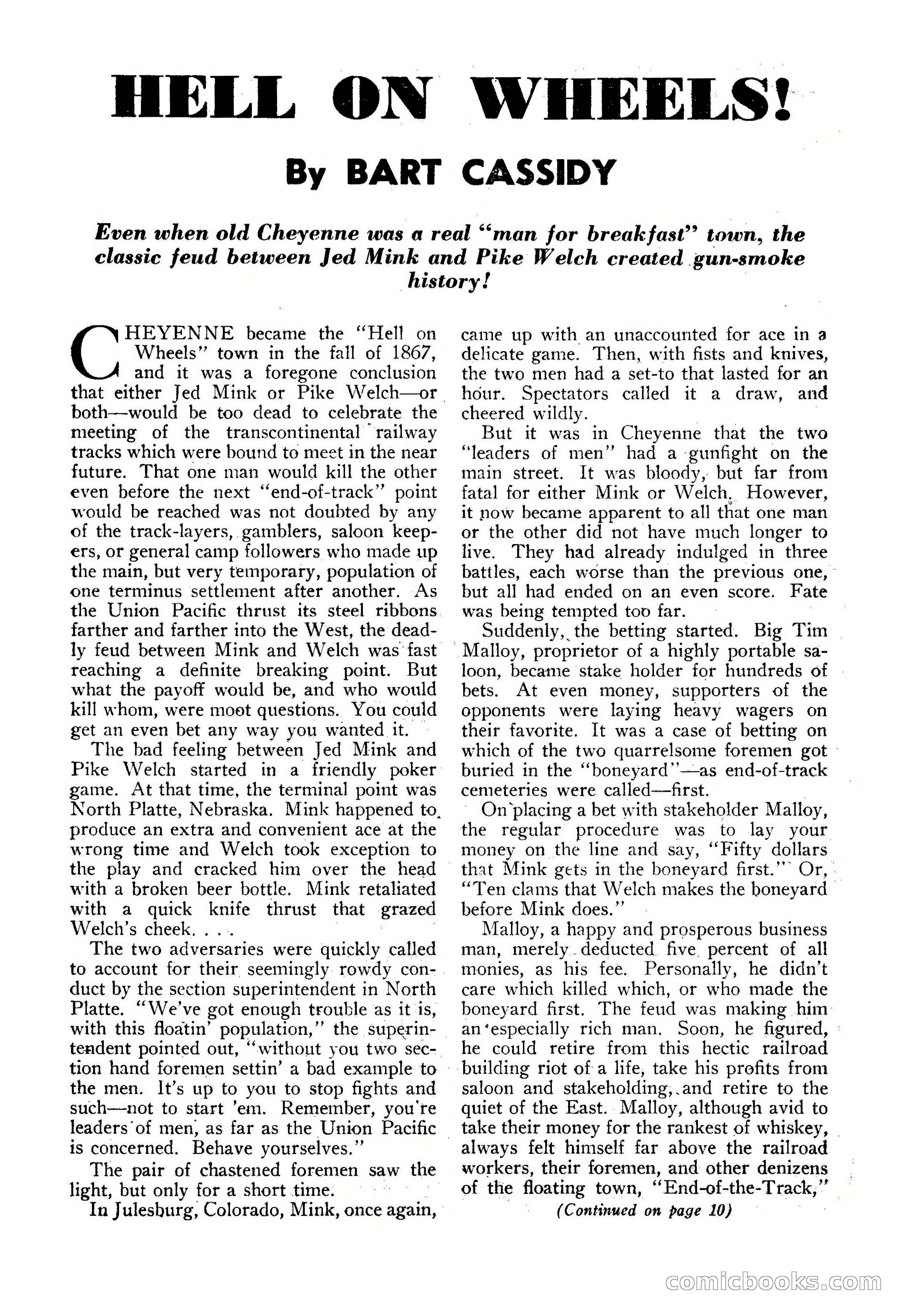
A restored page from Pulp Fiction, 1953. Page through the whole issue in the reader above.
📄 Transcribed text from this page (OCR, searchable)
Machine-transcribed from the original scan — historical spelling and the odd misread are preserved.
HELL ON WHEELS! By BART CASSIDY Even when old Cheyenne was a real “man for breakfast’ town, the classic feud between Jed Mink and Pike Welch created gun-smoke history! HEYENNE became the “Hell on Wheels” town in the fall of 1867, and it was a foregone conclusion that either Jed Mink or Pike Welch—or | both—would be too dead to celebrate the meeting of the transcontinental railway tracks which were bound to meet in the near future. That one man would kill the other even before the next “end-of-track” point would be reached was not doubted by any of the track-layers, gamblers, saloon keep- ers, or general camp followers who made up the main, but very temporary, population of one terminus settlement after another. As the Union Pacific thrust its steel ribbons. farther and farther into the West, the dead- ly feud between Mink and Welch was fast reaching a definite breaking point. But what the payoff would be, and who would kill whom, were moot questions. You could get an even bet any way you wanted it. | The bad feeling between Jed Mink and Pike Welch started in a friendly poker game. At that time, the terminal point was North Platte, Nebraska. Mink happened to, produce an extra and convenient ace at the wrong time and Welch took exception to the play and cracked him over the head with a broken beer bottle. Mink retaliated with a quick knife thrust that grazed Welch’s cheek. The two atergatles were quickly called to account for their seemingly rowdy con- duct by the section superintendent in North Platte. “We've got enough trouble as it is, with this floatin’ population,” tendent pointed out, tion hand foremen settin’ a bad example to the men. It’s up to you to stop fights and such—not to start ‘em. Remember, you're leaders of men, as far as the Union Pacific _ is concerned. Behave yourselves.” The pair of chastened foremen saw the light, but only for a short time. In Julesburg, Colorado, Mink, once again, that Mink gets in the boneyard first.”’ the superin-_ “without you two sec-. came up with an unaccounted for ace in a delicate game. Then, with fists and knives, the two men had a set-to that lasted for an hour. Spectators called it a draw, and cheered wildly. But it was in _ Cheyenne that the two “leaders of men” had a gunfight on the main street. It was bloody, but far from fatal for either Mink or Welch, However, it now became apparent to all that one man or the other did not have much longer to live. They had already indulged in three battles, each worse than the previous one, ° but all had ended on an even score. Fate was being tempted too far. Suddenly, the betting started. Big Tim | _Malloy, proprietor of a highly portable sa- loon, became stake holder for hundreds of | bets. At even money, supporters of the opponents were laying heavy wagers on their favorite. It was a case of betting on which of the two quarrelsome foremen got - buried in the “‘boneyard’’—as end-of-track cemeteries were called—frst. | ~ On’placing a bet with stakeholder Malloy, the regular procedure was to lay your money on the line and say, “Fifty dollars * Or, - “Ten clams that Welch makes the boneyard 7 before Mink does.”’ Malloy, a happy and prosperous business man, merely deducted. five, percent of all monies, as his fee. Personally, he didn’t eare which killed which, or who made the boneyard first. The feud was making him: an‘especially rich man. he could retire from this hectic railroad --building riot of a life, take his profits from saloon and stakeholding,.and retire to the quiet of the East. Malloy, although avid to Soon, he figured, : take their money for the rankest of whiskey, . always felt himself far above the railroad workers, their foremen, and other denizens of the floating town, “End-of-the- tmay: - (Continued on page 10) CoOMmicbooolk< CO