
Pulp Fiction, 1953 · page 100 of 116
Fifteen Western Tales, January 1953 — page 100: what you’re looking at
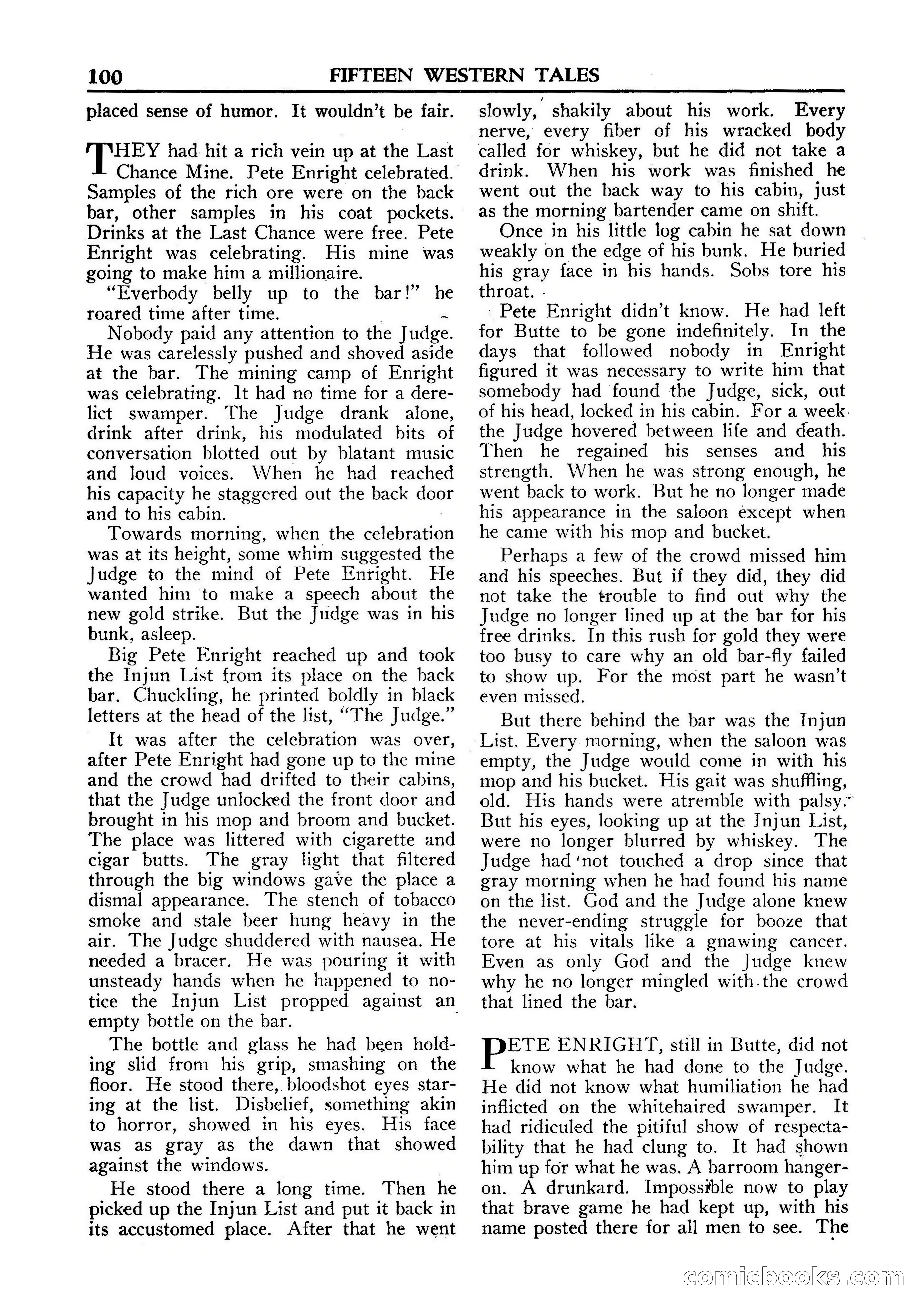
A restored page from Pulp Fiction, 1953. Page through the whole issue in the reader above.
📄 Transcribed text from this page (OCR, searchable)
Machine-transcribed from the original scan — historical spelling and the odd misread are preserved.
100 FIFTEEN WESTERN TALES placed sense of humor. It wouldn’t be fair. dh ok had hit a rich vein up at the Last Chance Mine. Pete Enright celebrated. Samples of the rich ore were on the back bar, other samples in his coat pockets. Drinks at the Last Chance were free. Pete Enright was celebrating. His mine was going to make him a millionaire. “Everbody belly up to the bar!” he roared time after time. Nobody paid any attention to the Judge. He was carelessly pushed and shoved aside at the bar. The mining camp of Enright was celebrating. It had no time for a dere- lict swamper. The Judge drank alone, drink after drink, his modulated bits of conversation blotted out by blatant music and loud voices. When he had reached his capacity he staggered out the back door and to his cabin. Towards morning, when the lebraten was at its height, some whim suggested the Judge to the mind of Pete Enright. He wanted him to make a speech about the new gold strike. But the Judge was in his bunk, asleep. Big Pete Enright reached up and took the Injun List from its place on the back bar. Chuckling, he printed boldly in black letters at the head of the list, “The Judge.” It was after the celebration was over, after Pete Enright had gone up to the mine and the crowd had drifted to their cabins, that the Judge unlocked the front door and brought in his mop and broom and bucket. The place was littered with cigarette and cigar butts. The gray light that filtered through the big windows gave the place a dismal appearance. The stench of tobacco smoke and stale beer hung heavy in the air. The Judge shuddered with nausea. He needed a bracer. He was pouring it with unsteady hands when he happened to no- tice the Injun List propped against an empty bottle on the bar. The bottle and glass he had been hold- ing slid from his grip, smashing on the floor. He stood there, bloodshot eyes star- ing at the list. Disbelief, something akin to horror, showed in his eyes. His face was as gray as the dawn that showed against the windows. | He stood there a long time. Then he picked up the Injun List and put it back in its accustomed place. After that he went slowly, shakily about his work. Every nerve, every fiber of his wracked body called for whiskey, but he did not take a drink. When his work was finished he went out the back way to his cabin, just as the morning bartender came on shift. Once in his little log cabin he sat down weakly on the edge of his bunk. He buried his gray face in his hands. Sobs tore his throat. - - Pete Enright didn’t know. He had left for Butte to be gone indefinitely. In the days that followed nobody in Enright figured it was necessary to write him that somebody had found the Judge, sick, out of his head, locked in his cabin. For a week the Judge hovered between life and death. Then he regained his senses and his strength. When he was strong enough, he went back to work. But he no longer made his appearance in the saloon except when he came with his mop and bucket. Perhaps a few of the crowd missed him and his speeches. But if they did, they did not take the trouble to find out why the Judge no longer lined up at the bar for his free drinks. In this rush for gold they were too busy to care why an old bar-fly failed to show up. For the most part he wasn’t even missed. But there behind the bar was the Injun List. Every morning, when the saloon was empty, the Judge would come in with his mop and his bucket. His gait was shuffling, old. His hands were atremble with palsy.” But his eyes, looking up at the Injun List, were no longer blurred by whiskey. The Judge had ‘not touched a drop since that gray morning when he had found his name on the list. God and the Judge alone knew the never-ending struggle for booze that tore at his vitals like a gnawing cancer. Even as only God and the Judge knew why he no longer mingled with.the crowd that lined the bar. ETE ENRIGHT, still in Butte, did not know what he had done to the Judge. He did not know what humiliation he had inflicted on the whitehaired swamper. It had ridiculed the pitiful show of respecta- bility that he had clung to. It had shown him up for what he was. A barroom hanger- on. A drunkard. Imposstble now to play that brave game he had kept up, with his name posted there for all men to see. The CoOMmiclhoo S CO