
Pulp Fiction, 1953 · page 65 of 116
Fifteen Western Tales, January 1953 — page 65: what you’re looking at
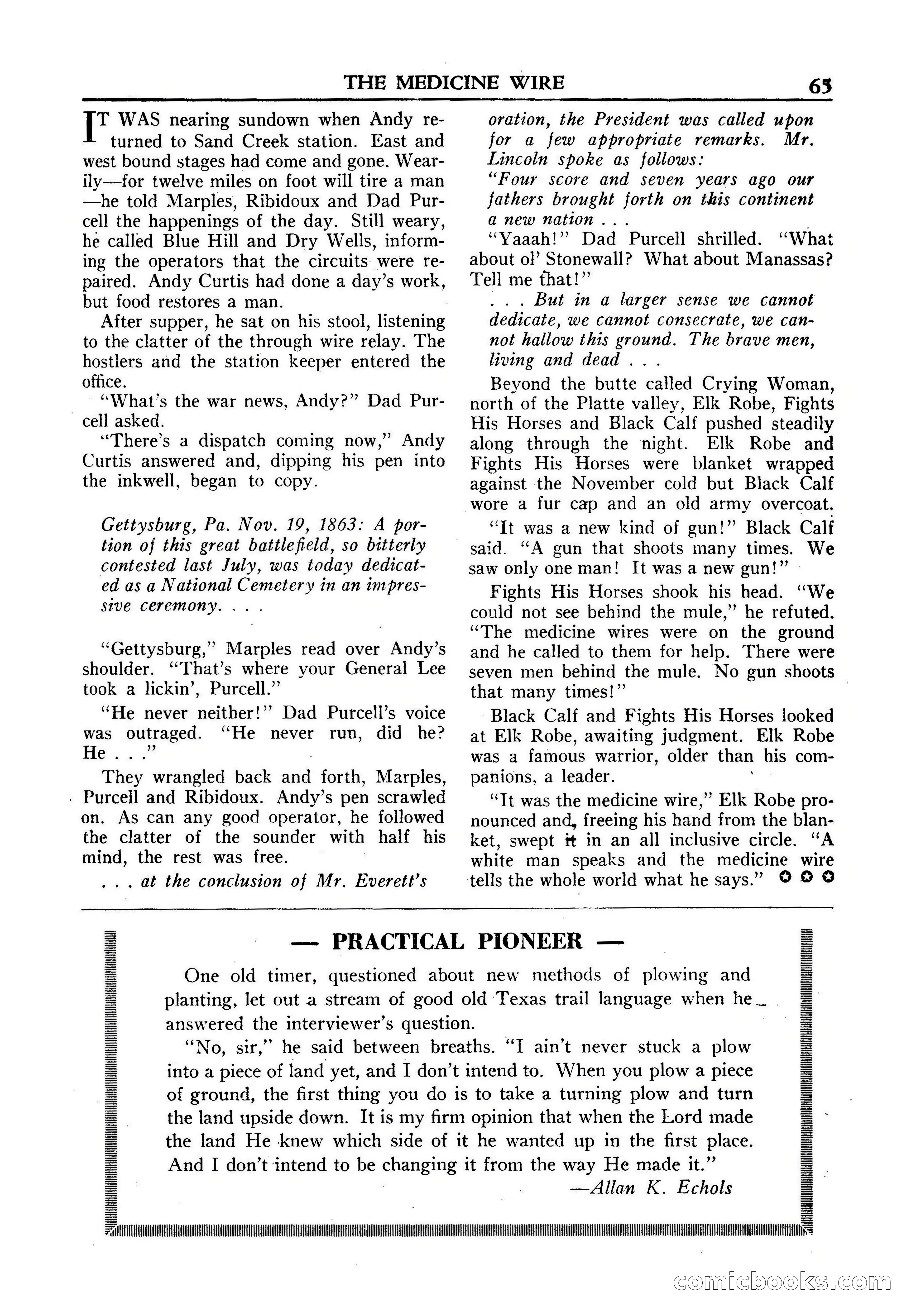
A restored page from Pulp Fiction, 1953. Page through the whole issue in the reader above.
📄 Transcribed text from this page (OCR, searchable)
Machine-transcribed from the original scan — historical spelling and the odd misread are preserved.
THE MEDICINE WIRE 63 ig WAS nearing sundown when Andy re- turned to Sand Creek station. East and west bound stages had come and gone. Wear- ily—for twelve miles on foot will tire a man —he told Marples, Ribidoux and Dad Pur- cell the happenings of the day. Still weary, he called Blue Hill and Dry Wells, inform- ing the operators. that the circuits were re- paired. Andy Curtis had done a day’s work, but food restores a man. After supper, he sat on his stool, listening to the clatter of the through wire relay. The hostlers and the station keeper entered the office. ~“What’s the war news, Andy?” Dad Pur- cell asked. ‘“There’s a dispatch coming now,” Andy Curtis answered and, dipping his pen into the inkwell, began to copy. Gettysburg, Pa. Nov. 19, 1863: A por- tion of this great battlefield, so bitterly contested last July, was today dedicat- ed as a National Cemetery in an impres- sive ceremony. “Gettysburg,” Marples read over Andy’s shoulder. “That’s where your General Lee took a lickin’, Purcell.” “He never neither!’ Dad Purcell’s voice was outraged. “He never run, did he? He...” They wrangled back and forth, Marples, . Purcell and Ribidoux. Andy’s pen scrawled on. As can any good operator, he followed the clatter of the sounder with half his mind, the rest was free. | . . at the conclusion of Mr. Everett’s “No, sir,’ SURAT Sl NT ~ said. tells the whole world what he says.” — PRACTICAL PIONEER — One old timer, questioned about new methods of plowing and planting, let out a stream of good old Texas trail language when he _ answered the interviewer's question. ’ he said between breaths. “I ain’t never stuck a plow into a piece of land yet, and I don’t intend to. When you plow a piece of ground, the first thing you do is to take a turning plow and turn the land upside down. It is my firm opinion that when the Lord made the land He knew which side of it he wanted up in the first place. And I don’t intend to be changing it from the way He made it.”’ oration, the President was called upon for a few appropriate remarks. Mr. Lincoln spoke as follows: “Four score and seven years ago our fathers brought forth on this continent anew nation... . “Vaaah!’”? Dad Purcell shrilled. “What about ol’ Stonewall? What about Manassase Tell me that!” _.. But in a larger sense we cannot dedicate, we cannot consecrate, we can- not hallow this ground. The brave men, living and dead . . Beyond the butte called Crying Woman, north of the Platte valley, Elk Robe, Fights His Horses and Black Calf pushed steadily along through the night. Elk Robe and Fights His Horses were blanket wrapped against the November cold but Black Calf wore a fur cap and an old army overcoat. “Tt was a new kind of gun!” Black Calf “A gun that shoots many times. We saw only one man! It was a new gun!” | Fights His Horses shook his head. ‘‘We could not see behind the mule,” he refuted. “The medicine wires were on the ground and he called to them for help. There were seven men behind the mule. No gun shoots that many times!” Black Calf and Fights His Horses looked at Elk Robe, awaiting judgment. Elk Robe was a famous watrior, older than his com- panions, a leader. “Tt was the medicine wire,” Elk Robe pro- nounced and, freeing his hand from the blan- ket, swept #t in an all inclusive circle. “A white man speaks and the medicine wire Ooo o —Allan K. Echols aU al MICLOO S UN Y CO