
Pulp Fiction, 1953 · page 40 of 116
Fifteen Western Tales, January 1953 — page 40: what you’re looking at
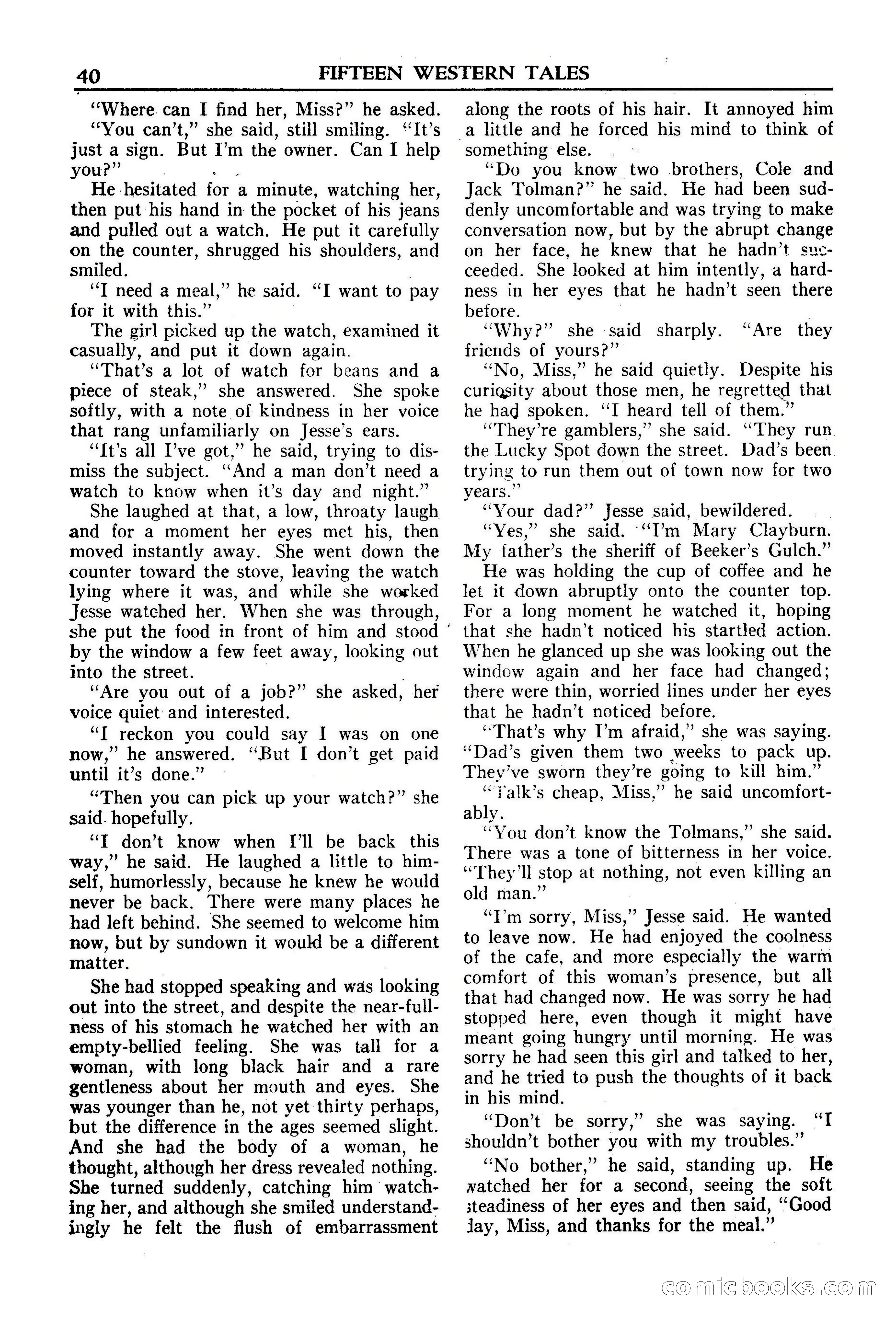
A restored page from Pulp Fiction, 1953. Page through the whole issue in the reader above.
📄 Transcribed text from this page (OCR, searchable)
Machine-transcribed from the original scan — historical spelling and the odd misread are preserved.
40 FIFTEEN WESTERN TALES ‘“‘Where can I find her, Miss?” he asked. “You can’t,” she said, still smiling. ‘It’s just a sign. But I’m the owner. Can I help your?” He. hesitated for | a minute, watching her, then put his hand in the pocket of his jeans and pulled out a watch. He put it carefully on the counter, shrugged his shoulders, and smiled. “T need a meal,” he said. for it with this.” The girl picked up the watch, examined it casually, and put it down again. “That’s a lot of watch for beans and a piece of steak,” she answered. She spoke softly, with a note of kindness in her voice that rang unfamiliarly on Jesse’s ears. “It’s all I’ve got,” he said, trying to dis- miss the subject. ‘““And a man don’t need a watch to know when it’s day and night.” She laughed at that, a low, throaty laugh and for a moment her eyes met his, then moved instantly away. She went down the counter toward the stove, leaving the watch lying where it was, and while she worked Jesse watched her. When she was through, “T want to pay she put the food in front of him and stood by the window a few feet away, looking out into the street. | “Are you out of a job?” she asked, her voice quiet and interested. “T reckon you could say I was on one now,” he answered. “But I don’t get paid until it’s done.” “Then you can pick up your watch?” she said. hopefully. “Tt don’t know when [ll be back this way,” he said. He laughed a little to him- self, humorlessly, because he knew he would never be back. There were many places he had left behind. She seemed to welcome him now, but by sundown it woukd be a different matter. She had stopped speaking and wads looking out into the street, and despite the near-full- ness of his stomach he watched her with an empty-bellied feeling. She was tall for a woman, with long black hair and a rare gentleness about her mouth and eyes. She was younger than he, not yet thirty perhaps, but the difference in the ages seemed slight. And she had the body of a woman, he thought, although her dress revealed nothing. She turned suddenly, catching him ‘watch- ing her, and although she smiled understand- ingly he felt the flush of embarrassment along the roots of his hair. It annoyed him a little and he forced his mind to think of something else. , “Do you know two brothers, Cole and Jack Tolman?” he said. He had been sud- denly uncomfortable and was trying to make conversation now, but by the abrupt change on her face, he knew that he hadn’t suc- ceeded. She looked at him intently, a hard- ness in her eyes that he hadn’t seen there before. “Why?” she said sharply. friends of yours?” “No, Miss,” he said quietly. Despite his curigsity about those men, he regretted that he hag spoken. “TI heard tell of them.” ‘“They’re gamblers,” she said. “Are they trying to run them out of town now for two years.” “Vour dad?” Jesse said, bewildered. “Ves,” she said. “I’m Mary Clayburn. My father’s the sheriff of Beeker’s Gulch.” He was holding the cup of coffee and he let it down abruptly onto the counter top. For a long moment he watched it, hoping that she hadn’t noticed his startled action. When he glanced up she was looking out the window again and her face had changed; there were thin, worried lines under her eyes that he hadn’t noticed before. “That’s why I’m afraid,” she was saying. “Dad’s given them two weeks to pack up. They’ve sworn they’re going to kill him.” “Talk’s cheap, Miss,” he said uncomfort- ably. “Vou don’t know the Tolmans,” she said. There was a tone of bitterness in her voice, “They'll stop at nothing, not even killing an old man.’ “T’m sorry, Miss,” Jesse said. ‘He wanted to leave now. He had enjoyed the coolness of the cafe, and more especially the warm comfort of this woman’s presence, but all that had changed now. He was sorry he had stopped here, even though it might have meant going hungry until morning. sorry he had seen this girl and talked to her, and he tried to push the thoughts of it back in his mind. “Don’t be sorry,” she was saying. “I shouldn’t bother you with my troubles.” “No bother,” he said, standing up. He watched her for a second, seeing the soft. steadiness of her eyes and then said, ‘‘Good jay, Miss, and thanks for the meal.” Coniicloooks.c© “They run. the Lucky Spot down the street. Dad’s been He was