
Pulp Fiction, 1953 · page 71 of 116
Fifteen Western Tales, January 1953 — page 71: what you’re looking at
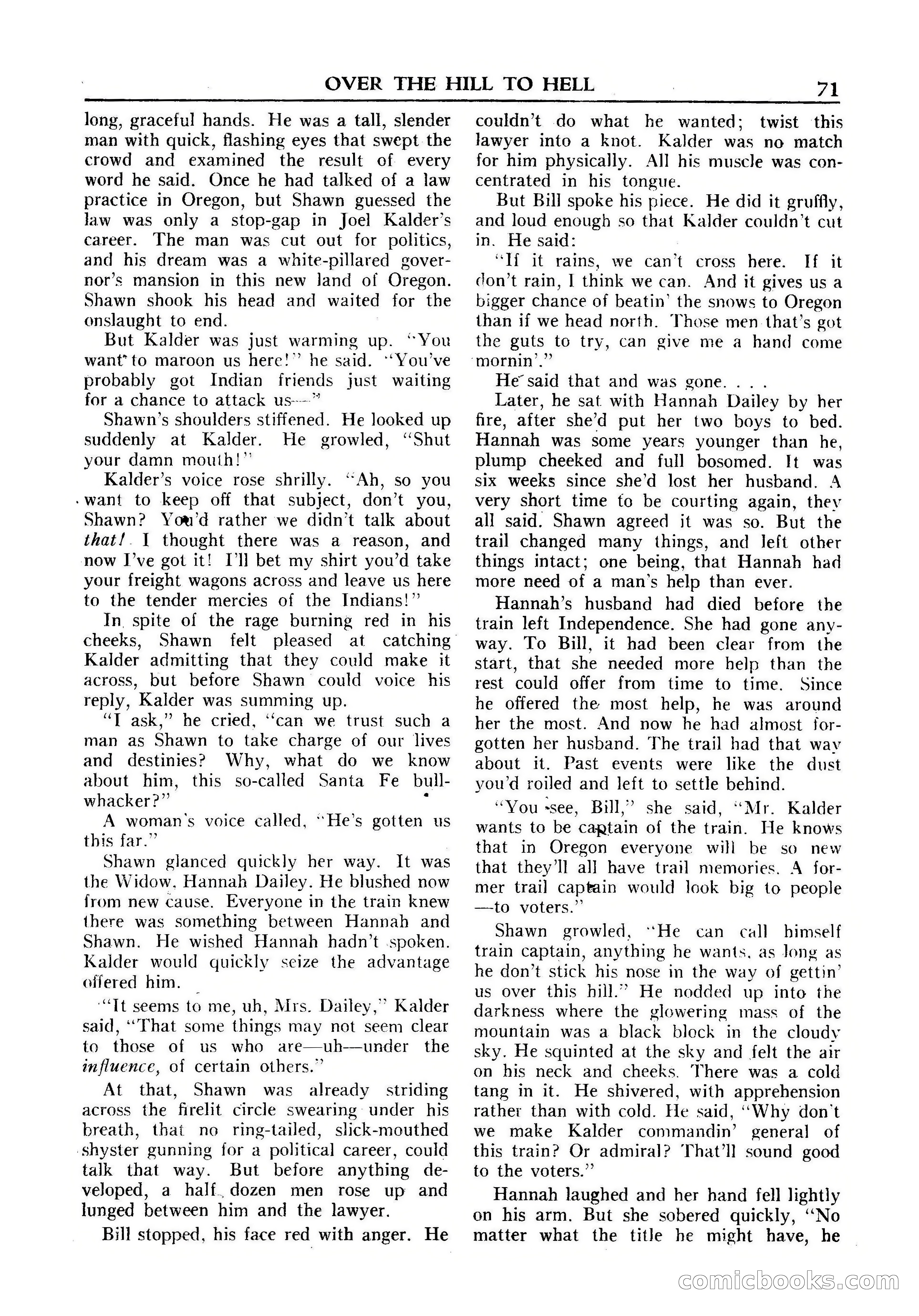
A restored page from Pulp Fiction, 1953. Page through the whole issue in the reader above.
📄 Transcribed text from this page (OCR, searchable)
Machine-transcribed from the original scan — historical spelling and the odd misread are preserved.
OVER THE HILL TO HELL 71 long, graceful hands. He was a tall, slender man with quick, flashing eyes that swept the crowd and examined the result of every word he said. Once he had talked of a law practice in Oregon, but Shawn guessed the law was only a stop-gap in Joel Kalder’s career. The man was cut out for politics, and his dream was a white-pillared gover- nor’s mansion in this new land of Oregon. Shawn shook his head and waited for the onslaught to end. : But Kalder was just warming up. “You want’ to maroon us here!” he said. *‘ You've probably got Indian friends just waiting for a chance to attack us-—” Shawn's shoulders stiffened. He looked up suddenly at Kalder. He growled, “Shut your damn mouth!” Kalder’s voice rose shrilly. “Ah, so you -want to keep off that subject, don’t you, Shawn? You'd rather we didn’t talk about that!. 1 thought there was a reason, and now I’ve got it! I'll bet my shirt you’d take your freight wagons across and leave us here to the tender mercies of the Indians!” In. spite of the rage burning red in his cheeks, Shawn felt pleased at catching Kalder admitting that they could make it across, but before Shawn could voice his reply, Kalder was summing up. “T ask,” he cried, ‘‘can we trust such a man as Shawn to take charge of our lives and destinies? Why, what do we know about him, this so-called Santa Fe bull- whacker?”’ . A woman's voice called, “He’s gotten us this far.” | Shawn glanced quickly her way. It was the Widow, Hannah Dailey. He blushed now from new cause. Everyone in the train knew there was something between Hannah and Shawn. He wished Hannah hadn’t spoken. Kalder would quickly seize the advantage oifered him. _ “Tt seems to me, uh, Mrs. Dailey,” Kalder said, ‘That some things may not seem clear to those of us who are—uh-—under the influence, of certain others.” At that, Shawn was already striding across the firelit circle swearing: under his breath, that no ring-tailed, slick-mouthed shyster gunning for a political career, could talk that way. But before anything de- veloped, a half. dozen men rose up and lunged between him and the lawyer. Bill stopped, his face red with anger. He couldn’t do what he wanted; twist this lawyer into a knot. Kalder was no match for him physically. All his muscle was con- centrated in his tongue. But Bill spoke his piece. He did it gruffly, and loud enough so that Kalder couldn't cut in. He said: . “Ii it rains, we can’t cross here. If it don’t rain, I think we can. And it gives us a bigger chance of beatin’ the snows to Oregon than if we head north. Those men that’s got the guts to try, can give me a hand come ‘mornin’.” He’ said that and was gone... . Later, he sat with Hannah Dailey by her fire, after she’d put her two boys to bed. Hannah was some years younger than he, plump cheeked and full bosomed. It was six weeks since she’d lost her husband. A very short time to be courting again, they all said. Shawn agreed it was so. But the trail changed many things, and left other things intact; one being, that Hannah had more need of a man’s help than ever. Hannah’s husband had died before the train left Independence. She had gone any- way. To Bill, it had been clear from the start, that she needed more help than the rest could offer from time to time. Since he offered the most help, he was around her the most. And now he had almost for- gotten her husband. The trail had that wav about it. Past events were like the dust you'd roiled and left to settle behind. “Vou ssee, Bill,” she said, “Mr. Kalder wants to be captain of the train. He knows that in Oregon everyone will be so new that they'll all have trail memories. A for- mer trail captain would look big to people —to voters.”’ Shawn growled, ‘He can call himself train captain, anything he wants, as Jong as he don’t stick his nose in the way of gettin’ us over this hill.” He nodded up into the darkness where the glowering mass of the mountain was a black bleck in the cloudy sky. He squinted at the sky and felt the air on his neck and cheeks. There was a cold tang in it. He shivered, with apprehension rather than with cold. He said, “Why don't we make Kalder commandin’ general of this train? Or admiral? That’ll sound good to the voters.” Hannah laughed and her hand fell lightly on his arm. But she sobered quickly, ‘““No matter what the title he might have, he oO Comiclbooks 5}