
Pulp Fiction, 1953 · page 16 of 116
Fifteen Western Tales, January 1953 — page 16: what you’re looking at
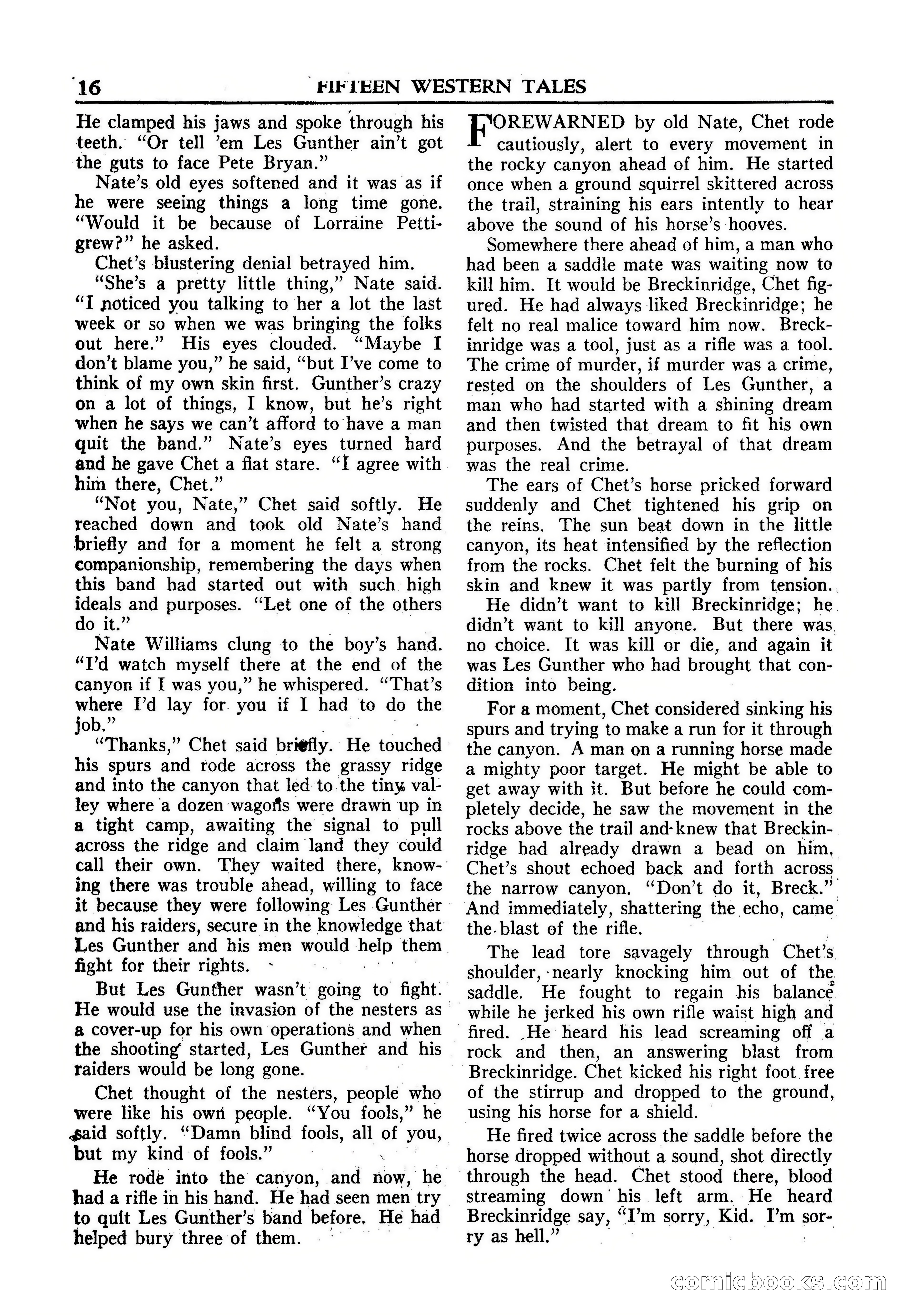
A restored page from Pulp Fiction, 1953. Page through the whole issue in the reader above.
📄 Transcribed text from this page (OCR, searchable)
Machine-transcribed from the original scan — historical spelling and the odd misread are preserved.
‘16 -FIFIEEN WESTERN TALES He clamped his jaws and spoke through his teeth. “Or tell ’em Les Gunther ain’t got the guts to face Pete Bryan.” Nate’s old eyes softened and it was as if he were seeing things a long time gone. “Would it be because of Lorraine Petti- grew?” he asked. Chet’s blustering denial betrayed him. ‘“‘She’s a pretty little thing,” Nate said. “T noticed you talking to her a lot the last week or so when we was bringing the folks out here.” His eyes clouded. “Maybe I don’t blame you,” he said, “but I’ve come to think of my own skin first. Gunther’s crazy on a lot of things, I know, but he’s right when he says we can’t afford to have a man quit the band.” Nate’s eyes turned hard and he gave Chet a flat stare. “I agree with. him there, Chet.” “Not you, Nate,” Chet said softly. He reached down and took old Nate’s hand briefly and for a moment he felt a strong companionship, remembering the days when this band had started out with such. high ideals and purposes. “Let one of the others do it.” Nate Williams clung to the boy’s hand. “’d watch myself there at the end of the canyon if I was you,” he whispered. “That’s where I’d lay for. you if I had to do the job. ” “Thanks,” Chet said briefly. He tauchrad his spurs and rode across the grassy ridge and into the canyon that led to the tiny val- ley where a dozen wagofis were drawn up in a tight camp, awaiting the signal to pull across the ridge and claim land they could call their own. They waited there, know- ing there was trouble ahead, willing to face it because they were following Les Gunther and his raiders, secure in the knowledge that Les Gunther and his men would a them. fight for their rights. But Les Gunther wasn’t going to fight. He would use the invasion of the nesters as | a cover-up for his own operations and when the shooting’ started, Les Gunther and his — raiders would be long gone. Chet thought of the nesters, people who were like his own people. “You fools,” he said softly. but my kind of fools.” : , He rode into the canyon, and now, he. had a rifle in his hand. He had seen men try — to quit Les Gunther’s band before. He had helped bury three of them. =~ “Damn blind fools, all of you, | | Fabs gn by old Nate, Chet rode cautiously, alert to every movement in the rocky canyon ahead of him. He started once when a ground squirrel skittered across the trail, straining his ears intently to hear above the sound of his horse’s hooves. Somewhere there ahead of him, a man who had been a saddle mate was waiting now to kill him. It would be Breckinridge, Chet fig- ured. He had always liked Breckinridge; he felt no real malice toward him now. Breck- inridge was a tool, just as a rifle was a tool. The crime of murder, if murder was a crime, rested on the shoulders of Les Gunther, a man who had started with a shining dream and then twisted that dream to fit his own purposes. And the betrayal of that dream was the real crime. The ears of Chet’s horse pricked forward suddenly and Chet tightened his grip on the reins. The sun beat down in the little canyon, its heat intensified by the reflection from the rocks. Chet felt the burning of his skin and knew it was partly from tension.. He didn’t want to kill Breckinridge; he. didn’t want to kill anyone. But there was. no choice. It was kill or die, and again it was Les Gunther who had brought that con- dition into being. For a moment, Chet considered sinking his spurs and trying to make a run for it through the canyon. A man on a running horse made a mighty poor target. He might be able to get away with it. But before he could com- pletely decide, he saw the movement in the rocks above the trail and-knew that Breckin-. ridge had already drawn a bead on him, Chet’s shout echoed back and forth across the narrow canyon. the. blast of the rifle. “Don’t do it, Breck.” And immediately, shattering the echo, came The lead tore savagely through Chet’ s shoulder, -nearly knocking him out of the saddle. while he jerked his own rifle waist high and fired. _He heard his lead screaming off a rock and then, an answering blast from ~ Breckinridge. Chet kicked his right foot. free of the stirrup and dropped to the ground, using his horse for a shield. He fired twice across the saddle before the horse dropped without a sound, shot directly through the head. Chet stood there, blood streaming down’ his left arm. He heard Breckinridge say, “YT m sorry, Kid. I’m sor ry as hell.” CoMmichoooks ‘He fought to regain his balance. CO