
Pulp Fiction, 1953 · page 22 of 116
Fifteen Western Tales, January 1953 — page 22: what you’re looking at
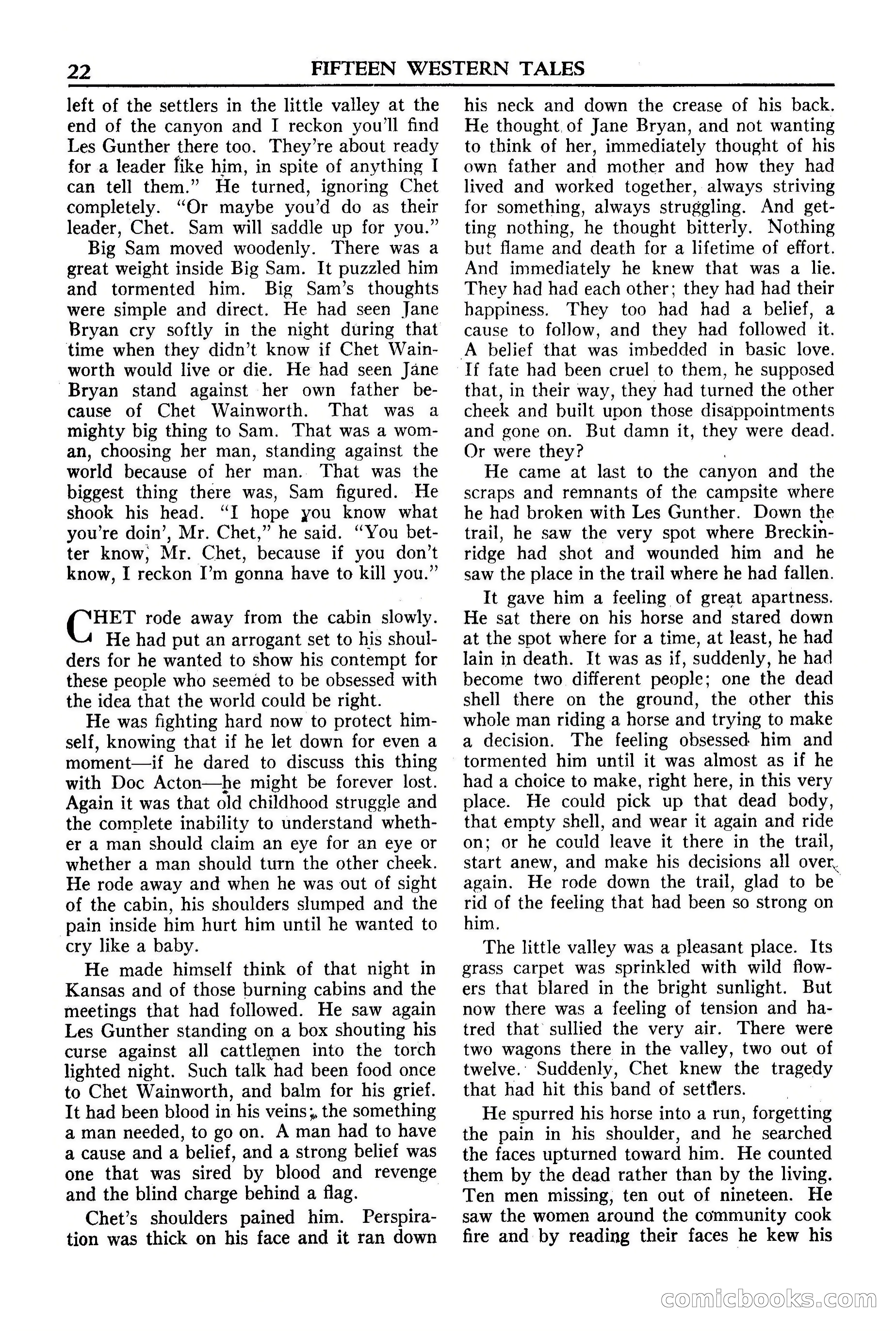
A restored page from Pulp Fiction, 1953. Page through the whole issue in the reader above.
📄 Transcribed text from this page (OCR, searchable)
Machine-transcribed from the original scan — historical spelling and the odd misread are preserved.
22 | FIFTEEN WESTERN TALES left of the settlers in the little valley at the end of the canyon and I reckon you'll find Les Gunther there too. They’re about ready for a leader like him, in spite of anything I can tell them.” He turned, ignoring Chet completely. “Or maybe you’d do as their leader, Chet. Sam will saddle up for you.” Big Sam moved woodenly. There was a great weight inside Big Sam. It puzzled him and tormented him. Big Sam’s thoughts were simple and direct. He had seen Jane Bryan cry softly in the night during that time when they didn’t know if Chet Wain- worth would live or die. He had seen Jane Bryan stand against her own father be- cause of Chet Wainworth. That was a mighty big thing to Sam. That was a wom- an, choosing her man, standing against the world because of her man. That was the biggest thing there was, Sam figured. He shook his head. “I hope you know what yow’re doin’, Mr. Chet,” he said. “You bet- ter know, Mr. Chet, because if you don’t know, I reckon I’m gonna have to kill you.” HET rode away from the cabin slowly. He had put an arrogant set to his shoul- ders for he wanted to show his contempt for these people who seemed to be obsessed with the idea that the world could be right. He was fighting hard now to protect him- self, knowing that if he let down for even a moment—if he dared to discuss this thing with Doc Acton—he might be forever lost. Again it was that old childhood struggle and the complete inability to understand wheth- er a man should claim an eye for an eye or whether a man should turn the other cheek. He rode away and when he was out of sight of the cabin, his shoulders slumped and the pain inside him hurt him until he wanted to cry like a baby. He made himself think of that night in Kansas and of those burning cabins and the meetings that had followed. He saw again Les Gunther standing on a box shouting his curse against all cattlemen into the torch lighted night. Such talk ‘had been food once to Chet Wainworth, and balm for his grief. It had been blood in his veins; the something a man needed, to go on. A man had to have a cause and a belief, and a strong belief was one that was sired by blood and revenge and the blind charge behind a flag. Chet’s shoulders pained him. Perspira- tion was thick on his face and it ran down his neck and down the crease of his back. He thought. of Jane Bryan, and not wanting to think of her, immediately thought of his own father and mother and how they had lived and worked together, always striving for something, always struggling. And get- ting nothing, he thought bitterly. Nothing but flame and death for a lifetime of effort. And immediately he knew that was a lie. They had had each other; they had had their happiness. They too had had a belief, a cause to follow, and they had followed it. A belief that was imbedded in basic love. If fate had been cruel to them, he supposed that, in their way, they had turned the other cheek and built upon those disappointments and gone on. But damn it, they were dead. Or were they? He came at last to the canyon and the scraps and remnants of the campsite where he had broken with Les Gunther. Down the trail, he saw the very spot where Breckin- ridge had shot and wounded him and he saw the place in the trail where he had fallen. It gave him a feeling of great apartness. He sat there on his horse and stared down at the spot where for a time, at least, he had lain in death. It was as if, suddenly, he had become two different people; one the dead shell there on the ground, the other this whole man riding a horse and trying to make a decision. The feeling obsessed) him and tormented him until it was almost as if he had a choice to make, right here, in this very place. He could pick up that dead body, that empty shell, and wear it again and ride on; or he could leave it there in the trail, start anew, and make his decisions all over, again. He rode down the trail, glad to be rid of the feeling that had been so strong on him. The little valley was a pleasant place. Its grass carpet was sprinkled with wild flow- ers that blared in the bright sunlight. But now there was a feeling of tension and ha- tred that sullied the very air. There were two wagons there in the valley, two out of twelve. Suddenly, Chet knew the tragedy that had hit this band of settlers. He spurred his horse into a run, forgetting the pain in his shoulder, and he searched the faces upturned toward him. He counted them by the dead rather than by the living. Ten men missing, ten out of nineteen. He saw the women around the community cook fire and by reading their faces he kew his COMICMOoOkKS.cO