
Pulp Fiction, 1953 · page 62 of 116
Fifteen Western Tales, January 1953 — page 62: what you’re looking at
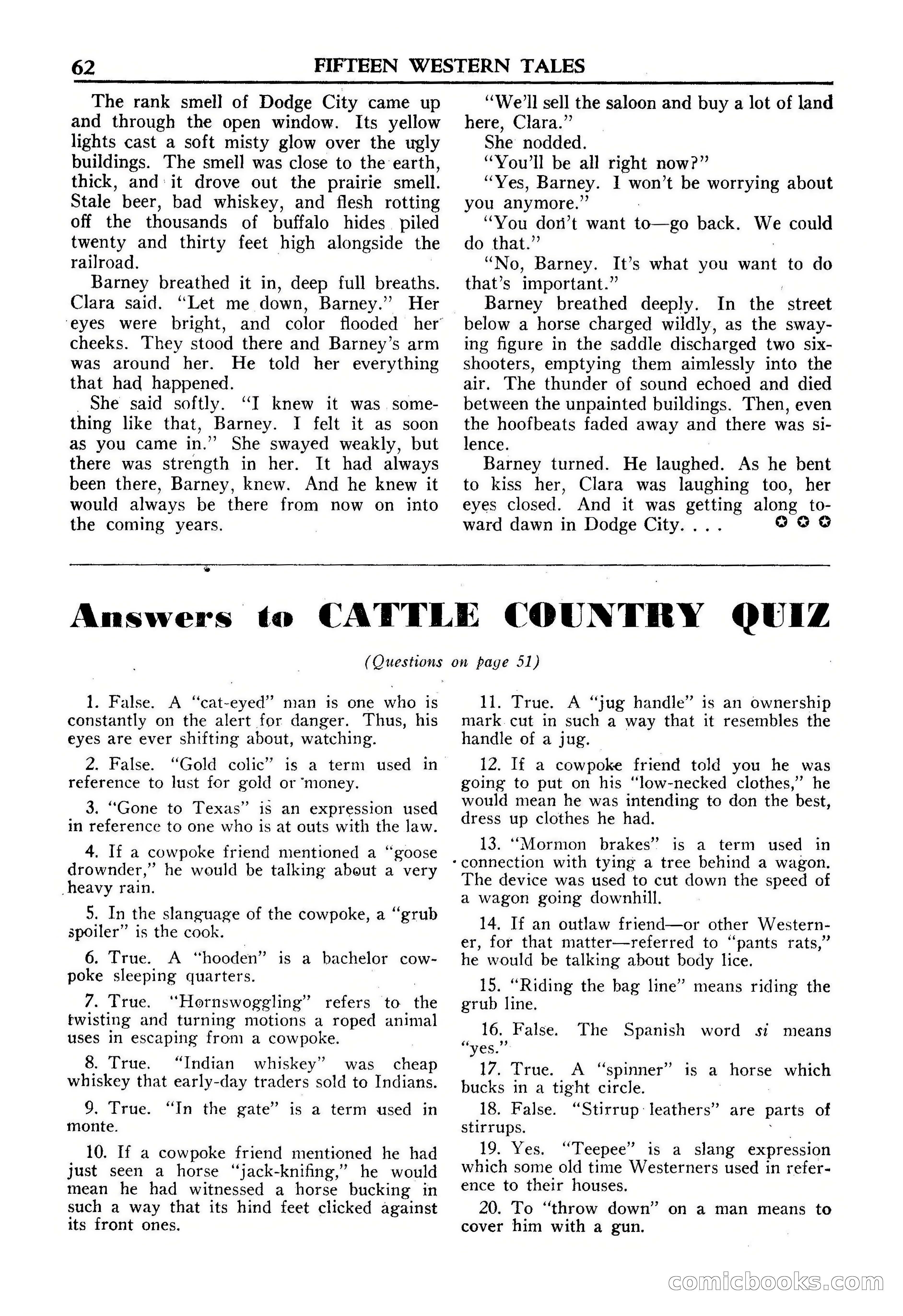
A restored page from Pulp Fiction, 1953. Page through the whole issue in the reader above.
📄 Transcribed text from this page (OCR, searchable)
Machine-transcribed from the original scan — historical spelling and the odd misread are preserved.
62 FIFTEEN WESTERN TALES The rank smell of Dodge City came up and through the open window. Its yellow lights cast a soft misty glow over the ugly buildings. The smell was close to the earth, thick, and it drove out the prairie smell. Stale. beer, bad whiskey, and flesh rotting off the thousands of buffalo hides. piled twenty and thirty feet high alongside the railroad. Barney breathed it in, deep full breaths. Clara said. “Let me down, Barney.” Her ‘eyes were bright, cheeks. They stood there and Barney’s arm was around her. He told her everything that had happened. _ She said softly. “I knew it was. some- thing like that, Barney. I felt it as soon aS you came in.” She swayed weakly, but there was strength in her. It had always been there, Barney, knew. And he knew it would always be there from now on into the coming years. wo and color flooded her’ “We'll sell the saloon and buy a lot of land here, Clara.” She nodded. “You'll be all right now?” “Ves, Barney. 1 won’t be worrying about you anymore.’ “You don’t want to—ge back. we could do that.” “No, Barney. It’s what you want to do that’s important. “ Barney breathed deeply. In the street below a horse charged wildly, as the sway- ing figure in the saddle discharged two six- shooters, emptying them aimlessly into the air. The thunder of sound echoed and died between the unpainted buildings. Then, even the hoofbeats faded away and there was si- lence. Barney turned. He et As he bent to kiss her, Clara was laughing too, her eyes closed. And it was getting along. to- ward dawn in Dodge City. . & © Answers to CATTLE COUNTRY QUIZ (Questions on page 51) 1. False. A “cat-eyed” man is one who is constantly on the alert for danger. Thus, his eyes are ever shifting about, watching. 2. False. “Gold colic” reference to lust for gold or ‘money. 3. “Gone to Texas” is an expression used in reference to one who is at outs with the law. 4. If a cowpoke friend mentioned a “goose drownder,” he would be talking about a very heavy rain. 5. In the slanguage of the cowpoke, a “grub spoiler” is the cook. 6. True. A “hooden” is a bachelor cow- poke sleeping quarters. | | 7. True. ‘Hornswoggling” refers to the twisting and turning motions a roped animal uses in escaping from a cowpoke. 8. True. “Indian whiskey” was cheap whiskey that early-day traders sold to Indians. 9. True. “In the gate” is a term used in monte. 10. If a cowpoke friend mentioned he had just seen a horse “jack-knifing,” he would mean he had witnessed a horse bucking in such a way that its hind feet clicked against its front ones. is a term used in ll. True. A “jug handle” is an ownership mark. cut in such a way that it resembles the handle of a jug. 12. If a cowpoke friend told you he was going to put on his “low-necked clothes,” he would mean he was intending to don the best, dress up clothes he had. 13. ‘‘Mormon brakes” is a term used in ‘connection with tying a tree behind a wagon. The device was used to cut down the speed of a wagon going downhill. 14, If an outlaw friend—or other Western- er, for that matter—referred to “pants rats,” he would be talking about body lice. 15. “Riding the bag line” means riding the grub line. 16. False. The Spanish word si means “ves.” 17. True. A “spinner” is a horse which bucks in a tight circle. : : 18. False. “Stirrup leathers” are parts of stirrups. 19. Yes. “Teepee” is a slang expression which some old time Westerners used in refer- ence to their houses. 20. To “throw down” on a man means to cover him with a gun. Coniicloooks.c© inn