
Pulp Fiction, 1953 · page 78 of 116
Fifteen Western Tales, January 1953 — page 78: what you’re looking at
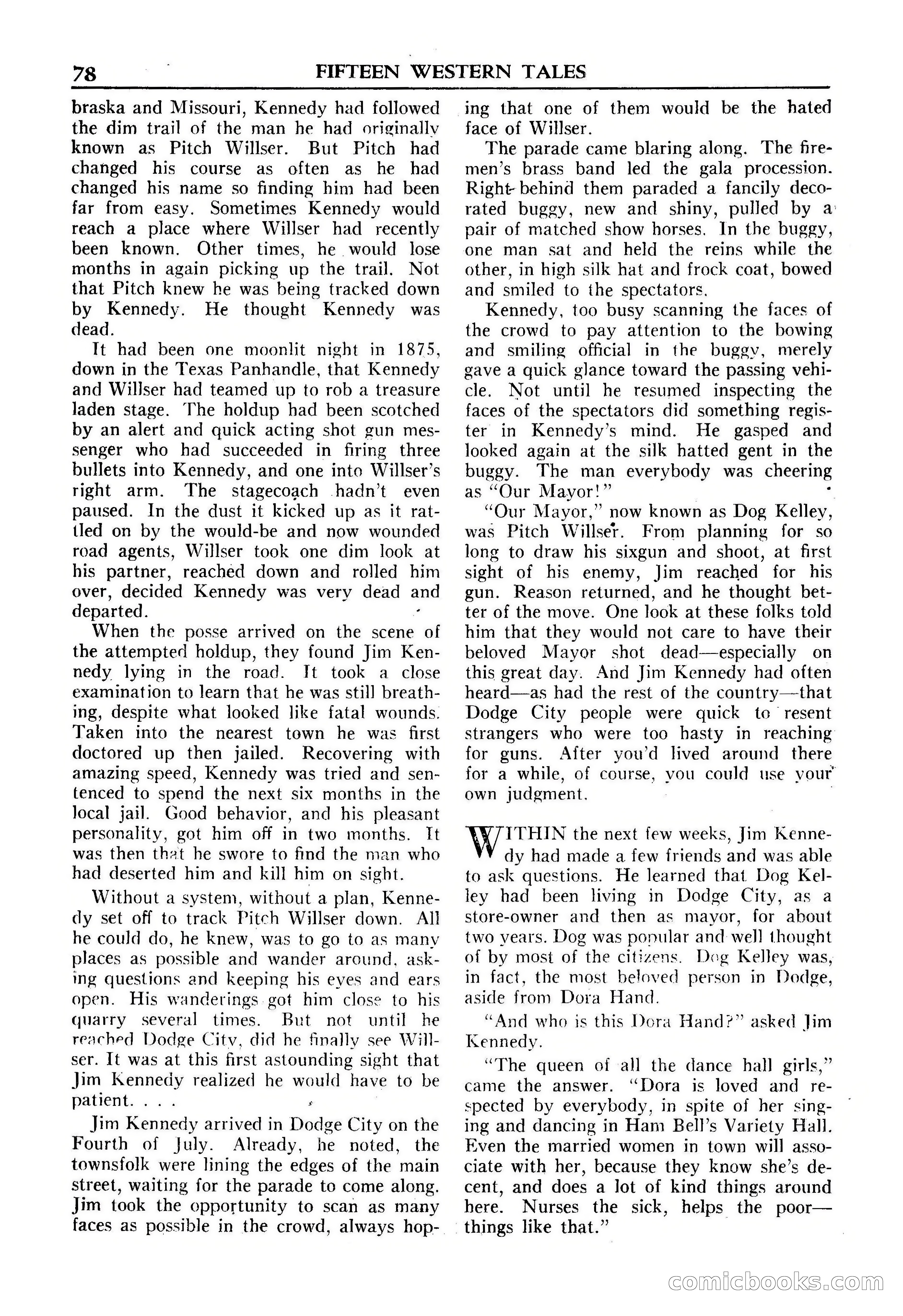
A restored page from Pulp Fiction, 1953. Page through the whole issue in the reader above.
📄 Transcribed text from this page (OCR, searchable)
Machine-transcribed from the original scan — historical spelling and the odd misread are preserved.
ee FIFTEEN WESTERN TALES braska and Missouri, Kennedy had followed the dim trail of the man he had originallv known as Pitch Willser. But Pitch had changed his course as often as he had changed his name so finding him had been far from easy. Sometimes Kennedy would reach a place where Willser had recently been known. Other times, he would lose months in again picking up the trail. Not that Pitch knew he was being tracked down by Kennedy. He thought Kennedy was dead. It had been one moonlit night in 1875, down in the Texas Panhandle, that Kennedy and Willser had teamed up to rob a treasure laden stage. The holdup had been scotched by an alert and quick acting shot gun mes- senger who had succeeded in firing three bullets into Kennedy, and one into Willser’s right arm. The stagecoach -hadn’t even paused. In the dust it kicked up as it rat- tled on by the would-be and now wounded road agents, Willser took one dim look at his partner, reached down and rolled him over, decided Kennedy was very dead ant departed. When the posse arrived on the scene of the attempted holdup, they found Jim Ken- nedy lying in the road. It took a close examination to learn that he was still breath- ing, despite what looked like fatal wounds. Taken into the nearest town he was first doctored up then jailed. Recovering with amazing speed, Kennedy was tried and sen- tenced to spend the next six months in the Jocal jail. Good behavior, and his pleasant personality, got him off in two months. It was then that he swore to find the man who had deserted him and kill him on sight. Without a system, without a plan, Kenne- dy set off to track Pitch Willser down. All he could do, he knew, was to go to as many places as possible and wander around, ask- mg questions and keeping his eves and ears open. His wanderings got him close to his quarry several times. But not until he reached Dodge Citv, did he finally see Will- ser. It was at this first astounding sight that Jim Kennedy realized he would have to be patient. ... ’ Jim Kennedy arrived in Dodge City on the Fourth of July. Already, he noted, the townsfolk were lining the edges of the main Street, waiting for the parade to come along. Jim took the opportunity to scan aS many faces as possible in the crowd, always hop-. ing that one of them would be the hated face of Willser. The parade came blaring along. The frre- men’s brass band led the gala procession. Right behind them paraded a fancily deco- rated buggy, new and shiny, pulled by a pair of matched show horses. In the buggy, one man sat and held the reins while the other, in high silk hat and frock coat, bowed and smiled to the spectators. Kennedy, too busy scanning the faces of the crowd to pay attention to the bowing and smiling official in the buggv, merely gave a quick glance toward the passing vehi- cle. Not until he resumed inspecting the faces of the spectators did something regis- ter in Kennedy’s mind. He gasped and looked again at the silk hatted gent in the bugey. The man everybody was cheering s “Our Mayor'” “Our Mayor,” was Pitch Willser. From planning for so long to draw his sixgun and shoot, at first sight of his enemy, Jim reached for his gun. Reason returned, and he thought bet- ter of the move. One look at these folks told him that they would not care to have their beloved Mayor shot dead—especially on this great day. And Jim Kennedy had often heard—as had the rest of the country—that Dodge City people were quick to resent strangers who were too hasty in reaching for guns. After you'd lived around there for a while, of course, vou could use your own judgment. ITHIN the next few weeks, Jim Kenne- dy had made a few friends and was able to ask questions. He learned that Dog Kel- ley had been living in Dodge City, as a store-owner and then as mayor, for about two vears. Dog was ponular and well thought of by most of the citizens. in fact, the most beloved person in Dodge, aside from Dora Hand. “And who is this Dora Hand?” asked Jim Kennedy. “The queen of all the dance hall girls,” came the answer. “Dora is loved and re- spected by everybody, in spite of her sing- ing and dancing in Ham Bell’s Variety Hall. Even the married women in town will asso- ciate with her, because they know she’s de- cent, and does a Jot of kind things around bere. Nurses the sick, helps the poor— ‘things like that.” Coniiclboooks.c© now known as Dog Kelley, Dog Kelley was,