
Pulp Fiction, 1953 · page 23 of 116
Fifteen Western Tales, January 1953 — page 23: what you’re looking at
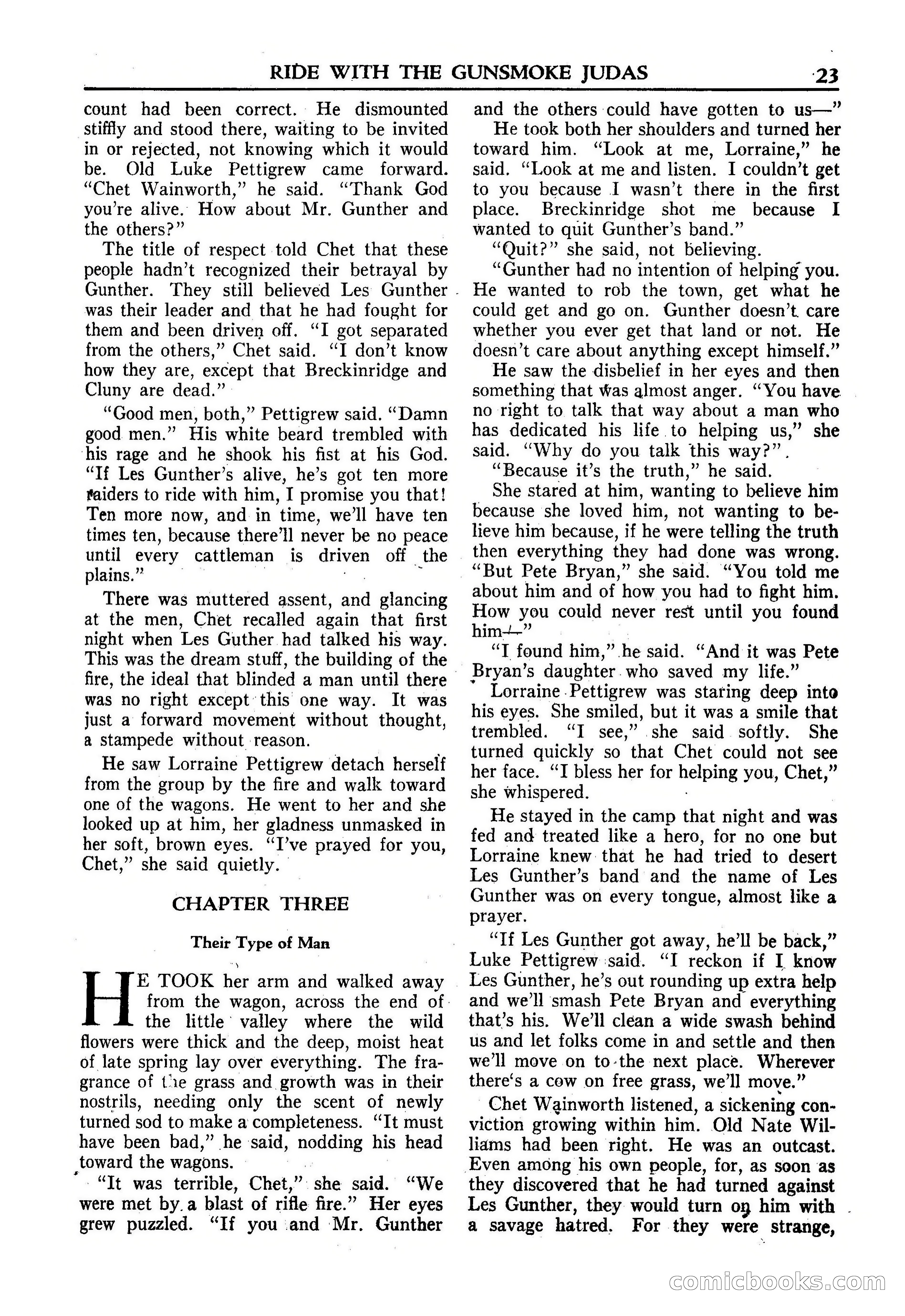
A restored page from Pulp Fiction, 1953. Page through the whole issue in the reader above.
📄 Transcribed text from this page (OCR, searchable)
Machine-transcribed from the original scan — historical spelling and the odd misread are preserved.
RIDE WITH THE GUNSMOKE JUDAS ‘23 count had been correct. He dismounted stiffly and stood there, waiting to be invited in or rejected, not knowing which it would be. Old Luke Pettigrew came forward. “Chet Wainworth,” he said. “Thank God you're alive. How about Mr. Gunther and the others?” | The title of respect told Chet that these people hadn’t recognized their betrayal by Gunther. was their leader and that he had fought for them and been driven off. “I got separated from the others,” Chet said. “I don’t know how they are, except that Breckinridge and Cluny are dead.” “Good men, both,” Pettigrew said. “Damn good men.” His white beard trembled with ‘his rage and he shook his fist at his God. “If Les Gunther’s alive, he’s got ten more taiders to ride with him, I promise you that! Ten more now, and in time, we’ll have ten times ten, because there’ll never be no peace until every cattleman ‘is driven off the plains.” There was muttered assent, and glancing at the men, Chet recalled again that first night when Les Guther had talked his way. This was the dream stuff, the building of the fire, the ideal that blinded a man until there | was no right except’ this one way. It was just a forward movement without thought, a stampede without reason. He saw Lorraine Pettigrew detach herself from the group by the fire and walk toward one of the wagons. He went to her and she looked up at him, her gladness unmasked in her soft, brown eyes. “I’ve prayed for you, Chet,” she said quietly. | CHAPTER THREE Their Type of Man the little’ valley where the wild flowers were thick and the deep, moist heat of late spring lay over everything. The fra- grance of (ie grass and growth was in their nostrils, needing only the scent of newly turned sod to make a completeness. “It must have been bad,” he said, naveng his head toward the wagons. | “Jt was terrible, Chet,” she said. “We were met by.a blast of rifle fire.” Her eyes grew puzzled. “If you and Mr. Gunther s They still believed Les Gunther - ~ Luke Pettigrew ‘said. E TOOK her arm and walked away | from the wagon, across the end of. and the others could have gotten to us—” He took both her shoulders and turned her toward him. “Look at me, Lorraine,” he said. “Look at me and listen. I couldn’t get to you because I wasn’t there in the first place. Breckinridge shot me _ because I wanted to quit Gunther’s band.” “Quit?” she said, not believing. “Gunther had no intention of helping you. He wanted to rob the town, get what he could get and go on. Gunther doesn’t. care whether you ever get that land or not. He doesn’t care about anything except himself.” He saw the disbelief in her eyes and then something that Was almost anger. “You have | no right to talk that way about a man who has dedicated his life to helping us,” she said. “Why do you talk this way?” . “Because it’s the truth,” he said. She stared at him, wanting to believe him because she loved him, not wanting to be- lieve him because, if he were telling the truth _ then everything they had done was wrong. “But Pete Bryan,” she said. “You told me about him and of how you had to fight him. How you could never rest until you found him-— ) “T found him,” he said. “And it was Pete Bryan’s daughter. who saved my life.” Lorraine Pettigrew was staring deep into his eyes. She smiled, but it was a smile that trembled. “I see,” she said. softly. She turned quickly so that Chet could not see her face. “TI bless her for HeNBIng you, Chet,” she whispered. He stayed in the camp that night and was fed and treated like a hero, for no one but Lorraine knew that he had tried to desert Les Gunther’s band and the name of Les Gunther was on every tongue, almost like a prayer. “If Les Gunther got away, he’ll be back,” “T reckon if I know Les Gunther, he’s out rounding up extra help and we'll smash Pete Bryan and everything that’s his. We'll clean a wide swash behind us and let folks come in and settle and then we'll move on to-the next place. Wherever there‘s a cow on free grass, we'll move.” Chet Wainworth listened, a sickening con- viction growing within him. Old Nate Wil- liams had been right. He was an outcast. Even among his own people, for, as soon as they discovered that he had turned against Les Gunther, they would turn oy him with . a savage hatred, For they were _ Strange, CoMmicboOoks.c©