
Pulp Fiction, 1953 · page 50 of 116
Fifteen Western Tales, January 1953 — page 50: what you’re looking at
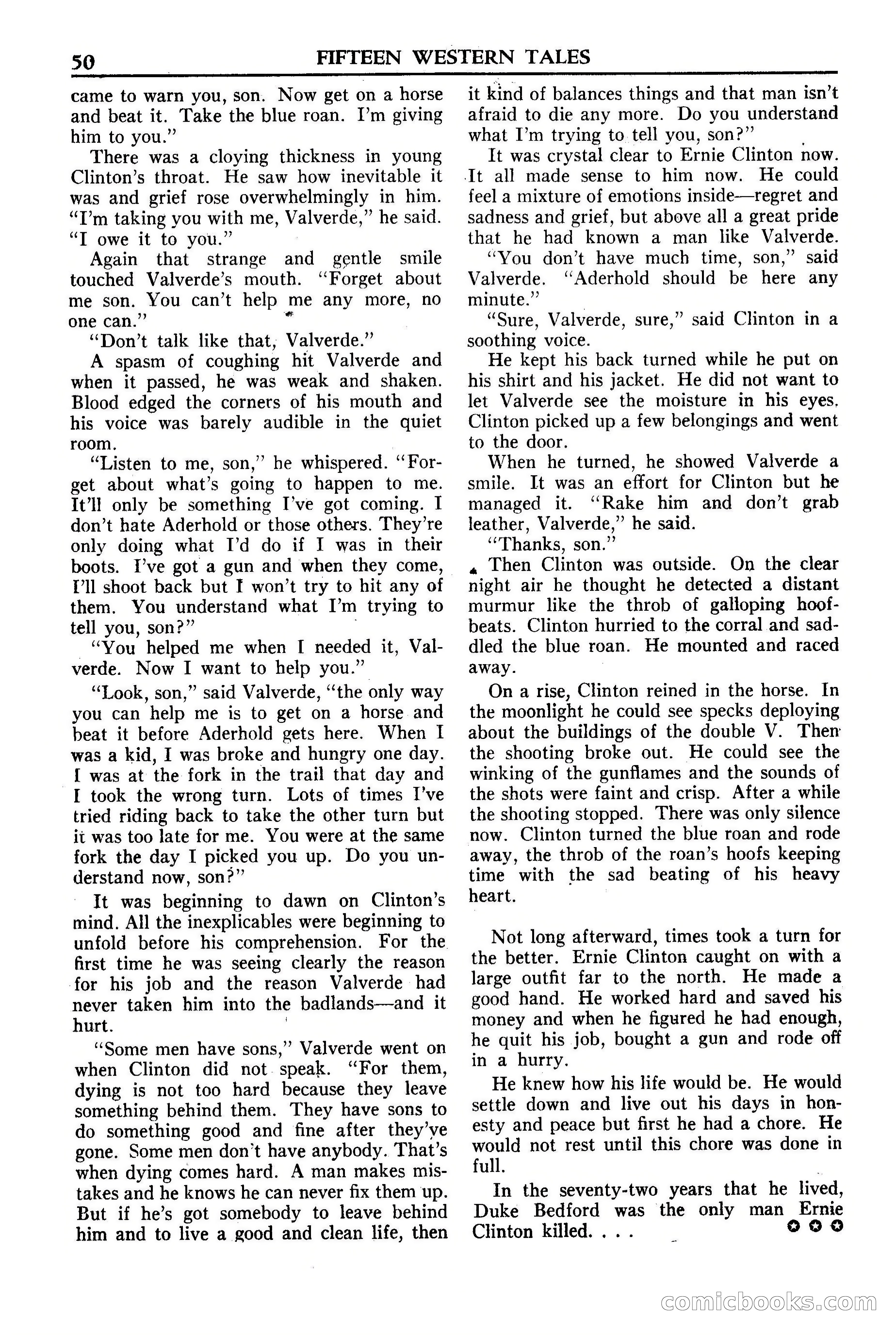
A restored page from Pulp Fiction, 1953. Page through the whole issue in the reader above.
📄 Transcribed text from this page (OCR, searchable)
Machine-transcribed from the original scan — historical spelling and the odd misread are preserved.
50 FIFTEEN WESTERN TALES en ea a a ddd athe nnn came to warn you, son. Now get on a horse and beat it. Take the blue roan. I’m giving him to you.” There was a cloying thickness in young Clinton’s throat. He saw how inevitable it was and grief rose overwhelmingly in him. “T’m taking you with me, Valverde, ” he said. “T owe it to you.” Again that strange ond gentle smile touched Valverde’s mouth. ‘Forget about me son. You can’t help” me any more, no one can.’ “Don’t talk like that, Valverde.” A spasm of coughing hit Valverde and when it passed, he was weak and shaken. Blood edged the corners of his mouth and his voice was barely audible in the quiet room. “Listen to me, son,” he whispered. “For- get about what’s going to happen to me. It'll only be something I’ve got coming. I don’t hate Aderhold or those others. They’re only doing what I’d do if I was in their boots. I’ve got a gun and when they come, — ll shoot back but I won’t try to hit any of them. You understand what I’m trying to tell you, son?” _“VYou helped me when [ needed it, Val- verde. Now I want to help you.” “Look, son,” said Valverde, “the only way you can help me is to get on a horse and beat it before Aderhold gets here. When I was a kid, I was broke and hungry one day. I was at the fork in the trail that day and I took the wrong turn. Lots of times I’ve tried riding back to take the other turn but it was too late for me. You were at the same fork the day I picked you up. Do you un- derstand now, son?” It was beginning to dawn on Clinton’s mind. All the inexplicables were beginning to unfold before his comprehension. For the. first time he was seeing clearly the reason for his job and the reason Valverde had never taken him into the badlands—and it hurt. “Some men have sons,” Valverde went on when Clinton did not. speak. “For them, dying is not too hard because they leave something behind them. They have sons to do something good and fine after they’ve gone. Some men don’t have anybody. That’s when dying comes hard. A man makes mis- takes and he knows he can never fix them up. But if he’s got somebody to leave behind him and to live a good and clean life, then it kind of balances things and that man isn’t afraid to die any more. Do you understand what I’m trying to. tell you, son?” It was crystal clear to Ernie Clinton now. It all made sense to him now. He could feel a mixture of emotions inside—regret and sadness and grief, but above all a great pride that he had known a man like Valverde. “Vou don’t have much time, son,” said Valverde. ‘Aderhold should be here any minute.” | “Sure, Valverde, sure,” said Clinton in a soothing voice. He kept his back turned while he put on his shirt and his jacket. He did not want to let Valverde see the moisture in his eyes, Clinton picked up a few belongings and went to the door. When he turned, he showed Valverde a smile. It was an effort for Clinton but he managed it. “Rake him and don’t grab leather, Valverde,” he said. ‘Thanks, son.” . [hen Clinton was outside. On the clear night air he thought he detected a distant murmur like the throb of galloping hoof- beats. Clinton hurried to the corral and sad- dled the blue roan. He mounted and raced away. | On a rise, Clinton reined in the horse. In the moonlight he could see specks deploying about the buildings of the double V. Ther the shooting broke out. He could see the winking of the gunflames and the sounds of the shots were faint and crisp. After a while the shooting stopped. There was only silence now. Clinton turned the blue roan and rode away, the throb of the roan’s hoofs keeping time with the sad beating of his heavy heart. Not long afterward, times took a turn for the better. Ernie Clinton caught on with a large outfit far to the north. He made a good hand. He worked hard and saved his money and when he figured he had enough, he quit his job, bought a gun and rode off in a hurry. He knew how his life would be. He would settle down and live out his days in hon- esty and peace but first he had a chore. He would not rest until this chore was done in full. ; In the seventy-two years that he lived, Duke Bedford was the only man Ernie Clinton killed. . ; oo 0 cComiclbooks.com