
Pulp Fiction, 1953 · page 39 of 116
Fifteen Western Tales, January 1953 — page 39: what you’re looking at
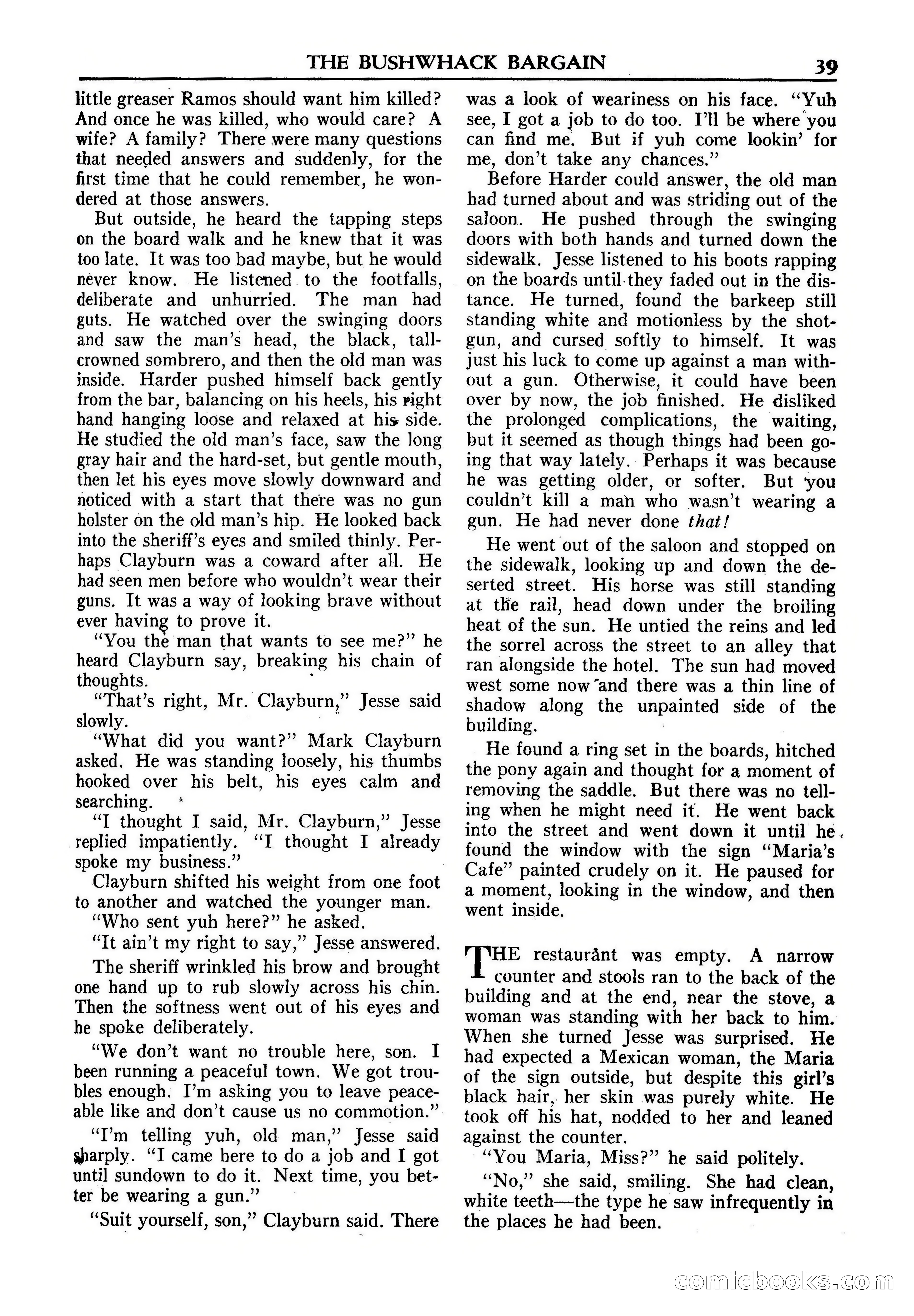
A restored page from Pulp Fiction, 1953. Page through the whole issue in the reader above.
📄 Transcribed text from this page (OCR, searchable)
Machine-transcribed from the original scan — historical spelling and the odd misread are preserved.
THE BUSHWHACK BARGAIN 39 little greaser Ramos should want him killed? And once he was killed, who would care? A wife? A family? There were many questions that needed answers and suddenly, for the first time that he could remember, he won- dered at those answers. But outside, he heard the tapping steps on the board walk and he knew that it was too late. It was too bad maybe, but he would never know. . He listened to the footfalls, deliberate and unhurried. The man had guts. He watched over the swinging doors and saw the man’s head, the black, tall- crowned sombrero, and then the old man was inside. Harder pushed himself back gently from the bar, balancing on his heels, his right hand hanging loose and relaxed at his side. He studied the old man’s face, saw the long gray hair and the hard-set, but gentle mouth, then let his eyes move slowly downward and noticed with a start that there was no gun holster on the old man’s hip. He looked back into the sheriff’s eyes and smiled thinly. Per- haps Clayburn was a coward after all. He had seen men before who wouldn’t wear their guns. It was a way of looking brave without ever having to prove it. “You the man that wants to see me?” he heard Clayburn say, breaking his chain of thoughts. “That’s right, Mr. _Clayburn, ” Jesse said slowly. “What did you want?” Mark Clayburn asked. He was standing loosely, his thumbs hooked over his belt, his eyes calm and searching. * “T thought I said, Mr. Clayburn,”’ Jesse replied impatiently. “I thought I already spoke my business.” Clayburn shifted his weight from one foot to another and watched the younger man. “Who sent yuh here?” he asked. “It ain’t my right to say,” Jesse answered. The sheriff wrinkled his brow and brought one hand up to rub slowly across his chin. Then the softness went out of his eyes and he spoke deliberately. “We don’t want no trouble here, son. I been running a peaceful town. We got trou- bles enough. I’m asking you to leave peace- able like and don’t cause us no commotion.” “T’m telling yuh, old man,” Jesse said sharply. “I came here to do a job and I got until sundown to do it. Next time, you bet- ter be wearing a gun.” “Suit yourself, son,’ Clayburn said. There was a look of weariness on his face. “Yuh see, I got a job to do too. I’ll be where you can find me. But if yuh come lookin’ for me, don’t take any chances.” Before Harder could answer, the old man bad turned about and was striding out of the saloon. He pushed through the swinging doors with both hands and turned down the sidewalk. Jesse listened to his boots rapping _ on the boards until-they faded out in the dis- tance. He turned, found the barkeep still standing white and motionless by the shot- gun, and cursed softly to himself. It was just his luck to come up against a man with- out a gun. Otherwise, it could have been over by now, the job finished. He disliked the prolonged complications, the waiting, but it seemed as though things had been go- ing that way lately.. Perhaps it was because he was getting older, or softer. But ‘you couldn’t kill a man who wasn’t wearing a gun. He had never done that! He went out of the saloon and stopped on the sidewalk, looking up and down the de- serted street. His horse was still standing at tHe rail, head down under the broiling heat of the sun. He untied the reins and led the sorrel across the street to an alley that ran alongside the hotel. The sun had moved west some now and there was a thin line of shadow along the unpainted side of the building. He found a ring set in the boards, hitched the pony again and thought for a moment of removing the saddle. But there was no tell- ing when he might need it. He went back into the street and went down it until he found the window with the sign ‘“Maria’s Cafe” painted crudely on it. He paused for a moment, looking in the window, and then went inside. f ie restaurant was empty. A narrow counter and stools ran to the back of the building and at the end, near the stove, a woman was standing with her back to him. When she turned Jesse was surprised. He had expected a Mexican woman, the Maria of the sign outside, but despite this girl’s black hair, her skin was purely white. He took off his hat, nodded to her and leaned against the counter. ~“You Maria, Miss?” he said politely. “No,” she said, smiling. She had clean, white teeth——the type he saw xine Ment. In the places he had been. MICLOOK C© inn