
Pulp Fiction, 1953 · page 99 of 116
Fifteen Western Tales, January 1953 — page 99: what you’re looking at
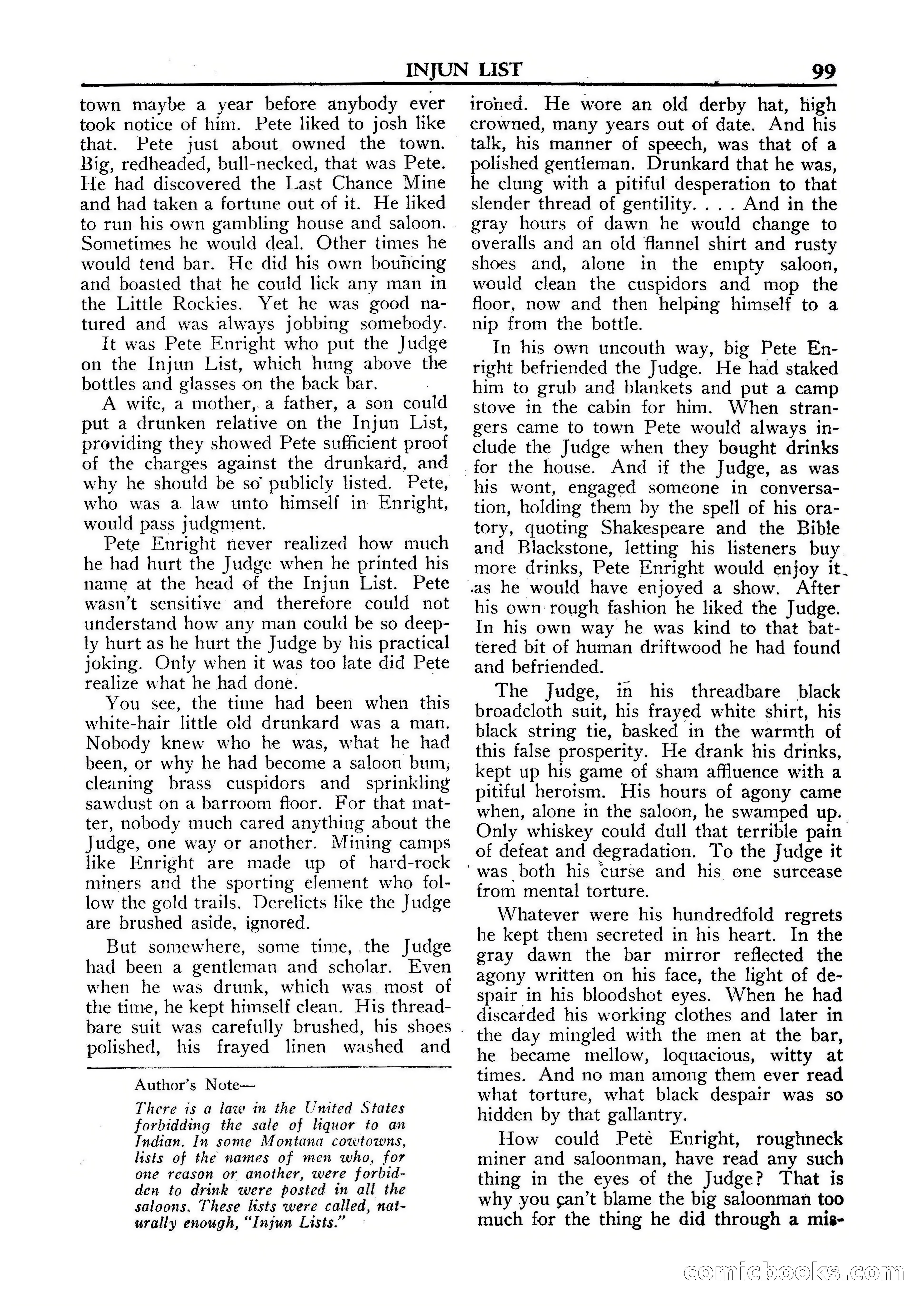
A restored page from Pulp Fiction, 1953. Page through the whole issue in the reader above.
📄 Transcribed text from this page (OCR, searchable)
Machine-transcribed from the original scan — historical spelling and the odd misread are preserved.
INJUN LIST | | 99 town maybe a year before anybody ever took notice of him. Pete liked to josh like that. Big, redheaded, bull-necked, that was Pete. He had discovered the Last Chance Mine and had taken a fortune out of it. He liked to run his own gambling house and saloon. . Sometimes he would deal. Other times he would tend bar. He did his own bouncing and boasted that he could lick any man in the Little Rockies. Yet he was good na- tured and was always jobbing somebody. It was Pete Enright who put the Judge on the Injun List, which hung above the bottles and glasses on the back bar. A wife, a mother,.a father, a son could put a drunken relative on the Injun List, previding they showed Pete sufficient proof of the charges against the drunkard, and why he should be so publicly listed. Pete, who was a law unto himself in Enright, would pass judgment. Pete Enright never realized how much he had hurt the Judge when he printed his name at the head of the Injun List. Pete wasn’t sensitive and therefore could not understand how any man could be so deep- ly hurt as he hurt the Judge by his practical joking. Only when it was too late did Pete realize what he had done. You see, the time had been when this white-hair little old drunkard was a man. Nobody knew who he was, what he had been, or why he had become a saloon bum, cleaning brass cuspidors and sprinkling sawdust on a barroom floor. For that mat- ter, nobody much cared anything about the Judge, one way or another. Mining camps like Enright are made up of hard-rock miners and the sporting element who fol- low the gold trails. Derelicts like the Judge are brushed aside, ignored. But somewhere, some time, the Judge had been a gentleman and scholar. Even when he was drunk, which was. most of the time, he kept himself clean. His thread- bare suit was carefully brushed, his shoes . polished, his frayed linen washed and Author’s Note— There is a law in the United States forbidding the sale of liquor to an Indian. In some Montana cowtowns, lists of the names of men who, for one reason or another, were forbid- den to drink were posted im all the saloons. These lists were called, nat- urally enough, “Injun Lists.” — Pete just about. owned the town. | ironed. He wore an old derby hat, high crowned, many years out of date. And his talk, his manner of speech, was that of a polished gentleman. Drunkard that he was, he clung with a pitiful desperation to that slender thread of gentility... . And in the gray hours of dawn he would change to overalls and an old flannel shirt and rusty shoes and, alone in the empty saloon, would clean the cuspidors and mop the floor, now and then helping himself to a nip from the bottle. In his own uncouth way, big Pete En- right befriended the Judge. He had staked him to grub and blankets and put a camp stove in the cabin for him. When stran- gers came to town Pete would always in- clude the Judge when they bought drinks for the house. And if the Judge, as was his wont, engaged someone in conversa- tion, holding them by the spell of his ora- tory, quoting Shakespeare and the Bible and Blackstone, letting his listeners buy more drinks, Pete Enright would enjoy it. as he would have enjoyed a show. After his own rough fashion he liked the Judge. In his own way he was kind to that bat- tered bit of human driftwood he had found and befriended. The Judge, in his threadbare black broadcloth suit, his frayed white shirt, his black string tie, basked in the warmth of this false prosperity. He drank his drinks, kept up his game of sham affluence with a pitiful heroism. His hours of agony came when, alone in the saloon, he swamped up. Only whiskey could dull that terrible pain of defeat and degradation. To the Judge it ‘was both his curse and his one surcease from mental torture. Whatever were his hundredfold regrets he kept them secreted in his heart. In the gray dawn the bar mirror reflected the agony written on his face, the light of de- spair in his bloodshot eyes. When he had discarded his working clothes and later in the day mingled with the men at the bar, he became mellow, loquacious, witty at times. And no man among them ever read what torture, what black despair was so hidden by that gallantry. How could Pete Enright, roughneck miner and saloonman, have read any such thing in the eyes of the Judge? That is why you ¢an’t blame the big saloonman too much for the thing he did through a mis- oO COMmichooks.c©