
A complete issue · 48 pages · 1928
Life — August 16, 1928
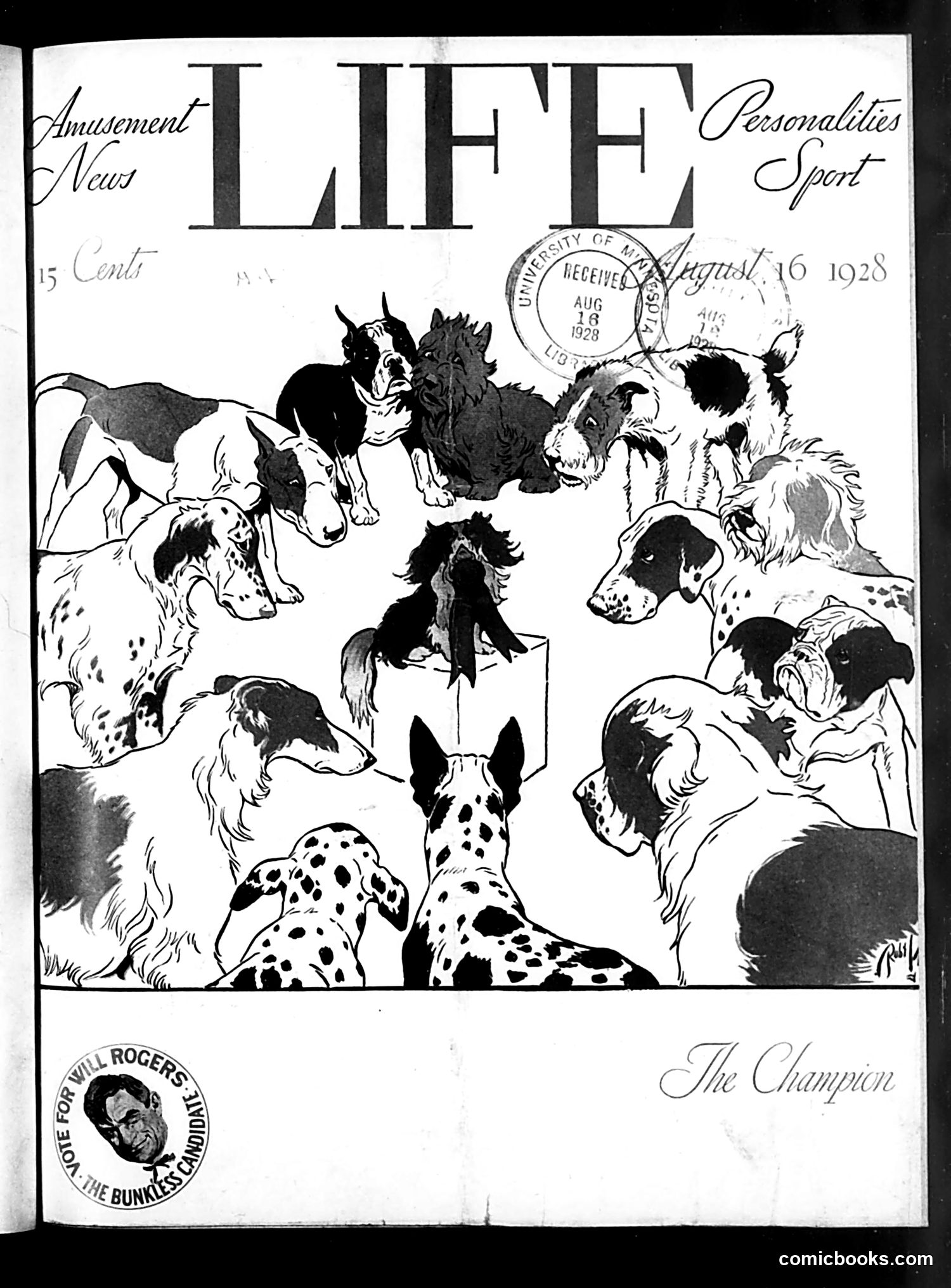
This cover illustration depicts approximately a dozen dogs of various breeds gathered together, with the title "LIFE" prominently displayed above. The caption reads "The Champion." The satirical point appears to be social commentary on dog shows or breeding competitions popular in 1928. The central spotted dog (appearing to be a pointer or similar breed) is positioned prominently, suggesting it's the prize-winner or "champion" referenced in the title. The joke likely mocks either: the pretentiousness of elite dog-show culture, or uses the dogs as stand-ins for satirizing human competitors or social figures of the era. The Will Rogers reference at bottom suggests possible connection to contemporary personalities, though the specific satire target remains unclear from the image alone.
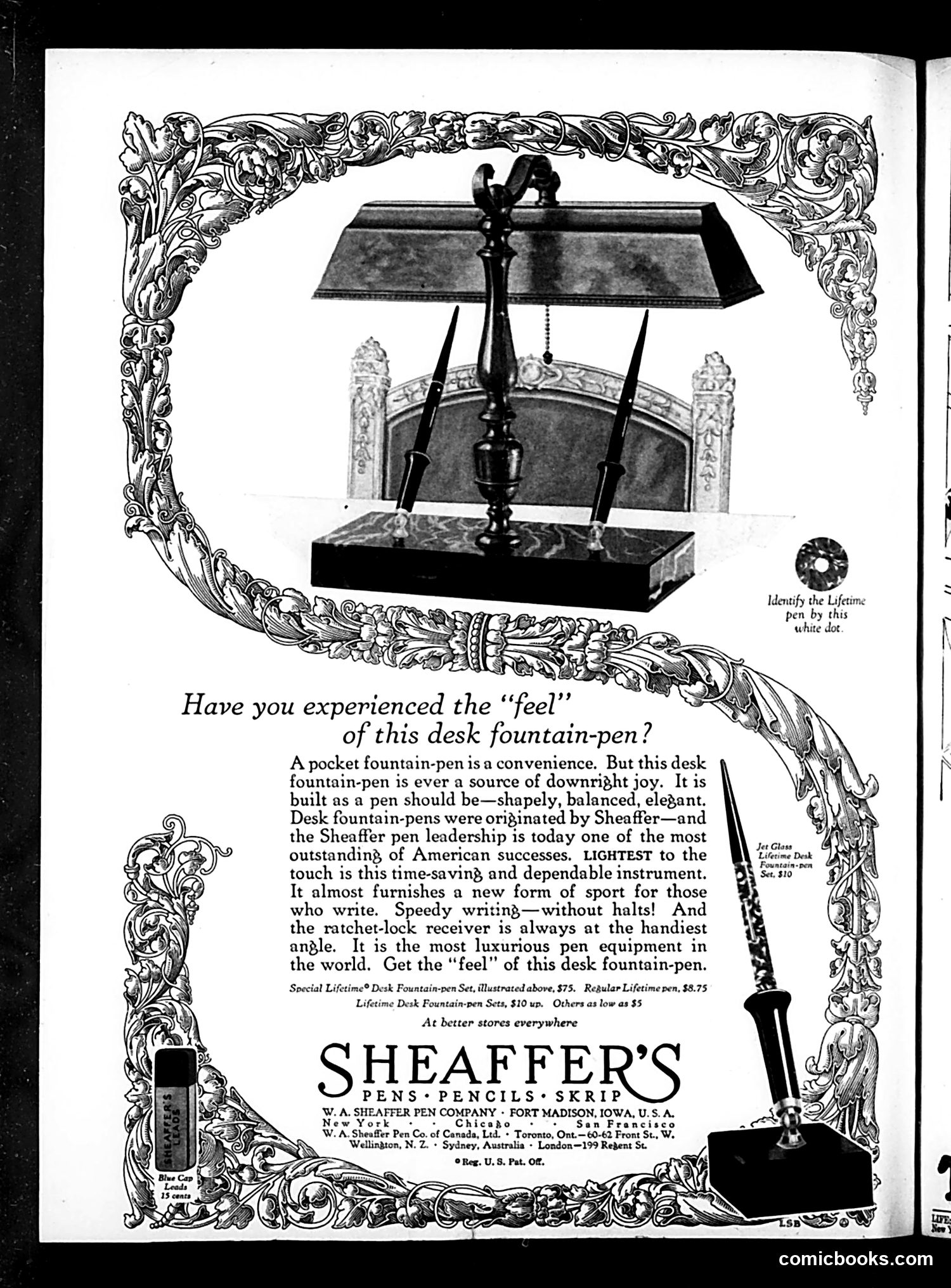
This page is **primarily an advertisement**, not a political cartoon. It promotes Sheaffer's desk fountain pens through a full-page ad with ornamental borders. The ad targets affluent consumers, emphasizing luxury and writing quality. It claims desk fountain pens offer "downright joy" and superior craftsmanship compared to pocket pens. The text highlights Sheaffer's market leadership and the pen's reliability—"the ratchet-lock receiver is always at the handiest angle." Prices listed ($75 for special sets, $8.75 for regular models) indicate this was premium merchandise. The ornate decorative frame suggests sophistication appealing to educated, wealthy readers of *Life* magazine. No political satire or caricature appears here—this is straightforward commercial persuasion typical of early-to-mid 20th century advertising in quality publications.
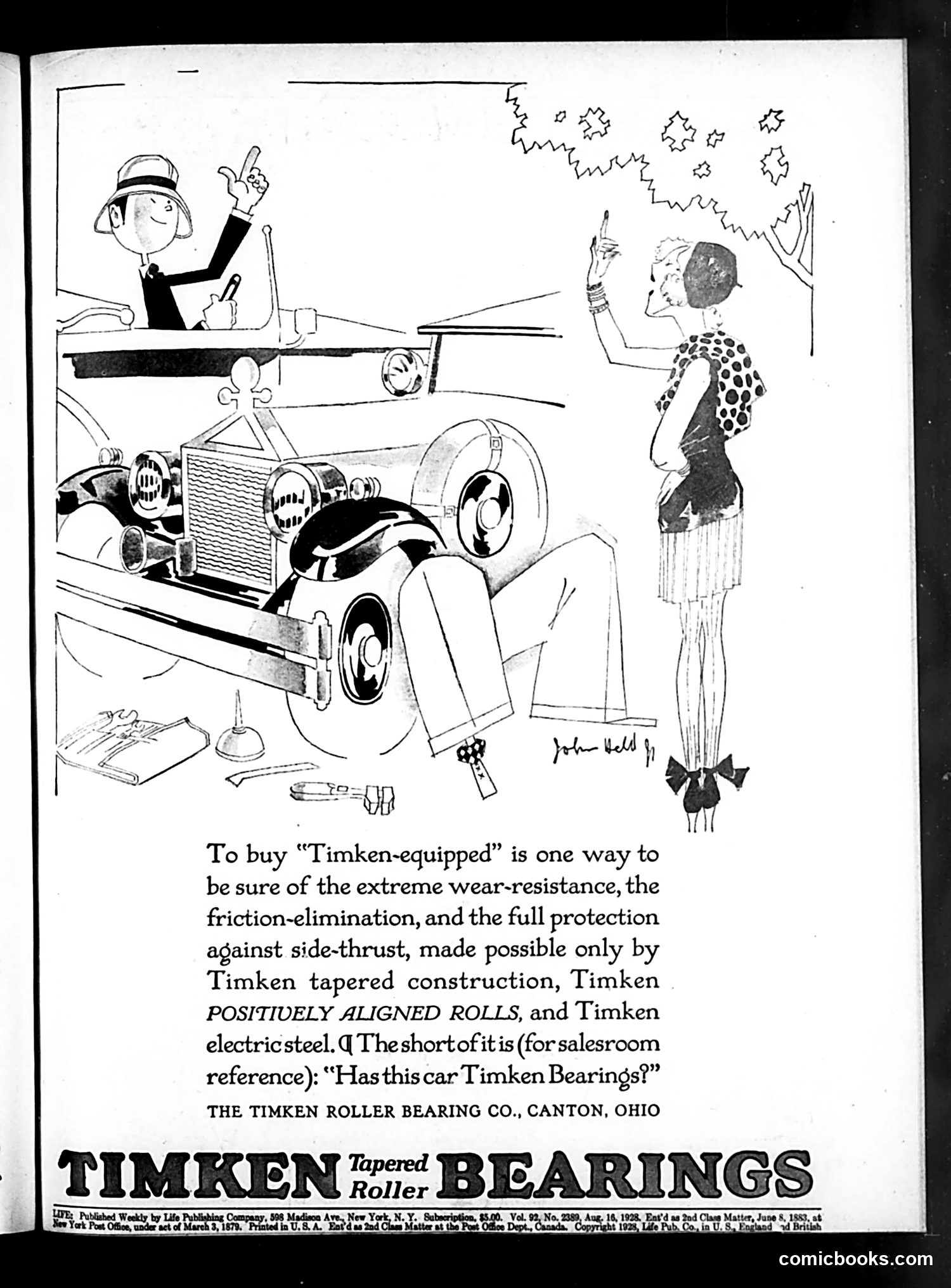
This is primarily a **Timken Roller Bearings advertisement**, not political satire. The illustration depicts a humorous domestic scene where a woman admires a toy car equipped with Timken bearings while a man works underneath a full-sized automobile. The joke advertises product quality through an exaggerated comparison: if toy cars use Timken bearings, they must be so reliable and durable that even miniature vehicles benefit from them. The tagline "Has this car Timken Bearings?" became a salesroom reference point. The cartoon uses 1920s-style fashion and illustration conventions typical of *Life* magazine's advertising section. It's a straightforward commercial message using humor and attractive illustration, not social or political commentary. The ad emphasizes Timken's claimed superiority in wear-resistance and friction-elimination.
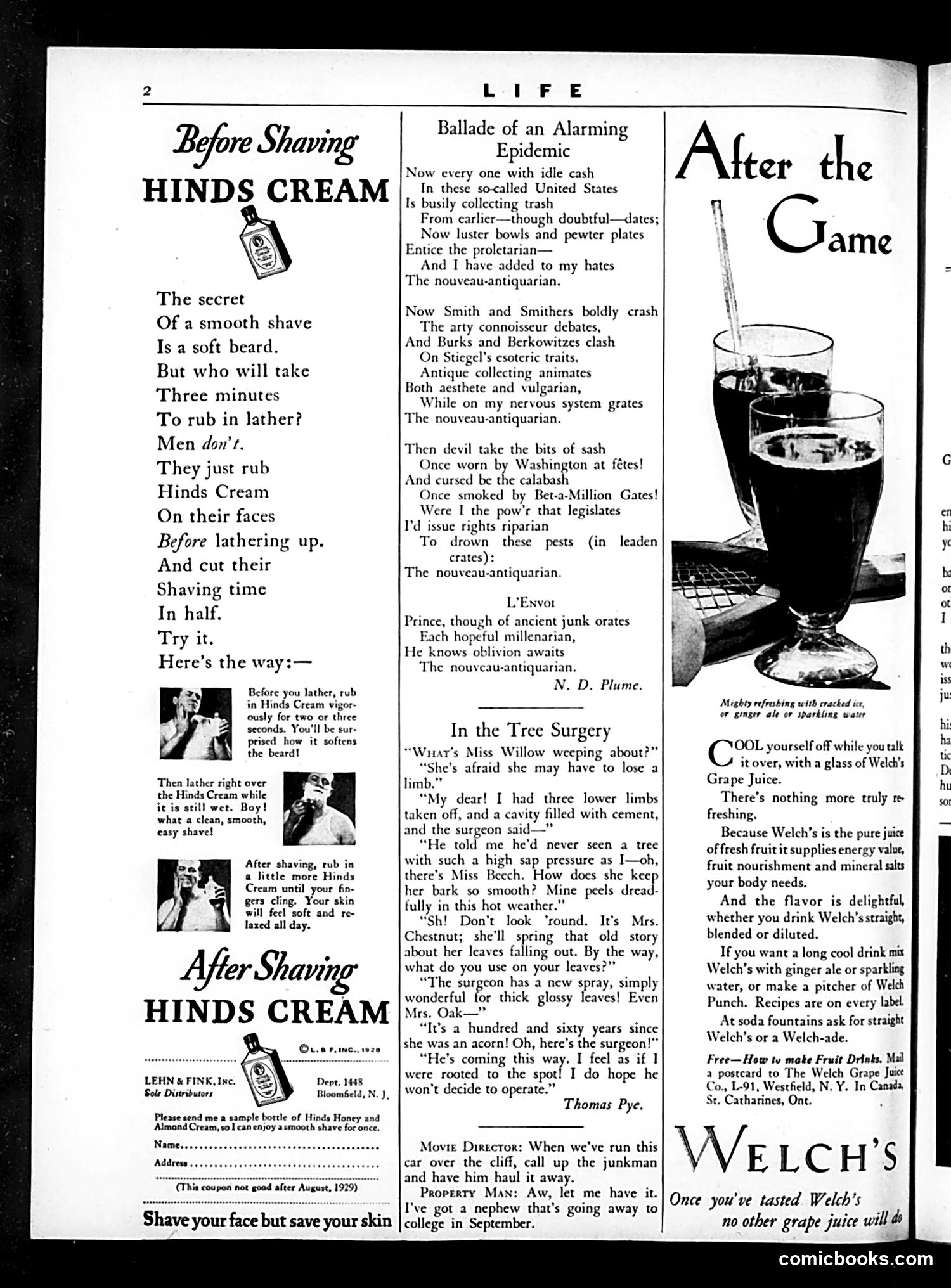
This page is primarily **advertising and light humor** rather than political satire. The left side advertises **Hinds Cream** shaving products with instructional illustrations showing proper application before and after shaving. The center contains three **humorous poems/verses** mocking contemporary collecting trends ("nouveau-antiquarian"), debates among intellectuals like Smith, Smithers, Burks, and Berkowitzes, and antique collecting fads. The satire targets wealthy people's obsession with acquiring junk and calling it valuable—poking fun at nouveau riche pretension. The right side advertises **Welch's Grape Juice** with an illustration of refreshing beverages. The "In the Tree Surgery" section is a humorous anecdote about medical procedures. Overall, this reflects 1920s consumer culture and gentle mockery of status-seeking behavior among the affluent, not serious political commentary.
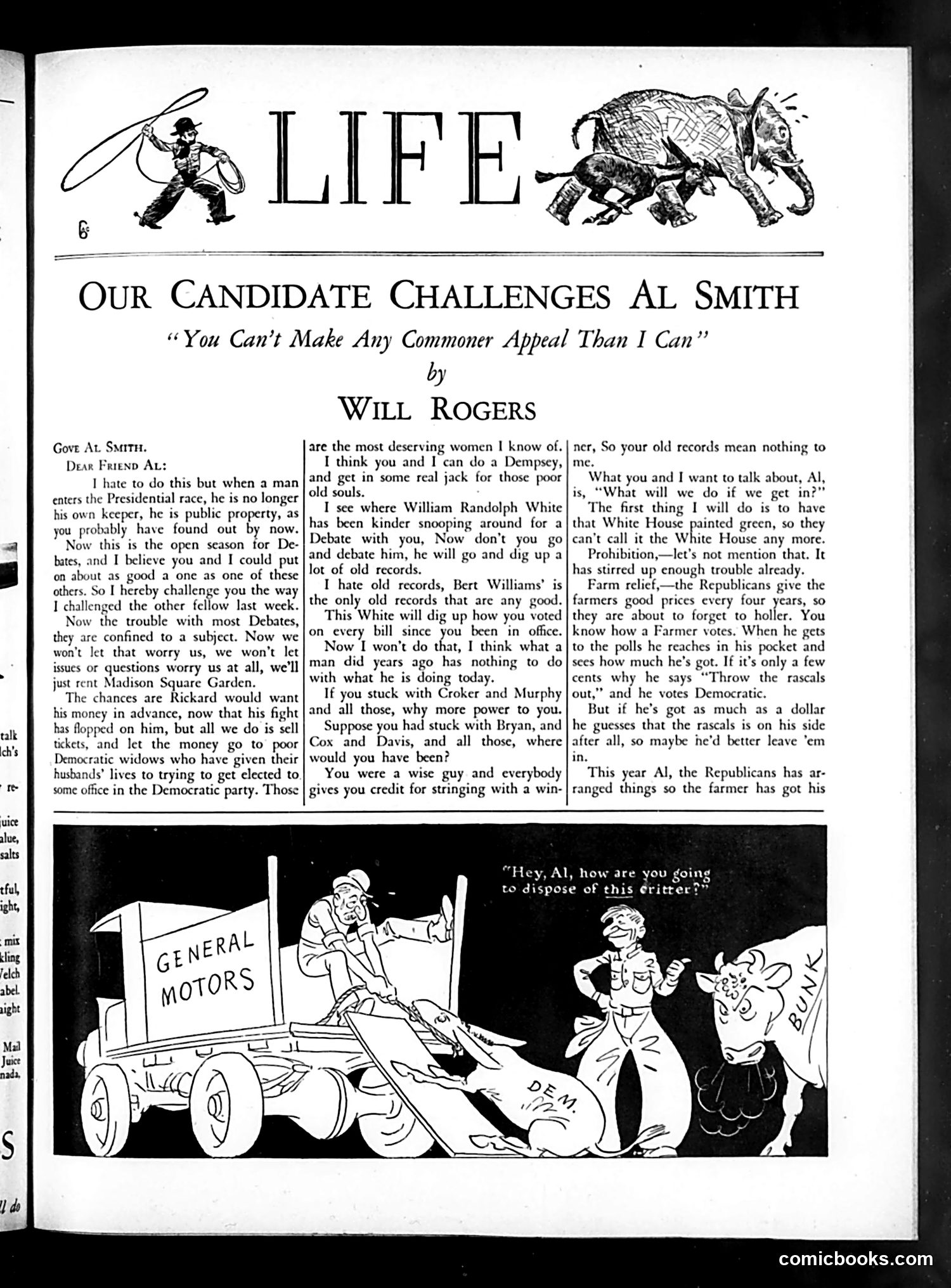
This page features Will Rogers's commentary on a political challenge between two candidates, with a satirical cartoon below. **The Figures:** - "Al Smith" (likely Al Smith, Democratic politician of that era) - References to William Randolph Hearst and various political figures - The cartoon shows a "General Motors" wagon, suggesting corporate interests **The Satire's Point:** Rogers attacks politicians for digging up old records and past votes to discredit opponents rather than discussing current issues. He sarcastically suggests candidates should debate Bryan, Davis, and Cox (prior Democratic figures) instead of Al Smith. The cartoon suggests corporate interests (General Motors) are manipulating the political "offer"—questioning candidates' genuine independence. **The Joke:** Politicians rely on outdated ammunition and personal attacks rather than substantive policy debate, while corporate power lurks behind the scenes.
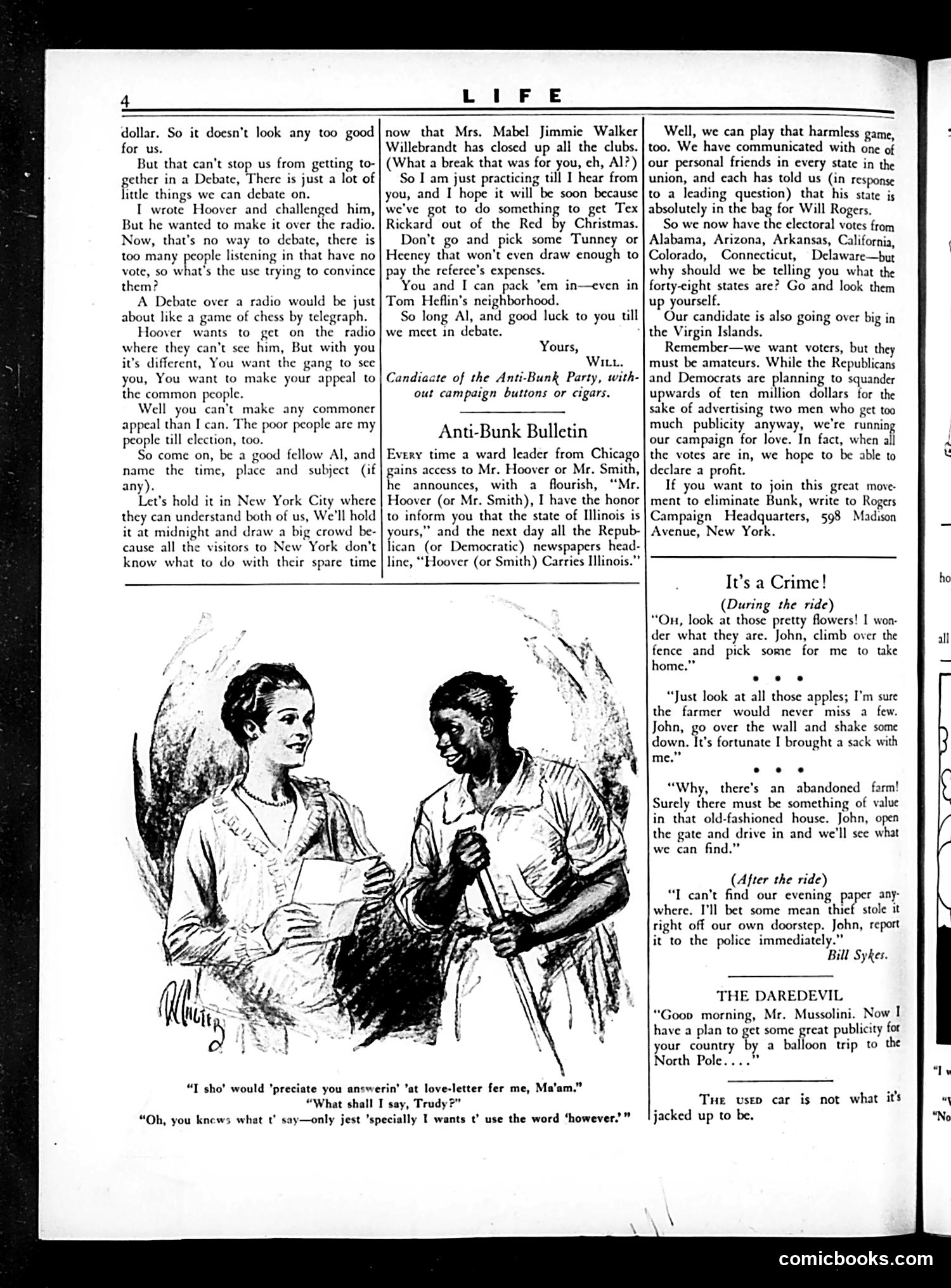
This page contains political commentary about the 1924 U.S. presidential election. The "Anti-Bunk Bulletin" section mocks Republican campaign announcements that repetitively declare state endorsements (e.g., "Hoover Carries Illinois"), suggesting the rhetoric is hollow and formulaic. The main illustration depicts a couple on a romantic outing. The caption jokes about the woman wanting her companion to pick flowers and explore an abandoned farm—likely a satirical commentary on rural nostalgia or Americana that politicians were exploiting during the era. The "It's a Crime!" section humorously presents a woman urging property theft during a carriage ride, subverting domestic sentimentality for comedic effect. The page reflects Life magazine's characteristic irreverent mockery of political campaigns and social pretension during the Jazz Age.
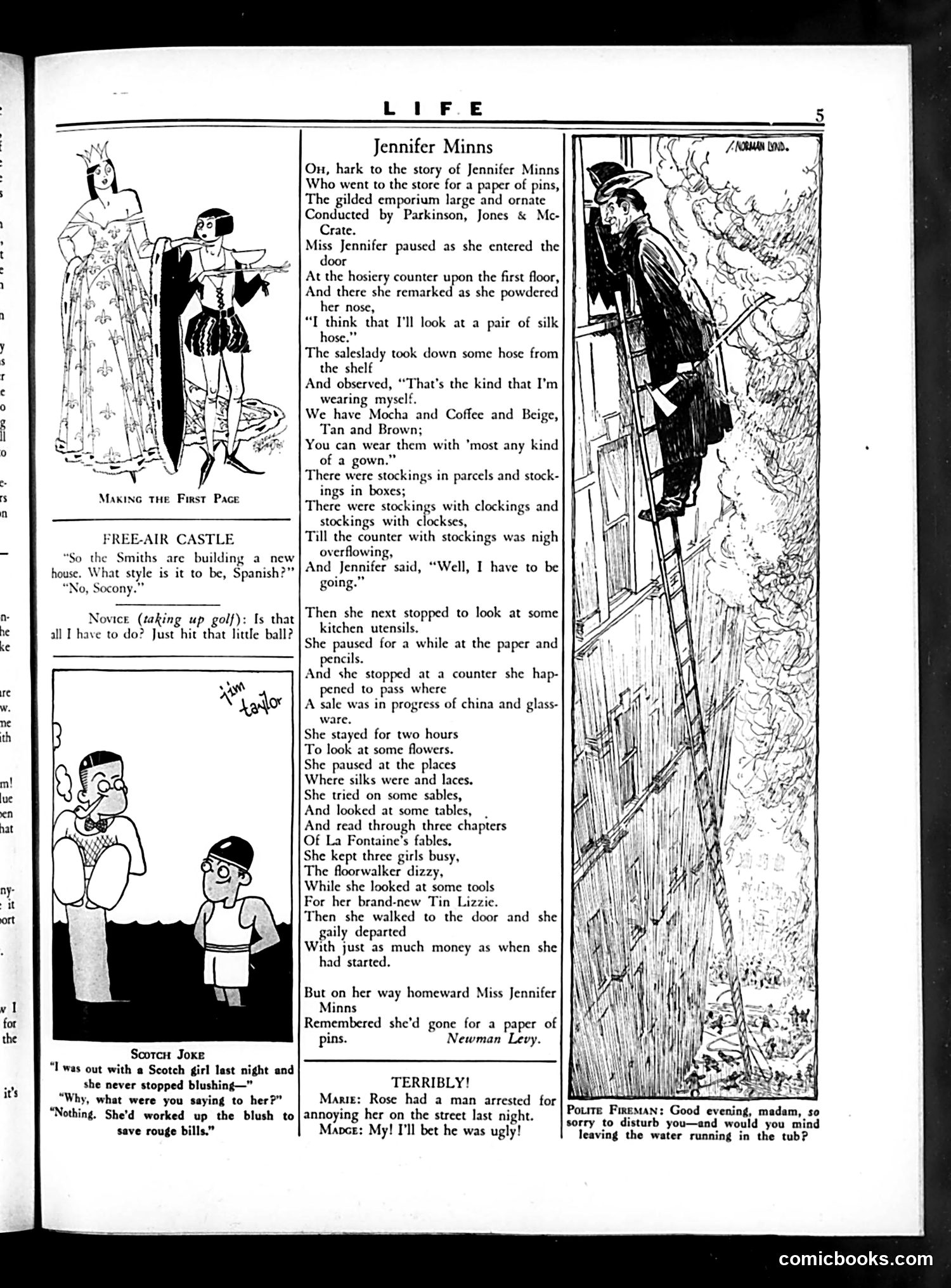
This page contains three separate humor items typical of early 20th-century Life magazine: 1. **"Jennifer Minns"** (center/right): A narrative poem about a woman visiting an emporium to buy pins but getting distracted shopping for hours, eventually leaving with the same amount of money she arrived with. It's a gentle satire on women's shopping habits and impulsive spending. 2. **"Free-Air Castle"** (left): A brief joke about Spanish architecture, with a visual gag about hitting a golf ball. 3. **"Scotch Joke"** (bottom left): A crude ethnic joke playing on Scottish stereotypes about frugality and avoiding expenses. 4. **Bottom section**: Brief humor items ("Terribly!" and "Polite Fireman") with accompanying illustrations. The humor reflects period attitudes toward gender, nationality, and class that would be considered offensive today.
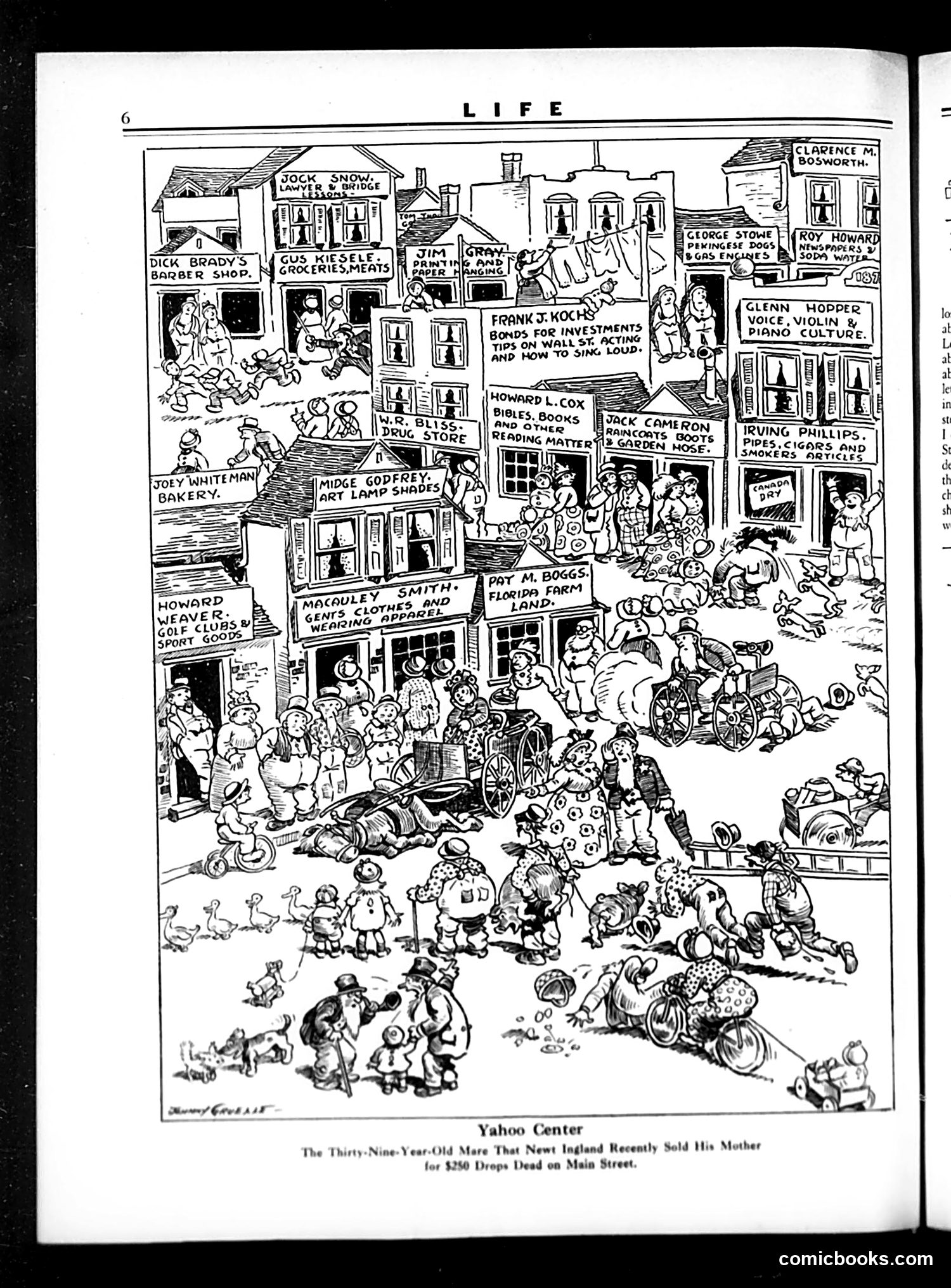
This is a satirical street scene titled "Yahoo Center," depicting a chaotic New England town where "the Thirty-Nine-Year-Old Mare That New England Recently Sold His Mother for $250 Drops Dead on Main Street." The cartoon labels various businesses and townspeople, creating a densely-packed community snapshot. The central event—a dead horse collapsed in the street—appears to be the joke's focal point, suggesting small-town absurdity and scandal. The reference to someone selling "his mother" for $250 (in exchange for the mare) satirizes rural greed and moral degradation. The numerous labeled shops (barber, drugstore, bakery) and named residents suggest this lampoons a specific real New England town, though the names appear fictional. The overall effect mocks provincial life, petty commerce, and small-town melodrama through dark humor typical of early 20th-century American satire.
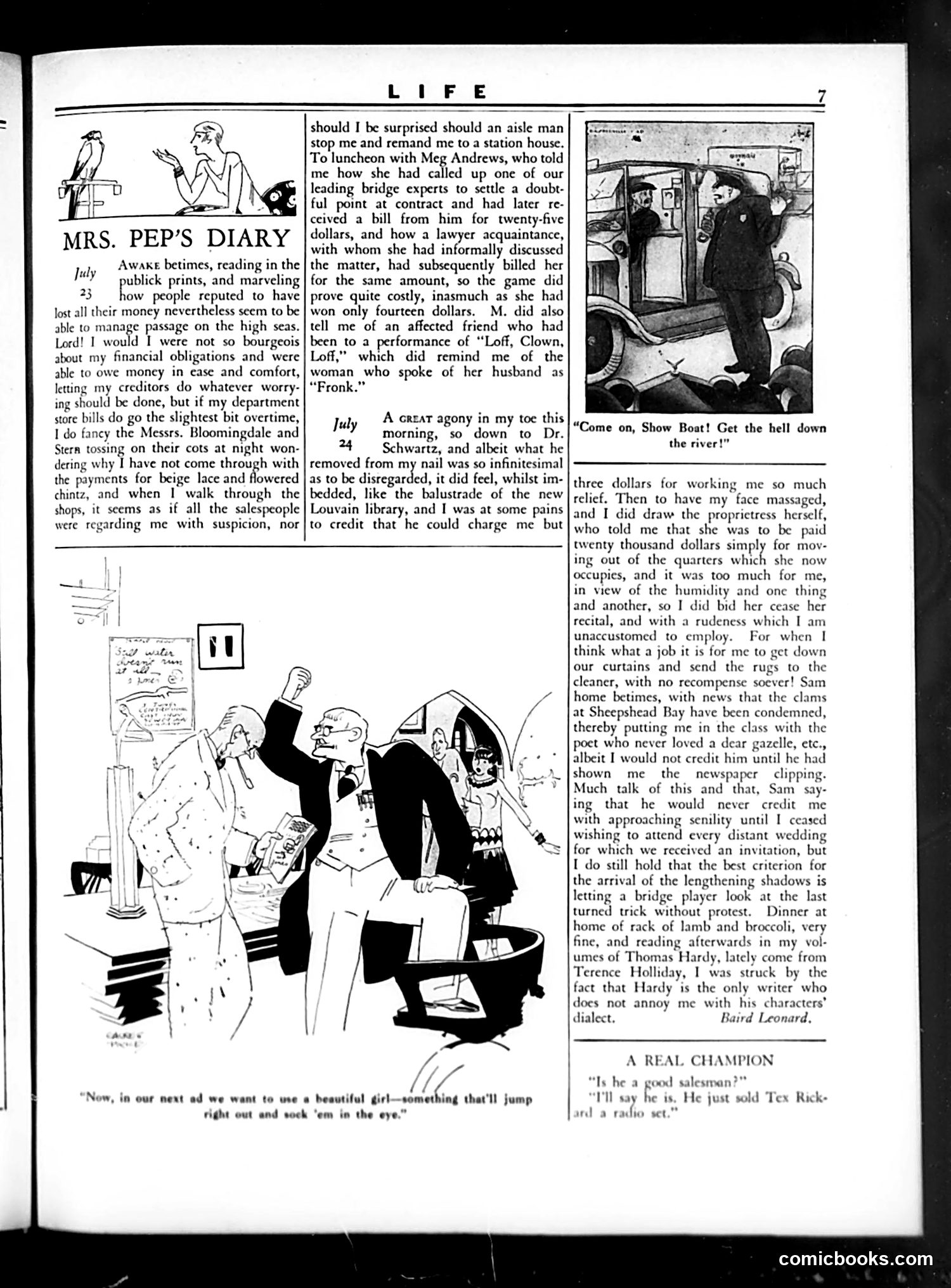
This page presents "Mrs. Pep's Diary," a satirical column featuring two cartoons mocking upper-class social pretensions and financial anxieties of the 1920s era. The diary entries (July 23-24) humorously chronicle trivial complaints: financial worries despite wealth, disputes over minor expenses, and social climbing. The left cartoon depicts fashionable people in financial distress; the right shows a motorist scene with the caption "Come on, Show Boat! Get the hell down the river!"—likely satirizing both automobile culture and theatrical references of the period. The satire targets bourgeois hypocrisy: characters obsess over pennies while maintaining expensive lifestyles. The writing references bridge expertise, lawyers, and cultural touchstones (Thomas Hardy), mocking intellectual pretension among the wealthy during this era of social upheaval.
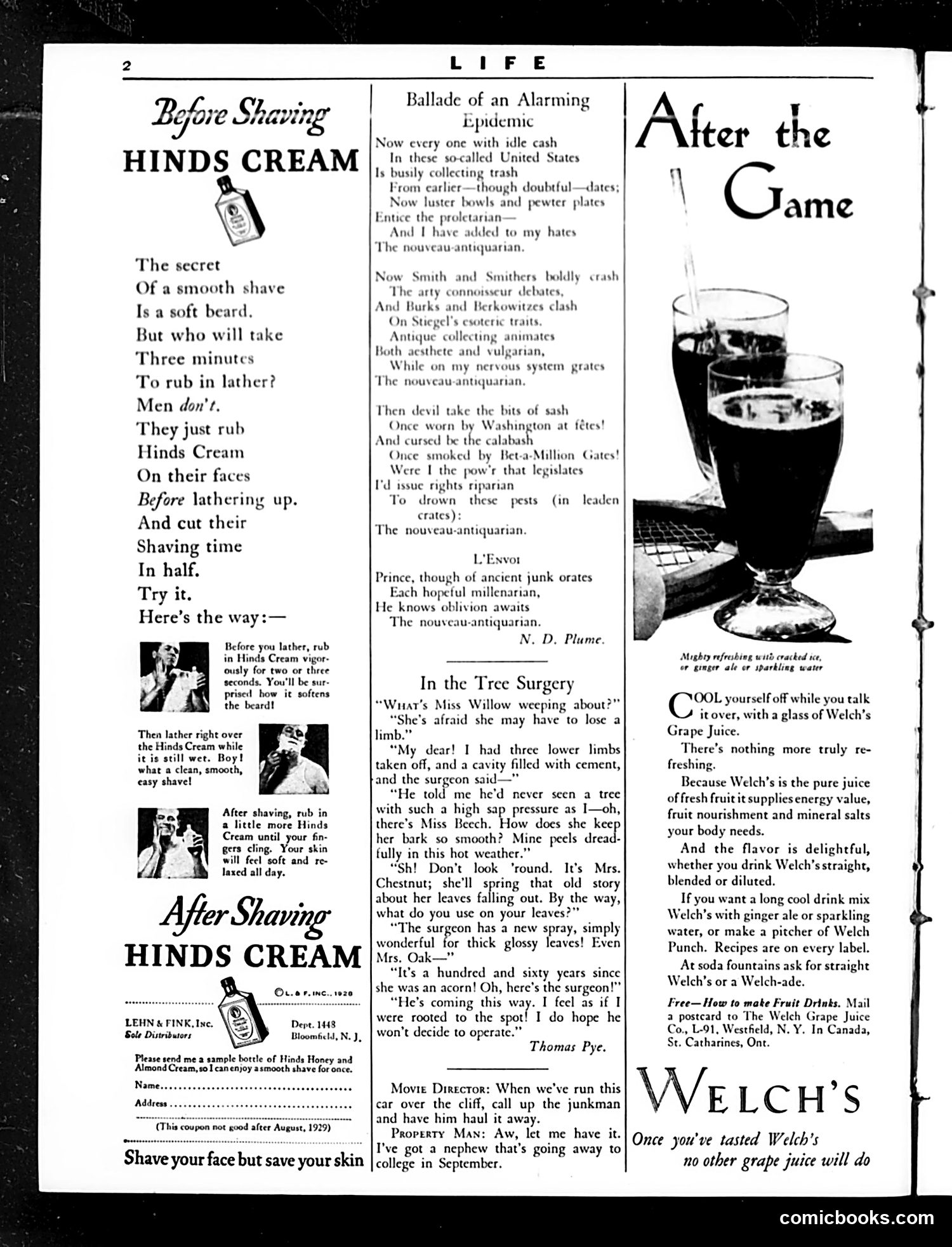
This page mixes advertisements with satirical content typical of Life magazine's format. The **left side** advertises Hinds Cream shaving product with instructional diagrams showing application steps. The **center** contains "Ballade of an Alarming Epidemic" by N.D. Plume, a satirical poem mocking 1920s collecting crazes. It references real figures like **Washington** and **Bet-a-Million Gates** (a known wealthy collector), while skewering nouveau-riche Americans obsessively accumulating antiques and curios. The "nouveau-antiquarian" refrain satirizes pretentious social climbing through acquisition. The **right side** advertises Welch's grape juice, using a illustration of refreshing drinks. The poem's satire targets materialism and status-seeking among the wealthy during the prosperous 1920s—a common Life magazine theme mocking American consumer culture and affectation.
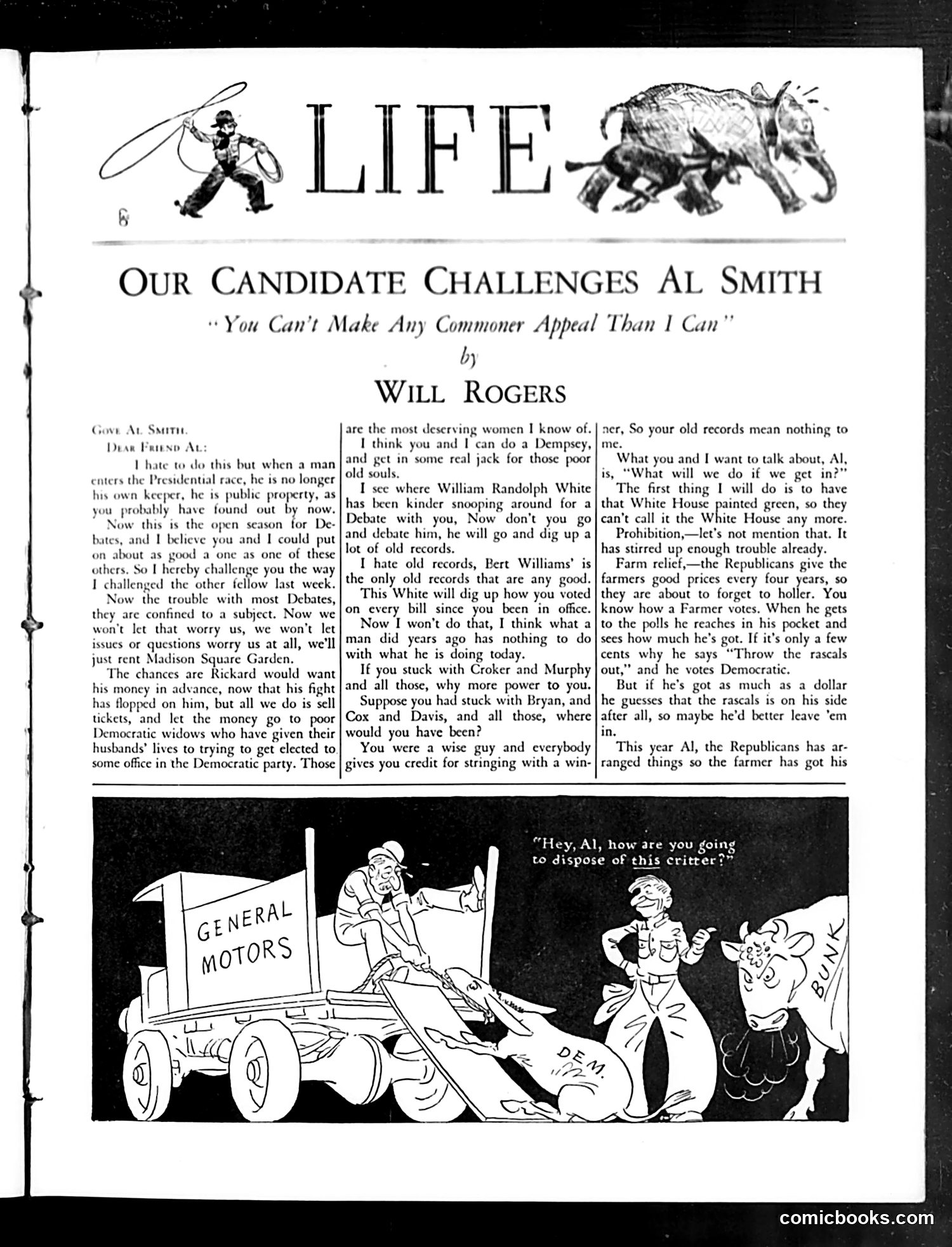
This Life magazine page features Will Rogers's satirical challenge to Democratic presidential candidate Al Smith. Rogers criticizes Smith's acceptance of support from wealthy Democratic donors and party figures, arguing Smith cannot claim to represent common people while accepting money from political machines. The cartoon depicts Smith as unable to escape Democratic Party entanglements—shown literally crushed under a General Motors vehicle labeled with names like "Bryan," "Cox," and "Davis" (likely previous Democratic candidates/operatives). The critter asks how Smith will escape this "mess," implying he's trapped by Democratic establishment interests that contradict populist appeals. The satire targets the hypocrisy of claiming common-man appeal while dependent on wealthy backers.
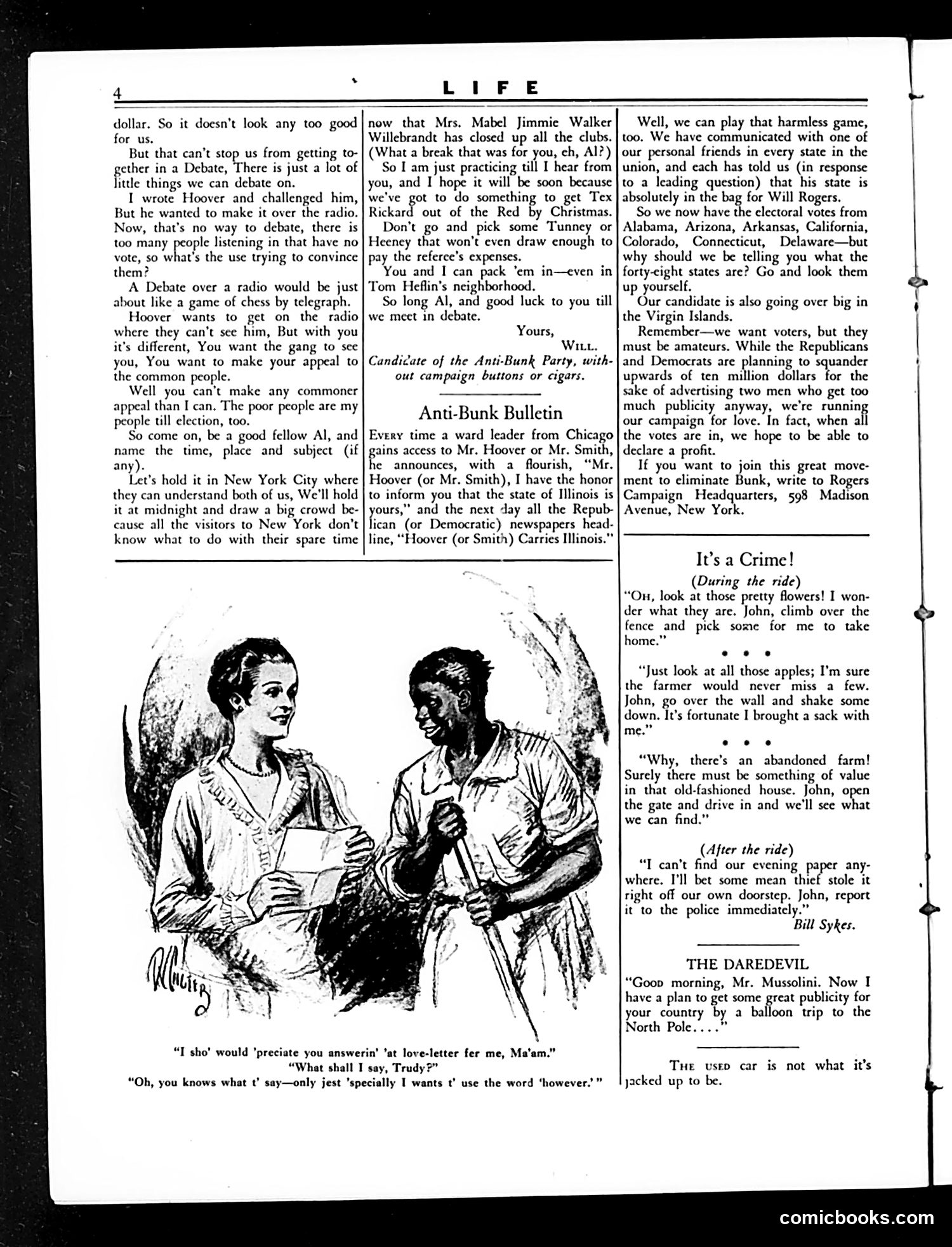
This page contains political satire about the 1928 U.S. presidential campaign. The main text discusses a proposed radio debate between Herbert Hoover and his opponent (likely Al Smith, based on context), with the Anti-Bunk Party candidate "Will" mocking both major candidates' reluctance to debate publicly. The illustration shows a flirtation scene with dialogue about writing a love letter, using romantic language ("'specially I wants t' use the word 'however'") as wordplay commentary on Hoover's political evasiveness. The sidebar "It's a Crime!" presents satirical vignettes of petty theft and moral transgressions as social critique. "The Daredevil" section mocks Mussolini with absurdist humor about balloon publicity stunts. The overall tone ridicules political posturing and insincerity during the campaign season.
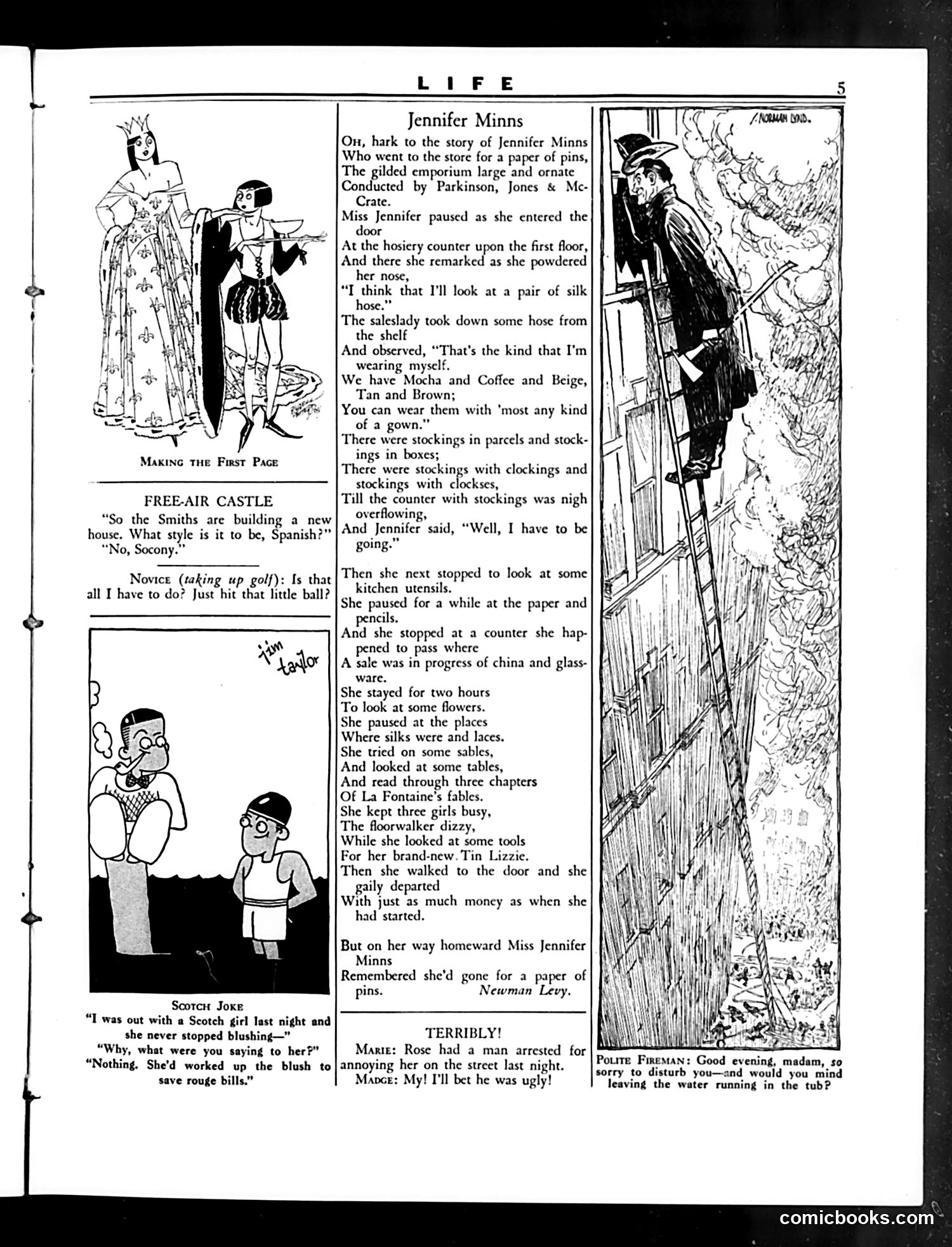
This page contains three distinct comedic pieces: 1. **"Making the First Page"**: A fashion illustration satirizing early 20th-century shopping culture, showing a woman in elaborate dress at a department store counter examining hosiery. 2. **"Free-Air Castle"**: A brief joke about Spanish-style architecture, with "Novorik" (likely a character name) complaining that his only task is "hitting a little ball"—possibly mocking golf as a leisure activity of the wealthy. 3. **"Scotch Joke"**: A crude joke about a Scottish woman spending money on alcohol rather than hygiene. The right panel appears to be an illustration accompanying the "Jennifer Minns" story, depicting a woman shopping in an ornate department store. These pieces represent typical Life magazine humor: social satire targeting fashion, leisure activities, ethnic stereotypes, and consumer culture of the era.
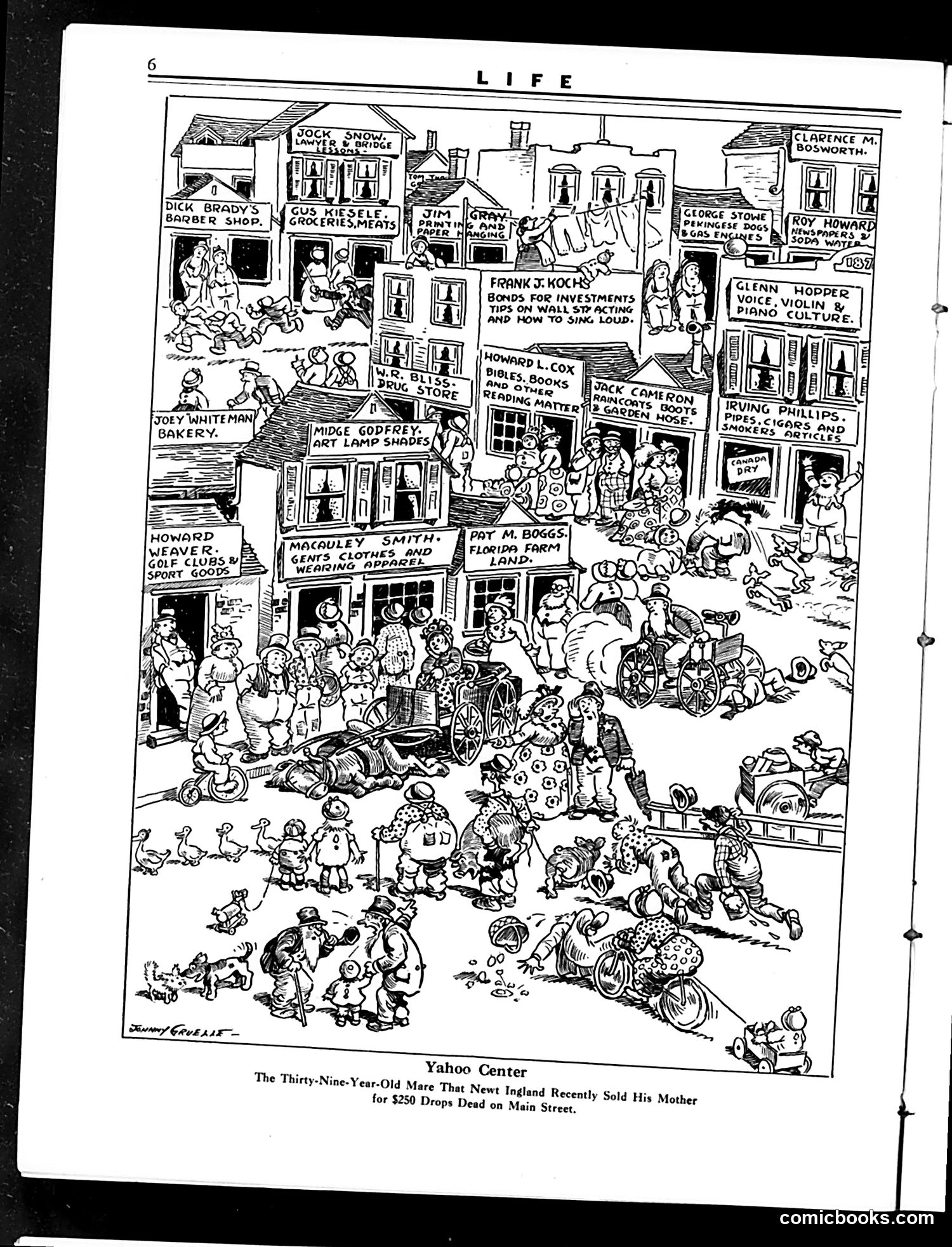
This is a single-panel cartoon satirizing small-town American life, labeled "Yahoo Center." The subtitle references "The Thirty-Nine-Year-Old Mare That New England Recently Sold His Mother for $250 Drops Dead on Main Street." The cartoon depicts a chaotic street scene with various storefronts (barber shop, grocery, drug store, etc.) and townspeople reacting to a dead horse in the middle of the street. The satire targets rural or unsophisticated American communities—the "yahoo" reference being a period slang term for unsophisticated people. The humor derives from the absurdity of the transaction itself (selling one's mother for a horse) and the commotion this causes in the provincial town setting, mocking both rural commerce and values.
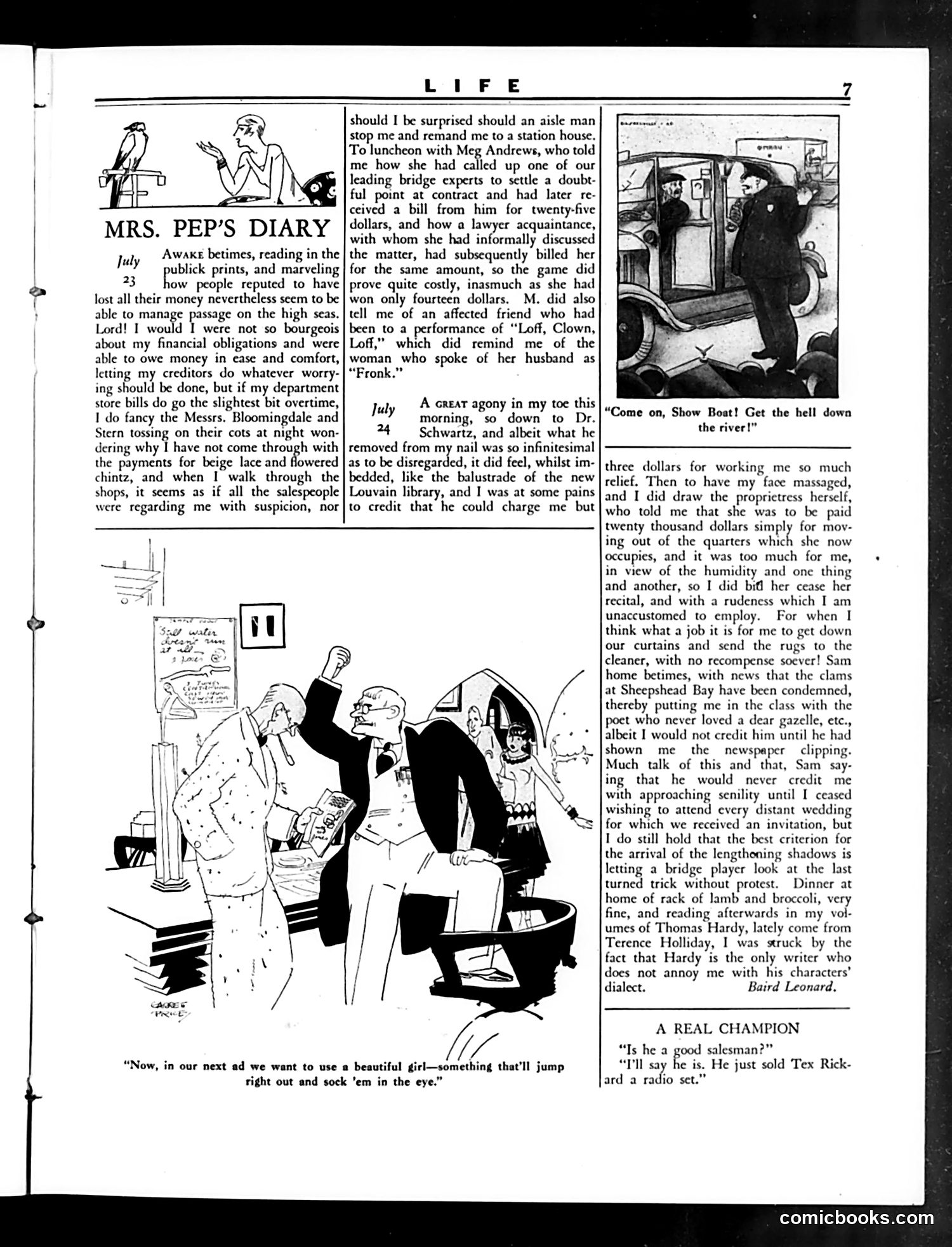
This page features a satirical diary column and an accompanying cartoon about financial anxieties and social obligations during what appears to be the 1920s-30s. **The main cartoon** depicts well-dressed advertising executives or businessmen in an office, debating which "beautiful girl" to use in their next advertisement, wanting someone who will "jump right out and sock 'em in the eye." The satire targets both advertising's objectification of women and the era's emerging consumer culture. **The diary entries** mock upper-middle-class anxiety about money, credit, and social pretense—worrying about overdue bills while maintaining appearances, dealing with servants' wages, and fretting over wedding invitations. The satire suggests that maintaining genteel status requires constant financial juggling and social performance, despite actual financial strain.
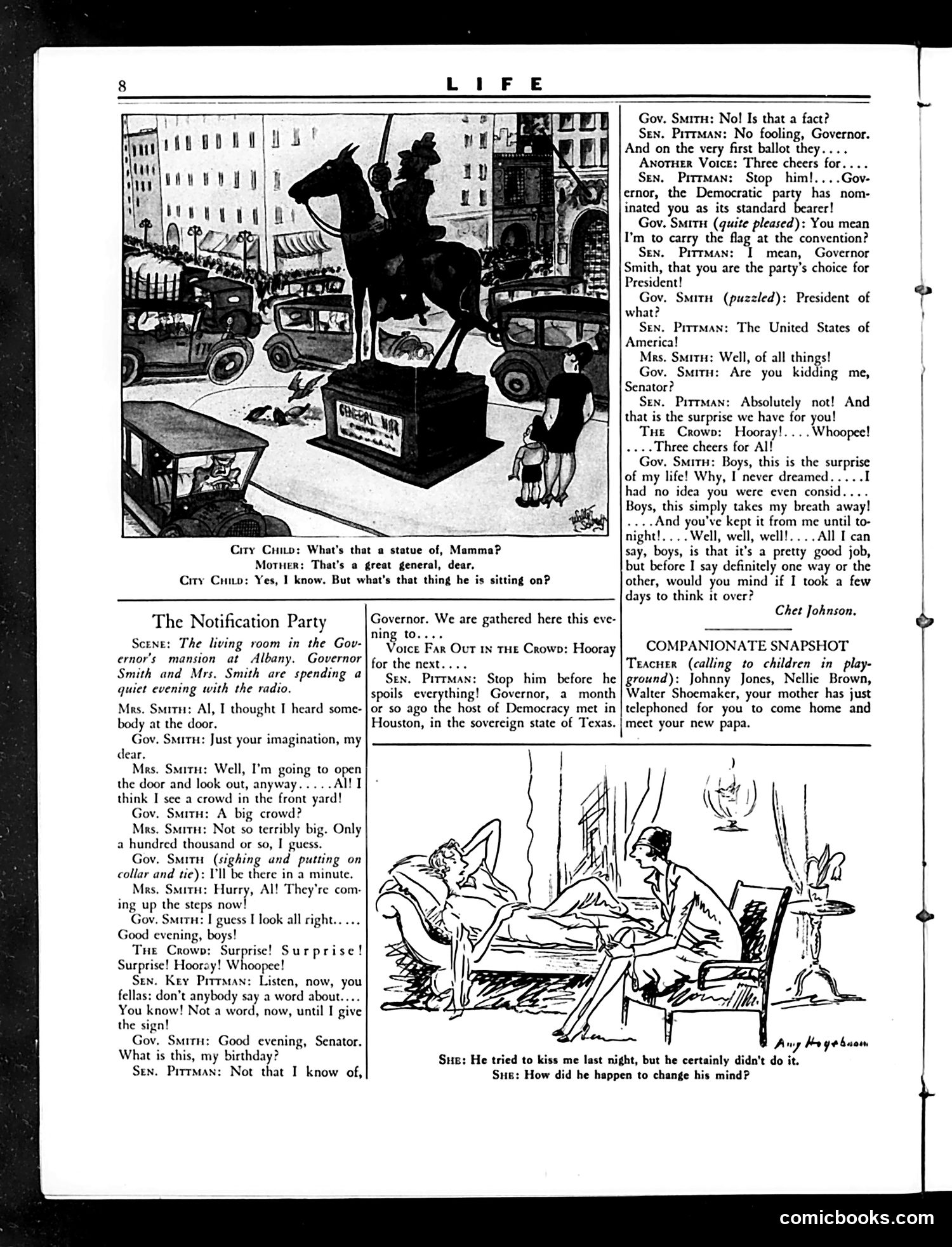
This satirical piece mocks the formal political tradition of the "notification party," where a presidential candidate is officially informed of their nomination. The cartoon depicts Governor Smith being surprised by a massive crowd gathering outside his home to "notify" him he's the Democratic Party's presidential standard-bearer. The humor centers on the artificiality of the ritual—Smith pretends ignorance of his own nomination until formally told, treating it as genuine news rather than the orchestrated ceremony it actually was. Senator Pittman attempts to control the notification speech, but the crowd's enthusiasm overwhelms the proceedings. The satire critiques how political parties stage-manage supposedly spontaneous democratic moments, revealing the gap between theatrical political tradition and reality. The "Companionate Snapshot" below provides comic relief through domestic humor.
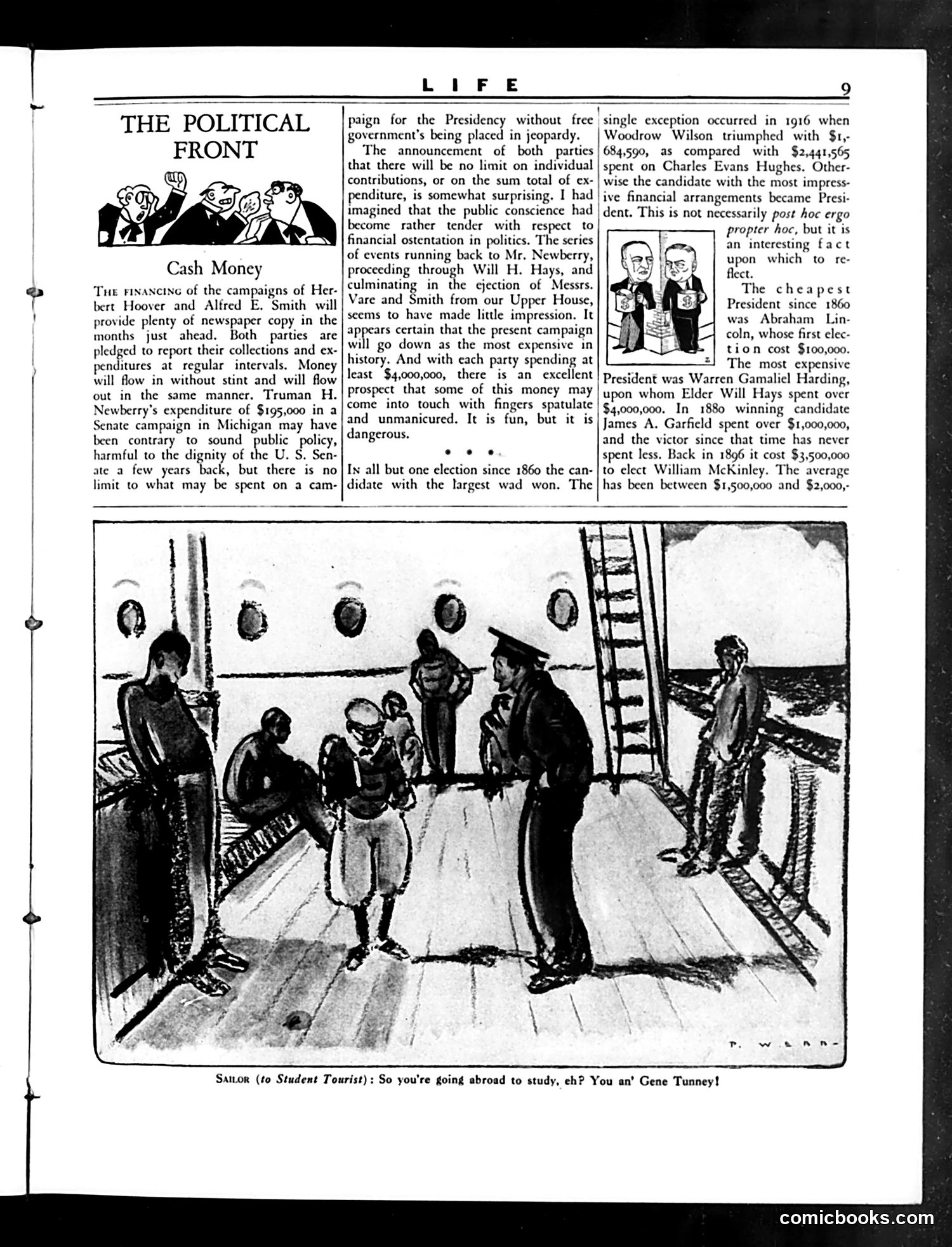
**"The Political Front" Section:** This article discusses campaign financing for the 1928 presidential election between Herbert Hoover and Alfred E. Smith. The text notes that campaign spending has grown dramatically—the 1916 Wilson campaign cost $684,590, while the current race will exceed $4,000,000. The article expresses concern that unlimited spending undermines democratic principles, and notes that the Senate lacks authority to regulate campaign costs. **The Cartoon Below:** The sailor's joke references Gene Tunney, a famous heavyweight boxer of the 1920s. The humor plays on the double meaning: the sailor assumes the young man is going abroad as a tourist/student, but the sailor makes a quip suggesting instead he's pursuing boxing or athletics like Tunney—a contemporary celebrity reference that would have been instantly recognizable to 1928 readers.
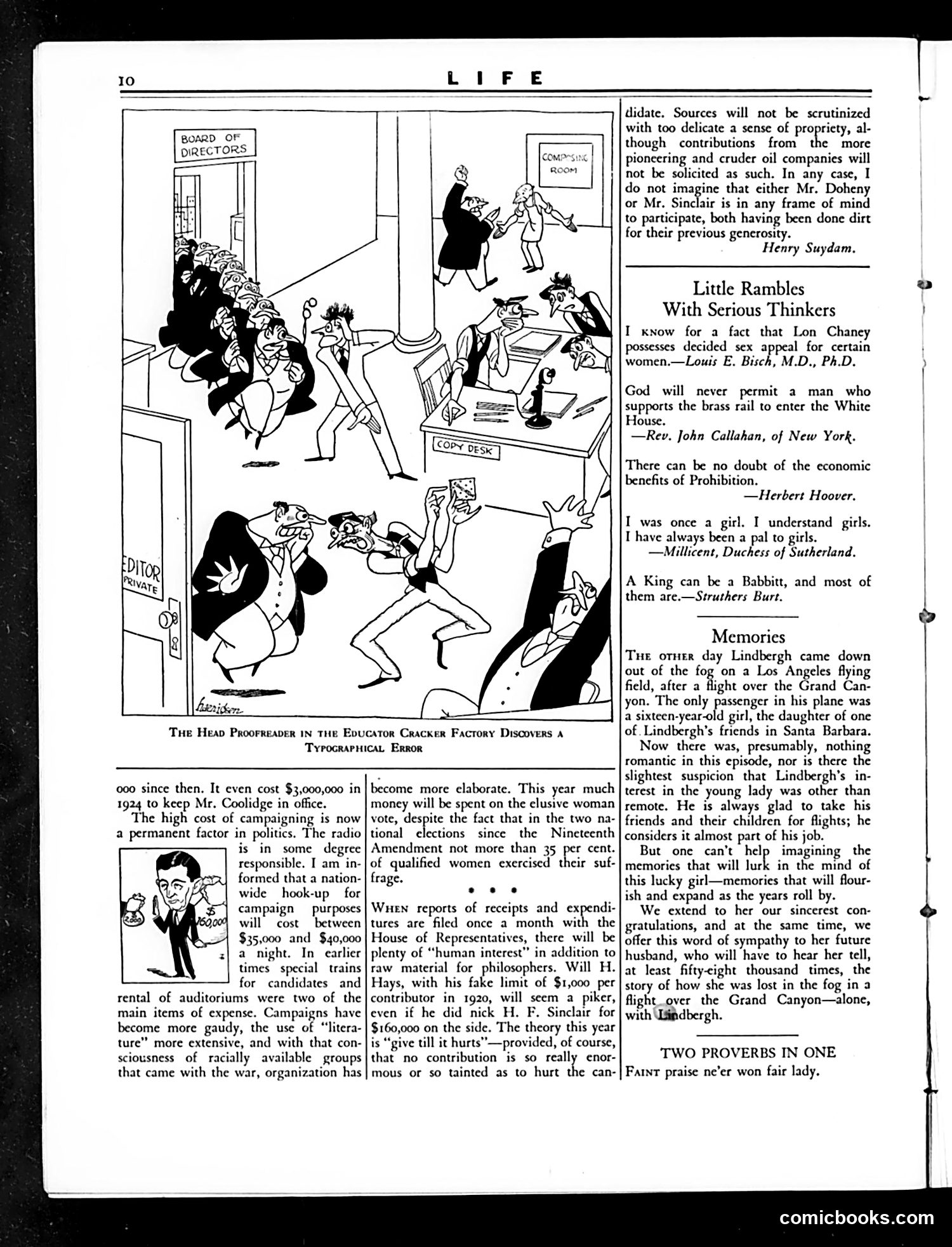
The main cartoon depicts chaos in a newspaper office, captioned "The Head Proofreader in the Educator Cracker Factory Discovers a Typographical Error." It's a visual gag showing multiple figures in comedic disarray around office furniture and desks. The page also contains "Little Rambles With Serious Thinkers"—a section of brief quotes from notable figures (including Herbert Hoover and others) on topics like prohibition, politics, and gender. Below is a "Memoirs" section recounting an anecdote about aviator Lindbergh, describing his flight over the Grand Canyon with a young passenger, emphasizing the romantic implications. The humor relies on period-specific references to Prohibition-era politics and 1920s celebrity culture, particularly Lindbergh's fame as an aviator and public figure.
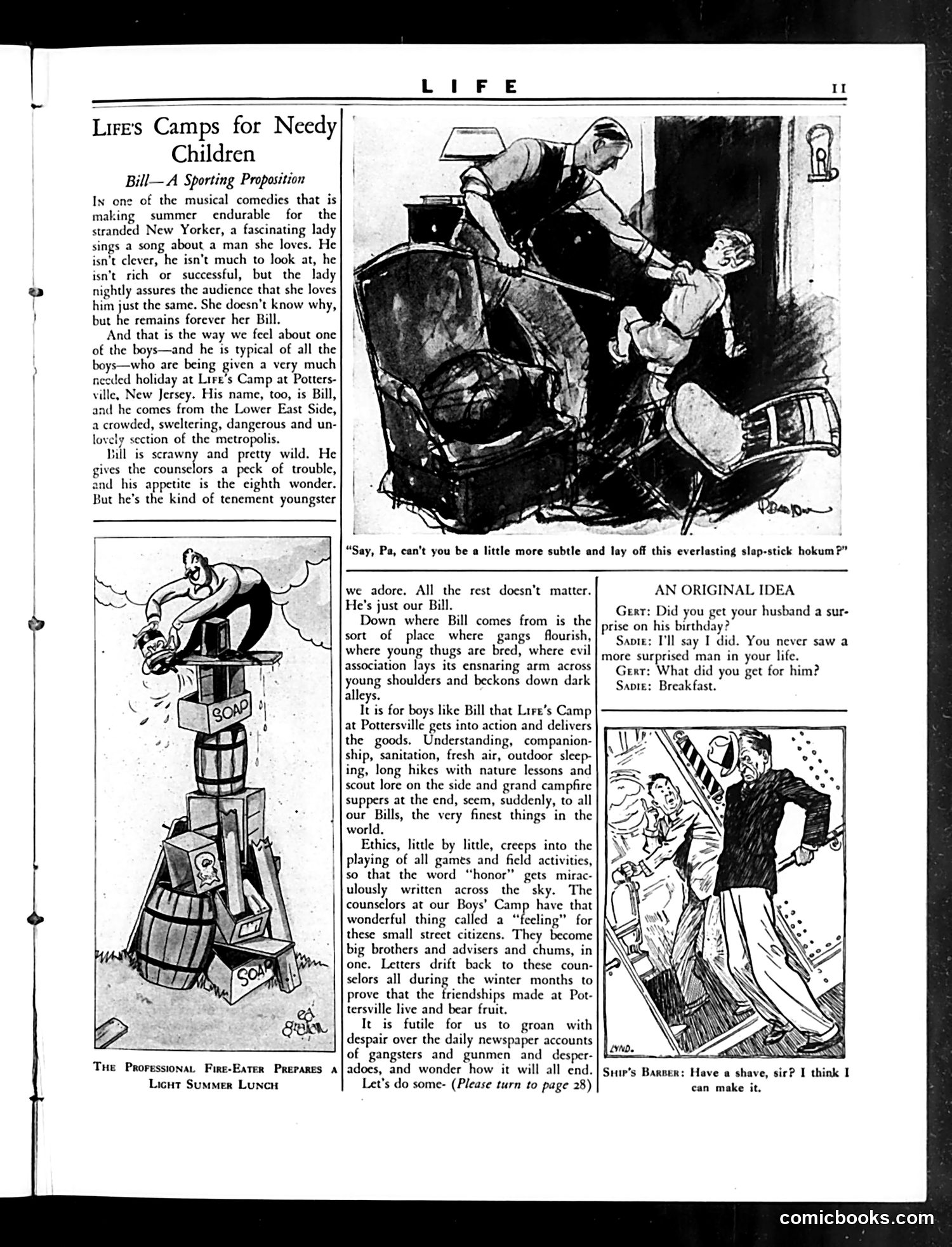
This page describes Life magazine's charitable initiative providing summer camps for disadvantaged urban children, particularly boys from New York's Lower East Side tenements. The article focuses on "Bill," a typical street youth the camp aims to help. The cartoons illustrate the problem the camp addresses: the first shows a precariously stacked tower of soap boxes (labeled "soap"), satirizing makeshift urban conditions; another depicts a boy being struck by an adult, representing the violence and neglect these children faced. The article argues that camps provide structure, outdoor activities, and mentorship that instill "honor" and ethics in street children. It presents the camp as a moral reform project, emphasizing how friendships formed there persist through winter correspondence, proving the program's lasting impact on vulnerable youth.
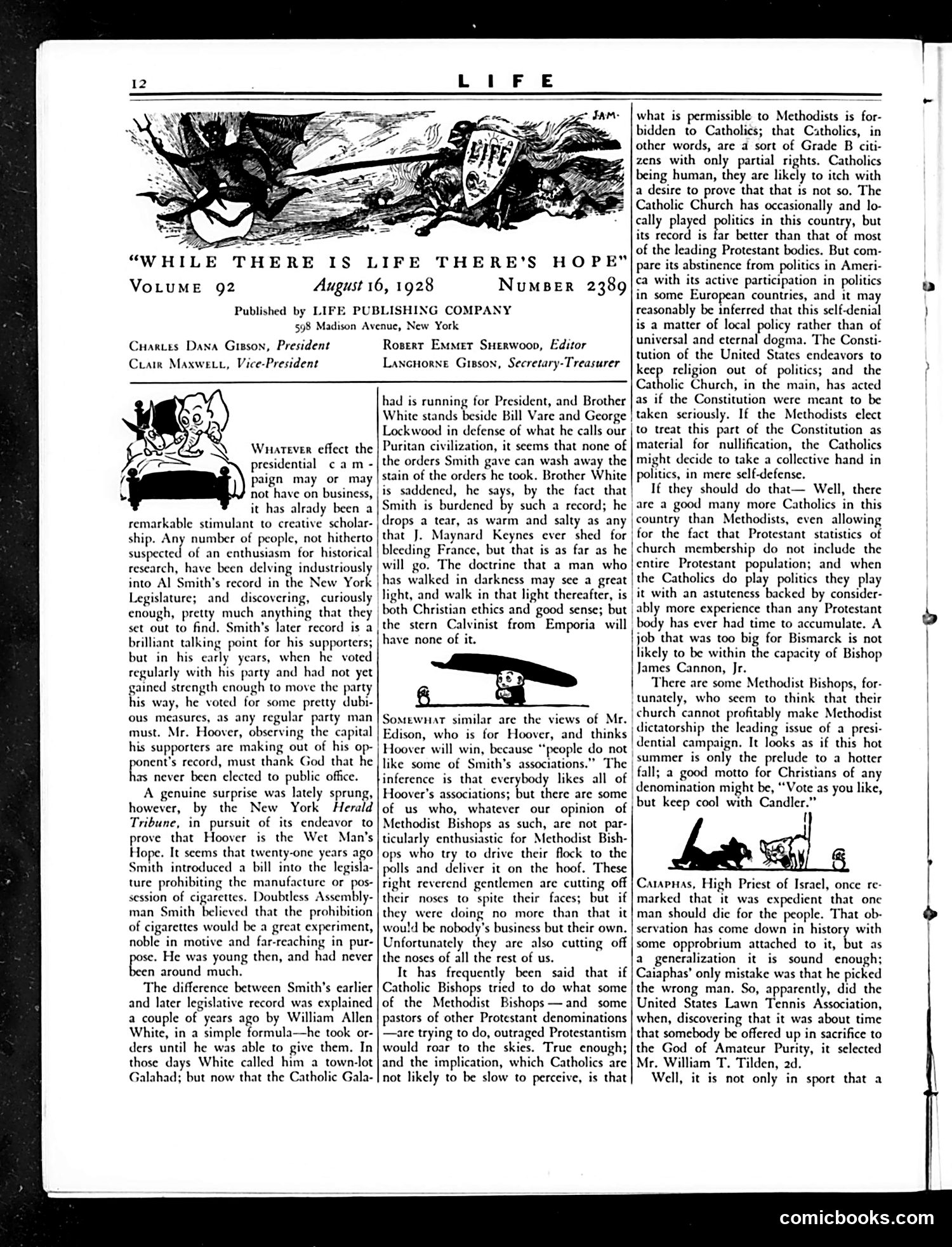
This editorial attacks Protestant clergy—particularly Methodist bishops—for their partisan political involvement in the 1928 presidential election. The context: Al Smith, a Catholic Democrat, was running for president against Republican Herbert Hoover. **The satire's targets:** - **Methodist Bishops** who actively campaigned against Smith, "driving their flock to the polls and deliver[ing] it on the hoof" (treating congregants as cattle) - **William Allen White** (the "Calvinist from Emporia"), a prominent journalist and Hoover supporter who attacked Smith's record - **Thomas Edison**, another Hoover backer criticizing Smith's "associations" **The point:** Life argues that if Catholic bishops behaved this way, Protestants would cry foul about religious interference in politics. The hypocrisy is exposed: Protestant clergy get away with exactly what they'd condemn Catholics for doing. The editorial defends Smith against attacks on his earlier legislative votes while criticizing religious institutions' political activism.
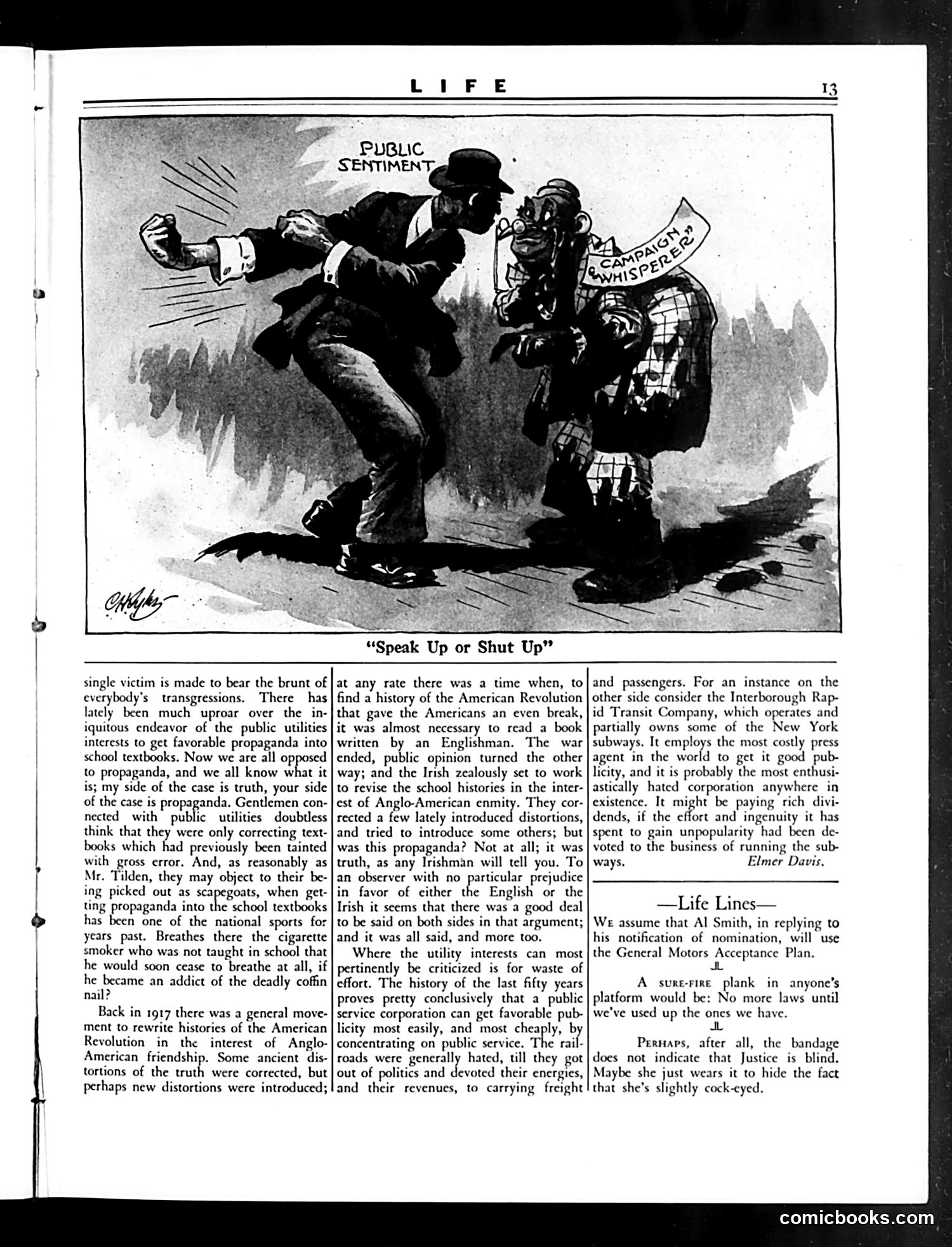
This Clifford cartoon satirizes hypocrisy in propaganda debates. The figure labeled "Public Sentiment" (center-left) is being physically assaulted by two figures representing competing interests—one labeled "Campaign Whispered" (right). The cartoon illustrates the article's argument by Elmer Davis: everyone condemns propaganda *in principle*, but all sides practice it. Davis cites examples: utilities companies inserting pro-business content into textbooks; post-WWI efforts to rewrite American Revolution histories first pro-British, then pro-Irish; and the much-despised Interborough Rapid Transit Company's failed publicity campaigns. The satire's point: "Public sentiment" becomes a victim caught between self-righteous factions, each convinced *their* propaganda is truth while opponents' is lies. Davis argues the real solution isn't fighting propaganda, but focusing on actual service quality—railroads improved reputation by serving passengers well, not through PR spin.
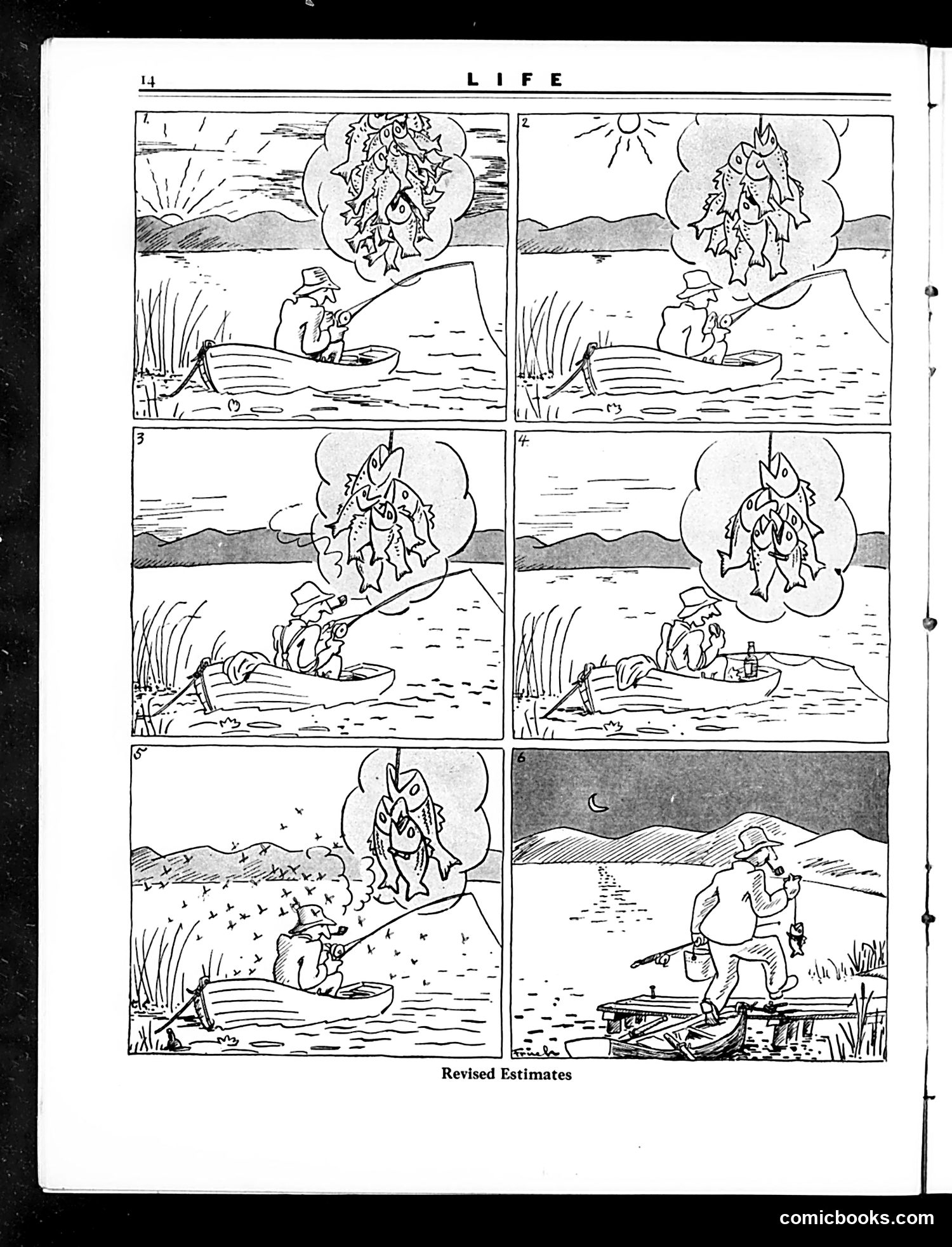
This six-panel comic depicts a fisherman's increasingly exaggerated imaginary catches, shown in thought bubbles. Panel 1 shows him calmly fishing with a modest mental image of his catch. Each subsequent panel escalates his fantasy—the fish grows larger and more elaborate (panels 2-5), with increasingly dramatic imagery. By panel 6, night has fallen and he's exhausted, having abandoned his boat to continue chasing the fantasy on land. The satire mocks how fishermen (and people generally) habitually exaggerate their stories and expectations. The title "Revised Estimates" suggests repeatedly inflating claims. It's a timeless joke about optimism, wishful thinking, and the gap between imagination and reality—themes that remain relatable today.
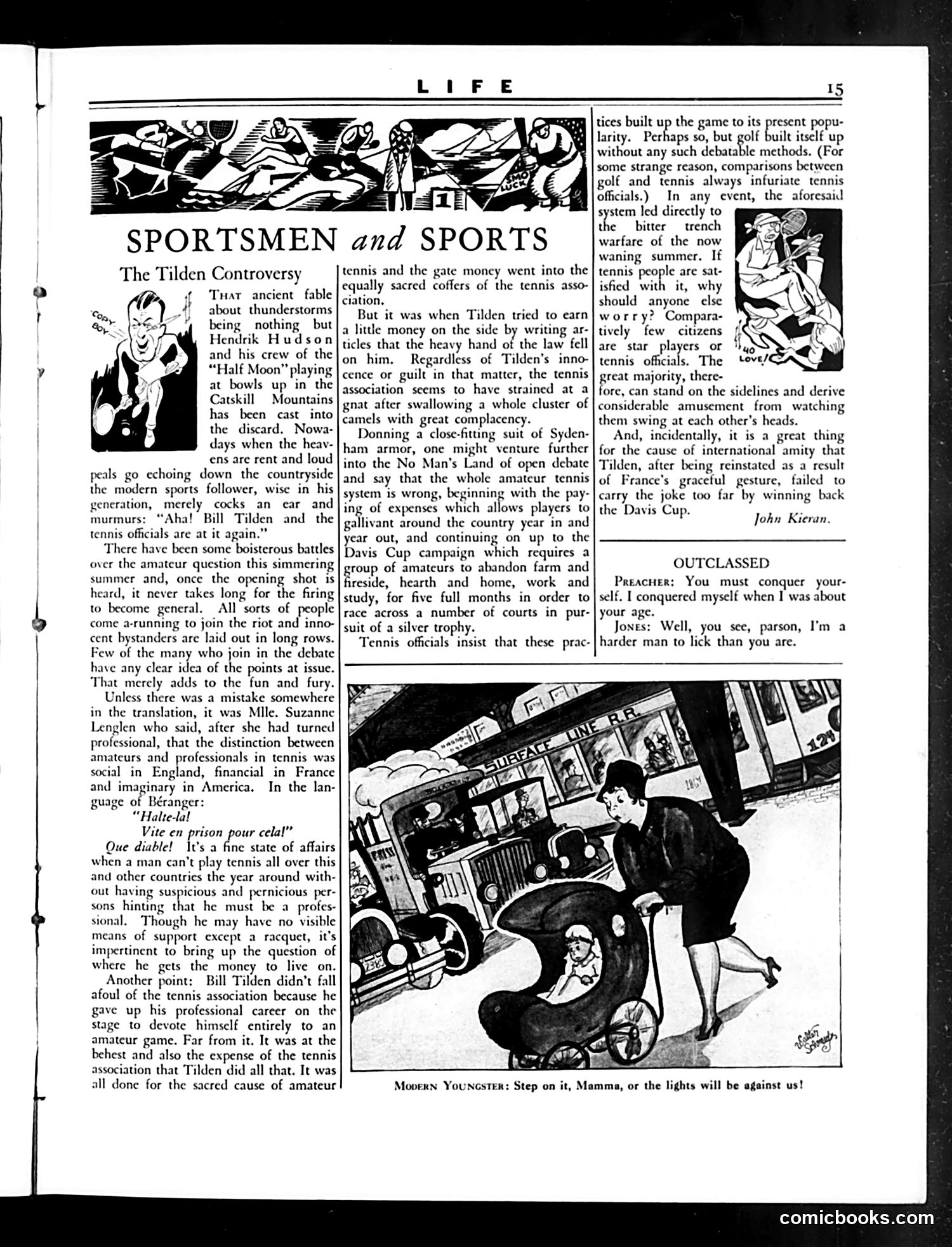
This article satirizes the amateur tennis establishment's hypocrisy regarding Bill Tilden, the era's dominant player. The controversy centers on whether Tilden violated amateur status by writing newspaper articles for pay—a rule the tennis association enforced selectively. Life's point: the tennis officials had already compromised amateurism by paying players' travel expenses for tournaments and Davis Cup campaigns, yet they punished Tilden for modest side income from writing. The satire quotes French tennis player Suzanne Lenglen's observation that the amateur/professional distinction was merely "social" in England and "imaginary in America." The cartoon below depicts a modern youngster nearly hit by a train, captioned as commentary on reckless behavior—likely paralleling the tennis establishment's "reckless" enforcement of arbitrary rules. Life argues the entire amateur system is fundamentally flawed, built on convenient contradictions.
This is a theatre criticism column introducing the 1928-29 Broadway season. The author humorously establishes "new resolutions" for reviewing plays with more rigor and candor, claiming they've been too lenient previously. The specific plays mentioned—**"Elmer Gantry"** (a Sinclair Lewis adaptation), **"Trapped,"** and Earl Carroll's **"Vanities of 1928"**—were actual Broadway productions. The author cynically predicts "Elmer Gantry" will be quickly forgotten, while praising Carroll's production (notably featuring **W.C. Fields**, a major silent-film comedian). The column discusses the tension between writing for general audiences versus theatre professionals, noting that theatre reviews must balance accessibility with insider knowledge. The tone is satirical self-mockery—the critic jokes about their own power to influence ticket sales while admitting they rarely return to New York to actually see plays promptly. The small cartoon illustration appears decorative rather than satirical—a typical feature of 1920s magazine layout.
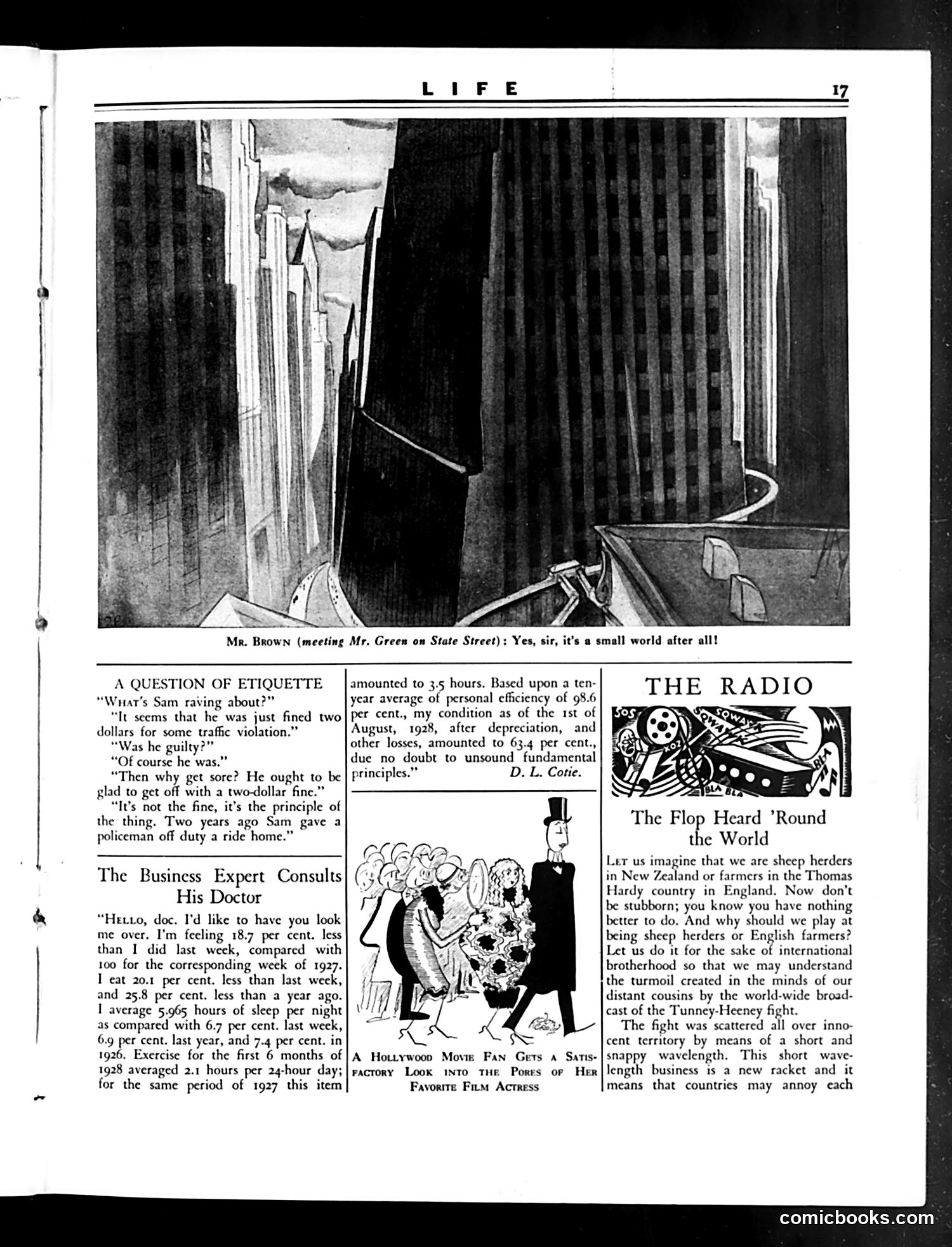
This page contains three satirical pieces from Life magazine (circa 1928): 1. **"A Question of Etiquette"**: A joke about principle over practicality. Sam was fined for a traffic violation he actually committed, but resents it because a policeman he once helped gave him a ride two years ago—he expected reciprocal goodwill rather than enforcement. 2. **"The Business Expert Consults His Doctor"**: Sharp satire mocking obsessive quantification. A businessman describes his health decline entirely in statistical terms (percentages, hours, efficiency ratings), reducing human wellbeing to absurd metrics. The joke is on the era's misplaced faith in numbers and scientific management. 3. **"The Flop Heard 'Round the World"**: References the 1928 Tunney-Heeney boxing match, whose radio broadcast reached international audiences via new short-wave technology. The satire mocks how this sporting event disrupted distant communities (imagined sheep herders in New Zealand, English farmers) who had no interest in American boxing. The page satirizes 1920s American obsessions: courtesy conventions, statistical mania, and technological reach without wisdom.
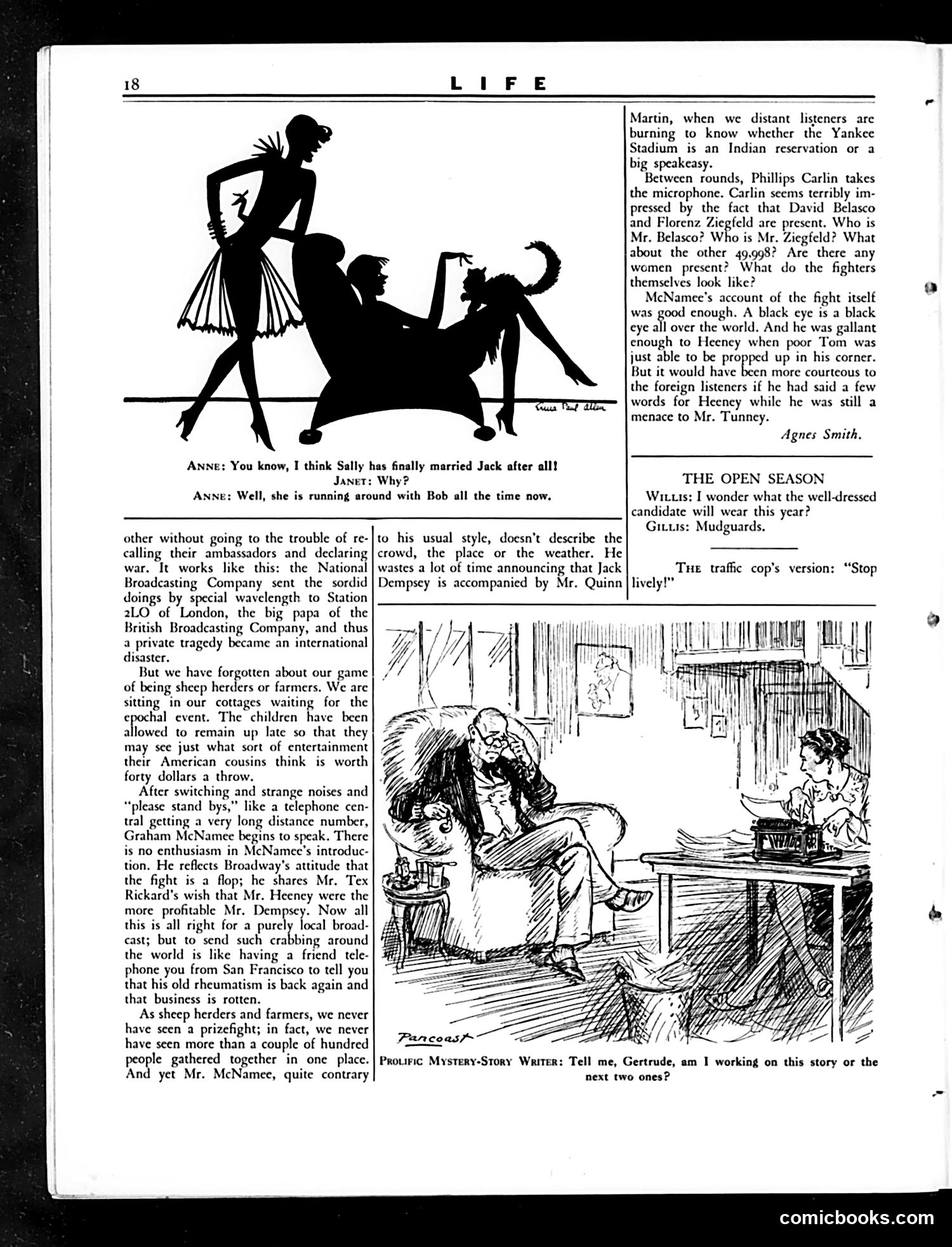
This page from *Life* magazine features "Neighborhood News"—a satirical gossip column format reporting on various American cities (Seattle, Detroit, Los Angeles, Boston, Chicago, Spokane). The humor relies on **small-town trivialities presented as major news**: a man wearing spats, a new store's unpainted exterior, blackberry season sales, and marathon dancers in Windsor. The satire mocks both provincial small-town life and newspapers' breathless coverage of mundane local events. Several items reference **Prohibition-era culture**: stone crocks and gallon jugs (used for illegal alcohol production), and a temperance conference. References to "unsolved gang murders" in Los Angeles reflect real 1920s organized crime. The column also includes minor celebrity mentions (Mayor Walker, newspaper cartoonists Swinnerton and Powers) and political figures, treating them with irreverent familiarity typical of *Life*'s satirical tone. The overall point: mocking the absurdity of small-town American life and local newspaper self-importance during the Jazz Age.
This is a **gossip and humor column** page from Life magazine, organized by city (Kansas City, Ottawa, Cincinnati, Milwaukee, Omaha, Saratoga Springs). There are **no political cartoons** visible—instead, it's a collection of brief, satirical social notes about local citizens. The humor is **gentle mockery of small-town life**: a grocer's boy bitten by a coyote still delivers groceries the next day; someone slips in a bathtub and injures themselves; citizens hold worthless pari-mutuel (horse racing) betting tickets; a man registers to vote, presented as remarkable enough to report. The satire targets **local pretension and absurdity**—a pianist claiming to be in "the piano business," a librarian with an obsessive footnote habit, a "Society of Ex-Cincinnatians" requiring members to leave town to join. This represents Life's early-20th-century format: **urbane commentary on provincial American life**, poking fun at civic boosterism, social climbing, and everyday mishaps rather than major political issues.
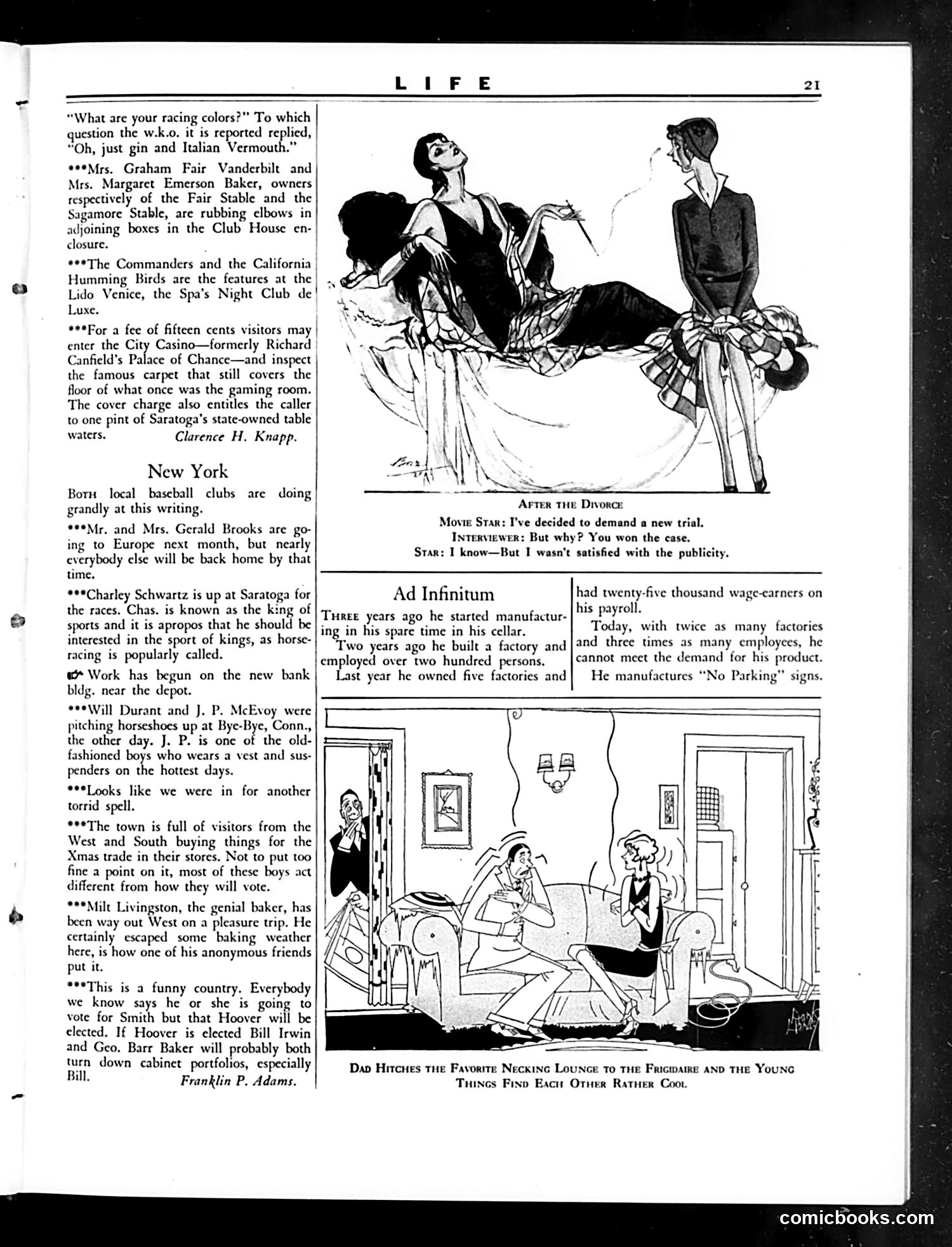
This page contains several satirical items about 1920s American society: **"After the Divorce"** mocks celebrity culture—a movie star won her divorce case but demands a new trial because the *publicity* disappointed her, revealing superficial celebrity priorities. **"Ad Infinitum"** satirizes absurd business success: a man manufacturing "No Parking" signs has exponentially expanded his factories and workforce, yet cannot meet demand. The joke critiques both the proliferation of parking regulations in modern cities and entrepreneurs profiting from trivial products. The main illustration depicts a father figure and young woman lounging together while examining each other—captioned as finding "each other rather cool." This appears to mock changing social mores and the informality of modern courtship. The column by Franklin P. Adams contains gossipy New York society notes about horse racing, baseball, and upcoming trips, peppered with political commentary suggesting voters will claim to support Smith but elect Hoover (likely referencing the 1928 presidential election). Overall, the page satirizes modern commercialism, celebrity vanity, and shifting social values.
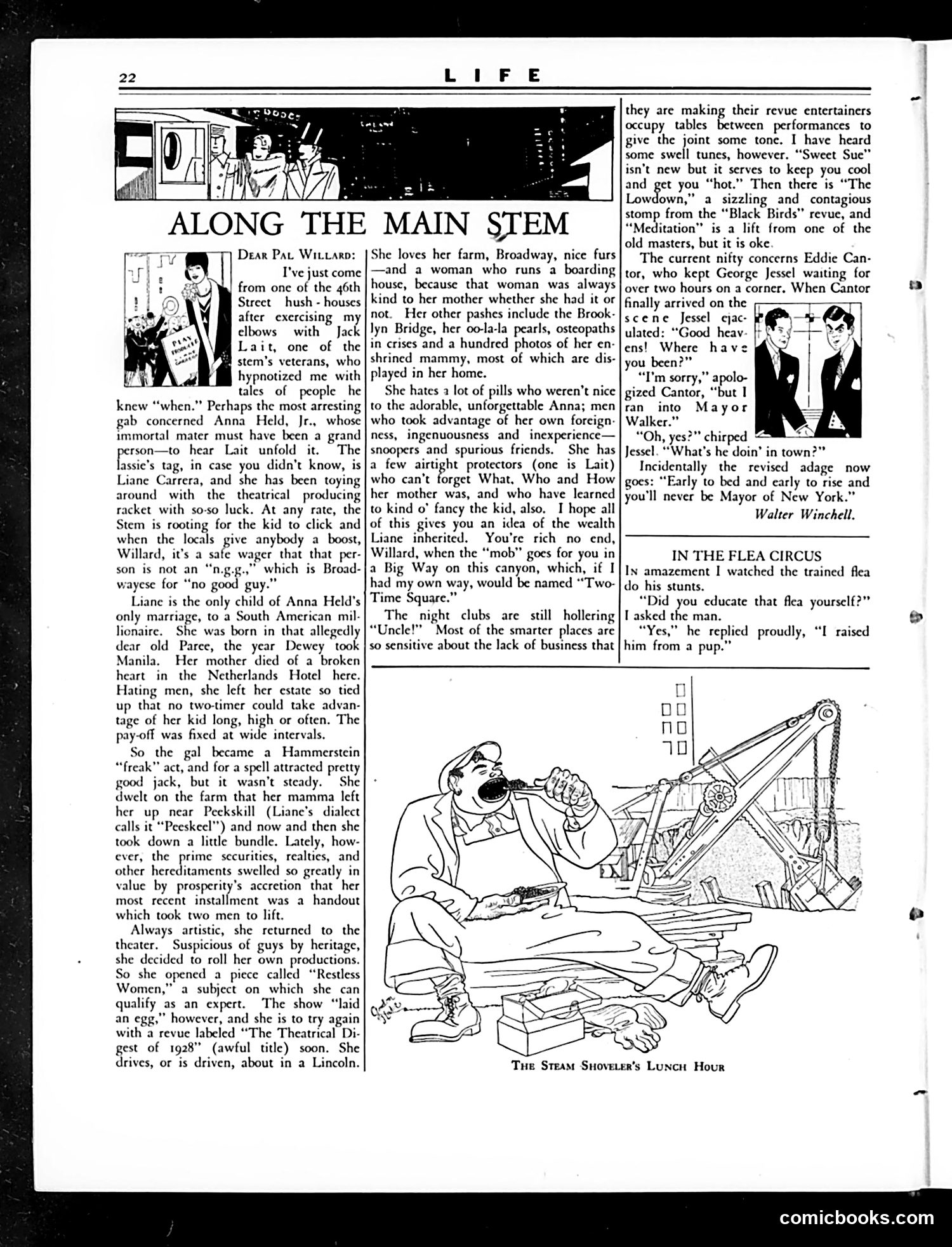
This page from Life contains entertainment gossip and humor circa 1928. The main column "Along the Main Stem" (Broadway slang) discusses Liane Carrera, daughter of legendary actress Anna Held, who is attempting a theatrical career. The writer uses contemporary Broadway jargon ("n.g.g." = "no good guy," "freak act") to chronicle her struggles—her show "laid an egg" (failed), and she's launching a new revue titled "The Theatrical Digest of 1928." The sidebar joke features Walter Winchell reporting on comedian Eddie Cantor keeping George Jessel waiting, with Jessel referencing Mayor Jimmy Walker. The punchline subverts the maxim "early to bed and early to rise" into a quip about avoiding mayoral ambitions. The cartoon "The Steam Shoveler's Lunch Hour" shows a laborer operating machinery while eating—likely satirizing working-class conditions or industrial labor. The gossip assumes readers' familiarity with Broadway figures and slang of the Jazz Age era.
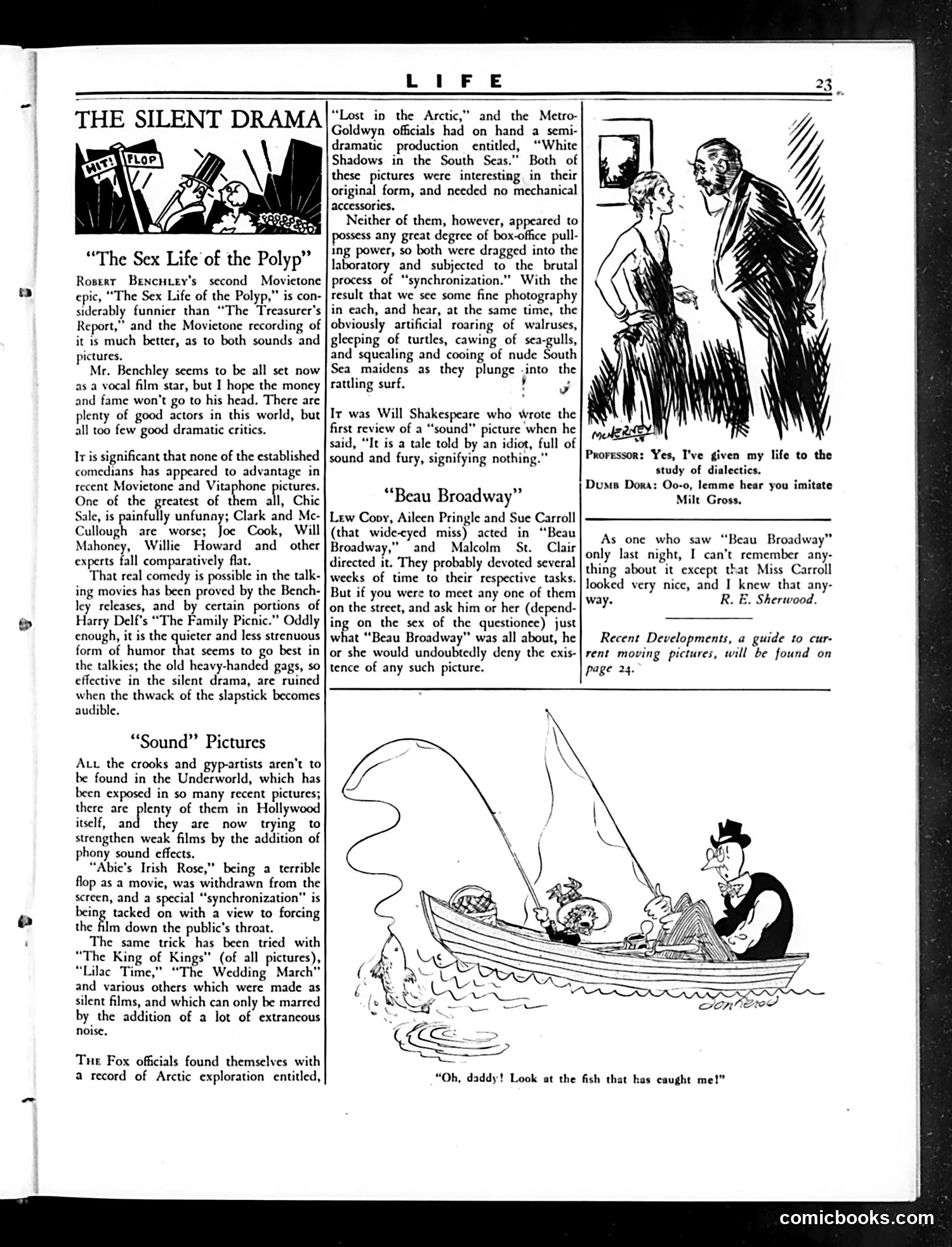
This *Life* magazine page critiques the early "talkie" era's desperate attempts to salvage weak films by adding sound effects. The central complaint: Hollywood studios were taking poorly-performing silent movies and artificially adding synchronized sound—roaring walruses, sea-gulls, etc.—hoping noise would mask bad storytelling. The critic praises Robert Benchley's comedic sound shorts as genuinely funny, contrasting them with established comedians who flop in talkies. The Shakespeare quote ("a tale told by an idiot, full of sound and fury, signifying nothing") perfectly captures the satire: adding sound without substance is worthless. The cartoons humorously illustrate this excess. The bottom cartoon shows a fisherman excitedly catching a fish—visual humor that needs no added sound, implying that good comedy works silently. The page argues the transition to sound should enhance good material, not rescue bad films with artificial effects.
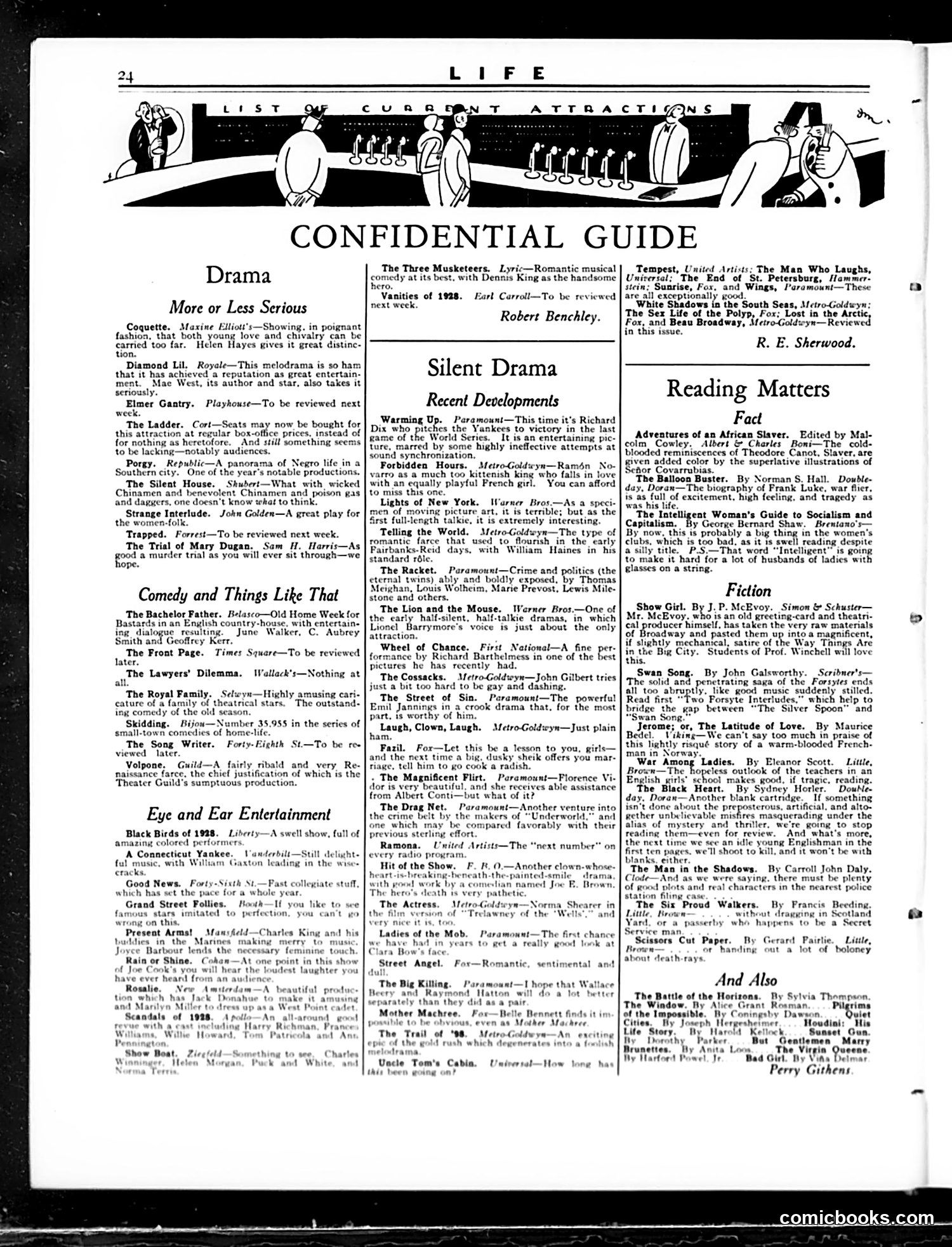
This page is **not a cartoon or satire**—it's a theater and entertainment review guide from Life magazine. The decorative header illustration shows stylized figures representing different entertainment genres, but contains no political content or caricature. The page catalogs current Broadway plays and films with brief, often sarcastic reviews. The satire is **textual, not visual**: reviewers mock productions through sharp one-liners. For example, "Diamond Lil" is called ham that "has achieved a reputation as great entertainment" (implying it's so bad it's entertaining), and "The Lawyers' Dilemma" receives simply "Nothing at all." Notable references include Mae West as author/star of "Diamond Lil" and the recent innovation of "talking pictures" (early sound films like "Lights of New York"), which reviewers note with fascination despite technical flaws. This serves as a period snapshot of 1928 entertainment trends and critical taste.
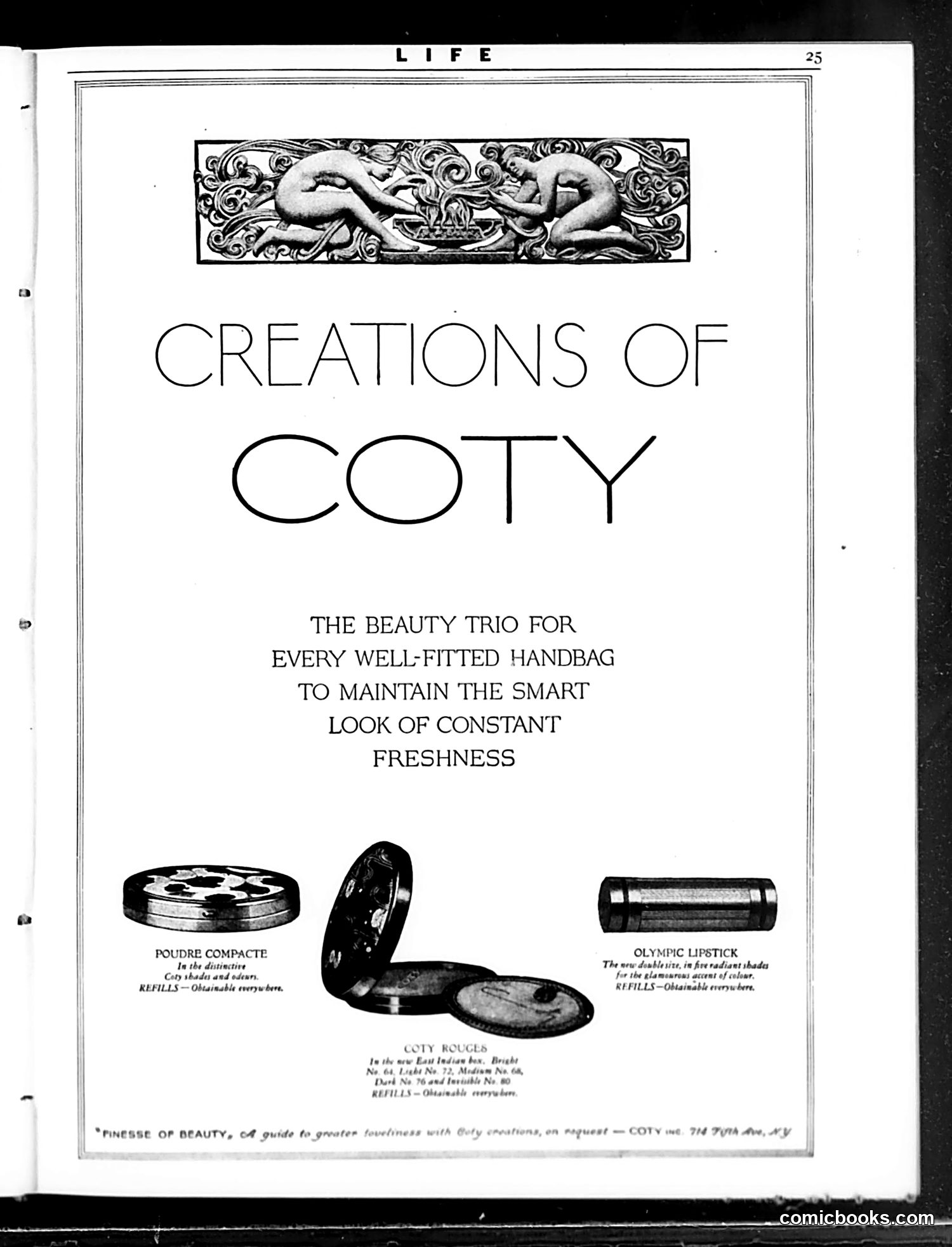
This is a **cosmetics advertisement**, not political satire or a cartoon. It's a full-page ad for Coty beauty products from an era when Life magazine carried such advertising. The page promotes "Creations of Coty" — specifically three cosmetic items: powder compact, rouge, and lipstick. The ornamental header shows classical figures, typical Art Deco design of the period. The text promises these products will help women maintain "the smart look of constant freshness" — appealing to early-to-mid 20th century beauty standards emphasizing polished, well-groomed appearance. The phrase "every well-fitted handbag" suggests these were portable, luxury items. All products mention "refills — obtainable everywhere," emphasizing convenient repurchasing. The ad directs readers to Coty's NYC address for guidance. This is straightforward period advertising with no satirical content.
This page from *Life* magazine contains humorous, gossipy items from readers across North America—a typical format for the publication. Rather than containing political cartoons, it features brief anecdotes and jokes organized by city. The humor reflects early-20th-century concerns: a coyote bite delivered to a grocery store; bathtub mishaps; references to professional opera singers and society figures; and commentary on local politics (sheriff elections, city beautification efforts). Notable references include mentions of Percy Grainger (pianist/composer), Madame Schumann-Heink (famous opera singer), and Premiers/political officials. The "pari-mutuel tickets" joke references horse-racing betting losses from Connaught Park. The tone is lighthearted social satire targeting small-town life, society pretensions, and everyday absurdities rather than hard political criticism. This represents *Life*'s role as a humor magazine publishing reader submissions and local gossip.
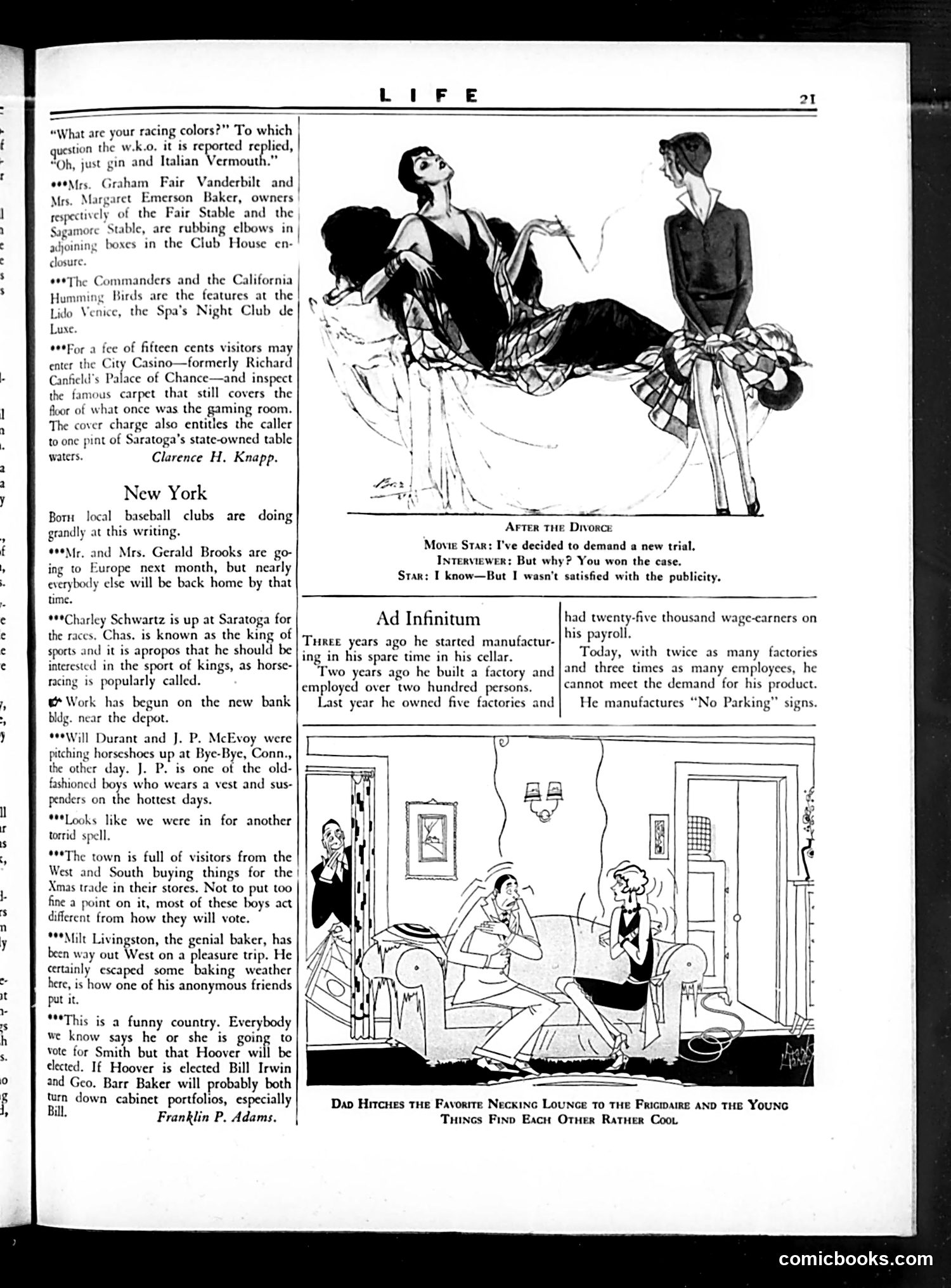
This page contains social gossip and satirical commentary typical of Life's era (appears to be 1920s-30s based on references to Hoover and Prohibition-era "gin and Italian Vermouth"). **Top cartoon**: Shows a fashionable woman discussing divorce with an interviewer. The satire is that she won her legal case but demands a new trial because the *publicity* disappointed her—mocking celebrities' vanity and divorce scandals as entertainment spectacles. **"Ad Infinitum" section**: A humorous paradox about industrial growth. A manufacturer started small but now owns five factories with triple the employees, yet *cannot* meet demand. The joke: his product is "No Parking" signs—utterly useless prosperity. This satirizes American consumer culture and the absurdity of manufacturing demand during economic expansion. **Bottom cartoon**: Depicts a father and young people lounging near a refrigerator, finding each other "cool." Light domestic satire on generational social trends. The gossip column includes references to wealthy figures (Vanderbilts, Emersons) and mentions Saratoga racing—typical society-page content mixed with political commentary (the Smith vs. Hoover election reference).
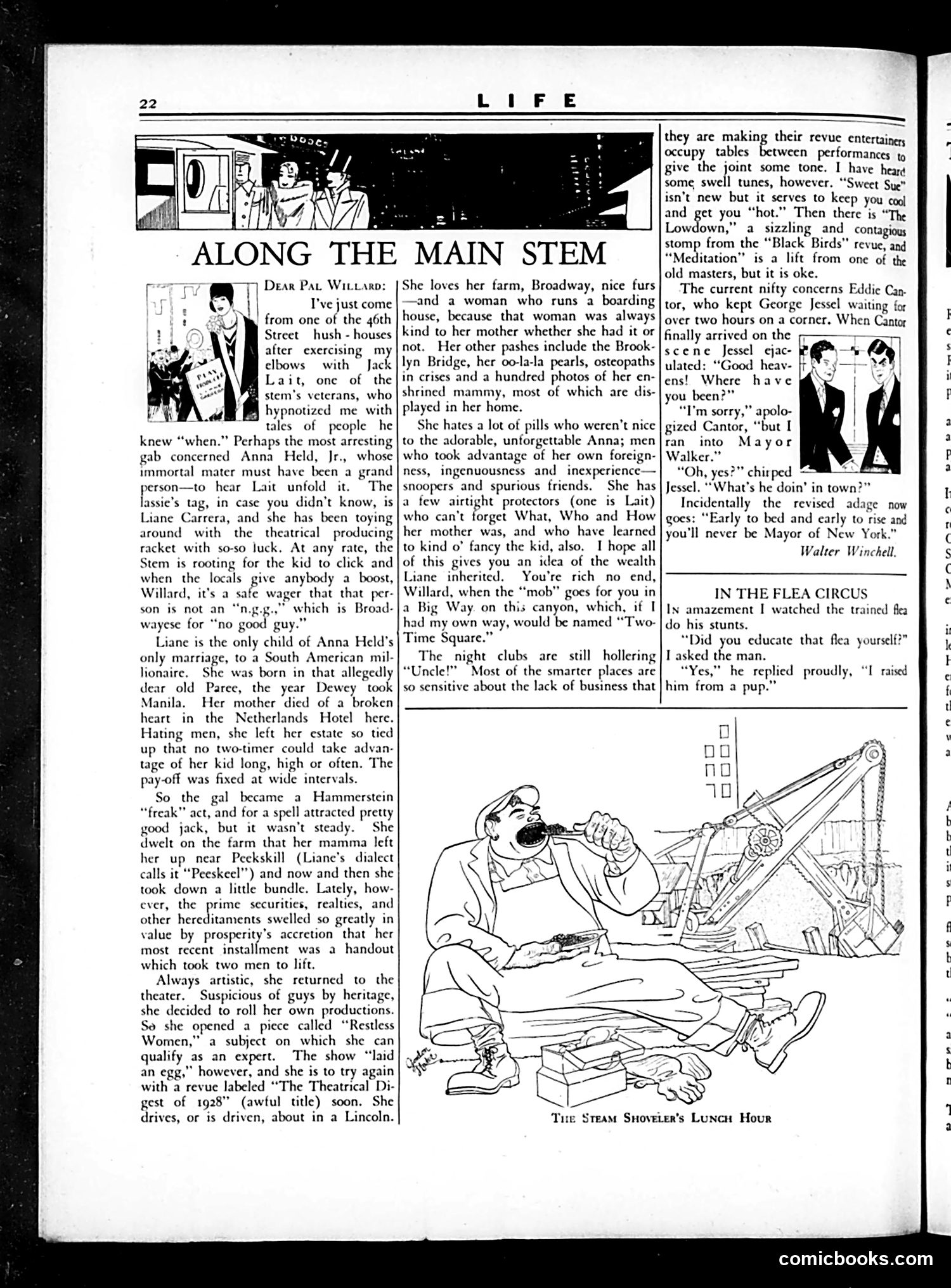
This is a gossip column titled "Along the Main Stem" (Broadway slang for the theater district) discussing theatrical personalities and nightlife. **Main subject:** Liane Carrera, daughter of the famous early 1900s performer Anna Held. The column describes her as wealthy (inheriting from her mother's estate), artistically inclined but unsuccessful (her show "Restless Women" flopped), and planning another revue. It portrays her as emotionally protective of her mother's memory and distrustful of men who exploited her. **The cartoon below** shows "The Steam Shoveler's Lunch Hour"—a working-class man eating amid construction debris, likely satirizing the contrast between Broadway glamour and ordinary labor. **Historical context:** The 1928 date places this during Prohibition and the Jazz Age. References to "hush-houses" (speakeasies), nightclubs, and revues reflect that era's entertainment scene. The gossipy tone is typical of Life magazine's satirical celebrity coverage.
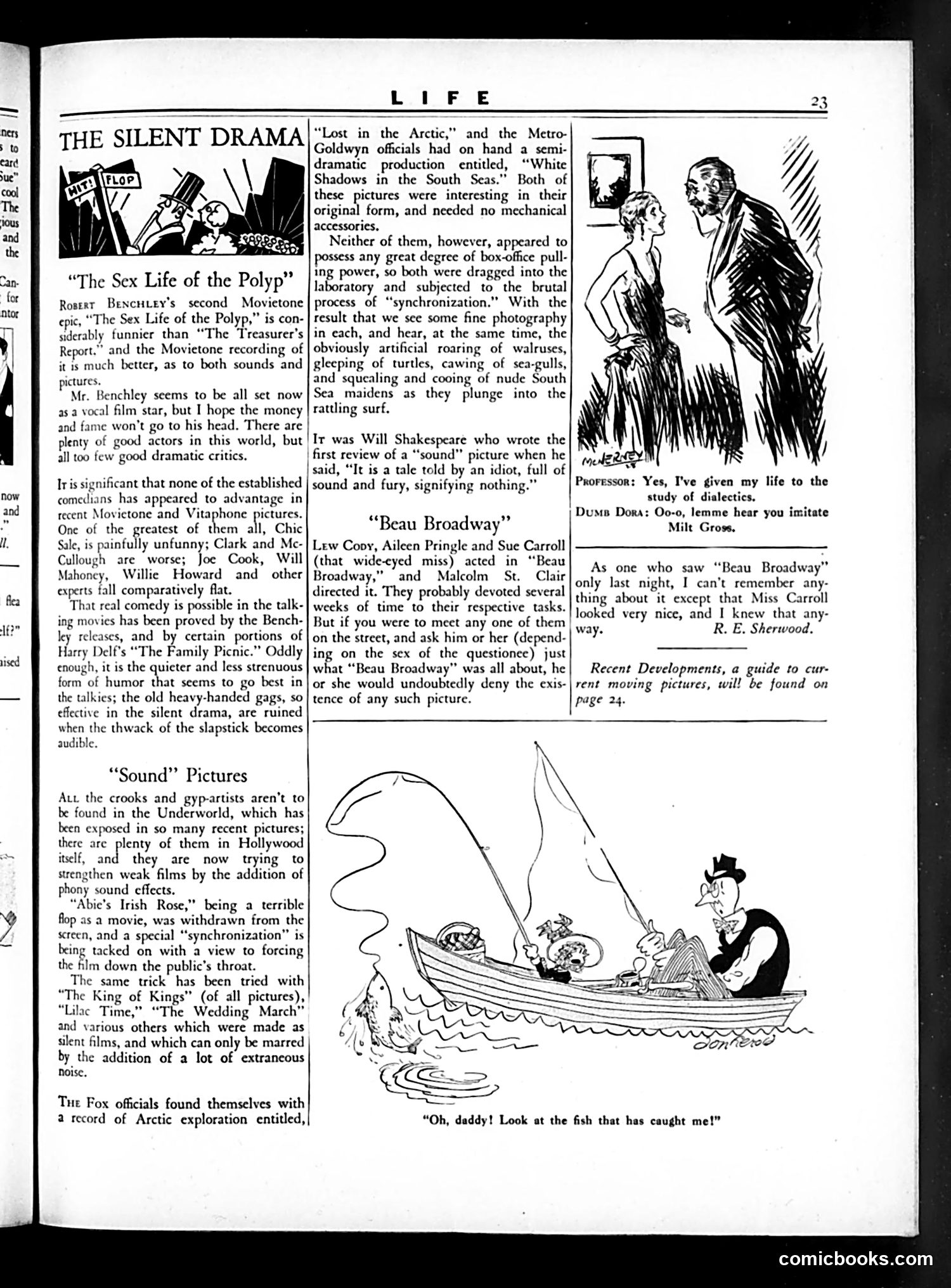
This Life magazine page (page 23) critiques early "talking pictures" (talkies)—films transitioning from silent to sound in the late 1920s. **Main Arguments:** The critic argues that adding artificial sound effects to weak films is fraudulent. Studios like Fox and Metro-Goldwyn retrofitted mediocre silent films ("Lost in the Arctic," "White Shadows in the South Seas") with fake animal noises and dubbed sounds, hoping sound would salvage box-office failures. This is criticized as deceptive. **The Satire:** The Shakespeare quote ("a tale told by an idiot, full of sound and fury, signifying nothing") mocks these "synchronization" attempts as meaningless noise masking poor filmmaking. **The Cartoons:** The top cartoon shows a professor and "Dumb Dora" discussing dialectics—she asks him to imitate comedian Milt Gross, deflating his pretensions. The bottom cartoon depicts a fisherman catching what appears to be people, captioned "Oh, daddy! Look at the fish that has caught me!"—likely commenting on early cinema's absurdity. The page criticizes Hollywood's fraudulent practices and the struggle to adapt comedy to sound technology.
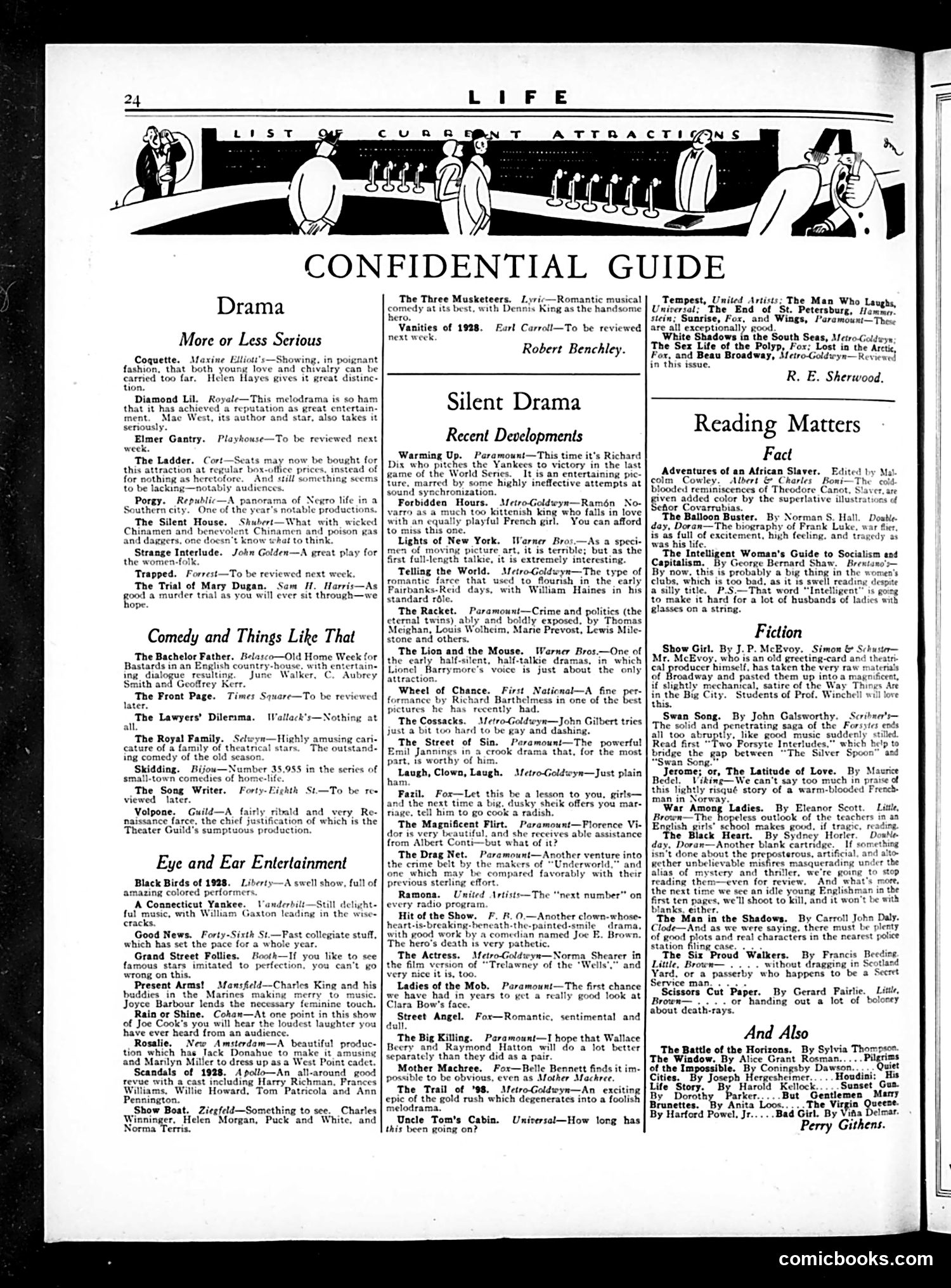
This page is a comprehensive listing guide for New York theater and entertainment, presented as a "Confidential Guide" to current attractions. The header illustration depicts a stylized theater or entertainment venue with figures in period dress. The content reviews Broadway plays, musicals, and silent films currently showing. Notable entries include: **Theater**: Reviews of plays like *The Front Page*, *Strange Interlude*, and *Show Boat* — major productions of the era. **Silent Films**: Listings of recent movies, many still silent (sound was just emerging in 1928). Films mentioned include *Warming Up* (baseball drama) and *Lights of New York* (described as "the 9th talkie"). **The Satire**: The "confidential" framing humorously suggests insider knowledge. Several reviews are cheeky — *The Ladder* is mocked, and *Lights of New York* is called "terrible" as art but "extremely interesting" as a technological novelty. This reflects 1928's transitional moment: sound movies were revolutionary but still crude, and theater remained culturally dominant.

This is not satire or a political cartoon—it's a **full-page advertisement** for Coty cosmetics products, published in *Life* magazine (page 25). The ornamental header depicts classical cherubs in a decorative baroque style, setting an elegant tone. The ad promotes "Creations of Coty," a beauty brand marketing three cosmetic items: powder compact, lipstick, and rouge. These are pitched as essential items for a woman's handbag to maintain "constant freshness." The products are presented with period-typical language emphasizing glamour and refinement ("radiant shades," "finesse of beauty"). Refillable packaging is highlighted—a practical selling point when cosmetics were expensive. This represents early-to-mid 20th century beauty advertising targeting affluent women concerned with maintaining an impeccable appearance. There is no political or satirical commentary; it's straightforward commercial promotion.
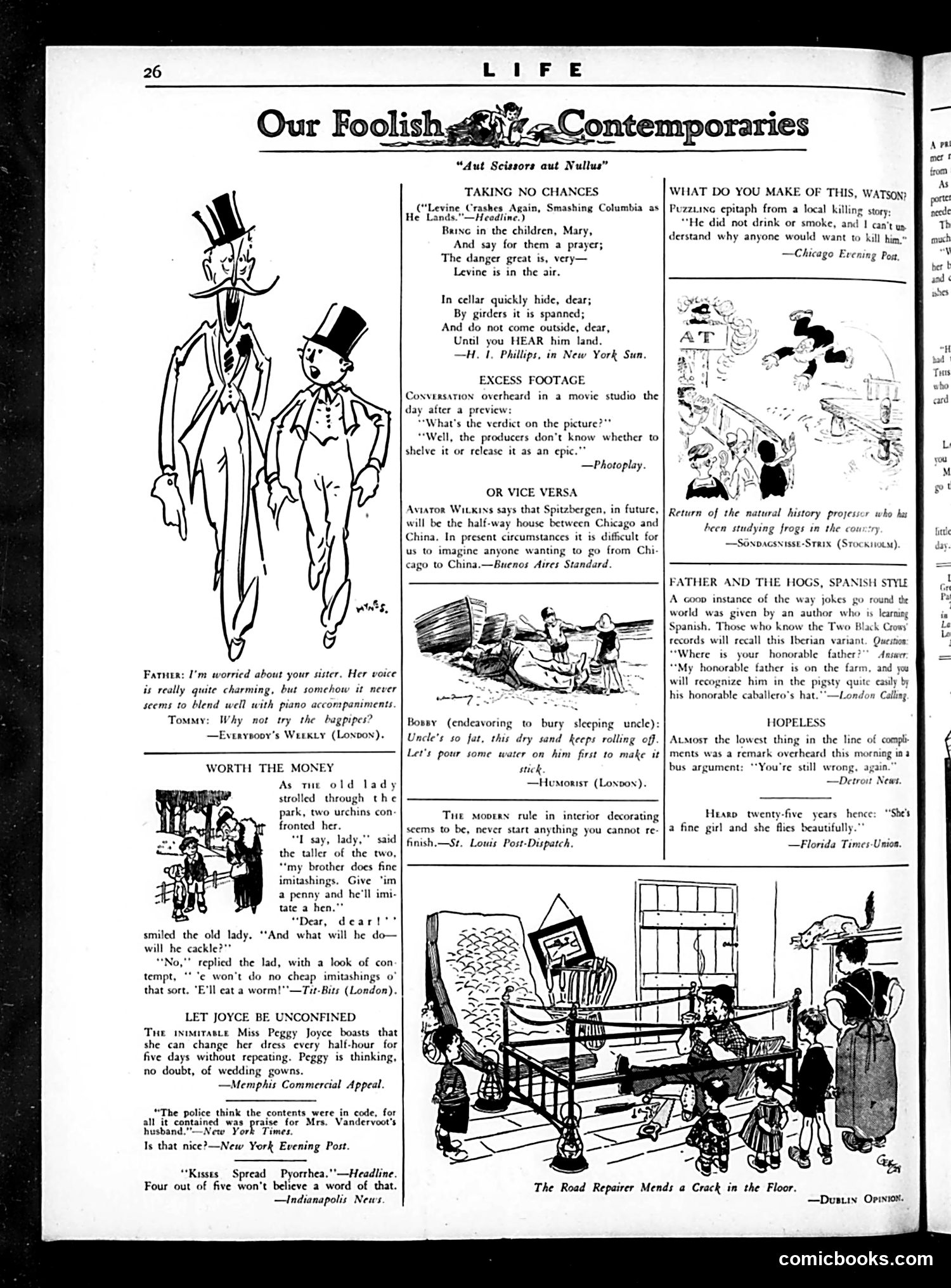
This page from Life magazine is a collection of humorous short jokes and satirical observations typical of 1920s-era American humor. The centerpiece cartoon shows two well-dressed men—likely representing upper-class types—in conversation. The surrounding text includes quips about contemporary figures and situations: a reference to aviator Levine's crash landing (with readers urged to hide indoors), jokes about actress Peggy Joyce's frequent costume changes, observations about interior decorating rules, and commentary on cross-cultural humor involving Spanish-language variations of the "Two Black Crows" comedy routine. The humor relies on wordplay, exaggeration, and social commentary typical of the period. References to Mrs. Vandervoot suggest coverage of wealthy socialite scandals. The overall tone mocks both celebrity excess and everyday foolishness, with jokes sourced from newspapers and magazines worldwide—reflecting Life's role as a sophisticated satirical publication for educated readers familiar with current events and popular culture.
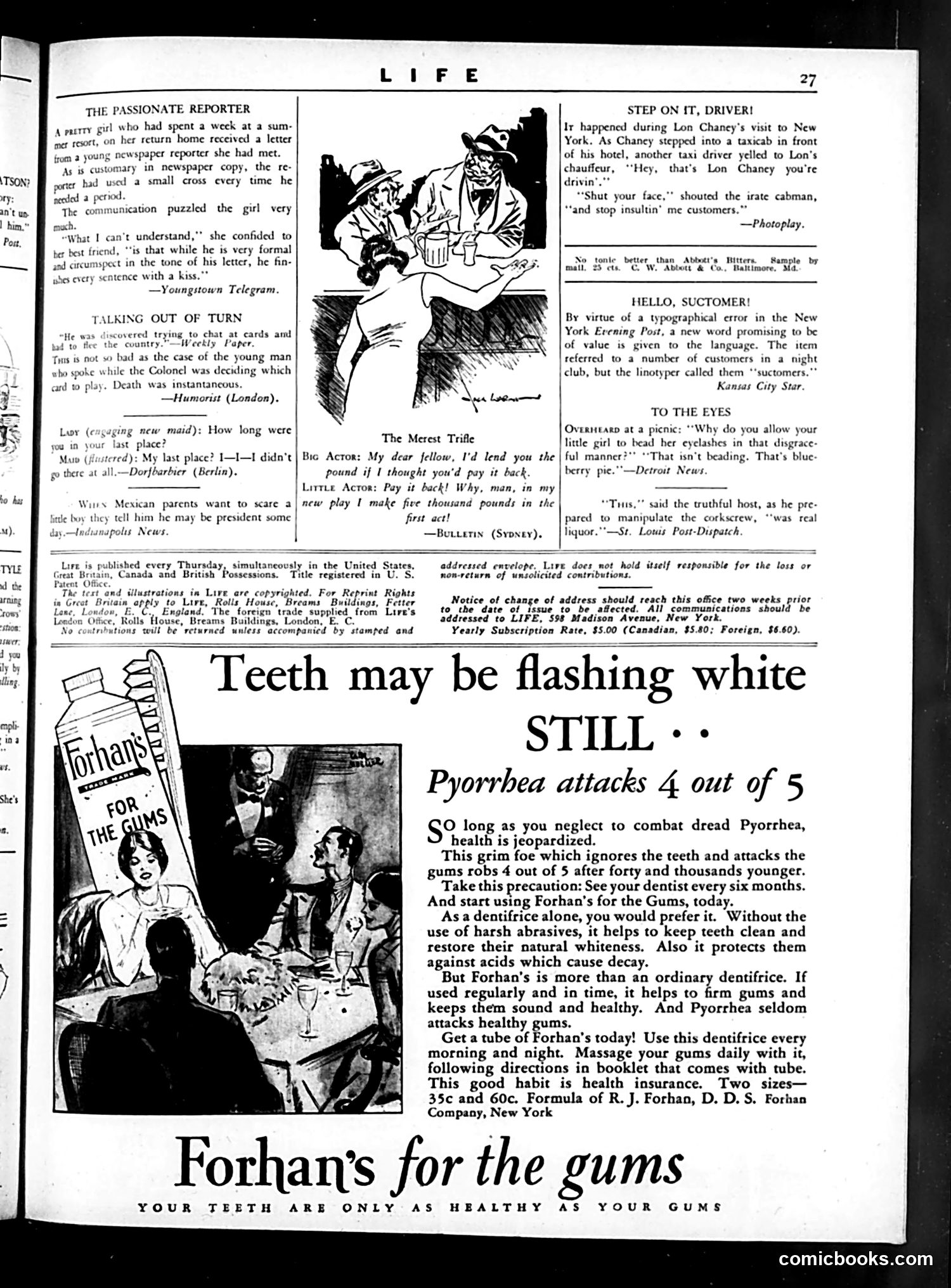
This page from Life magazine contains several brief humorous anecdotes and advertisements, primarily showcasing early 20th-century satirical humor. **Main Cartoons/Jokes:** The page includes multiple short humor pieces mocking everyday social situations: a reporter's awkwardly formal letter punctuated with kisses; a man fatally interrupting a colonel at cards; a new maid's evasiveness about her previous employment; and an actor unable to repay borrowed money. **Notable Reference:** One anecdote mentions **Lon Chaney**, the famous silent film actor, being recognized in a New York taxicab. A rival cabman shouts the identification; Chaney's driver angrily tells him to stop "insultin'" his customers—a play on professional courtesy and territorial pride among taxi drivers. **Advertisements:** The page is dominated by a **Forhan's dentifrice ad** warning that pyorrhea affects "4 out of 5" people over forty, promoting daily gum massage as preventative health care. The humor is gentle, class-conscious, and relies on readers' familiarity with contemporary social conventions and minor celebrities.
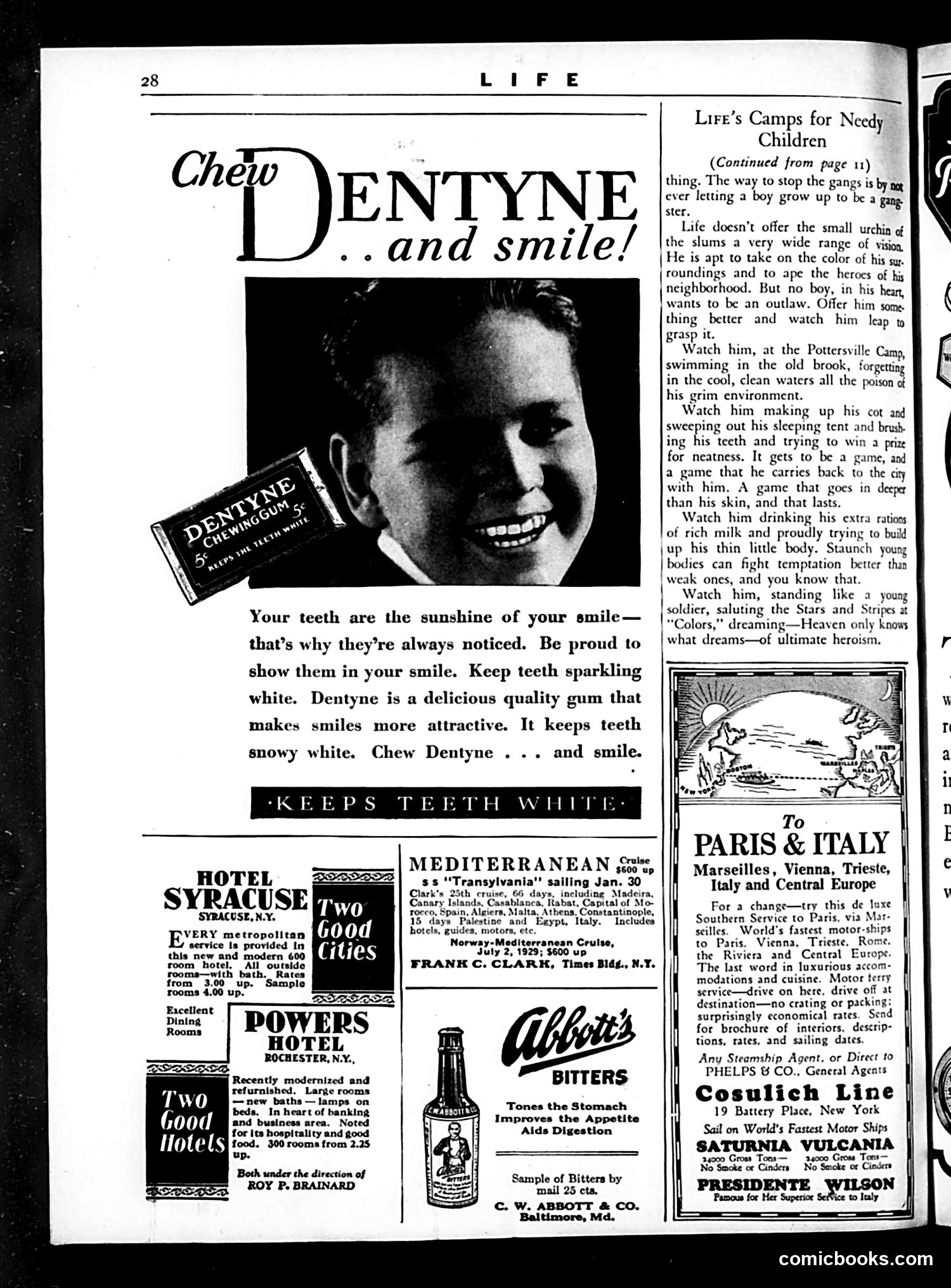
This page is primarily **advertising**, not political satire. The dominant content is a Dentyne chewing gum ad featuring a smiling young man with the slogan "Chew Dentyne...and smile!" The ad promises that the gum "keeps teeth snowy white" and makes "smiles more attractive." The right column contains an article titled "Life's Camps for Needy Children," describing a charitable initiative where poor urban boys are sent to camps (specifically Pottersville Camp) for recreation, physical care, and moral development. The text celebrates how camping—swimming, maintaining hygiene, drinking milk, and patriotic activities—instills discipline and redirects boys away from gang life. The remaining space features travel advertisements (Mediterranean cruises, European tours) and hotel promotions, typical of 1920s Life magazine content aimed at affluent readers. There is **no political cartoon or social satire** on this page—it's a straightforward commercial and lifestyle publication.
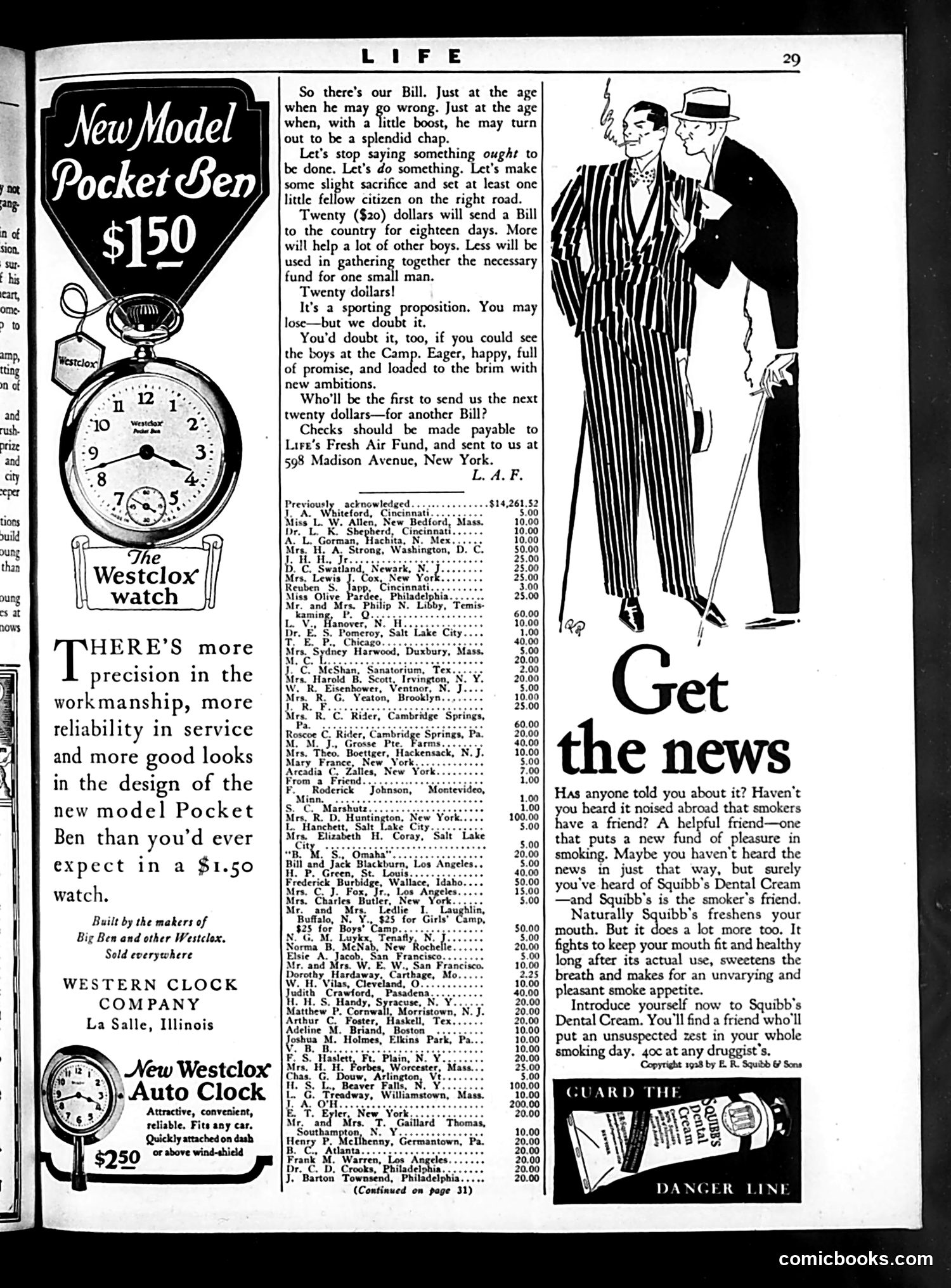
This page combines **charitable fundraising** with period advertising. The main content is a pitch for Life's Fresh Air Fund, seeking $20 donations to send urban boys ("Bills") to summer camp for eighteen days. The appeal emphasizes character-building and redemption—preventing youth from "going wrong" through outdoor recreation and wholesome influence. The accompanying illustration shows two well-dressed men discussing a boy, visualizing the "before and after" concept of the fund's mission. The page is otherwise dominated by **product advertisements**: a Westclox pocket watch ($1.50) and Westclox auto clock ($2.50), plus a Squibb's Dental Cream ad targeting smokers. A long list of acknowledged donors appears in the center—typical of philanthropic publications crediting contributors. The "Danger Line" footer appears to be an unrelated advertisement section. This reflects 1930s-era concerns about urban youth welfare and the marketing strategies of mass-circulation magazines.
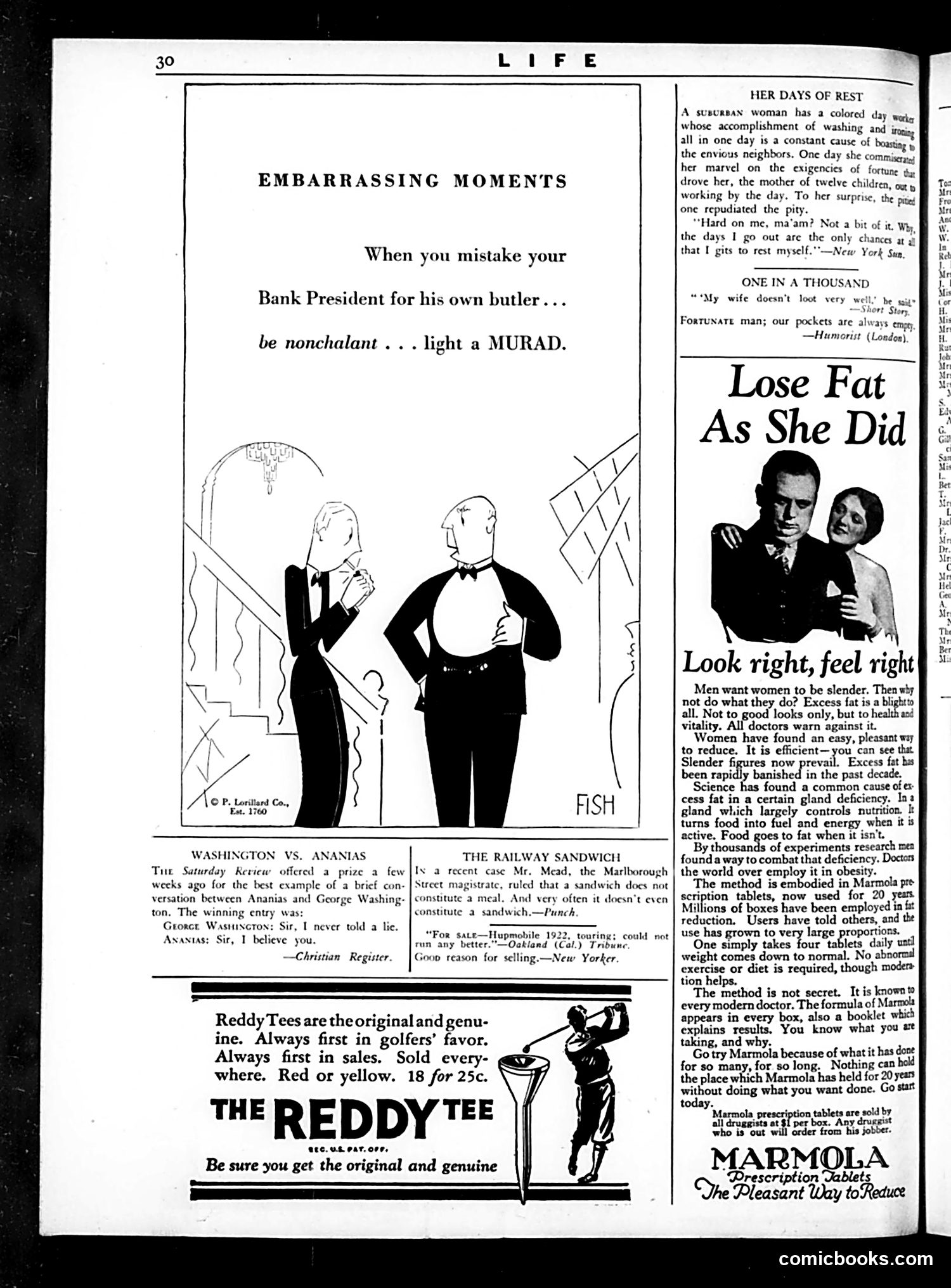
This page contains **humorous anecdotes and advertisements** rather than political cartoons. The main cartoon illustrates "Embarrassing Moments"—a social etiquette joke where someone mistakes a bank president for his butler, then tries to seem unbothered by lighting a Murad cigarette. Below are brief humor pieces: "Washington vs. Ananias" contrasts George Washington's famous honesty with Ananias (a biblical liar), implying even an honest man would believe Washington. "The Railway Sandwich" mocks how poor-quality sandwiches served on trains barely qualify as meals. The right side consists almost entirely of **period advertisements**, including Marmola prescription tablets for weight loss (marketed heavily to women as essential for attractiveness), and Reddy golf tees. There's also a brief anecdote about a Black domestic worker whose "day off" comment about working outside the home being her only rest reveals the harsh conditions of that era's domestic labor. The page is typical early-20th-century Life magazine content: light satire mixed with advertising.
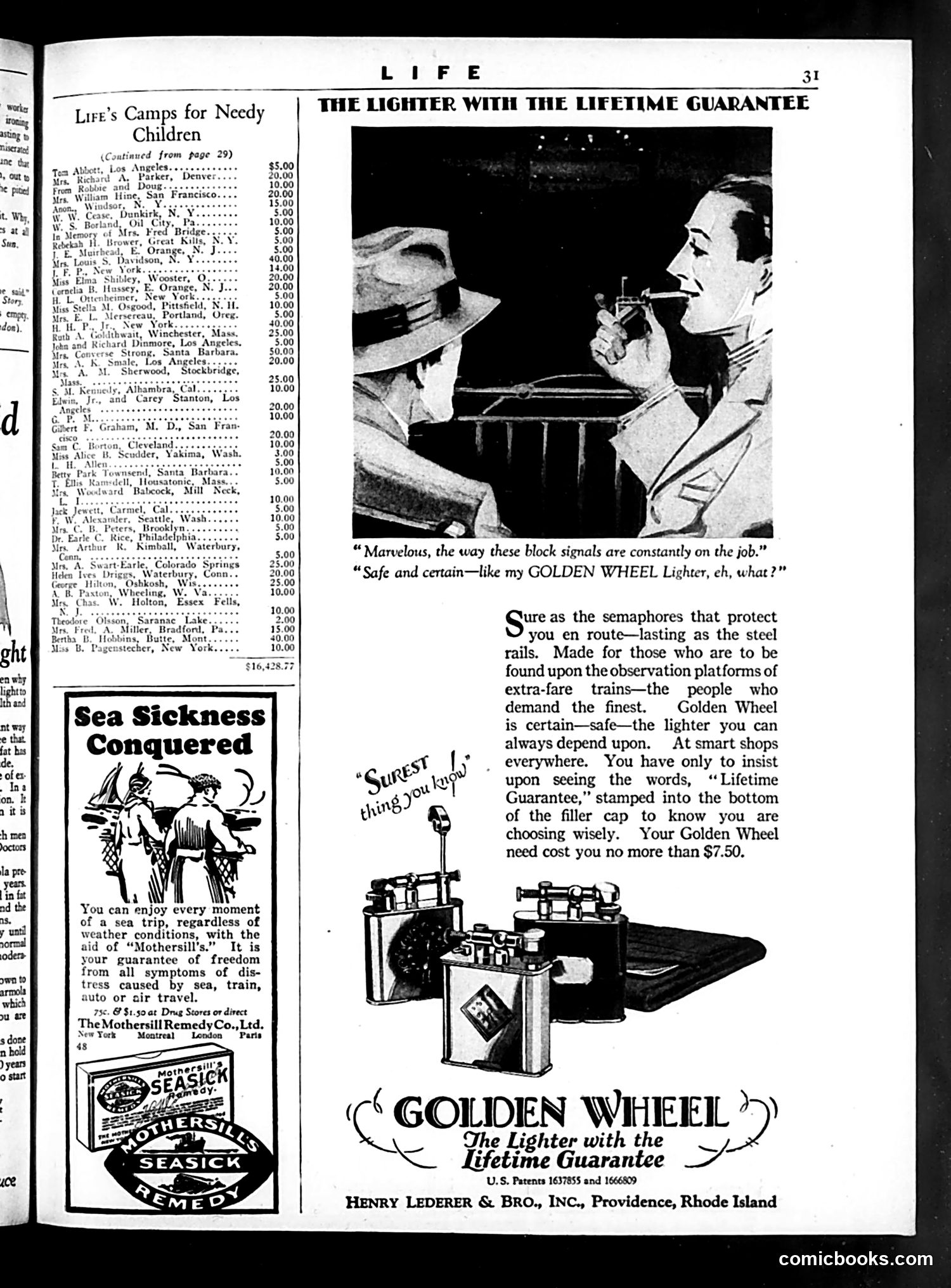
This page is primarily **advertising**, not political satire. It contains two product ads: 1. **Golden Wheel Lighter** (main ad): Uses a train observation-platform setting to sell a lighter with a "lifetime guarantee." The copy compares the lighter's reliability to railroad safety equipment (semaphores, steel rails). The ad targets affluent travelers who ride extra-fare trains. Price: $7.50. Manufacturer: Henry Lederer & Bros., Providence. 2. **Mothersill's Seasickness Remedy** (left side): A smaller ad promoting a patent medicine for motion sickness during travel by sea, train, or car. Cost: $1.30 at drugstores. There is also a charitable donations list titled "Life's Camps for Needy Children" showing contributions from readers. No political cartoons or satirical commentary appears on this page—it's a straightforward commercial section typical of Life magazine's revenue model.
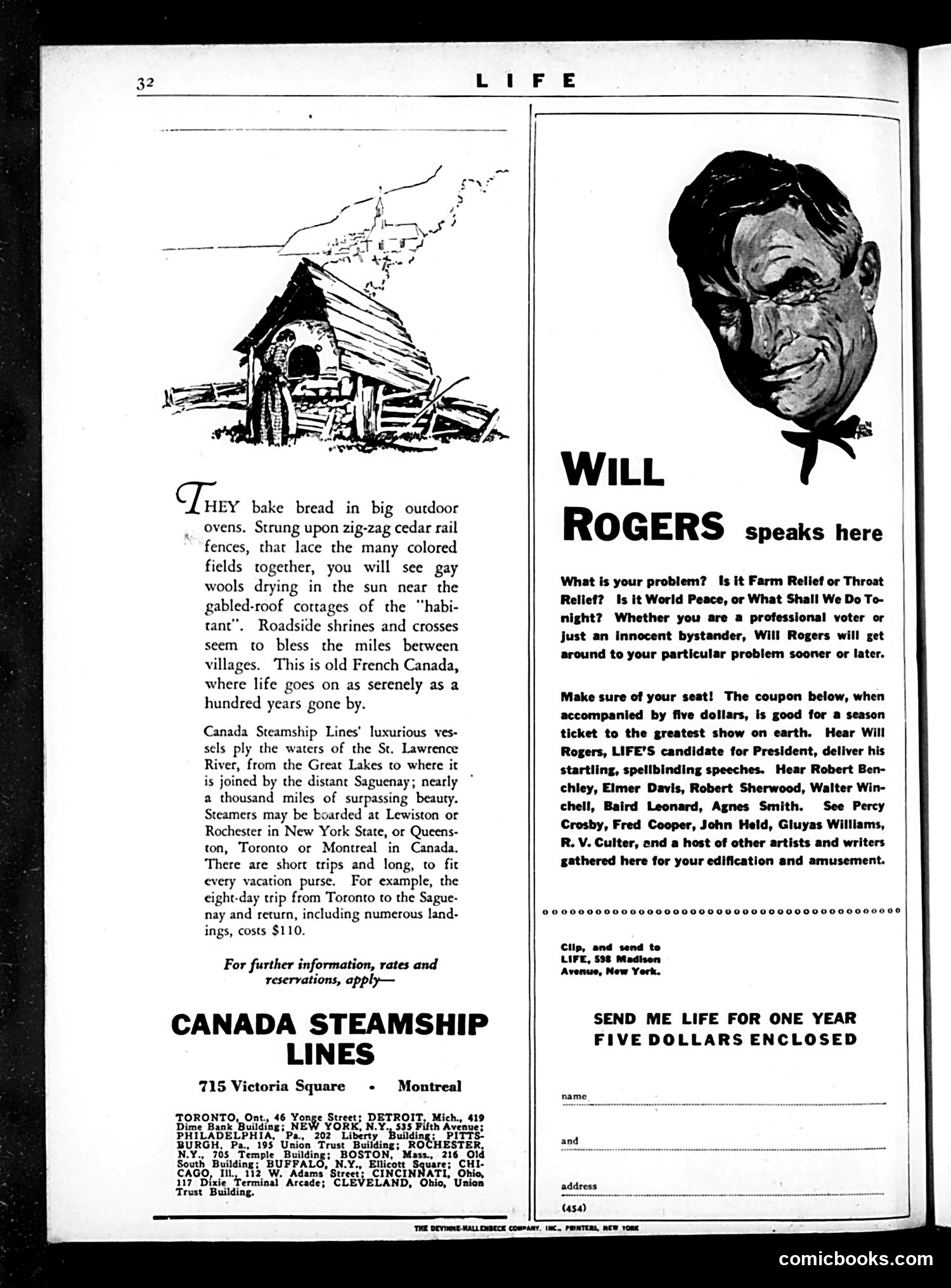
This page combines two advertisements. The left side promotes Canada Steamship Lines' St. Lawrence River cruises, emphasizing romanticized French-Canadian rural life and affordable vacation packages ($110 for eight days). The right side advertises a major event: Will Rogers speaking at what LIFE calls "the greatest show on earth." Rogers, a famous humorist and social commentator of the era, is positioned as LIFE's "candidate for President." The ad humorously promises Rogers will address any problem—"Farm Relief or Throat Relief," "World Peace, or What Shall We Do Tonight"—satirizing politicians' tendency to speak on all topics. The ad lists other prominent writers and cartoonists (Robert Benchley, Walter Winchell, Percy Crosby, John Held) attending, suggesting a major cultural event. For five dollars, readers could subscribe to LIFE for one year and attend this "season ticket" event, blending magazine promotion with entertainment marketing typical of 1920s-30s American publishing.
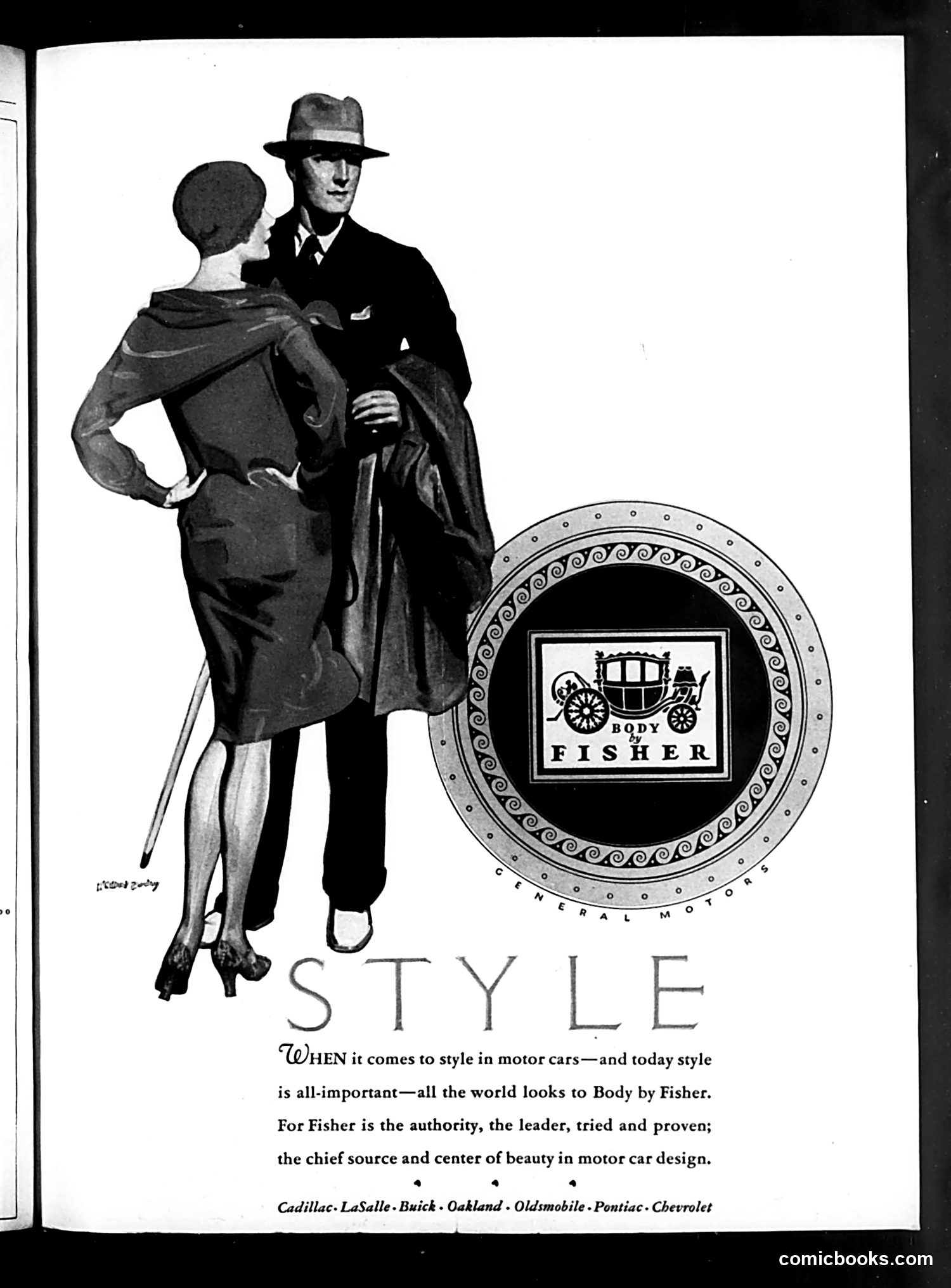
This is an advertisement, not a political cartoon. It promotes "Body by Fisher," a major automotive coachbuilding company of the early 20th century. The ad features an elegant couple in fashionable 1920s-30s attire, emphasizing that Fisher bodies represent style and beauty in motor car design. The decorative circular logo displays a horse-drawn carriage—Fisher's historical origins as a coachmaker before automobiles. The copy claims Fisher is "the authority, the leader" in automotive aesthetics. The listed manufacturers (Cadillac, Buick, Chevrolet, etc.) were Fisher's clients, whose cars featured Fisher-built bodies. This advertisement reflects how automotive styling had become a major selling point, with Fisher positioning itself as the arbiter of automotive elegance.
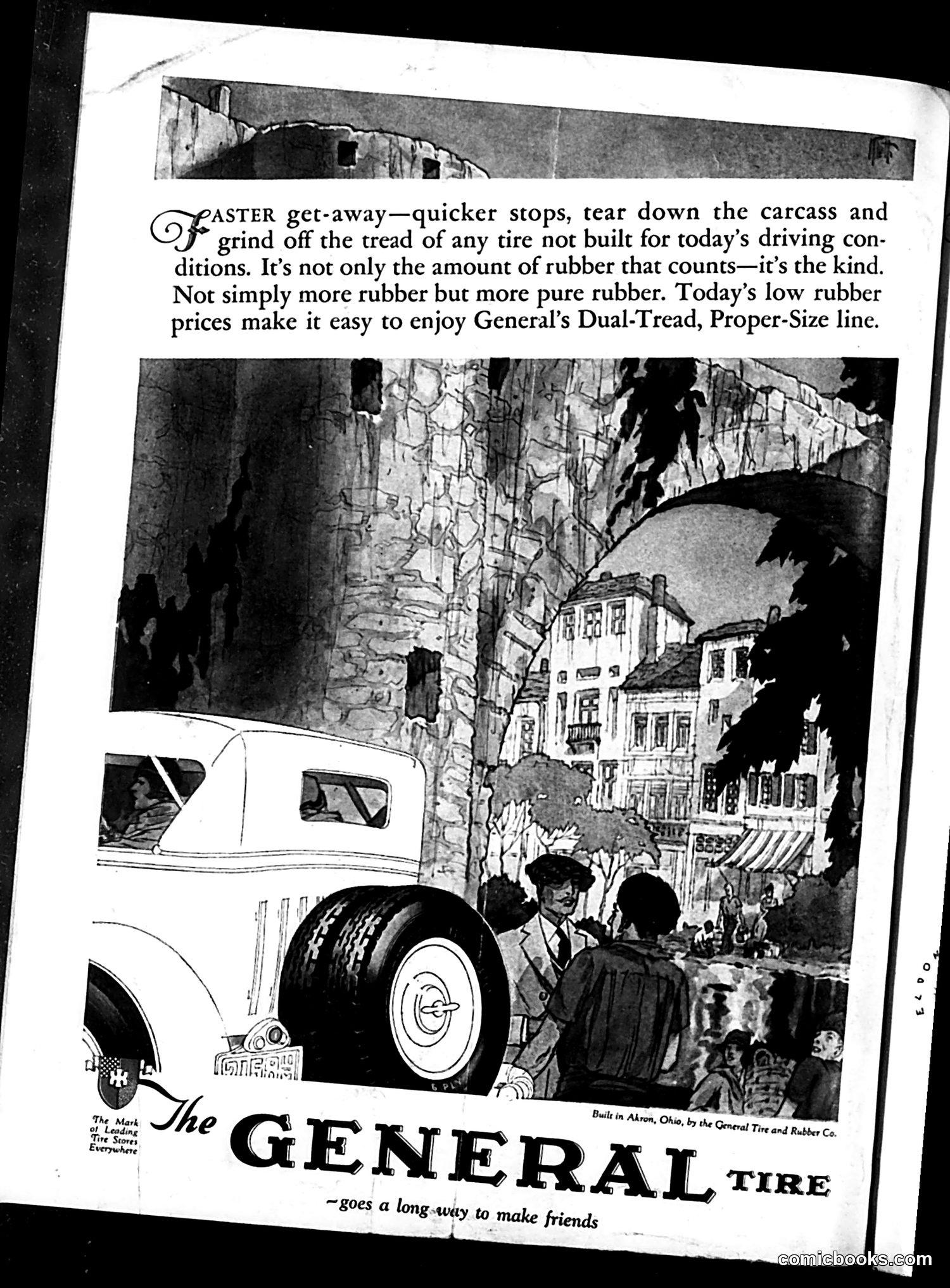
This is **advertising content**, not satire or political commentary. It's a General Tire company advertisement from Life magazine, likely 1920s-1930s based on the style and car depicted. The page promotes General's "Dual-Tread, Proper-Size" tire line to motorists. The illustration shows a well-dressed man displaying tires to a European couple near a scenic village—depicting tire-shopping as part of leisure travel culture. The text emphasizes that quality matters: it's not just rubber quantity but "pure rubber" composition that ensures performance in varied driving conditions. The tagline "goes a long way to make friends" suggests reliable tires improve travel experiences and relationships. The ad reflects post-WWI consumer culture when automobiles were becoming common and tire technology was actively marketed to competitive buyers.