
Life, 1928-08-16 · page 37 of 48
Life — August 16, 1928 — page 37: what you’re looking at
What you’re looking at
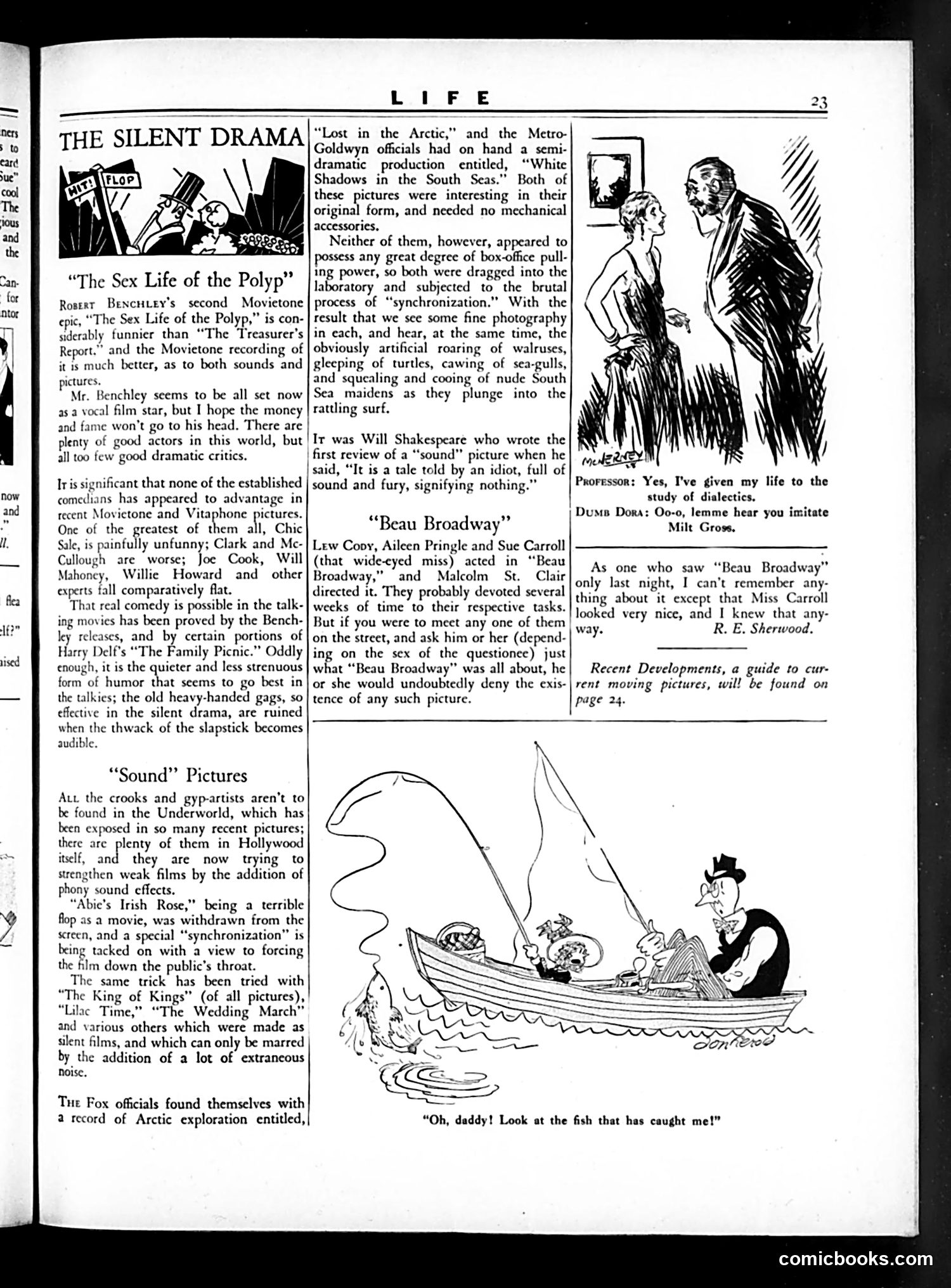
This Life magazine page (page 23) critiques early "talking pictures" (talkies)—films transitioning from silent to sound in the late 1920s. **Main Arguments:** The critic argues that adding artificial sound effects to weak films is fraudulent. Studios like Fox and Metro-Goldwyn retrofitted mediocre silent films ("Lost in the Arctic," "White Shadows in the South Seas") with fake animal noises and dubbed sounds, hoping sound would salvage box-office failures. This is criticized as deceptive. **The Satire:** The Shakespeare quote ("a tale told by an idiot, full of sound and fury, signifying nothing") mocks these "synchronization" attempts as meaningless noise masking poor filmmaking. **The Cartoons:** The top cartoon shows a professor and "Dumb Dora" discussing dialectics—she asks him to imitate comedian Milt Gross, deflating his pretensions. The bottom cartoon depicts a fisherman catching what appears to be people, captioned "Oh, daddy! Look at the fish that has caught me!"—likely commenting on early cinema's absurdity. The page criticizes Hollywood's fraudulent practices and the struggle to adapt comedy to sound technology.
📄 Transcribed text from this page (OCR, searchable)
Machine-transcribed from the original scan — historical spelling and the odd misread are preserved.
LIFE THE SILENT DRAMA “The Sex Life of the Polyp” Rosext Benctitey’s second Movietone epic, “The Sex Life of the Polyp,” is con- siderably funnier than “The Treasurer's Report.” and the Movietone recording of it is much better, as to both sounds and ictures. Mr. Benchley seems to be all set now as a vocal film star, but I hope the money and fame won't go to his head. There are plenty of good actors in this world, but all too few good dramatic critics. Iris significant that none of the established comedians has appeared to advantage in recent Movietone and Vitaphone pictures. One of the greatest of them all, Chic Sale, is painfully unfunny; Clark and Mc- Cullough are worse; Joe Cook, Will Mahoney, Willie Howard and other experts fall comparatively flat. That real comedy is possible in the talk- ing movies has been proved by the Bench- key releases, and by certain portions of Harry Delf's “The Family Picnic.” Oddly enough, it is the quicier and less strenuous form of humor that seems to go best in the talkies; the old heavy-handed gags, so effective in the silent drama, are ruined when the thwack of the slapstick becomes audible. “Sound” Pictures Att the crooks and gyp-artists aren't to be found in the Underworld, which has been exposed in so many recent pictures; there are plenty of them in Hollywood itself, cad they are now trying to strengthen weak films by the addition of phony sound effects. “Abie’s Irish Rose,” being a terrible flop as a movie, was withdrawn from the screen, and a special “synchronization” is being tacked on with a view to forcing the film down the public’s throat. The same trick has been tried with “The King of Kings” (of all pictures), “Lilac Time,” “The Wedding March” and various others which were made as silent films, and which can only be marred by the addition of a lot of extraneous Rose, Tue Fox officials found themselves with a record of Arctic exploration entitled, “Lost in the Arctic,” and the Metro- Goldwyn officials had on hand a semi- dramatic production entitled, “White Shadows in the South Seas.” Both of these pictures were interesting in their original form, and needed no mechanical accessories, Neither of them, however, appeared to possess any great degree of box-office pull- ing power, so both were dragged into the laboratory and subjected to the brutal process of “synchronization.” With the result that we see some fine photography in each, and hear, at the same time, the obviously artificial roaring of walruses, gleeping of turtles, cawing of sea-gulls, and squealing and cooing of nude South Sea maidens as they plunge into the rattling surf. | lI was Will Shakespeare who wrote the | first review of a “sound” picture when he said, “It is a tale told by an idiot, full of sound and fury, signifying nothing.” “Beau Broadway” Lew Copy, Aileen Pringle and Sue Carroll (that wide-eyed miss) acted in “Beau Broadway,” and Malcolm St. Clair directed it. They probably devoted several weeks of time to their respective tasks. But if you were to meet any one of them on the street, and ask him or her (depend- ing on the sex of the questionee) just what “Beau Broadway” was all about, he or she would undoubtedly deny the exis- tence of any such picture. Proressor: Yes, I've given my life to the study of dialectics, Dums Dora: Oo-o, lemme hear you imitate Milt Gross, As one who saw “Beau Broadway” only last night, I can’t remember any- thing about it except that Miss Carroll looked very nice, and I knew that any- way. R. E. Sherwood. Recent Developments, a guide to cur- rent moving pictures, wil! be found on page 24. “Oh, daddy! Look at the fish that has caught me!” comicbooks.com