
Life, 1928-08-16 · page 20 of 48
Life — August 16, 1928 — page 20: what you’re looking at
What you’re looking at
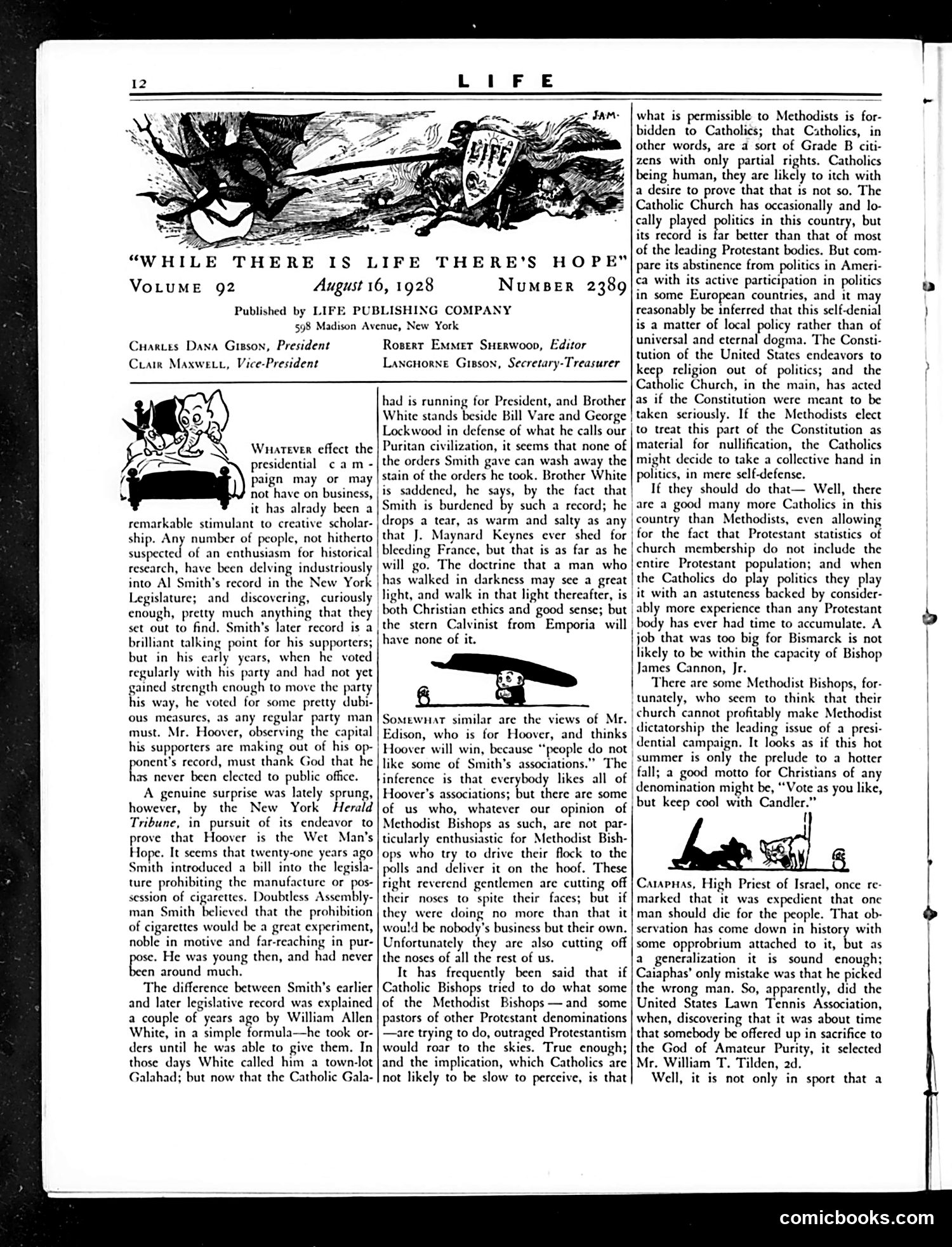
This editorial attacks Protestant clergy—particularly Methodist bishops—for their partisan political involvement in the 1928 presidential election. The context: Al Smith, a Catholic Democrat, was running for president against Republican Herbert Hoover. **The satire's targets:** - **Methodist Bishops** who actively campaigned against Smith, "driving their flock to the polls and deliver[ing] it on the hoof" (treating congregants as cattle) - **William Allen White** (the "Calvinist from Emporia"), a prominent journalist and Hoover supporter who attacked Smith's record - **Thomas Edison**, another Hoover backer criticizing Smith's "associations" **The point:** Life argues that if Catholic bishops behaved this way, Protestants would cry foul about religious interference in politics. The hypocrisy is exposed: Protestant clergy get away with exactly what they'd condemn Catholics for doing. The editorial defends Smith against attacks on his earlier legislative votes while criticizing religious institutions' political activism.
📄 Transcribed text from this page (OCR, searchable)
Machine-transcribed from the original scan — historical spelling and the odd misread are preserved.
ERE IS LIFE THERE'S HOPE” August 16, 1928 NuMBER 2389 Published by LIFE PUBLISHING COMPANY 598 Madison Avenue, New York VoLUME 92 Rosert Emmet Suerwoon, Editor Lancnorne Gisson, Secretary-Treasurer Cuarces Dana Gipson, President Crain Maxwett, Vice-President had is running for President, and Brother White stands beside Bill Vare and George Lockwood in defense of what he calls our Wuatever effect the | Puritan civilization, it seems that none of presidential cam - the orders Smith gave can wash away the paign may or may stain of the orders he took. Brother White not have on business, | is saddened, he says, by the fact that it has alrady been a Smith is burdened by such a record; he remarkable stimulant to creative scholar- | drops a tear, as warm and salty as any | ship. Any number of people, not hitherto | that J. Maynard Keynes ever shed for suspected of an enthusiasm for historical | bleeding France, but that is as far as he research, have been delving industriously will go. The doctrine that a man who into Al Smith's record in the New York | has walked in darkness may see a great | Legislature; and discovering, curiously enough, pretty much anything that they set out to find, Smith's later record is a brilliant talking point for his supporters; but in his early years, when he voted regularly with his party and had not yet gained strength enough to move the party his way, he voted for some pretty dubi- ous measures, as any regular party man must. Mr. Hoover, observing the capital his supporters are making out of his op- nent’s record, must thank God that he fs never been elected to public office. A genuine surprise was lately sprung, however, by the New York Herald Tribune, in pursuit of its endeavor to prove that Hoover is the Wet Man's Hope. It seems that twenty-one years ago Smith introduced a bill into the legisla- ture prohibiting the manufacture or pos- session of cigarettes. Doubtless Assembly- man Smith believed that the prohibition of cigarettes would be a great experiment, noble in motive and far-reaching in pur- sc. He was young then, and had never teen around much, The difference between Smith's earlier and later legislative record was explained a couple of years ago by William Allen White, in a simple formula—he took or- ders until he was able to give them. In those days White called him a town-lot Galahad; but now that the Catholic Gala- light, and walk in that light thereafter, is both Christian ethics and good sense; but |the stern Calvinist from Emporia will have none of it. Somewnat similar are the views of Mr. Edison, who is for Hoover, and thinks Hoover will win, because “people do not like some of Smith’s associations.” The inference is that everybody likes all of Hoover's associations; but there are some of us who, whatever our opinion of Methodist Bishops as such, are not par- ticularly enthusiastic for Methodist Bish- ops who try to drive their flock to the polls and deliver it on the hoof. These right reverend gentlemen are cutting off their noses to spite their faces; but if they were doing no more than that it would be nobody's business but their own. Unfortunately they are also cutting off the noses of all the rest of us. It has frequently been said that if Catholic Bishops tried to do what some of the Methodist Bishops—and some pastors of other Protestant denominations —are trying to do, outraged Protestantism would roar to the skies. True enough; and the implication, which Catholics are not likely to be slow to perceive, is that what is permissible to Methodists is for- bidden to Catholics; that Cuztholics, in other words, are a sort of Grade B citi- zens with only partial rights. Catholics being human, they are likely to itch with a desire to prove that that is not so. The Catholic Church has occasionally and lo- cally played politics in this country, but its record is far better than that of most of the leading Protestant bodies. But com- pare its abstinence from politics in Ameri- ca with its active participation in politics in some European countries, and it may reasonably be inferred that this self-denial is a matter of local policy rather than of universal and eternal dogma. The Consti- tution of the United States endeavors to keep religion out of politics; and the Catholic Church, in the main, has acted as if the Constitution were meant to be taken seriously. If the Methodists elect to treat this part of the Constitution as material for nullification, the Catholics might decide to take a collective hand in politics, in mere self-defense. If they should do that— Well, there are a good many more Catholics in this country than Methodists, even allowing |for the fact that Protestant statistics of church membership do not include the entire Protestant population; and when the Catholics do play politics they play it with an astuteness backed by consider- jably more experience than any Protestant body has ever had time to accumulate. A job that was too big for Bismarck is not likely to be within the capacity of Bishop James Cannon, Jr. There are some Methodist Bishops, for- jtunately, who seem to think that their church cannot profitably make Methodist j dictatorship the leading issue of a presi- {dential campaign. It looks as if this hot summer is only the prelude to a hotter fall; a good motto for Christians of any denomination might be, “Vote as you like, but keep cool with Candler.” ( Catapnas, High Priest of Israel, once re- marked that it was expedient that one man should dic for the people. That ob- servation has come down in history with some opprobrium attached to it, but as a generalization it is sound enough; Caiaphas’ only mistake was that he picked the wrong man. So, apparently, did the United States Lawn Tennis Association, when, discovering that it was about time that somebody be offered up in sacrifice to the God of Amateur Purity, it selected Mr. William T. Tilden, 2d. Well, it is not only in sport that a —_—_—g,- comicbooks.com