
Life, 1928-08-16 · page 17 of 48
Life — August 16, 1928 — page 17: what you’re looking at
What you’re looking at
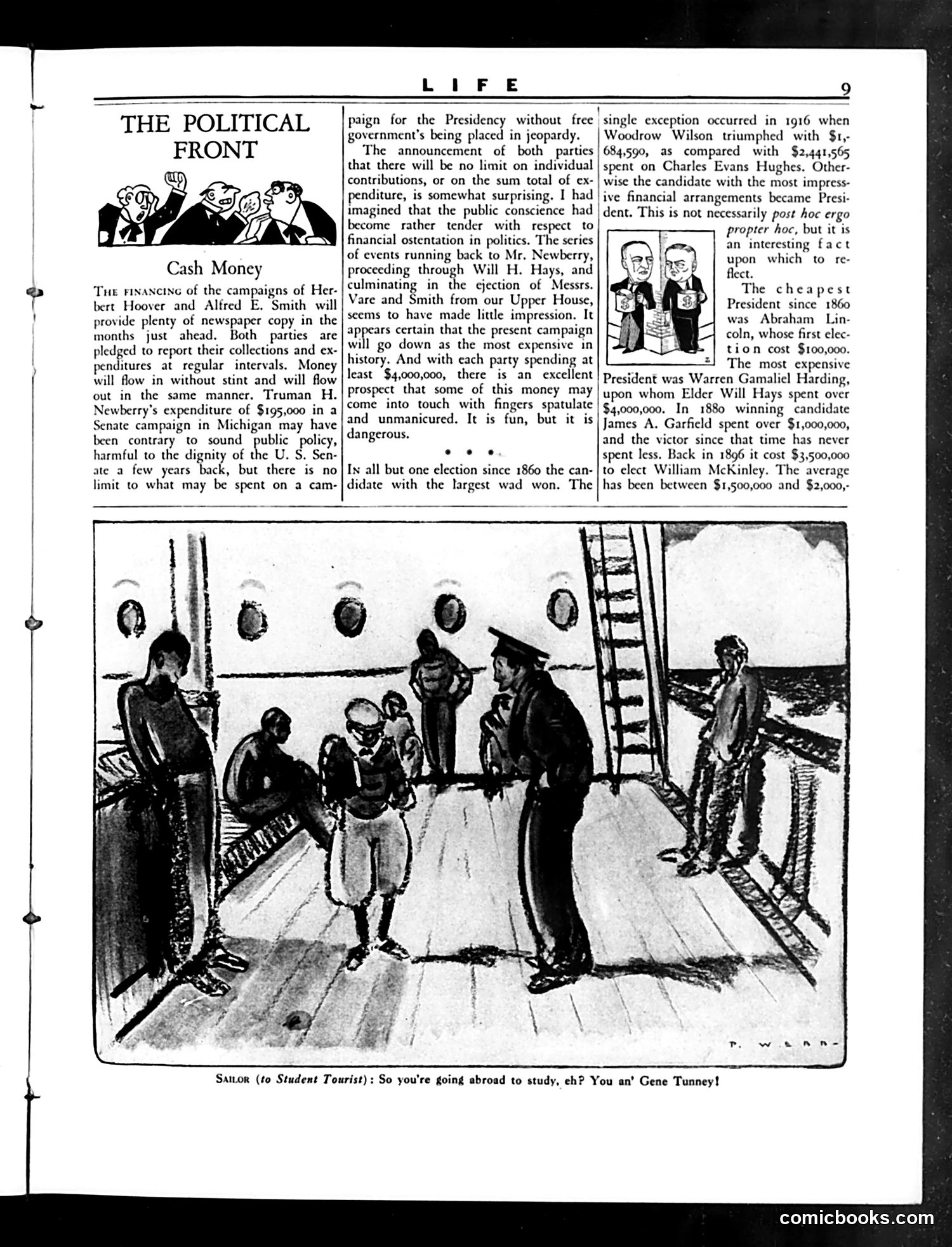
**"The Political Front" Section:** This article discusses campaign financing for the 1928 presidential election between Herbert Hoover and Alfred E. Smith. The text notes that campaign spending has grown dramatically—the 1916 Wilson campaign cost $684,590, while the current race will exceed $4,000,000. The article expresses concern that unlimited spending undermines democratic principles, and notes that the Senate lacks authority to regulate campaign costs. **The Cartoon Below:** The sailor's joke references Gene Tunney, a famous heavyweight boxer of the 1920s. The humor plays on the double meaning: the sailor assumes the young man is going abroad as a tourist/student, but the sailor makes a quip suggesting instead he's pursuing boxing or athletics like Tunney—a contemporary celebrity reference that would have been instantly recognizable to 1928 readers.
📄 Transcribed text from this page (OCR, searchable)
Machine-transcribed from the original scan — historical spelling and the odd misread are preserved.
LIFE "THE POLITICAL FRONT Cash Money Tue Financine of the campaigns of Her- bert Hoover and Alfred E, Smith will provide plenty of newspaper copy in the months just ahead. Both parties are pledged to report their collections and ex- penditures at regular intervals. Money will flow in without stint and will flow out in the same manner. Truman H. Newberry’s expenditure of $195,000 in a Senate campaign in Michigan may have been contrary to sound public policy, harmful to the dignity of the U. S. Sen- ate a few years back, but there is no limit to what may be spent on a cam- paign for the Presidency without free government's being placed in jeopardy. The announcement of both parties that there will be no limit on individual contributions, or on the sum total of ex- penditure, is somewhat surprising. I had imagined that the public conscience had become rather tender with respect to financial ostentation in politics. The series of events running back to Mr. Newberry, proceeding through Will H. Hays, and culminating in the ejection of Messrs. Vare and Smith from our Upper House, seems to have made little impression. It appears certain that the present campaign will go down as the most expensive in history. And with each party spending at least $4,000,000, there is an excellent prospect that some of this money may come into touch with fingers spatulate and unmanicured. It is fun, but it is dangerous. see In all but one election since 1860 the can- didate with the largest wad won. The single exception occurred in 1916 when Woodrow Wilson triumphed with $1,- 684,590, as compared with $2,441,565 spent on Charles Evans Hughes. Other- | wise the candidate with the most impress- jive financial arrangements became Presi- | dent. This is not necessarily post hoc ergo propter hoc, but it is an interesting fact upon which to re- flect. The cheapest President since 1860 was Abraham Lin- coln, whose first elec- tion cost $100,000. The most expensive President was Warren Gamaliel Harding, upon whom Elder Will Hays spent over $4,000,000. In 1880 winning candidate James A. Garfield spent over $1,000,000, and the victor since that time has never spent less. Back in 1896 it cost $3,500,000 to elect William McKinley. The average has been between $1,500,000 and $2,000,- Sator (to Student Tourist): So you're going abroad to study, eh? You an’ Gene Tunney! comicbooks.com