
Life, 1928-08-16 · page 18 of 48
Life — August 16, 1928 — page 18: what you’re looking at
What you’re looking at
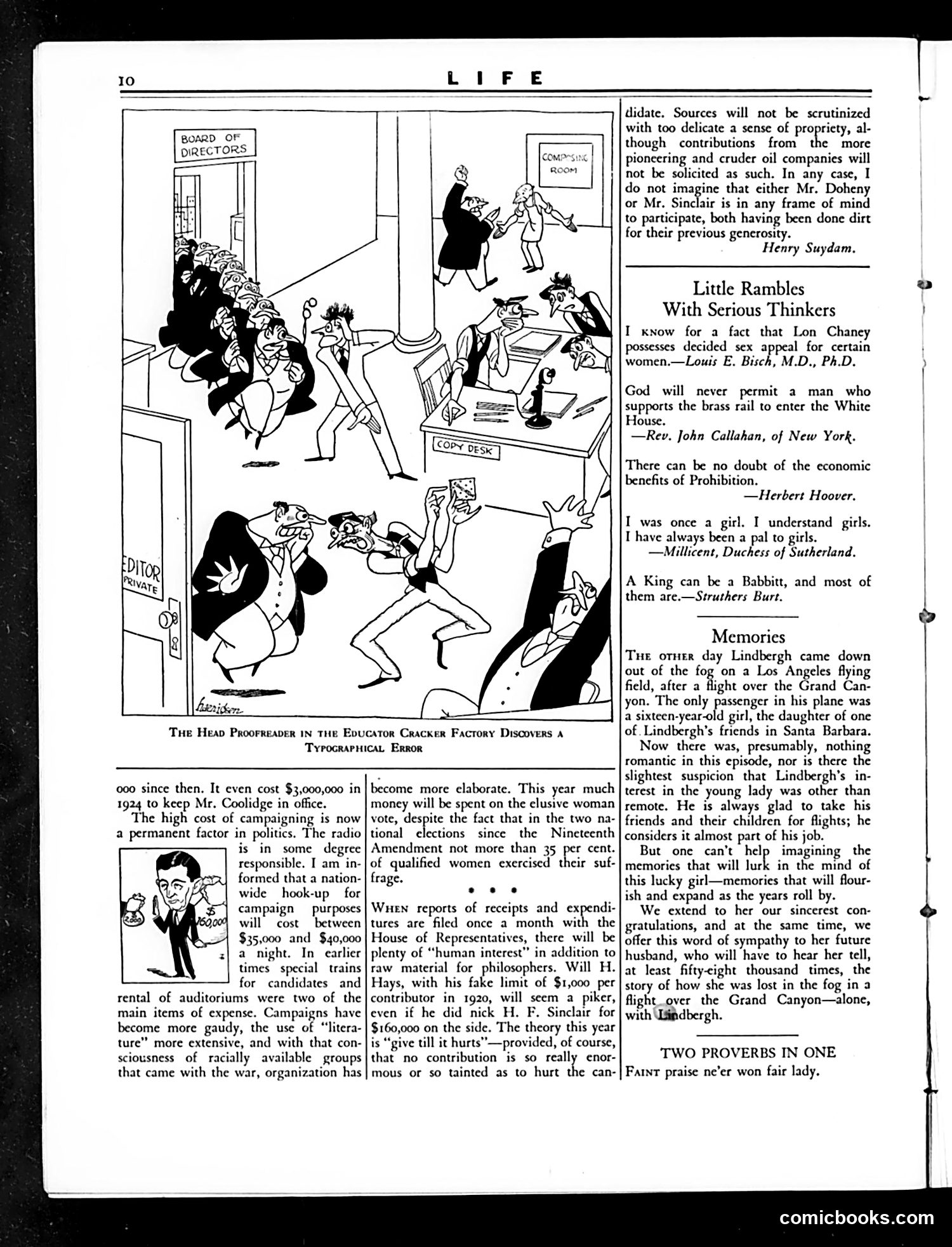
The main cartoon depicts chaos in a newspaper office, captioned "The Head Proofreader in the Educator Cracker Factory Discovers a Typographical Error." It's a visual gag showing multiple figures in comedic disarray around office furniture and desks. The page also contains "Little Rambles With Serious Thinkers"—a section of brief quotes from notable figures (including Herbert Hoover and others) on topics like prohibition, politics, and gender. Below is a "Memoirs" section recounting an anecdote about aviator Lindbergh, describing his flight over the Grand Canyon with a young passenger, emphasizing the romantic implications. The humor relies on period-specific references to Prohibition-era politics and 1920s celebrity culture, particularly Lindbergh's fame as an aviator and public figure.
📄 Transcribed text from this page (OCR, searchable)
Machine-transcribed from the original scan — historical spelling and the odd misread are preserved.
Te Heap Proorreaver IN THE Epucator Cracker Factory Discovers A TyrocraPHicaL Error ooo since then. It even cost $3,000,000 in 1924 to keep Mr. Coolidge in office. The high cost of campaigning is now a permanent factor in politics. The radio is in some degree responsible. I am in- formed that a nation- wide hook-up for campaign — purposes will cost between $35,000 and $40,000 a night. In earlier times special trains for candidates and rental of auditoriums were two of the main items of expense. Campaigns have become more gaudy, the use of “litera- ture” more extensive, and with that con- sciousness of racially available groups that came with the war, organization has become more elaborate. This year much money will be spent on the elusive woman vote, despite the fact that in the two na- tional dlectioas since the Nineteenth Amendment not more than 35 per cent. of qualified women exercised their suf- frage. eee Wuen reports of receipts and expendi- tures are filed once a month with the House of Representatives, there will be plenty of “human interest” in addition to raw material for philosophers. Will H. Hays, with his fake limit of $1,000 per contributor in 1920, will seem a piker, even if he did nick H. F. Sinclair for $160,000 on the side. The theory this year is “give till it hurts”—provided, of course, that no contribution is so really enor- mous or so tainted as to hurt the can- didate, Sources will not be scrutinized with too delicate a sense of propriety, al- though contributions from the more pioneering and cruder oil companies will not be solicited as such. In any case, I do not imagine that either Mr. Doheny or Mr. Sinclair is in any frame of mind to participate, both having been done dirt for their previous generosity. Henry Suydam. Little Rambles With Serious Thinkers I know for a fact that Lon Chaney possesses decided sex appeal for certain women.—Louis E. Bisch, M.D., Ph.D. God will never permit a man who supports the brass rail to enter the White House, —Rev. John Callahan, of New York. There can be no doubt of the economic benefits of Prohibition. —Herbert Hoover. I was once a girl. I understand girls. T have always been a pal to girls. —Millicent, Duchess of Sutherland. A King can be a Babbitt, and most of them are.—Struthers Burt. Memories Tue orner day Lindbergh came down out of the fog on a Los Angeles flying field, after a flight over the Grand Can- yon. The only passenger in his plane was a siateensyear old girl, the daughter of one of .Lindbergh’s friends in Santa Barbara. Now there was, presumably, nothing romantic in this episode, nor is there the slightest. suspicion that Lindbergh's in- terest in the young lady was other than remote. He is always glad to take his friends and their children for flights; he considers it almost part of his job. But one can’t help imagining the memories that will Turk in the mind of this lucky girl—memories that will flour- ish and expand as the years roll by. We extend to her our sincerest con- gratulations, and at the same time, we offer this word of sympathy to her future husband, who will have to hear her tell, at least fifty-cight thousand times, the story of how she was lost in the fog in a flight_over the Grand Canyon—alone, with Lindbergh. TWO PROVERBS IN ONE Fant praise ne’er won fair lady. comicbooks.com