
Life, 1928-08-16 · page 24 of 48
Life — August 16, 1928 — page 24: what you’re looking at
What you’re looking at
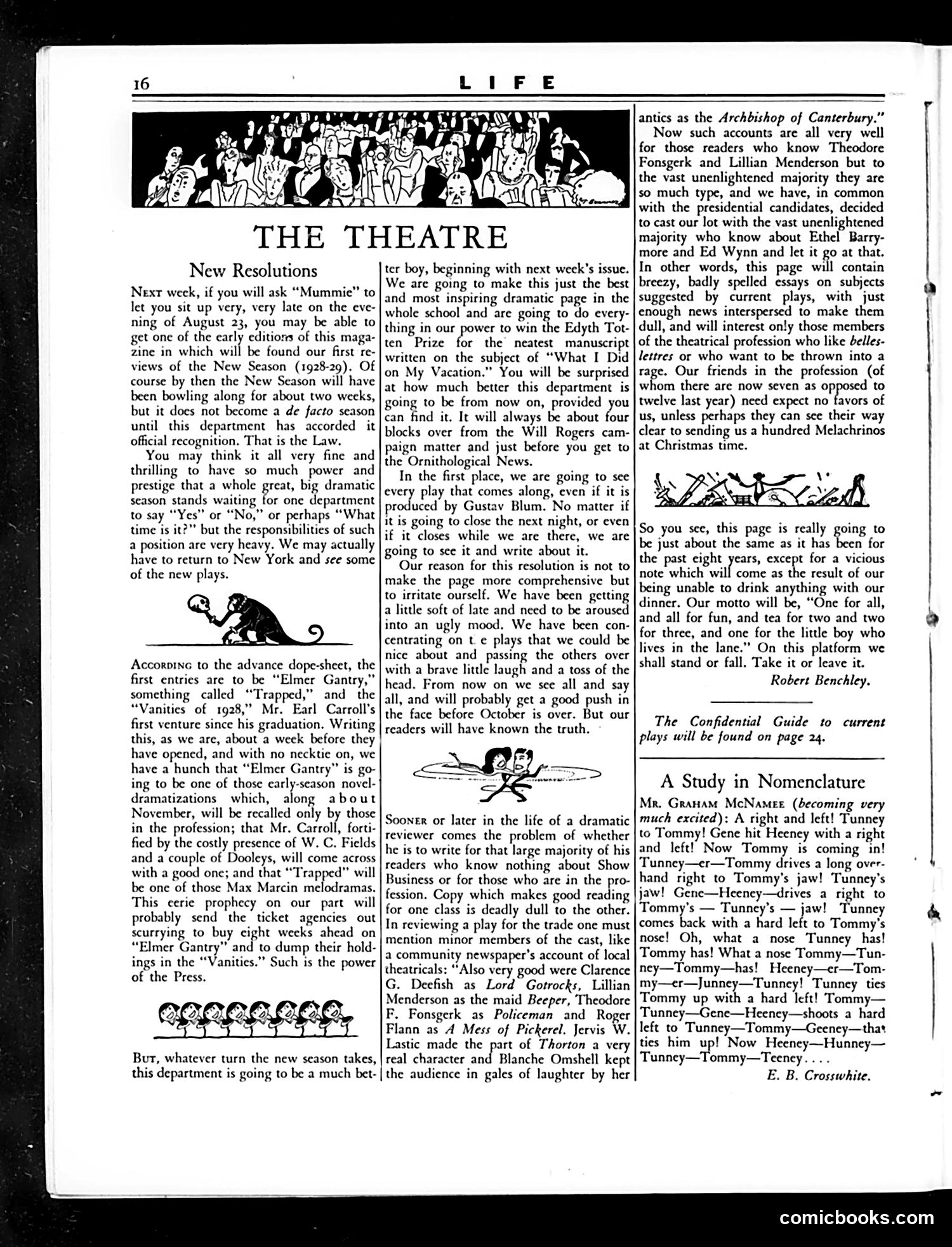
This is a theatre criticism column introducing the 1928-29 Broadway season. The author humorously establishes "new resolutions" for reviewing plays with more rigor and candor, claiming they've been too lenient previously. The specific plays mentioned—**"Elmer Gantry"** (a Sinclair Lewis adaptation), **"Trapped,"** and Earl Carroll's **"Vanities of 1928"**—were actual Broadway productions. The author cynically predicts "Elmer Gantry" will be quickly forgotten, while praising Carroll's production (notably featuring **W.C. Fields**, a major silent-film comedian). The column discusses the tension between writing for general audiences versus theatre professionals, noting that theatre reviews must balance accessibility with insider knowledge. The tone is satirical self-mockery—the critic jokes about their own power to influence ticket sales while admitting they rarely return to New York to actually see plays promptly. The small cartoon illustration appears decorative rather than satirical—a typical feature of 1920s magazine layout.
📄 Transcribed text from this page (OCR, searchable)
Machine-transcribed from the original scan — historical spelling and the odd misread are preserved.
—— J aye 6 ty Piciaer ay £6 Waller oe THE THEATRE New Resolutions Next week, if you will ask “Mummiec” to let you sit up very, very late on the eve- ning of August 23, you may be able to get one of the catty editions of this maga- zine in which will be found our first re- views of the New Season (1928-29). Of course by then the New Season will have been bowling along for about two weeks, but it does not become a de facto season until this department has accorded it official recognition. That is the Law. You may think it all very fine and thrilling to have so much power and prestige that a whole great, big dramatic season stands waiting for one department to say “Yes” or “No,” or perhaps “What time is it?” but the responsibilities of such a position are very heavy. We may actually have to return to New York and see some of the new plays. ter boy, beginning with next week's issue. We are going to make this just the best and most inspiring dramatic page in the whole school and are going to do every- thing in our power to win the Edyth Tot- ten Prize tor the neatest manuscript written on the subject of “What I Did on My Vacation.” You will be surprised at how much better this department is going to be from now on, provided you can find it. It will always be about our blocks over from the Will Rogers cam- paign matter and just before you get to the Ornithological News. In the first place, we are going to see overy play that comes along, even if it is produced by Gustav Blum. No matter if it is going to close the next night, or even if it closes while we are there, we are going to see it and write about it. Our reason for this resolution is not to make the page more comprehensive but to irritate ourself. We have been getting a little soft of late and need to be aroused into an ugly mood, We have been con- centrating on te plays that we could be nice about and passing the others over with a brave little laugh and a toss of the head. From now on we sce all and say all, and will probably get a good push in the face before October is over. But our readers will have known the truth. Accorpinc to the advance dope-sheet, the first entries are to be “Elmer Gantry,” something called “Trapped,” and the “Vanities of 1928,” Mr. Earl Carroll's first venture since his graduation. Writing this, as we are, about a week before they have opened, and with no necktie on, we have a hunch that “Elmer Gantry” is go- ing to be one of those early-season novel- dramatizations which, along about November, will be recalled only by those in the profession; that Mr. Carroll, forti- fied by the costly presence of W. C. Fields and a couple of Dooleys, will come across with a good one; and that “Trapped” will be one of those Max Marcin melodramas. This cerie prophecy on our part will probably send the ticket agencies out scurrying to buy cight weeks ahead on “Elmer Gantry” and to dump their hold- ings in the “Vanities.” Such is the power of the Press. Sooner or later in the life of a dramatic reviewer comes the problem of whether he is to write for that large majority of his readers who know nothing about Show Business or for those who are in the pro- fession. Copy which makes good reading for one class is deadly dull to the other. In reviewing a play for the trade one must mention minor members of the cast, like a community newspaper's account of local theatricals: “Also very good were Clarence G. Deefish as Lord Gotrocks, Lillian Menderson as the maid Beeper, Theodore F, Fonsgerk as Policeman and Roger Flann as A Mess of Pickerel. Jervis W. Lastic made the part of Thorton a very But, whatever turn the new season takes, | real character and. Blanche Omshell kept this department is going to be a much bet-| the audience in gales of laughter by her EE, Tommy has! What a nose Tommy—Tun- ney—Tommy—has!_ Heeney—er—Tom- my—er—Junney—Tunney! Tunney ties Tommy up with a hard left! Tommy— Tunney—Gene—Heeney—shoots a hard left to Tunney—Tommy—Geeney—that ties him up! Now Heeney—Hunney— Tunney—Tommy—Teeney.... antics as the Archbishop of Canterbury.” Now such accounts are all very well for those readers who know Theodore Fonsgerk and Lillian Menderson but to the vast unenlightened majority they are so much type, and we have, in common with the presidential candidates, decided to cast our lot with the vast unenlightened majority who know about Ethel Barry- more and Ed Wynn and let it go at that. In other words, this page will contain breezy, badly spelled essays on subjects suggested by current plays, with just enough news interspersed to make them dull, and will interest only those members of the theatrical profession who like belles- lettres or who want to be thrown into a rage. Our friends in the profession (of whom there are now seven as opposed to twelve last year) need expect no tavors of us, unless perhaps they can see their way clear to sending us a hundred Melachrinos at Christmas ume. So you see, this page is really going to be just about the same as it has been for the past eight years, except for a vicious note which will come as the result of our being unable to drink anything with our dinner. Our motto will be, “One for all, and all for fun, and tea for two and two for three, and one for the little boy who lives in the lane.” On this platform we shall stand or fall. Take it or leave it. Robert Benchley. The Confidential Guide to current plays will be found on page 24. A Study in Nomenclature Mr. Granam McNamee (becoming very much excited): A right and left! Tunney to Tommy! Gene hit Heeney with a right and left! Now Tommy is coming in! Tunney—er—Tommy drives a long over- hand right to Tommy's jaw! Tunney’s jaw! Gene—Hceeney—drives a right to Tommy's — Tunney’s — jaw! Tunney comes back with a hard left to Tommy's nose! Oh, what a nose Tunney has! E. B. Crosswhite. —4q s comicbooks.com