
Life, 1928-08-16 · page 32 of 48
Life — August 16, 1928 — page 32: what you’re looking at
What you’re looking at
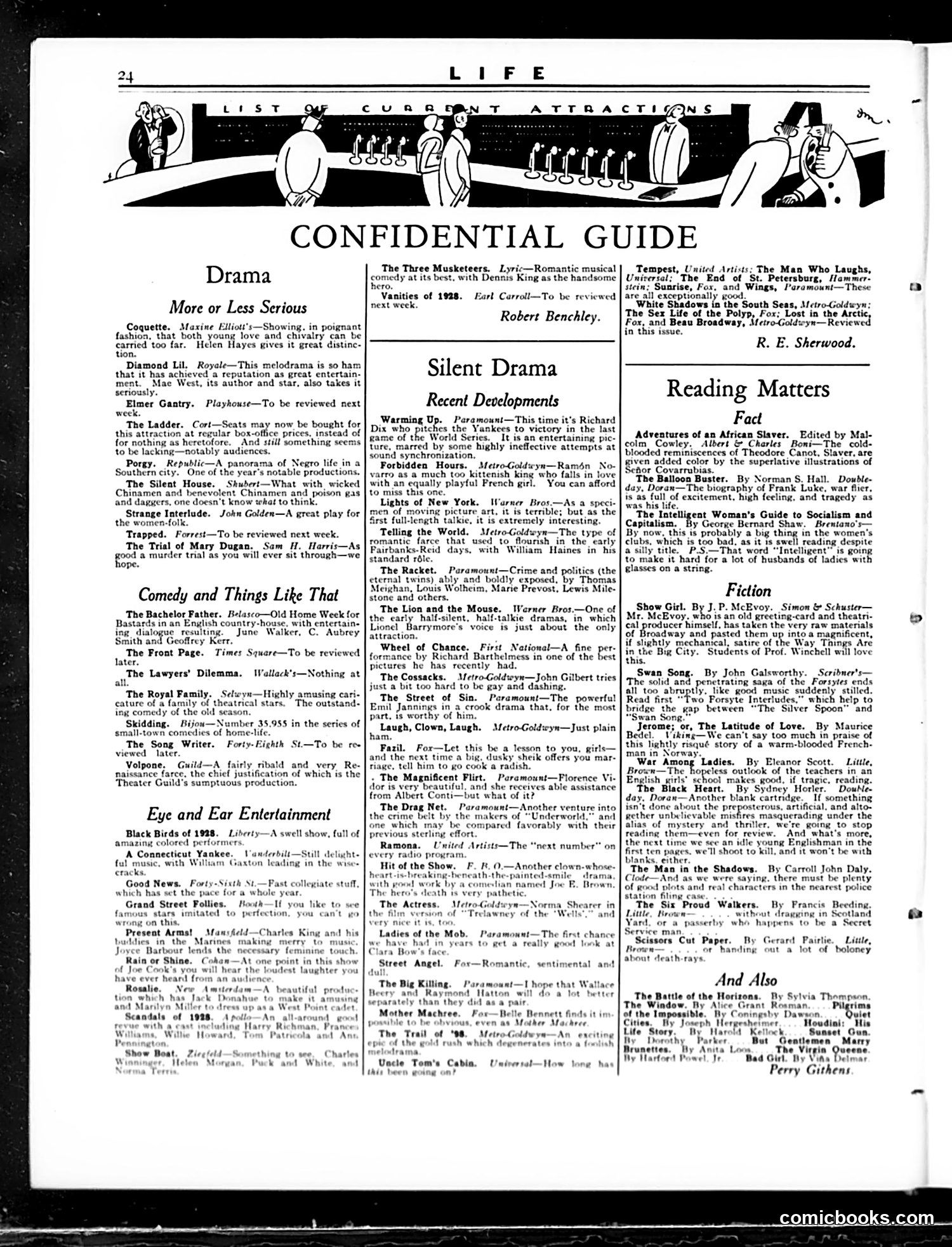
This page is **not a cartoon or satire**—it's a theater and entertainment review guide from Life magazine. The decorative header illustration shows stylized figures representing different entertainment genres, but contains no political content or caricature. The page catalogs current Broadway plays and films with brief, often sarcastic reviews. The satire is **textual, not visual**: reviewers mock productions through sharp one-liners. For example, "Diamond Lil" is called ham that "has achieved a reputation as great entertainment" (implying it's so bad it's entertaining), and "The Lawyers' Dilemma" receives simply "Nothing at all." Notable references include Mae West as author/star of "Diamond Lil" and the recent innovation of "talking pictures" (early sound films like "Lights of New York"), which reviewers note with fascination despite technical flaws. This serves as a period snapshot of 1928 entertainment trends and critical taste.
📄 Transcribed text from this page (OCR, searchable)
Machine-transcribed from the original scan — historical spelling and the odd misread are preserved.
FE CONFIDENTIAL GUIDE Drama More or Less Serious Coquette. Maxine Elliott's—Showing. in poignant fashion, that both young love and chivalry can be carried too far. Helen Hayes gives it great distinc- tion. Diamond Lil. Royale—This melodrama is so ham that it has achieved a reputation as great entertain- ment. Mae West, its author and star, also takes it seriously. Elmer Gantry. Playhouse—To be reviewed next week. The Ladder. Cor!—Seats may now be bought for this attraction at regular box-office prices, instead of for nothing as heretofore. And still something see to be lacking—notably audiences. Porgy. Republic—A panorama of Negro life in a Southern city. One of the year's notable produ The Silent House. Shubert—What with wicked Chinamen and benevolent Chinamen and poison gas and daggers, one doesn't know what to think. Strange Interlude. John Golden—A great play for the women-folk. Trapped. Forrest—To be reviewed next week. The Trial of Mary Dugan. Sam H. Harris—As food & murder tril as you will ever sit through—we Ope. Comedy and Things Like That The Bachelor Father. Belasco—Old Home Week for Bastards in an English country-house, with entertain ing dialogue resulting. June Walker, C. Aubrey Smith and Geoffrey Kerr. The Front Page. Times Square—To be reviewed later. The Lawyers’ Dilemma, 1alleck's—Nothing at all. The Royal Family. Selwyn—Highly amusing c: cature of a family of theatrical stars. The outstar ing comedy of the old season. Skidding. Bijou—Number 35,955 in the series of small-town comedies of hor life. The, Song Writer. Forty-Righth St—To be roe viewed later. Volpone. Guild—A fairly ribald and very Re naissance farce, the chief justificat ‘Theater Guild's sumptuous production. Eye and Ear Entertainment Black Birds of 1938. Liherty—A swell show, full of amazing colored performers. A Connecticut Yankee. ful music Wily cracks. Good News. Forty-Sixth which has set the pace Grand Street Follies. Howth Vanderbilt—Still deli Past collegiate stuff, ule year. If you like to see or aw famous stars imitated to perfection, you can't 0 wron mm this, Present Arms! Mansfeld—Charles Kin 1 his buddies in the Marines makiny perry to musi Joyce Barbour lends the necessary feminine tow Rain of Shine. Cohan—At one point in this sh of Joe ¢ 1 will hear the loudest laughter y ave ever heant from an Rosali New Amuterd tion which has Tack Ds and M n Miller t Scandals of Witla, " Show Boat ato see, ( w va k and White. and The Three Musketeers. Lyric—Romantic musical comedy at its best. with Dennis King as the handsome hero. Vanities of 1928. next week t Carroll—To be reviewed Robert Benchley. Silent Drama Recent Developments Warming Up. Paramount—This time it’s Richard Dix who pitches the Yankees to victory in the last game of the World Series. It is an entertaining pic- ture, marred by some highly ineffective attempts at sound synchronization, Forbidden Hours. MetroGoldwyn—Ramén No- varro as a much too kittenish king who falls in love with an equally playful Prench girl. You can afford to miss this one. Lights of New York. Warner Bros.—As a speci- men of moving picture art, it is terrible; but as the first full-length talkie, it is extremely interesting. Telling the World. Metro-Goldwyn—The type of romantic farce that used to flourish in the early Pairbanks-Reid days, with William Haines in his standard réle. The Racket. Paramount—Crime and politics (the eternal twins) ably and boldly exposed, by Thomas Meighan, Louis Wotheim, Marie Prevost, Lewis Mile- stone and others. The Lion and the Mouse. IWerner Bros.—One of the early half-silent, half-talkie dramas, in which Lionel Barrymore's voice is just about the only attraction. Wheel of Chance. First National—A fine per- formance by Richard Barthelmess in one of the best pictures he has recently had. The Cossacks. Metro-Goldweyn—John Gilbert tries just a bit too hard to be gay and dashing. The Street of Sin. Paramount—The powerful Emil Jannings in a crook drama that, for the most part, is worthy of him. Laugh, Clown, Laugh. Metro-Goldwyn—Just plain ham. For—Let this be a lesson to you, girls— next time a big, dusky sheik offers you mar- age, tell him to go cook a radish. « The Magnificent Flirt. Paramount—Florence Vi- dor is very beautiful. and she receives able assistance from Albert Conti—but what of it? The Drag Net. Paramount—Another venture into the crime belt by the makers of “Underworld,” and one which may be compared favorably with their previous sterling effort. Ramona. United Artists—The “next number" on every radio pr , Hit of the Show. F. FR. 0.—Anoth clown-whose- heart-is-breaking-beneath-the-painted-smile | dram with good work by a comedian named Joc n The hero's death ts very 1 The Actress. Metr —Norma Shearer in the film version of “Trelawney of the ‘Wells’. and Ladies of the Mob. "s have had in years t amonnt—The first chi a really good lor antic, sentimental a e that Wall a lot better Paramount—1 nd Hatton will pide Big Kilting. and Ray arately than they did as a pair Mother Machree, For—Belle Bennett finds it ir possible t vious, even as Mother Machree of 6. Metro ya—An eaciting Universal—Now lone ha Tempest, United Artists: The Man Who Lau Universal; The End of St. Petersburg, Hamm stein: Sunrise, Fox, and Wings, /’aramount—These are all cere tooally. good. White Shadows in the South Seas, Metro-Goldwyn; The Sex Life of the Polyp, Fox; Lost in the Arctic, For, and Beau Broadway, Afetro-Goldwyn—Reviewed in this issue. R. E. Sherwood. Reading Matters Fact Adventures of an African Slaver. Edited by M colm Cowley. Albert & Charles Boni—The cold- blooded reminiscences of Theodore Canot, Slaver, are given added color by the superlative illustrations of Seftor Covarrubias. The Balloon Buster. By Norman S. Hall. Double- day, Doran—The biography of Prank Luke, war flier, is as full of excitement, high feeling, and tragedy as was his life, The Intelligent Woman's Guide to Socialism and Capitalism. By George Bernard Shaw. Brentano's— By now, this is probably a big thing in the women’s clubs, which is too bad, as it 1 swell reading despite a silly title. P.S.—That word “Intelligent” is going to make it hard for a lot of husbands of ladies with glasses on a string. Fiction Show Girl. By J.P. McEvoy. Simon & Schuster— Mr. McEvoy, who is an old grecting-card and theatri- cal producer himself, has taken the very raw materials of Broadway and pasted them up into a magnificent, if slightly mechanical, satire of the Way Taings Arc in the Big City. Students of Prof. Winchell will love this. Swan Song. By John Galsworthy. Scribmer's— ‘The solid and penetrating saga of the Forsytes ends all too abruptly, like good music suddenly stilled. Read first “Two Forsyte Interludes,” which help to bridge the gap between “The Silver Spoon” and “Swan Song. Jerome; or, The Latitude of Love. By Maurice Bedel. Viking—We can’t say too much in praise of this lightly risqué story of a warm-blooded French- man in Norway, War Among Ladies. By Eleanor Scott. Little, Brown—The hopeless outlook of the teachers in an English girls’ school makes good, if tragic, reading. The Black Heart. By Sydney Horler. Douhle- day, Doran—Another blank cartridge. If something isn't done about the preposterous, artificial, and alto- gether unbelievable mishres masquerading under the alias of mystery and thriller, we're going to stop reading them—even for review. And what's more, the next time we see an idle young Englishman in the first ten pages. we'll shoot to kill, and it won't be with blanks. either. The Man in the Shadows. By Carroll John Daly. Clode—And as we were saying. there must be plenty nts and real characters in the nearest police The Six Proud Walkers. By Little, Brown without who happens Francis Beeding. ing in Scotland be a Secret erby Scissors Cut Paper. My man. Gerard Pairlie. Little, Broven a lot of boloney about death-rays ‘or handing out And Also ttle of the Horizons. By Sylvia Thompson By Alice Rosman: Pilgrims Ry © julet Hergeshe: His By Har Gun. Par’ Marry By Anita Le Powel. Ir Vi y Perry Githens a a g