
Life, 1928-08-16 · page 38 of 48
Life — August 16, 1928 — page 38: what you’re looking at
What you’re looking at
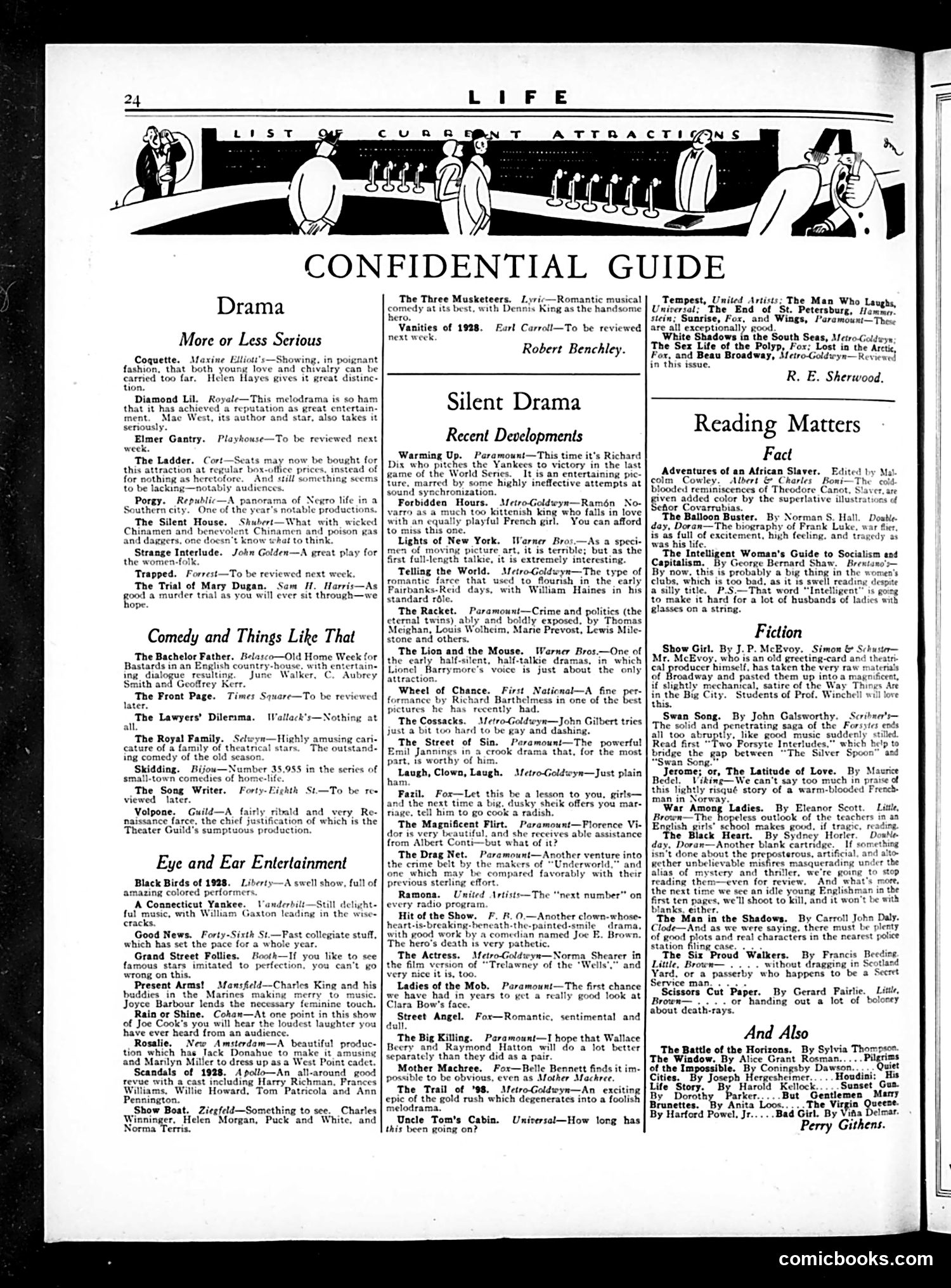
This page is a comprehensive listing guide for New York theater and entertainment, presented as a "Confidential Guide" to current attractions. The header illustration depicts a stylized theater or entertainment venue with figures in period dress. The content reviews Broadway plays, musicals, and silent films currently showing. Notable entries include: **Theater**: Reviews of plays like *The Front Page*, *Strange Interlude*, and *Show Boat* — major productions of the era. **Silent Films**: Listings of recent movies, many still silent (sound was just emerging in 1928). Films mentioned include *Warming Up* (baseball drama) and *Lights of New York* (described as "the 9th talkie"). **The Satire**: The "confidential" framing humorously suggests insider knowledge. Several reviews are cheeky — *The Ladder* is mocked, and *Lights of New York* is called "terrible" as art but "extremely interesting" as a technological novelty. This reflects 1928's transitional moment: sound movies were revolutionary but still crude, and theater remained culturally dominant.
📄 Transcribed text from this page (OCR, searchable)
Machine-transcribed from the original scan — historical spelling and the odd misread are preserved.
CONFIDENTIAL GUIDE Drama More or Less Serious Coquette. Maxine Elliots's—Showing, in pe fashion, that both young love and chivalry can be carried too far, Helen Hayes gives it great distine- tion. Diamond Lil. Royale—This melodrama is so hi that it has achieved a ment. Mac West, seriously. Elmer Gantry. week. The Ladder. (© this attraction at regular box-office prices, inst for h it something scems to be lackinj Porgy. Republic Southern city. One o The Silent House. Chinamen and benevole and dag oT Strange Interlude. the women-folk. Trapped. Forrest—To be reviewed next week. The Trial of Mary Dugan. Sam HH. Harris—As good a murder trial as you will ever sit through—we or and star, also takes it Playkouse—To be reviewed next with wicked and poison gas r think John Golden—A great play for Comedy and Things Like That The Bachelor Father. Belasco—Old Home Week Bastards in an English country-house, with entertai ing dialogue resulting. June Walker, C. Aubrey Smith and Geoffrey Kerr. The Front Page. Times Square—To be reviewed later. The Lawyers’ Dilerima. all. The Royal Family. S cature of a family of theat ing comedy of the old seas: Skidding. Bijou—Number 35,955 in the series of small-town comedies of hor e. The Song Writer. Forty-Eighth viewed later. Volpone. Guild—A fairly ritald and very Re- naissance farce, the chief justification of which is the Theater Guild's sumptuous production. Watlack's—Nothing at High! stars, amusing cari- The outstand- St.—To be ree Eye and Ear Entertainment Black Birds of 1928. Liberty—A swell show, full of zing colored performers. A Connecticut Yankee. 1 ful music, with William cracks, Good News. Forty-Sixth St.—Past collegiate stuff, which has set the pace for a whole year. Grand Street Follies. Hooth—If you like to sce famous stars imitated to perfection, you can't go wrong on this. Present Arms! Mansfield—Charles King and his buddies in the Marines making merry to music. Joyce Barbour lends the necessary feminine touch. Rain or Shine. Cohan—At one point in this show of Joe Cook’s you will hear the loudest laughter you have ever heard from an audience. Rosalie, New Amsterdam—A beautiful ps tion which has Tack Donahue to make it and Marilyn Miller to dress up asa West Point cadet. Scandals of 1928. A pollo—An all-around good revue with a cast including Harry Richr rances Williams, Willie Howard, Tom Patricola and Ann Pennington. Show Boat. Ziesfeld—Something to see. Charles Winninger, Helen Morgan, Puck and White, and Norma Terris. Still delight z in the wise= The Three Musketeers. Ly comedy at its best, with De hero. Vanities of 1928. next week —Romantic musical ing as the handsome Earl Carroll—To be reviewed Robert Benchley. Silent Drama Recent Developments Warming Up. Paramount—This time it's Richard Dix who pitches the Yankees to victory in the last game of the World Ser It is an entertaining pic- Metro-Goldwyn—Just plain into world,” and ared favorably with their Fox—Romantic, ture, marred by some highly ineffective attempts at sound synchronization. Forbidden Hours. Metro-Goldwyn—Ramén No- varro as a much too kittenish king who falls in love with an equally playful Prench girl. You can afford to miss this one. Lights of New York. Warner Bros.—As a speci- men of moving picture art, it is ternble; but as the th talkie, it is extremely interesting. Telling the World. Metro-Goldwyn—The type of romantic farce that used to flourish in the early Pairbanks-Reid days, with William Haines in his standard 16) The Racket. Paramount—Crime and politics (the eternal twins) ably and boldly exposed, by Thomas Meighan, Louis Wolheim, Marie Prevost, Lewis Mile- stone and others. The Lion and the Mouse. Warner Bros.—One of the early half-silent, half-talkie dramas, in which Lionel Barrymore's voice is just about the only attraction. Wheel of Chance. First National—A fine per- rd Barthelmess in one of the best ecently had. MetroGoldwyn—John Gilbert tries just a bit too hard to be gay and dashing. The Street of Sin. Paramount—The powerful Emil Jannings in a crook drama that, for the most part, is worthy of hi Laugh, Clown, Laugh. ham Fazil. Fox—Let this be a lesson to you, gitls— and the next time a big, dusky sheik offers you mar- iage, tell him to go cook a radish. The Magnificent Flirt. Paramownt—Plorence Vi- dor is very beautiful, and she receives able assistance from Albert C The Drag Ne the crime belt by one which may be com; previous sterling effort. Ramona. United Artists—The “next number” on every radio program. of the Show. F. BR. 0.—Another clown-whose- h breaking-heneath-the-painted-smile. drama, with good work by a comedian named Joc E. Brown. The hero's death is very pathetic. The Actress. Metro-Goldweyn—Norma Shearer in the film version of “Trelawney of the ‘Wells'.” and very nice it is, too, Ladies of the Mob. Paramount—The first chance we have had in years to get a really good look at Clara Bow's face. , Street Angel. sentimental and dull. The Big Killing. Paramount—I hope that Wallace Beery and Raymond Hatton will do a lot better separately than they did as a pair. Mother Machree. Fox—Belle Bennett finds it im- possible to be obvious, even as Mother Mackree. The Trail of °98. MetroGoldwyn—An exciting epic of the gold rush which degenerates into a foolish melodrama. Uncle Tom's Cabin. this been going on? Universal—How long has Tempest, United Artists; The Man Who Unisertol; The End of St. Petersburge Hace stein; Sunrise, Fox, and Wings, /aramouxt—Thew are all exceptionally good. White Shadows in the South Seas, Metro-Goldeyy The Sex Life of the Polyp, For: Lost in the Arcee, For, and Beau Broadway, Sleiro-Goldwyn—Reveedl in this issue. R. E. Sherwood. Reading Matters Fact Adventures of an African Slaver. colm Cowley. Albert & Charles | Boni—The blooded reminiscences of Theodore Canot, Sia given added color by the superlative illu: Seftor Covarrubias. The Balloon Buster. By Norman S. Hall. Doutte. day, Doran—The biography of Frank Luke, war fier, is as full of excitement, high feeling. and traged was his life. The Intelligent Woman's Guide to Socialism and Capitalism. By George Bernard Shaw. Brentan: By now, this is probably a big thing in the ns clubs, which is too bad, as it 1s swell reading despite a silly title. P.S.—That word “Intelligent” is gong to make it hard for a lot of husbands of ladies with glasses on a string. Edited by M esd Fiction Show Girl. By J.P. McEvoy. Simon & Schuste— Mr. McEvoy, who is an old grectin 7 cal producer himself, has taken the of Broadway and pasted them up inte if slightly mechanical, satire of the Wa: in the Big City. Students of Prof. Winche this. Swan Song. By John Galsworthy. Scribner's— The solid and penetrating saga of the Forsytes ends all too abruptly, like good music suddenly Read first “Two Porsyte Interludes,” which help t0 bridge the gap between “Th: Spoon” asd “Swan Song.” ‘or, The Latitude of Love. ing—We can't say too m risqué story of a warm: Ladies. By Eleanor Scott. Little, jopeless outlook of the teachers in an English girls’ school makes good. if tragic, The Black Heart. By Sydney Horler day, Doran—Another blank cartridg If something isn't done about the preposterous, artifi gether unbelievable misfires masquerading alias of mystery and thriller, we're going to reading them—even for review. And what's more, the next time we see an idle young Englishman in the first ten pages, we'll shoot to kill, and it won't be with blanks, either. The Man in the Shadows. By Carroll John Daly. Clode—And as we were saying, there must be p! of good plots and real characters in the neares' station fling case. . . The Six Proud Walkers. By Francis B Little, Brown— . ... without dragging in Yard, or a passerby who happens to be a Service man... . Scissors Cut Paper. By Gerard Pairlie. Littl Brown— .... or handing out a lot of boloney about death-rays. And Also The Battle of the Horizons. By Sylvia Thompsor. The Window. By Alice Grant Rosman... . . Pil of the Impossible. By Coningsby Dawson... .. Cities. By Joseph Hergesheimer.... . Houdini: Life Story. By Harold Kellock. Sunset Gi By Doroth: Parker. ..But Gentlemen Mary Brunettes. By Anita Loos.....The Virgin Con By Harford Powel, Jr.....Bad Girl. By Vif'a Delmar. Perry Githens. By Maurice h in praise of looded Freneh- comicbooks.com