
Life, 1928-08-16 · page 21 of 48
Life — August 16, 1928 — page 21: what you’re looking at
What you’re looking at
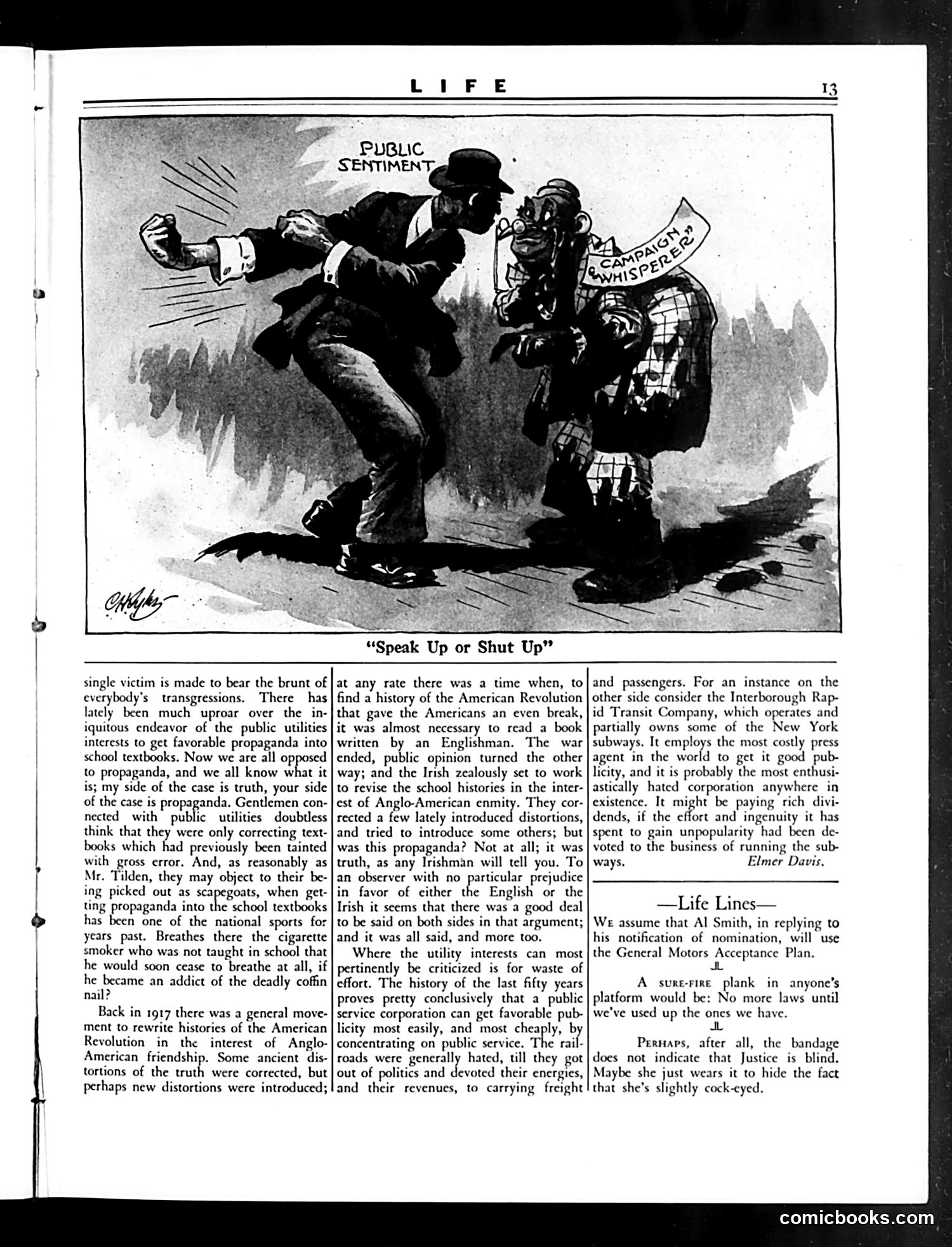
This Clifford cartoon satirizes hypocrisy in propaganda debates. The figure labeled "Public Sentiment" (center-left) is being physically assaulted by two figures representing competing interests—one labeled "Campaign Whispered" (right). The cartoon illustrates the article's argument by Elmer Davis: everyone condemns propaganda *in principle*, but all sides practice it. Davis cites examples: utilities companies inserting pro-business content into textbooks; post-WWI efforts to rewrite American Revolution histories first pro-British, then pro-Irish; and the much-despised Interborough Rapid Transit Company's failed publicity campaigns. The satire's point: "Public sentiment" becomes a victim caught between self-righteous factions, each convinced *their* propaganda is truth while opponents' is lies. Davis argues the real solution isn't fighting propaganda, but focusing on actual service quality—railroads improved reputation by serving passengers well, not through PR spin.
📄 Transcribed text from this page (OCR, searchable)
Machine-transcribed from the original scan — historical spelling and the odd misread are preserved.
PUBLIC SENTIMENT, “Speak Up or Shut Up” single victim is made to bear the brunt of everybody's transgressions. There has lately been much uproar over the in- iquitous endeavor of the public utilities interests to get favorable propaganda into school textbooks. Now we are all opposed to propaganda, and we all know what it is; my side of the case is truth, your side of the case is propaganda. Gentlemen con- nected with public utilities doubtless think that they were only correcting text- books which had previously been tainted with gross error. And, as reasonably as Mr. Tilden, they may object to their be- ing picked out as scapegoats, when get- ting propaganda into the school textbooks has been one of the national sports for years past. Breathes there the cigarette smoker who was not taught in school that he would soon cease to breathe at all, if he became an addict of the deadly coffin nail? Back in 1917 there was a general move- ment to rewrite histories of the American Revolution in the interest of Anglo- American friendship. Some ancient dis- tortions of the truth were corrected, but perhaps new distortions were introduced; at any rate there was a time when, to find a history of the American Revolution that gave the Americans an even break, it was almost necessary to read a book written by an Englishman. The war ended, public opinion turned the other way; and the Irish zealously set to work to revise the school histories in the inter- est of Anglo-American enmity. They cor- rected a few lately introduced distortions, and tried to introduce some others; but was this propaganda? Not at all; it was truth, as any Irishman will tell you. To an observer with no particular prejudice in favor of cither the English or the Irish it seems that there was a good deal to be said on both sides in that argument; and it was all said, and more too. Where the utility interests can most pertinently be criticized is for waste of effort. The history of the last fifty years proves pretty conclusively that a public service corporation can get favorable pub- licity most easily, and most cheaply, bi concentrating on public service. The rail- roads were generally hated, till they got out of politics and devoted their energies, and their revenues, to carrying freight and passengers. For an instance on the other side consider the Interborough Rap- id Transit Company, which operates and partially owns some of the New York subways. It employs the most costly press agent in the world to get it good pub- licity, and it is probably the most enthusi- astically hated corporation anywhere in existence. It might be paying rich divi- dends, if the effore and ingenuity it has spent to gain unpopularity had been de- voted to the business of running the sub- ways. Elmer Davis. —Life Lines— We assume that Al Smith, in replying to his notification of nomination, will use the General Motors Acceptance Plan, LL A. sure-rire plank in anyone’s platform would be: No more laws until we've used up the ones we have. aL Pernaps, after all, the bandage does not indicate that Justice is blind. Maybe she just wears it to hide the fact that she’s slightly cock-eyed. comicbooks.com