
A complete issue · 97 pages · 1920
Life — December 2, 1920
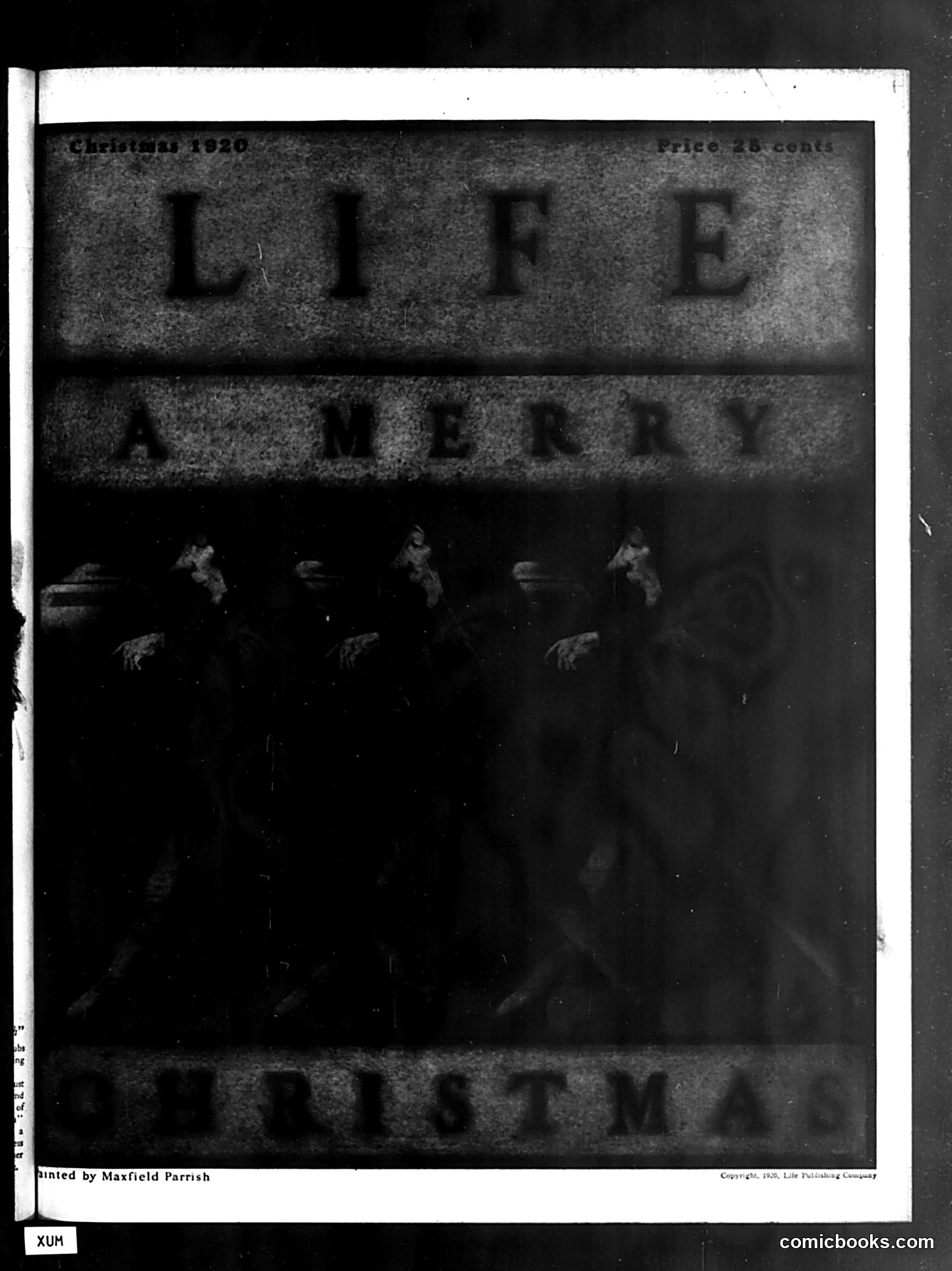
This appears to be a cover or feature page from Life's Christmas 1920 issue, priced at 20 cents. The large text reads "LIFE AMERICA" across the top, with what appears to be additional text below (partially illegible in this reproduction). The image itself is quite dark and difficult to decipher clearly, but appears to show multiple figures in silhouette or shadow. The poor image quality and heavy contrast make it impossible to identify specific individuals or fully determine the satirical content. The attribution to Maxfield Parrish (a renowned illustrator) suggests this was likely artistic commentary on American society during the post-WWI period, but without clearer visibility of the figures and details, I cannot reliably explain the specific satire or political references intended.
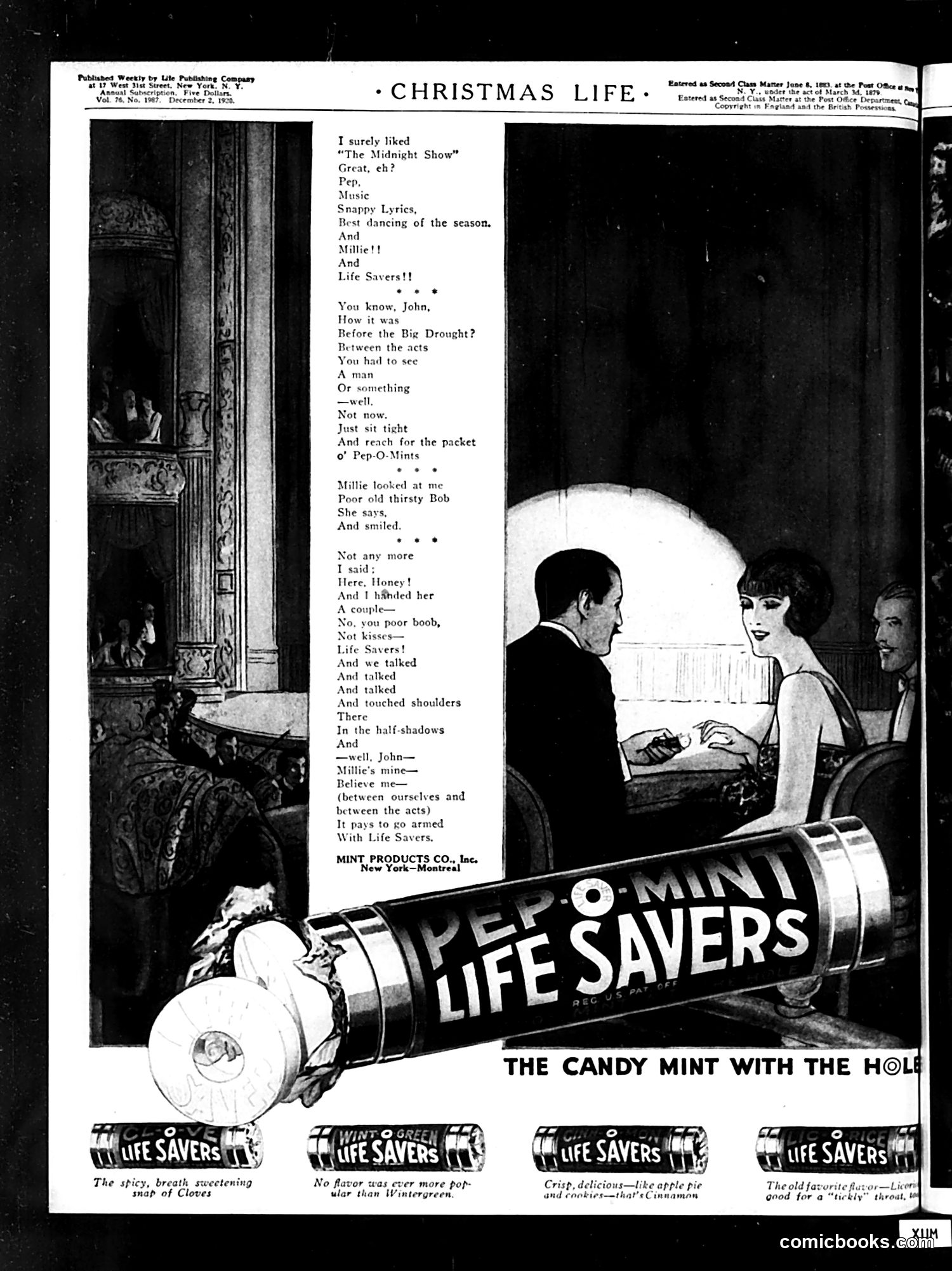
This page is primarily a **Pep-O-Mint Life Savers advertisement**, not political satire. The content consists of a poem titled "Christmas Life" (left) and an advertisement for the candy (right). The poem humorously describes a theater date where a man tries to impress a woman but has bad breath. He's advised to eat Life Savers mints. The poem includes parenthetical asides suggesting the awkwardness of their interaction. The advertisement below shows a couple at what appears to be a theater, emphasizing the product as a solution to social embarrassment from poor breath. The tagline reads "The Candy Mint with the Hole." This reflects 1920s consumer advertising strategies: using humor and social anxiety to market products. The "hole" in Life Savers was a distinctive selling point that allowed the candy to last longer while dissolving.
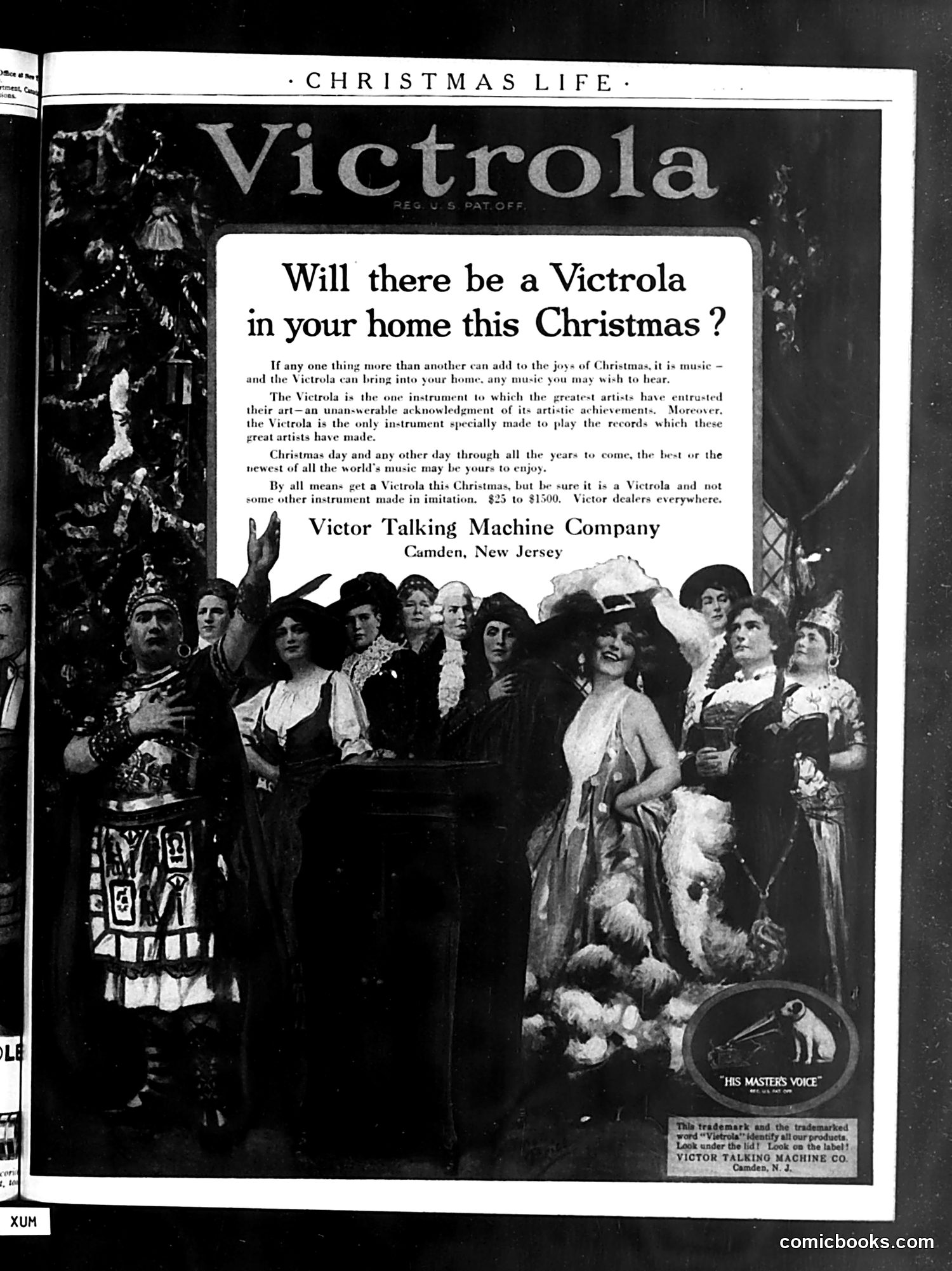
This is a **Victrola advertisement**, not political satire. The page promotes the Victor Talking Machine Company's phonograph as a Christmas gift. The ad features elaborately costumed figures—appearing to represent characters from opera or classical music performances—gathered around a Victrola phonograph. The message emphasizes that music, particularly recordings of "great artists," enhances Christmas joy. The ad stresses that a Victrola is the only machine capable of playing the original recordings these artists made, and warns consumers to ensure they purchase an actual Victrola (priced $25-$150) rather than imitations from competitors. The "His Master's Voice" logo (visible in the circular emblem) was Victor's trademark, featuring their famous dog-and-gramophone image.
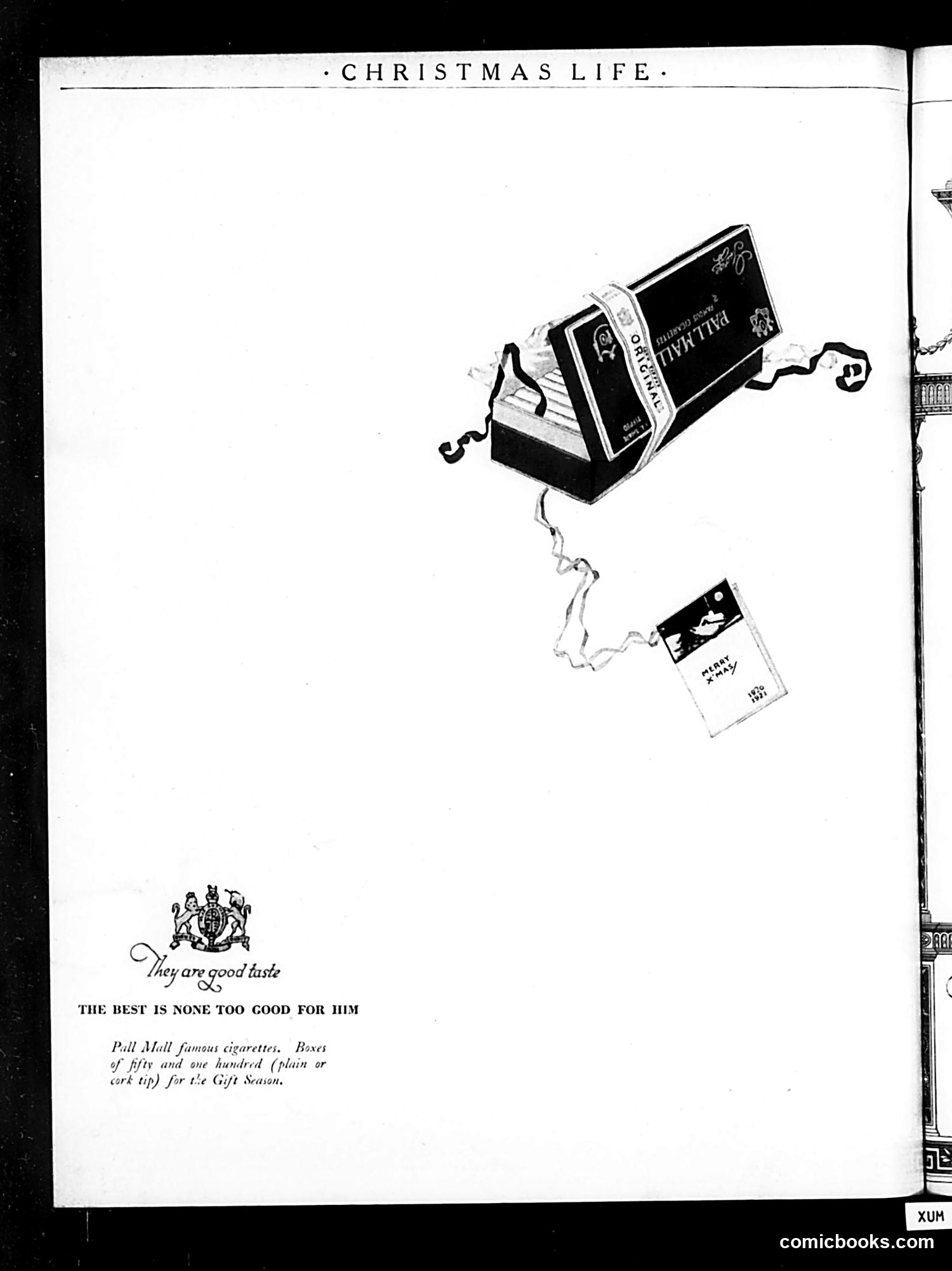
This is a **Pall Mall cigarette advertisement**, not political satire. The page heading "CHRISTMAS LIFE" and the tagline "They are good taste / THE BEST IS NONE TOO GOOD FOR HIM" indicate this is a gift-giving advertisement for the holiday season. The illustration shows an oversized cigarette box with anthropomorphic limbs, connected by a string to a smaller gift box below—a visual metaphor suggesting cigarettes as an ideal Christmas present. The design is whimsical rather than satirical. The advertisement specifically promotes "Pall Mall famous cigarettes" in boxes of fifty and one hundred with plain or cork tips as appropriate gifts for the season. This reflects early-to-mid 20th-century advertising when cigarettes were commonly marketed as luxury gifts without health warnings.
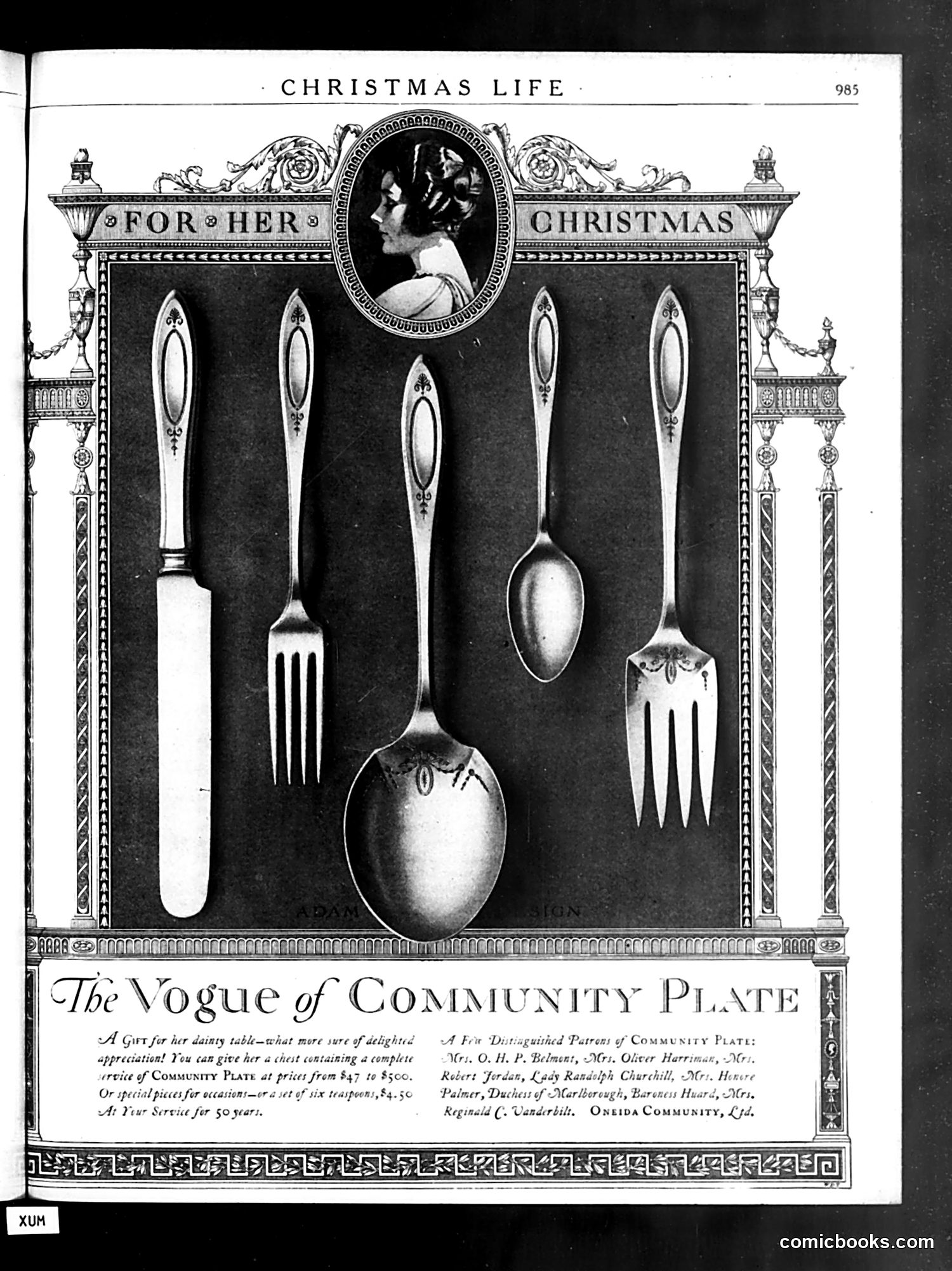
This is a Christmas gift advertisement for "The Vogue of Community Plate," a silverware brand. The page shows flatware (knife, forks, spoons) arranged formally against a dark background, topped with a classical female profile portrait. The heading "For Her Christmas" indicates this targets female gift-recipients. The text describes Community Plate as an affordable option for dining—prices ranging from $47 to $100 for complete sets, with special pieces available. The advertisement lists distinguished patrons' names (Mrs. O.H.P. Belmont, Robert Jordan, Lady Randolph Churchill, etc.), a common marketing tactic to suggest social prestige and endorsement by the wealthy. This is straightforward product advertising rather than political satire—typical of Life magazine's commercial content from this era.
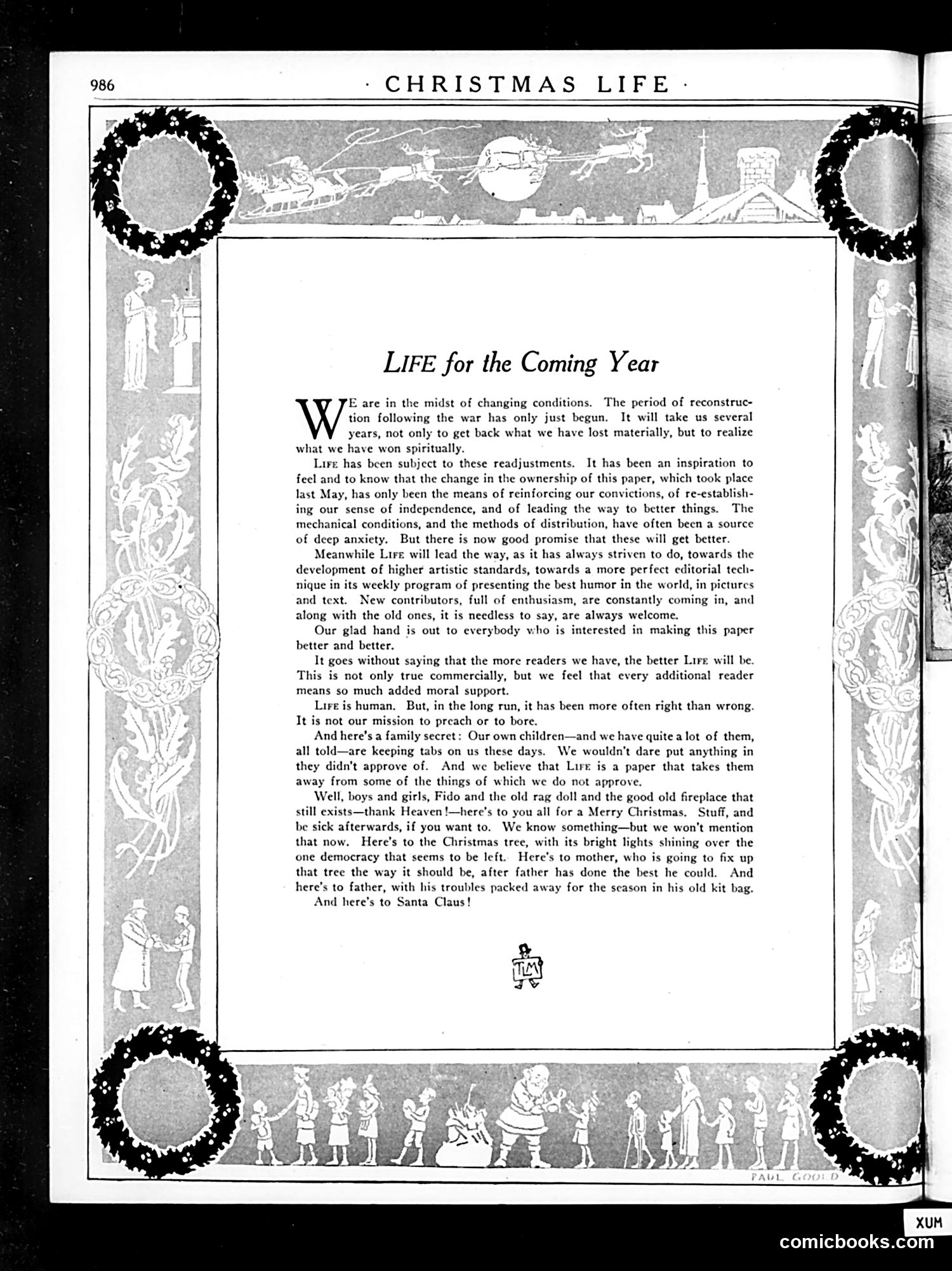
This is not a cartoon but rather an editorial statement from *Life* magazine addressing post-World War I reconstruction. The text discusses the magazine's commitment to better editorial standards and expanding readership. The piece reflects on changing post-war conditions and acknowledges *Life*'s recent change in ownership as a means of reinforcing "convictions" and promoting "independence." The message emphasizes *Life*'s humanistic mission: it's described as "human" but "more often right than wrong." The editorial concludes with nostalgic Christmas references—toys, fireplaces, Santa Claus, the Christmas tree—positioning the magazine as a family publication that shares values parents approve of, contrasting with unspecified content the magazine ostensibly avoids. The decorative border features wreaths and seasonal imagery appropriate to the Christmas-themed publication.
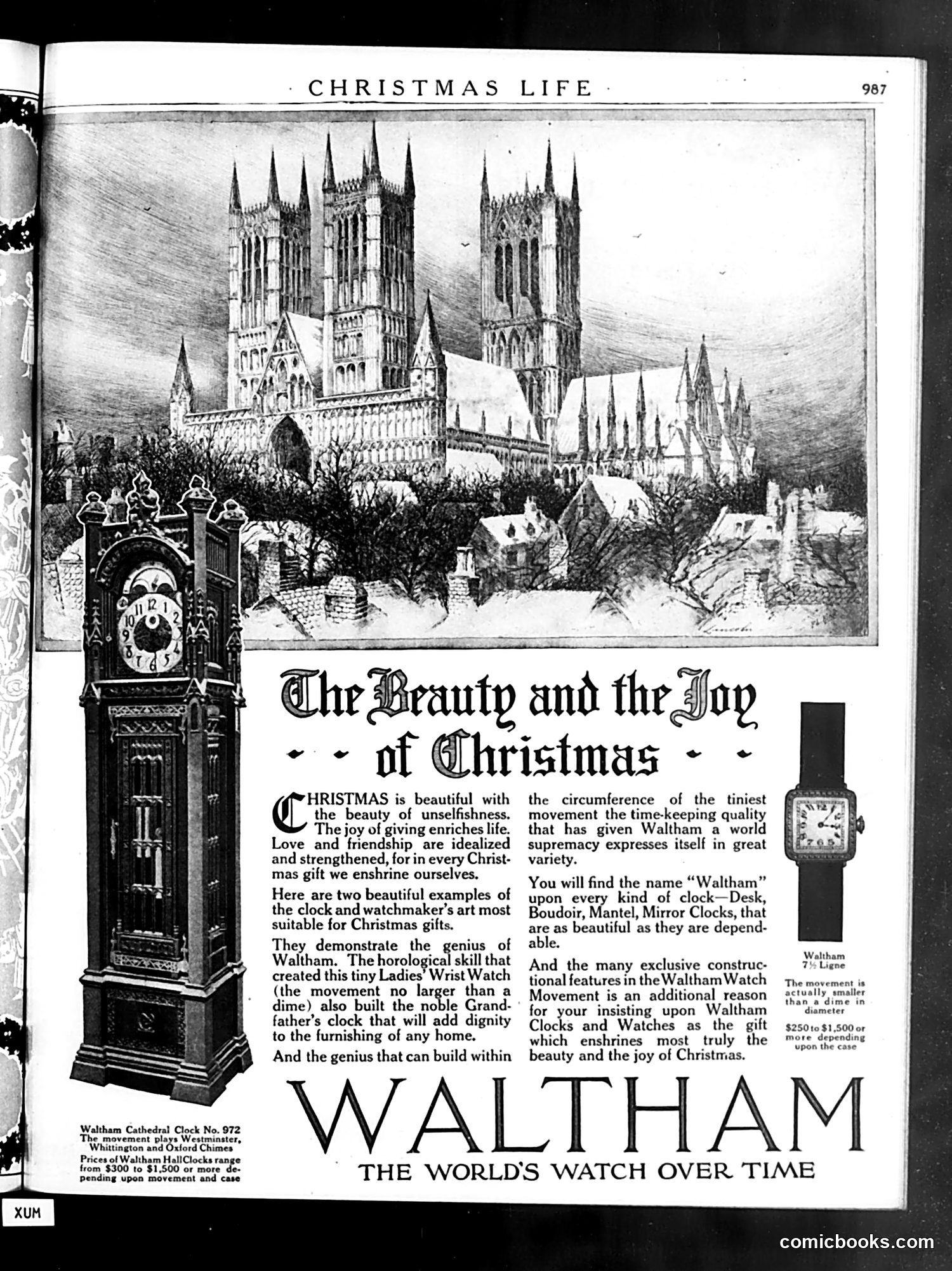
This is primarily a **Christmas advertisement**, not a political cartoon. The page features Waltham watches and clocks as holiday gift suggestions. The visual content includes: - An illustrated cathedral (appears to be a European Gothic structure, possibly inspirational rather than specific) - A tall ornate grandfather clock (Waltham Cathedral Clock No. 972) - A square wristwatch (Waltham) The text argues that Christmas gifts should embody "beauty and unselfishness" and promotes Waltham timepieces as fulfilling this ideal. It emphasizes the "horological skill" and craftsmanship of Waltham products, positioning them as dignified, beautiful objects suitable for gift-giving. The slogan "The World's Watch Over Time" serves as Waltham's marketing tagline. This is straightforward commercial advertising rather than satirical commentary.
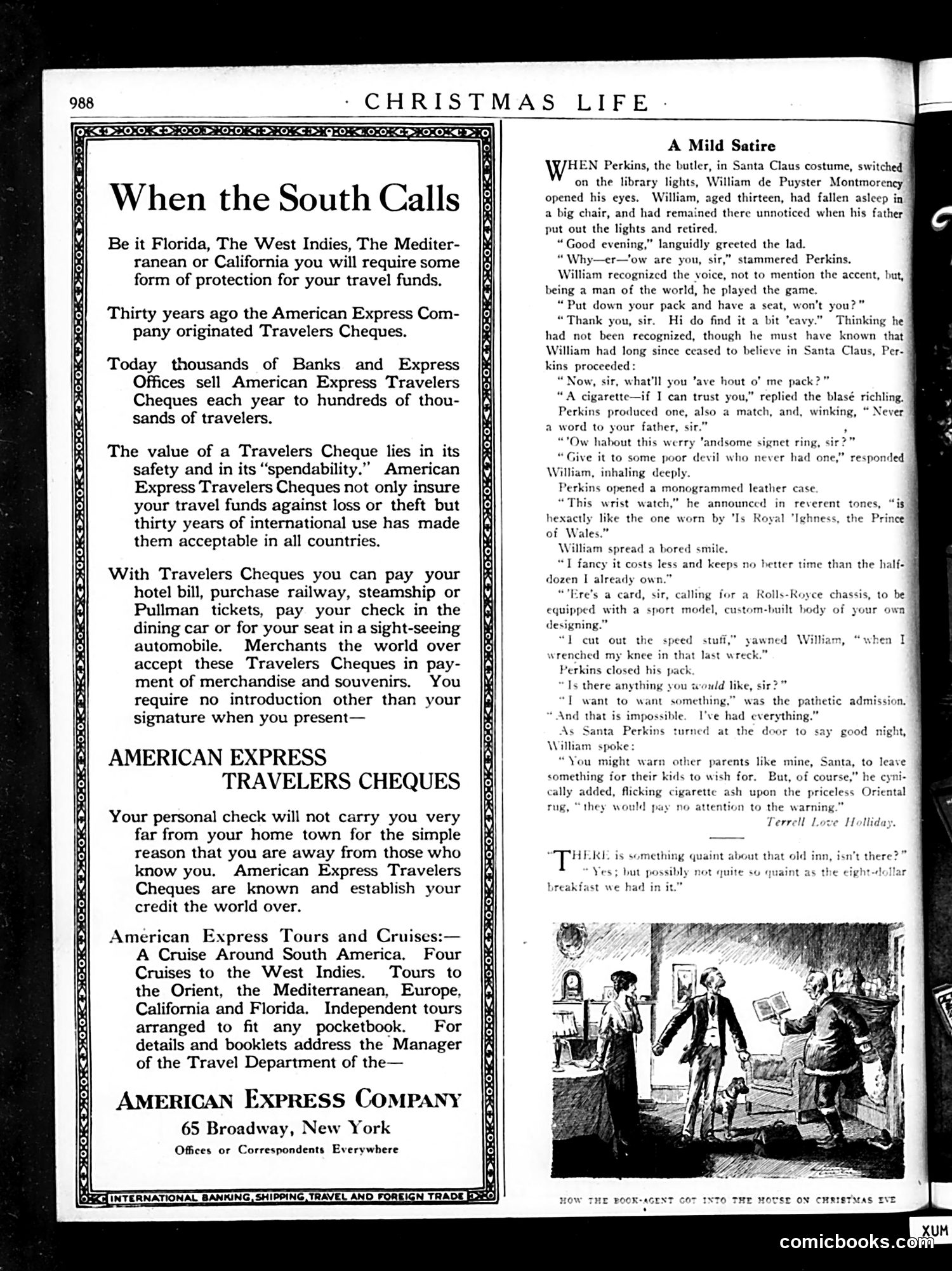
This page consists primarily of an **American Express Travelers Cheques advertisement** (left side) with an unrelated short story titled "A Mild Satire" (right side). The story depicts a humorous Christmas Eve scene where **Perkins, a butler in Santa Claus costume**, interacts with **William, a thirteen-year-old boy**. The satire centers on William's bratty materialism—he requests cigarettes, matches, and a Rolls-Royce chassis rather than appreciating gifts. Perkins repeatedly offers him modest alternatives, which William dismisses as inadequate. The joke mocks **spoiled children and consumer excess**, with the boy's absurd demands escalating throughout. The final illustration shows what appears to be the confrontation between the costumed butler and the ungrateful child. The satire is mild social commentary on Christmas greed among the privileged classes.
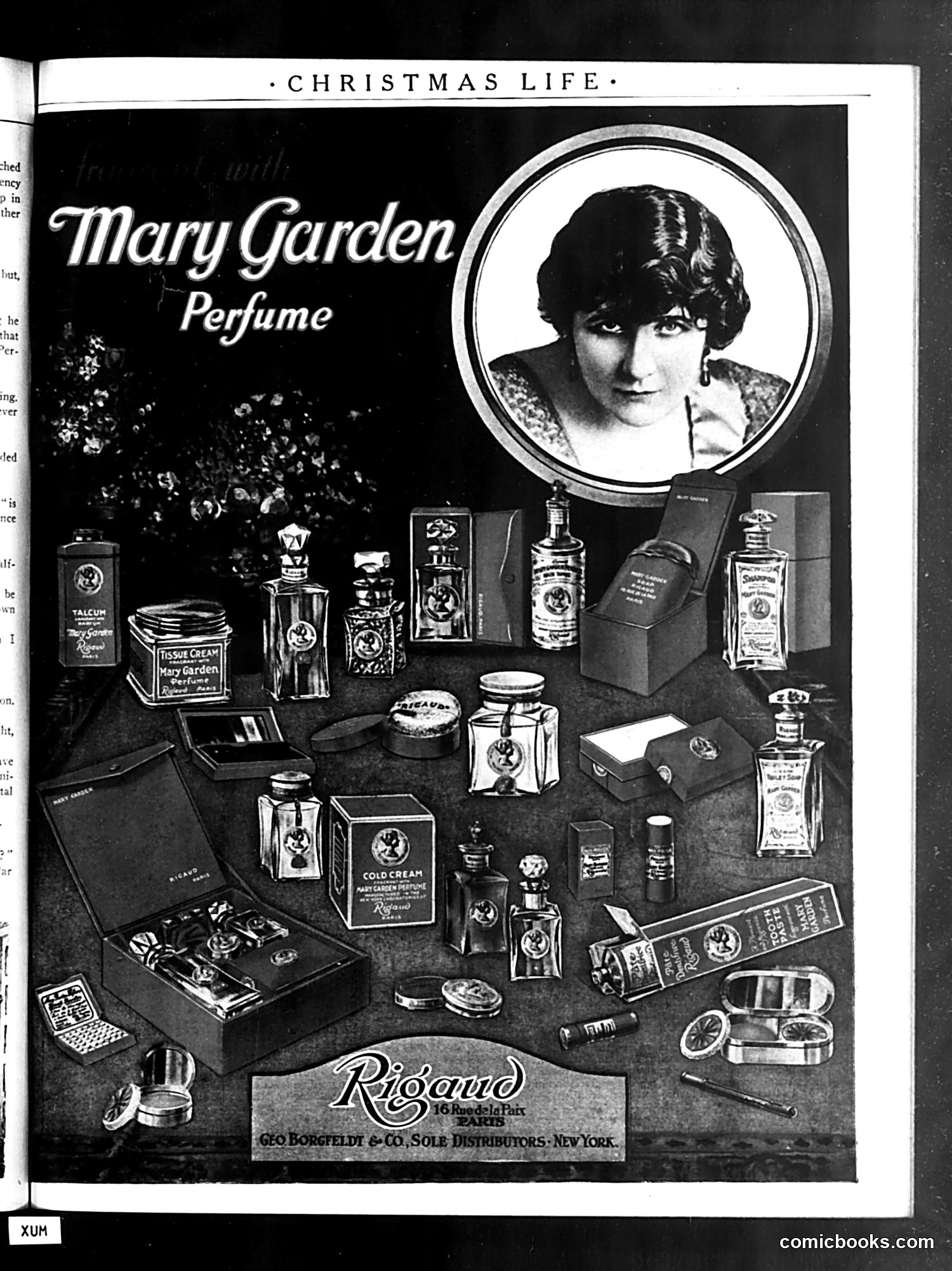
This is a **perfume advertisement**, not a political cartoon. The page features Mary Garden Perfume by Rigaud, a luxury fragrance line distributed by Geo. Borgfeldt & Co. in New York. The advertisement showcases a woman's portrait in a circular frame at top center, surrounded by various Mary Garden beauty and fragrance products—perfume bottles, cold cream, tissue cream, and cosmetics arranged on a dark surface. For modern readers: This represents early 20th-century luxury marketing targeting affluent women. Mary Garden was likely a celebrity endorser (possibly the opera singer of that name), lending prestige to the brand. The lavish product display emphasizes exclusivity and sophistication—typical of high-end cosmetics advertising from this era before strict FDA regulations or truth-in-advertising standards.
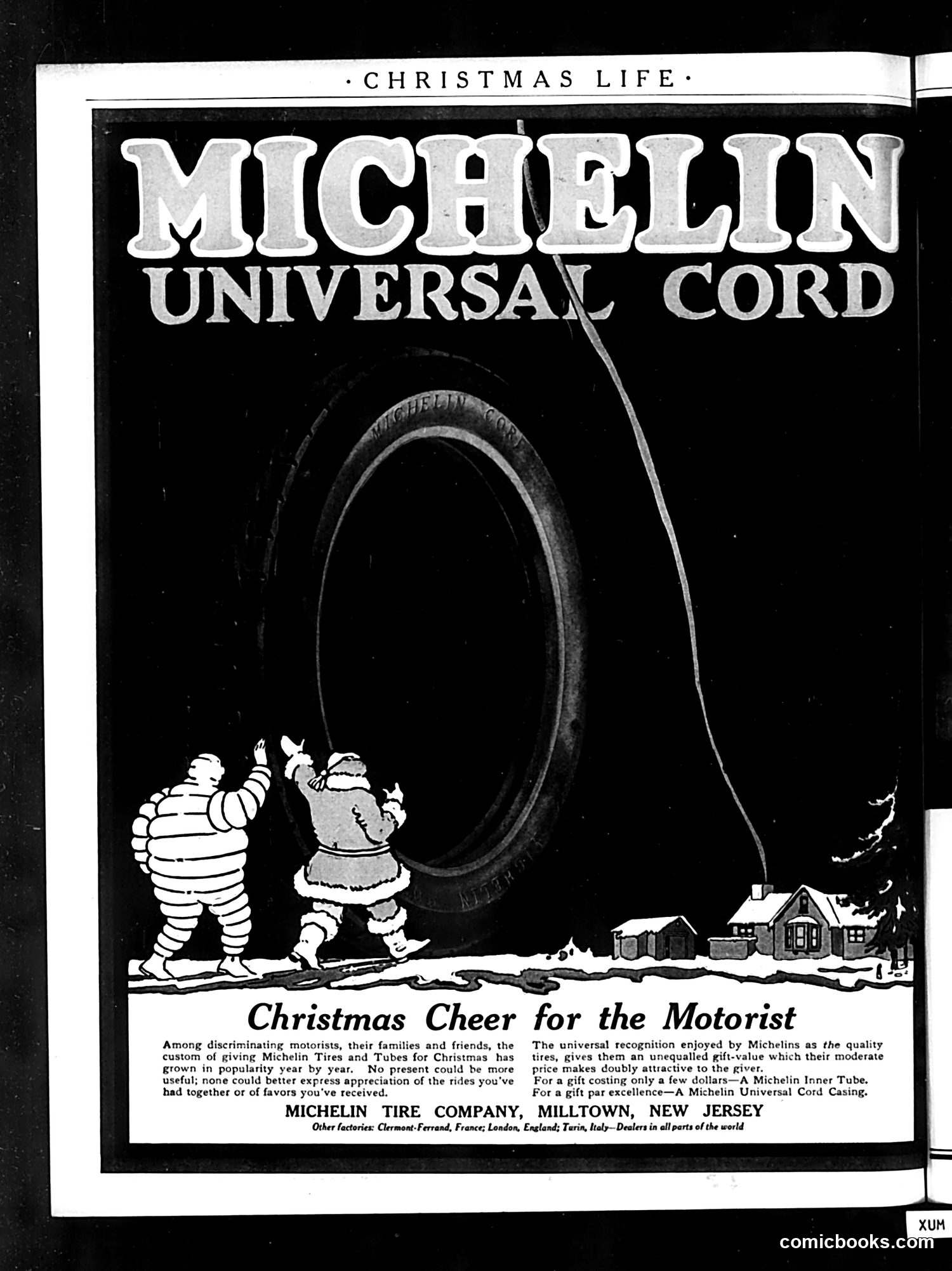
This is a Christmas advertisement for Michelin tires, not political satire. The page shows the famous Michelin Man (Bibendum) mascot—the rotund, puffy figure made of tire rings—alongside another character examining a large tire in a snowy scene with houses in the background. The ad targets motorists, positioning Michelin tires as an ideal Christmas gift. The text emphasizes Michelin's reputation for quality and value, suggesting their tires offer "Christmas Cheer for the Motorist" through reliability and affordability. The company's address in Milltown, New Jersey is listed, along with international offices, indicating Michelin's global reach during this era of automobile expansion.
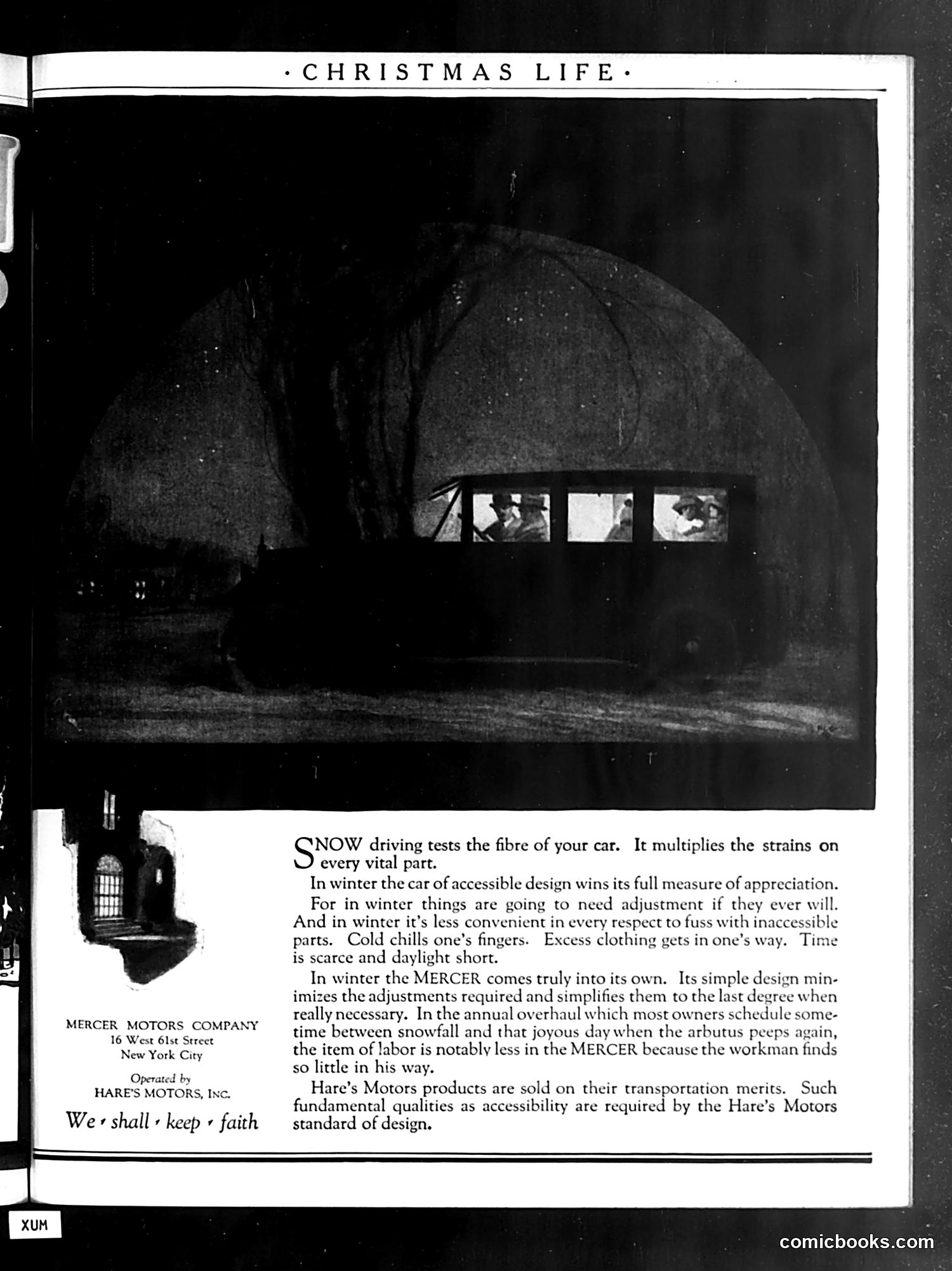
This is a **Mercer Motors advertisement** disguised as editorial content under the "Christmas Life" section heading. The image shows a car (a Mercer) driving through heavy snow at night, with illuminated windows visible in its body. The text argues that winter driving conditions test a car's reliability, and that the Mercer's "simple design" makes it superior because it requires fewer adjustments and repairs during harsh weather. The advertisement emphasizes "accessibility" of parts and design—meaning owners can service the vehicle themselves without specialist help. This is essentially a **performance claim** pitched as practical winter advice. The tagline "We shall keep faith" (Hare's Motors, the distributor) promises reliability when conditions are most demanding.
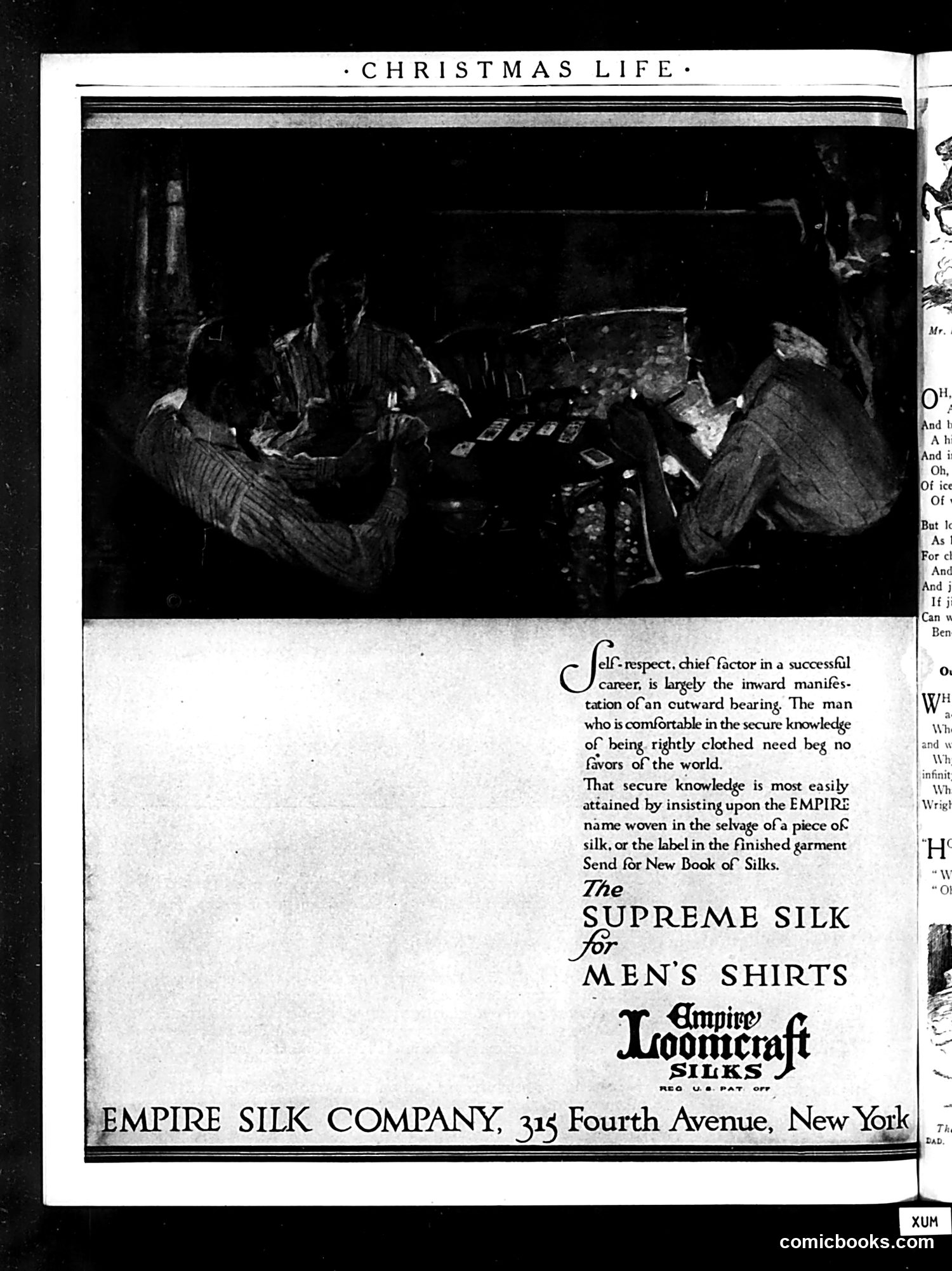
This page is primarily an **advertisement for Empire Loomcraft Silks**, not political satire. The top image shows what appears to be a formal Christmas gathering or dinner scene with men in period dress around a table. The ad's text emphasizes that self-respect depends on "outward bearing" and being "rightly clothed"—arguing that wearing quality silk shirts (specifically those bearing the Empire brand name) conveys respectability and success to the world. The humor, if any, is gentle: the ad suggests that proper clothing is a shortcut to social confidence and professional success. This reflects early 20th-century advertising's focus on linking consumer goods to character and social status—a common marketing approach of the era that modern readers might find amusingly superficial or manipulative.
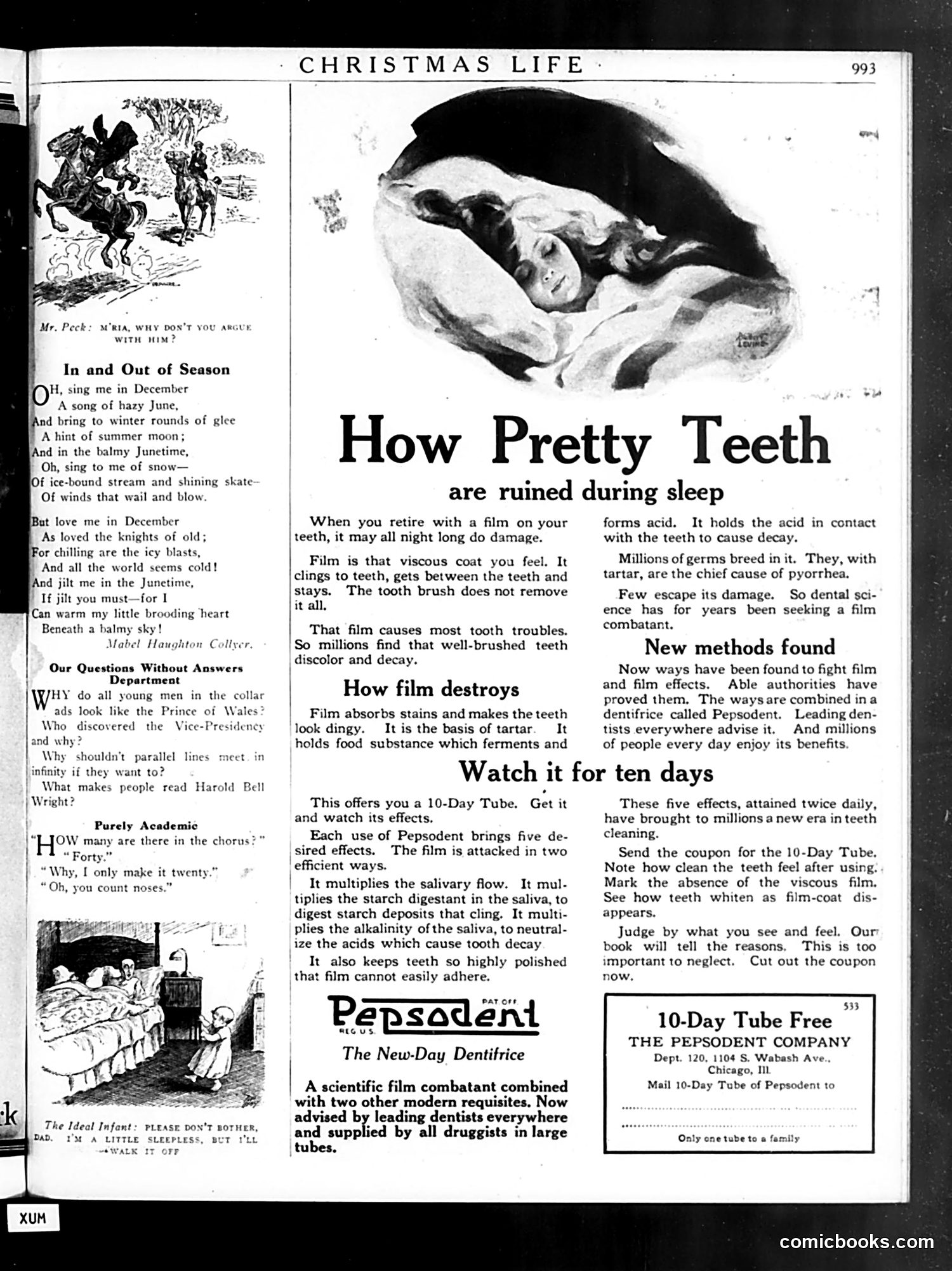
This page is primarily **advertising and light humor**, not political satire. The main content is a **Pepsodent toothpaste advertisement** titled "How Pretty Teeth are ruined during sleep." It warns that a film coating on teeth causes decay and presents Pepsodent as a scientific solution with a "10-Day Tube" offer. The left side contains three unrelated humor sections: a poem "In and Out of Season" by Mabel Houghton Collyer; a "Questions Without Answers" quiz (asking why young men admire the Prince of Wales, etc.); and a "Purely Academic" joke about counting in a chorus. A small cartoon shows a father and sleepless child with the caption "The Ideal Infant: Please don't bother, Dad. I'm a little sleepless, but I'll walk it off." The page reflects early 20th-century advertising claims about scientific dental care.
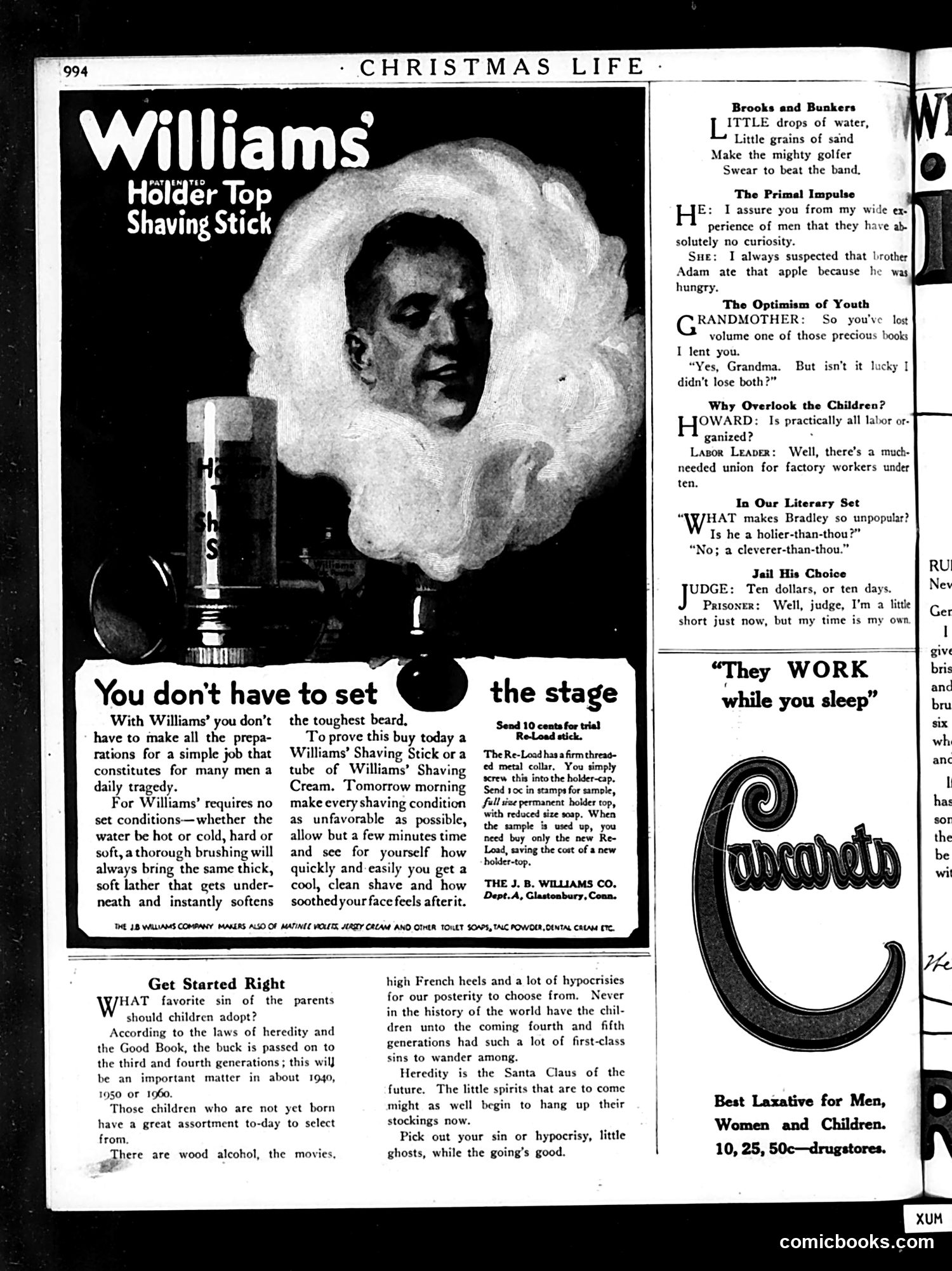
This page is primarily a **product advertisement** for Williams' Holder Top Shaving Stick, disguised as editorial content—a common early 20th-century advertising technique. The large image shows a man's face surrounded by lathered shaving cream, demonstrating the product's ability to produce a rich lather. The ad's central claim is that Williams' requires no special preparation or technique: "You don't have to set the stage" to achieve good shaving results. The accompanying text emphasizes convenience and consistency—the product allegedly works equally well regardless of water temperature or user skill, positioning it as accessible to "many men" who perform daily shaving. The right column contains unrelated satirical humor pieces typical of *Life* magazine's editorial content, contrasting sharply with the advertisement.
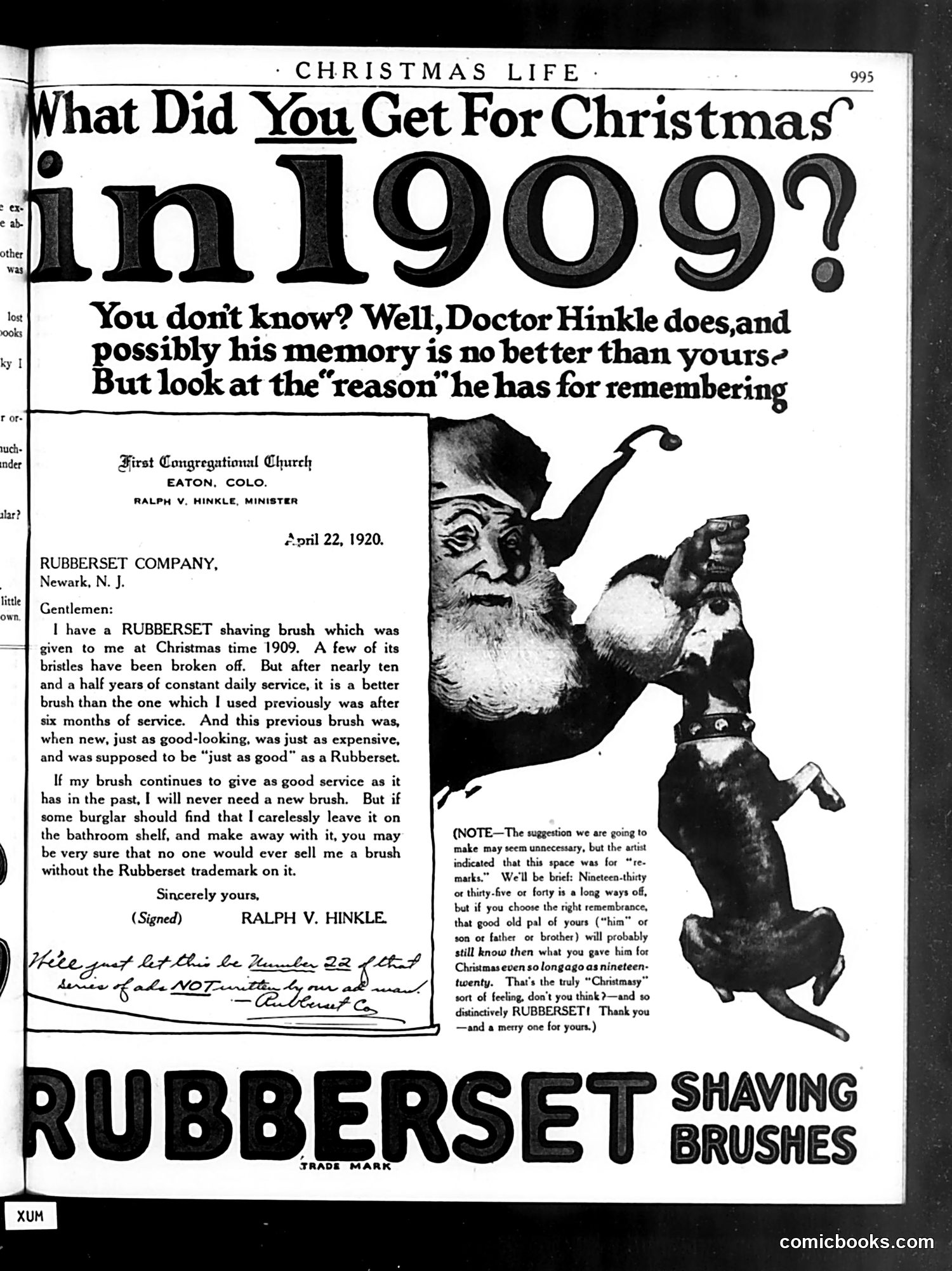
This is primarily a **Rubberset shaving brush advertisement** disguised as editorial content—a common early 20th-century marketing technique. The ad features a **letter from Ralph V. Hinkle**, a minister in Eaton, Colorado, dated April 22, 1920. Hinkle testifies that a Rubberset brush given to him at Christmas 1909 has outlasted superior brushes, proving its durability and value. The accompanying illustration shows **Santa Claus** holding the brush, making the implicit argument that a Rubberset brush is the perfect long-lasting Christmas gift—one the recipient will remember fondly for over a decade. The satire is subtle: the headline asks what you got for Christmas in 1909, suggesting that *this* product is so memorable it deserves to be recalled. The "note" acknowledges the advertisement's manipulative nature while defending it as genuine customer testimony.
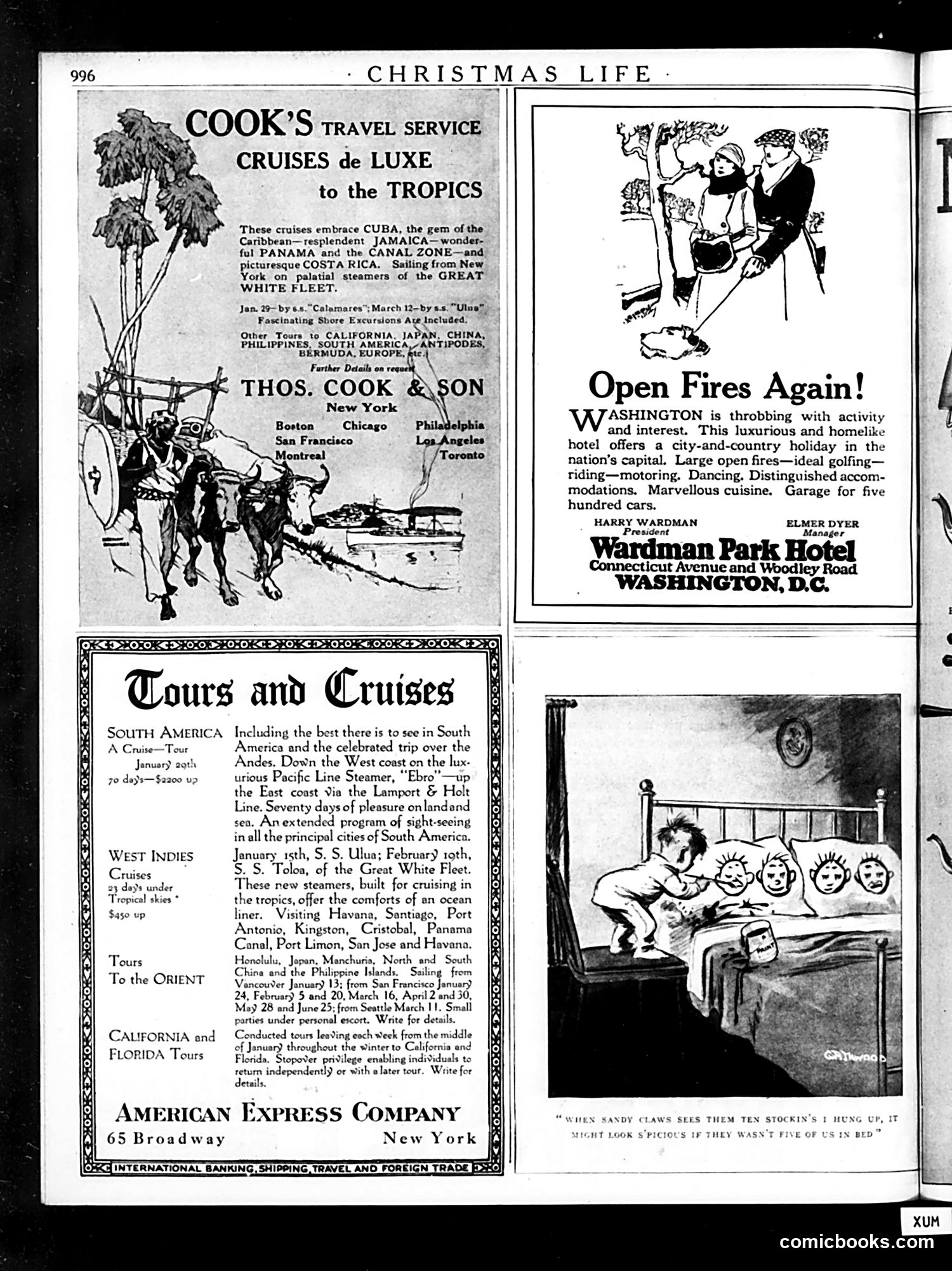
This page is primarily **advertising content**, not political satire. It contains three travel advertisements: 1. **Cook's Travel Service** (top left): Promoting luxury Caribbean cruises to Cuba, Jamaica, Panama, and Costa Rica aboard "Great White Fleet" steamships. 2. **Wardman Park Hotel** (top right): A Washington D.C. hotel advertisement featuring an illustration of two men by a fireplace with the headline "Open Fires Again!"—promoting seasonal holiday comfort and amenities like golf, dancing, and cuisine. 3. **Tours and Cruises** (bottom): American Express Company advertising South American cruises, West Indies trips, Orient tours, and California/Florida excursions with specific sailing dates and prices. The small cartoon at bottom right appears unrelated—a humorous domestic scene about Christmas stockings.
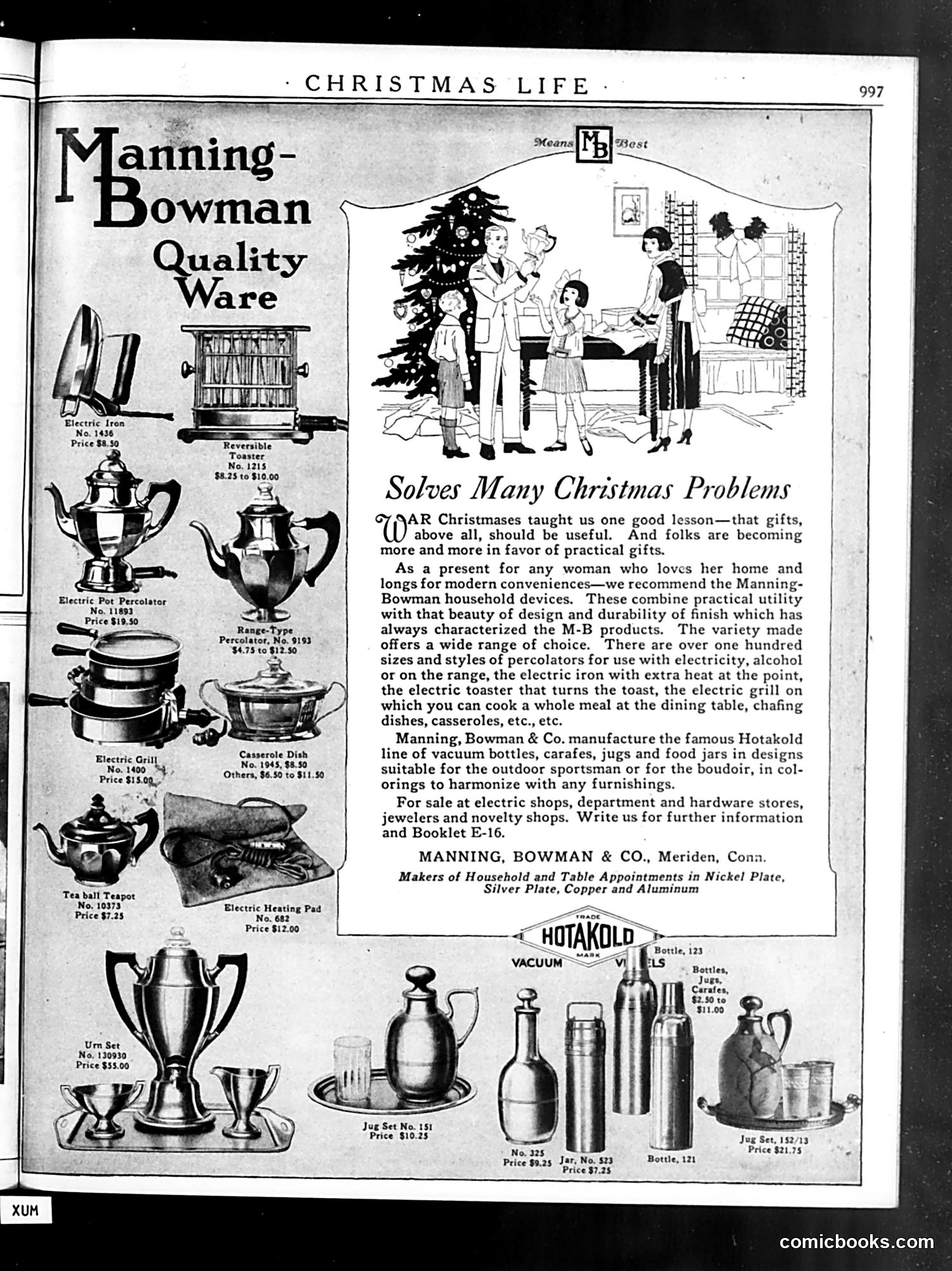
This is **not a cartoon or satire** — it's a straightforward product advertisement for Manning-Bowman & Co., a Connecticut manufacturer of household appliances and tableware. The page promotes electric kitchen devices as ideal Christmas gifts for homemakers: electric irons, toasters, percolators, grills, and heating pads. The illustration shows a family scene with a decorated Christmas tree, emphasizing that such practical appliances "solve many Christmas problems" by modernizing domestic work. The ad reflects 1920s-30s consumer culture, when electrified home goods were marketed as luxuries that combined utility with aesthetic appeal. The "Hotakold" vacuum bottles and serving pieces shown represent the company's full product range. This represents mainstream advertising ideology of the era: positioning labor-saving devices as desirable gifts that would improve women's domestic efficiency and home comfort.
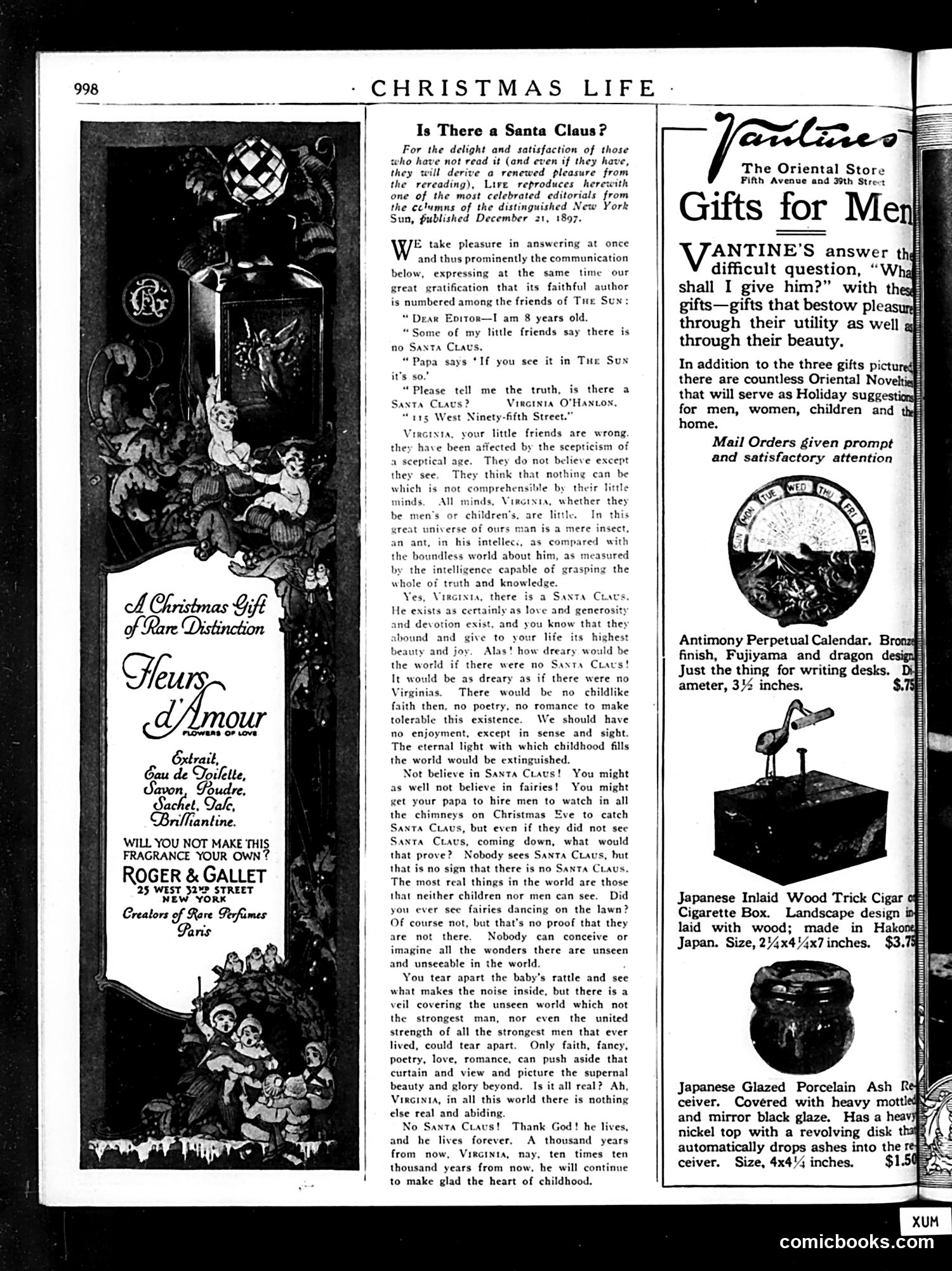
This page primarily comprises **reprinting of a famous 1897 New York Sun editorial** answering a child's letter asking "Is There a Santa Claus?"—not political satire. The editorial famously argues that Santa Claus exists as a metaphor for love, generosity, and imagination, asserting that "the most real things in the world are those that neither children nor men can see." The surrounding content is **commercial advertising**: Roger & Gallet perfumes (left column) and Vantine's Oriental Store gift suggestions for men (right), typical of Life magazine's revenue model. There are **no political cartoons or caricatures** on this page. The only illustration is a decorative Victorian Christmas gift image accompanying the perfume advertisement. This appears to be a Christmas-themed editorial/advertising issue rather than satirical political commentary.
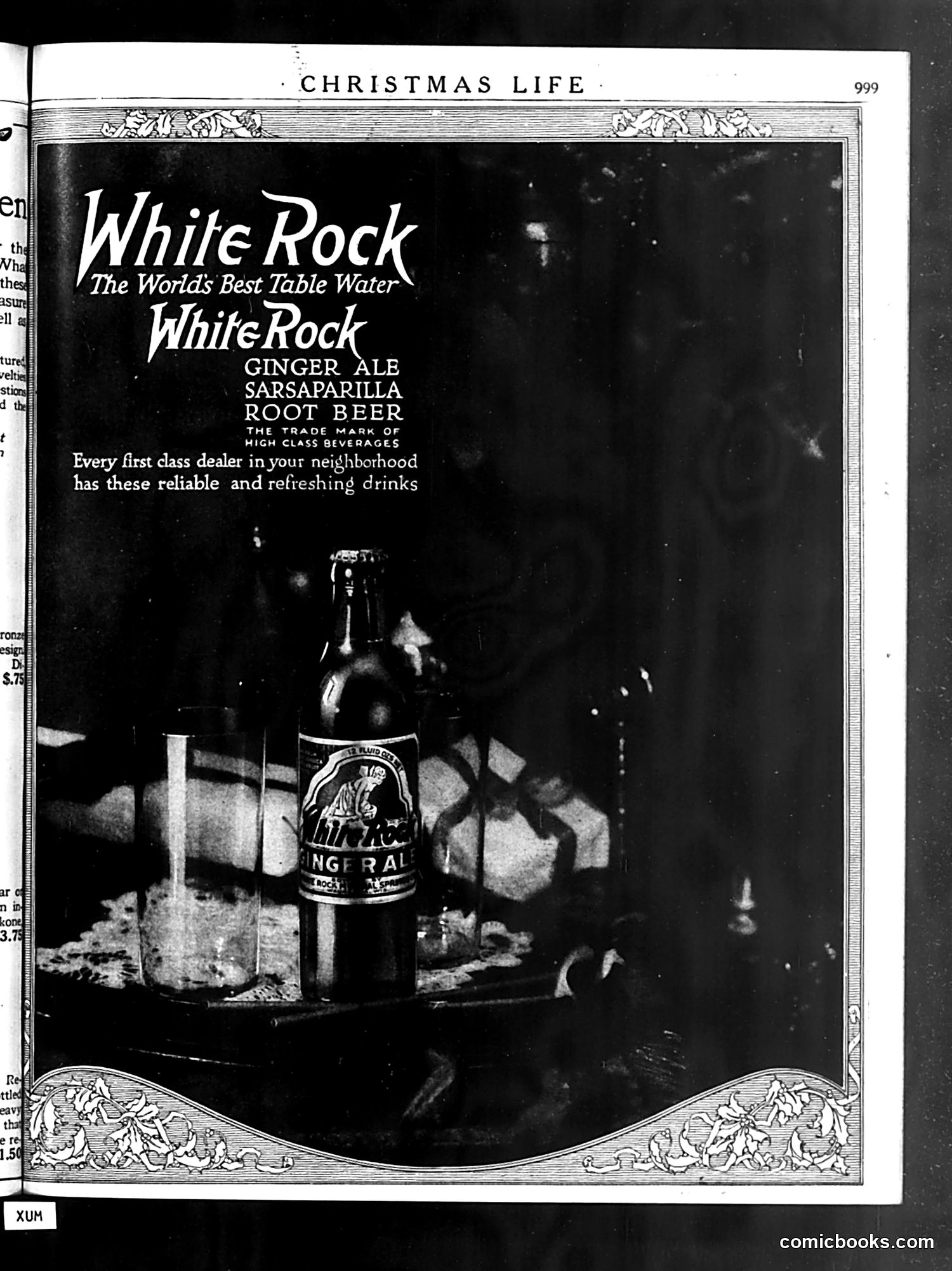
This is a full-page advertisement for White Rock beverages, not political satire. The ad promotes White Rock's product line—table water, ginger ale, sarsaparilla, and root beer—as "high class beverages" available at quality retailers. The advertisement features a bottle of White Rock ginger ale surrounded by glasses and what appears to be festive holiday imagery, positioned in the "Christmas Life" section of the magazine (page 999). The marketing language emphasizes reliability and refreshment, targeting consumers seeking upscale drink options. This appears to be a straightforward commercial advertisement from the early 20th century, with no satirical or political content—merely product promotion aligned with the holiday season.
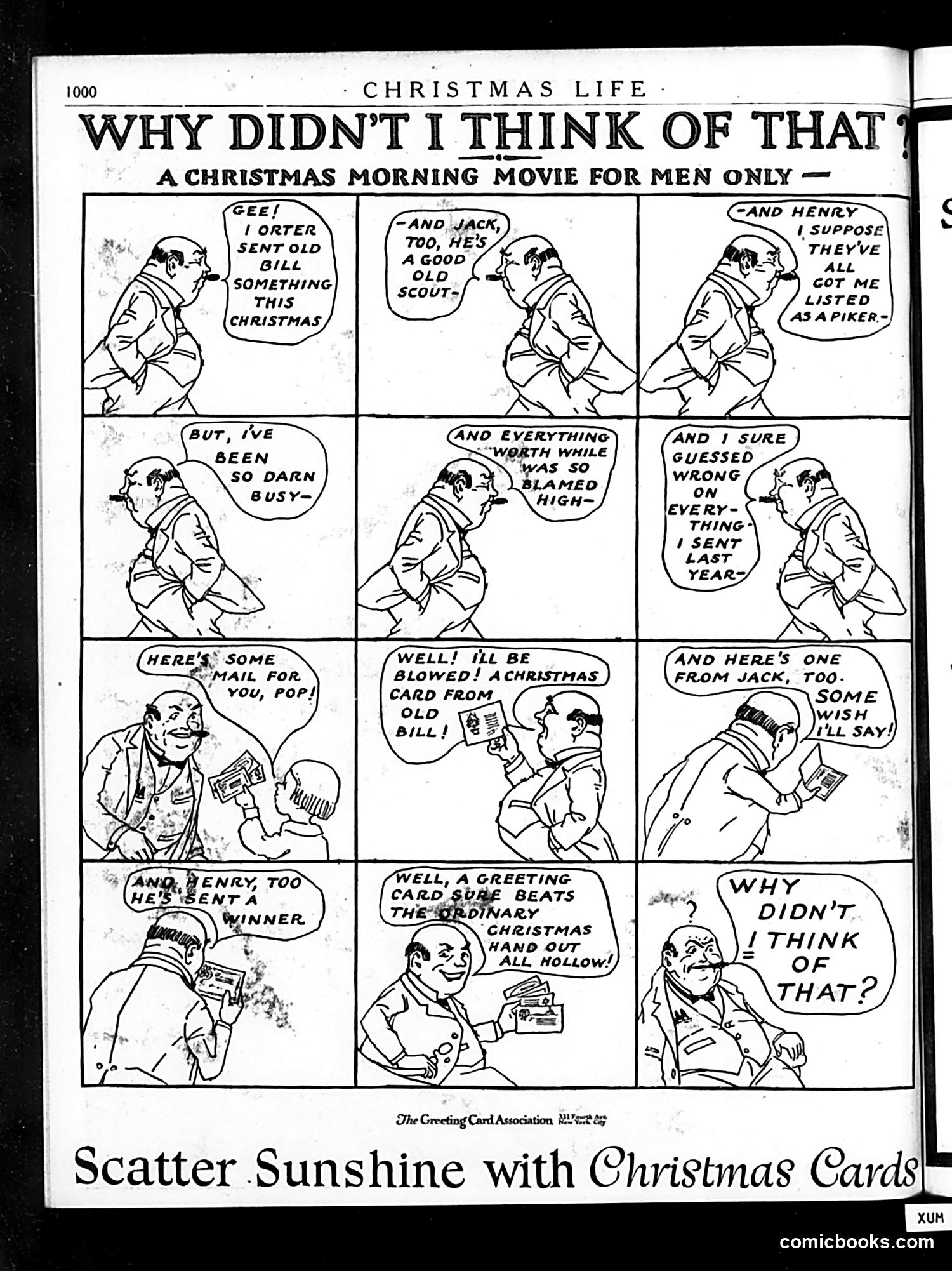
This is a humorous comic strip about Christmas gift-giving among men. The protagonist receives multiple Christmas cards and money from friends named Jack and Henry, prompting his realization: sending greeting cards is superior to traditional Christmas gifts because it's practical, thoughtful, and requires less effort than shopping. The joke satirizes male attitudes toward the holiday—men grumbling about shopping burdens ("I've been so darn busy") while appreciating receiving money or cards themselves. The punchline, "Why didn't I think of that?" reflects the character's sudden insight that Christmas cards offer an elegant solution to holiday gift-giving stress. This appears designed as advertising for the Greeting Card Association, promoting cards as ideal Christmas presents, particularly targeting male readers of Life magazine.
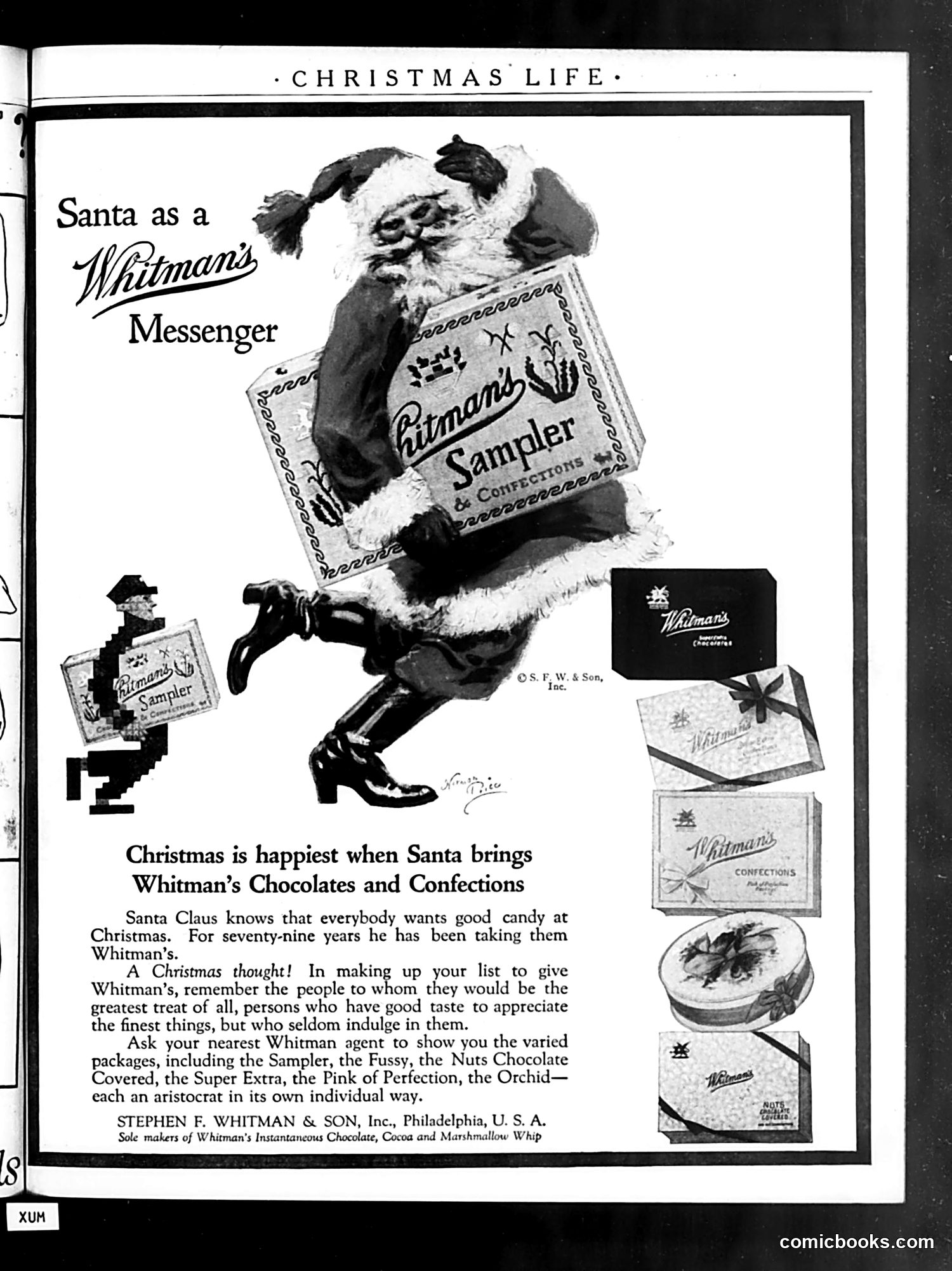
This is **advertising, not satire or political commentary**. The page features a Christmas advertisement for Whitman's Chocolates positioned within *Life* magazine's "Christmas Life" section. The central image depicts Santa Claus as a "Whitman's Messenger"—a cheerful, rotund Santa carrying an oversized Whitman's Sampler box, with smaller figures below also holding the product. The visual joke is straightforward: Santa has become Whitman's delivery agent, suggesting the candy is so desirable that even Santa endorses it. The ad copy appeals to middle/upper-class sensibilities by describing Whitman's as luxury goods for people with "good taste" who "seldom indulge." Various package names—"Pink of Perfection," "Orchid," "Aristocrat"—reinforce this positioning as premium confections. The text emphasizes the product's seventy-nine-year heritage, establishing brand tradition and reliability. This represents early-to-mid 20th-century advertising strategy: associating commercial products with beloved cultural figures (Santa) and aspirational class identity.
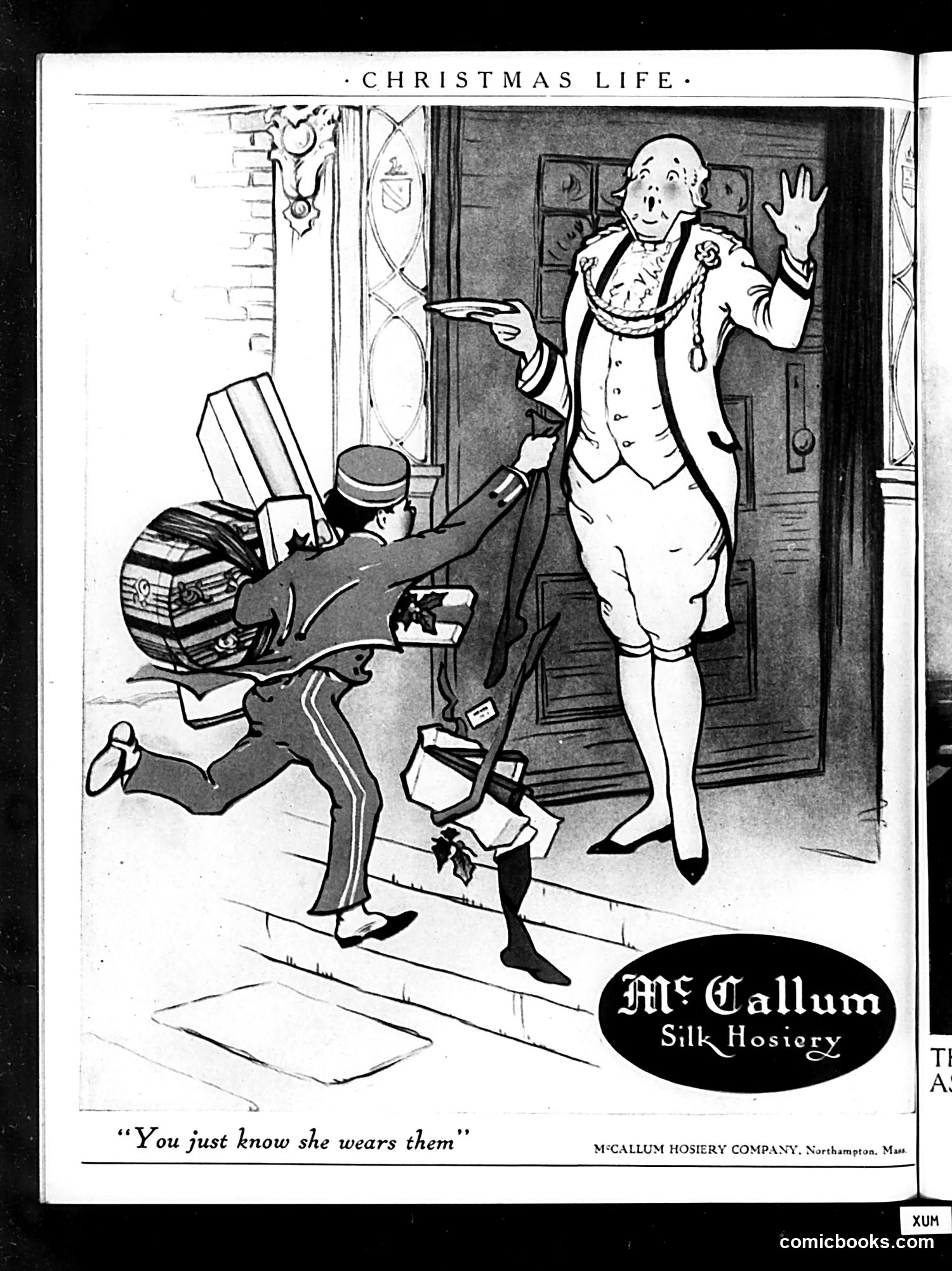
This is a Christmas-themed advertisement for McCallum Silk Hosiery, not political satire. The cartoon shows a comedic domestic scene: a man arriving home laden with wrapped Christmas presents, while a portly gentleman (possibly meant to represent wealth or authority) emerges from the house gesturing in surprise or protest. The advertisement's caption—"You just know she wears them"—uses suggestive humor typical of 1920s-30s marketing, implying that silk hosiery is a desirable, recognizable luxury gift. The joke appears to rest on the implication that the recipient's fine hosiery is noticeable and memorable, playing on period attitudes about women's fashion and attraction. The chaotic present-laden scene emphasizes gift-giving abundance during Christmas season.
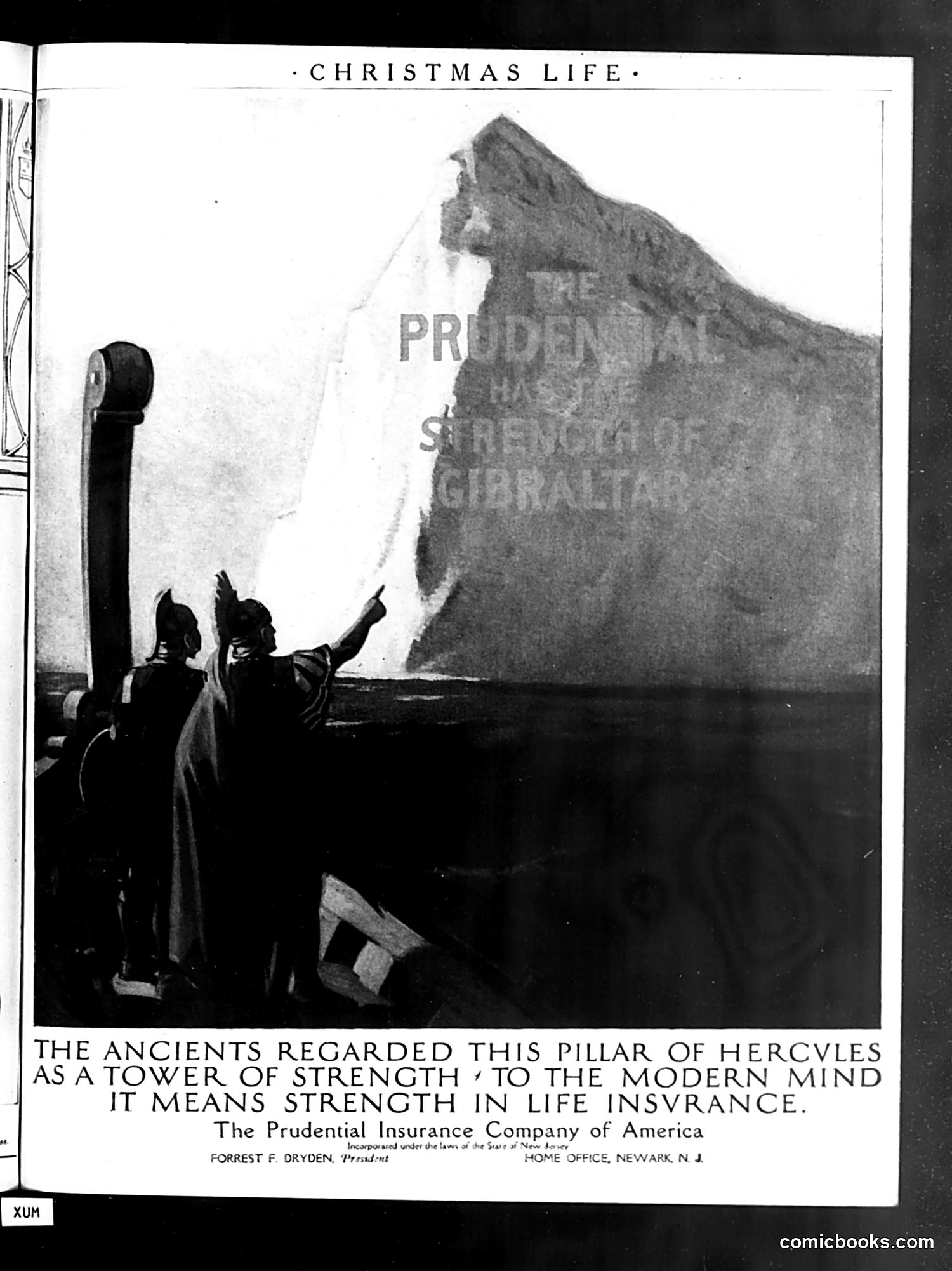
This is a Prudential Insurance advertisement disguised as editorial content. The image shows two figures on a ship gazing at a large rock formation (the Pillars of Hercules, ancient markers at the Strait of Gibraltar). The ad uses classical mythology to make an implicit pitch: just as ancients saw the Pillars as symbols of strength and safety, modern people should view life insurance as their "tower of strength"—financial security and protection. The visual metaphor equates insurance stability with ancient navigational landmarks, suggesting insurance provides reliable guidance through life's uncertainties. The Christmas Life header positions this as holiday-season reading matter, giving the insurance pitch a festive, editorial veneer rather than obvious advertising.
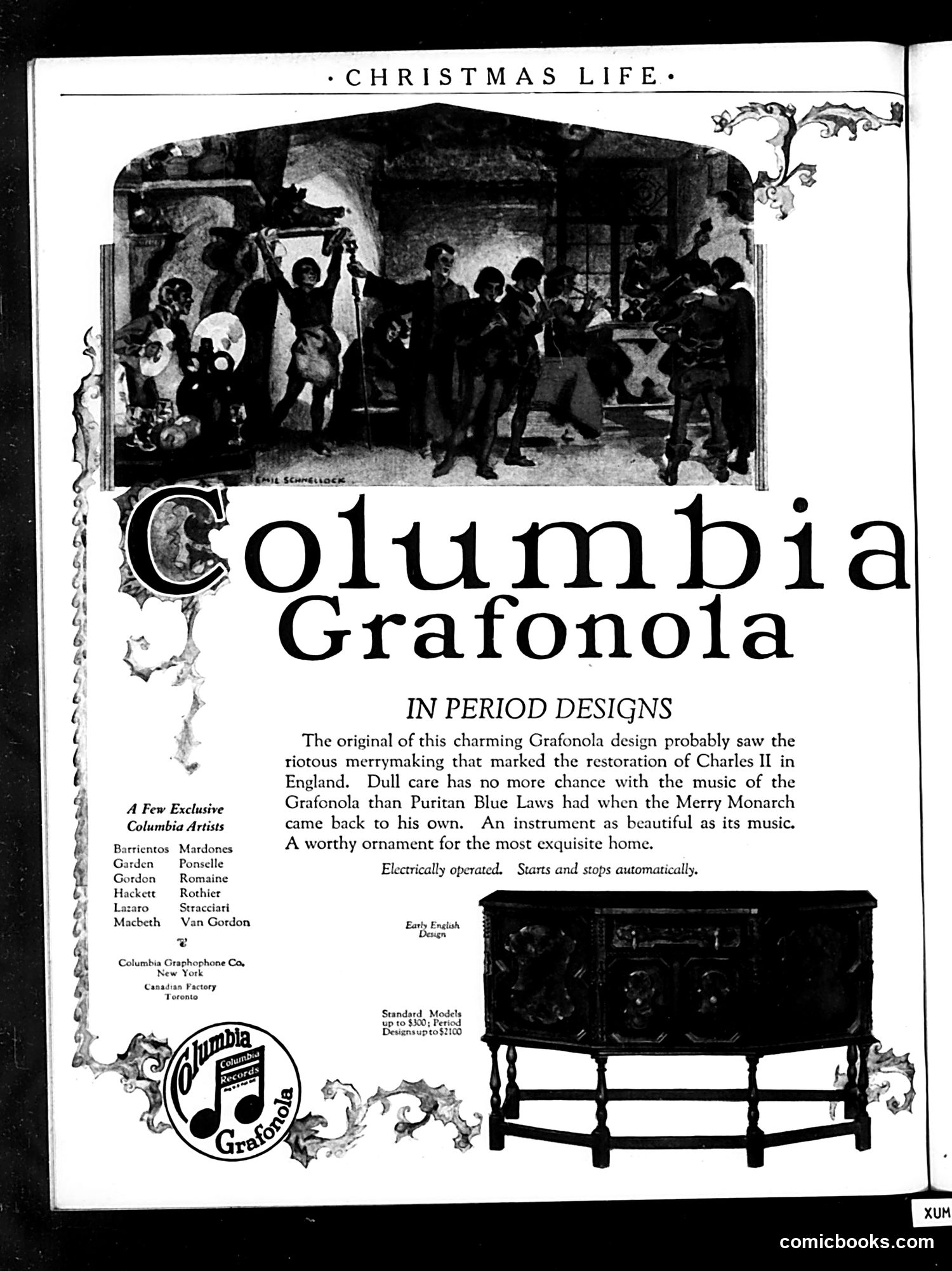
This is primarily a **Christmas advertisement**, not political satire. It promotes Columbia's "Grafonola" phonograph in period furniture designs. The ad uses a historical reference to make a lifestyle pitch: it compares the phonograph's cheerful music to the "riotous merrymaking" following King Charles II's restoration in England (1660), contrasting this joy against the austere "Puritan Blue Laws" that had preceded it. The implicit message: just as Charles II brought back merriment to England, this elegant phonograph will bring cultured entertainment to your home. The top image shows a lively 17th-century scene—the visual parallel to Charles II's court. The featured grafonola shown is styled as "Early English Design," positioning it as sophisticated period furniture. The ad lists exclusive Columbia recording artists (opera singers and classical performers), targeting affluent consumers seeking both musical quality and aesthetic refinement. This is consumer advertising leveraging historical nostalgia, not political commentary.
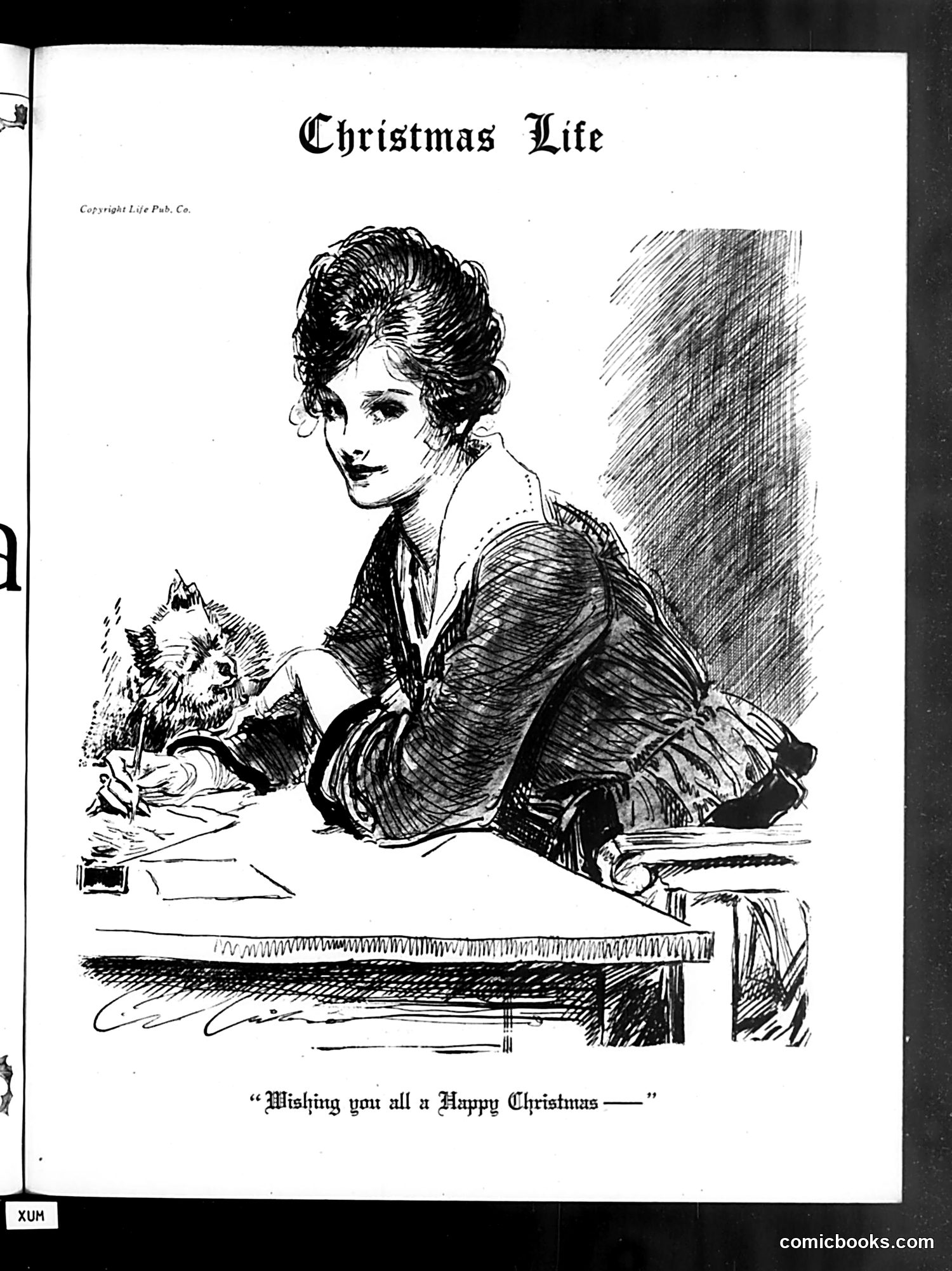
This is a title page or cover illustration from *Life* magazine featuring a stylized pen-and-ink drawing of an elegant woman in early 20th-century dress, seated and holding a small dog or similar pet. The illustration appears to be signed by the artist. The page carries the simple seasonal greeting "Wishing you all a Happy Christmas —" below the image. Rather than containing political satire or social commentary, this appears to be a straightforward holiday greeting card or cover page, presenting an idealized image of genteel femininity and domesticity appropriate to the Christmas season. The work exemplifies the magazine's typical illustration style of that era.
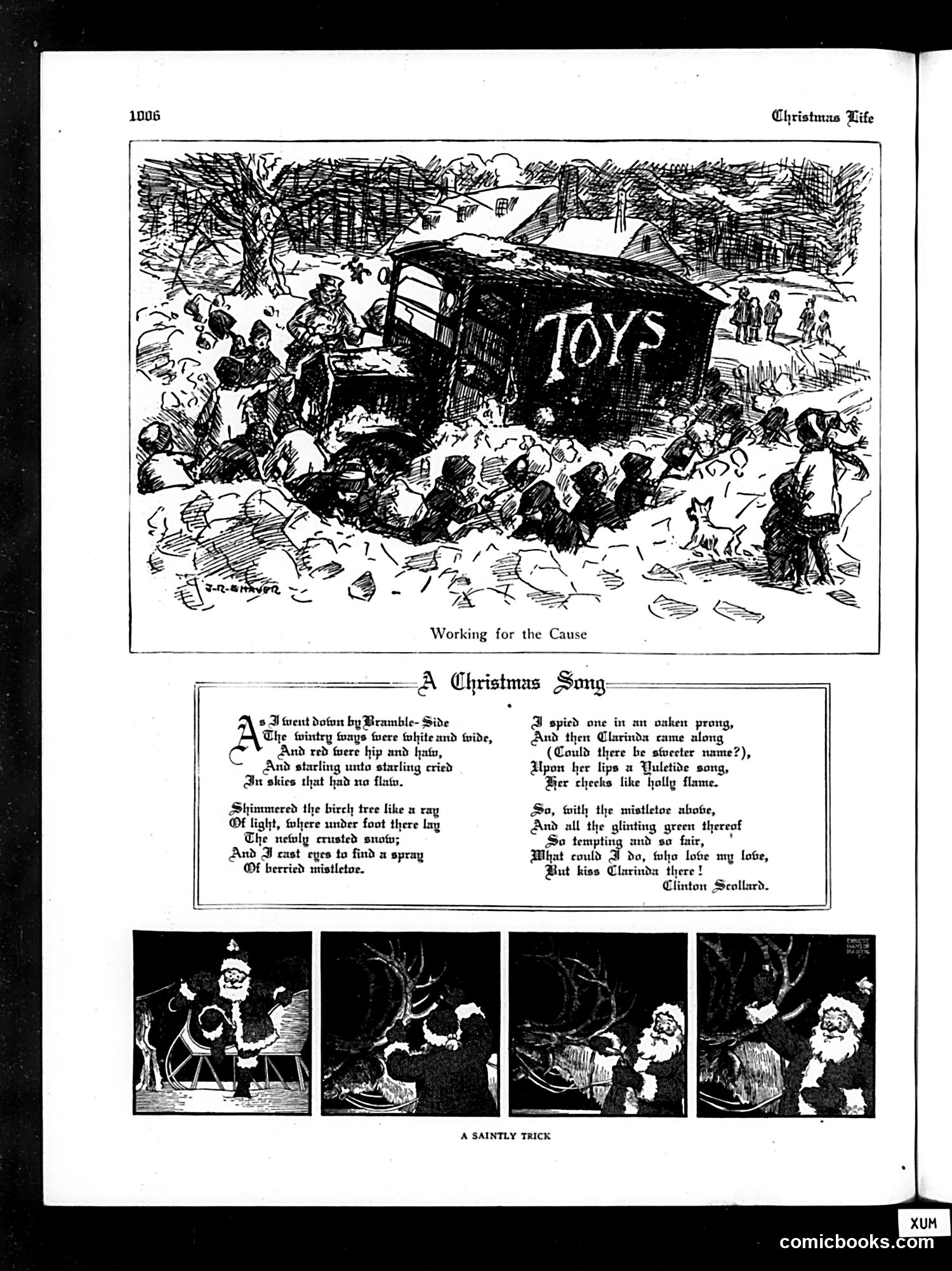
The top illustration shows a large toy wagon or cart surrounded by children in a snowy landscape, labeled "TOYS." This depicts charitable toy distribution—likely a Christmas charity drive or welfare initiative. The caption "Working for the Cause" suggests this represents charitable work supporting underprivileged children during the holiday season. "A Christmas Song" by Clinton Scollard is a sentimental romantic poem about a man finding mistletoe while walking through winter woods and using it as a pretext to kiss a woman named Clarinda he encounters. "A Saintly Trick" (four sequential panels below) appears to be a comic story featuring Santa Claus in various scenes, though specific details are unclear from the image quality. The page combines sentimental holiday poetry and charitable imagery with humorous comics—typical Life magazine content mixing sentiment with gentle satire.
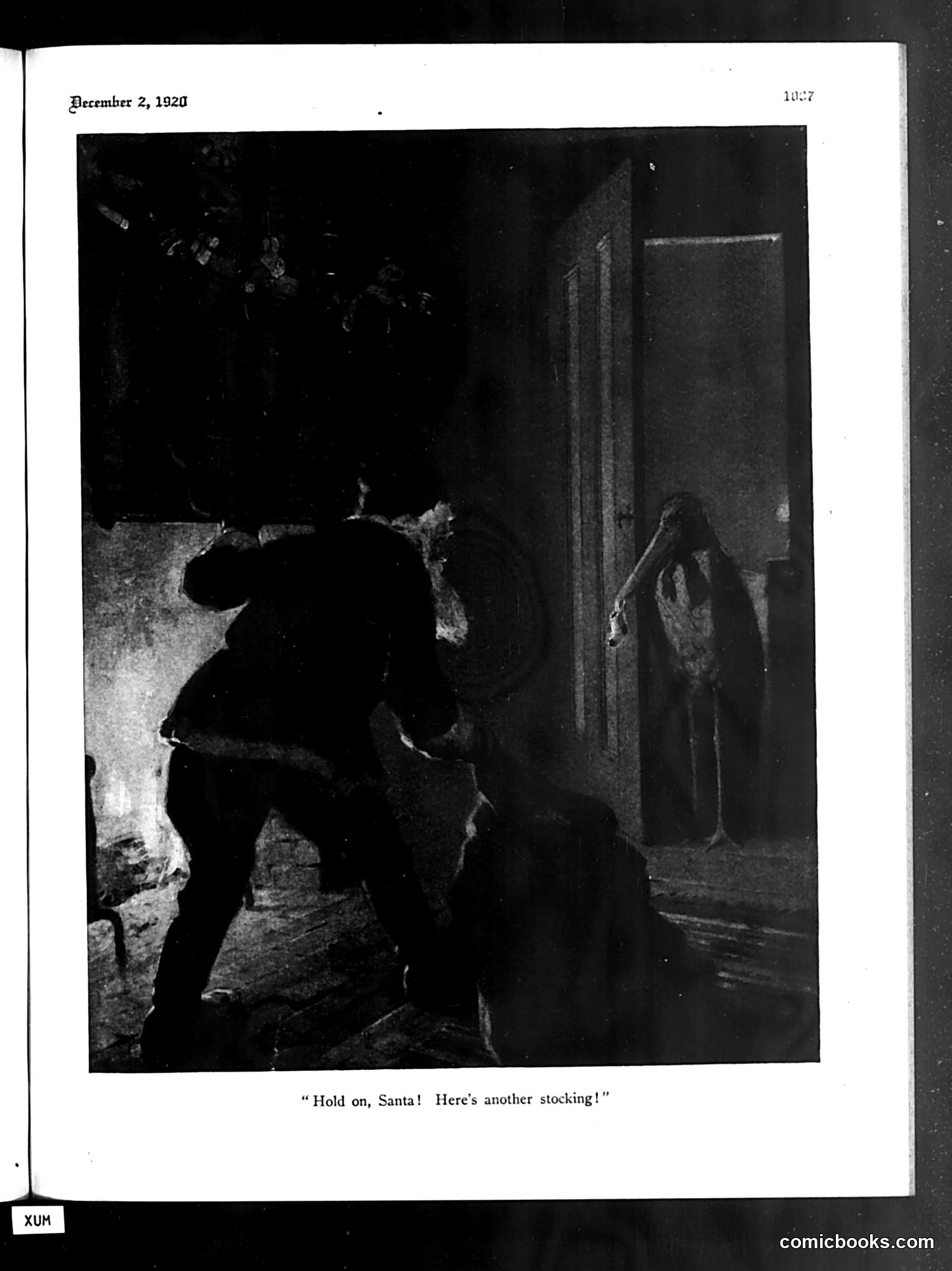
This is a Christmas-themed satirical illustration showing Santa Claus being stopped by a figure (appearing to be female) who points to another stocking that needs filling. The caption reads: "Hold on, Santa! Here's another stocking!" The joke likely references post-WWI economic concerns or the economic demands facing the nation in 1920. The "another stocking" suggests endless requests or unfulfilled needs—possibly alluding to war debts, reconstruction costs, or social welfare demands that exceeded available resources. Santa represents either the government or national prosperity being asked to provide more than he can reasonably deliver. The satire critiques the seemingly insatiable economic expectations placed on the nation during this period of readjustment following World War I.
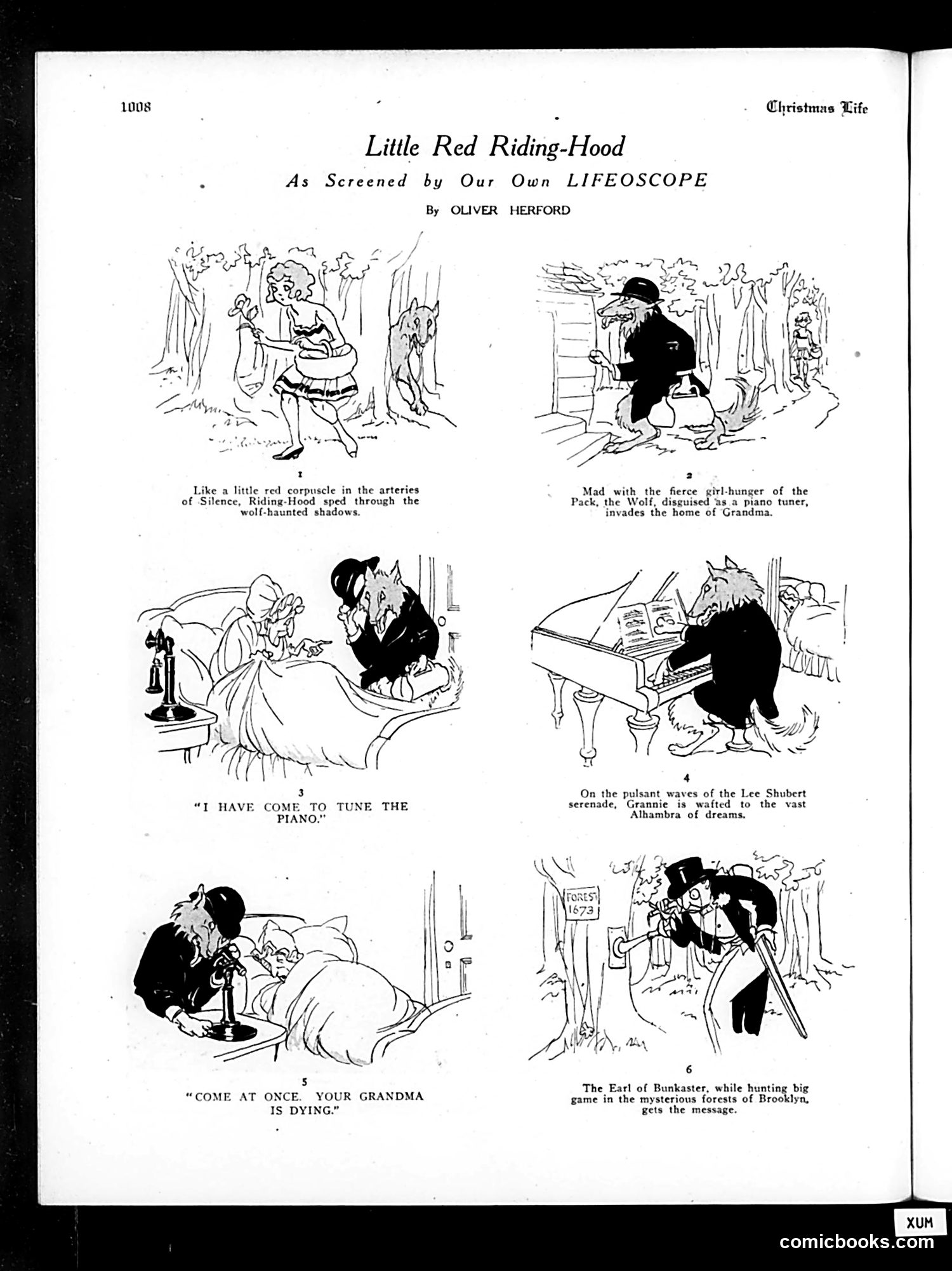
This is Oliver Herford's comedic reimagining of the classic fairy tale, published in *Life* magazine. The satire mocks early 20th-century theatrical and cultural pretensions by transplanting the story into contemporary urban settings. Key satirical elements: - **Panel 2**: The Wolf disguises himself as a "piano tuner" (rather than grandmother), invading Grandma's home—a modern urban twist - **Panel 3-4**: References to "Lee Shubert serenade" and "Alhambra of dreams" mock flowery theatrical language; Grandma is transported via musical fantasy rather than magic - **Panel 6**: "The Earl of Bunkaster" hunting "big game in the mysterious forests of Brooklyn" satirizes wealthy aristocrats pretending European nobility applies to the mundane American city The overall joke is that *Life* is applying overwrought, precious theatrical and romantic language to a simple children's story, mocking contemporary theatrical excess and class pretension. The "Lifeoscope" frames this as Life magazine's own satirical lens on modern culture.
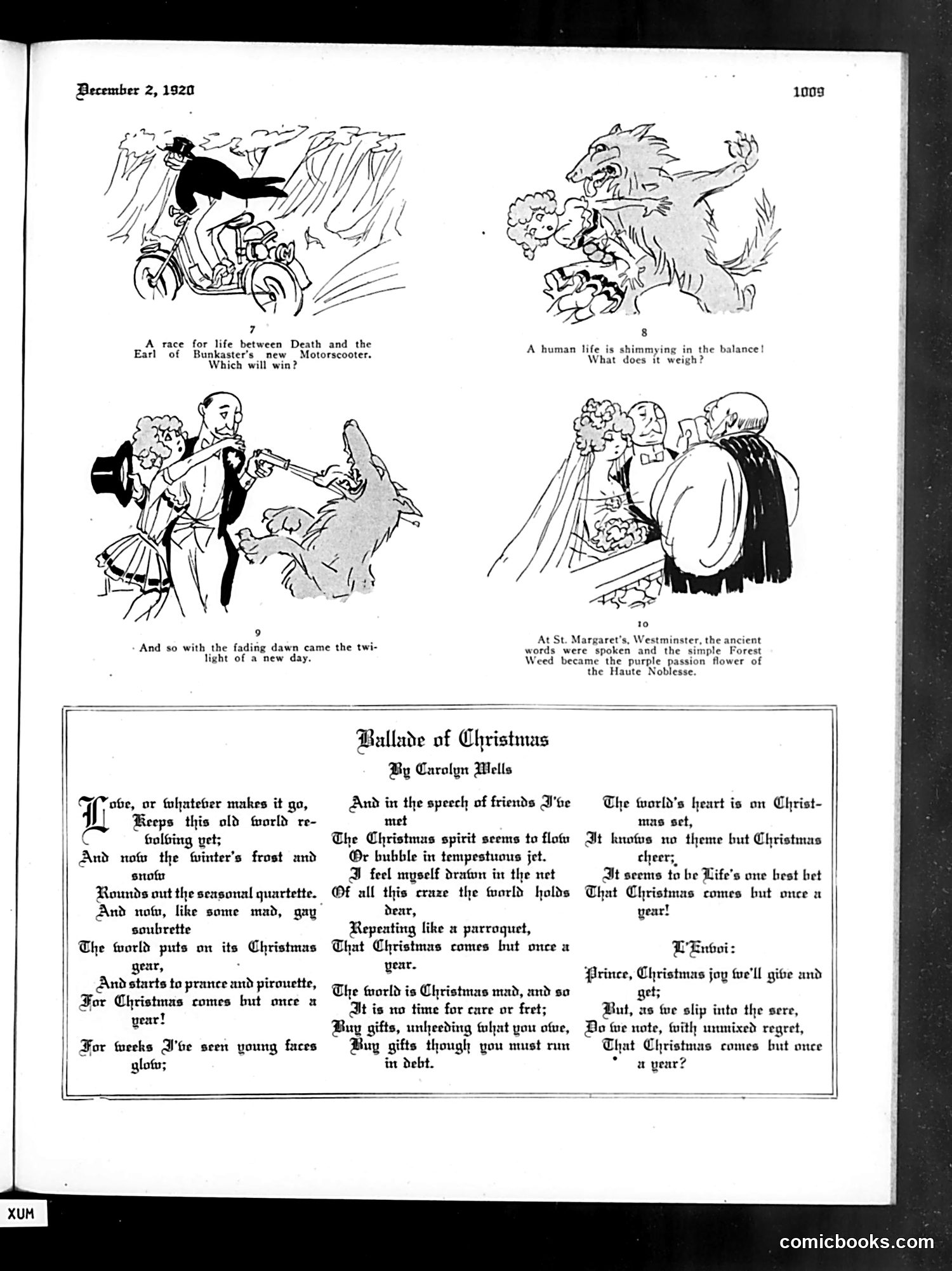
This page mixes political cartoons with poetry. The top cartoons employ dark humor about contemporary anxieties: 1. **"Motorscooter vs. Death"**: A satirical jab at the new motorscooter technology—treating it as dangerously reckless, personifying Death as a competitor in a "race for life." This reflects 1920s public concern about automobile safety. 2. **"Human Life on Balance"**: Depicts children on a scale against a beast, likely representing childhood vulnerability weighed against societal dangers—possibly referencing post-WWI anxieties about children's safety. 3. **Wedding at St. Margaret's Westminster**: The caption's sarcastic tone ("purple passion flower of the Haute Noblesse") mocks high-society wedding ceremonies and aristocratic pretension. The **"Ballade of Christmas"** by Carolyn Wells is a traditional poetic form critiquing Christmas commercialism—the repeated refrain "Christmas comes but once a year" ironically undercuts warnings against overspending on gifts during economic uncertainty. The poem suggests people buy recklessly despite debt. Overall, the page reflects post-WWI concerns: technological danger, social class mockery, and economic anxiety during the holiday season.
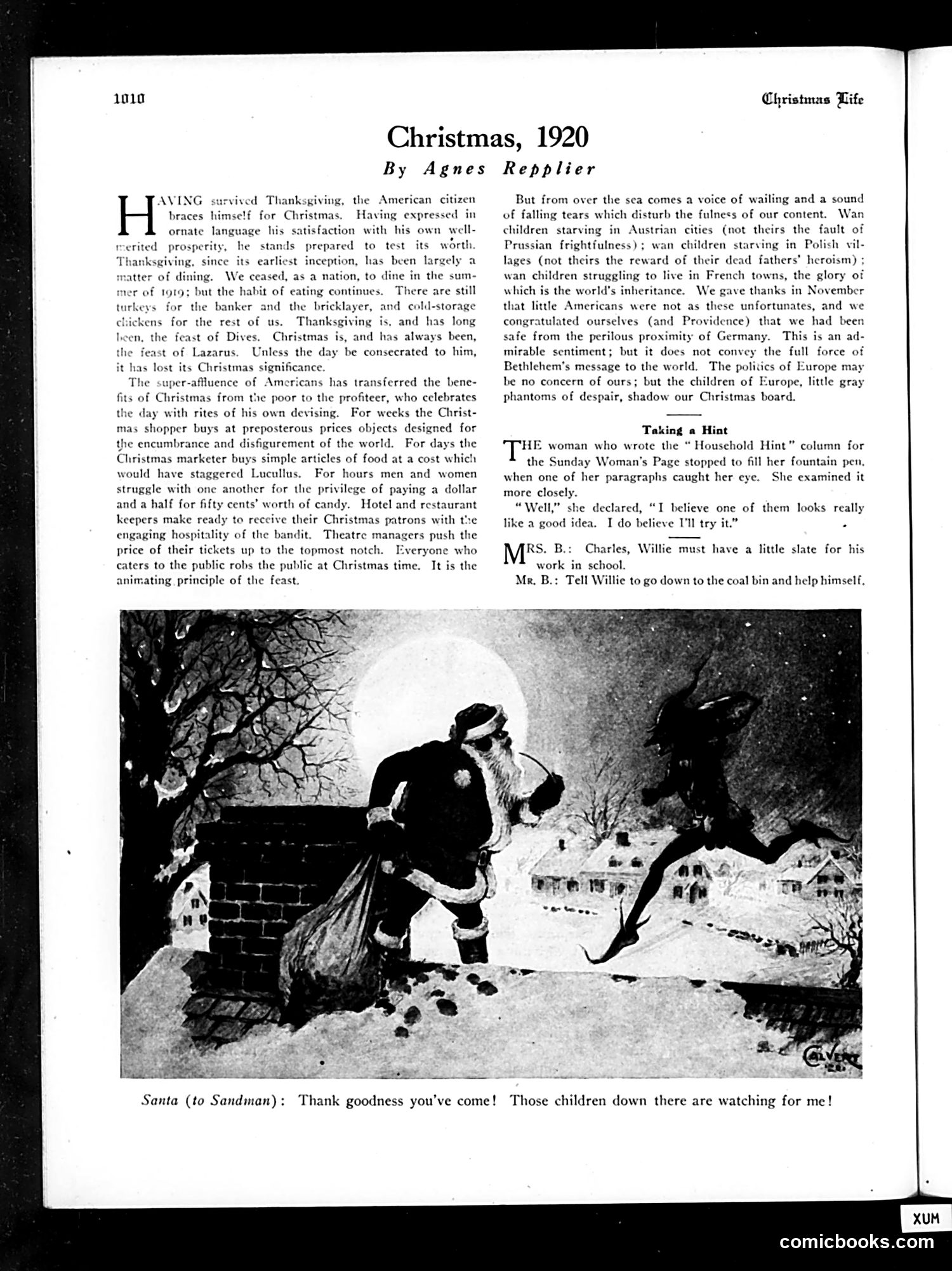
This page contains **two distinct pieces**: ## Main Article: "Christmas, 1920" by Agnes Repplier A satirical essay criticizing American commercialism during the 1920 holiday season. Repplier argues that Christmas has been corrupted by profiteers and merchants who exploit consumers with inflated prices on unnecessary goods. She contrasts American prosperity with the suffering of European children starving in post-WWI Austria, Poland, and France—a pointed reminder that American abundance came while war-devastated Europe struggled. The piece critiques the materialism that has displaced Christmas's spiritual meaning. ## Secondary Item: "Taking a Hint" A brief, humorous household advice anecdote. A woman writing a "Household Hint" column notices one of her own published tips (suggesting children use coal dust as slate for schoolwork) and decides to try it herself—implying the suggestion was impractical or she hadn't tested it. ## Illustration The cartoon shows Santa meeting the Sandman, with Santa noting European children awaiting his aid, anchoring Repplier's critique about conflicting Christmases.
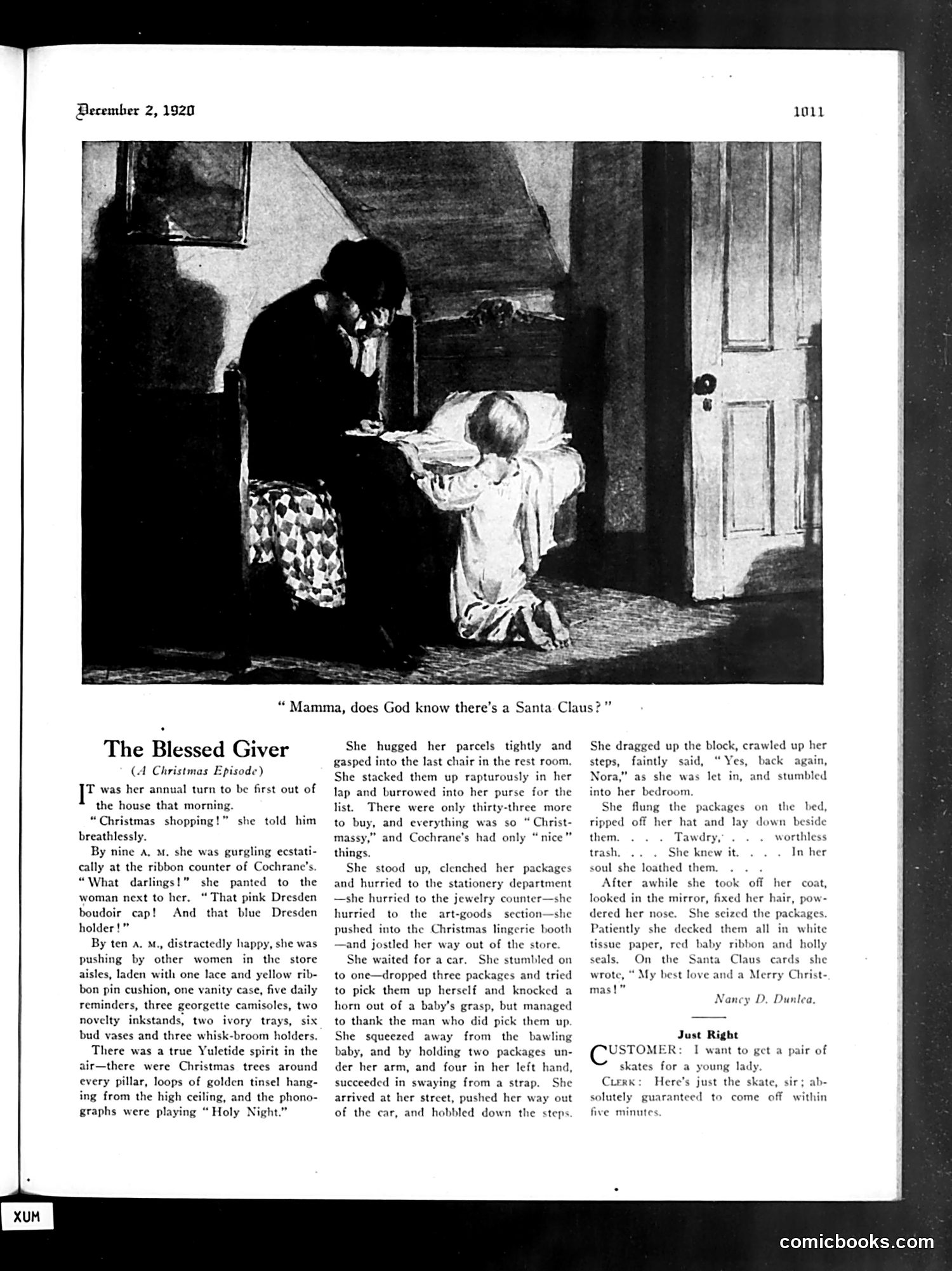
This satirical story mocks the commercialized chaos of Christmas shopping. The narrative follows an unnamed woman experiencing the frenzy of holiday retail—she spends her morning frantically purchasing thirty-three gifts at "Cochrane's" department store, accumulating frivolous items like pin cushions, vanity cases, and bud vases. The satire lies in the contrast between her ecstatic shopping fervor and her actual emotional state: exhausted, she collapses at home, finds her purchases "tawdry" and "worthless," and admits her soul "loathed them." Yet she still wraps everything beautifully and signs the Santa Claus cards with "My best love." The caption photo shows a child asking about Santa Claus, emphasizing the irony—Christmas gift-giving has become a hollow, compulsive ritual divorced from genuine sentiment or spiritual meaning. The accompanying "Just Right" joke about skates that fall off comments on product quality amid commercialism. The piece critiques consumer culture's transformation of Christmas into mindless material acquisition.
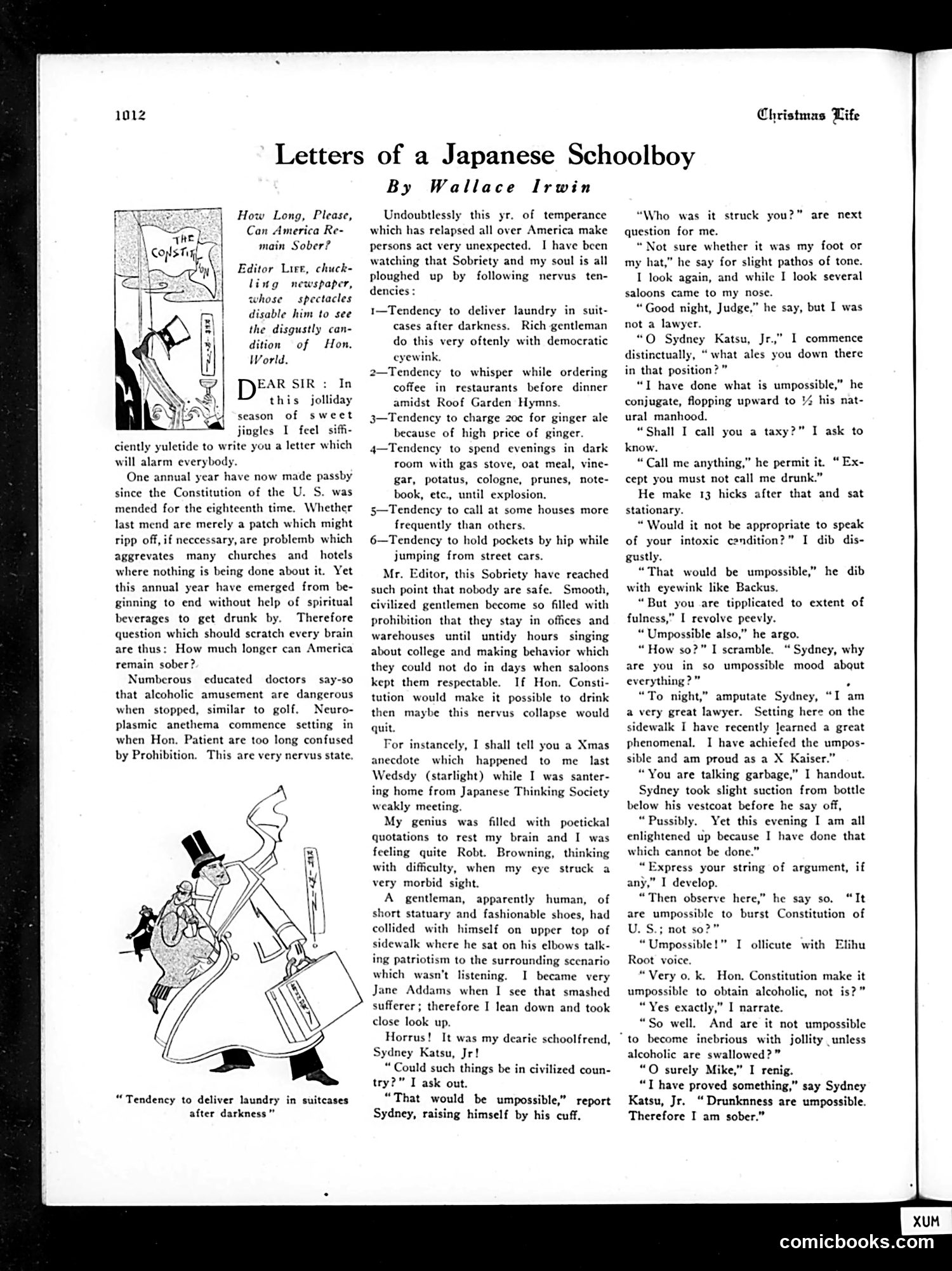
This is a satirical letter written in deliberately fractured English by a fictional Japanese schoolboy character, mocking America's 1920s Prohibition era. The author, Wallace Irwin, uses broken grammar and malapropisms as comedic devices. The letter critiques Prohibition's unintended consequences, arguing that forced sobriety is causing nervous psychological damage and bizarre behavior. The six "tendencies" listed (like delivering laundry in suitcases after dark, whispering when ordering coffee) satirize how Prohibition drove alcohol consumption underground and made ordinary citizens act suspiciously. The anecdote about finding his drunk friend Sydney Katsu, Jr. sprawled on the sidewalk illustrates the irony: despite Prohibition, people still drink heavily—they're just doing it secretly and dangerously. The cartoon depicts a disheveled figure, presumably representing the chaos Prohibition creates. The satire targets both Prohibition's failure and the nervous, deceptive behavior it induced in American society. The broken-English narration adds a xenophobic layer typical of 1920s Life magazine humor.
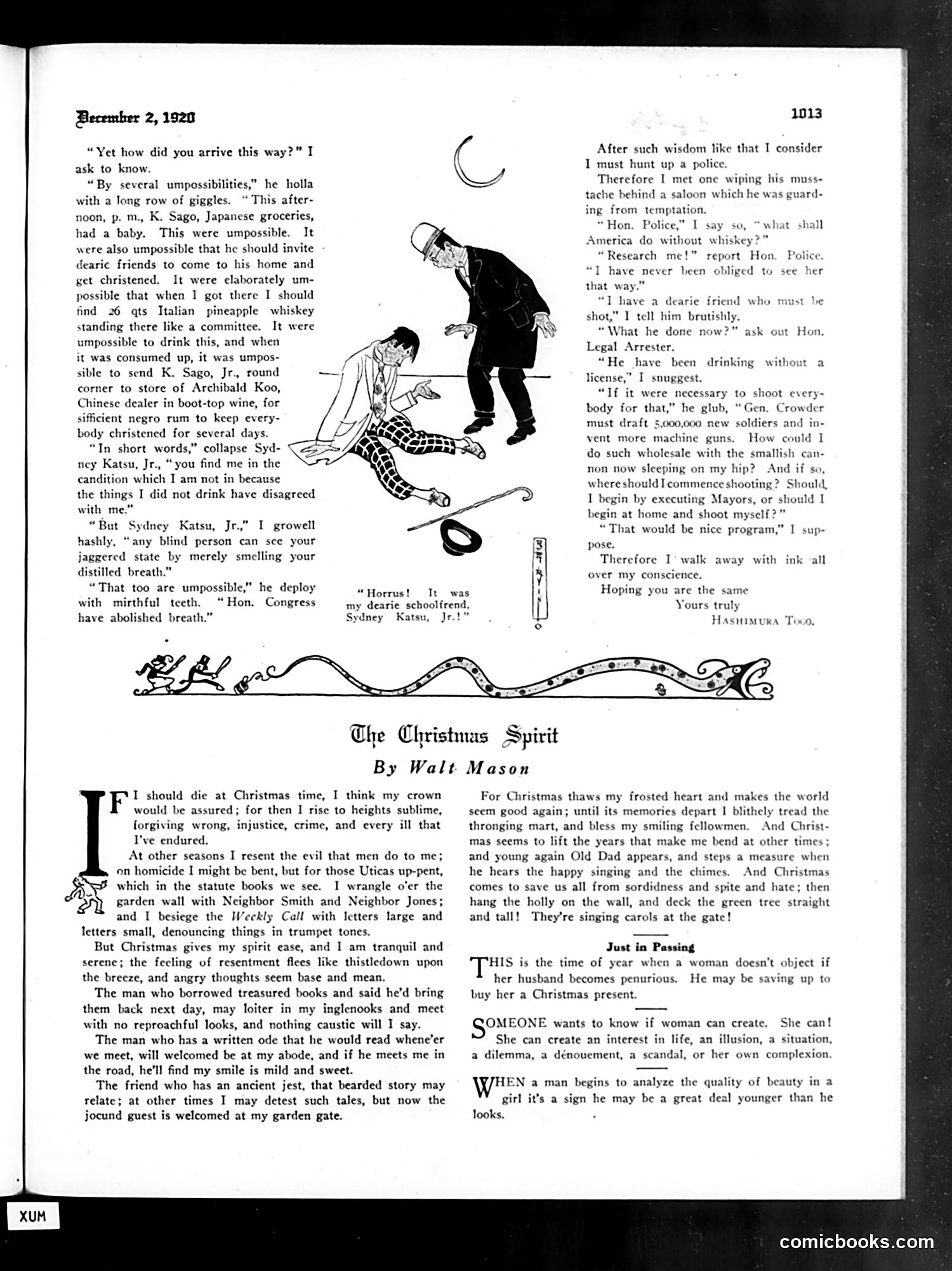
**The Cartoon (upper section):** This depicts a comedic encounter between the narrator and a heavily intoxicated Japanese-American man named Sydney Katsu Jr. The humor relies on exaggerated dialect and the character's absurd logic: he catalogs all the "impossibilities" that led to his drunkenness—from a baby christening at a Japanese grocer's to acquiring 26 quarts of Italian pineapple whiskey and Chinese bootleg wine. When confronted by a policeman about Prohibition violations, the drunk claims Congress has "abolished breath" itself. **The Context:** This satirizes Prohibition (1920-1933), enacted just months before this issue. The joke mocks both the law's obvious ineffectiveness and the creative rationalizations drinkers used. The exaggerated ethnic dialect reflects period stereotyping, presenting the violation as lighthearted rather than serious. **Below: "The Christmas Spirit" by Walt Mason** This sentimental poem celebrates Christmas's power to inspire forgiveness and kindness, contrasting festive generosity against year-round resentment.
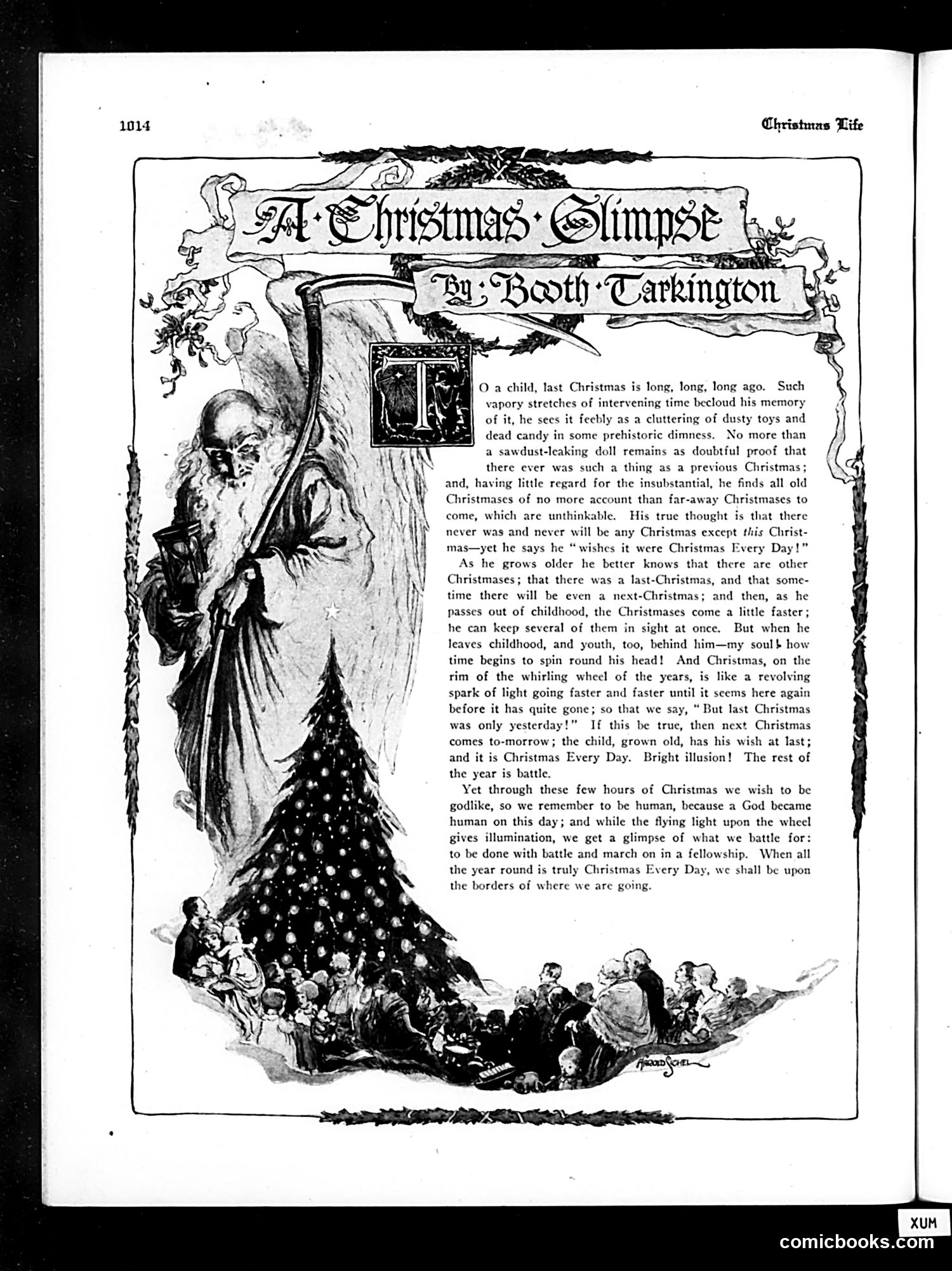
This is a philosophical essay, not a political cartoon. Tarkington reflects on how children and adults experience Christmas differently. A child perceives only the immediate Christmas before them, wishing "it were Christmas Every Day." As one ages, the ability to recognize multiple Christmases past and future develops—yet paradoxically, time accelerates so dramatically that Christmases blur together. An adult experiences each Christmas as if it were "only yesterday," effectively achieving the child's wish through temporal distortion rather than fulfillment. The essay's deeper message is spiritual rather than satirical: Tarkington argues that true meaning lies not in Christmas's repetition but in using those hours to transcend "battle" and embrace human fellowship. The imagery of a "revolving spark" accelerating around "the whirling wheel of the years" captures this vertigo of aging. The piece suggests that genuine progress occurs when everyday life achieves Christmas's values—compassion and community—making every day feel like Christmas.
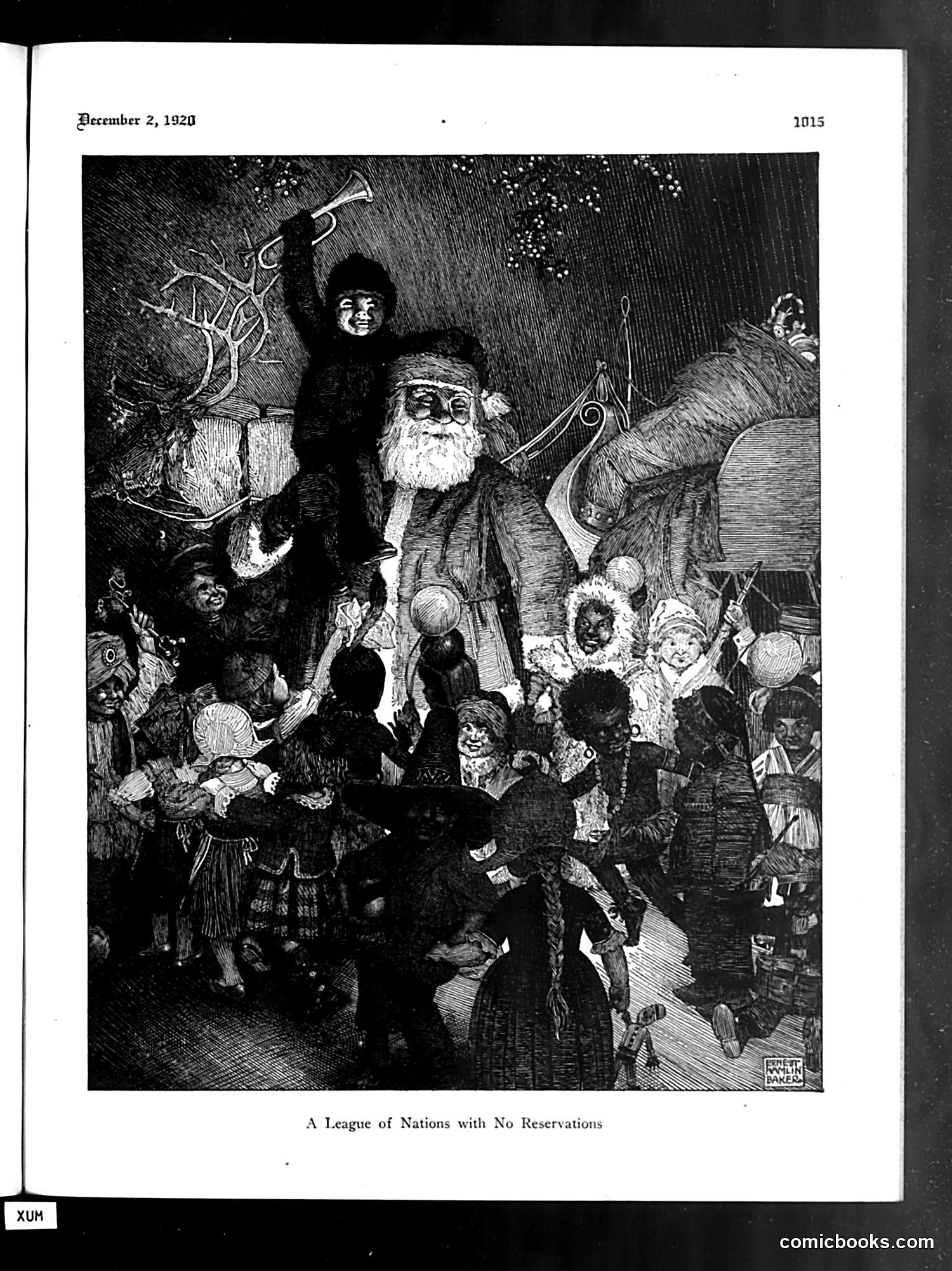
This December 2, 1920 cartoon titled "A League of Nations with No Reservations" depicts Santa Claus surrounded by diverse children. The satire addresses the League of Nations debate: many American senators, led by Henry Cabot Lodge, sought "reservations" (conditions) before ratifying the League Covenant. The cartoon suggests that without such reservations, the League would be like Santa's gift-giving—universally inclusive and uncritical. The children's diversity likely represents different nations, while Santa symbolizes either American generosity or naive idealism. The "no reservations" phrasing puns on both diplomatic conditions and Santa's unconditional gift-giving, mocking either isolationist concerns or internationalist optimism depending on the artist's stance. The image dates to America's ultimate rejection of League membership.
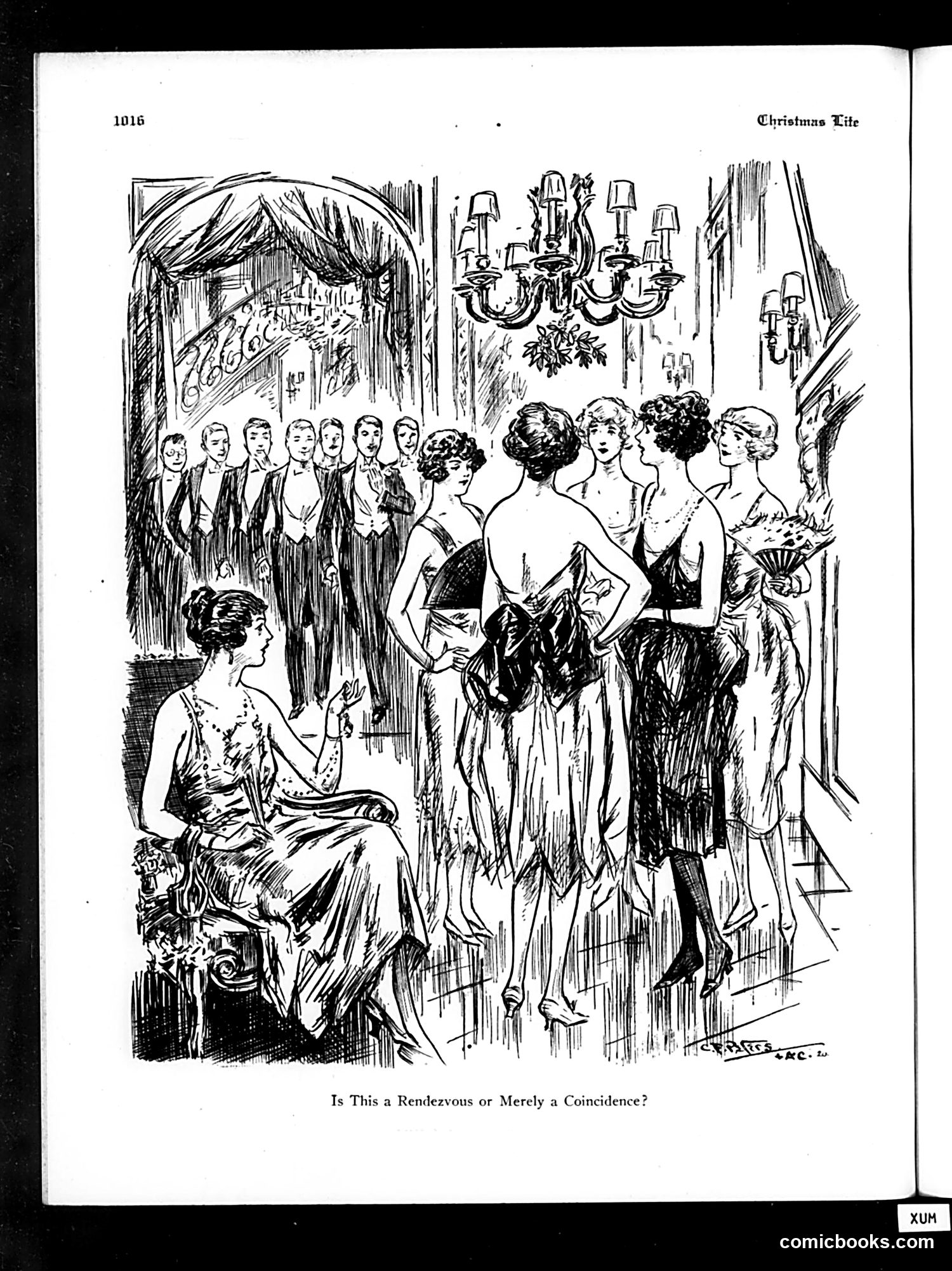
This sketch depicts a formal holiday social gathering, likely from the early 20th century based on the art style and fashion. A seated woman in an elegant gown observes a group of women in evening wear conversing with a line of men in formal attire in the background. The caption "Is This a Rendezvous or Merely a Coincidence?" suggests satirical commentary on social conventions—specifically, the pretense that chance encounters at formal gatherings are actually orchestrated romantic meetings. The humor targets upper-class social rituals where men and women's interactions were carefully managed despite being presented as spontaneous. The drawing's style and context suggest this is satirizing the artificiality of high-society Christmas events and courtship rituals of that era.
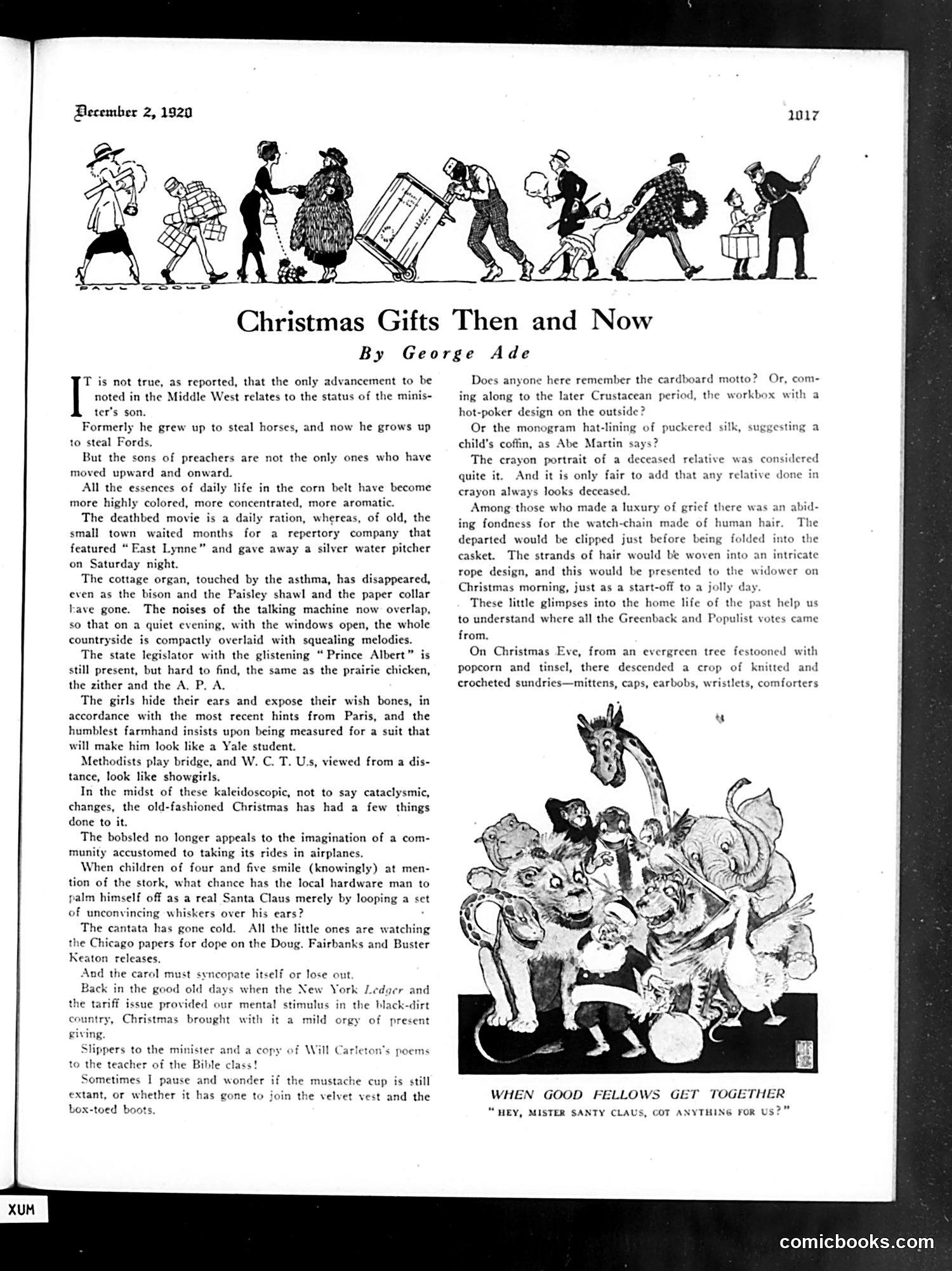
This satirical essay by George Ade contrasts rural Midwestern life before and after modernization. Ade observes how technology and cultural change have transformed Christmas traditions and social customs between the "good old days" and 1920. **Key points of satire:** - **Social mobility**: Ministers' sons once stole horses; now they steal Fords (automobiles) - **Entertainment shifts**: Silent films and phonographs replace traveling theater troupes - **Fashion/morality**: Young women expose "wish bones" (collarbones) per Paris fashions; Methodists play bridge; WCTU members look like "showgirls" - **Obsolete gifts**: Mustache cups, crayon portraits of deceased relatives, watch chains made from human hair, and embroidered workboxes represent outdated sentimental Victorianism - **Lost innocence**: Children no longer believe in Santa; they follow Douglas Fairbanks and Buster Keaton movie releases instead The satire gently mocks rural conservatism while documenting genuine cultural transformation—mechanization, cinema, fashion, and declining religious/sentimental traditions reshaping American life.
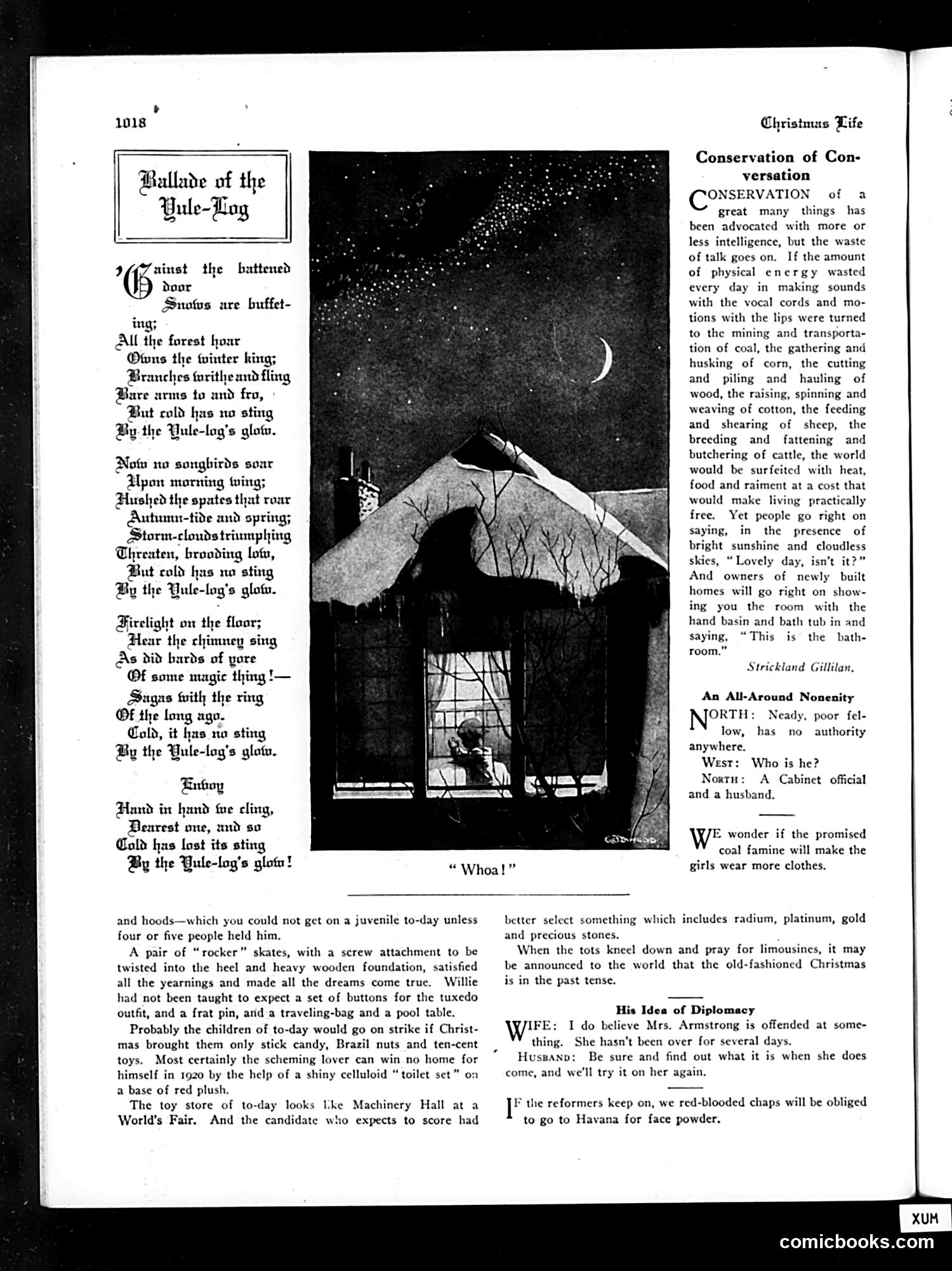
This page combines poetry and social satire typical of *Life* magazine's format. **"Ballade of the Yule-Log"** is a romantic poem celebrating how a fireplace provides warmth and comfort during harsh winter—a traditional Christmas theme. The accompanying illustration shows a cozy domestic scene viewed through windows, emphasizing the poem's message about domestic joy overcoming cold. **The satirical commentary** consists of brief social critiques: - **"Conservation of Conversation"** mocks people's wasteful chatter about obvious things ("Lovely day, isn't it?") and their tedious house tours, suggesting wasted energy could solve resource shortages. - **"An All-Around Nonentity"** is a joke about a forgettable Cabinet official—apparently so unremarkable that even his wife's identity is his only distinguishing feature. - **The closing quips** satirize modern materialism: children now demand expensive gifts (radium, platinum, limousines) rather than simple toys; and men must buy luxuries like face powder to win romantic favor—mock-critiques of changing consumer culture and gender norms in post-WWI America.
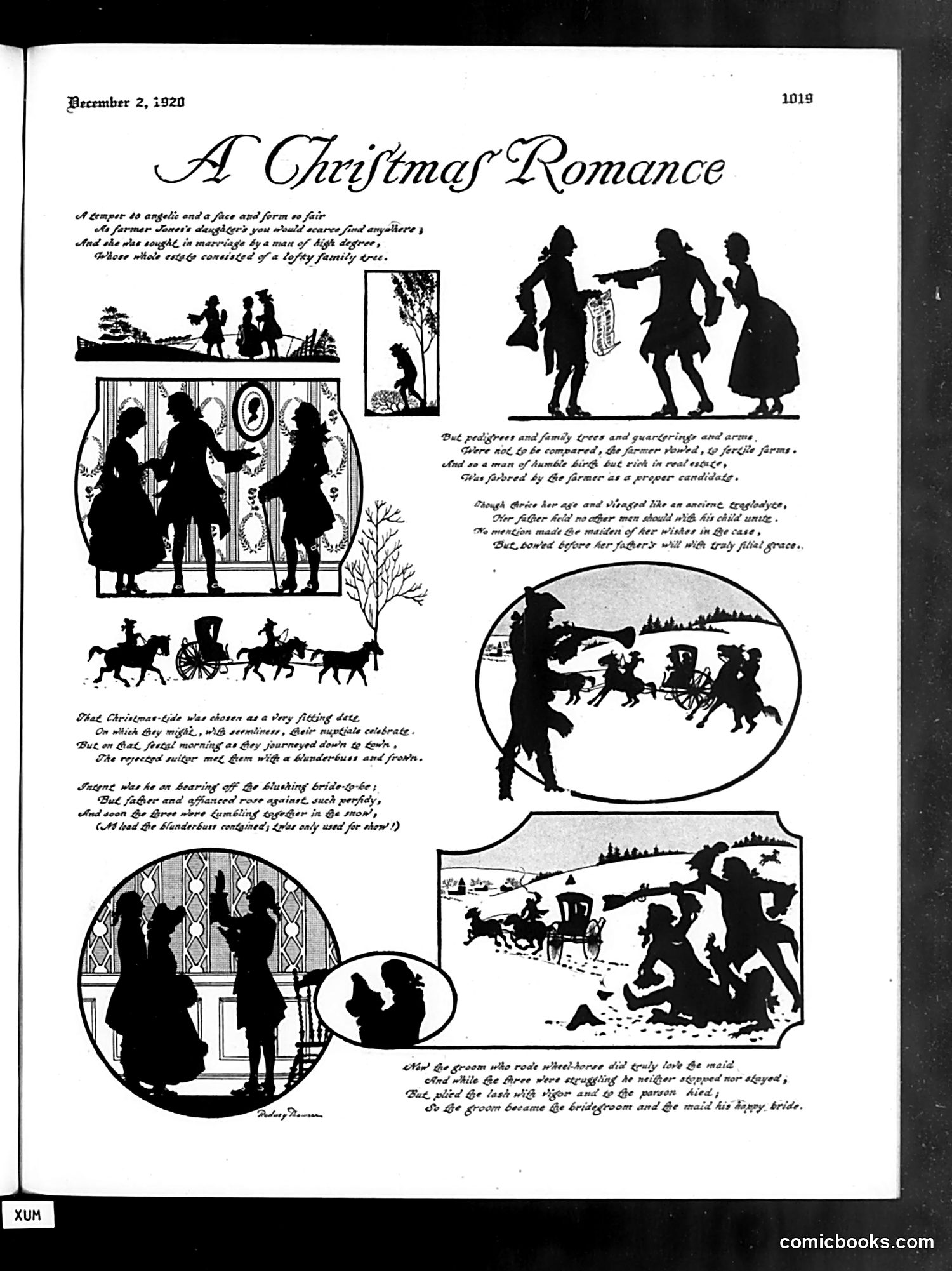
This is a silhouette narrative comic depicting a romantic comedy in the tradition of rural/pastoral tales. The story follows a farmer's beautiful daughter sought in marriage by a wealthy nobleman with impressive pedigree but no real wealth ("lofty family tree"). The farmer prefers a humble but honest suitor. On Christmas Day, as the family travels to the wedding, the rejected nobleman attempts to abduct the bride with a blunderbuss (an old-fashioned gun). A chase and struggle ensue—though the gun only contains harmless doves, a comedic detail. The true suitor whips his horse, reaches the clergyman first, and marries the girl before the nobleman can intervene. The satire mocks the pretensions of nobility and emphasizes that genuine love and action trump inherited status. It's a straightforward morality tale dressed as period adventure—snobbish aristocracy loses to honest working-class virtue.
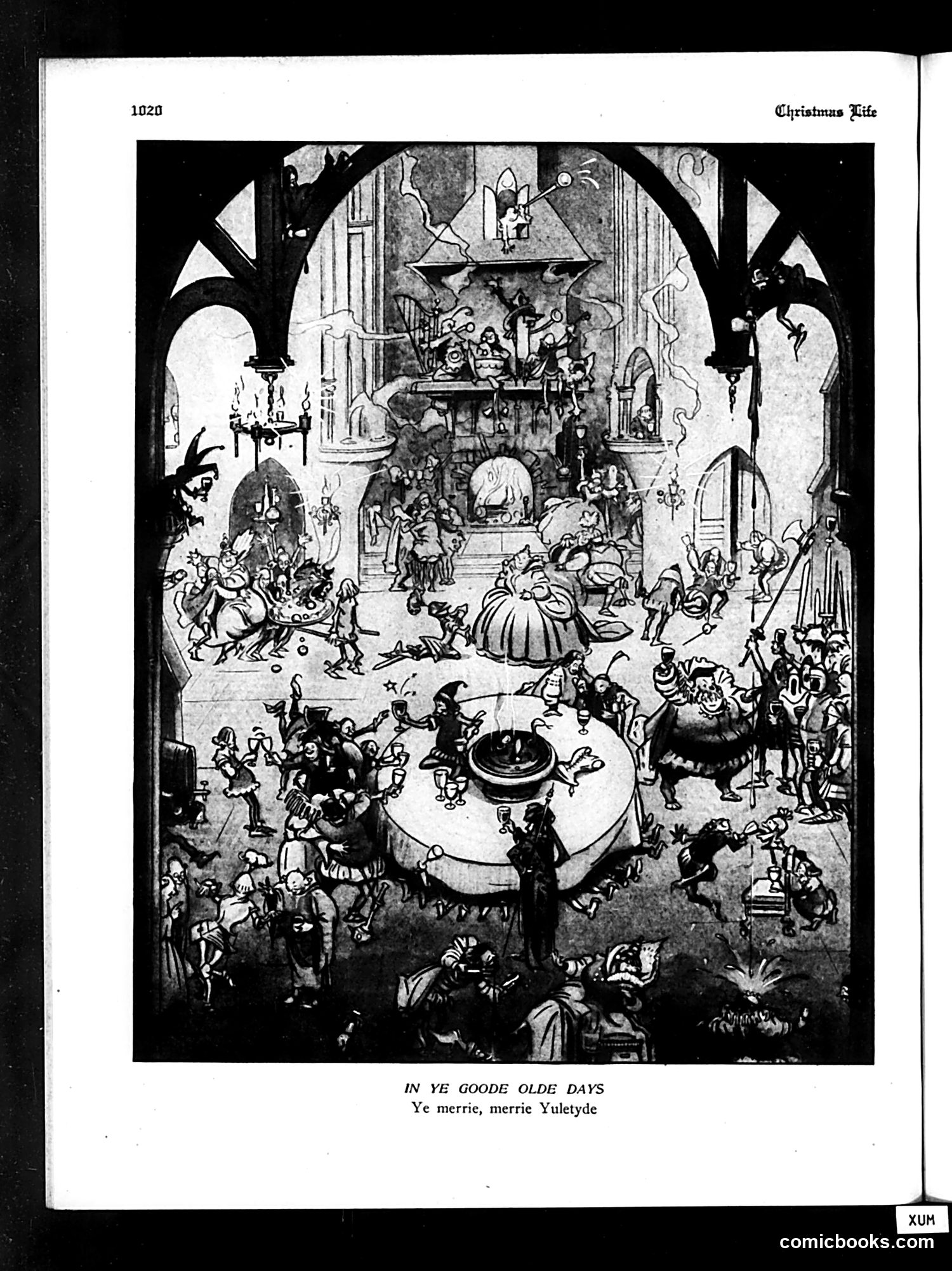
This is a festive Christmas illustration titled "In Ye Goode Olde Days," depicting a nostalgic medieval or Tudor-era holiday celebration. The image shows a grand hall filled with numerous figures engaged in merrymaking—dancing, feasting, and revelry around a central circular space, with musicians and performers on elevated platforms. The satirical point appears to be **ironic nostalgia**: the caption's archaic language ("Ye goode olde days," "merrie Yuletyde") romanticizes a past era of uninhibited celebration and excess. For early 20th-century American readers, this likely referenced contemporary debates about Christmas traditions and social propriety. The crowded, chaotic nature of the scene—with its abundance of activity and apparent lack of restraint—may satirize either the desire to return to "simpler times" or criticisms of modern Christmas becoming overly commercialized or constrained. The detailed, busy composition itself is characteristic of Life magazine's visual humor style.
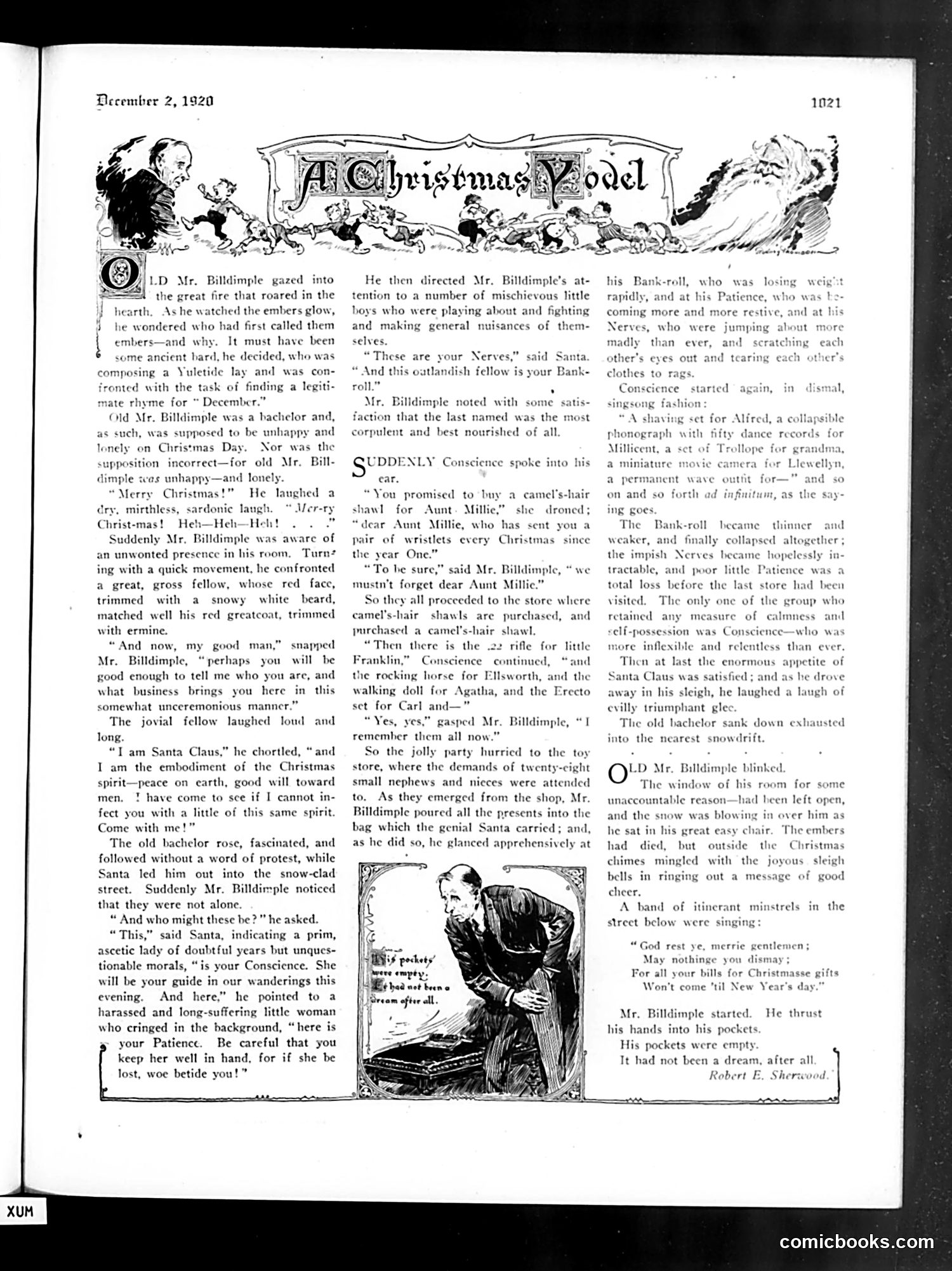
This is a satirical Christmas story about Mr. Billdimple, a lonely bachelor visited by Santa Claus who represents the Christmas spirit. Santa guides him through a moral lesson featuring allegorical characters: Conscience, Patience, his Nerves (mischievous boys), and his Bank-roll (a corpulent fellow). The satire targets post-WWI economic anxiety. As Conscience pushes Billdimple to buy gifts for numerous relatives—a camel's-hair shawl, rifles, rocking horses, toy sets—his "Bank-roll" becomes visibly exhausted and "collapsed altogether." His "Nerves" grow "hopelessly intractable," and "Patience" becomes "a total loss." The joke: holiday gift-giving expectations drain financial resources and emotional resilience, particularly acute in 1920 during economic uncertainty following World War I. The story mocks both the commercialization of Christmas and the psychological toll of familial obligations disguised as seasonal generosity.
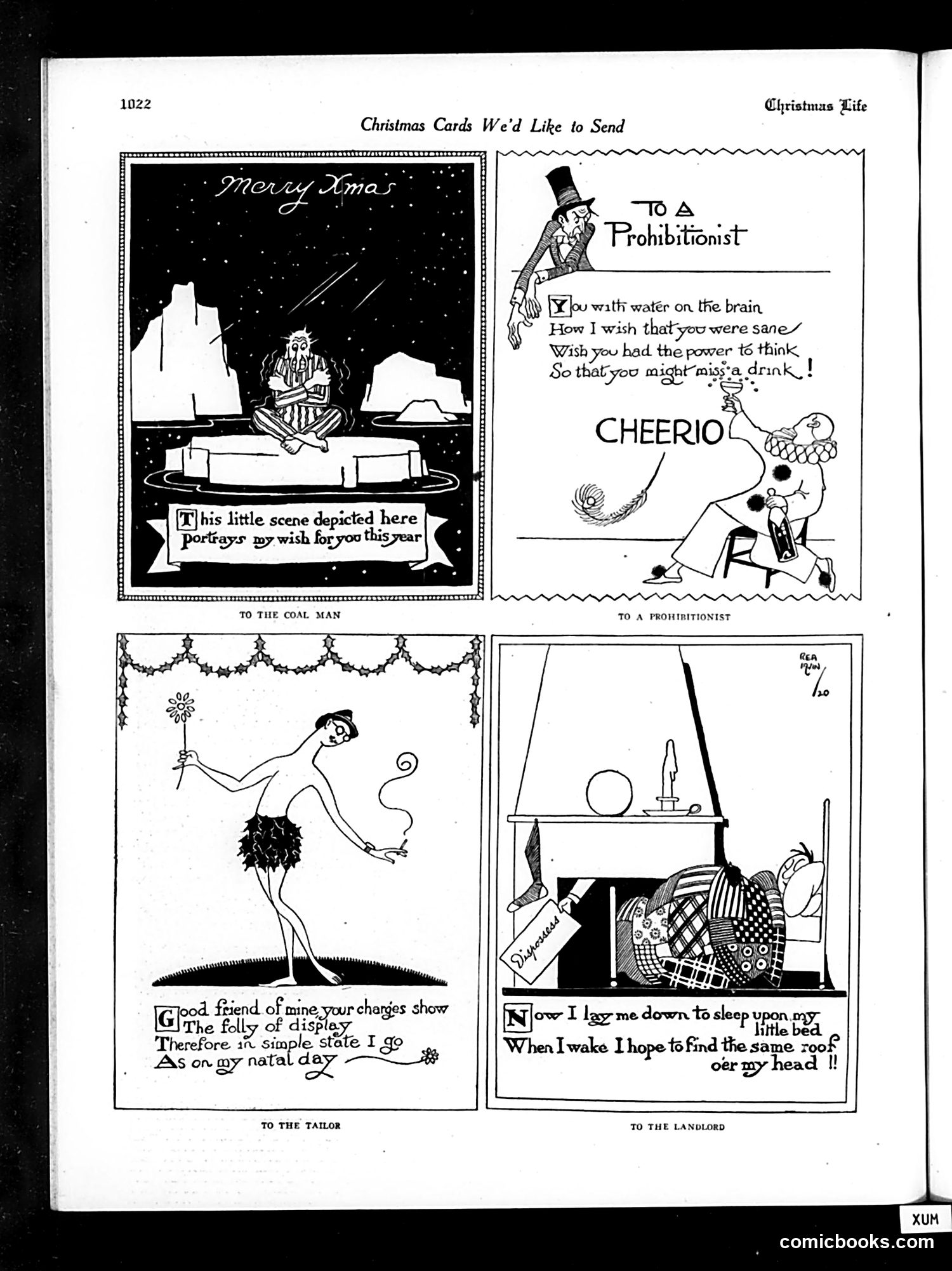
This page from *Life* presents satirical Christmas cards mocking various social figures during the Prohibition era (likely 1920s-early 1930s). **"To a Prohibitionist"**: Mocks temperance advocates by wishing they had "water on the brain" and could "miss a drink"—suggesting prohibitionists are foolish and hypocritical. **"To the Coal Man"**: References wartime/postwar coal shortages and price-gouging; the sender wishes to give modest gifts rather than lavish ones due to inflated costs. **"To the Tailor"**: Satirizes tailors' tendency toward ostentatious display, wishing the tailor would dress more modestly. **"To the Landlord"**: A bitter complaint about housing conditions and unaffordable rent, hoping to keep the same roof overhead—suggesting financial struggle. The cards collectively lampoon economic hardship, profiteering, and the unpopular Prohibition movement through mock Christmas wishes expressing opposite sentiments from genuine goodwill.
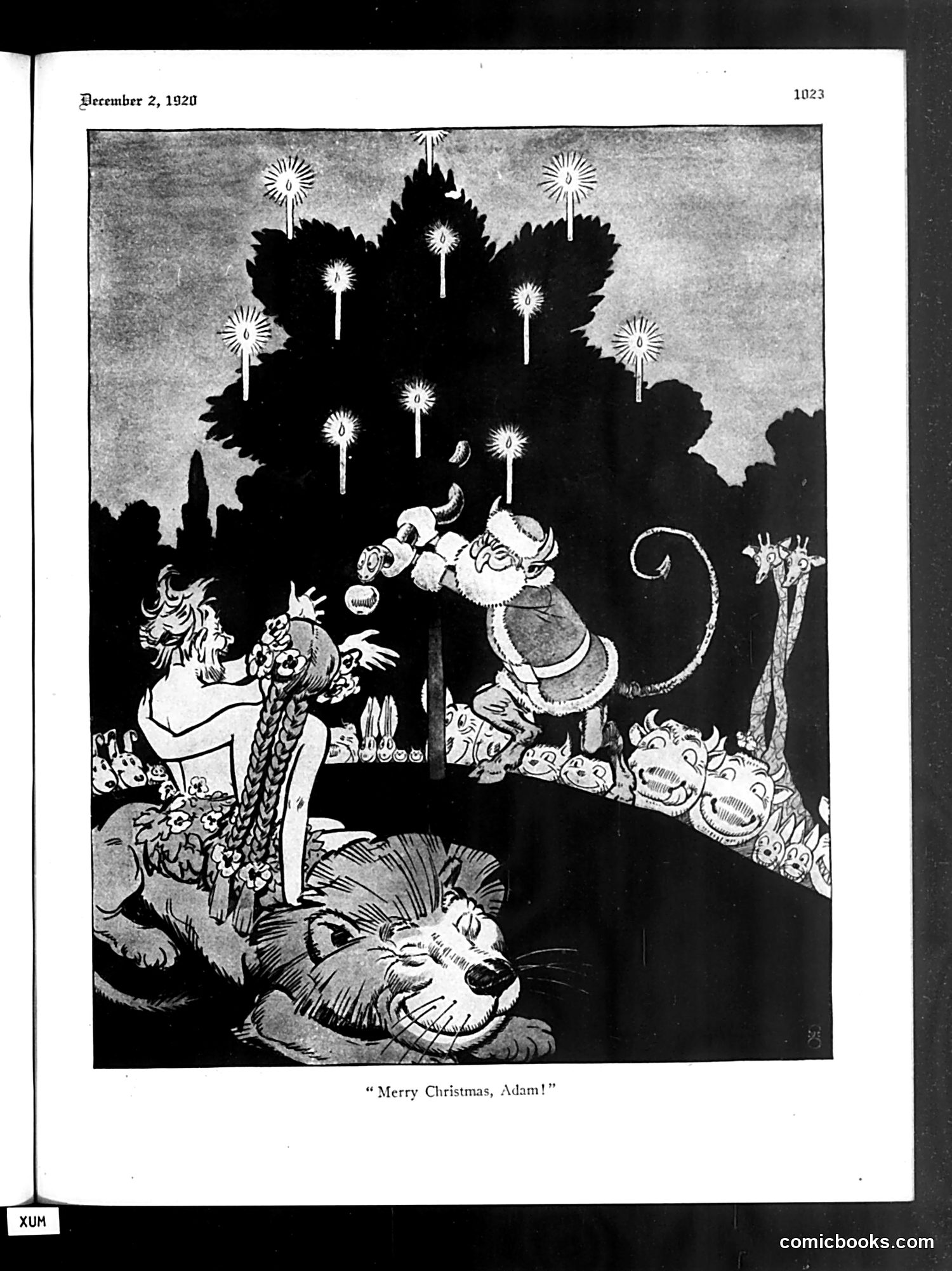
This appears to be a satirical Christmas illustration from *Life* magazine. The image depicts Santa Claus delivering gifts to various fantastical or grotesque creatures gathered around a dark, ominous tree with glowing lights. The caption "Merry Christmas, Adam!" suggests a reference to the biblical Adam, implying these creatures represent humanity or human nature in its base form. The satire likely comments on post-WWI society or contemporary American life circa 1920—the creatures' exaggerated, sometimes monstrous appearance may mock political figures, social groups, or human vices receiving their "just deserts" during the Christmas season. Without additional context identifying specific figures, the exact political targets remain unclear, though the overall tone suggests dark commentary on who "deserves" Christmas blessing.
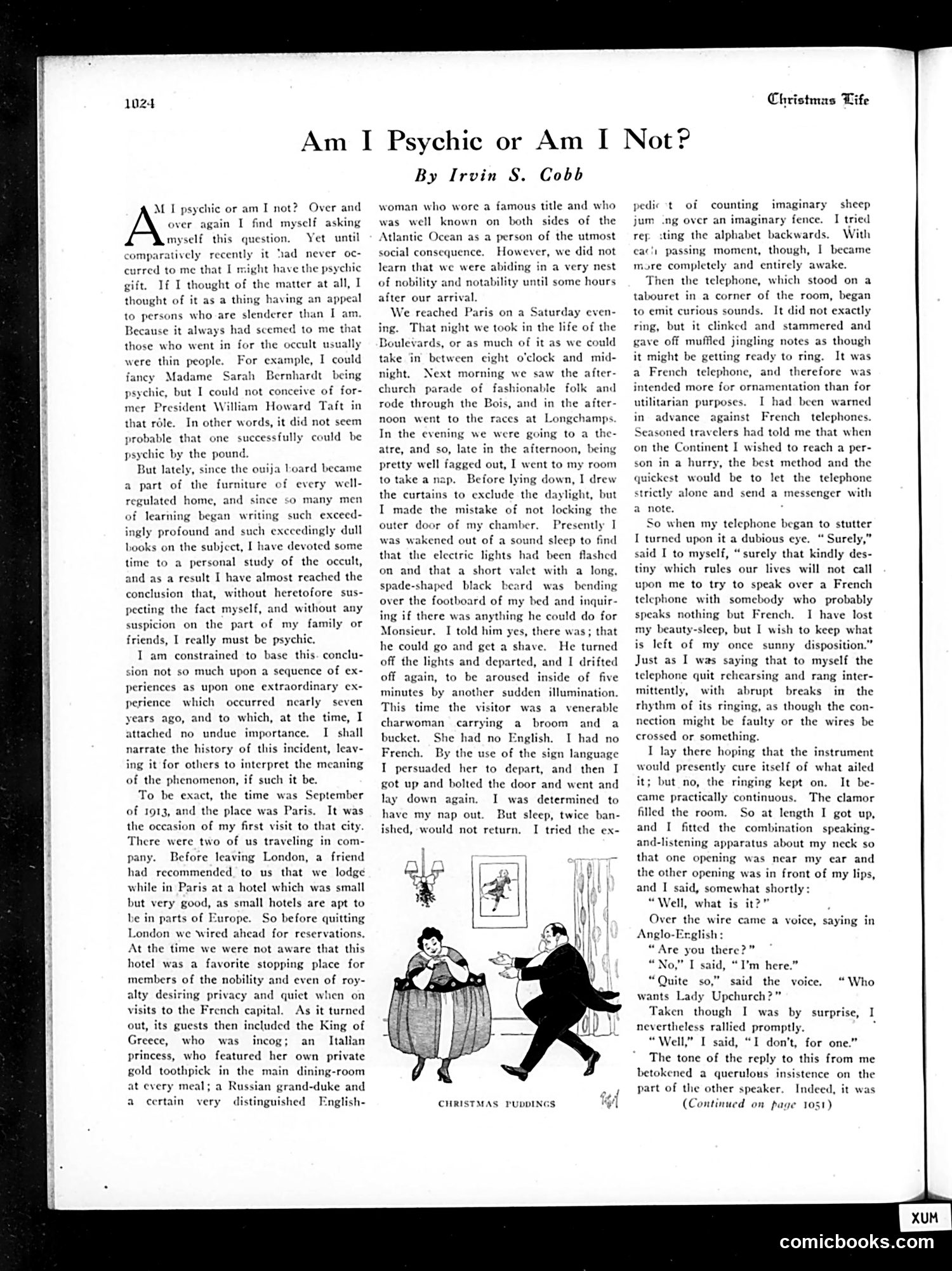
This is the opening installment of a humorous essay by well-known American humorist Irvin S. Cobb, published in *Life* magazine around 1913-1914. The accompanying cartoon shows two figures in what appears to be a séance or spiritualist setting—reflecting the early 20th-century American fascination with Ouija boards and occult phenomena that Cobb references in his text. The essay's satire targets this contemporary craze for spiritualism and psychic claims. Cobb sets up the joke by noting that he's "almost reached the conclusion" he possesses psychic abilities, then promises to recount "one extraordinary experience" from a 1913 Paris trip to justify this claim. The humor lies in the expectation that his "proof" of psychic powers will likely be mundane or coincidental rather than genuinely supernatural—a common target of satirical debunking of spiritualism's popularity among educated, gullible audiences of the era.
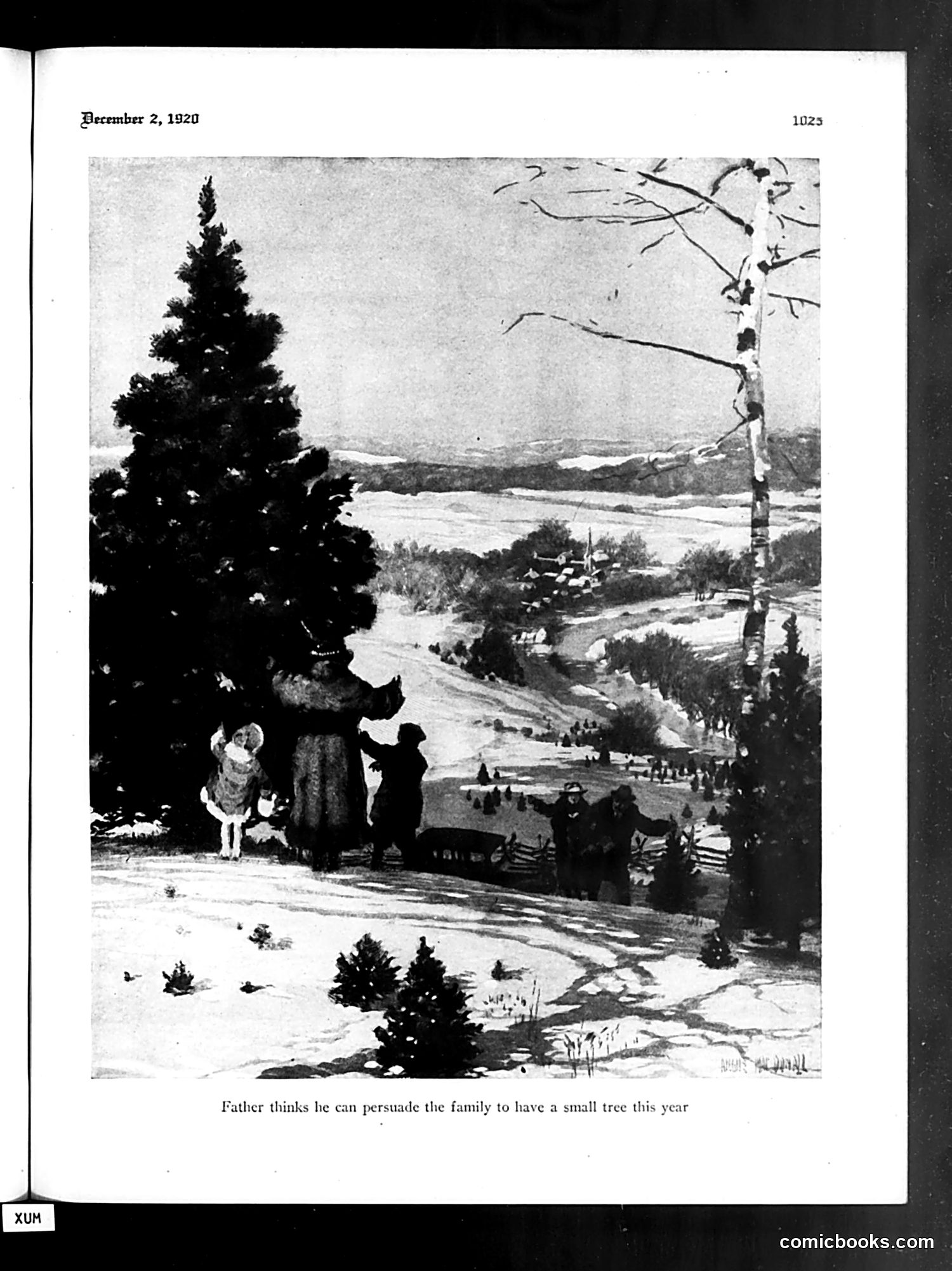
This is a gentle domestic cartoon about Christmas planning. The caption reads: "Father thinks he can persuade the family to have a small tree this year." The image shows a father figure gesturing toward the landscape while family members (appearing to be a mother and children) stand nearby. A large evergreen tree dominates the left foreground, with a bare birch tree on the right. The expansive rural vista suggests they're viewing the family's property. The humor lies in the father's optimistic delusion—he believes he can convince his family to accept a modestly-sized Christmas tree, when the naturally magnificent landscape (with its abundance of large trees) surrounds them. The satire gently mocks fathers' perpetual underestimation of family expectations during holiday season, and the humorous gap between "small" and what nature actually provides.
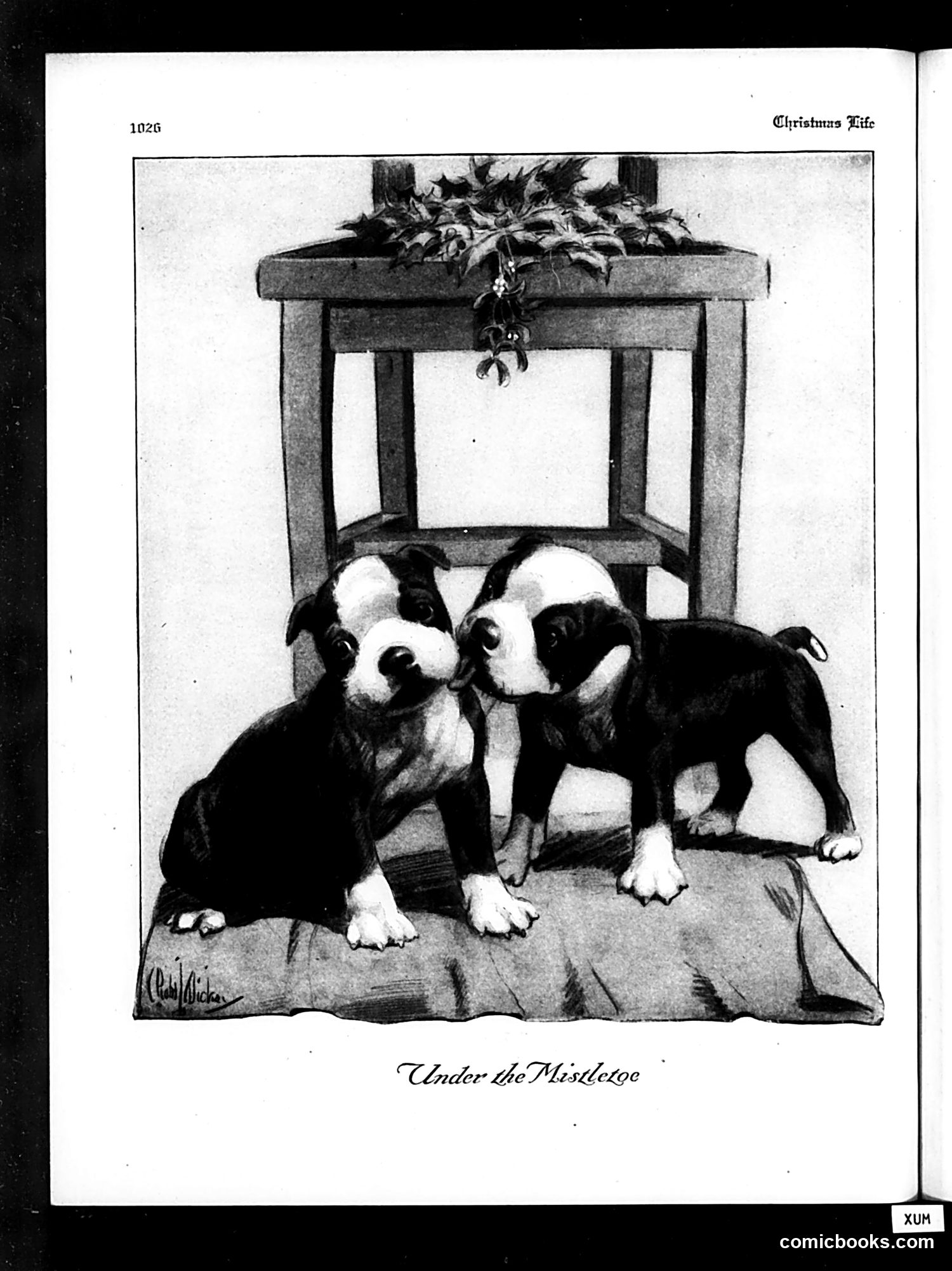
This appears to be a sentimental Christmas illustration rather than political satire. It depicts two small dogs (possibly puppies or terriers, one black-and-white) sitting together on a cushion beneath a wooden chair decorated with mistletoe and holly above them. The title "Under the Mistletoe" plays on the Christmas tradition where couples kiss under mistletoe. The artist has humorously applied this romantic custom to the dogs, suggesting they're about to kiss—a charming, domestic scene meant to evoke warmth and holiday sentiment. The page number and "Christmas Life" header indicate this is from Life magazine's holiday issue. The illustration uses sentimental animal humor typical of early 20th-century American comic periodicals.
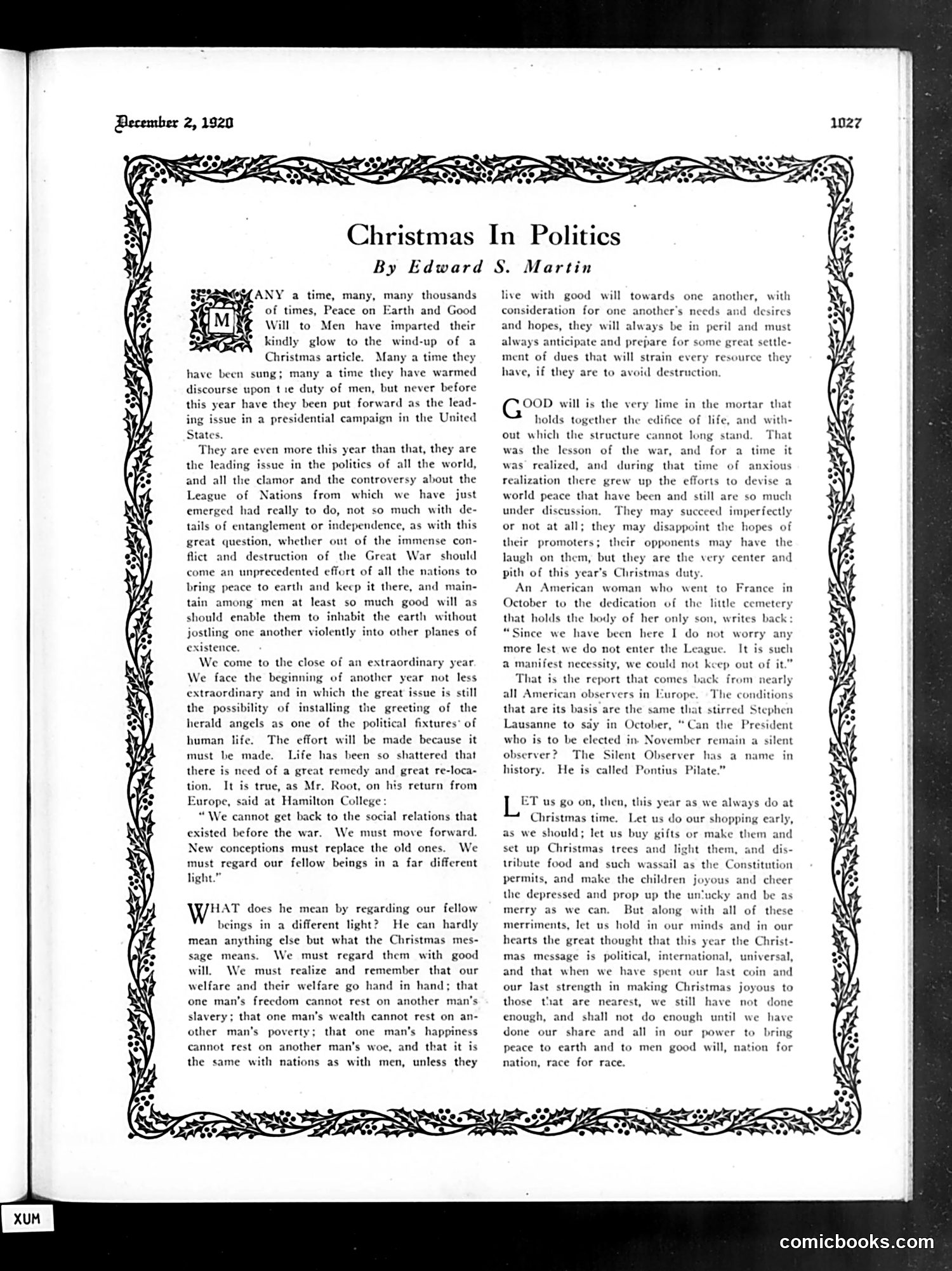
This is not a cartoon but a serious editorial essay by Edward S. Martin arguing for international peace and goodwill as the central political issue of 1920. **Historical Context:** The article addresses the League of Nations debate that dominated American politics after World War I (which ended November 1918). Martin argues that Christmas's message of "peace on earth and good will"—traditionally sentimental—has become the defining political question: whether nations should cooperate for lasting peace or retreat to isolationism. **Key References:** - "The Great War" and its destruction necessitate international cooperation - The League of Nations controversy (isolationists versus internationalists) - Root (likely Secretary of State Elihu Root) advocating new post-war social relations - An American woman's visit to a French military cemetery symbolizing the human cost of refusing collective security **The Point:** Martin contends that Christmas ideals—mutual welfare, shared responsibility, interdependence—must become practical politics, not merely sentiment, or nations will repeat cycles of conflict.
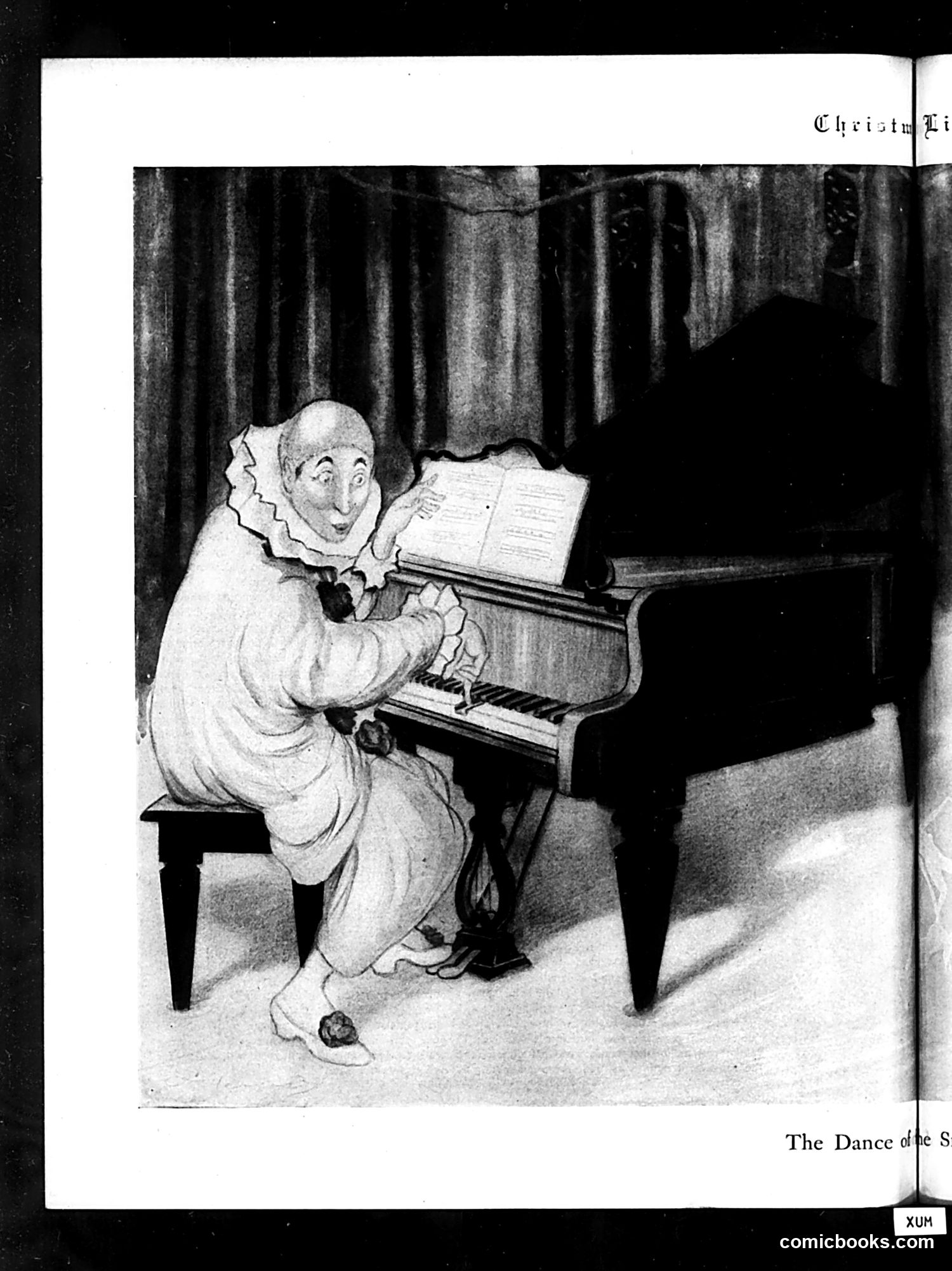
This page shows a caricatured figure at a piano, wearing Elizabethan-style clothing with a large ruff collar. The figure has exaggerated facial features typical of early 20th-century satirical art. The caption reads "The Dance of the S[...]" (text cut off), and the OCR mentions "Cheisty Li" at the top, though these references are unclear or incomplete. Without the full caption and context, the specific target of satire cannot be definitively identified. The Elizabethan costume suggests mockery of affected pretension or artistic pretentiousness, and the caricatured figure at the piano implies commentary on musical performance or performers. However, without clearer text or knowing the publication date and issue, I cannot reliably identify who is being satirized or what social/political point is being made. The style is consistent with Life magazine's early humorous illustration approach.
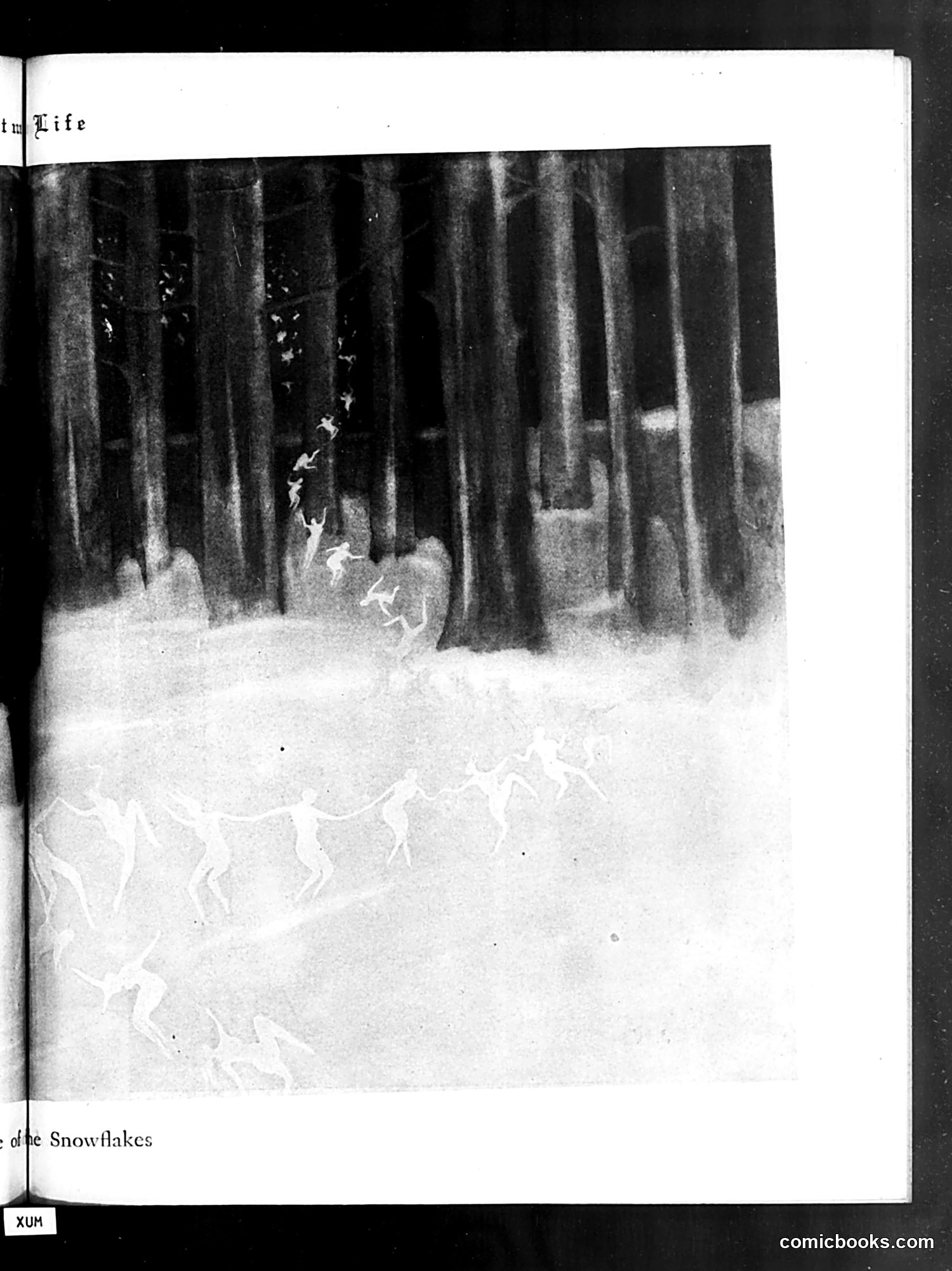
This appears to be an illustration from *Life* magazine showing figures dancing in snow in front of a dark forest. The visible text fragment references "Snowflakes," suggesting this is a whimsical or satirical depiction of winter activities. The image shows silhouettes of people in motion against snow, with dark tree trunks framing the scene. Without additional context or caption text visible on the page, the specific satirical point remains unclear. The style and composition suggest it could be commenting on winter social activities or perhaps offering social commentary through the metaphor of snowflakes—though the exact target of any satire cannot be determined from what's visible here.
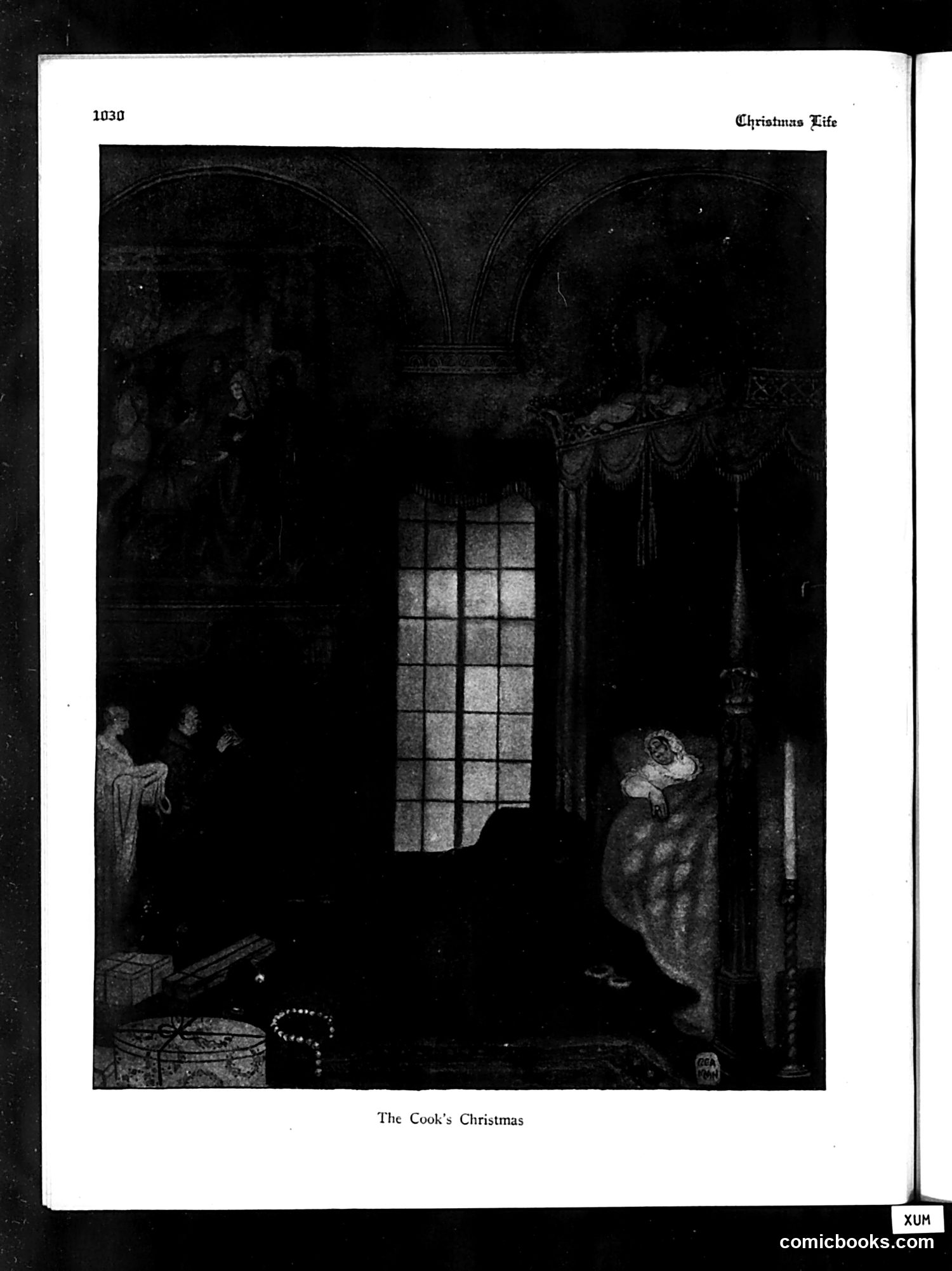
This illustration depicts a dark, Gothic interior scene titled "The Cook's Christmas." The image shows what appears to be a kitchen or servant's quarters with vaulted ceilings and a barred window. Several figures are present, though their exact identities remain unclear from the image alone. The satire likely contrasts the luxurious Christmas celebrations of wealthy households with the modest or bleak circumstances of domestic servants, particularly the cook. The stark architectural setting and dim lighting emphasize this class disparity. Without additional context about Life magazine's specific 1930 social commentary, the precise satirical target is uncertain, though it appears to critique class inequality during the holiday season.
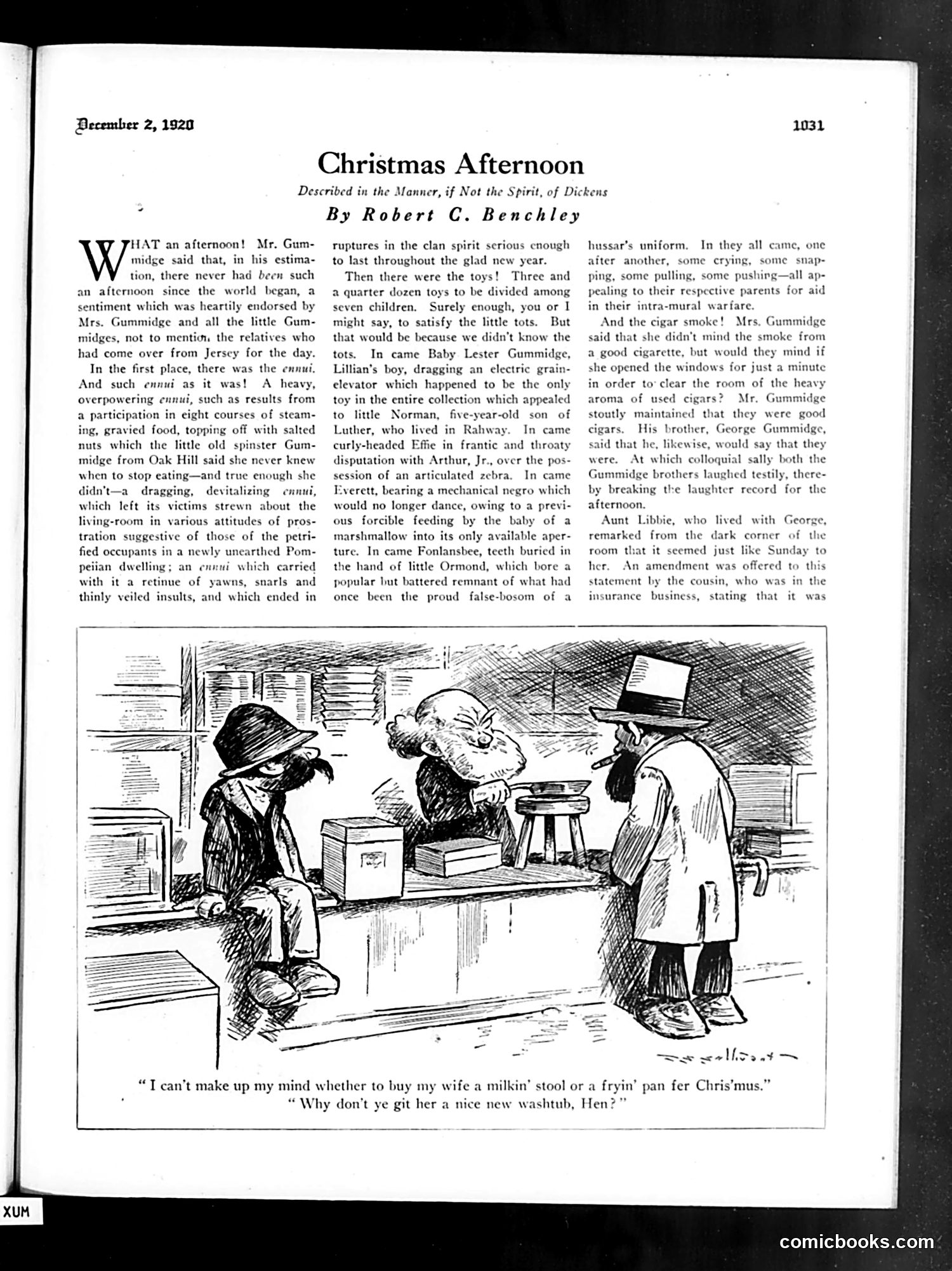
This is a humorous essay satirizing a chaotic family Christmas gathering, illustrated by a cartoon showing two men debating gift purchases with a shopkeeper. The text describes the Gummidge family's miserable holiday: guests overstuffed from eight courses of food, lying about in post-meal stupor like "petrified occupants" of Pompeii; seven children fighting over only three-and-a-quarter dozen toys (each wanting the same ones); and thick cigar smoke choking the house—which Mrs. Gummidge politely mentions, only to be dismissed by the men. The cartoon's joke captures this spirit: a working-class man cannot decide whether to buy his wife a "milkin' stool or a fryin' pan" for Christmas, while another suggests a washtub—practical domestic items presented as gift options, humorously highlighting the gap between romantic holiday expectations and utilitarian reality for ordinary families in 1920s America.
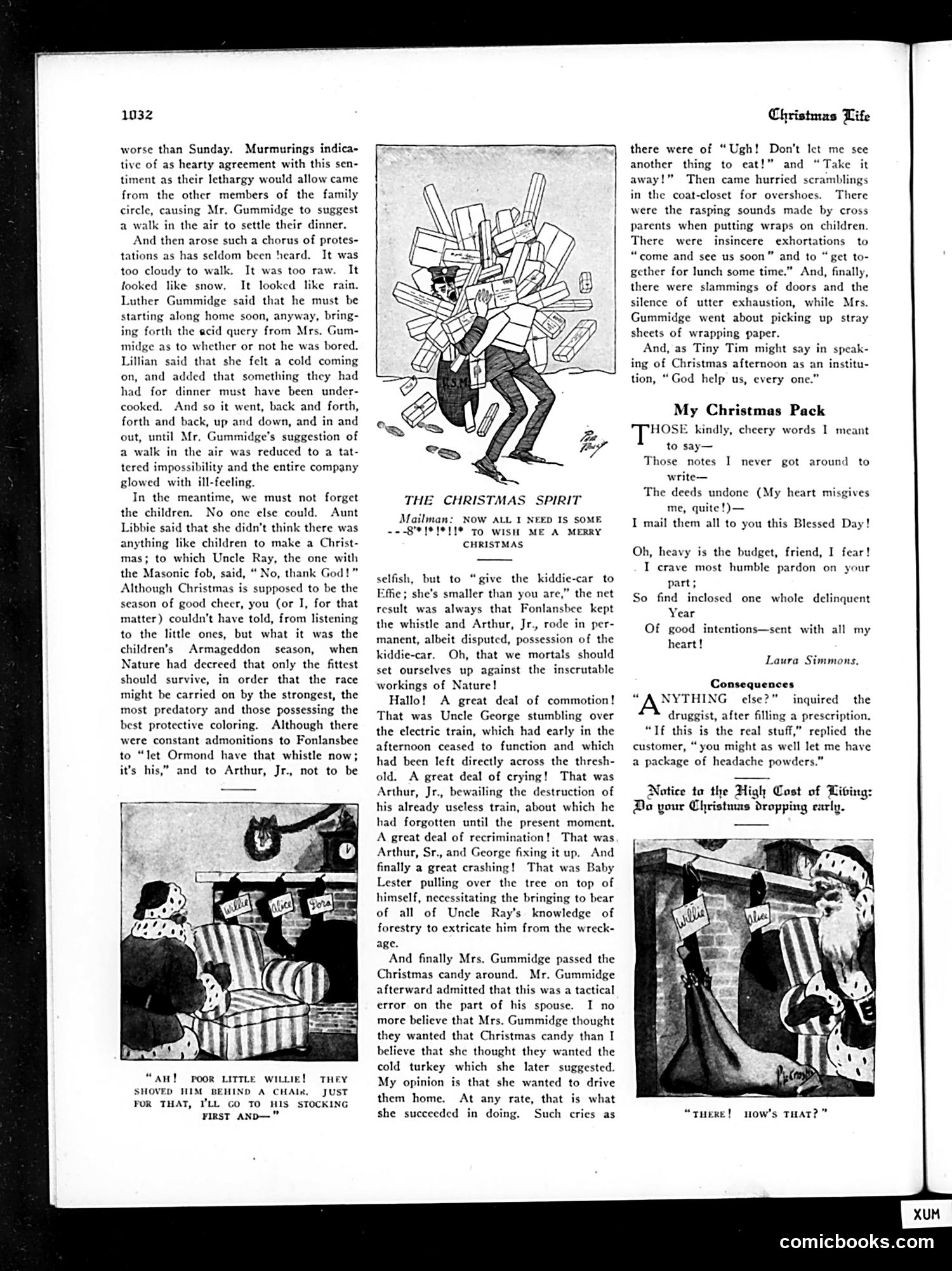
This satirical piece mocks the sentimentality surrounding Christmas family gatherings. The text describes the Gummidge household's thoroughly miserable holiday—characterized by complaints, conflicts, and ill-feeling disguised as cheerfulness. The central joke targets the gap between Christmas's supposed "spirit of good cheer" and actual family reality: petulant children fighting over toys, adults bickering about walks and undercooked food, and general dysfunction. Uncle Ray's comment—"No, thank God!" to the suggestion that children make Christmas special—encapsulates the satire's cynical view. The illustrations show typical holiday chaos: a child buried under wrapping paper and gifts (titled "The Christmas Spirit"), and children receiving presents while fighting. The piece concludes with Mrs. Gummidge strategically offering Christmas candy to drive her unwanted relatives out of the house—revealing that even holiday generosity masks hidden hostility. This reflects Life magazine's tradition of gently satirizing middle-class American pretense and hypocrisy through domestic situations.
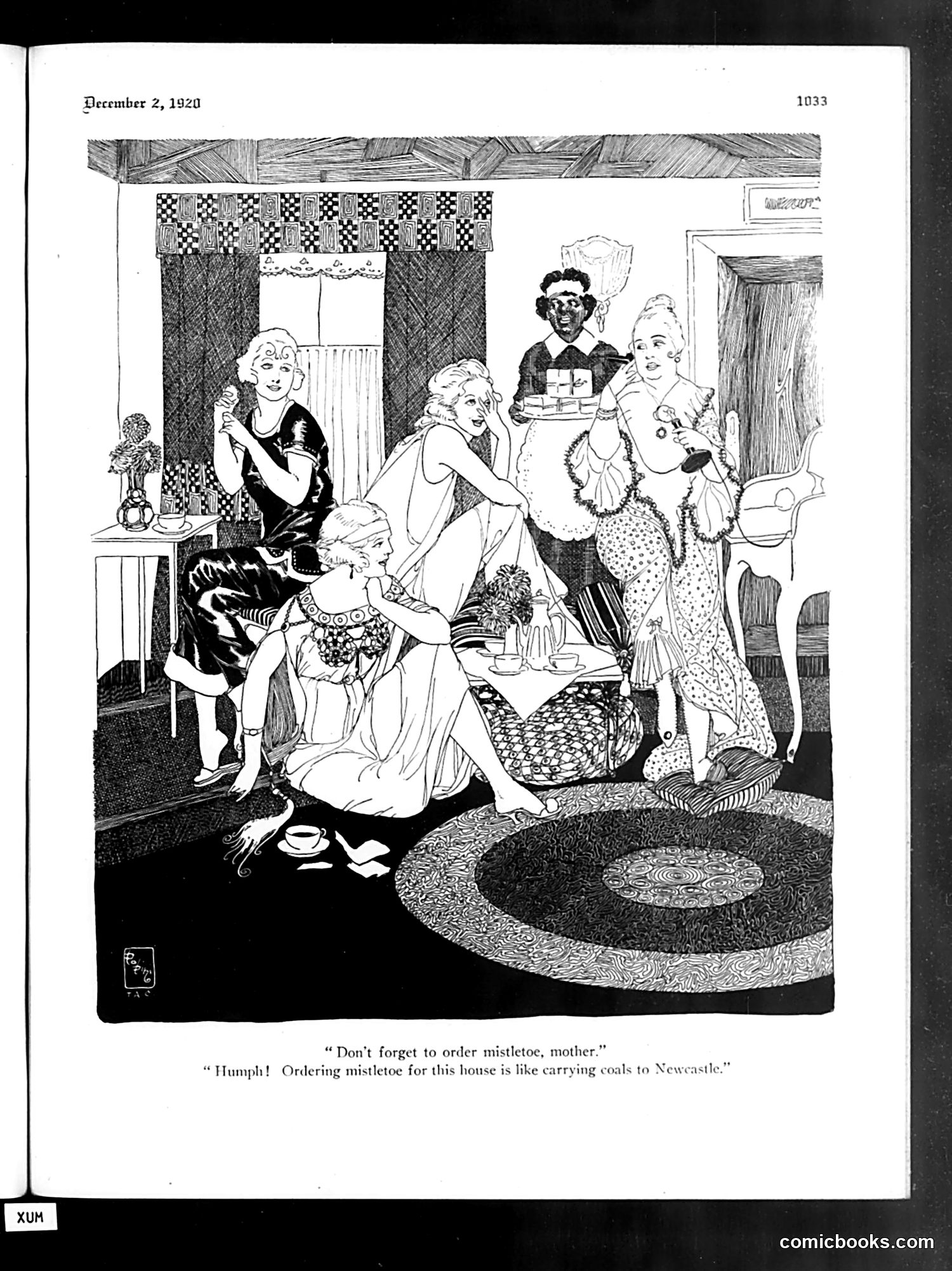
This is a single-panel cartoon from *Life* magazine (December 2, 1920) depicting a domestic holiday scene. A young woman reminds her mother to order mistletoe for Christmas decorations. The mother dismissively replies that ordering mistletoe is unnecessary—"like carrying coals to Newcastle" (an idiom meaning doing something pointless, since Newcastle was a major coal-producing region). The joke's implication: the house apparently has *so many* young men visiting or present that mistletoe is already plentiful and unnecessary as a romantic device. The illustration shows multiple fashionably dressed women entertaining male visitors in what appears to be an affluent home, suggesting the household's popularity or the women's romantic appeal makes additional mistletoe redundant. The cartoon satirizes 1920s dating culture and young women's social freedoms in the post-WWI era.
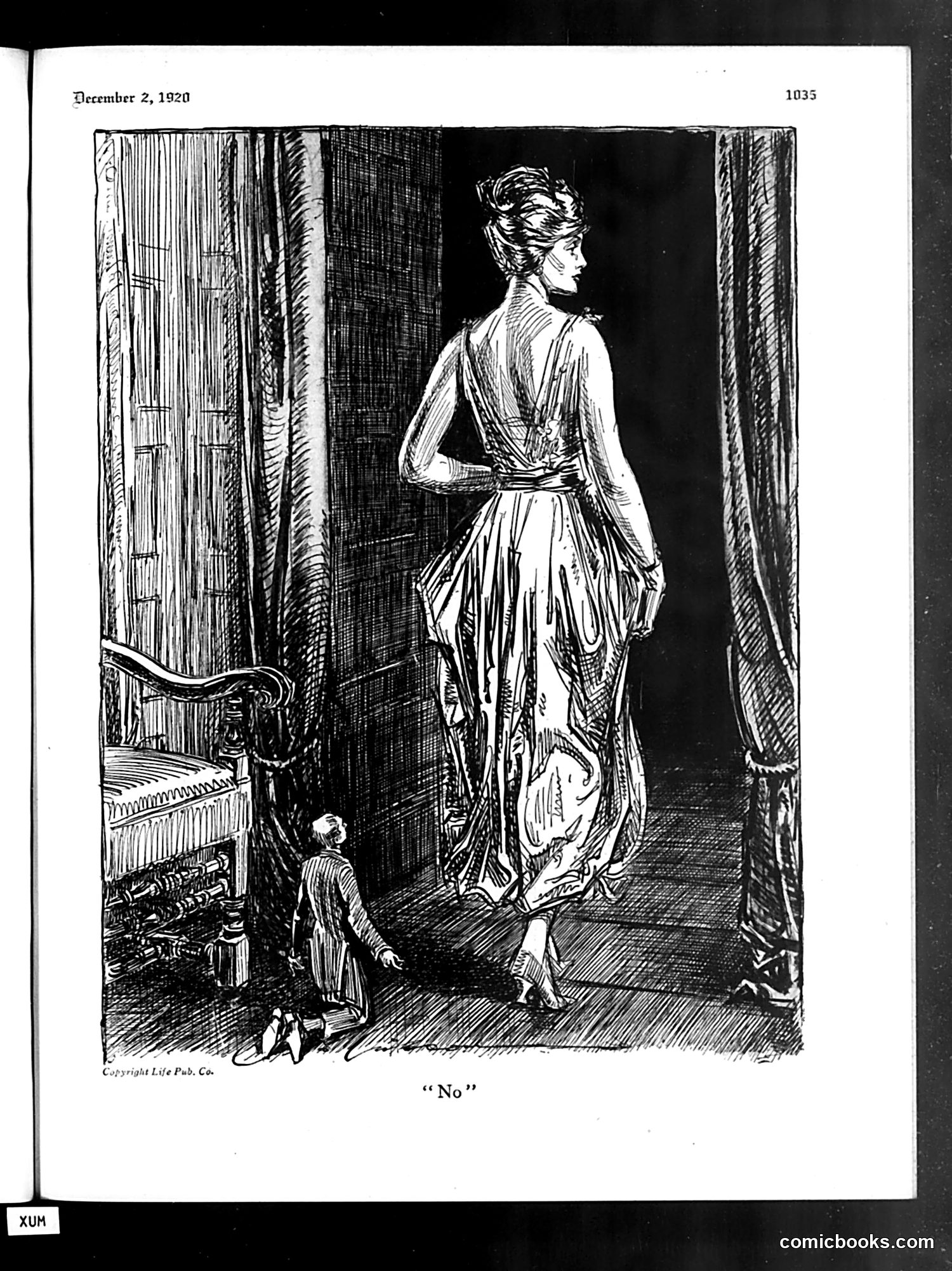
This Life magazine illustration depicts a woman in elegant evening wear standing in a doorway, viewed from behind. A small child stands nearby looking up at her. The single-word caption—"No"—appears to be satirizing the post-WWI "New Woman" and changing social attitudes toward courtship and marriage. The image likely comments on women's growing independence and refusal of traditional romantic advances or marriage proposals during the 1920s. The child's presence may suggest commentary on motherhood or domesticity versus women's newfound freedom. The sophisticated dress and composed posture emphasize the woman's agency in rejecting conventional expectations. Copyright attribution shows "Life Pub. Co.," confirming this is from the major American satirical publication.
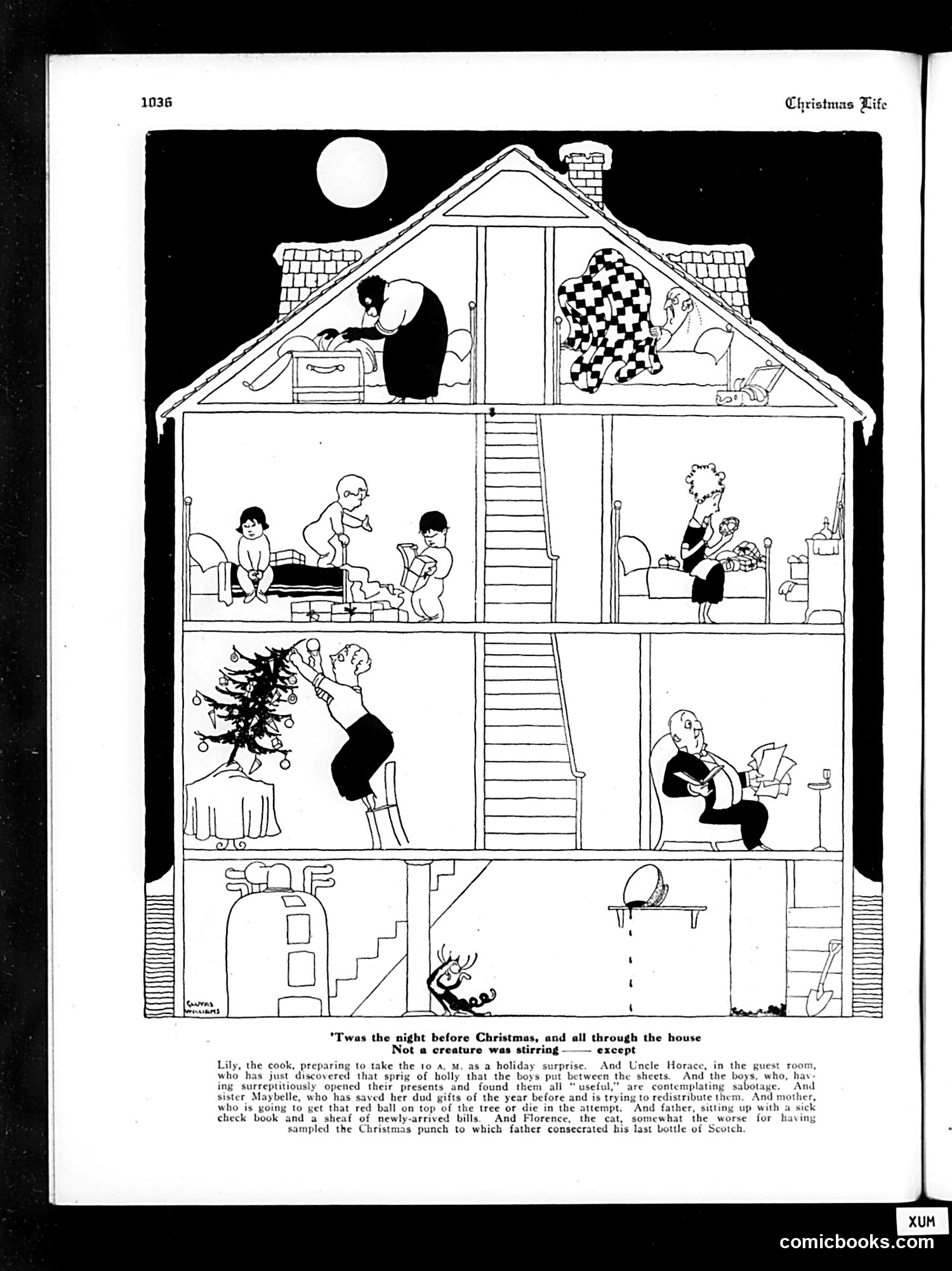
This is a humorous cross-section illustration of a chaotic Christmas Eve household, satirizing the gap between the idealized "peaceful night before Christmas" and actual family pandemonium. The cartoon mocks various domestic frustrations: a cook planning to skip work, uncle Horace discovering a prank (holly in his sheets), disappointed children plotting revenge over "useful" gifts, a mother desperately trying to secure a desired toy, a father stressed over bills and expenses, and the family cat drunk on spilled holiday punch and whiskey. The satire targets middle-class Christmas reality—financial strain, domestic chaos, failed gift-giving, and the contrast between Yuletide sentiment and everyday family dysfunction. The "except" in the opening line is key: everyone in the house is stirring, contradicting the famous poem's peaceful opening. It's gentle social commentary on how Christmas celebrations often create stress rather than harmony.
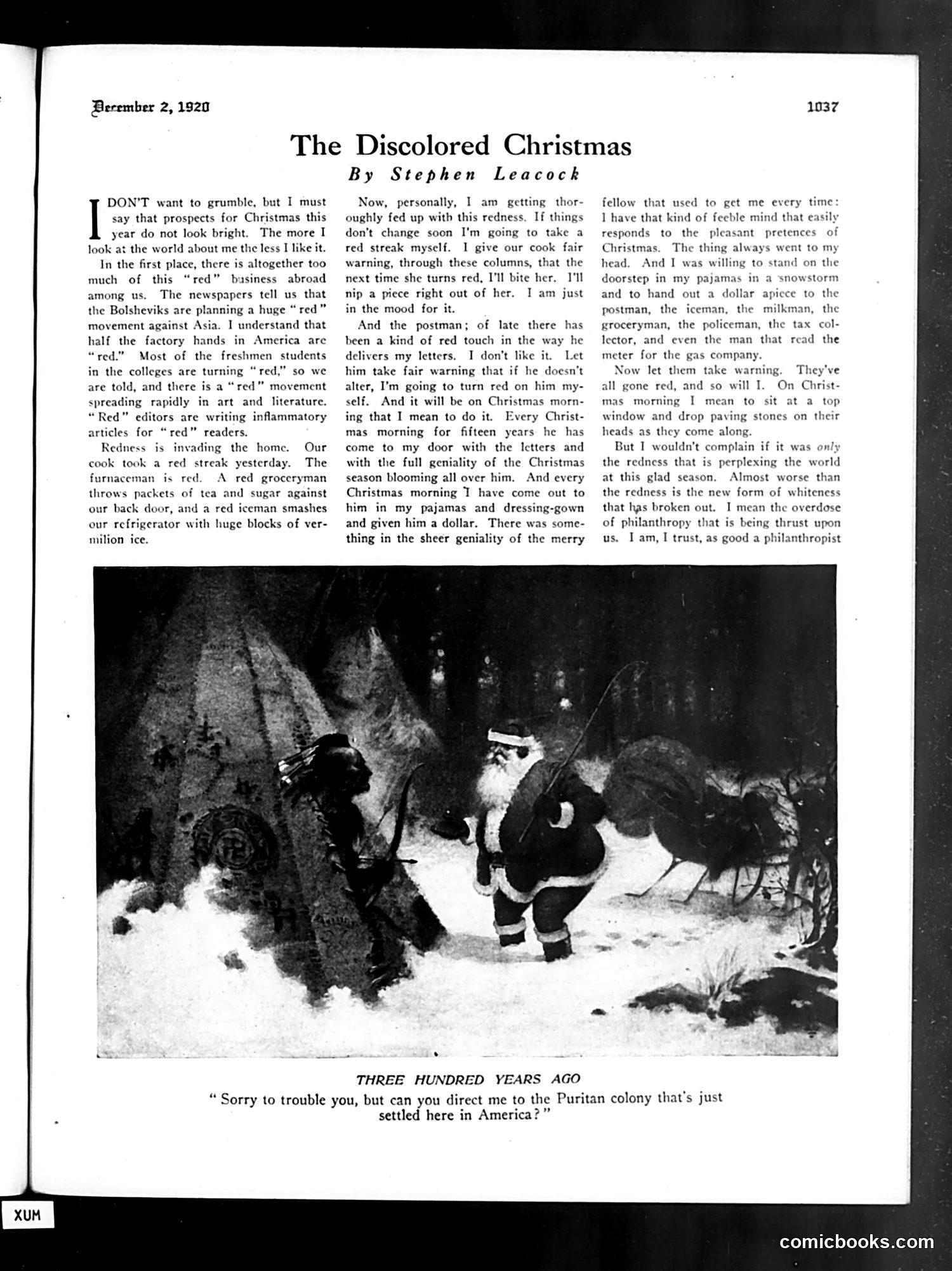
This satirical essay mocks two anxieties gripping post-WWI America: the "Red Scare" and excessive Christmas philanthropy. **The "Red" references**: Leacock targets anti-communist hysteria sweeping 1920 America. He catalogs widespread panic about "Reds"—Bolsheviks, factory workers, college students, artists, and editors allegedly promoting communist revolution. The joke is grotesque exaggeration: even the cook, grocer, iceman, and furnaceman are "red," with the iceman literally delivering "vermilion ice." **The cartoon**: Shows Santa encountering Native Americans, with the caption "Three Hundred Years Ago" and Santa asking directions to a Puritan colony. This appears to satirize Christmas as an American tradition imposed on indigenous peoples, perhaps commenting on colonial exploitation masked by festive sentiment. **The philanthropy complaint**: Leacock warns that excessive Christmas charity and goodwill toward service workers threatens to undermine his misanthropic resistance. He threatens to abandon his annual dollar-giving ritual and drop "paving stones" on deliverymen instead. The satire mocks both Red-baiting paranoia and performative holiday generosity.
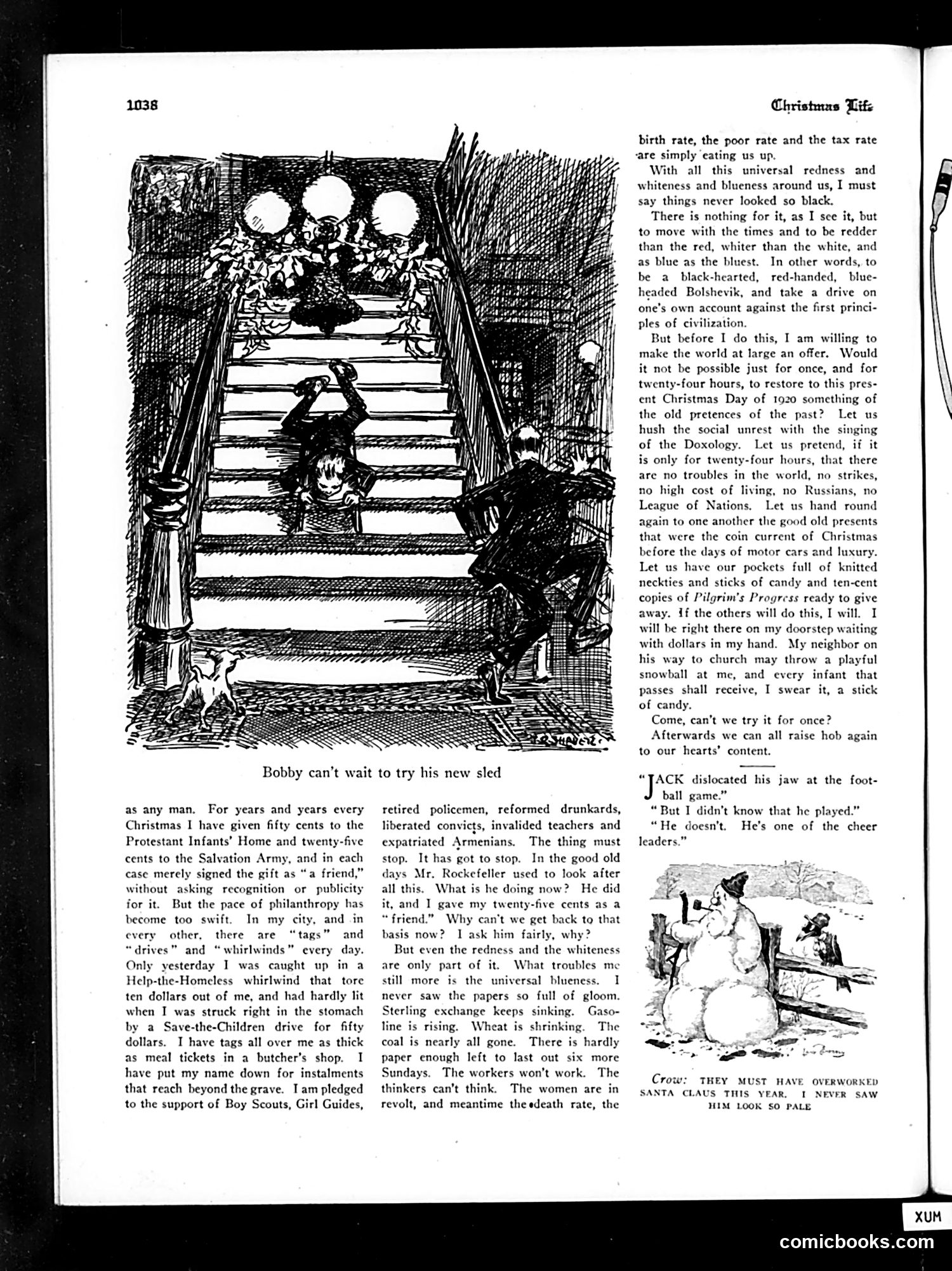
This page contains a satirical essay (likely from 1920) critiquing post-WWI American life. The author complains about charity "tag" and "drive" campaigns that demand constant donations, replacing the old system where wealthy philanthropists like Rockefeller handled poor relief. He employs color symbolism—red (social unrest/communism), white (wealth), and blue (depression)—to describe societal chaos, referencing "Bolsheviks," strikes, the Russian Revolution, and the League of Nations. The sarcastic proposal: restore a simpler 1920 Christmas by pretending all modern problems don't exist—no strikes, no high cost of living, no Russia—and exchange humble gifts (knitted neckties, candy, cheap books) instead of luxury goods. The cartoons show children sledding and a exhausted Santa, reinforcing the nostalgia theme. The humor satirizes both charitable exhaustion and yearning for pre-modern simplicity amid postwar anxiety.
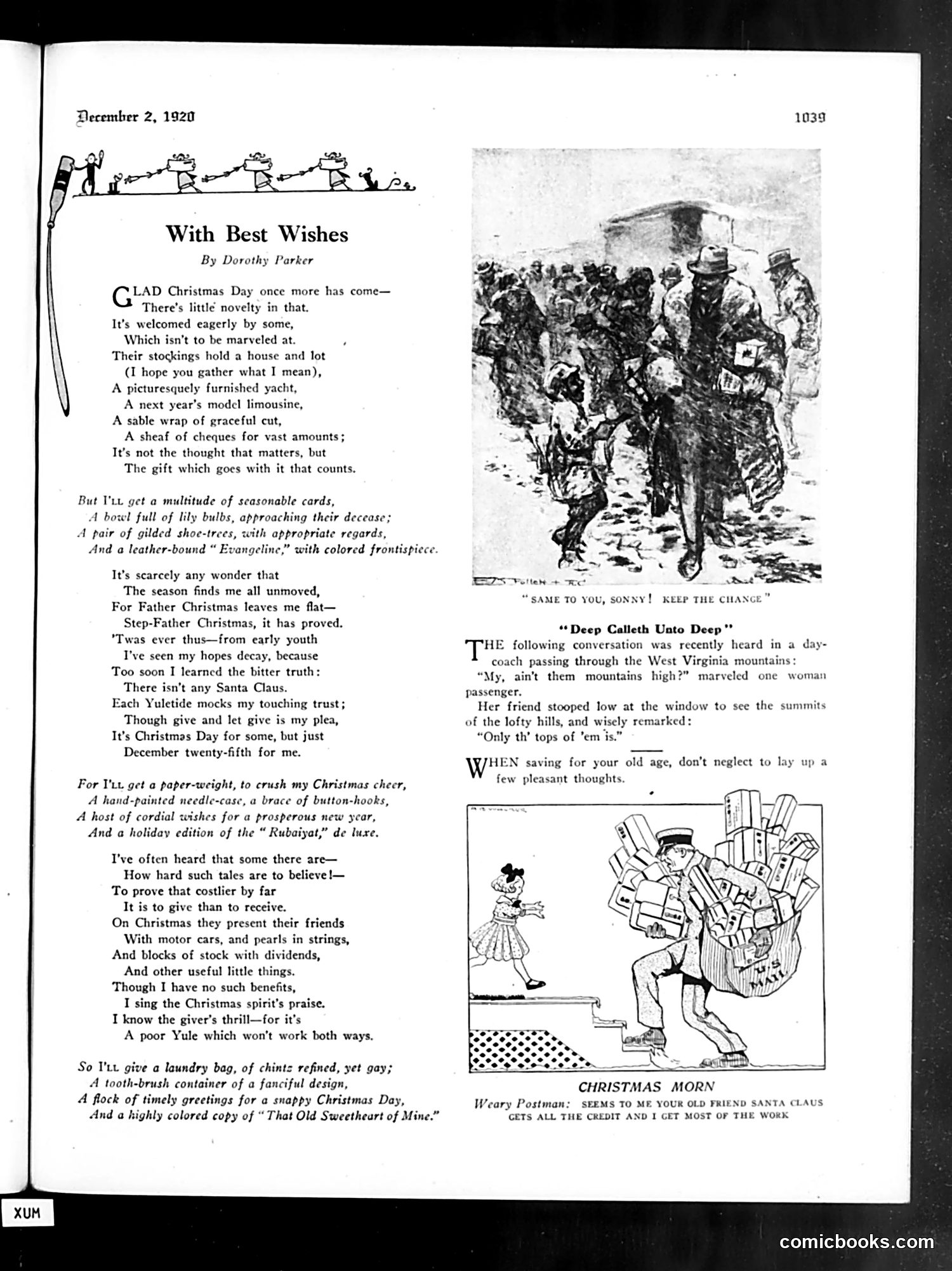
This page features Dorothy Parker's sardonic poem about economic inequality during the Christmas season. Parker contrasts wealthy recipients who receive yachts, limousines, and stock dividends with herself, who receives humble items like paperweights, needle-cases, and greeting cards. The satire targets the disparity between rich and poor: Christmas "counts" only for the wealthy, while for Parker it's merely "December twenty-fifth." The accompanying cartoons reinforce this theme. One depicts a weary postman noting that Santa Claus gets all the credit while postal workers do the actual labor—a working-class commentary. Another shows mountain passengers, likely satirizing rural simplicity. Parker's wit cuts at both social inequality and the commercialization of Christmas, suggesting that festive joy is reserved for the privileged while ordinary people endure disappointment and drudgery.
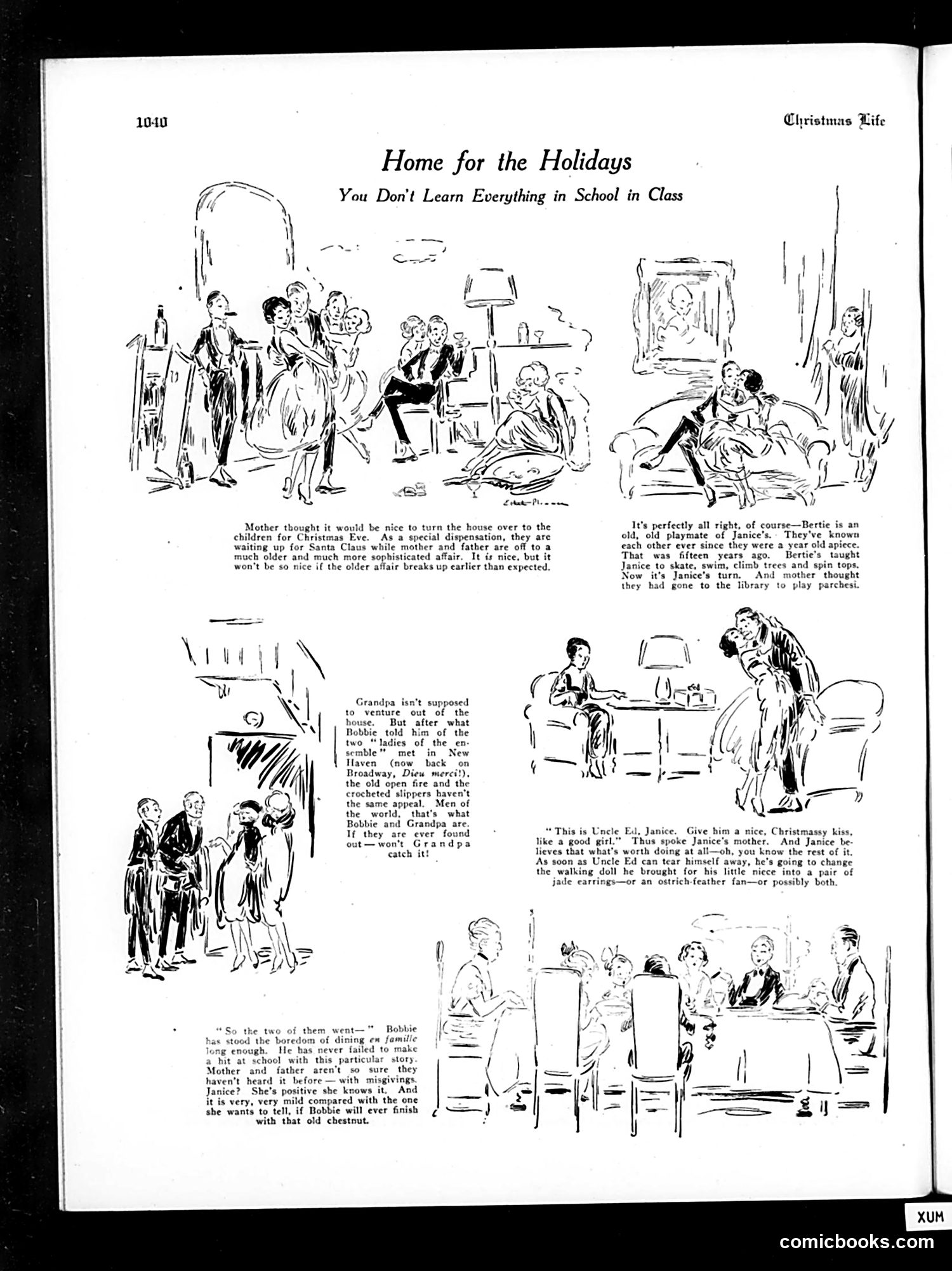
This satirical piece mocks the pretensions and behavior of young people during Christmas Eve when parents leave them unsupervised. The humor targets: **The Setup:** Parents naively allow children to stay up alone on Christmas Eve, believing they'll play innocent games like parchesi. **The Satire:** - **Janice and Bertie**: A teenage couple's unsupervised time together is presented as romantic/potentially compromising, playing on parental anxiety about youth morality - **Grandpa**: Represents worldly, sophisticated men who seduce young women with stories - **Uncle Ed**: Flirts with Janice by requesting a "Christmassy kiss," implying adults exploit the holiday's social conventions for romantic advantage - **Bobbie's "chestnut"**: References tired, recycled stories told to impress (implying dishonesty) **The Point:** Young people (and some adults) use the holiday's relaxed atmosphere and removed parental supervision to pursue romance and tell exaggerated stories—behavior parents would disapprove of if present. The title's subtitle—"You Don't Learn Everything in School in Class"—suggests real education happens through unsupervised social interaction.
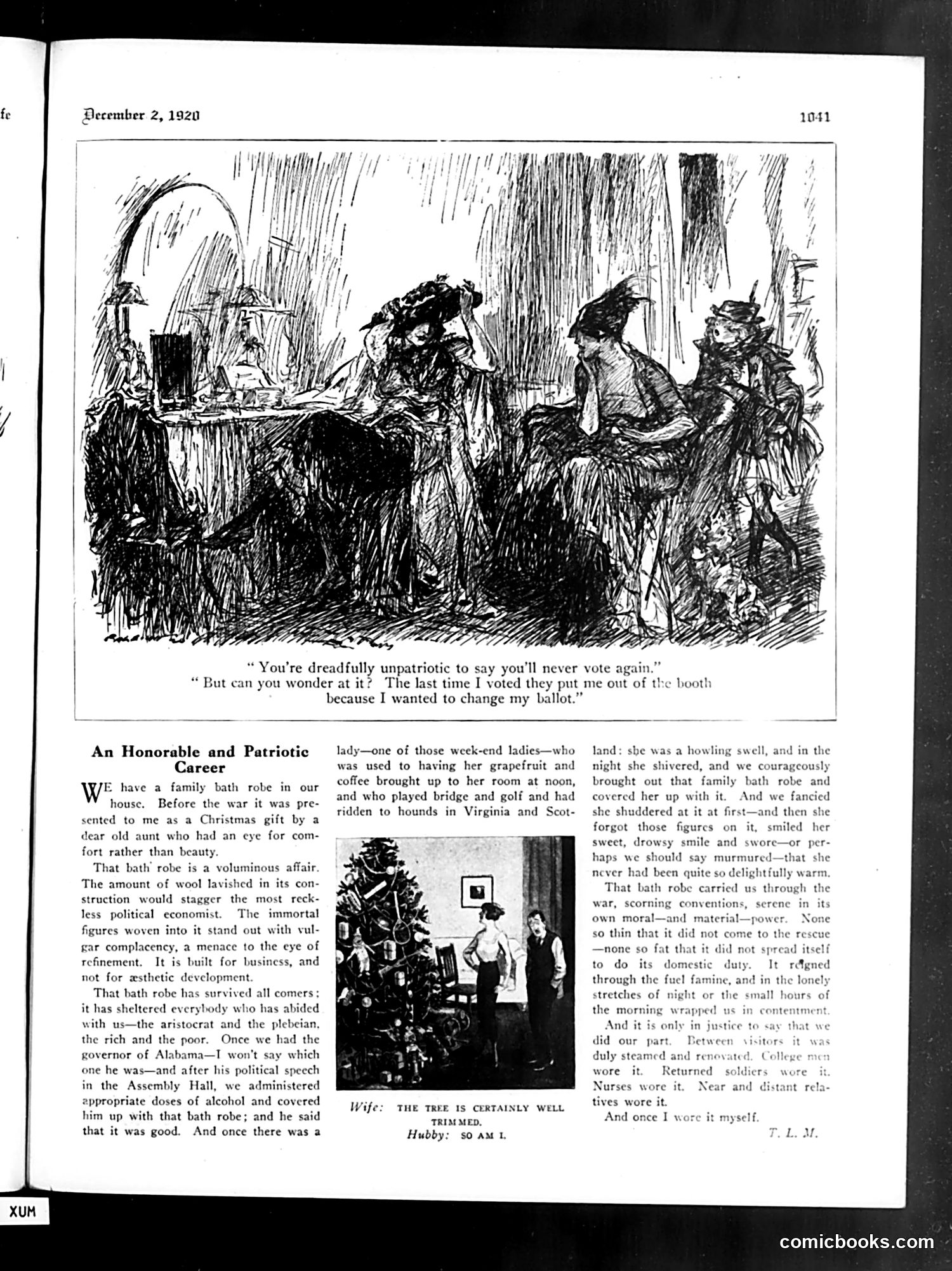
The top cartoon satirizes women's newly won voting rights (the 19th Amendment was ratified in August 1920, just months before this December issue). A woman expresses frustration with voting, saying she'll "never vote again" because election officials removed her from the booth when she tried to change her ballot—implying incompetence or obstruction by poll workers. The satire cuts two ways: it mocks both the woman's complaint as "unpatriotic" and, more pointedly, exposes the practical obstacles women faced exercising their freshly granted right to vote. The joke's sting is that despite finally winning suffrage, women encountered dismissive treatment and bureaucratic interference when attempting to actually cast ballots. The lower section is an unrelated humorous essay about a durable family bathrobe that has served various guests through wartime shortages, ultimately praising its humble practicality.
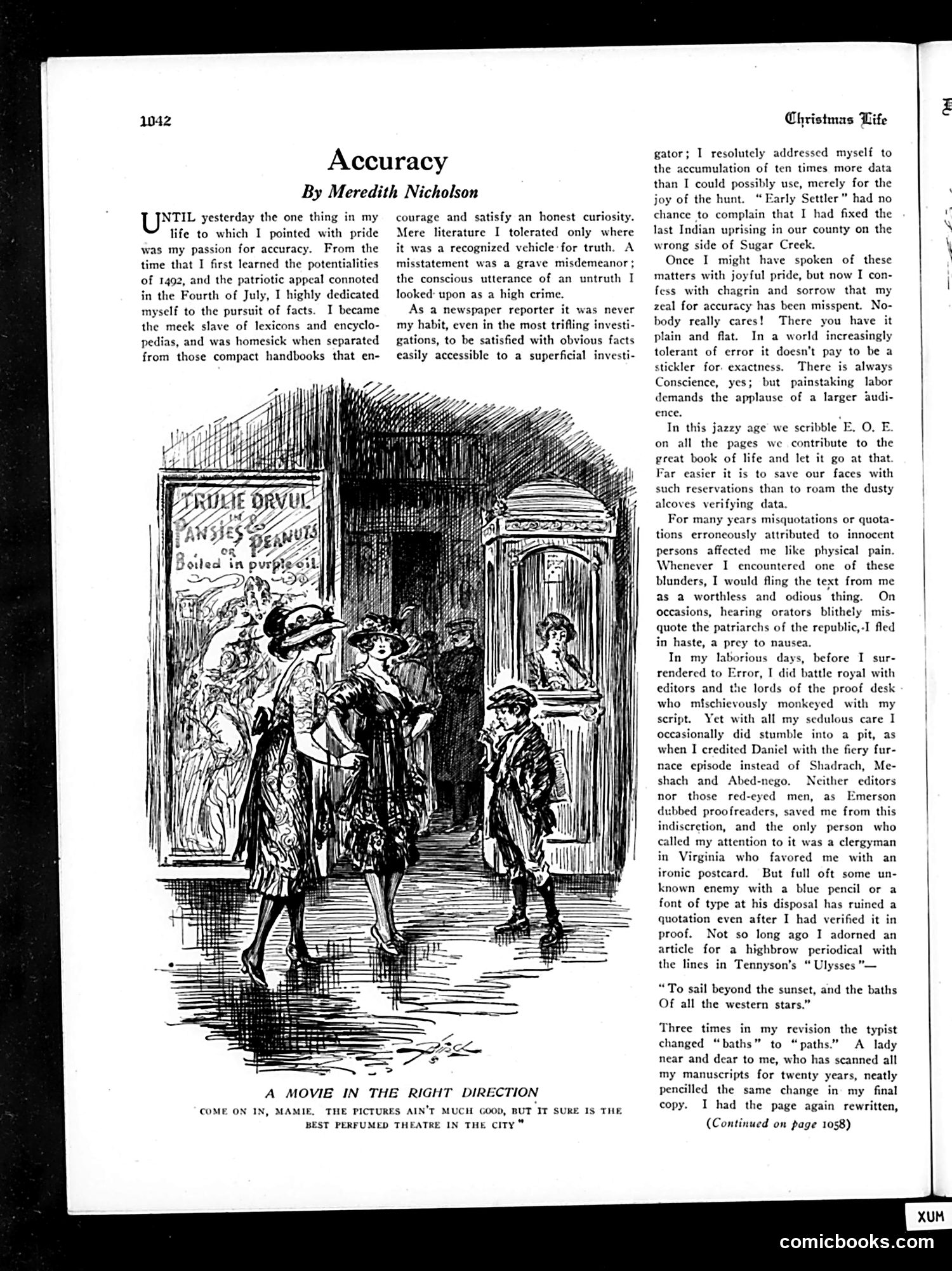
This page contains an essay (not a political cartoon) about the decline of factual rigor in modern culture. The author, a self-described perfectionist who obsessively verified facts throughout his career as a newspaper reporter, laments that "nobody really cares" about accuracy anymore. He confesses that his painstaking labor to correct errors, challenge misquotes, and battle editors over details now seems pointless in "this jazzy age." The accompanying illustration shows a theater lobby with patrons—a humorous visual commentary on lowered standards: the caption notes the pictures "ain't much good" but the theater is "the best perfumed theatre in the city"—suggesting people now prioritize comfort and atmosphere over quality. The essay represents early 20th-century anxiety about modern society's alleged moral and intellectual decline.
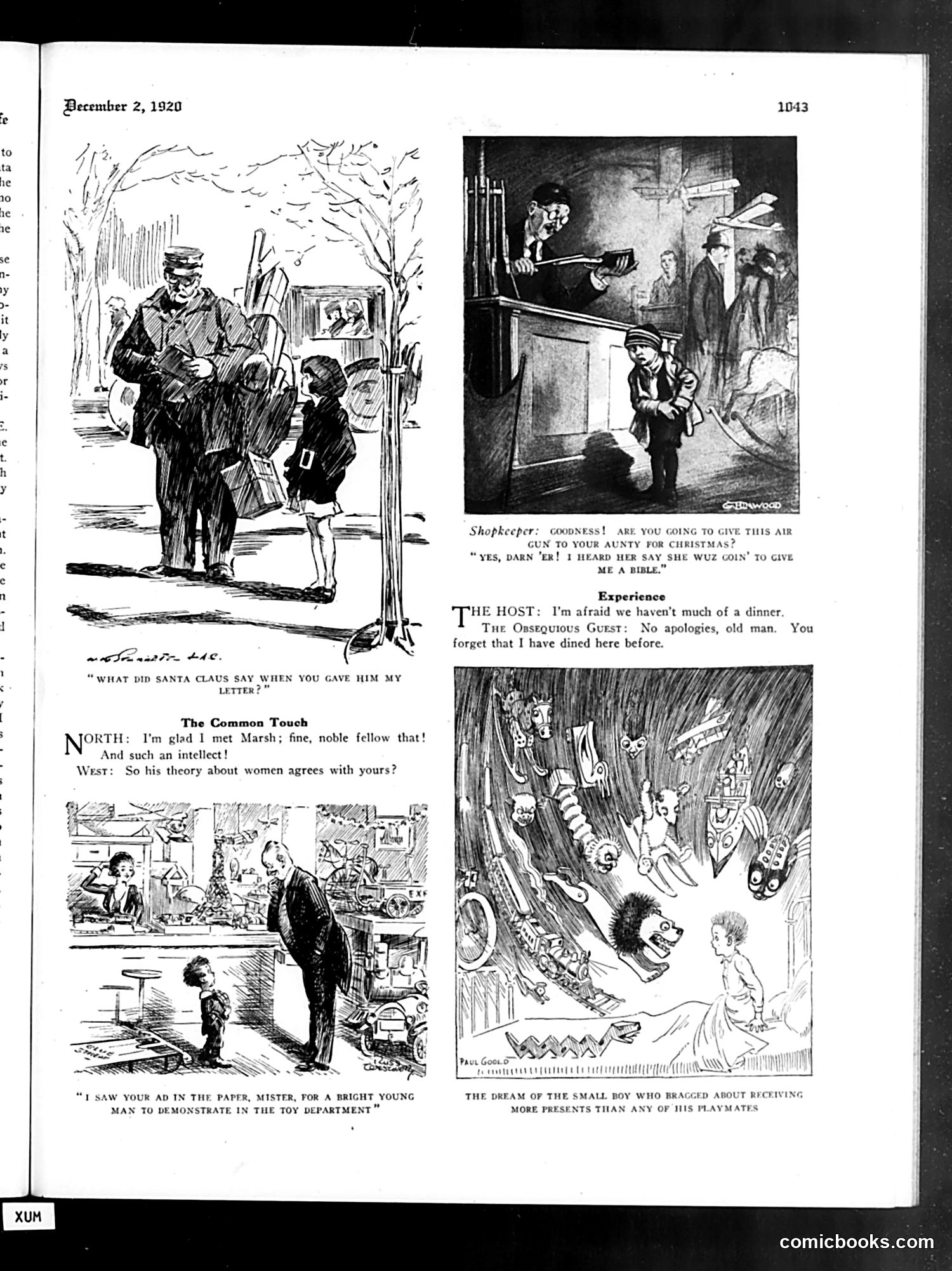
This page contains several brief humorous sketches satirizing domestic life and social pretense: **"The Common Touch"** mocks false intellectualism: a man named North praises another as intelligent and noble, then asks if his theory about women matches North's own—implying North likely has no serious theory, just prejudices he assumes others share. **"Experience"** jokes about an awkward dinner guest who claims prior dining experience at the host's home, subtly insulting the meal's quality. **The toy-shop exchange** satirizes childhood materialism and parental hypocrisy: a child plans to give an aunt air (worthless) as a gift in revenge for receiving a Bible—highlighting the clash between material desires and forced religious "improvement" gifts. **The dream sequence** depicts a boy's fantasy of receiving extravagant toys, mocking children's boastfulness about possessions. These sketches reflect 1920s concerns with class consciousness, social pretense, and consumer culture emerging post-WWI.
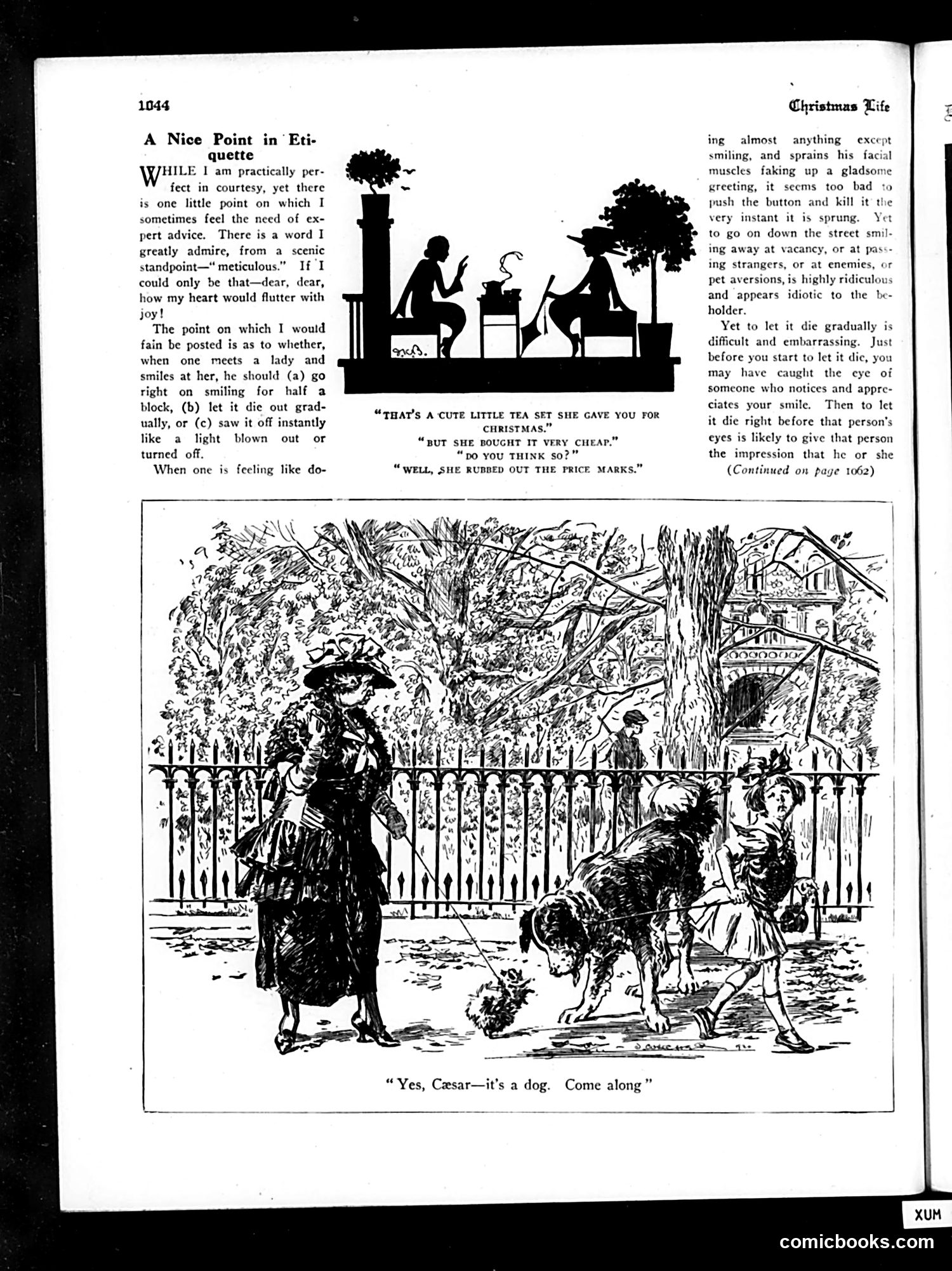
This page contains two distinct pieces about social etiquette from *Life* magazine's Christmas issue. **Top section:** A humorous essay about the awkwardness of smiling at strangers. The author debates whether, after greeting someone with a smile, one should: (a) maintain it for half a block, (b) let it fade gradually, or (c) abruptly stop smiling. The satire mocks the social anxiety of managing facial expressions in public—the fear that stopping too suddenly looks rude, but continuing looks foolish. **Bottom cartoon:** Shows a woman introducing a man to what appears to be a dog, saying "Yes, Caesar—it's a dog. Come along." The joke concerns a cheap Christmas gift: a woman gave her friend an inexpensive tea set but rubbed off the price marks to hide the cost. The humor lies in the pretense of generosity and the awkwardness of discovering—and discussing—a gift's actual value. Both pieces satirize the performance of politeness and the gap between genuine feeling and social convention.
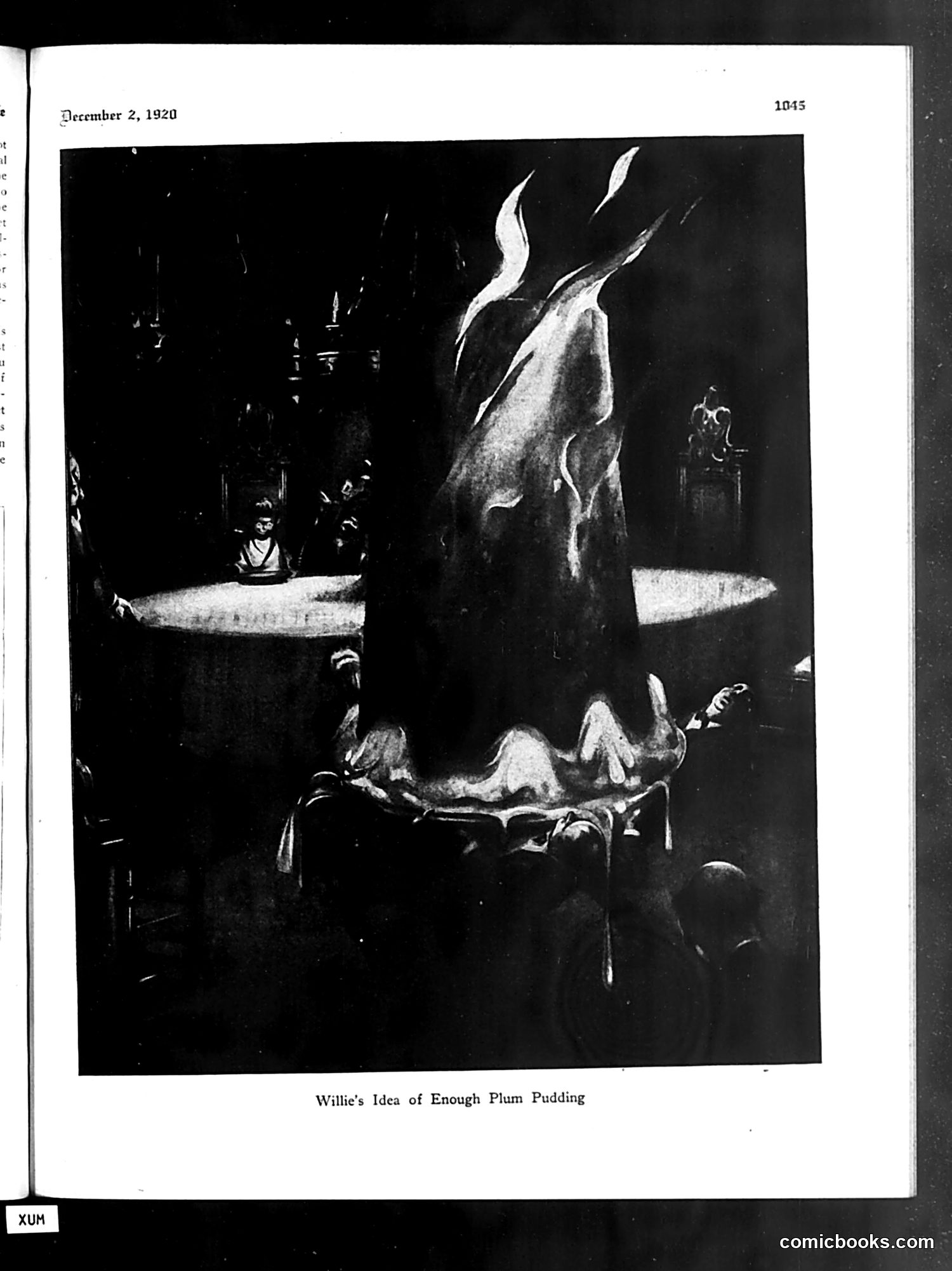
This December 1920 cartoon appears to depict a grotesquely oversized plum pudding being served to what looks like a figure labeled or associated with "Willie" (likely a political figure of that era, though the specific identity isn't entirely clear from the image alone). The pudding's enormous size—with flaming decorations—suggests satire about excess or overindulgence. The "plum pudding" reference likely alludes to something beyond literal food: "plum pudding" was period slang for desirable rewards or spoils. The cartoon's point appears to satirize someone's excessive appetite for these rewards or their outsized ambitions, presented as darkly comedic commentary on post-WWI politics or economics. Without additional context about "Willie," the specific satirical target remains somewhat unclear.
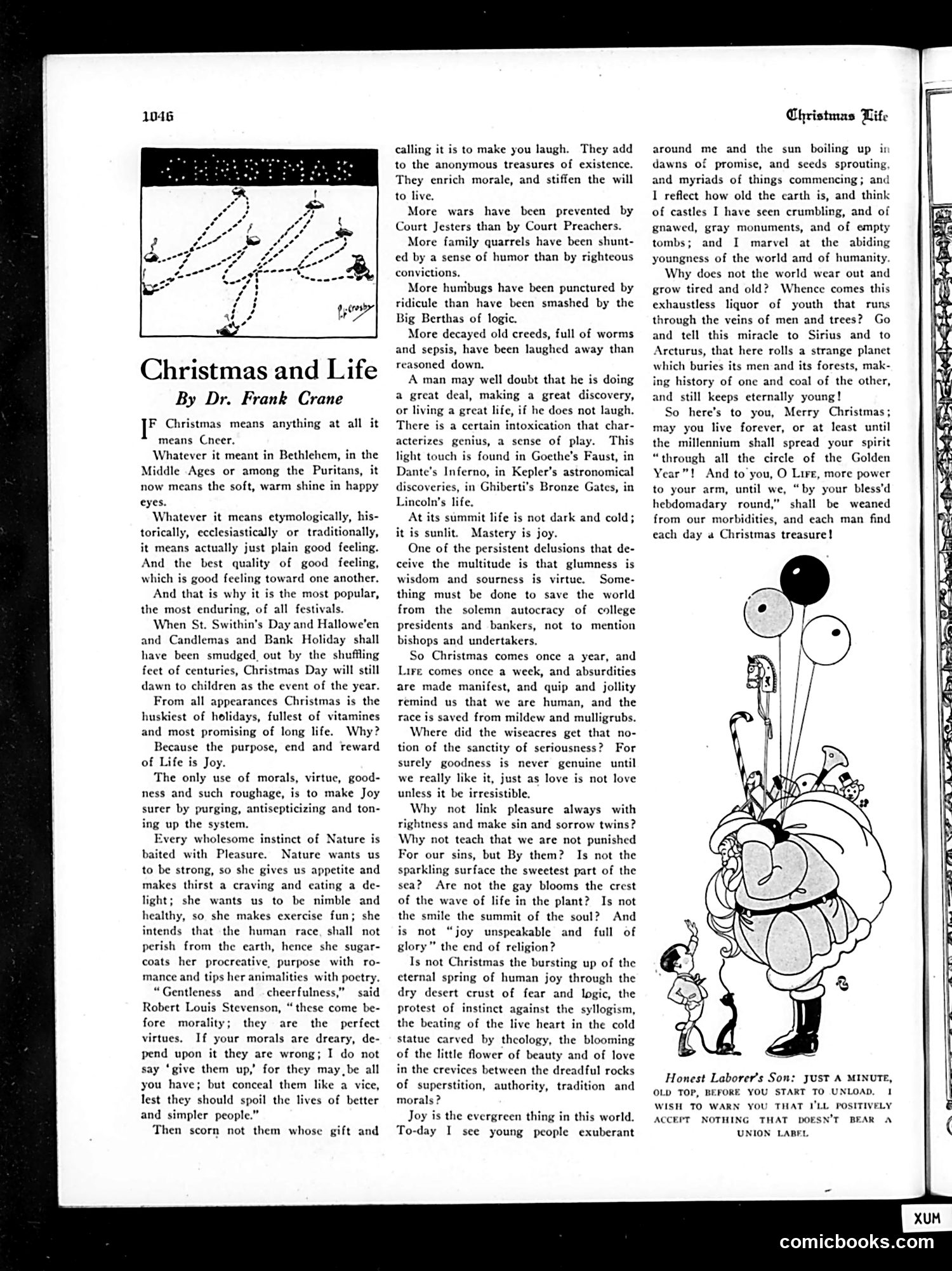
This is an essay-length article advocating for joy and humor as essential to human flourishing, not frivolous indulgences. The accompanying illustration (right side) shows a jolly Santa Claus figure surrounded by balloons and children. Crane argues that Christmas endures because it represents **cheer and good feeling**, and that society wrongly separates morality from pleasure. He critiques overly serious attitudes—particularly among "college presidents and bankers, not to mention bishops and undertakers"—who treat solemnity as virtue. The satire targets what Crane sees as **false piety and joylessness masquerading as morality**. He cites historical examples (Goethe, Lincoln, Kepler) to argue that genuine achievement requires playfulness and humor, not grim severity. The essay defends comedians and "court jesters" as social benefactors who "have prevented more wars" and "punctured more humbugs" than serious institutions. The underlying message: a humorous, life-affirming outlook is morally superior to austere righteousness.
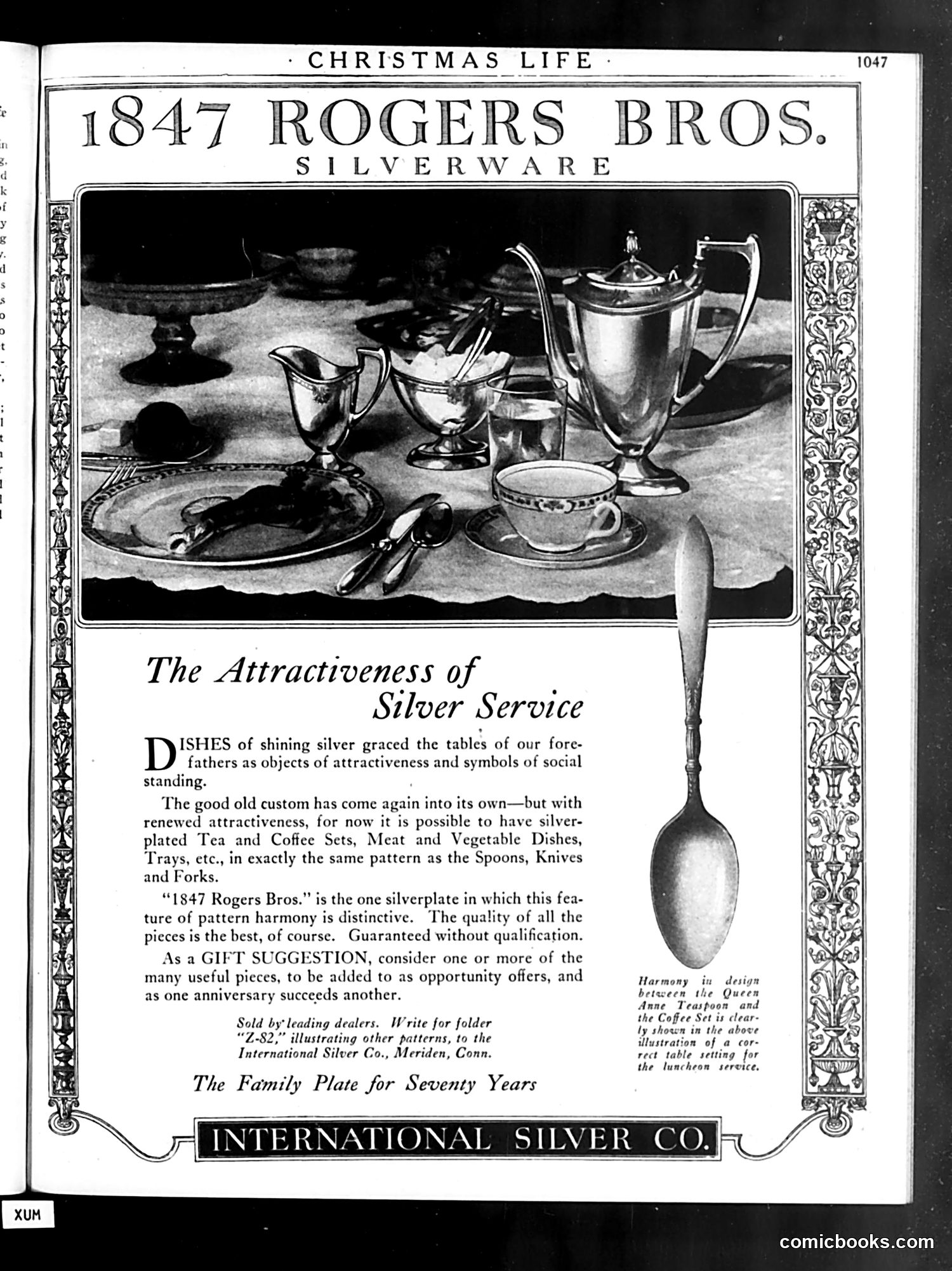
This is a **product advertisement**, not a cartoon or satirical content. It's a full-page ad for "1847 Rogers Bros." silverplate by International Silver Co., appearing in a Christmas issue of *Life* magazine. The ad appeals to social status by referencing how "shining silver graced the tables of our forefathers as objects of attractiveness and symbols of social standing." It positions silverplate as an affordable way to access this prestige—matching patterns across tea sets, dishes, and flatware rather than requiring individual piece purchases. The marketing angle emphasizes "pattern harmony" as distinctive to Rogers Bros. and suggests the product as a gift, with pieces added "as opportunity offers" and "as one anniversary succeeds another"—implying aspirational gradual accumulation for middle-class consumers. The slogan "The Family Plate for Seventy Years" claims durability and longevity. There is no satire or political content; this is straightforward early 20th-century consumer advertising leveraging social aspiration.
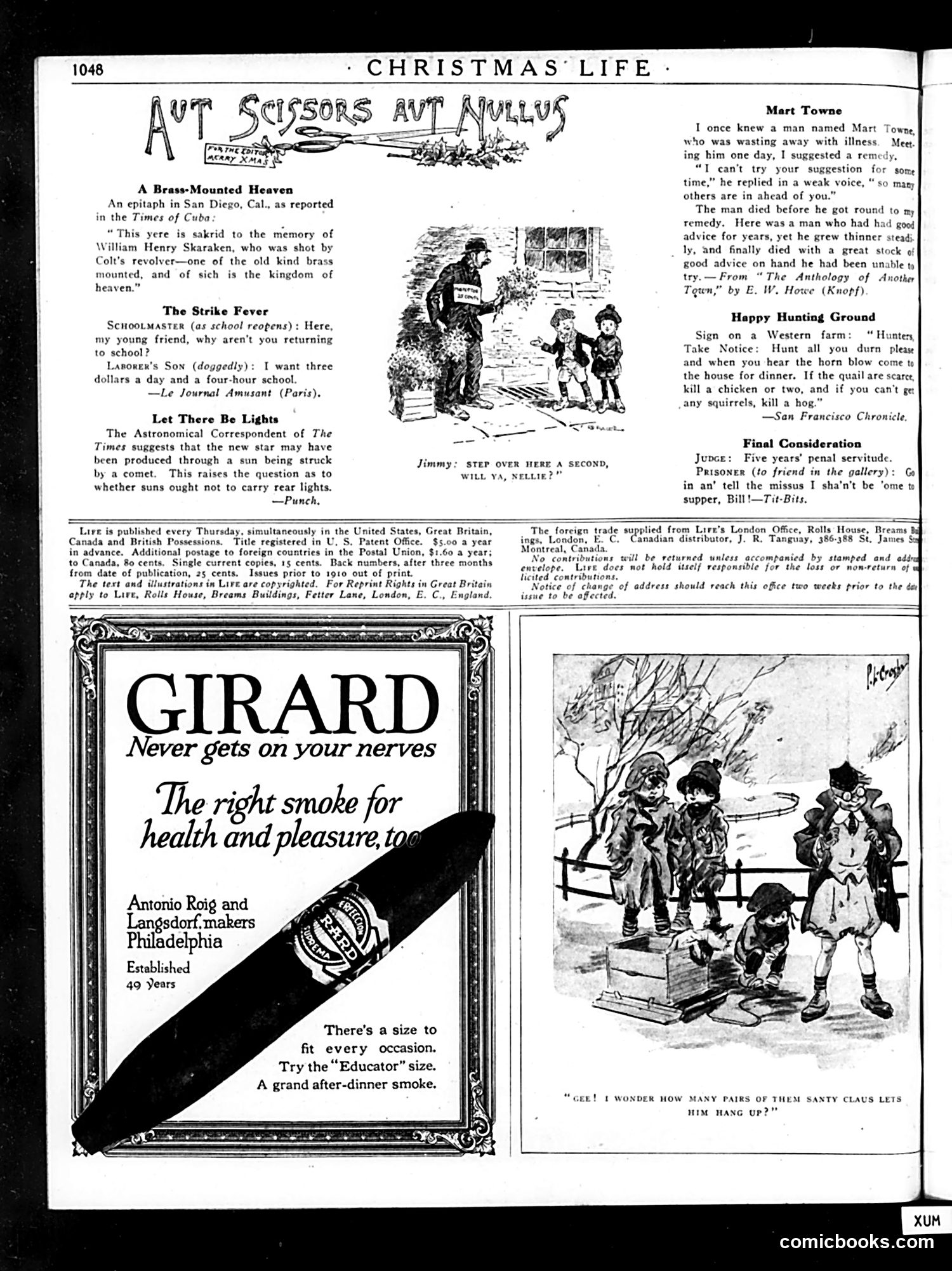
This is a mixed-content page from *Life* magazine featuring several short satirical pieces and an advertisement. The main cartoons mock contemporary social issues: "The Strike Fever" jokes about labor activism, depicting a schoolboy demanding adult wages and shorter hours—satirizing how strike demands were spreading. "Final Consideration" uses dark humor about a prisoner's casual response to a five-year sentence, suggesting working-class detachment from serious consequences. The right-side illustration shows children hanging stockings, with the caption questioning how many pairs "Santy Claus" allows—likely commenting on Santa's generosity or the economic constraints of gift-giving. The page also includes brief anecdotes and observations typical of *Life's* satirical format: an absurd epitaph celebrating a Colt revolver, and British magazine reprints (*Punch*, *Tit-Bits*). The prominent **Girard cigar advertisement** occupies significant space, claiming the product "never gets on your nerves"—typical early 20th-century marketing linking tobacco to health and calm.
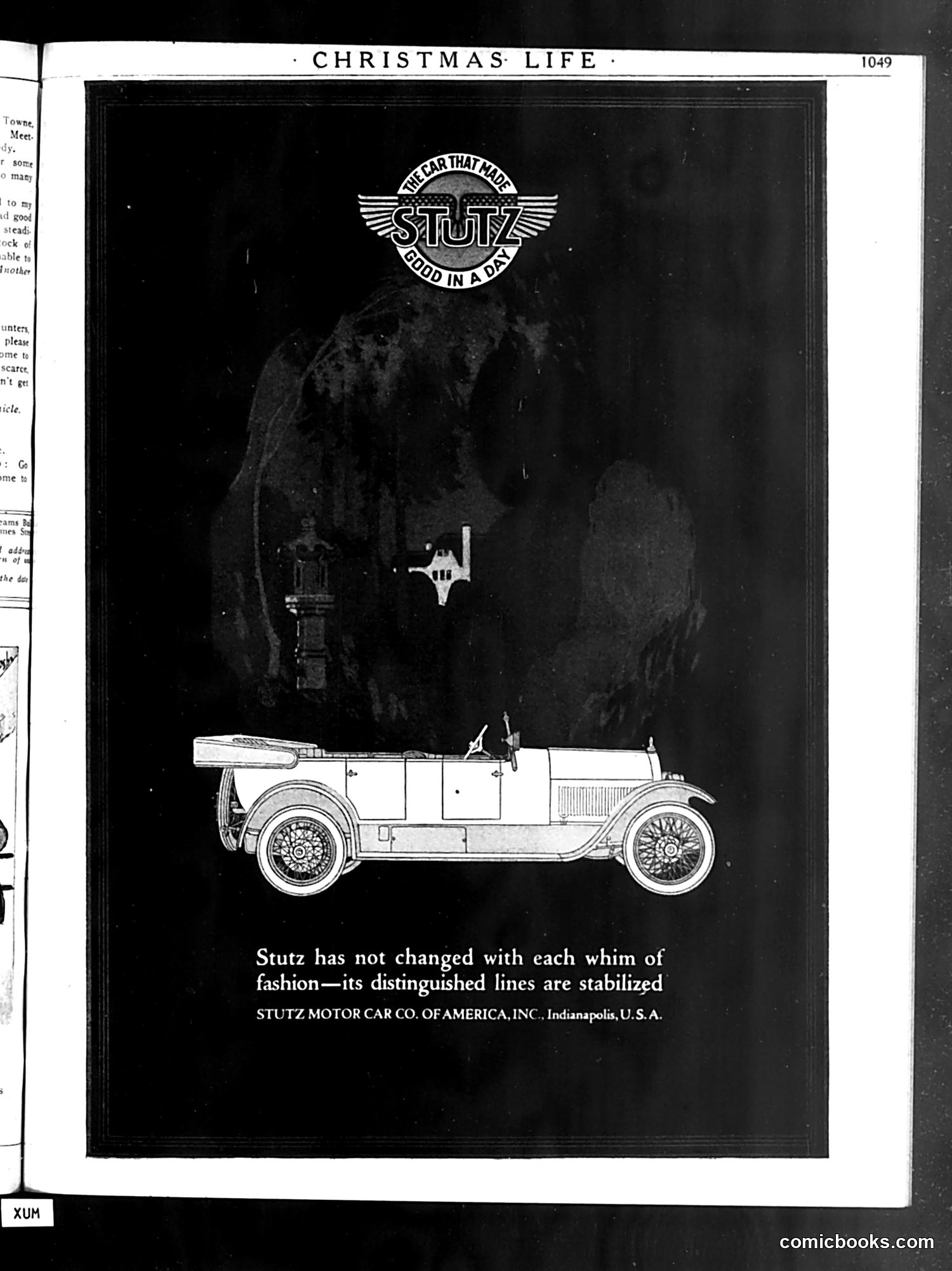
This is a **Stutz automobile advertisement**, not political satire. The page shows a luxury car in profile against a dark background with the Stutz winged logo at top. The ad's message claims that Stutz vehicles maintain consistent, timeless design principles rather than chasing fleeting fashion trends—their "distinguished lines are stabilized." The imagery juxtaposes the elegant automobile with what appears to be classical or romantic scenery above (possibly a church or monument), suggesting Stutz cars possess enduring sophistication. This was marketing strategy during the 1920s-30s automotive boom, when manufacturers competed by emphasizing either cutting-edge innovation or traditional quality. Stutz positioned itself as the latter—the car for discerning buyers who valued permanence over novelty.
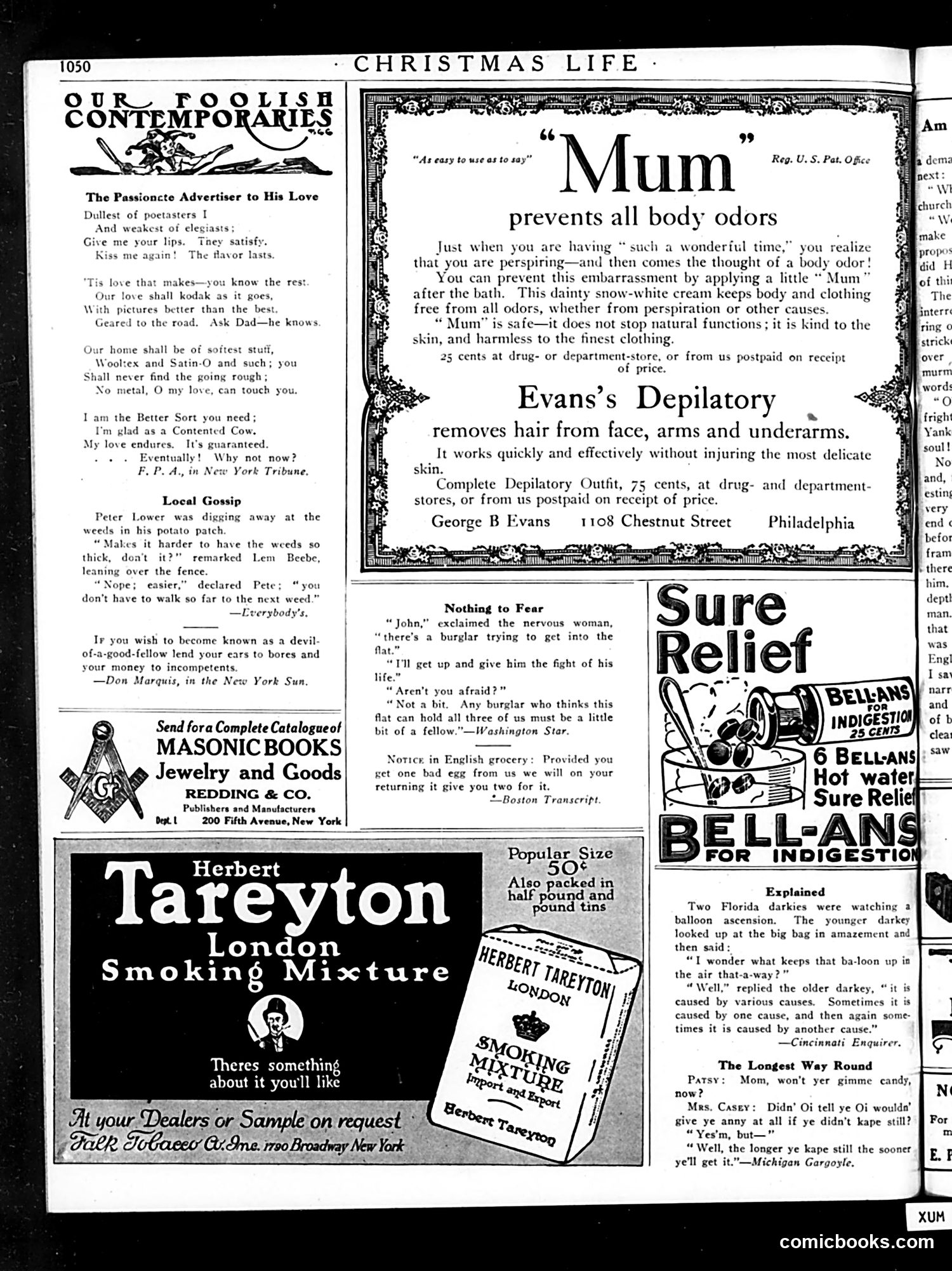
This page is primarily **advertisements and humor columns** rather than political satire. The content reflects early 20th-century consumer culture and social attitudes. **Key Elements:** The main advertisements promote personal hygiene products—"Mum" deodorant and "Evans's Depilatory" (hair removal)—targeting anxieties about body odors and appearance, common marketing tactics of the era. **The humor sections** include: - "Our Foolish Contemporaries": satirical poetry mocking romantic clichés - "Local Gossip": brief anecdotes about rural life (Lem Beebe and potato weeds) - A "Nothing to Fear" joke about a burglar and an overcrowded apartment - A dialect joke about two "Florida darkies" discussing a hot-air balloon—reflecting the period's casual use of racial stereotypes in "humor" The page reflects 1920s anxieties about modernity, cleanliness, and social propriety, alongside casual racism typical of the era's mainstream publications. There is no identifiable political satire present.
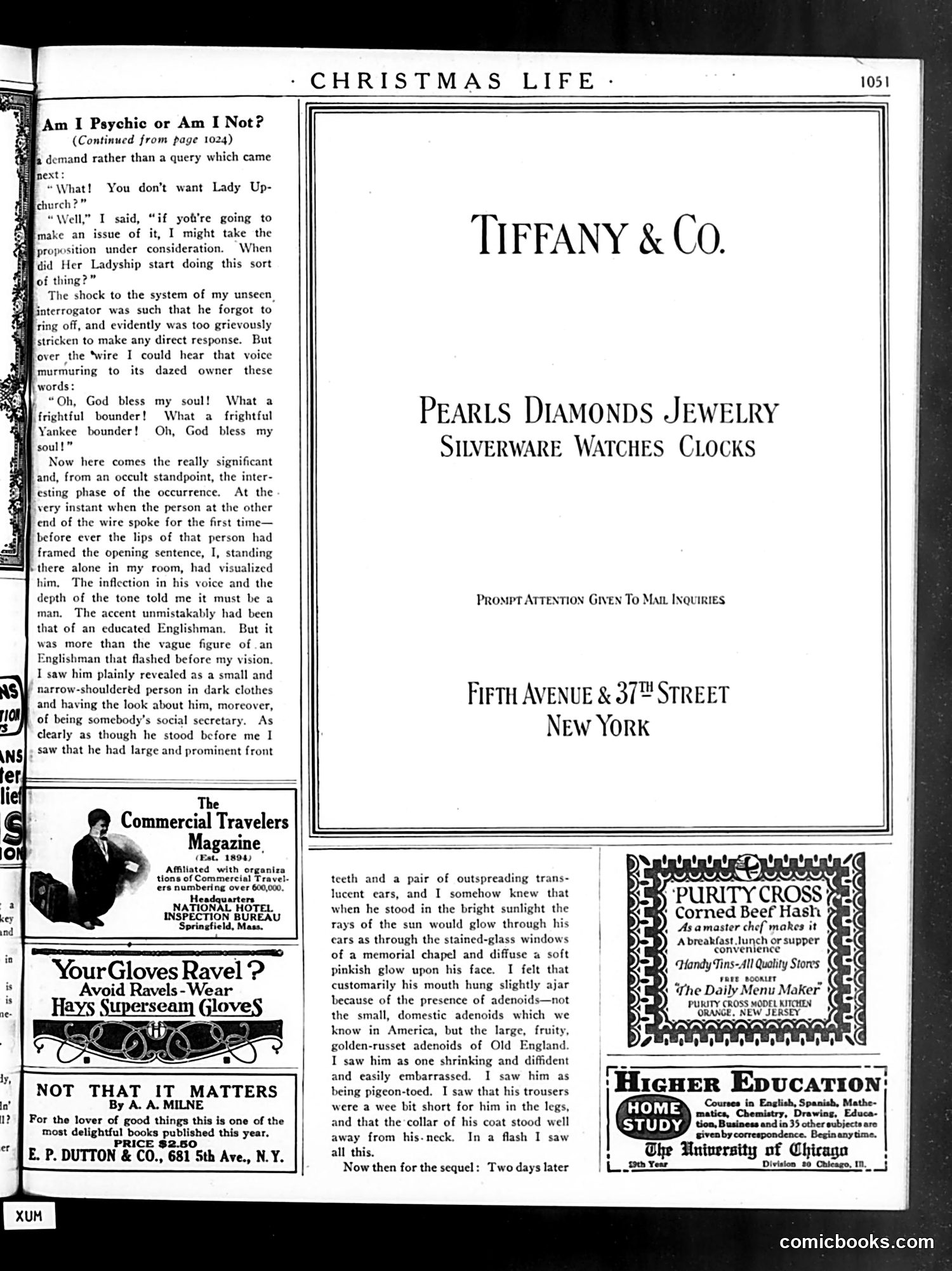
This page is primarily **advertising**, dominated by a Tiffany & Co. jewelry advertisement. The left column continues a serialized story titled "Am I Psychic or Am I Not?"—a first-person narrative about the author claiming psychic abilities after visualizing a mysterious telephone caller before hearing his voice. The story contains **period social satire**: the narrator describes "visualizing" an English social secretary as a small, narrow-shouldered man with prominent teeth and large ears. The description mocks English physical features and mannerisms in ways typical of early 20th-century Anglo-American humor. The remaining content consists of **vintage advertisements** (Hays Superseam Gloves, Commercial Travelers Magazine, a Purity Cross Corned Beef Hash ad, and University of Chicago correspondence courses) and an A.A. Milne book review—representative of *Life*'s mixed editorial-advertising format of that era. No political cartoons appear on this page.
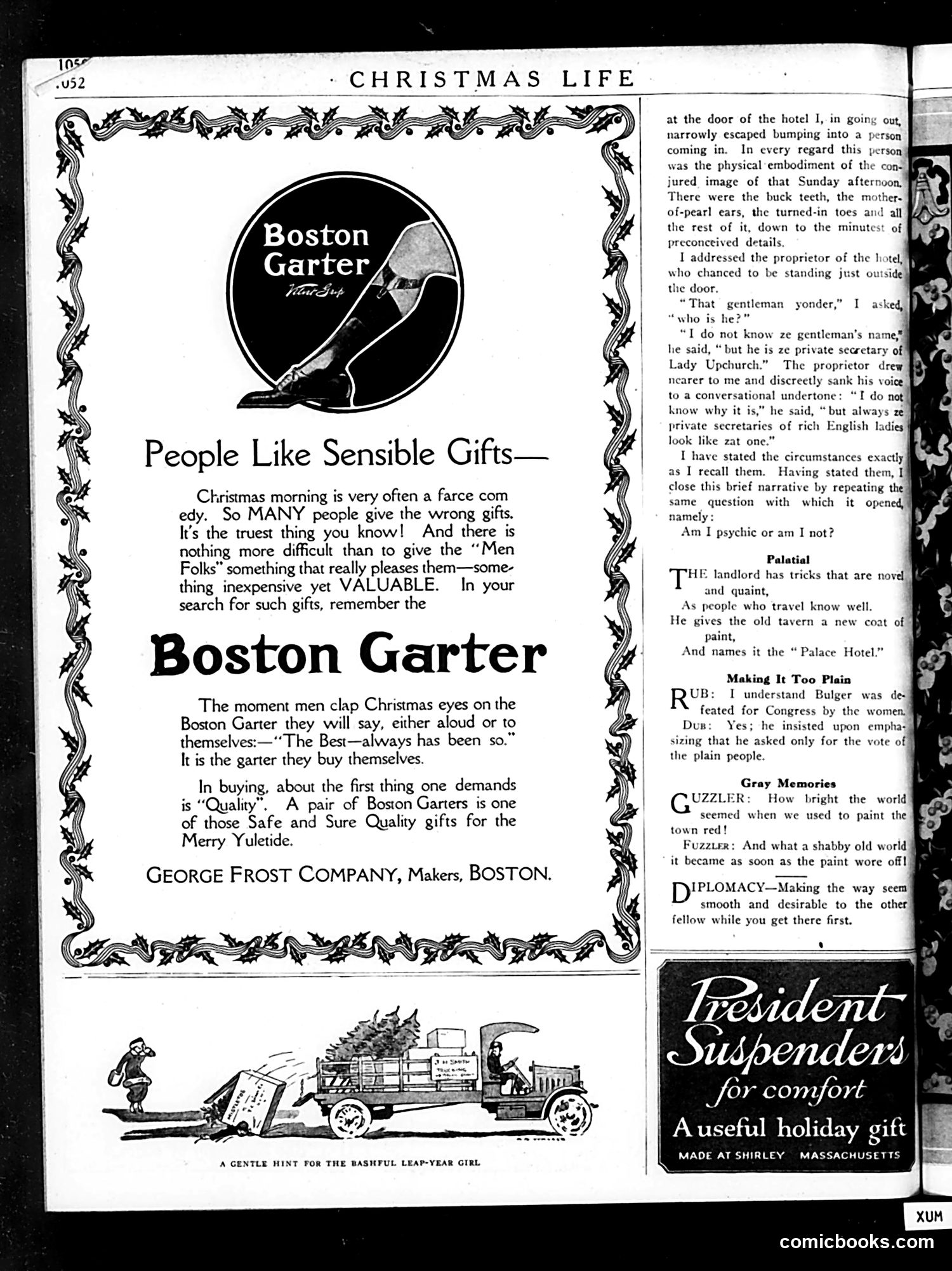
This page is primarily **advertising** mixed with brief satirical humor pieces. The main advertisement promotes **Boston Garters** (men's sock garters) as sensible Christmas gifts, claiming men always prefer this brand—a conventional product endorsement. Below is a cartoon captioned "A Gentle Hint for the Bashful Leap-Year Girl," referencing the tradition that women propose to men on leap-year day. The accompanying story recounts a coincidence where someone resembles a person the narrator imagined—playing on psychic phenomena or fate, ending with the humorous question "Am I psychic or am I not?" The right column contains brief satirical definitions and anecdotes, including one mocking Congressman Bulger for emphasizing appeals to "plain people," a comment on populist political rhetoric. A smaller advertisement for "President Suspenders" closes the page. The humor is gentle, domestic, and conventional—typical of Life magazine's satirical style in this era, focusing on everyday social awkwardness rather than sharp political critique.
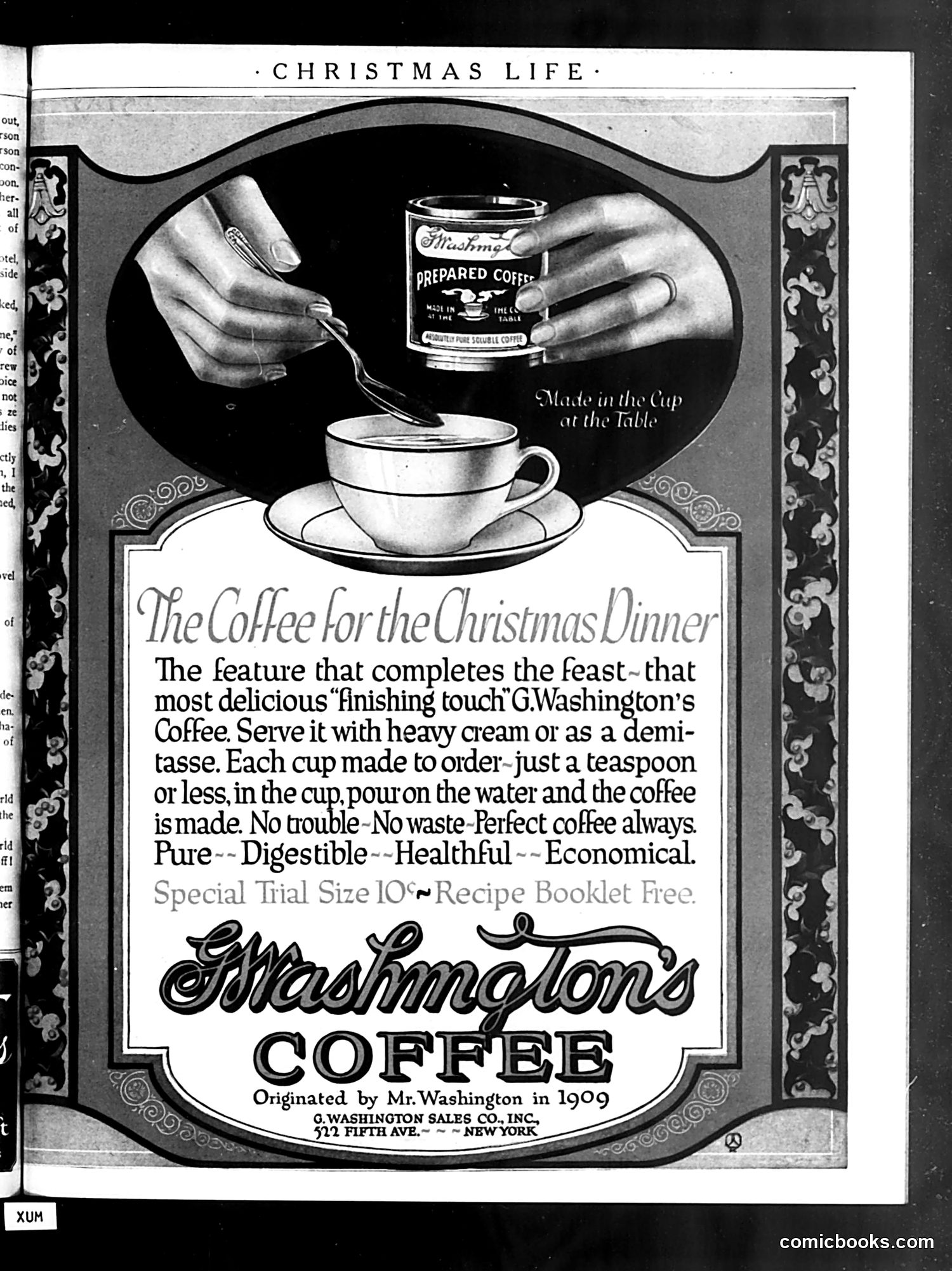
This is not a cartoon or satire—it's a **straightforward advertisement** for G. Washington's Prepared Coffee, appearing in *Life* magazine's Christmas issue. The ad promotes instant/prepared coffee as the ideal "finishing touch" for a Christmas dinner. It emphasizes convenience: users need only add "a teaspoon or less" of coffee to hot water in the cup, eliminating preparation trouble and waste. The product is marketed as "Pure—Digestible—Healthful—Economical." The imagery shows hands pouring the prepared coffee into a teacup, demonstrating the simplicity of use. The brand claims to have been "Originated by Mr. Washington in 1909," establishing product heritage and legitimacy. There is no political satire or social commentary visible here—this is period advertising targeting affluent *Life* readers seeking convenient, quality products for holiday entertaining.
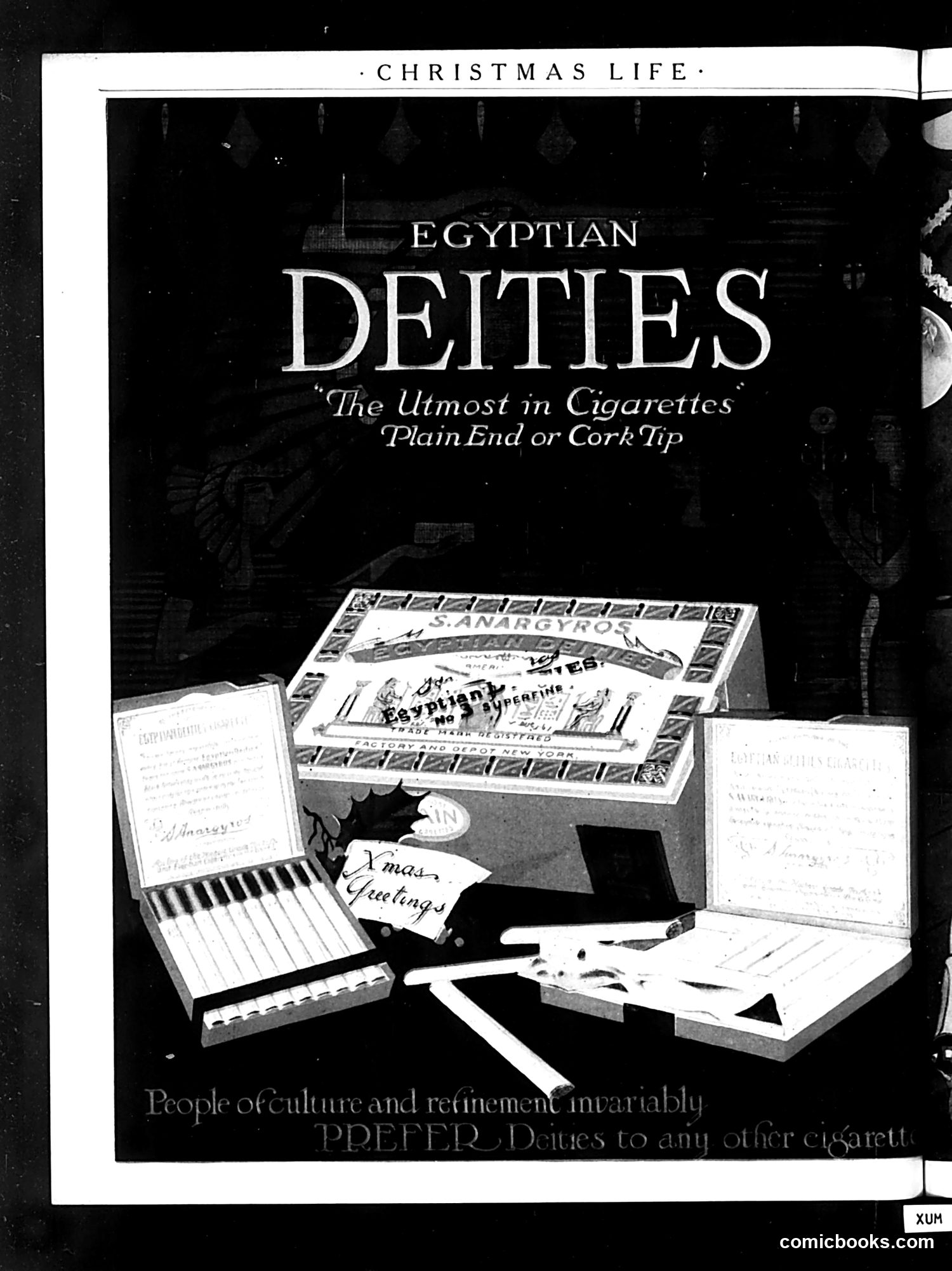
This is a **Christmas-season advertisement** for Egyptian Deities brand cigarettes, appearing in Life magazine. The ad uses Egyptian imagery and packaging as its selling point, displaying cigarette boxes decorated with Egyptian motifs and hieroglyphics. The tagline claims these are "The Utmost in Cigarettes" available in "Plain End or Cork Tip" varieties. The bottom text states that "People of culture and refinement invariably PREFER Deities to any other cigarette." This reflects early 20th-century marketing strategy: associating consumer products with exotic, "sophisticated" imagery (here, Ancient Egypt) to appeal to aspirational middle and upper-class buyers. The emphasis on "culture and refinement" was standard advertising rhetoric of this era. The Christmas presentation suggests gifting luxury cigarettes as holiday presents.
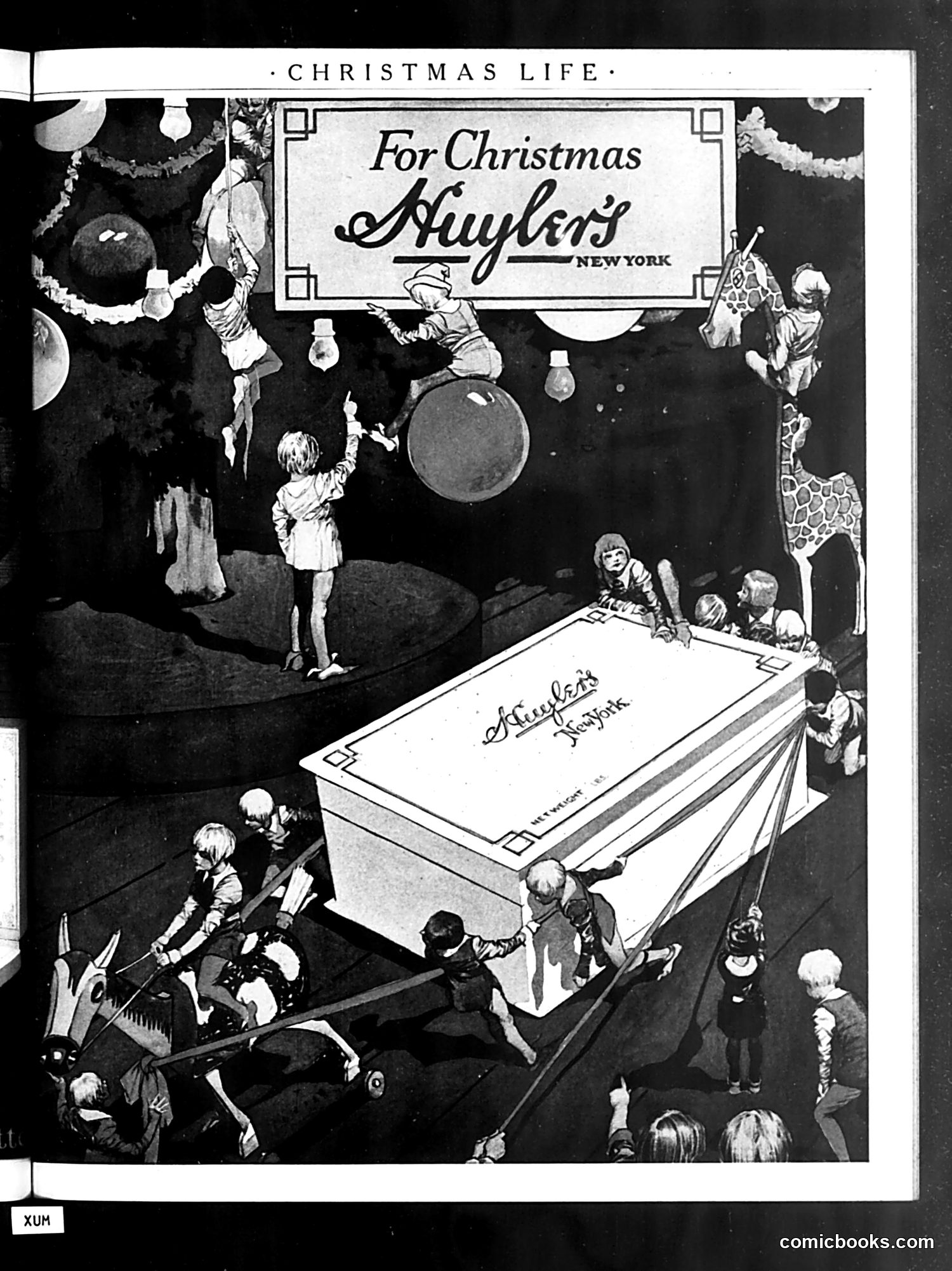
This is a **Christmas advertisement** for Auyler's of New York, not political satire. The page header reads "CHRISTMAS LIFE" and features an elaborate illustration of children and fantastical elements—toys, decorations, a giraffe, and oversized gift boxes—surrounding the store's name in an ornate frame. The scene depicts a whimsical Christmas wonderland with children playing amid holiday ornaments, garland, and toys, designed to evoke festive joy and appeal to parents shopping for gifts. The prominent display of a large wrapped box labeled "Auyler's New York" serves as the advertisement's centerpiece. This is commercial holiday marketing rather than satirical commentary.
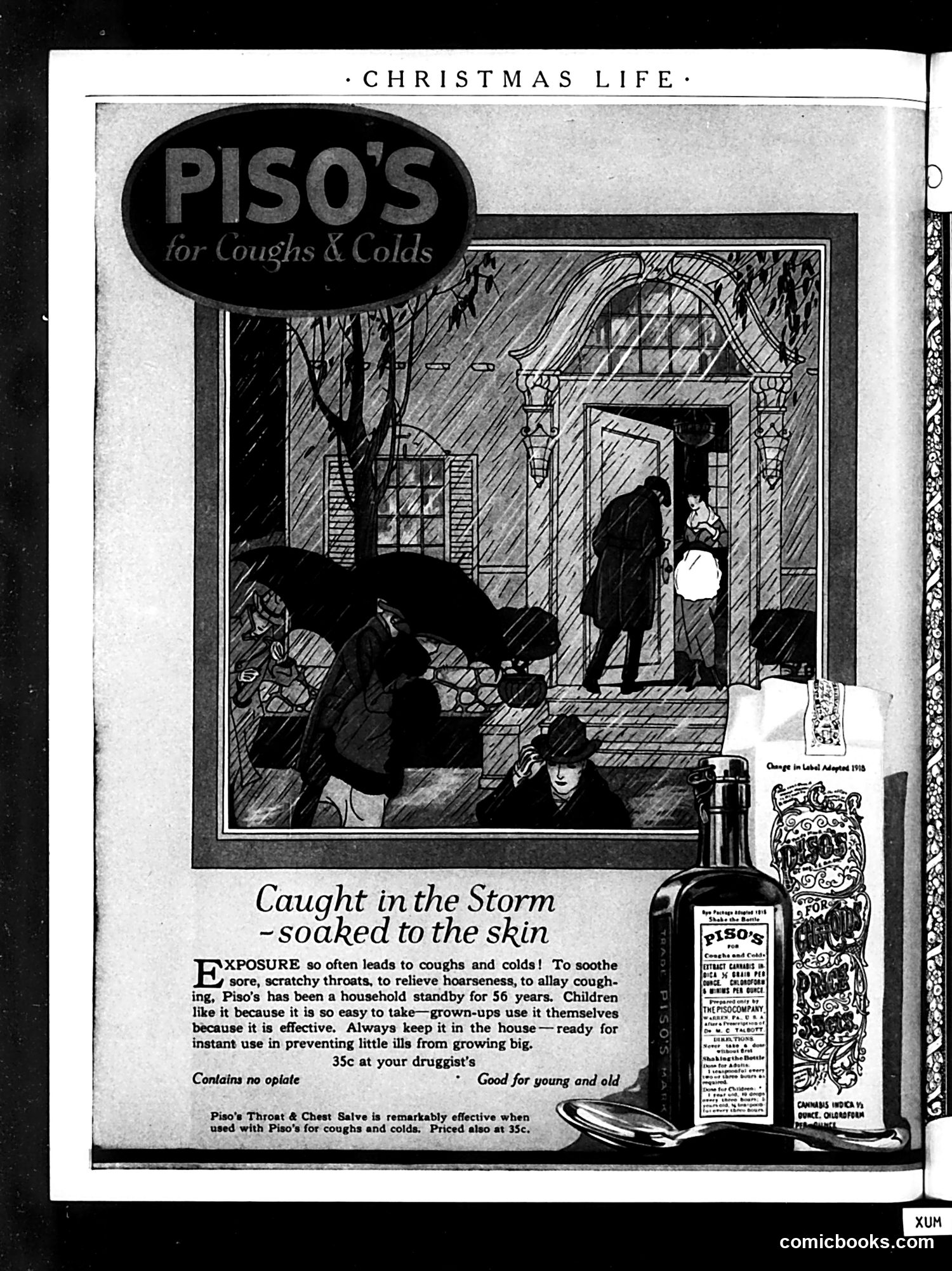
This is a **commercial advertisement**, not satire or political commentary. It's a full-page Christmas-themed ad for Piso's cough medicine in Life magazine's advertising section. The illustration shows a domestic scene: people caught in rain/sleet outside a house, establishing the scenario that "exposure" causes colds. The ad emphasizes Piso's 56-year track record as a household remedy, its ease of use for children and adults, and its lack of opiates—a selling point suggesting safety. The "Christmas Life" header indicates this ran in the magazine's holiday issue. At 35 cents, the product targets middle-class families seeking preventive medicine. The mention of a companion "Throat & Chest Salve" suggests a product line. This represents typical early-20th-century patent medicine marketing: using relatable domestic scenarios to sell remedies with broad therapeutic claims, before strict FDA regulations on drug advertising.
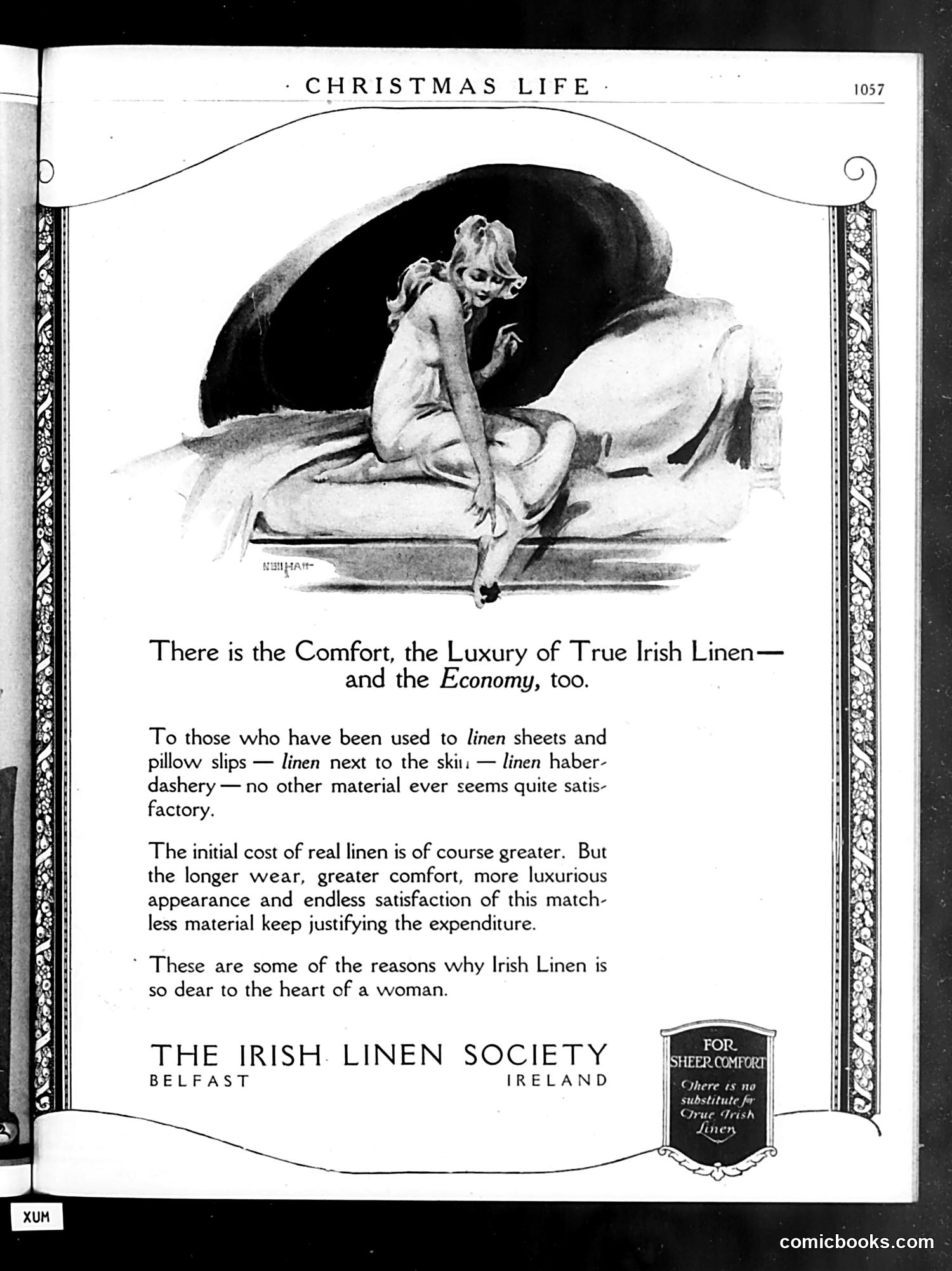
This is an advertisement for Irish Linen, not political satire. The page features an illustration of a woman in lingerie or nightwear on a bed, used to market linen bedsheets and clothing. The ad argues that while Irish linen costs more initially than alternatives, its superior durability, comfort, and luxury justify the expense. The text appeals to women as consumers, claiming linen is "dear to the heart of a woman." The small seal in the lower right emphasizes there is "no substitute for true Irish linen." This is a straightforward luxury goods advertisement from the Irish Linen Society (Belfast), employing suggestive imagery typical of early-to-mid-twentieth-century advertising to market household textiles.
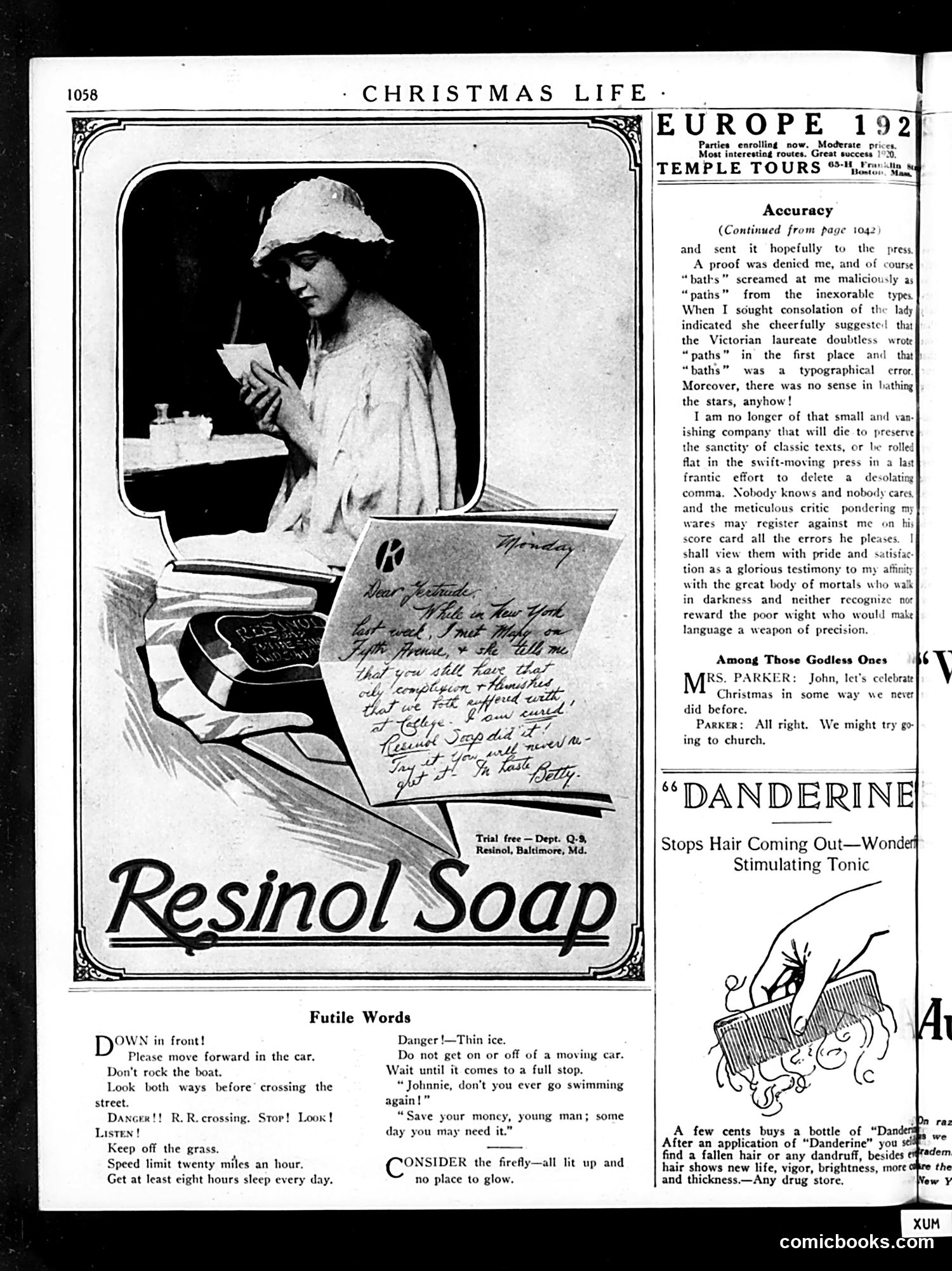
This page mixes advertising with satirical content typical of 1920s Life magazine. The main cartoon, "Futile Words," satirizes the gap between what adults tell children to do and what children actually do. It lists conventional safety warnings ("Look both ways," "Keep off the grass," "Speed limit twenty miles an hour") alongside children's predictable dismissals of these instructions. The joke is that such admonitions are universally ignored—hence "futile." The page also includes a Resinol Soap advertisement featuring a woman reading, and a "Danderine" hair tonic ad. The "Accuracy" column (continued from page 1042) appears to be editorial commentary defending typographical errors in published texts, arguing pedantic critics waste effort correcting minor mistakes in literature. The "Among Those Godless Ones" section humorously portrays a secular couple considering attending church as a novel Christmas celebration, implying irreligious households were notable enough to satirize in 1920s America.
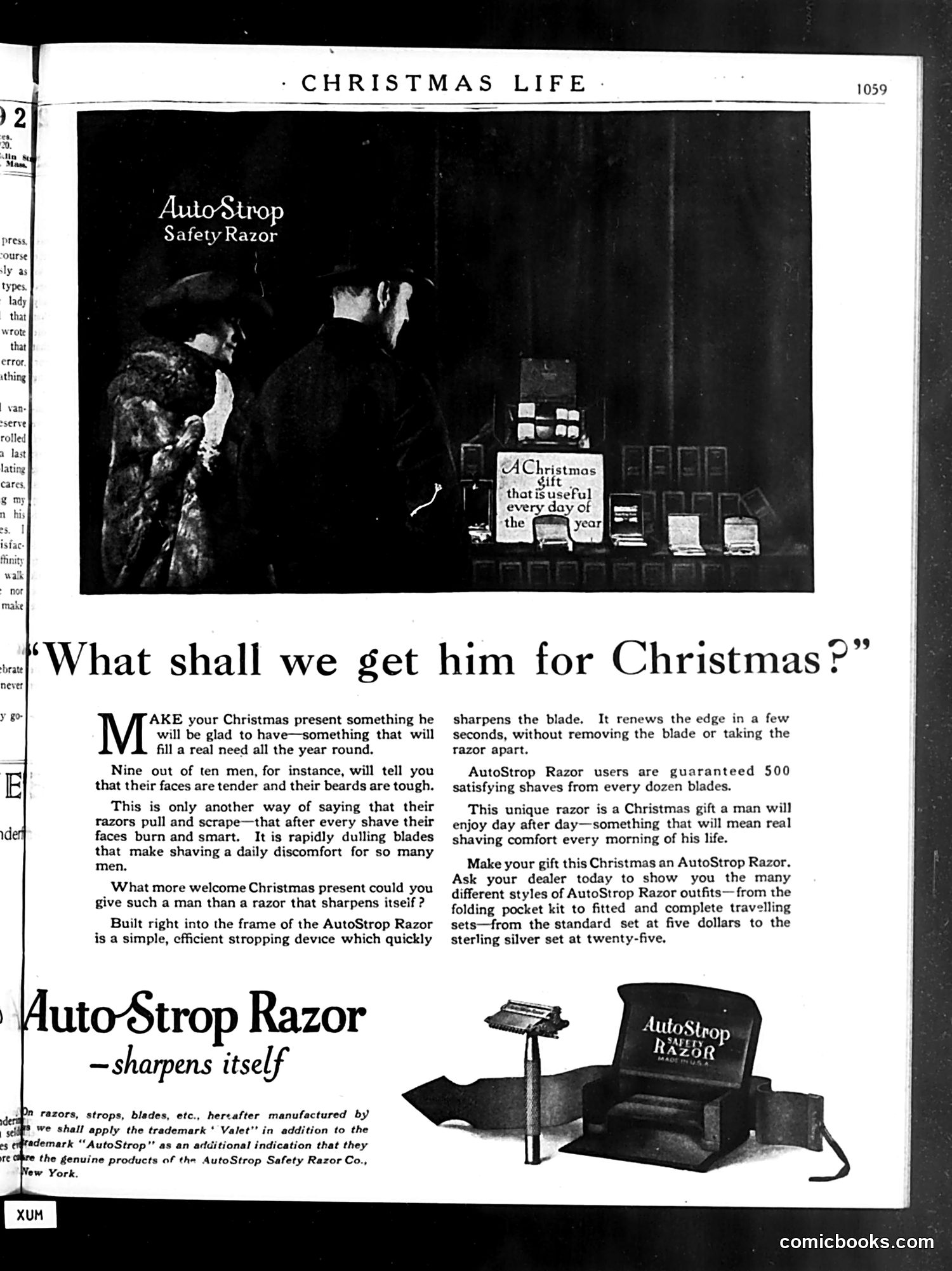
This is **not satire or a political cartoon**—it's a straightforward Christmas advertisement for the AutoStrop Safety Razor, appearing in Life magazine's Christmas issue. The page shows a shop window display where two men examine the razor as a gift option. The ad's humor is mild and commercial: it addresses the relatable problem that men of the era faced—tough beards and tender skin causing razor burn—and positions the AutoStrop's self-sharpening mechanism as the solution. The tagline "What shall we get him for Christmas?" frames the razor as an ideal gift because it's practical and used daily. The ad emphasizes durability (500 shaves per dozen blades) and luxury options (including a sterling silver set at twenty-five dollars). This reflects early 20th-century masculine consumer culture, where grooming products were marketed to men as practical necessities rather than luxuries. The "Christmas gift that is useful every day of the year" message was a common advertising strategy of the period.
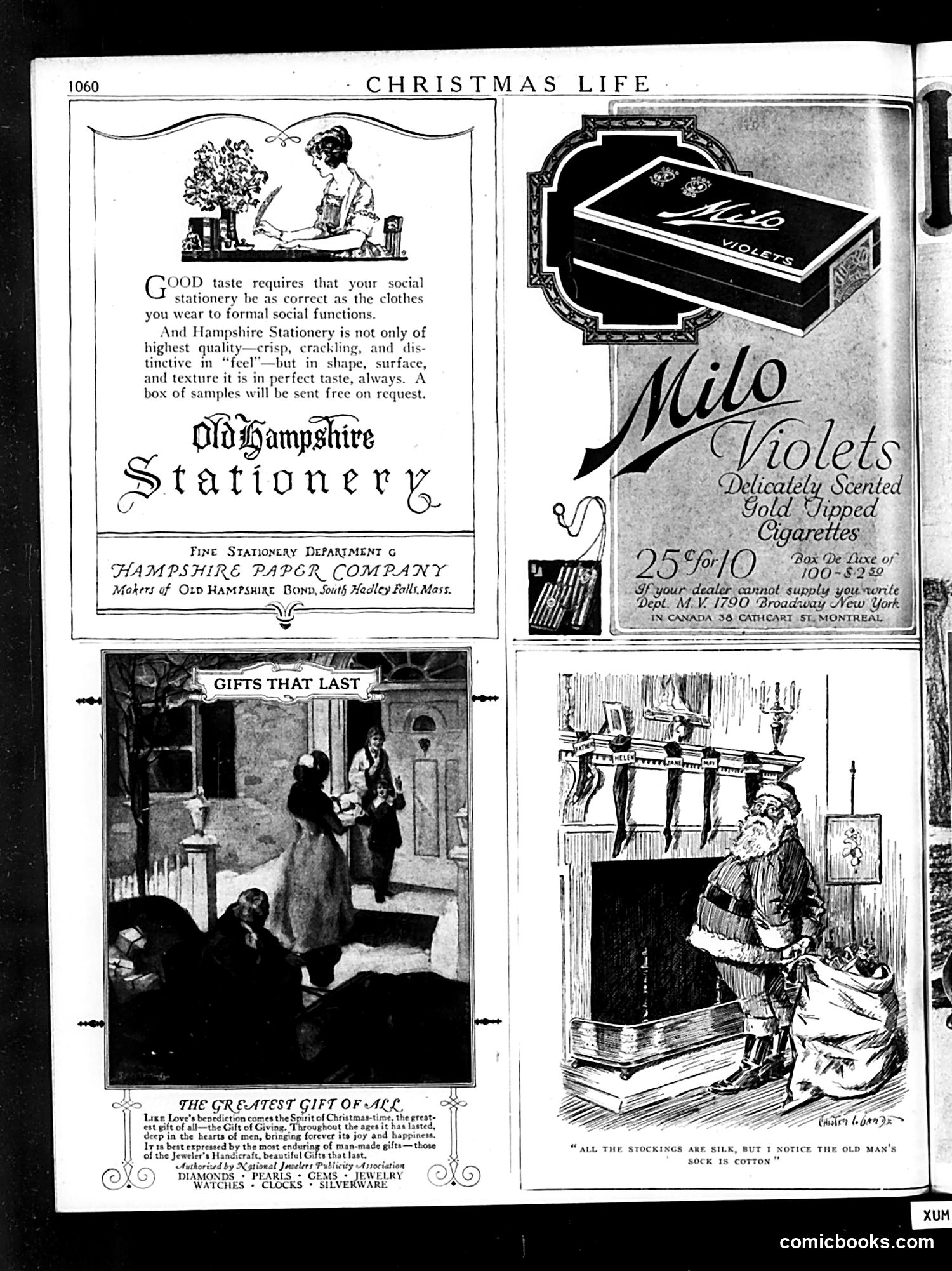
This page is primarily **advertising**, not political satire. It contains three distinct ads: 1. **Old Hampshire Stationery** (top left): Promotes fine writing paper, arguing that correct stationery is as essential to social standing as appropriate clothing for formal events. 2. **Milo Violets Cigarettes** (top right): Markets delicately scented, gold-tipped cigarettes at 25¢ for 10, with distribution through New York and Montreal. 3. **"The Greatest Gift of All"** (bottom): A jewelry advertisement emphasizing gift-giving during Christmas as expressing love and human connection, promoting diamonds, pearls, gems, and watches. The only illustration with narrative content shows a Christmas scene where jeweler's gifts are being presented—depicting the sentimental aspect of holiday giving through material luxury goods. The page reflects early 20th-century consumer culture and etiquette concerns around social class markers: correct stationery, luxury cigarettes, and fine jewelry as expressions of taste and social position.
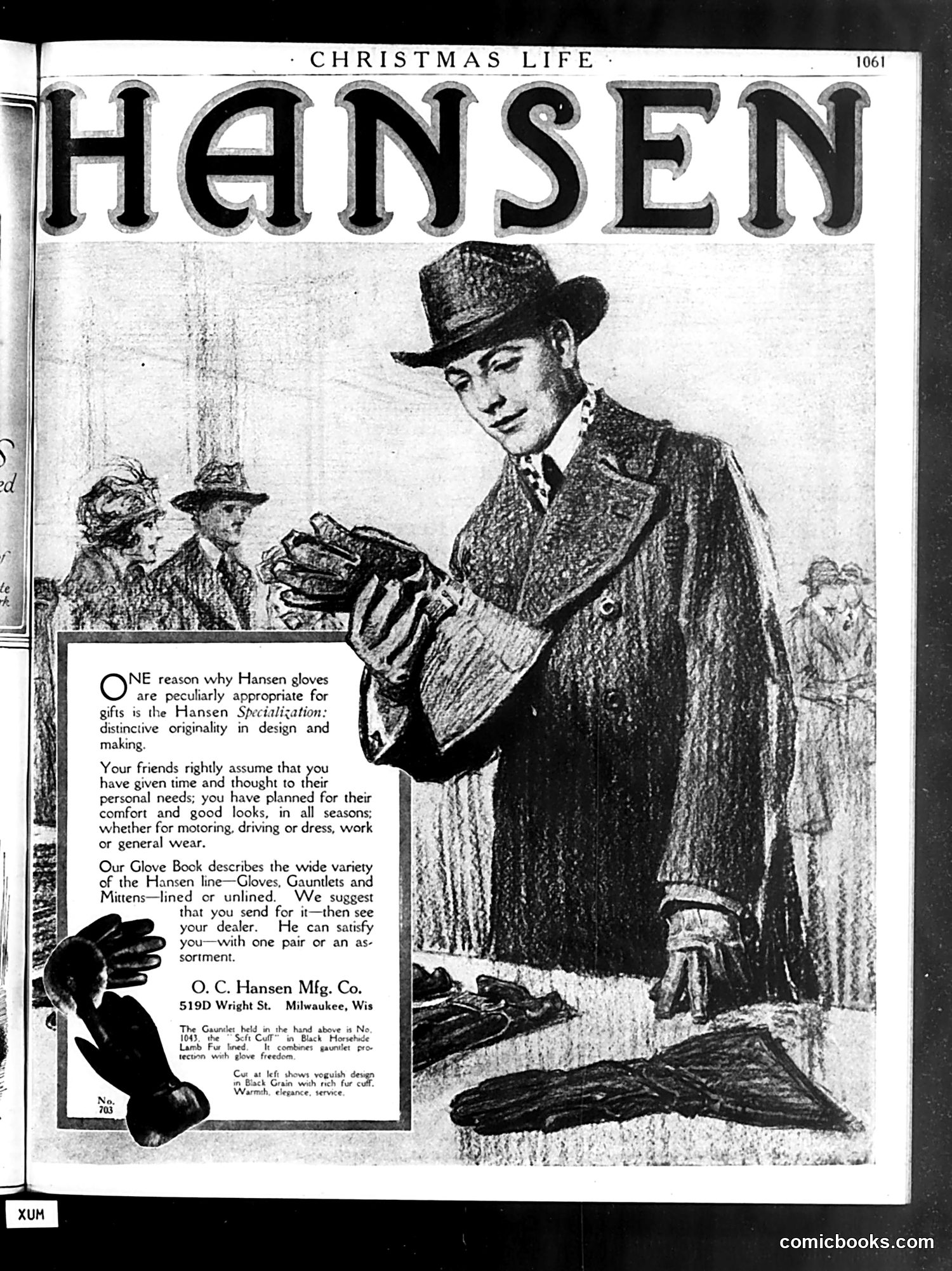
This is a **Christmas-themed advertisement**, not political satire or a cartoon. It promotes Hansen brand gloves as thoughtful gift-giving. The image shows a well-dressed man in a coat and fedora displaying Hansen gloves—positioning them as luxury items demonstrating care and consideration for recipients' comfort across seasons (motoring, driving, dress, work). The smaller figures in the background appear to be other people, contexualizing the gloves as socially appropriate gifts. The text emphasizes Hansen's "specialization" in distinctive design, and includes product details about specific models (gauntlets, mittens, lined/unlined options) and company information (O.C. Hansen Mfg. Co., Milwaukee). A sample glove is shown at bottom left. For a modern reader: this represents vintage advertising using aspirational imagery and gentle social pressure—the notion that quality gloves signal thoughtfulness—typical of early 20th-century Life magazine advertisements.
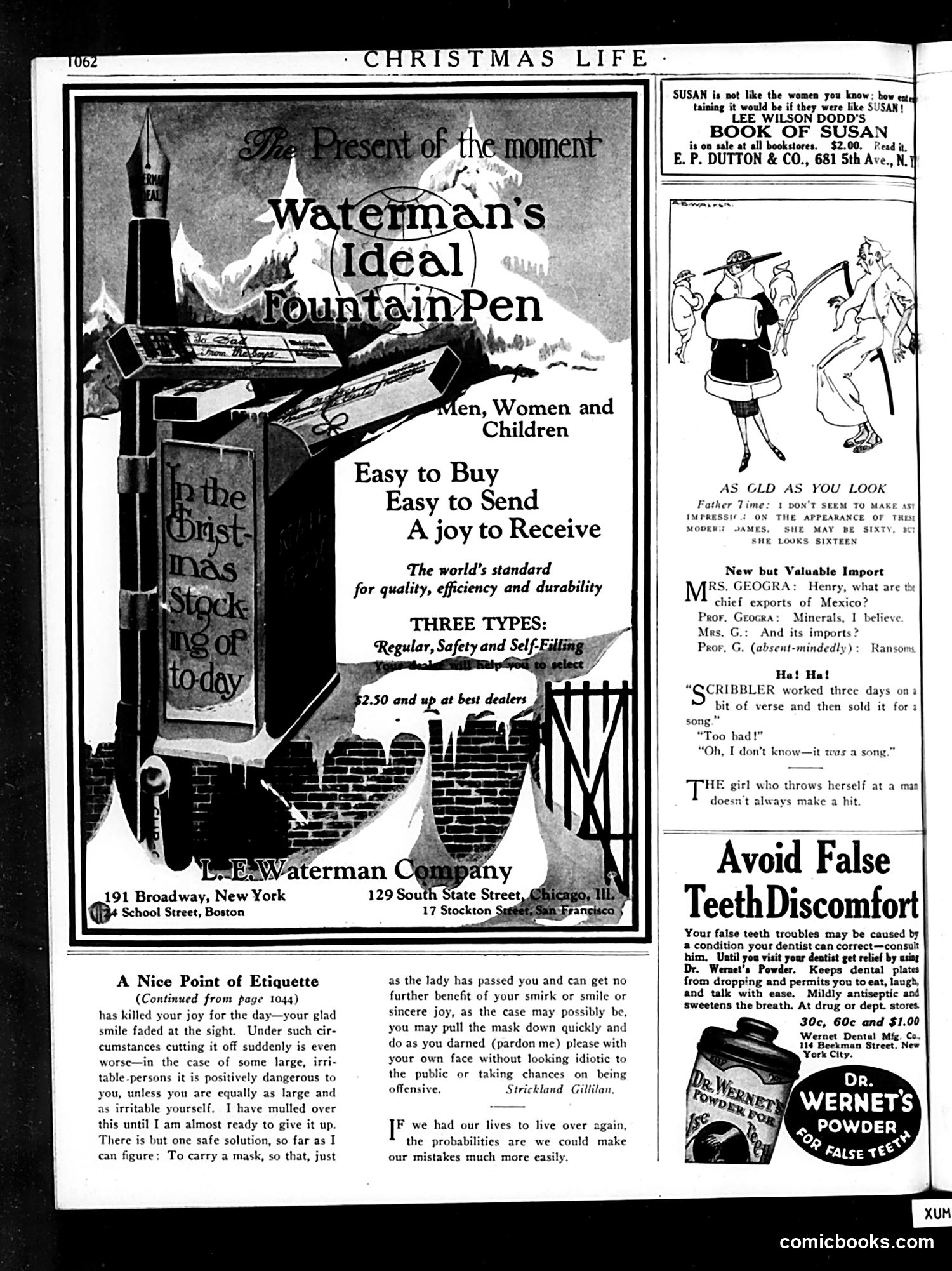
This page mixes advertisements with satirical humor typical of early 20th-century *Life* magazine. **The main advertisement** promotes Waterman's Ideal Fountain Pen as a Christmas gift—positioned as suitable "for Men, Women and Children" with the tagline emphasizing it's "Easy to Buy / Easy to Send / A joy to Receive." **The satirical content** includes several brief jokes and observations: - "A Nice Point of Etiquette" discusses the social awkwardness of maintaining a smile after encountering an unattractive person—suggesting one should wear a mask to hide one's true facial reaction. - "As Old as You Look" mocks modern women's efforts to appear younger than their actual age through cosmetics or appearance. - A joke about a poet selling verse "for a song" (literal irony). - A quip about girls who "throw themselves" at men not making romantic "hits." The page also includes book and false-teeth powder advertisements. The humor reflects period anxieties about etiquette, aging, gender presentation, and commercialism.
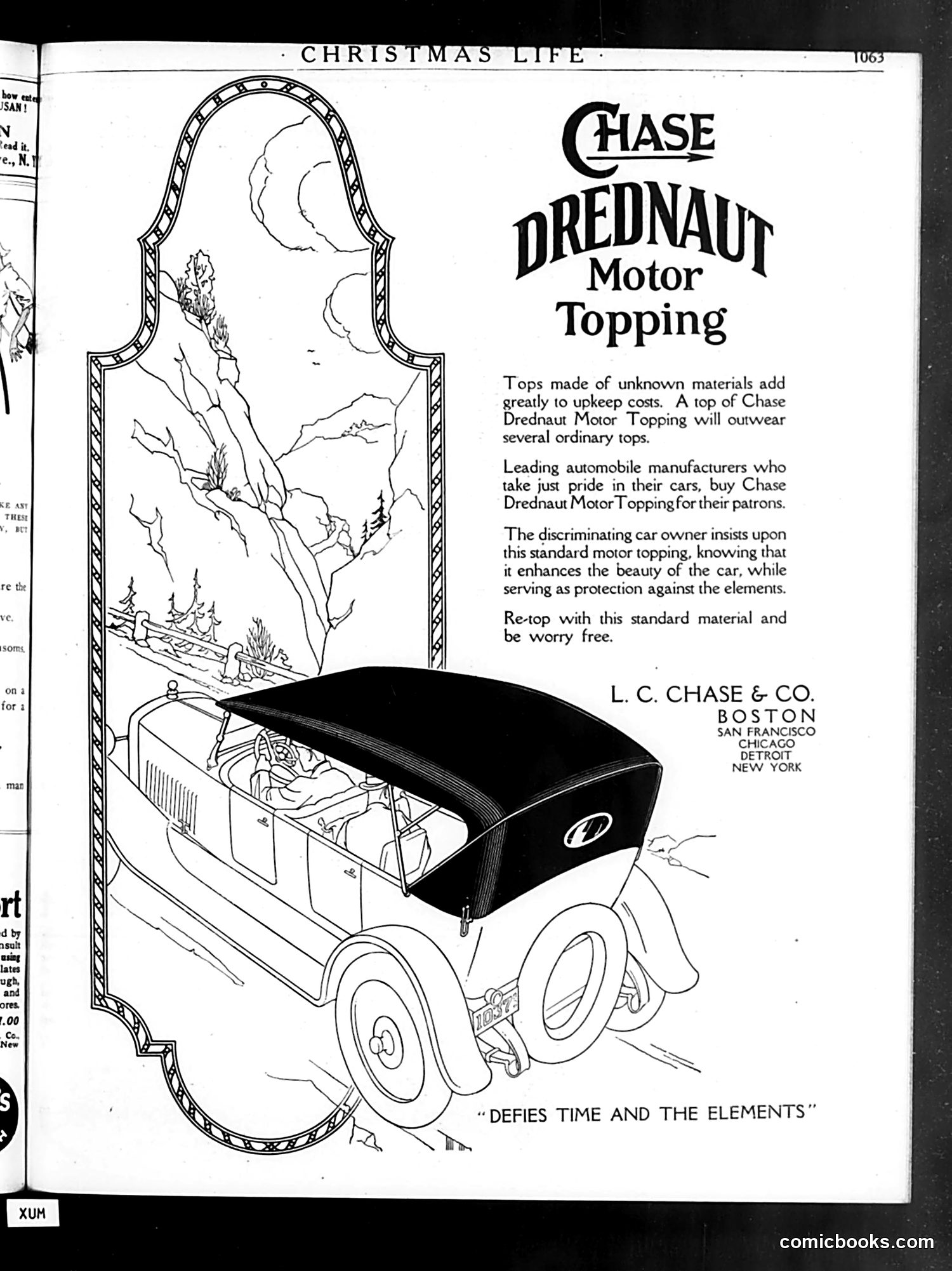
This is a **product advertisement**, not political satire. It promotes Chase Drednaut Motor Topping—a convertible car top material manufactured by L.C. Chase & Co. The ad targets early-20th-century automobile owners, arguing that cheap or unknown-material car tops require frequent replacement. The "Drednaut" brand claims superior durability and aesthetic appeal while protecting against weather. The illustrated car shows the black convertible top in use. The ornamental winter landscape border establishes a seasonal context—suggesting the product's value during harsh conditions. The copy emphasizes that discriminating car owners and manufacturers chose this standard material, appealing to consumers' desire for quality and status. This represents typical early automotive advertising strategy: positioning reliable products as markers of good taste and practical wisdom.
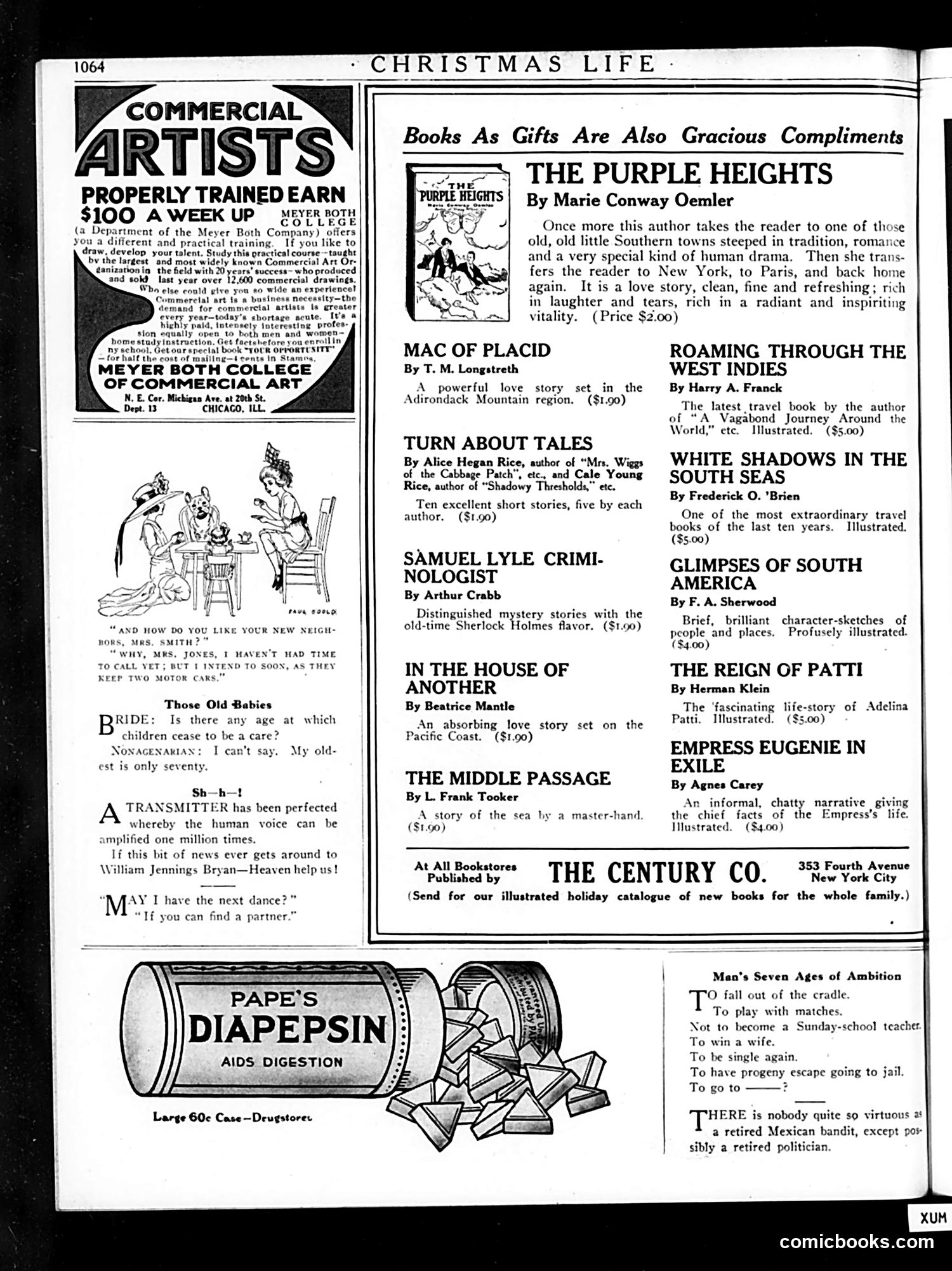
This page from *Life* magazine contains several satirical short jokes reflecting early 20th-century concerns: **"Those Old Babies"** mocks wealthy suburban status-anxiety: Mrs. Jones brags about her neighbors' two motor cars as a sign of their worth, suggesting material possessions define social standing. **The voice amplifier joke** is a political jab at William Jennings Bryan, the three-time presidential candidate known for his powerful oratory. The satire implies amplifying his voice a million times would be catastrophic—a dismissive swipe at his political influence. **"Man's Seven Ages of Ambition"** parodies life's progression, progressing from childhood innocence through marriage, infidelity ("To be single again"), and criminal worries about one's children, ending with an ambiguous "To go to ?" **The closing quip** about retired Mexican bandits and politicians being equally virtuous sarcastically suggests both are morally equivalent—a cynical commentary on political corruption. The page is predominantly book advertisements and commercial art school promotions, with these jokes functioning as filler entertainment.
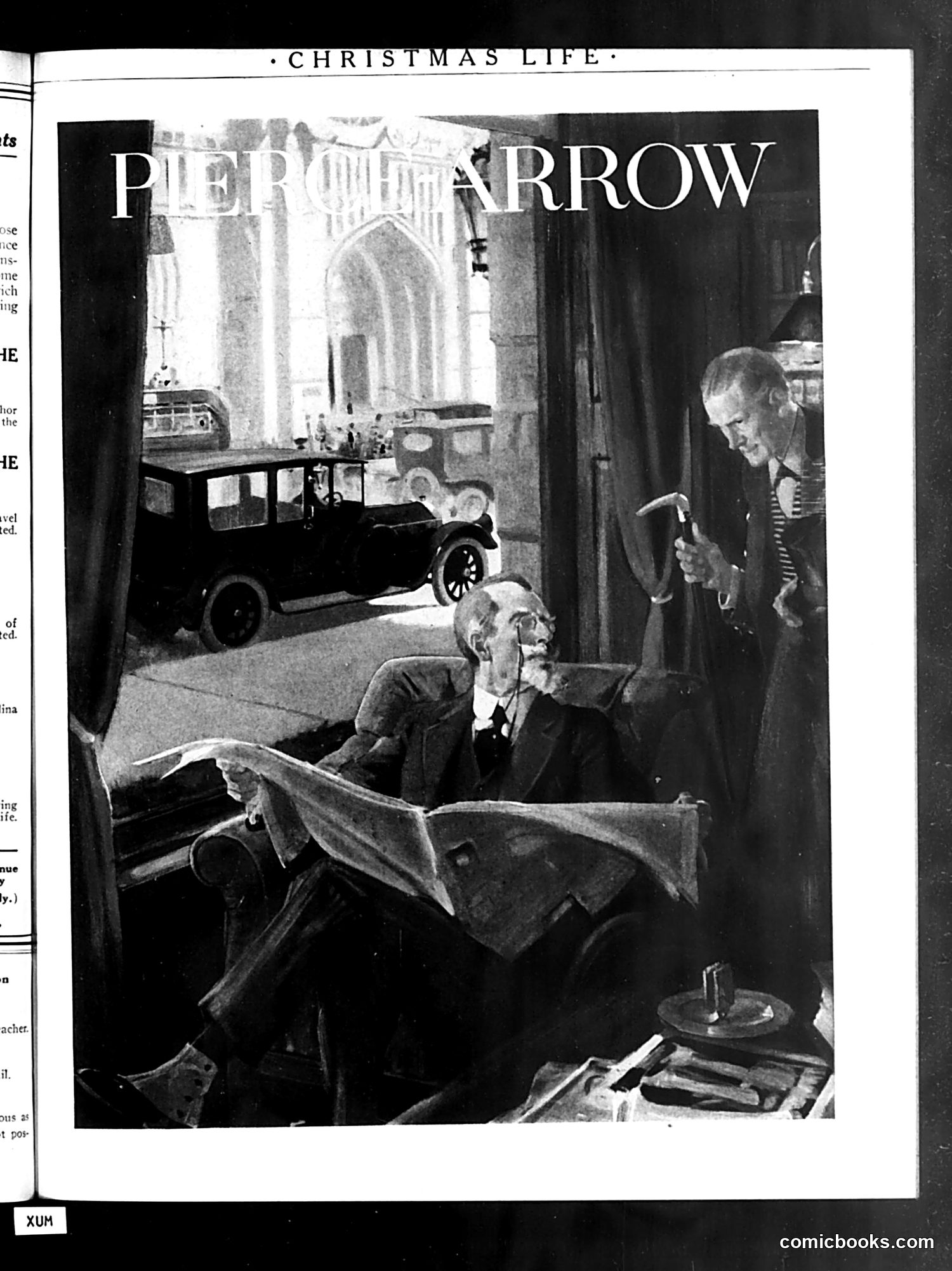
This appears to be a theatrical or film still titled "Pier Arrow," likely from an early 20th-century production. The image shows two men in formal attire examining what appears to be architectural plans or documents near a waterfront setting with period automobiles and gothic architecture visible in the background. Without additional context from the OCR text (which only shows the website attribution), the specific satirical point remains unclear. The scene suggests either a business transaction, investigation, or comedic misunderstanding typical of the era's theatrical humor. The gothic pier structure and vintage cars establish a specific historical setting, but the identities of the figures and the exact nature of the satire cannot be definitively determined from the image alone.
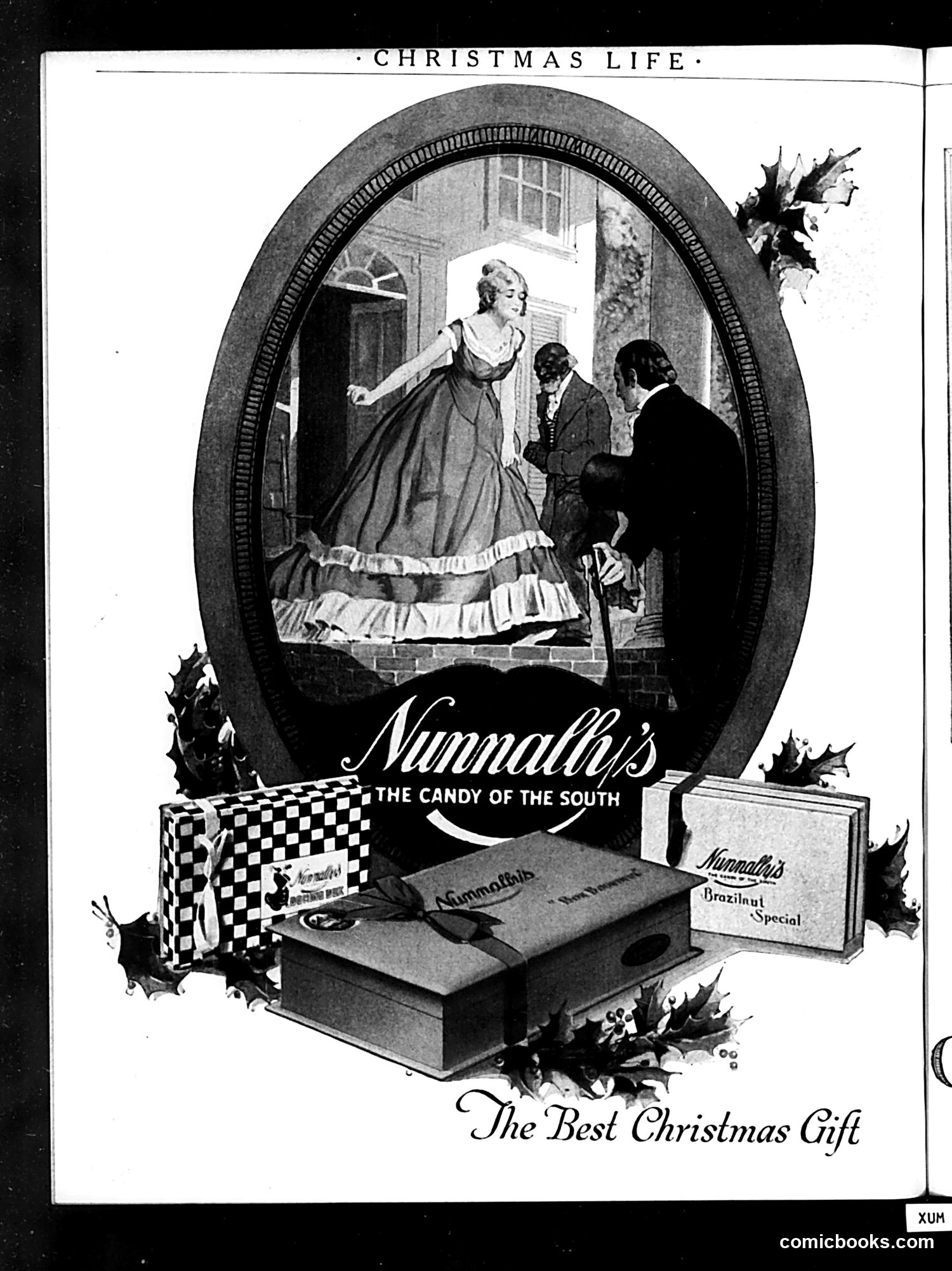
This is a **vintage advertisement**, not political satire. The page promotes "Nunnally's—The Candy of the South" as "The Best Christmas Gift." The advertisement uses a theatrical scene framed in an oval: a woman in an elegant dress welcomes two well-dressed gentlemen at a doorway, suggesting refined hospitality and social grace. Holly decorations and wrapped candy boxes frame the image. The marketing appeal targets upper-class Christmas gift-giving by associating Nunnally's candy with elegance, Southern charm, and sophisticated entertaining. The ornate presentation and formal scene suggest this candy was positioned as a luxury gift for cultivated consumers, rather than everyday confection. This reflects early 20th-century advertising strategies emphasizing status and refinement.
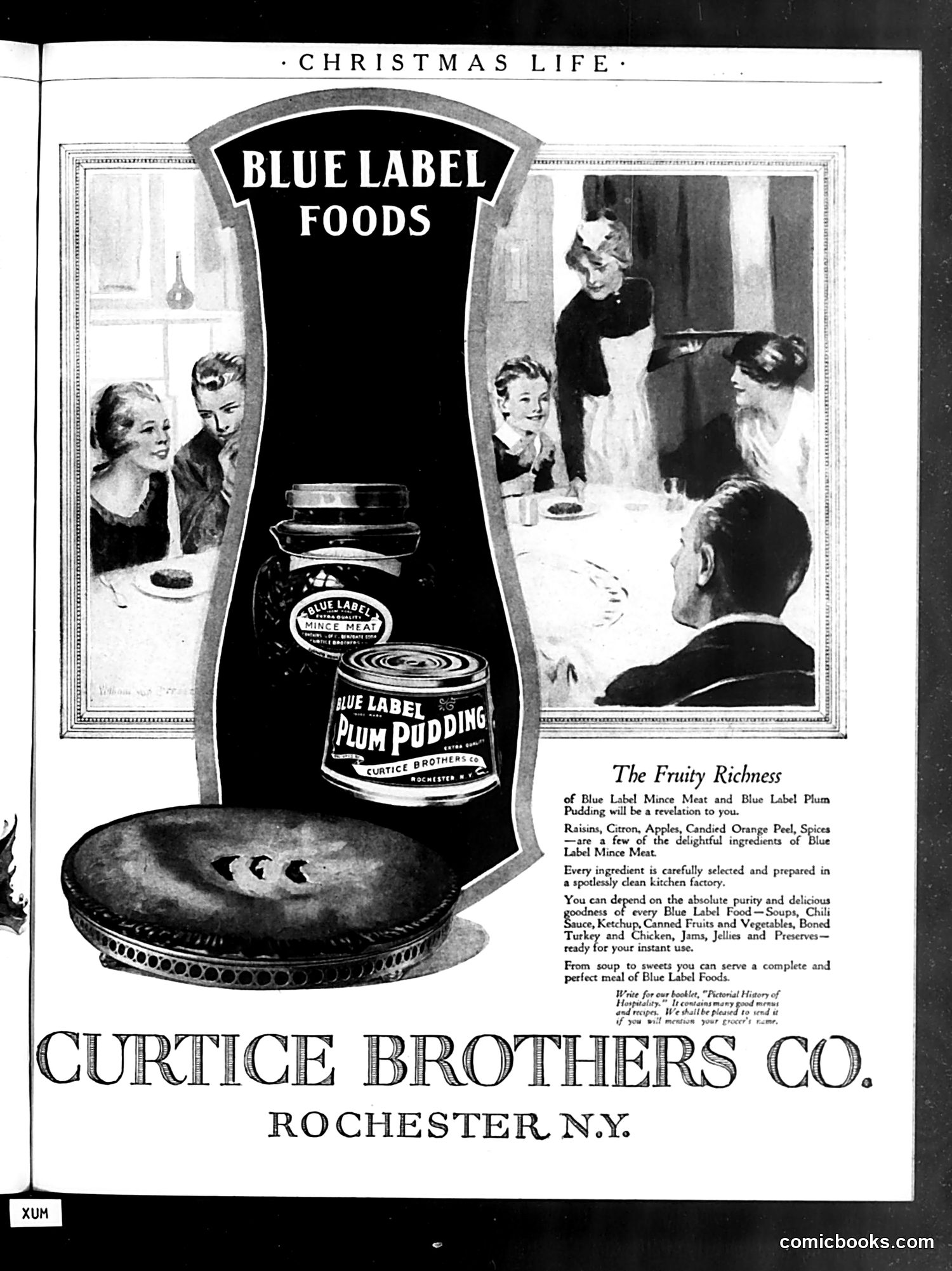
This is primarily a **Christmas-themed advertisement**, not political satire. It promotes Blue Label Foods by Curtice Brothers Co. of Rochester, New York. The page features two domestic scenes showing families enjoying meals, positioned around product images (mince meat and plum pudding jars) and a pie. The visual message emphasizes convenience and quality: these prepared foods allow hosts to serve "complete and perfect meals" with minimal effort during the busy holiday season. The marketing appeals to early 20th-century consumers by highlighting factory cleanliness, ingredient selection, and product variety—addressing contemporary concerns about food safety and purity. The lifestyle imagery suggests that using these convenience foods enables gracious entertaining without exhausting labor, positioning the brand as both practical and respectable for middle-class households during Christmas celebrations.
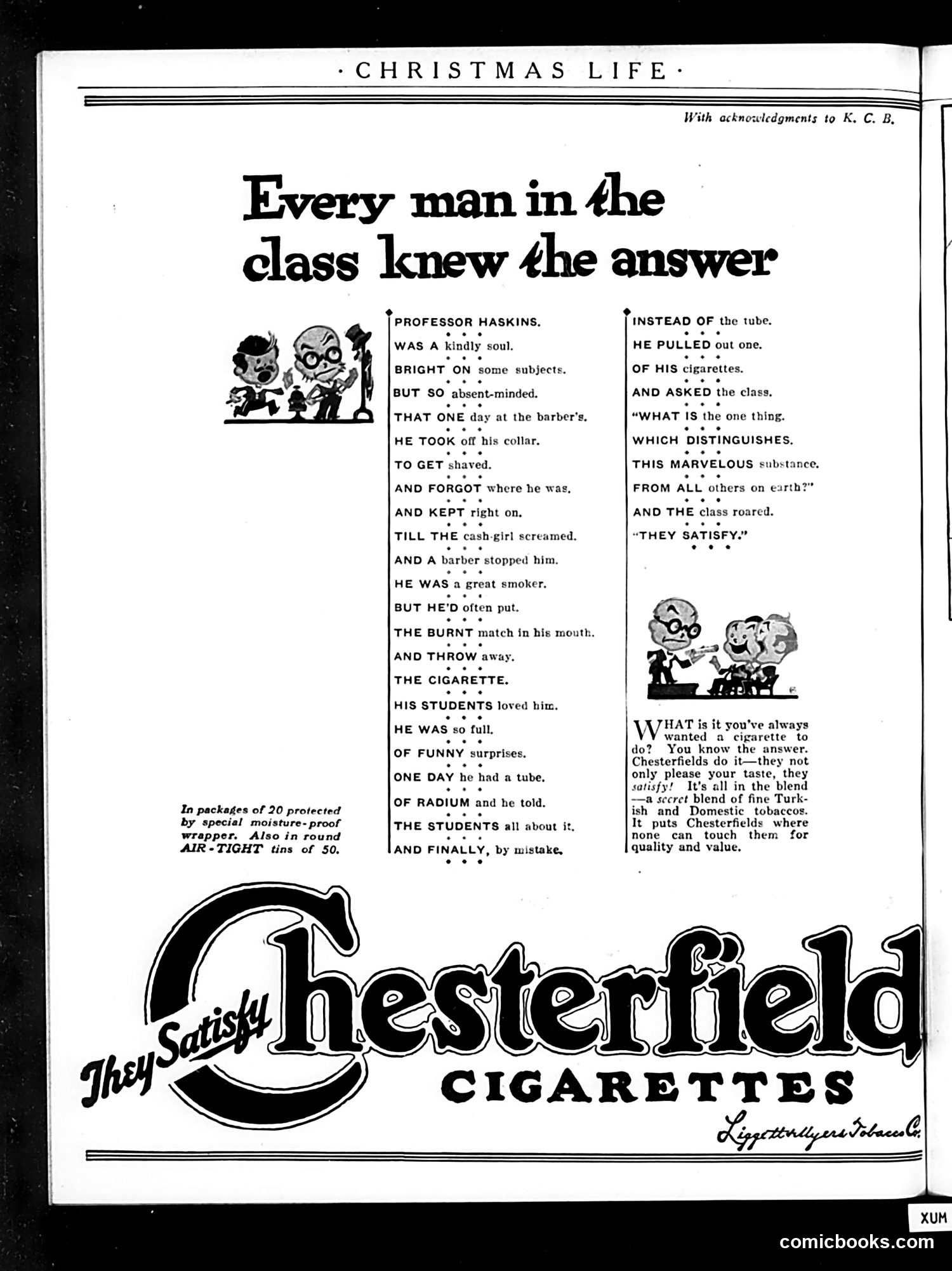
This is a **cigarette advertisement** disguised as humorous content from Life magazine. The "cartoon" is actually an extended joke setup promoting Chesterfield cigarettes. **The Setup:** Professor Haskins is an absent-minded academic who absent-mindedly continues shaving his entire face instead of just his neck, and habitually confuses his cigarettes with burnt matches. **The Punchline:** When he shows his students a tube of radium (a "marvelous substance"), he accidentally pulls out a Chesterfield cigarette instead and asks what distinguishes it from all others. The class answers: "They Satisfy!"—which is the advertiser's slogan. **The Satire:** The joke mocks both the professor's absentmindedness and plays on period advertising claims that cigarettes could "satisfy" desires. By framing the advertisement as a funny anecdote, it makes the product pitch feel like entertainment rather than commercial messaging. This reflects early 20th-century advertising practices before regulations restricted cigarette claims.
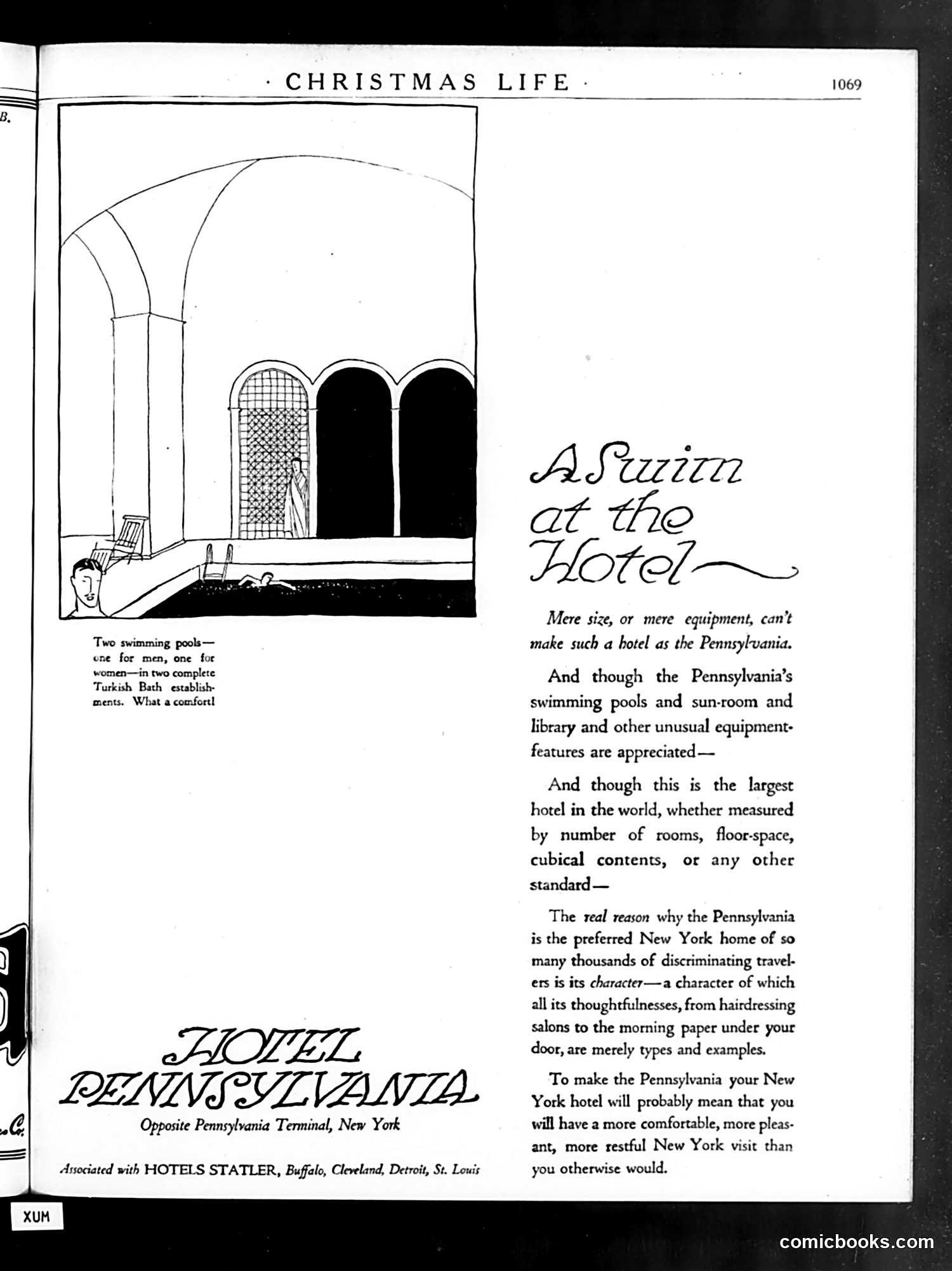
This is primarily a **hotel advertisement**, not political satire. The page promotes the Hotel Pennsylvania in New York City. The illustration shows an elegant Art Deco interior with arched doorways and a figure relaxing in what appears to be a Turkish bath facility. The accompanying text emphasizes that while the Pennsylvania boasts impressive amenities (two swimming pools, sun-room, library, Turkish baths) and claims to be "the largest hotel in the world," its real appeal is **character and service quality**—the attention to detail from hairdressing salons to morning newspaper delivery. This reflects early-20th-century luxury hotel marketing philosophy: size and equipment matter less than refinement and thoughtful service. The advertisement targets "discriminating travelers" seeking comfort and gentility during their New York visits. The Statler Hotels affiliation indicates this was part of a major hotel chain.
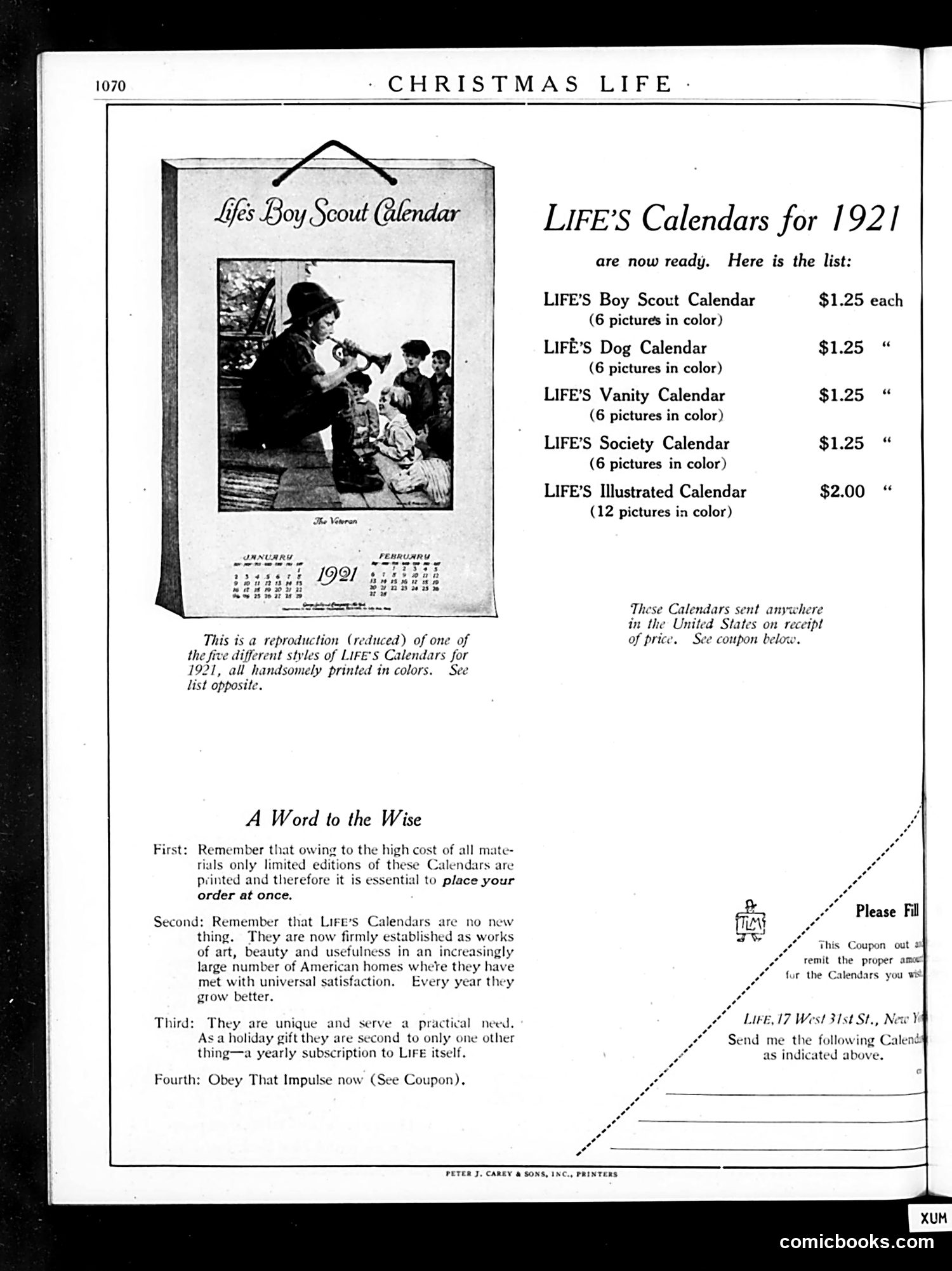
This page is primarily **advertising**, not satire or political commentary. It promotes LIFE magazine's 1921 calendar offerings. The content shows: - A reproduction of LIFE's Boy Scout Calendar featuring an illustration of an adult (appears to be a scoutmaster) with young Boy Scouts - Five calendar options priced from $1.25–$2.00, each featuring colored pictures on themes appealing to 1920s audiences: Boy Scouts, dogs, vanity/beauty, high society, and general illustration - A persuasive "Word to the Wise" section using four selling points: limited supply, established quality/artistic merit, practical gift value, and an impulse-to-buy appeal - A detachable coupon for mail orders There is no visible political cartoon or satire here. This is straightforward commercial promotion typical of early 20th-century magazine advertising, targeting holiday gift-buyers by emphasizing scarcity, prestige, and aesthetic appeal.
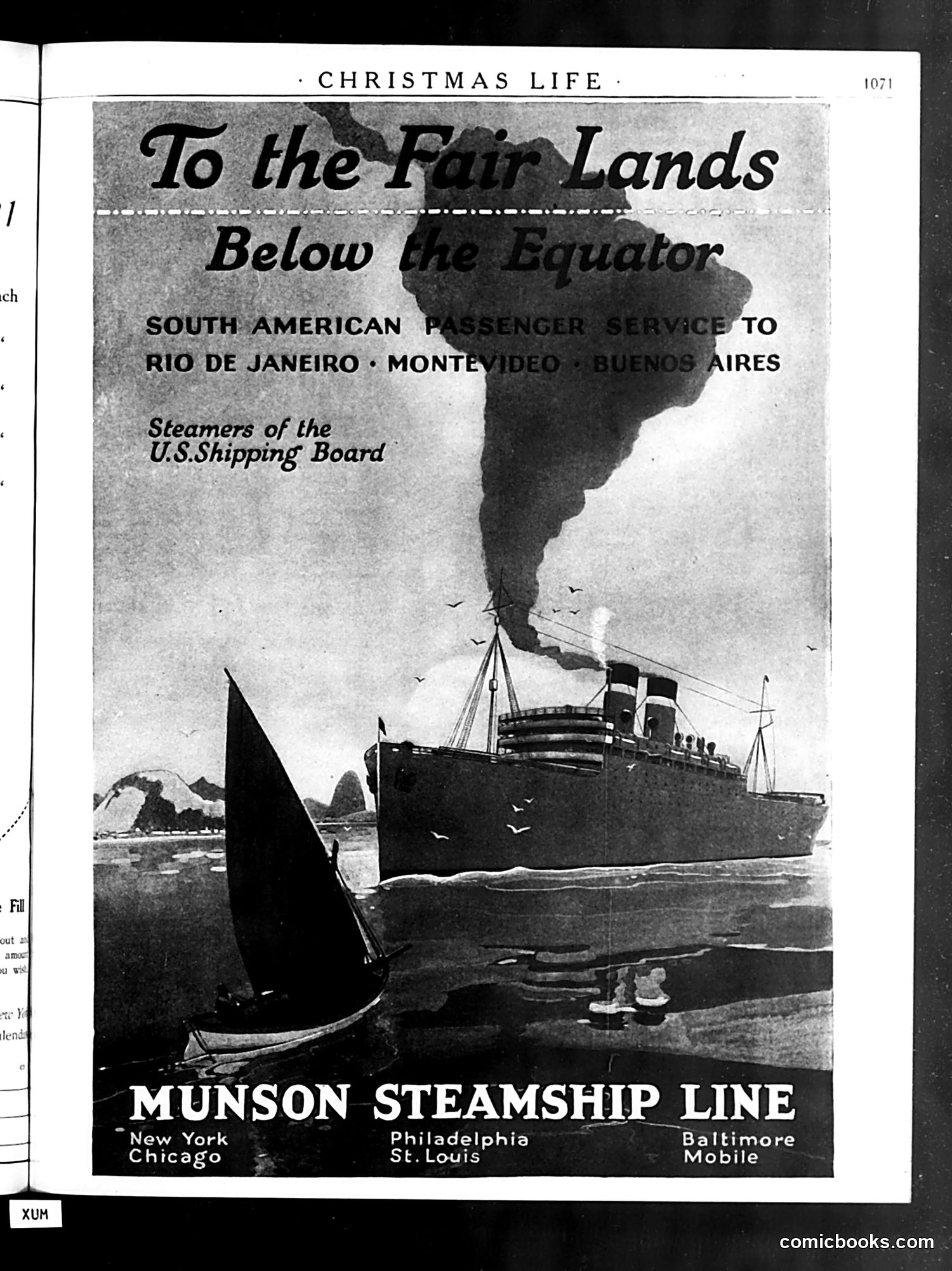
This is a **travel advertisement**, not political satire or commentary. It promotes the Munson Steamship Line's passenger service to South America (Rio de Janeiro, Montevideo, Buenos Aires), operating under U.S. Shipping Board authority. The ad features a large modern steamship with smoke billowing from its stack, positioned prominently against a silhouette map of South America. A traditional sailing vessel appears in the foreground, creating visual contrast between old and new maritime technology. The headline "To the Fair Lands Below the Equator" uses romantic language to attract Christmas-season travelers to exotic South American destinations. The multiple departure cities listed (New York, Chicago, Philadelphia, St. Louis, Baltimore, Mobile) emphasize the line's accessibility to American interior regions. This reflects post-WWI American commercial expansion and the U.S. Shipping Board's promotion of American maritime services.
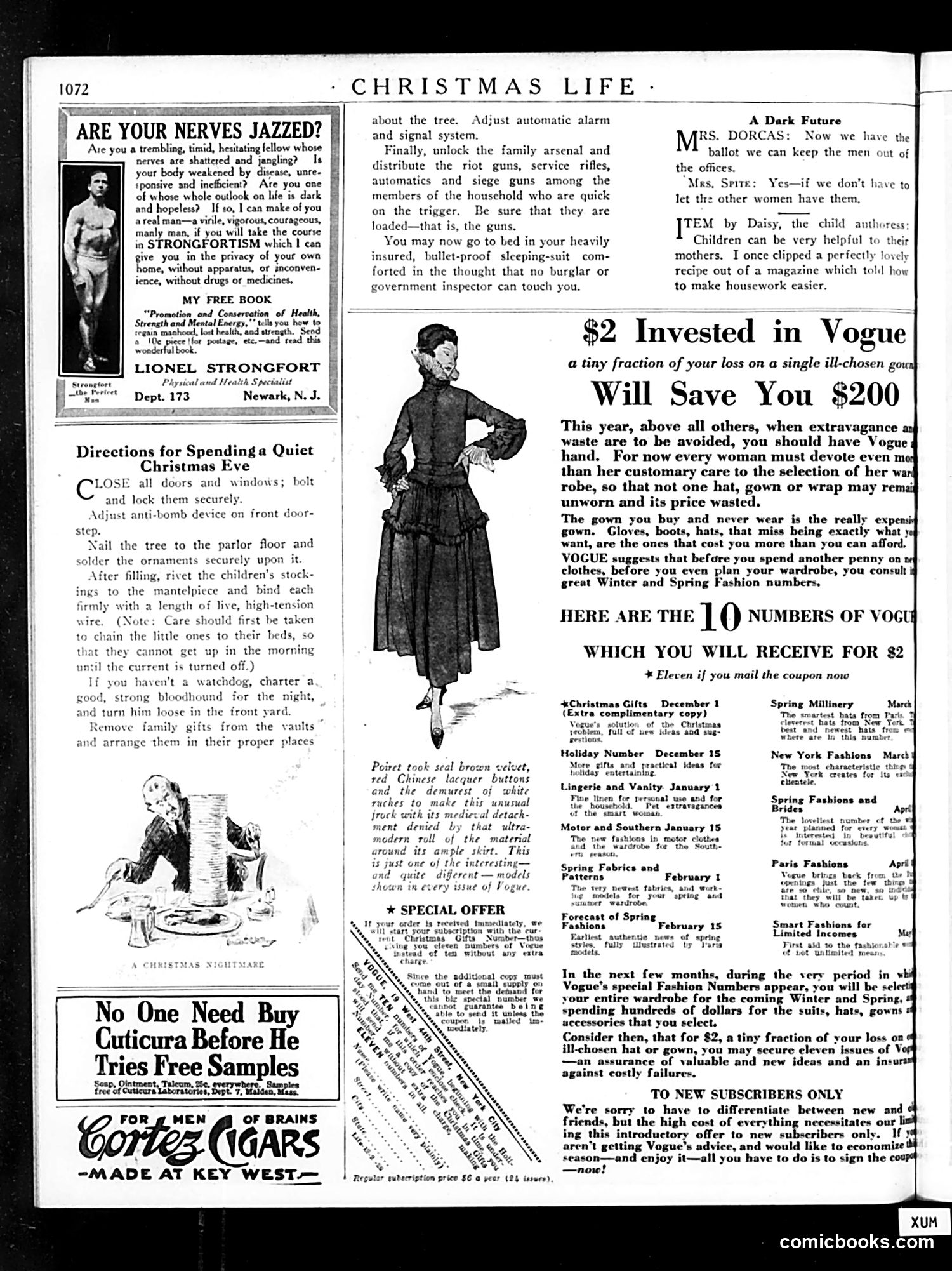
This Life magazine page (circa 1920s) contains satirical humor about Christmas anxieties and consumer culture: **"Directions for Spending a Quiet Christmas Eve"** is the main cartoon humor—a deadpan parody of safety guides. It absurdly escalates holiday precautions: bolting doors, soldering ornaments to trees, riveting children to mantels, installing anti-bomb devices, and distributing riot guns to family members. The satire mocks paranoia about burglars and "government inspectors," reflecting post-WWI anxiety about radicalism and property crime. **The political joke**: A brief dialog between "Mrs. Dorcas" and "Mrs. Sprite" about keeping men out of offices via voting (women's suffrage was recent), undercut by women competing against each other—satirizing feminist divisions. **The advertisements** promote Vogue magazine subscriptions and various products (Strongfort fitness, Cuticura samples, Cortez cigars), reflecting the magazine's advertising-heavy format. The overall tone mocks upper-class Christmas paranoia, consumer anxiety, and contemporary social tensions in the Jazz Age.
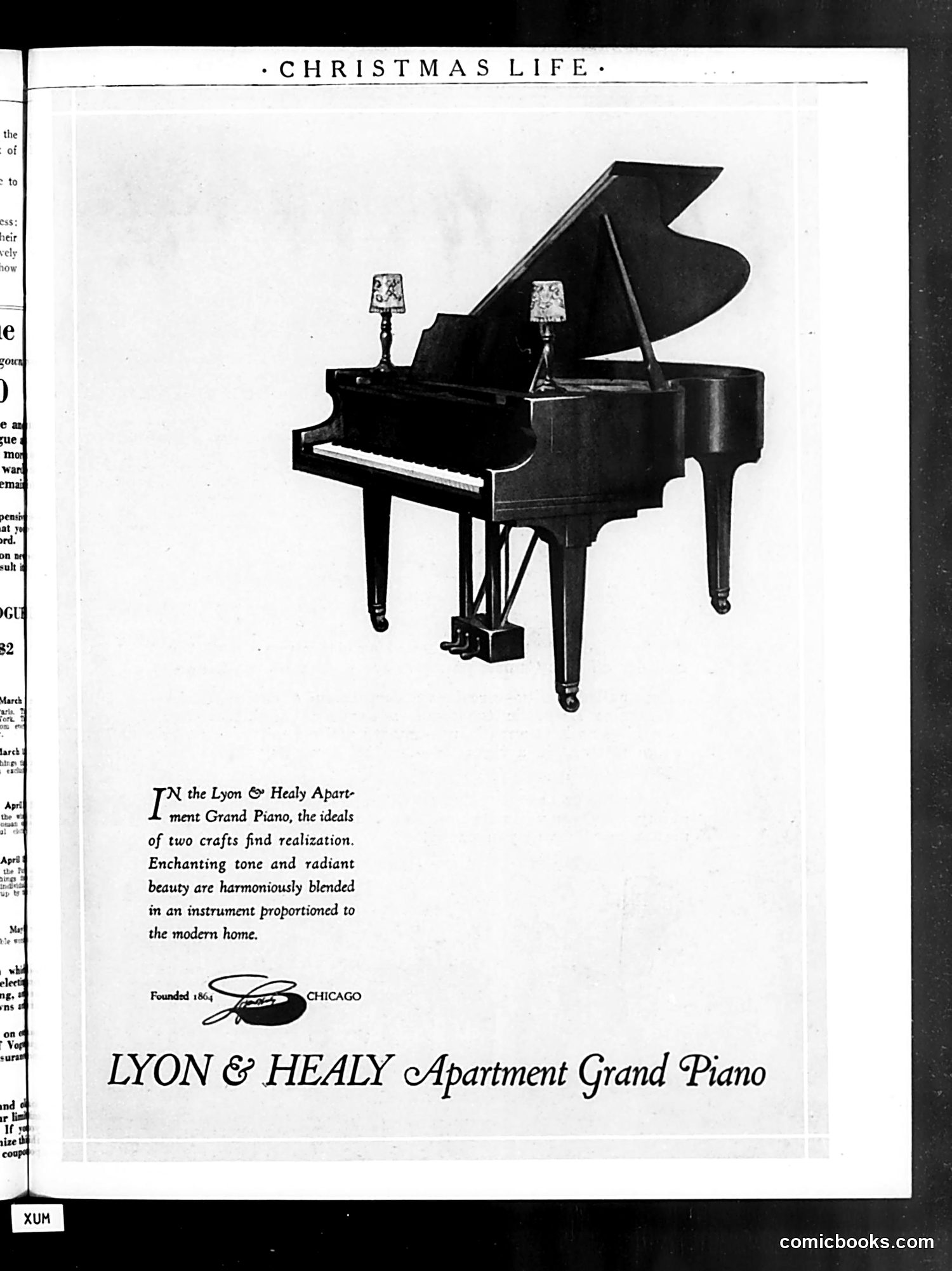
This is a **product advertisement, not satire or political content**. The page promotes Lyon & Healy's "Apartment Grand Piano," positioned as a Christmas gift for modern homes. The ad emphasizes that the instrument combines superior craftsmanship ("two crafts") with elegant design scaled appropriately for contemporary residential spaces—a practical alternative to full-sized concert grand pianos. The decorative lamps flanking the piano and the phrase "radiant beauty" appeal to middle-class aesthetics of the era. Founded in Chicago (visible in the logo), Lyon & Healy was a legitimate piano manufacturer. This represents typical *Life* magazine advertising from the early-to-mid 20th century, targeting affluent readers during the holiday season. There is no cartoon or satire present.
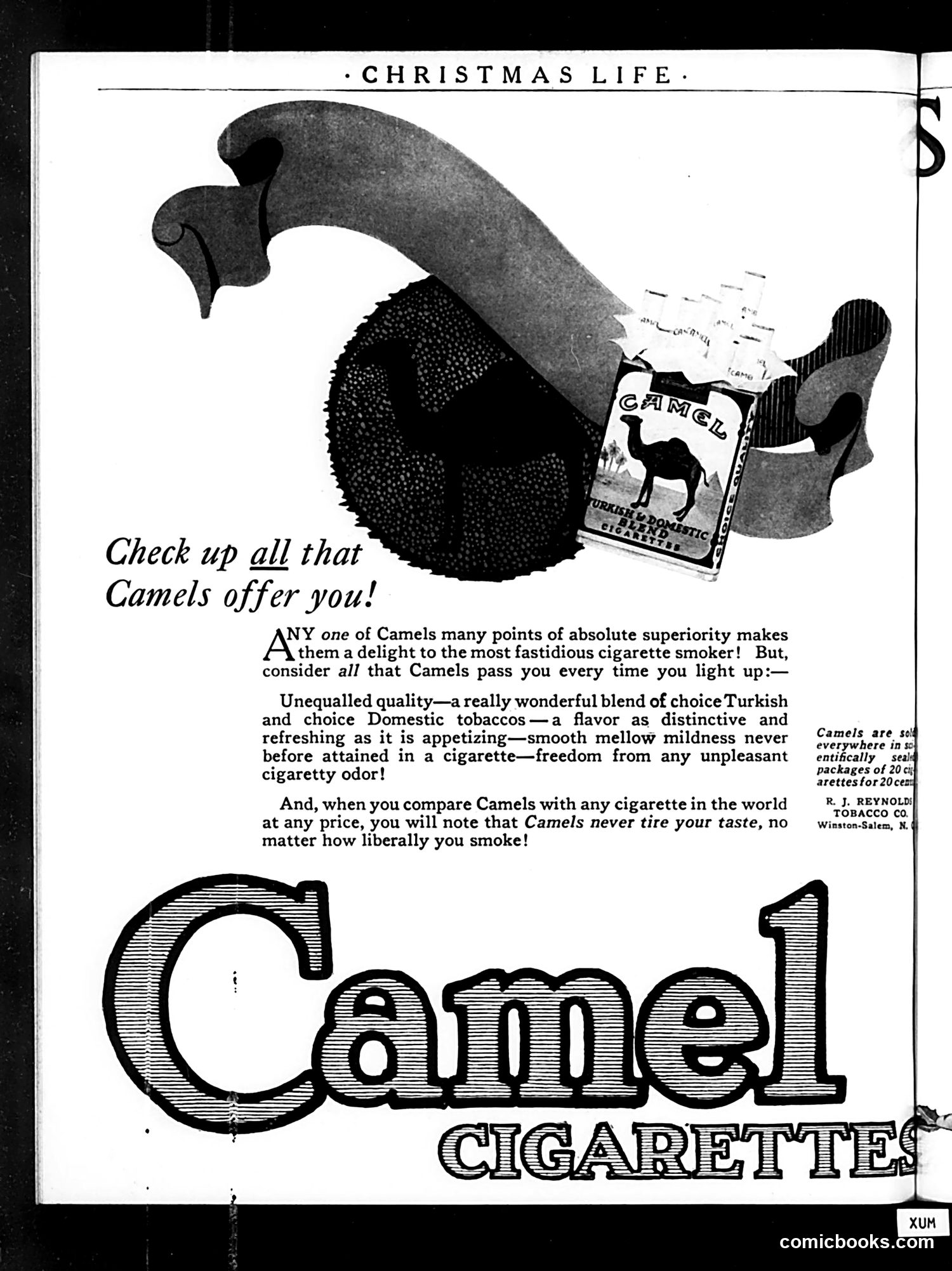
This is a **Camel cigarette advertisement**, not satire or political commentary. The page appears from a "Christmas Life" section of Life magazine (likely 1920s-1930s based on style). The imagery shows a decorative Christmas stocking or cornucopia overflowing with a Camel cigarette package. The ad makes claims about product superiority: superior Turkish-domestic tobacco blend, distinctive flavor, smoothness, lack of "cigaretty odor," and resistance to taste fatigue from heavy smoking. **What's historically striking to modern readers**: This represents an era when cigarette advertising made health-adjacent claims freely—emphasizing "mildness" and "smoothness" as positive attributes. The rhetorical strategy of comparing favorably to "any cigarette in the world" reflects pre-regulation advertising when manufacturers made unsubstantiated superiority claims. R.J. Reynolds' prominent branding reflects major tobacco companies' dominant market position and advertising budgets in this period.
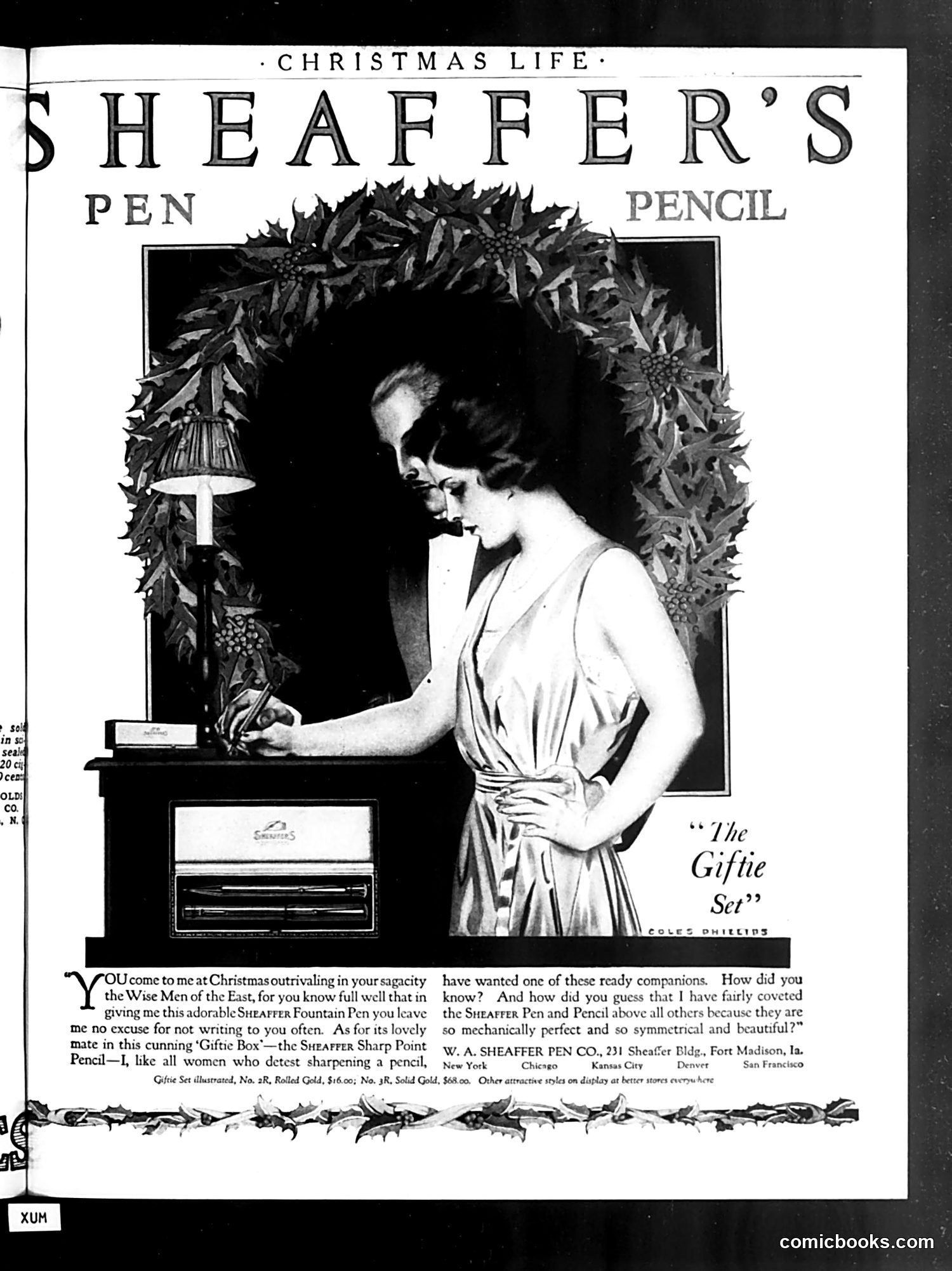
This is **not a political cartoon but a Christmas advertisement** for Sheaffer pens and pencils, disguised as editorial content in the satirical magazine *Life*. The "joke" is the exaggerated, breathlessly grateful monologue from a woman receiving a pen-and-pencil set as a gift. She gushes that the fountain pen eliminates her "excuse for not writing" and that the mechanical pencil solves the "dreadful" problem of sharpening—playing on stereotypical feminine complaints. The satire is gentle and self-aware: *Life* is mocking both the overwrought gratitude expected in advertising copy and the triviality of the "problems" marketed products solve. The woman's rapturous tone—treating writing implements as romantic gifts worthy of elaborate praise—is the humor. This represents early 20th-century advertising practice: companies paid magazines to run ads styled as editorial features, blurring the line between content and commerce in ways modern readers would recognize as deceptive.
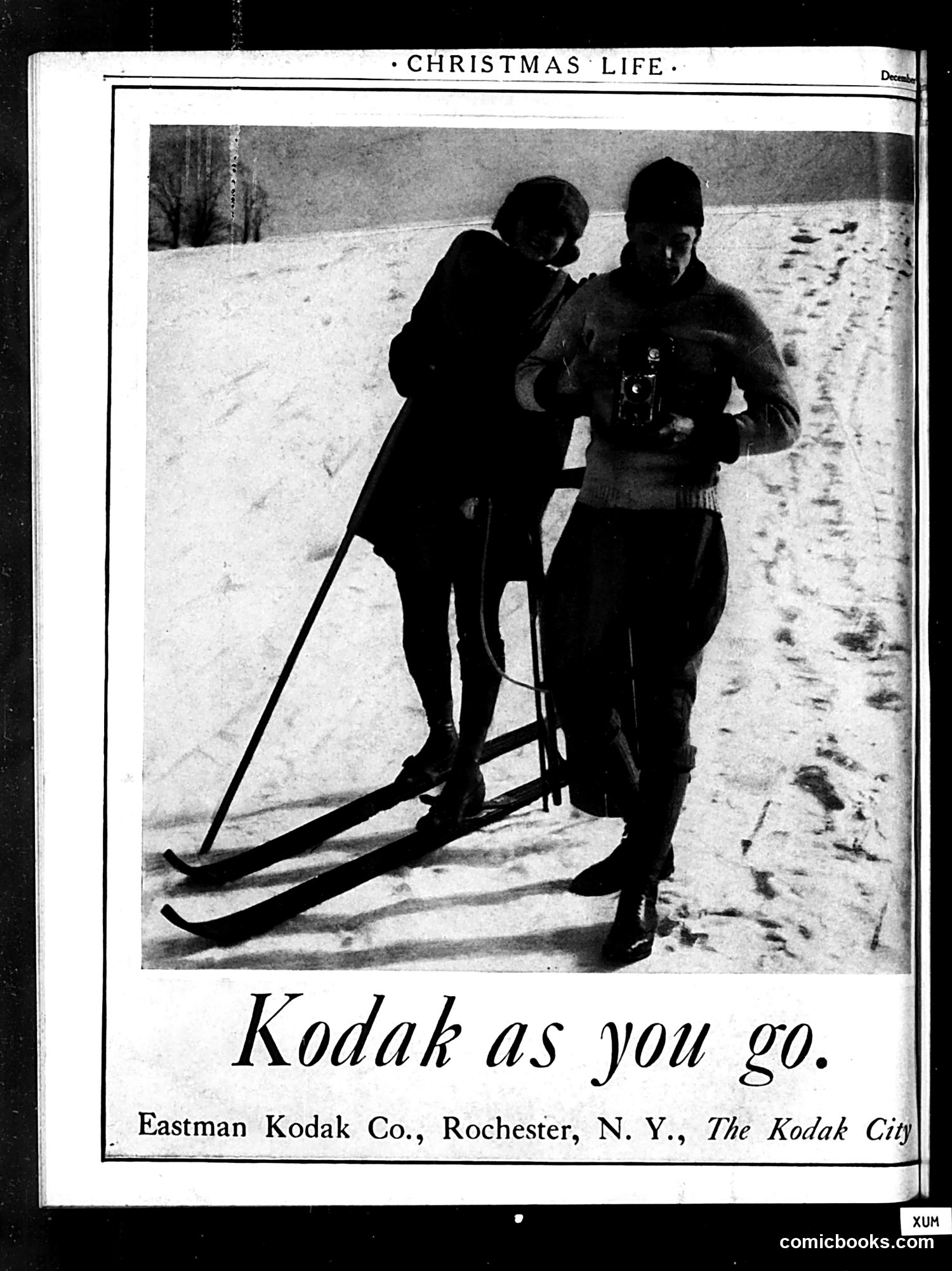
This is a **Kodak advertisement**, not political satire. The page header reads "CHRISTMAS LIFE," indicating it's from Life magazine's Christmas issue. The ad shows two people skiing in a snowy landscape. The tagline "Kodak as you go" encourages consumers to bring cameras on winter recreational activities to photograph their experiences. The text identifies the advertiser: Eastman Kodak Co. of Rochester, New York (called "The Kodak City"). This represents **early-20th-century consumer advertising** promoting photography as essential to leisure activities and holiday experiences—a marketing strategy that normalized documenting personal moments, which was then a relatively novel concept for average consumers.
I can see this is a mostly blank or very dark page from what appears to be a historical publication, with minimal visible content. The only clearly legible text is "comicbooks.com" at the bottom and what appears to be an archive identifier "XUM" in the lower left corner. The image is too dark and lacks sufficient detail for me to identify any cartoon figures, caricatures, political references, or satirical content. There may be illustrations or text present, but they are not discernible enough in this reproduction for accurate analysis. Without being able to see the actual cartoon content or read supporting text, I cannot reliably explain what this page means or what historical/political references it contains.