
Life, 1920-12-02 · page 47 of 97
Life — December 2, 1920 — page 47: what you’re looking at
What you’re looking at
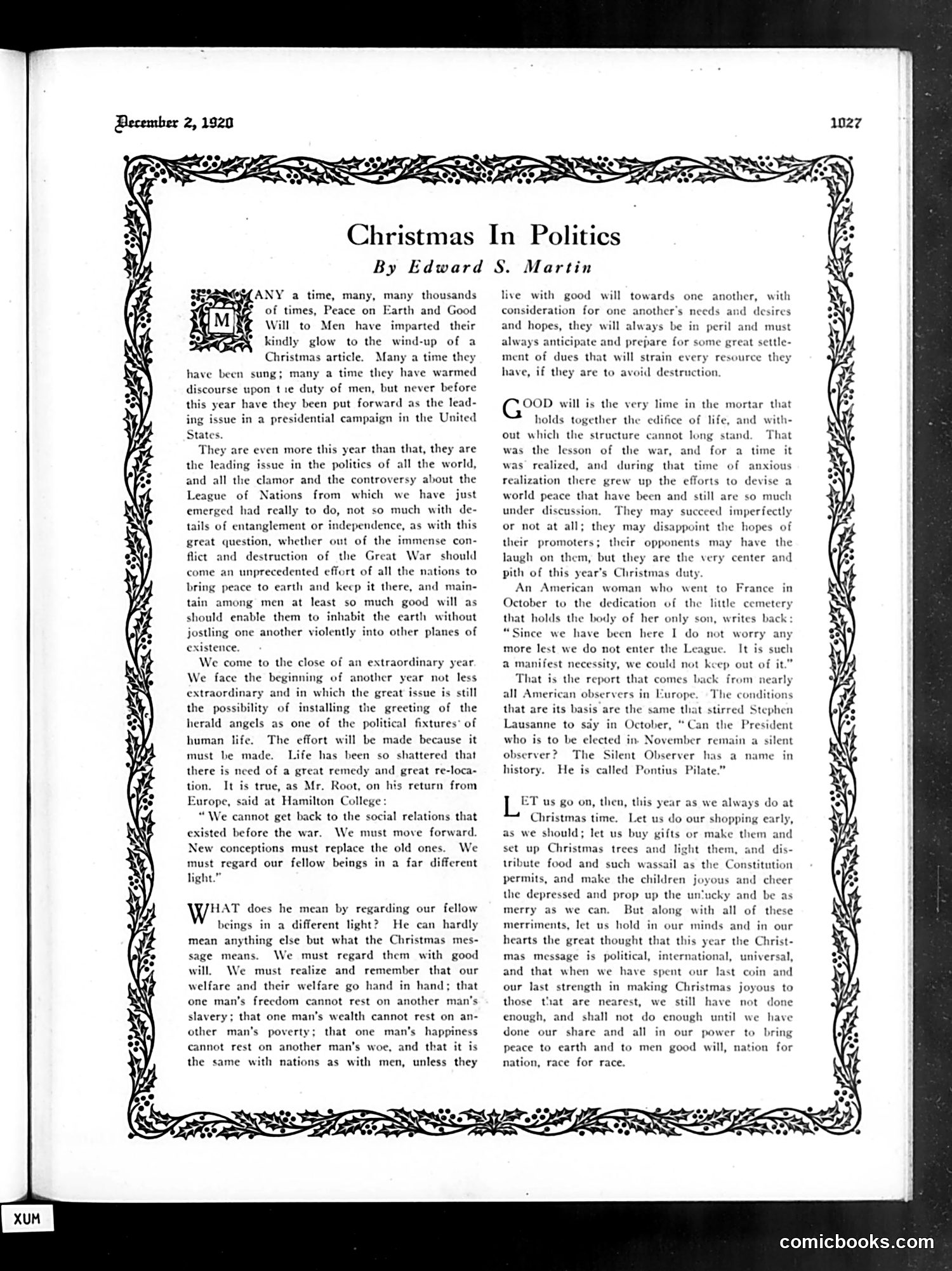
This is not a cartoon but a serious editorial essay by Edward S. Martin arguing for international peace and goodwill as the central political issue of 1920. **Historical Context:** The article addresses the League of Nations debate that dominated American politics after World War I (which ended November 1918). Martin argues that Christmas's message of "peace on earth and good will"—traditionally sentimental—has become the defining political question: whether nations should cooperate for lasting peace or retreat to isolationism. **Key References:** - "The Great War" and its destruction necessitate international cooperation - The League of Nations controversy (isolationists versus internationalists) - Root (likely Secretary of State Elihu Root) advocating new post-war social relations - An American woman's visit to a French military cemetery symbolizing the human cost of refusing collective security **The Point:** Martin contends that Christmas ideals—mutual welfare, shared responsibility, interdependence—must become practical politics, not merely sentiment, or nations will repeat cycles of conflict.
📄 Transcribed text from this page (OCR, searchable)
Machine-transcribed from the original scan — historical spelling and the odd misread are preserved.
Christmas In Politics By Edward S. Martin S{ANY a time, many, many thousands of times, Peace on Earth and Good Will to Men have imparted their kindly glow to the wind-up of a Christmas article. Many a time they have been sung; many a time they have warmed discourse upon tie duty of men, but never before this year have they been put forward as the lead- ing issue in a presidential campaign in the Unite States. They are even more this year than that, they are the leading issue in the politics of all the world, and all the clamor and the controversy about the League of Nations from which we have just emerged had really to do, not so much with de- tails of entanglement or independence, as with this great question, whether out of the immense con- flict and destruction of the eat War should n unprecedented effort of all the nations to bring peace to earth and keep it there, and main- tain among men at least so much good will as should enable them to inhabit the earth without jostling one another violently into other planes of come existence. We come to the close of an extraordinary year. We face the beginning of another year not less extraordinary and in which the great issue is still the possibility of installing the greeting of the herald angels as one of the political fixtures’ of human life. must be made. The effort will be made because it Life has been so shattered that there is need of a great remedy and great re-loca- tion. It is true, as Mr. Root, on his return from Zurope, said at Hamilton College: “We cannot get back to the social relations that sted before the war. We must move forward. ‘ew conceptions must replace the old ones. We must regard our fellow beings in a far different light.” HAT does he mean by regarding our fellow beings in a different light? He can hardly mean anything else but what the Christmas mes- ge means. We must regard them with good will, We must realize and remember that our welfare and their welfare go hand in hand; that one man’s freedom cannot rest on another man’s slavery; that one man’s wealth cannot rest on an- other man's poverty; that one man's happiness cannot rest on another man’s woe, and that it the same with nations as with men, unless they live with good will towards one another, with consideration for one another's needs and desires and hopes, they will always be in peril and must always anticipate and prepare for some great settle- ment of dues that will st have, if they are in every resource they avoid destruction. OOD will is the very lime in the mortar that holds together the edifice of life, and with- out which the structure cannot long stand. That was the lesson of the war, and for a time it was realized, and during that time of anxi realization there grew up the efforts to devise world peace that under discussion. e been and still are so much hey may succeed imperfectly or not at all; they may disappoint the hopes « their promoters; their opponents may have the laugh on them, but they are the very center and pith of this year’s Christmas duty An American woman who went to France in October to the dedication of the little cemetery that holds the body of her only son, writes back “Since we have been here I do not worry any more lest we do not enter the League. It is such est necessity, we could not kcep out of it.” That is the report that comes back from nearly all American observers in Europe. The conditions that are its basis are the same that stirred Stephen Lausanne to say in October, “Can the President who is to be elected in. November remain a silent observer? The history. He is Silent Observer has a name in led Pontius ET us go on, then, this year as we always do at Christmas time. Let us do our shopping early, as we should; let us buy gifts or make them and set up Christmas trees and it them, and dis- tribute food and such wassail as the Constitution permits, and make the children joyous and cheer the depressed and prop up the un‘ucky and be as merry as we can. But along with all of these merriments, let us hold in our minds and in our hearts the great thought that this year the Christ- mas message is political, international, universal, and that when we have spent our last coin and our last strength in making Christmas joyous to those that are nearest, we still have not done enough, and shall not do enough until we have done our share and all in our power t peace to earth and nation, race for race. bring men good will, nation for comicbooks.com