
Life, 1920-12-02 · page 59 of 97
Life — December 2, 1920 — page 59: what you’re looking at
What you’re looking at
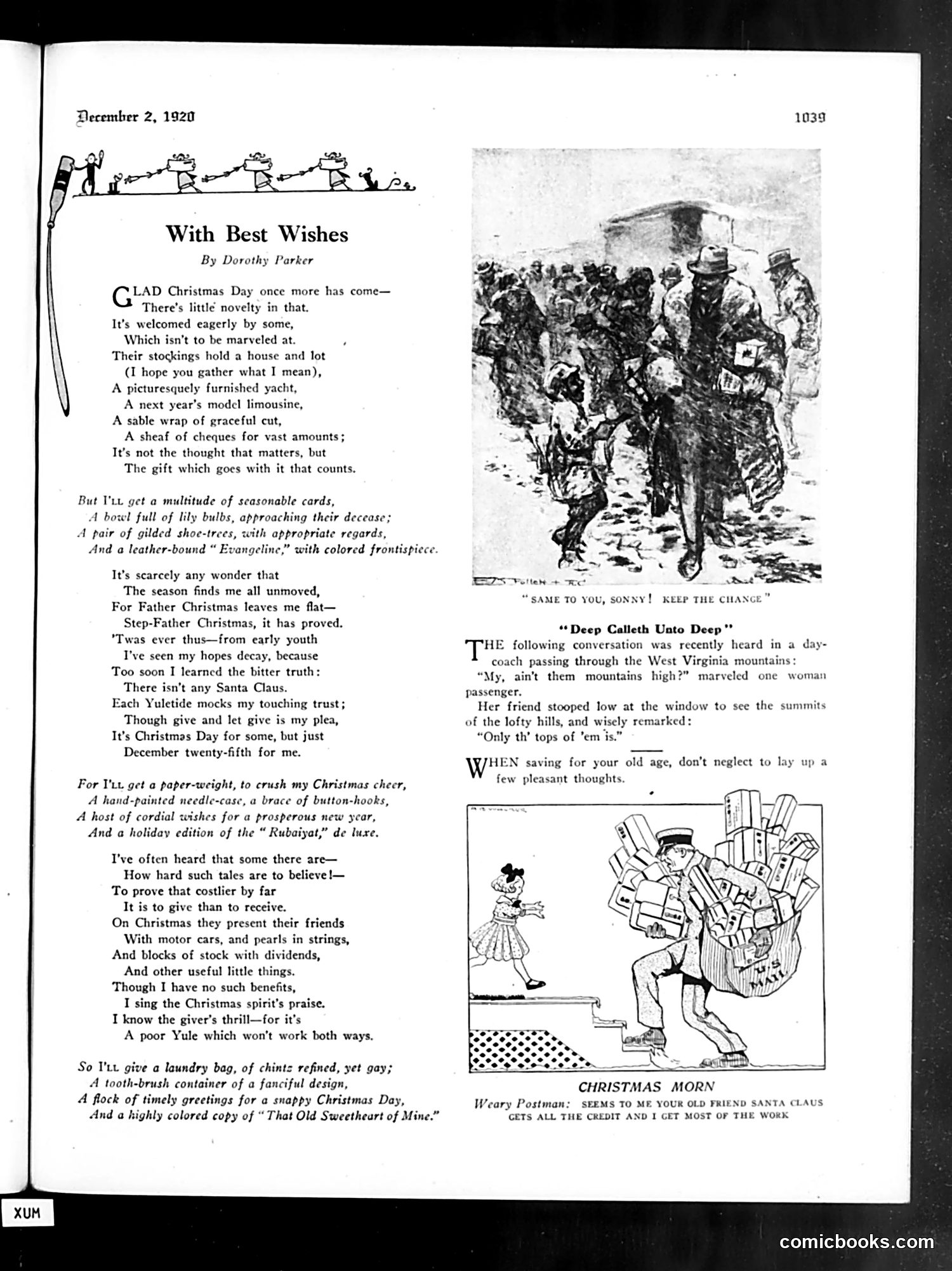
This page features Dorothy Parker's sardonic poem about economic inequality during the Christmas season. Parker contrasts wealthy recipients who receive yachts, limousines, and stock dividends with herself, who receives humble items like paperweights, needle-cases, and greeting cards. The satire targets the disparity between rich and poor: Christmas "counts" only for the wealthy, while for Parker it's merely "December twenty-fifth." The accompanying cartoons reinforce this theme. One depicts a weary postman noting that Santa Claus gets all the credit while postal workers do the actual labor—a working-class commentary. Another shows mountain passengers, likely satirizing rural simplicity. Parker's wit cuts at both social inequality and the commercialization of Christmas, suggesting that festive joy is reserved for the privileged while ordinary people endure disappointment and drudgery.
📄 Transcribed text from this page (OCR, searchable)
Machine-transcribed from the original scan — historical spelling and the odd misread are preserved.
December 2, 1920 With Best Wishes By Dorothy Parker @leey Christmas Day once more has come— There's little novelty in that. It’s welcomed eagerly by some, Which isn’t to be marveled at. Their stockings hold a house and lot (I hope you gather what I mean), A picturesquely furnished yacht, A next year’s model limousine, A sable wrap of graceful cut, A sheaf of cheques for vast amounts; It’s not the thought that matters, but The gift which goes with it that counts. But I'tt get a multitude of seasonable cards, A bowl full of lily bulbs, approaching their decease; A pair of gilded shoe-trees, with appropriate regards, And a leather-bound “ Evangeli with colored frontispiece. It’s scarcely any wonder that The season finds me all unmoved, For Father Christmas leaves me flat— Step-Father Christmas, it has proved. 'Twas ever thus—from early youth I’ve seen my hopes decay, because Too soon I learned the bitter truth: There isn’t any Santa Claus. Each Yuletide mocks my touching trust; Though give and let give is my plea, It's Christmas Day for some, but just December twenty-fifth for me. For I'tu get a paper-weight, to crush my Christmas cheer, A hand-painted needle-case, a brace of button-hooks, A host of cordial wishes for a prosperous new year, And a holiday edition of the “ Rubaiyat,” de luxe, I've often heard that some there are— How hard such tales are to believe !— To prove that costlier by far It is to give than to receive. On Christmas they present their friends With motor cars, and pearls in strings, And blocks of stock with dividends, And other useful little things. Though I have no such benefits, I sing the Christmas spirit’s praise. I know the giver’s thrill—for it’s A poor Yule which won't work both ways. So I'tu give a laundry bag, of chints refined, yet gay; A tooth-brush container of a fanciful design, A flock of timely greetings for a snappy Christmas Day, And a highly colored copy of “That Old Sweetheart of Mine.” “SAME TO YOU, SONNY! KEEP THE CIA) **Deep Calleth Unto Deep"’ 'HE following conversation was recently heard in a day- coach passing through the West Virginia mountains: “My, ain't them mountains high?” marveled one woman passenger. Her friend stooped low at the window to see the summits of the lofty hills, and wisely remarked: “Only th’ tops of ’em HEN saving for your old age, don’t neglect to lay up a few pleasant thoughts. CHRISTMAS MORN Weary Postman; SEEMS TO ME YOUR OLD FRIEND SANTA CLAUS GETS ALL THE CREDIT AND I GET MOST OF THE WORK comicbooks.com