
Life, 1920-12-02 · page 64 of 97
Life — December 2, 1920 — page 64: what you’re looking at
What you’re looking at
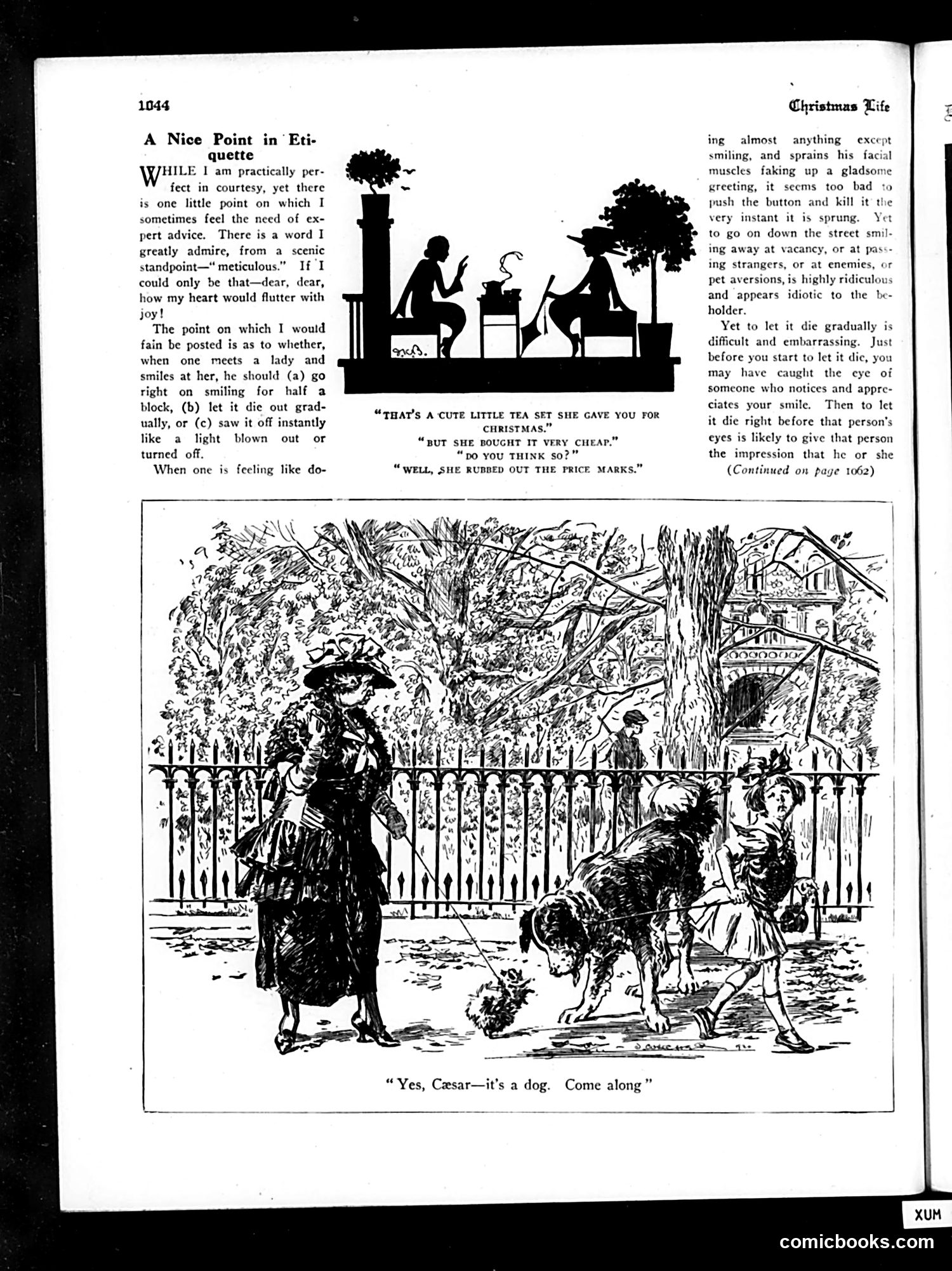
This page contains two distinct pieces about social etiquette from *Life* magazine's Christmas issue. **Top section:** A humorous essay about the awkwardness of smiling at strangers. The author debates whether, after greeting someone with a smile, one should: (a) maintain it for half a block, (b) let it fade gradually, or (c) abruptly stop smiling. The satire mocks the social anxiety of managing facial expressions in public—the fear that stopping too suddenly looks rude, but continuing looks foolish. **Bottom cartoon:** Shows a woman introducing a man to what appears to be a dog, saying "Yes, Caesar—it's a dog. Come along." The joke concerns a cheap Christmas gift: a woman gave her friend an inexpensive tea set but rubbed off the price marks to hide the cost. The humor lies in the pretense of generosity and the awkwardness of discovering—and discussing—a gift's actual value. Both pieces satirize the performance of politeness and the gap between genuine feeling and social convention.
📄 Transcribed text from this page (OCR, searchable)
Machine-transcribed from the original scan — historical spelling and the odd misread are preserved.
1044 A Nice Point in Eti- quette HILE I am practically per- fect in courtesy, yet there is one little point on which I sometimes feel the need of ex- pert advice. There is a word I greatly admire, from a scenic standpoint—“ meticulous.” If I could only be that—dear, dear, how my heart would flutter with joy! The point on which I would fain be posted is as to whether, when one meets a lady and smiles at her, he should (a) go right on smiling for half a block, (b) let it die out grad- ually, or (c) saw it off instantly like a light blown out or turned off. When one is feeling like do- “ THAYs A CUTE LITTLE TEA SET SHE GAVE YOU FOR CHRISTMAS.” “BUT SHE BOUGHT IT VERY CHEAP.” “Do YoU THINK so?” “WELL, SHE RUBBED OUT THE PRICE MARKS.” Christmas Life ing almost anything except smiling, and sprains his facial muscles faking up a gladsome greeting, it seems too bad to push the button and kill it the very instant it is sprung. Yet to go on down the street smil- ing away at vacancy, or at pass- ing strangers, or at enemies, or pet aversions, is highly ridiculous and appears idiotic to the be- holder. Yet to let it die gradually is difficult and embarrassing. Just before you start to let it dic, you may have caught the cye of someone who notices and appre- ciates your smile. Then to let it die right before that person's eyes is likely to give that person the impression that he or she (Continued on page 1062) comicbooks.com