
Life, 1920-12-02 · page 37 of 97
Life — December 2, 1920 — page 37: what you’re looking at
What you’re looking at
This satirical essay by George Ade contrasts rural Midwestern life before and after modernization. Ade observes how technology and cultural change have transformed Christmas traditions and social customs between the "good old days" and 1920. **Key points of satire:** - **Social mobility**: Ministers' sons once stole horses; now they steal Fords (automobiles) - **Entertainment shifts**: Silent films and phonographs replace traveling theater troupes - **Fashion/morality**: Young women expose "wish bones" (collarbones) per Paris fashions; Methodists play bridge; WCTU members look like "showgirls" - **Obsolete gifts**: Mustache cups, crayon portraits of deceased relatives, watch chains made from human hair, and embroidered workboxes represent outdated sentimental Victorianism - **Lost innocence**: Children no longer believe in Santa; they follow Douglas Fairbanks and Buster Keaton movie releases instead The satire gently mocks rural conservatism while documenting genuine cultural transformation—mechanization, cinema, fashion, and declining religious/sentimental traditions reshaping American life.
📄 Transcribed text from this page (OCR, searchable)
Machine-transcribed from the original scan — historical spelling and the odd misread are preserved.
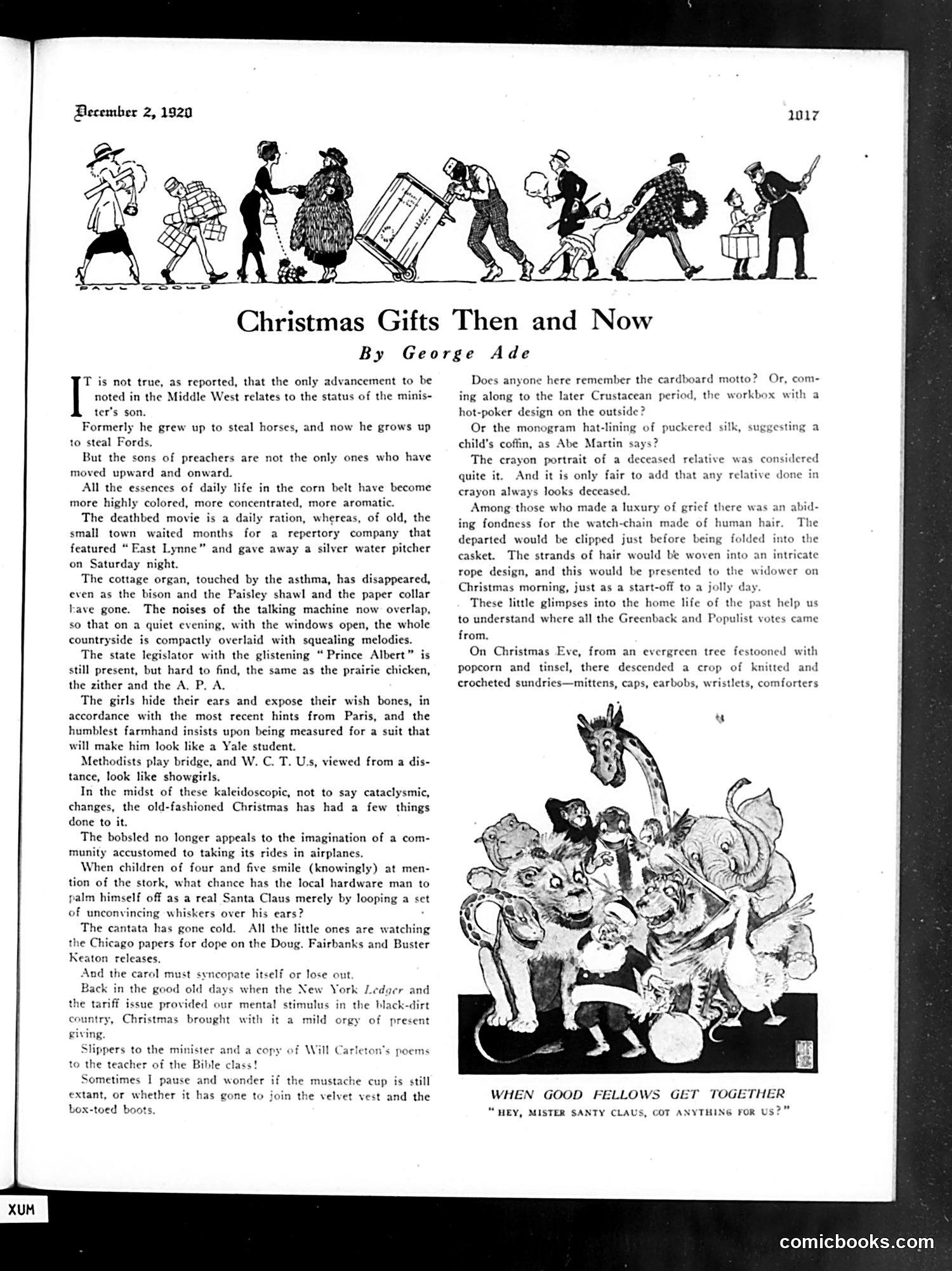
December 2, 1920 Christmas Gifts Then and Now By George Ade T is not true, as reported, that the only advancement to be noted in the Middle West relates to the status of the minis- ter’s son. Formerly he grew up to steal horses, and now he grows up to steal Fords. But the sons of preachers are not the only ones who have moved upward and onward. All the essences of daily life in the corn belt have become more highly colored, more concentrated, more aromatic. The deathbed movie is a daily ration, whereas, of old, the small town waited months for a repertory company that featured “East Lynne” and gave away a silver water pitcher on Saturday night. The cottage organ, touched by the asthma, has disappeared, even as the bison and the Paisley shawl and the paper collar lave gone. The noises of the talking machine now overlap, so that on a quiet evening, with the windows open, the whole countryside is compactly overlaid with squealing melodies. The state legislator with the glistening “Prince Albert” is still present, but hard to find, the same as the prairie chicken, the zither and the A. P. A. The girls hide their ears and expose their wish bones, in accordance with the most recent hints from Paris, and the humblest farmhand insists upon being measured for a suit that will make him look like a Yale student. Methodists play bridge, and W. C. T. U.s, viewed from a dis- tance, look like showgirls. In the midst of these kaleidoscopic, not to say cataclysmic, changes, the old-fashioned Christmas has had a few things done to it. The bobsled no longer appeals to the imagination of a com- munity accustomed to taking its rides in airplanes. When children of four and five smile (knowingly) at men- tion of the stork, what chance has the local hardware man to palm himself off as a real Santa Claus merely by looping a set of unconvincing whiskers over his ears? ‘ The cantata has gone cold. All the little ones are watching the Chicago papers for dope on the Doug. Fairbanks and Buster Keaton releases. And the carol must syncopate itself or lose out Back in the good old days when the New York Ledger and the tariff issue provided our mental stimulus in the black-dirt Christmas brought with it a mild orgy of present Slippers to the minister and a copy of Will Carleton to the teacher of the Bible clas poems Sometimes I pause and wonder if the mustache cup is still extant, or whether it has gone to join the velvet vest and the box-toed boots. Does anyone here remember the cardboard motto? Or, com- ing along to the later Crustacean period, the workbox with a hot-poker design on the outside? Or the monogram hat-lining of puckered silk, sugg child’s coffin, as Abe Martin says? The crayon portrait of a deceased relative was considered quite it. ii crayon always looks deceased. ing a And it is only fair to add that any relative do Among those who made a luxury of grief there was ing fondness for the watch-chain made of human hair. departed would be clipped just before being folded into the casket. rope design, and this would be presented to the widower on Christmas morning, just as a start-off to a jolly day These little glimpses into the home life of the past help us The strands of hair would be woven into an intricate to understand where all the Greenback and Populist votes came from, On Christmas Eve, from an evergreen tree festooned with popcorn and tinsel, there descended a crop of knitted and crocheted sundries—mittens, caps, earbobs, wristlets, comforters WHEN GOOD FELLOWS G. TOGETHER “HEY, MISTER SANTY CLAUS, COT ANYTHING FOR US? comicbooks.com