
Life, 1920-12-02 · page 62 of 97
Life — December 2, 1920 — page 62: what you’re looking at
What you’re looking at
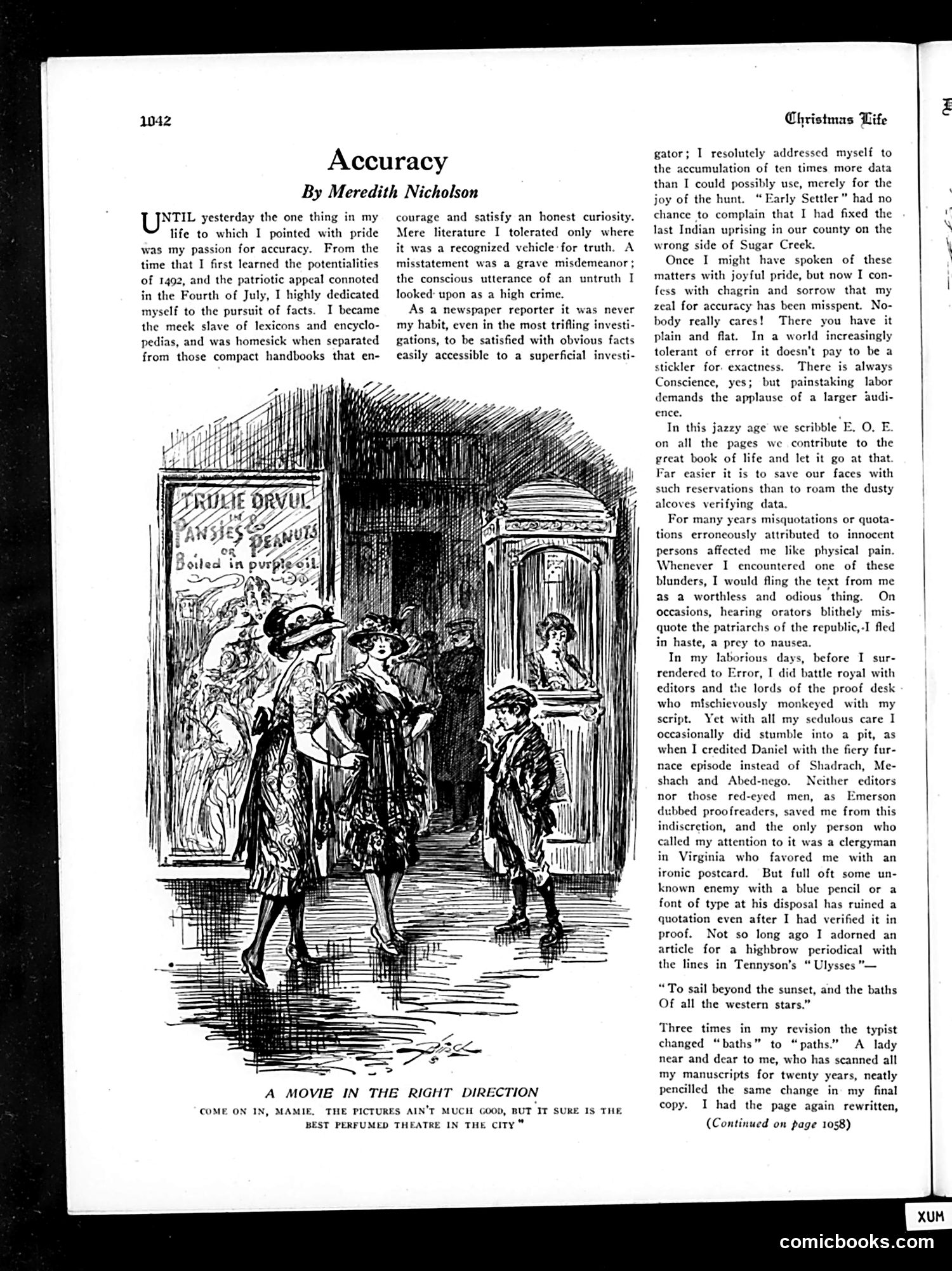
This page contains an essay (not a political cartoon) about the decline of factual rigor in modern culture. The author, a self-described perfectionist who obsessively verified facts throughout his career as a newspaper reporter, laments that "nobody really cares" about accuracy anymore. He confesses that his painstaking labor to correct errors, challenge misquotes, and battle editors over details now seems pointless in "this jazzy age." The accompanying illustration shows a theater lobby with patrons—a humorous visual commentary on lowered standards: the caption notes the pictures "ain't much good" but the theater is "the best perfumed theatre in the city"—suggesting people now prioritize comfort and atmosphere over quality. The essay represents early 20th-century anxiety about modern society's alleged moral and intellectual decline.
📄 Transcribed text from this page (OCR, searchable)
Machine-transcribed from the original scan — historical spelling and the odd misread are preserved.
Accuracy By Meredith Nicholson NTIL yesterday the one thing in my life to which I pointed with pride was my passion for accuracy. From the time that I first learned the potentialities of 1492, and the patriotic appeal connoted in the Fourth of July, I highly dedicated myself to the pursuit of facts. I became the meek slave of lexicons and encyclo- pedias, and was homesick when separated from those compact handbooks that en- courage and satisfy an honest curiosity. Mere literature I tolerated only where it was a recognized vehicle for truth. A misstatement was a grave misdemeanor; the conscious utterance of an untruth I looked: upon as a high crime. As a newspaper reporter it was never my habit, even in the most trifling investi- gations, to be satisfied with obvious facts easily accessible to a superficial investi- A MOVIE IN THE RIGHT DIRECTION COME ON IN, MAMIE, THE PICTURES AIN'T MUC. GOOD, BUT IT SURE IS THE BEST PERFUMED THEATRE IN THE CITY” Christmas Life gator; I resolutely addressed myself to the accumulation of ten times more data than I could possibly use, merely for the joy of the hunt. “Early Settler” had no chance to complain that I had fixed the last Indian uprising in our county on the wrong side of Sugar Creek. Once I might have spoken of these matters with joyful pride, but now I con- fess with chagrin and sorrow that my zeal for accuracy has been misspent. No- body really cares! There you have it plain and flat. In a world increasingly tolerant of error it doesn’t pay to be a stickler for. exactness. There is always Conscience, yes; but painstaking labor demands the applause of a larger audi- ence. ‘ In this jazzy age we scribble E. O. E. on all the pages we contribute to the great book of life and let it go at that. Far easier it is to save our faces with such reservations than to roam the dusty alcoves verifying data. For many years misquotations or quota- tions erroneously attributed to innocent persons affected me like physical pain. Whenever I encountered one of these blunders, I would fling the text from me as a worthless and odious thing. On occasions, hearing orators blithely mis- quote the patriarchs of the republic,-I fled in haste, a prey to nausea. In my laborious days, before I sur- rendered to Error, I did battle royal with editors and the lords of the proof desk who mischievously monkeyed with my script. Yet with all my sedulous care I occasionally did stumble into a pit, as when I credited Daniel with the fiery fur- nace episode instead of Shadrach, Me- shach and Abed-nego. Neither editors nor those red-eyed men, as Emerson dubbed proofreaders, saved me from this indiscretion, and the only person who called my attention to it was a clergyman in Virginia who favored me with an ironic postcard. But full oft some un- known enemy with a blue pencil or a font of type at his disposal has ruined a quotation even after I had verified it in proof. Not so long ago I adorned an article for a highbrow periodical with the lines in Tennyson's “ Ulysses "— “To sail beyond the sunset, and the baths Of all the western stars.” Three times in my revision the typist changed “baths” to “paths.” A lady near and dear to me, who has scanned all my manuscripts for twenty years, neatly pencilled the same change in my final copy. I had the page again rewritten, (Continued on page 1058) comicbooks.com