
Life, 1920-12-02 · page 44 of 97
Life — December 2, 1920 — page 44: what you’re looking at
What you’re looking at
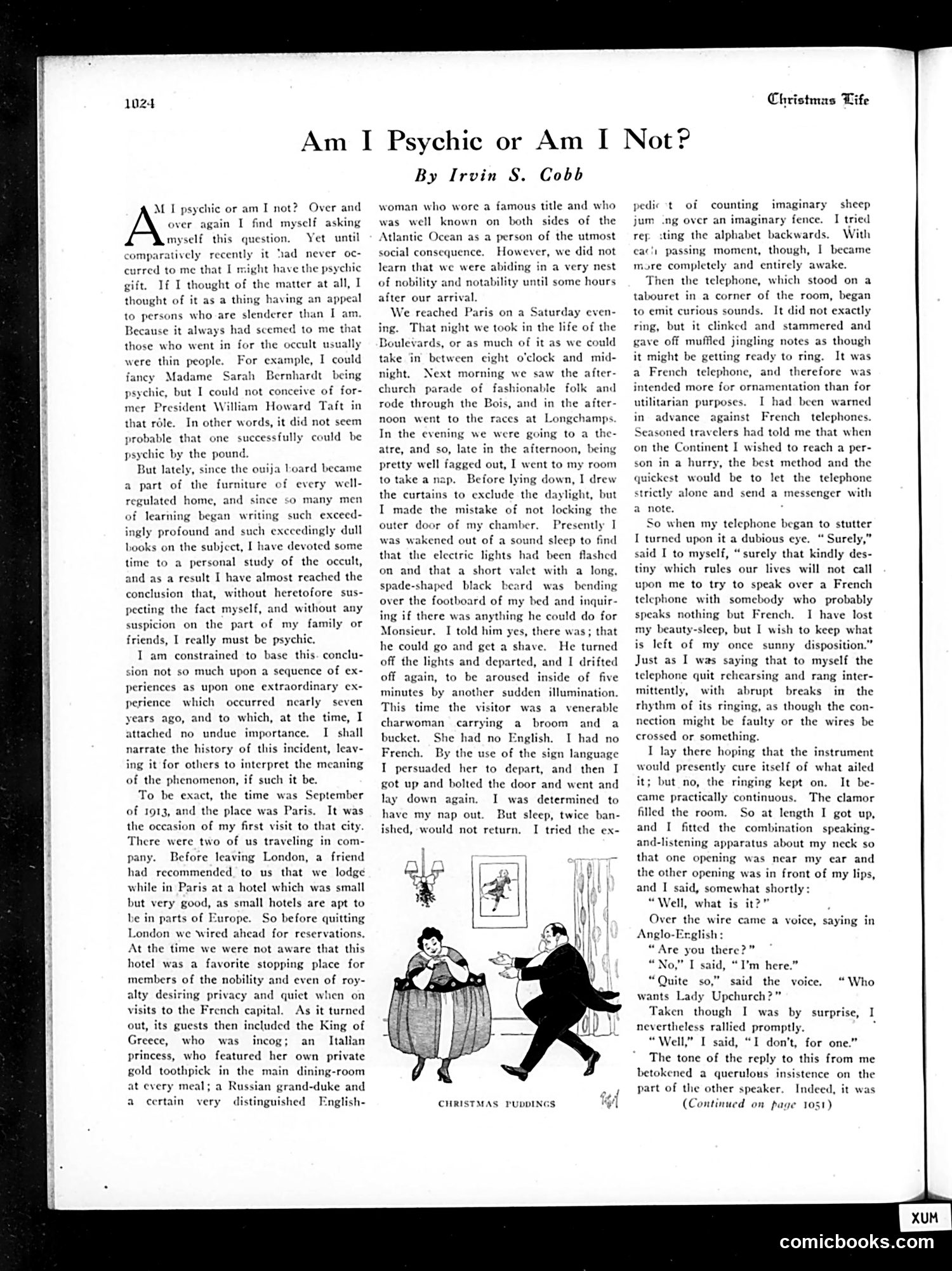
This is the opening installment of a humorous essay by well-known American humorist Irvin S. Cobb, published in *Life* magazine around 1913-1914. The accompanying cartoon shows two figures in what appears to be a séance or spiritualist setting—reflecting the early 20th-century American fascination with Ouija boards and occult phenomena that Cobb references in his text. The essay's satire targets this contemporary craze for spiritualism and psychic claims. Cobb sets up the joke by noting that he's "almost reached the conclusion" he possesses psychic abilities, then promises to recount "one extraordinary experience" from a 1913 Paris trip to justify this claim. The humor lies in the expectation that his "proof" of psychic powers will likely be mundane or coincidental rather than genuinely supernatural—a common target of satirical debunking of spiritualism's popularity among educated, gullible audiences of the era.
📄 Transcribed text from this page (OCR, searchable)
Machine-transcribed from the original scan — historical spelling and the odd misread are preserved.
1024 Christmas Tife Am I Psychic or Am I Not? M I psychic or am I not? Over and over again I find myself asking myself this question. Yet until comparatively recently it had never oc- curred to me that I might have the psychic gift. If I thought of the matter at all, I thought of it as a thing to persons who are slenderer than I am. Because it always had scemed to me that those who went in for the occult usually For example, I could having an appeal were thin people. Madame § psychic, but I could not conceive of for- fancy rah Bernhardt being mer President William Howard Taft in that role. In other words, it did not seem probable that one successfully could be psychic by the pound. But lately, since the ouija board became a part of the furniture of every well- regulated home, and since so many men of learning began writing such exceed- ingly Looks on the subject, I have devoted some profound and such exceedingly dull time to a personal study of the occult, and as a result I have almost reached the conclusion that, without heretofore sus- pecting the fact myself, and without any on the t of my family or friends, I really must be psychic. cion I am constrained to base this. conclu- sion not so much upon a sequence of ex- periences as upon one extraordinary ex- perience which occurred nearly seven years ago, and to which, at the time, I attached no undue importance. I shall narrate the history of this incident, leav- ing it for others to interpret the meaning of the phenomenon, if such it be. To be exact, the time was September of 1913, and the place was Paris. It was the occasion of my first visit to that cit There were two of us traveling in com- pany. Before leaving London, a friend had recommended to us that we lodge while in Paris at a hotel which was small but very good, as small hotels are apt to he in parts of Europe. So before quitting London we wired ahead for reservations. At the time we were not aware that this hotel was a favorite stopping place for members of the nobility and even of roy- alty desiring privacy and quiet when on visits to the French capital. As it turned out, its guests then included the King of Greece, who was incog; an Italian princess, who featured her own private gold toothpick in the main dining-room at every meal; a Russian grand-duke and a certain very distinguished English- By Irvin S. Cobb woman who wore a famous title and who was known on both sides of the Atlantic Ocean as a person of the utmost social consequence. However, we did not learn that we were abiding in a very nest of nobility and notability until some hours after our arrival. We reached Paris on a Saturday even- ing. That night we took in the life of the Boulevards, or as much of it as we could take in between eight o'clock and mid- night. Next morning we saw the after- church parade of fashionable folk and rode through the Bois, and in the after- noon went to the races at Longchamps. In the evening we were going to a the- atre, and so, late in the afternoon, being pretty well fagged out, I went to my room to take a nap. drew the curtains to exclude the daylight, but I made the mistake of not locking the outer door of my chamber, Presently I was wakened out of a sound sleep to find that the electric lights had been flashed on and that a short valet with a long, black beard was bending over the footboard of my bed and inquir- ing if there was anything he could do for Monsieur. I told him yes, there was; that he could go and get a shave. He turned off the lights and departed, and I drifted off again, to be aroused inside of five minutes by another sudden illumination. This time the visitor was a charwoman carrying a broom bucket. She had no English. I had no French. By the use of the sign language I persuaded her to depart, and then I got up and bolted the door and went and lay down again. I was determined to have my nap out. But sleep, twice ban- ished, would not return, I tried the ex- well Before lying down, I spade-shaped venerable and a CHRISTMAS PruppID pedi t of counting imaginary sheep jum .ng over an imaginary fence. I tried rep sting the alphabet backwards. With cali passing moment, though, I became more completely and entirely awake. Then the telephone, which stood on a tabouret in a corner of the room, began It did not exactly ring, but it clinked and stammered and gave off muffled jingling notes as though it might be getting ready to ring. It was a French telephone, and therefore was intended more for ornamentation than for utilita in advance to emit curious sounds. I had been warned against ench telephones. Seasoned travelers had told me that when on the Continent I wished to r son in a hurry, the best method and the quickest would be to let the telephone strictly alone and send a messenger with a note. . jan purposes. ha per- So when my telephone began to stutter I turned upon it a dubious eye. “ Surely,” said I to myself, “surely that kindly des- tiny which rules our lives will not call upon me to try to speak over a French telephone with somebody who probably speaks nothing but French. I have lost my beauty-sleep, but I wish to keep what is left of my once sunny disposition.” Just as I was saying that to myself the telephone quit rehearsing and rang inter- mittently, with abrupt breaks in the rhythm of its rinj s though the con- nection might be faulty or the wires be crossed or something. I lay there hoping that the instrument would presently cure itself of what ailed it; but no, the ringing kept on. It be- came practically continuous. The clamor filled the room, So at length I got up, and I fitted the combination speaking- and-listening apparatus about my neck so that one opening was near my car and the other opening was in front of my lips, and I said, somewhat shortly: “Well, what is it?” Over the wire came a voi Anglo-Erglish : “Are you there? “No,” I said, “I'm here.” “Quite so,” said the wants Lady Upchurch?” Taken though I was by nevertheless rallied promptly. “Well,” I said, “I don’t, for one. The tone of the reply to this from me betokened a querulons insistence on the part of the other speaker. Indeed, it was (Continued on page 1051) saying in “Who voice. surprise, I comicbooks.com