
A complete issue · 44 pages · 1914
Life — April 16, 1914
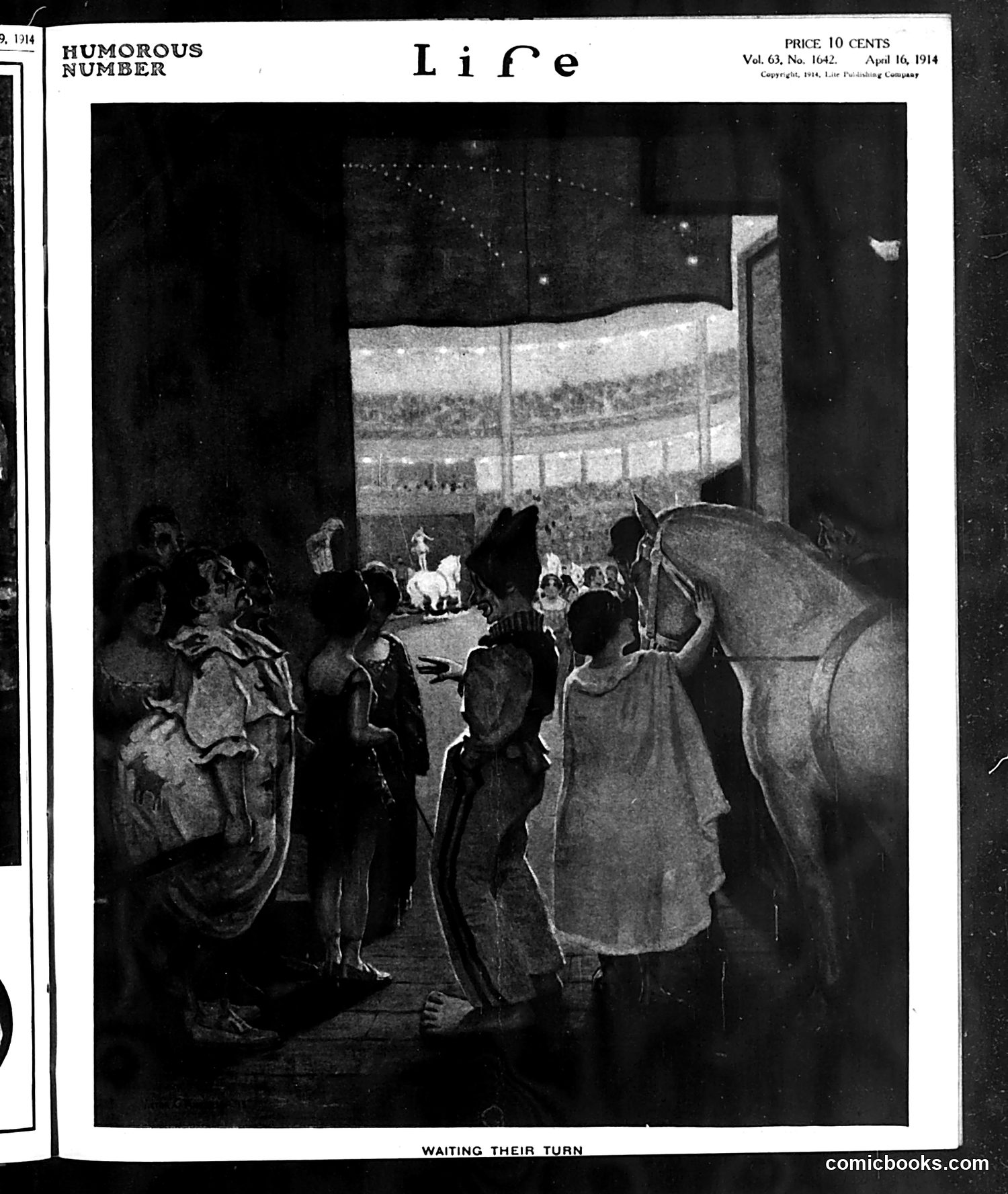
This satirical illustration depicts a circus or arena scene where spectators—primarily women in Edwardian dress—wait anxiously to enter or participate. The caption "Waiting Their Turn" suggests commentary on contemporary social dynamics, likely referencing women's suffrage activism of the era. The crowded, somewhat chaotic composition and prominent positioning of female figures implies satire about women's increasing demands for political participation and public roles. The circus setting may mock these aspirations as entertainment or spectacle. The formal dress and apparent social anxiety of the figures suggests satirizing middle-class women's ambitions during the Progressive Era, when women's rights activism was intensifying in America. Without additional context, the precise target remains unclear, though the tone appears dismissive of women's growing public presence.
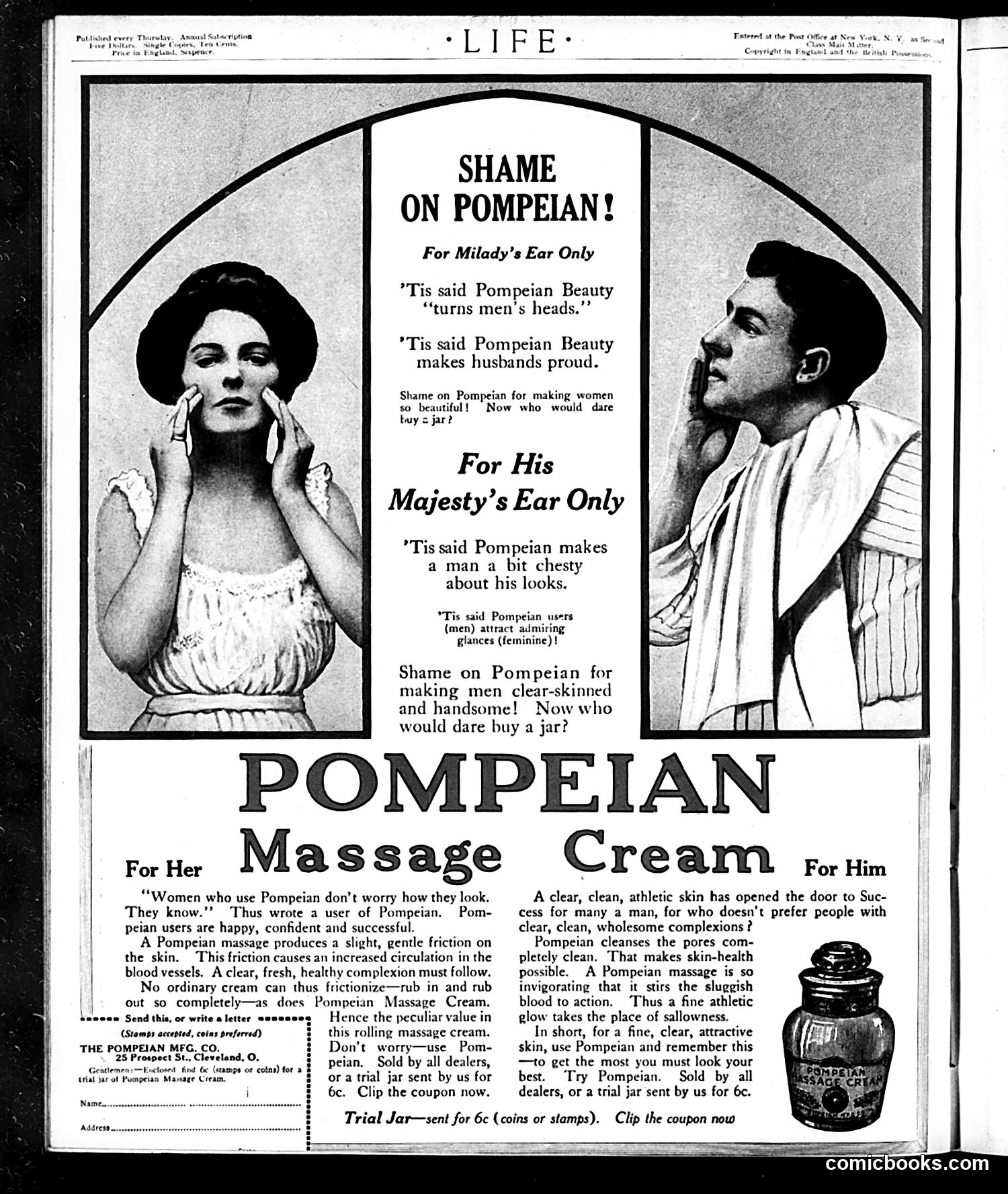
This page is primarily a **Pompeian Massage Cream advertisement**, not political satire. The "shame" framing is a marketing device, not social commentary. The ad uses gendered messaging to sell cosmetics: women are told the cream makes them beautiful and attractive to men; men are told it prevents vanity and keeps them "clear-skinned and handsome." The humor relies on mock-outrage—feigning scandal that beauty products might actually work. The left figure appears to be a woman applying the cream; the right figure, a man in Roman-style dress, represents the "Pompeian" classical branding. The reference to Pompeii (Roman city) lends pseudo-scientific or historical credibility to a commercial product. This reflects early 20th-century advertising conventions: using satire and gender stereotypes to promote mass-market beauty products.
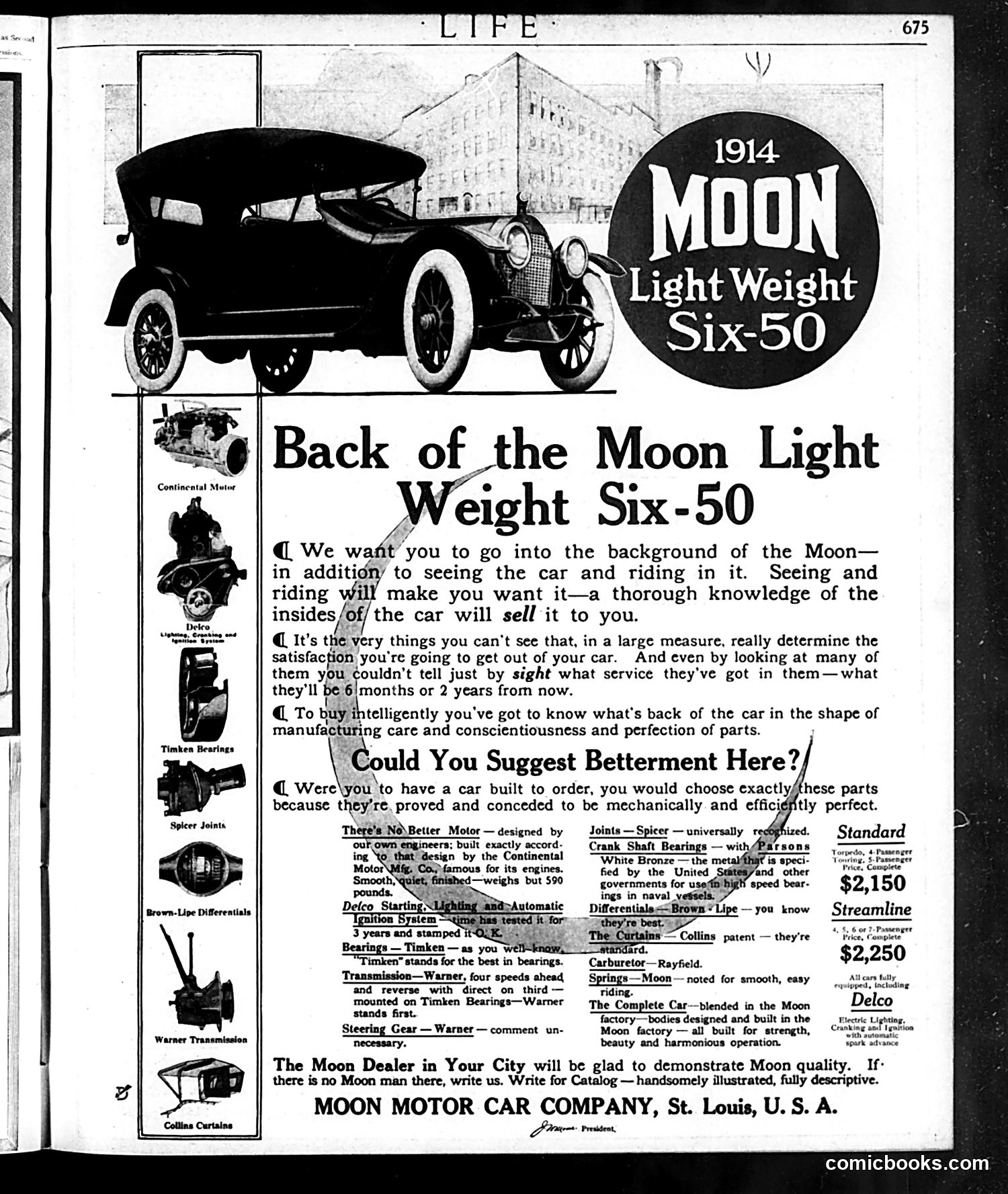
This page is **primarily an automobile advertisement**, not satirical content. It promotes the 1914 Moon Light Weight Six-50 car, manufactured by Moon Motor Car Company in St. Louis. The ad uses persuasive marketing language, encouraging potential buyers to experience the vehicle firsthand. It emphasizes quality engineering and component parts (Continental Motor, Delco ignition, Timken bearings, etc.), suggesting that understanding the car's mechanical sophistication would drive purchase decisions. The left sidebar displays detailed illustrations of these component parts—a common advertising technique to establish technical credibility and sophistication to middle-class readers of *Life* magazine. **No political satire or caricature is present.** This represents standard early 20th-century automotive advertising targeting affluent consumers.
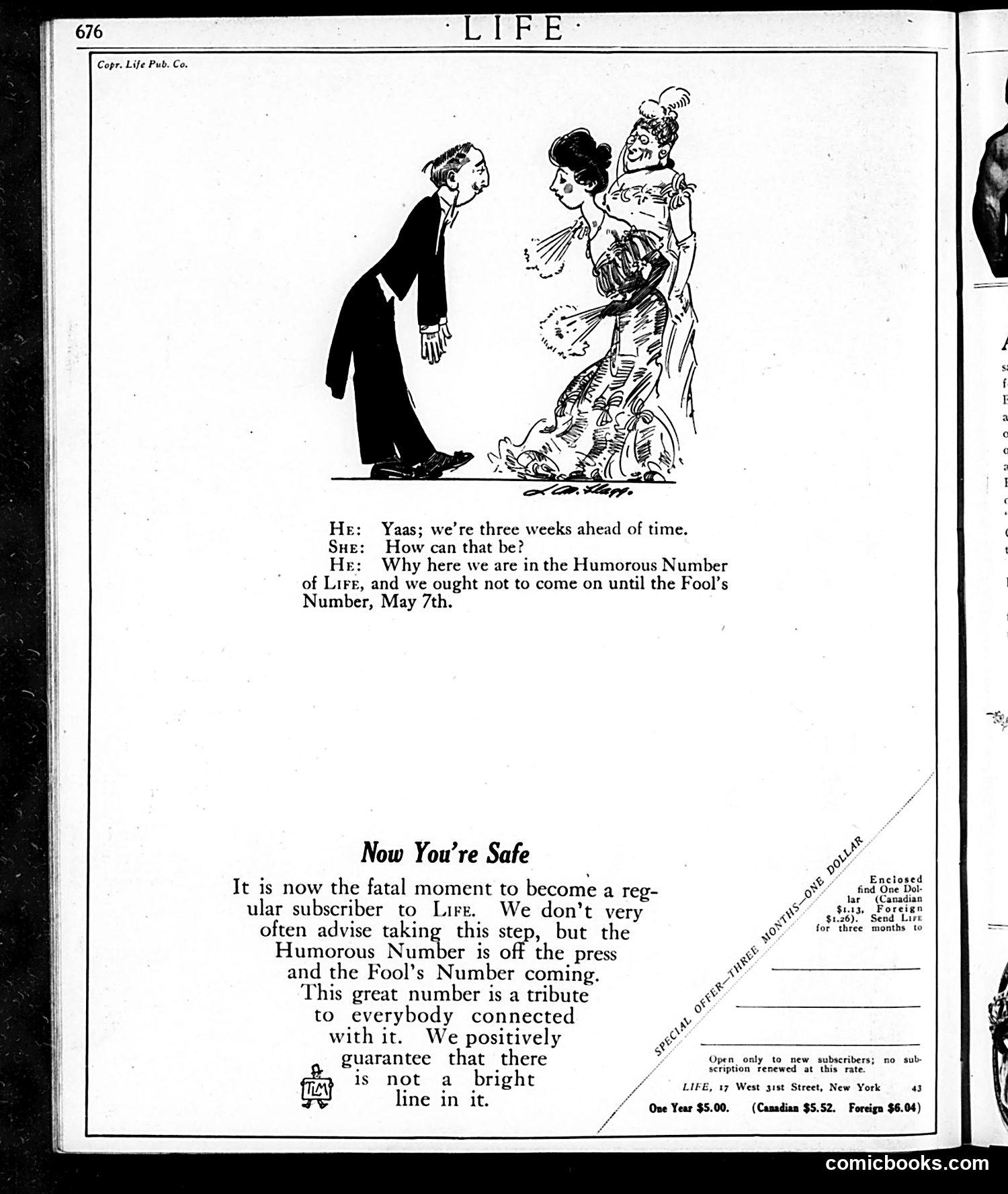
This page contains two elements: a cartoon joke and a subscription advertisement. The cartoon depicts a man in formal attire greeting an elegantly dressed woman and child. The humor relies on a meta-reference: the man claims they're "three weeks ahead of time" because this appears in LIFE's "Humorous Number," which shouldn't publish until May 7th (the "Fool's Number" reference suggests April Fool's timing). The joke is self-referential—it acknowledges the magazine's own publication schedule as part of the humor. Below, the "Now You're Safe" section is a subscription pitch encouraging readers to become regular subscribers, claiming the Humorous Number is exceptional and contains no poor content. The tone is lighthearted but promotional.
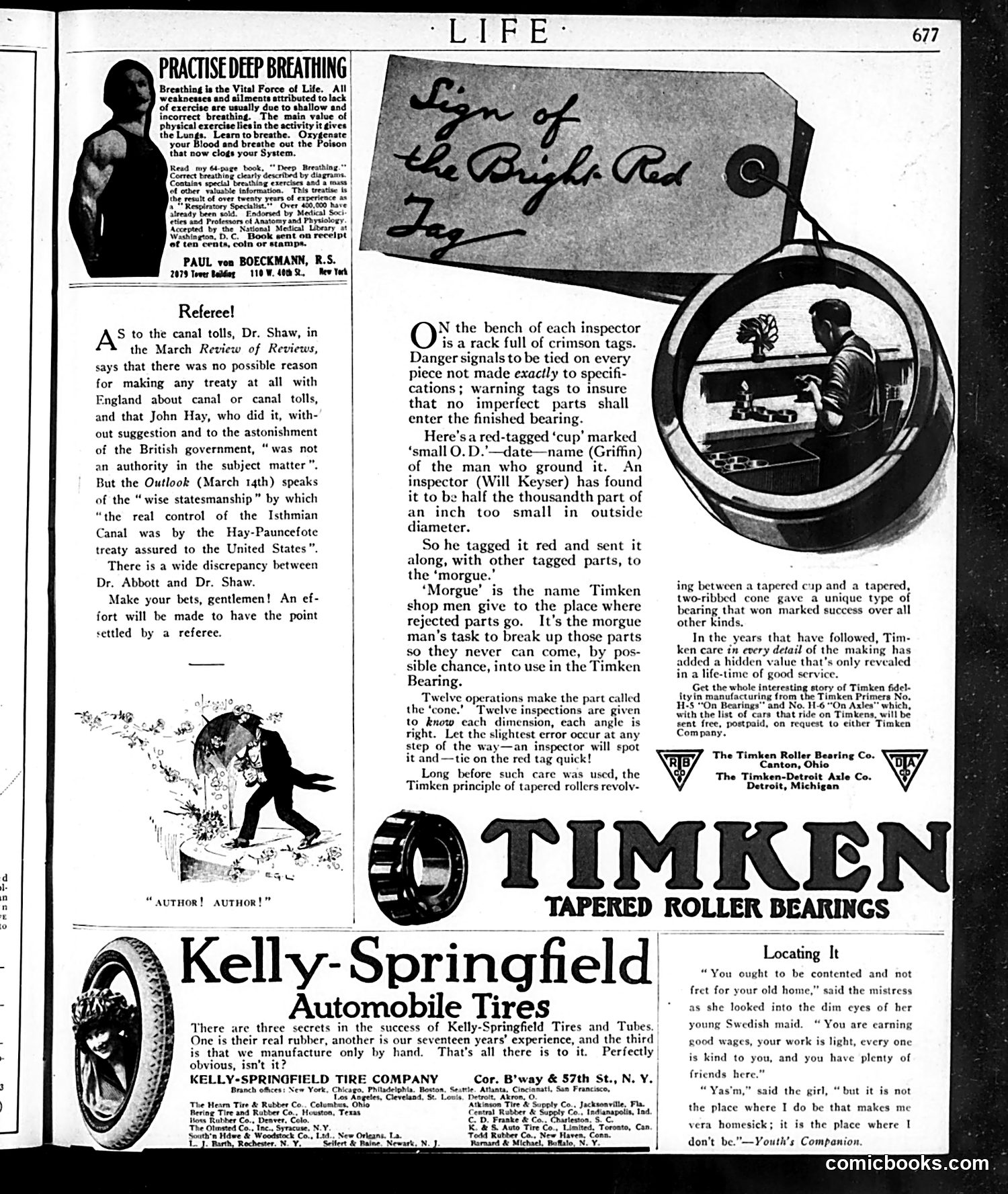
This page is primarily **advertising** for industrial and automotive products (Timken Tapered Roller Bearings, Kelly-Springfield Automobile Tires), with only minimal editorial content. The non-advertising sections include: 1. **"Practise Deep Breathing"** — a health advice column with a medical diagram 2. **"Referee"** — a brief article about canal tolls and the Isthmian Canal, referencing Dr. Shaw and the *Outlook* magazine's reporting on U.S.-British control disputes 3. One small cartoon captioned **"Author! Author!"** — appears to be generic humor about someone calling out, not tied to specific politics The page reflects *Life*'s mix of satirical commentary with commercial content. The canal discussion references early 20th-century geopolitical tensions, but the cartoons here lack the sharp political satire *Life* was known for.
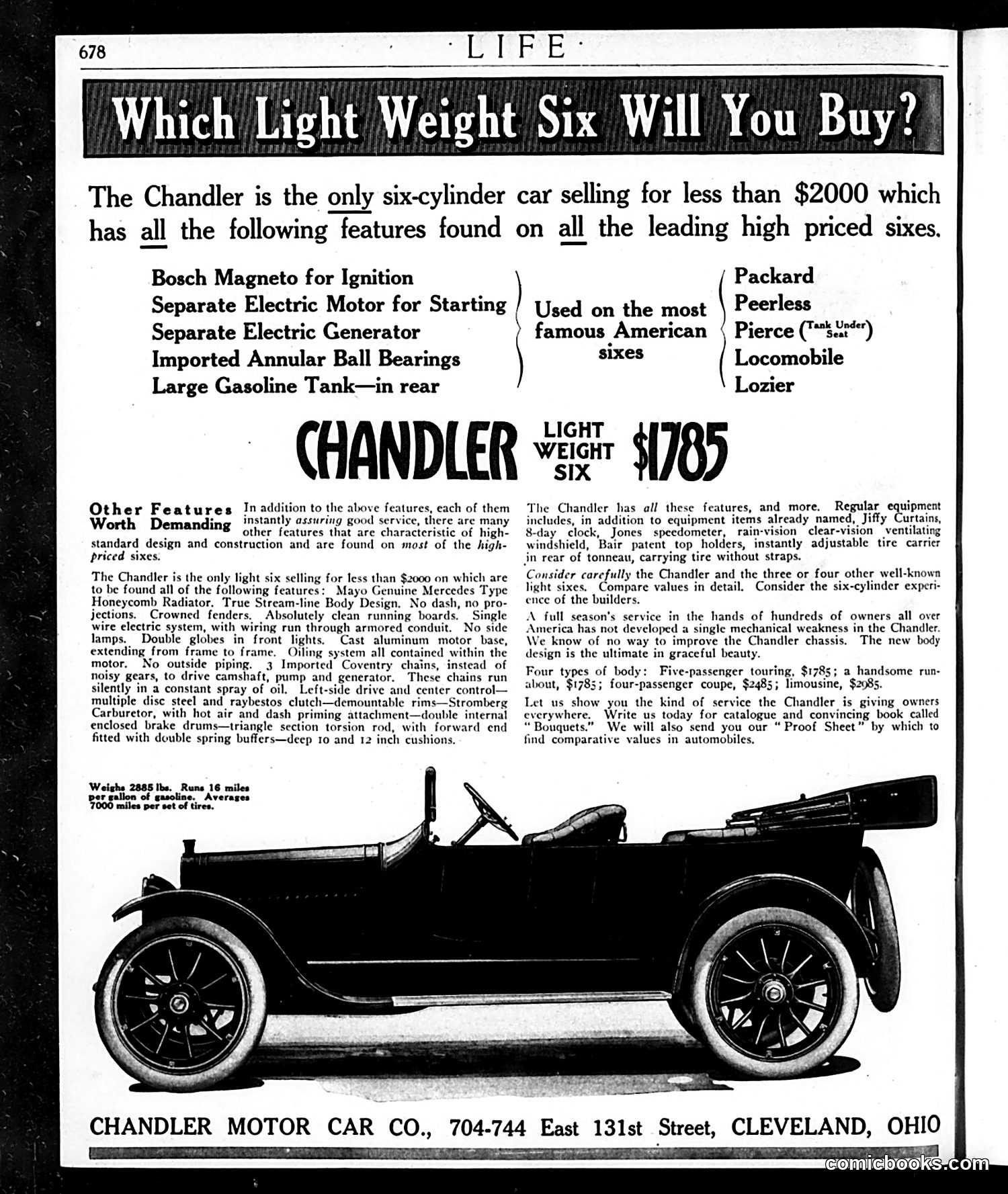
This is **not a cartoon or satire page**—it is a straightforward automobile advertisement for the Chandler Motor Car Company, based in Cleveland, Ohio. The ad promotes the Chandler Light Weight Six automobile, priced at $1,785. It's a genuine sales pitch emphasizing the car's value by claiming it's the only six-cylinder vehicle under $2,000 equipped with features (Bosch magneto, electric starter/generator, ball bearings, rear gasoline tank) typically found only on expensive models from competitors like Packard, Peerless, Pierce-Arrow, and Locomotile. The image shows the vehicle in side profile. The copy includes performance specs (2,285 lbs, 16 miles per gallon) and body type options. This represents early-1910s automotive marketing positioning an affordable six-cylinder as a luxury alternative.
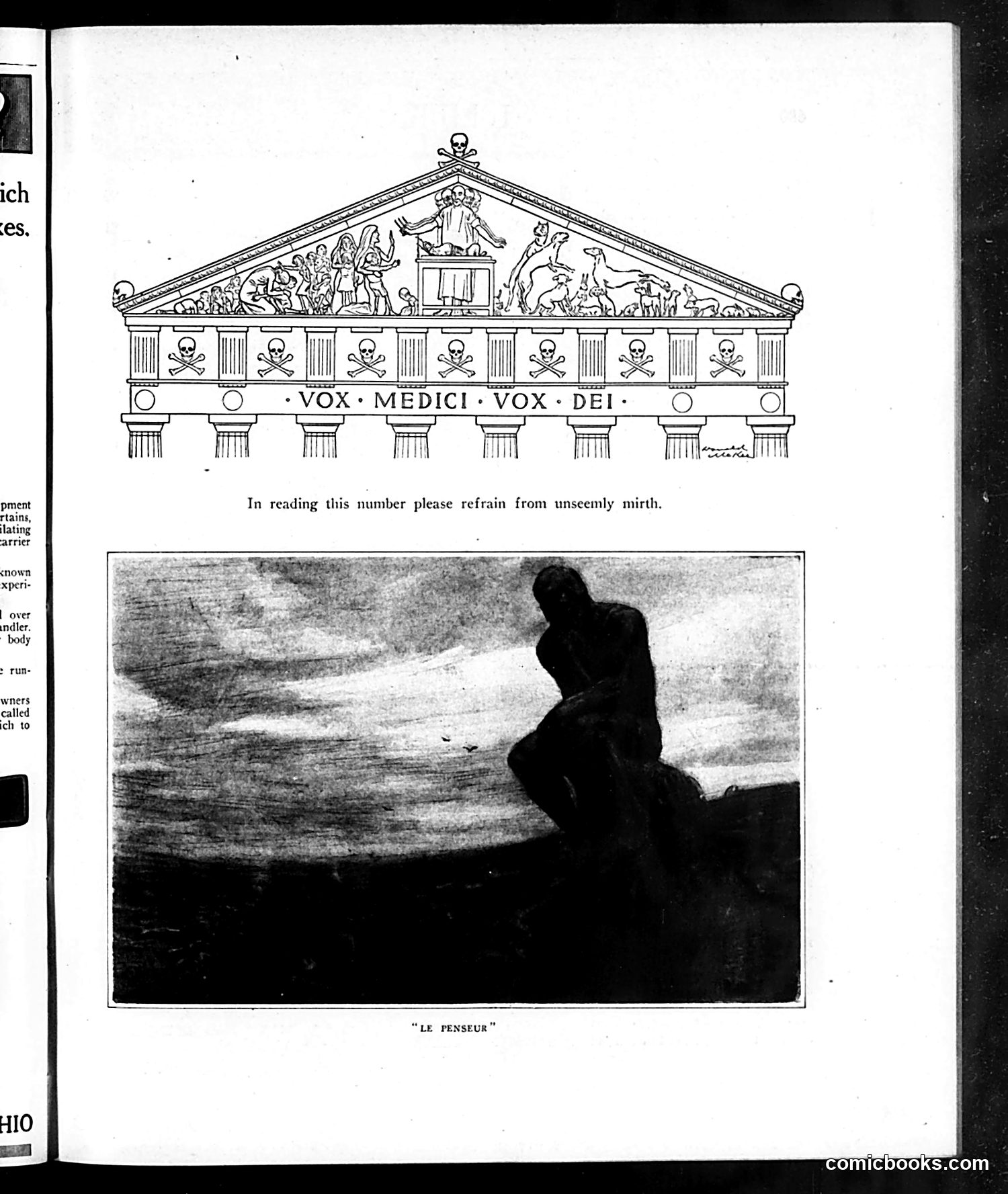
This page features a classical architectural diagram labeled "VOX MEDICI, VOX DEI" (Latin: "The voice of the physician is the voice of God"), decorated with skulls and crossbones—symbols of death. The frivolous tone contrasts darkly with the imagery. Below is a photograph titled "LE PENSEUR" (Rodin's famous sculpture of a contemplative thinker), showing a silhouetted figure in a brooding pose overlooking a landscape. The juxtaposition appears to satirize medical authority and mortality: the classical building venerating doctors' pronouncements is adorned with death symbols, while the penseur contemplates existential questions. The header warns readers to "refrain from unseemly mirth," suggesting the satire addresses serious matters—likely critiquing overconfidence in medical expertise or the inevitability of human mortality despite medical claims.
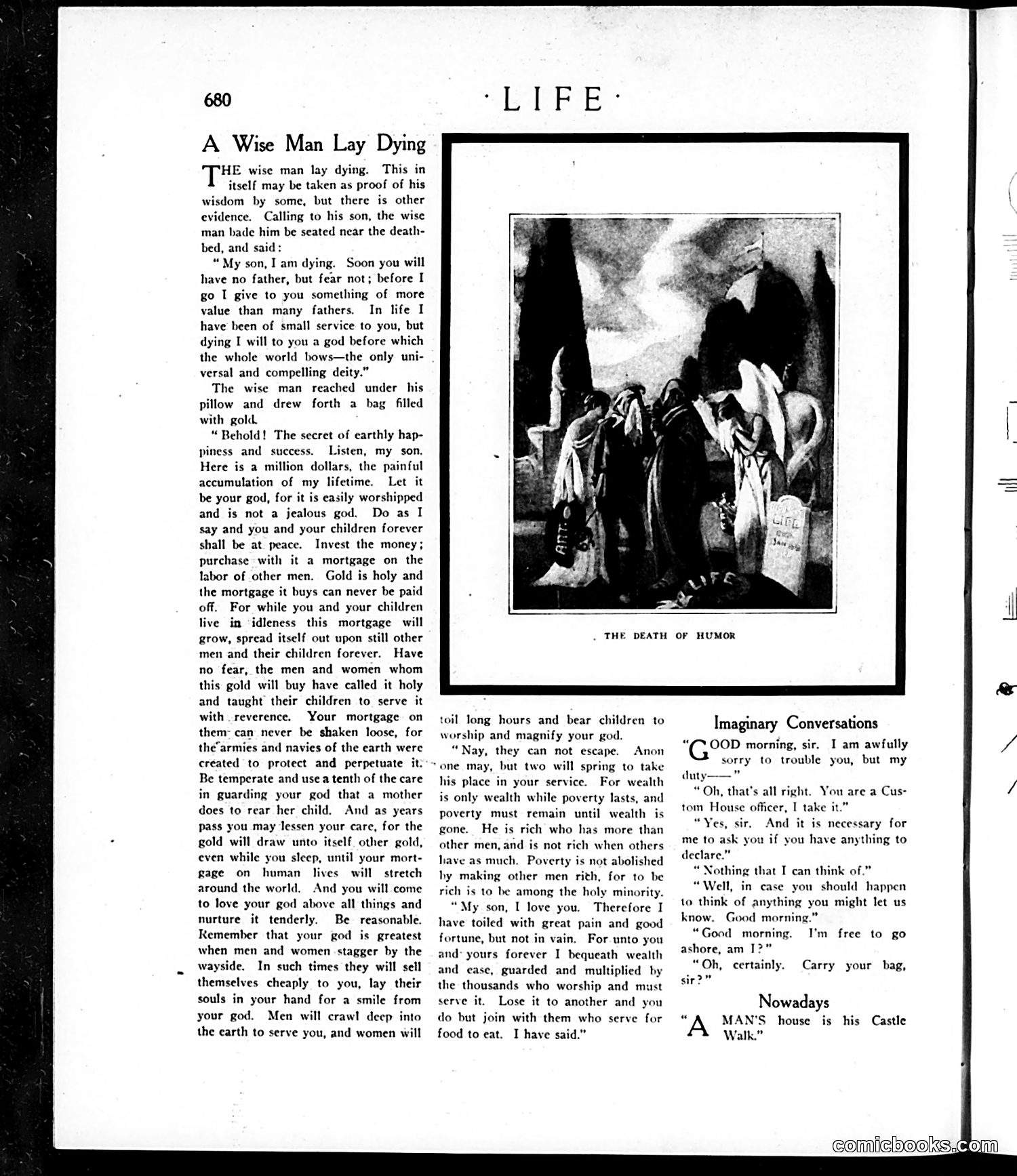
This page presents a cautionary tale about wealth and greed. The dying man's deathbed sermon warns his son against worshipping money as a "god." He describes gold as creating an inescapable "mortgage on the labor of other men" that perpetuates across generations, enslaving future people to serve wealth. The accompanying image, titled "THE DEATH OF HUMOR," appears to show robed figures (possibly clergy or allegorical characters) gathered around a deceased figure, reinforcing the moral lesson through visual allegory. The piece satirizes materialist culture and predatory economic systems. The satire suggests that accumulating wealth through others' labor is fundamentally immoral, and that such practices corrupt entire societies. This reflects turn-of-the-century Progressive Era critiques of industrial capitalism and financial exploitation.
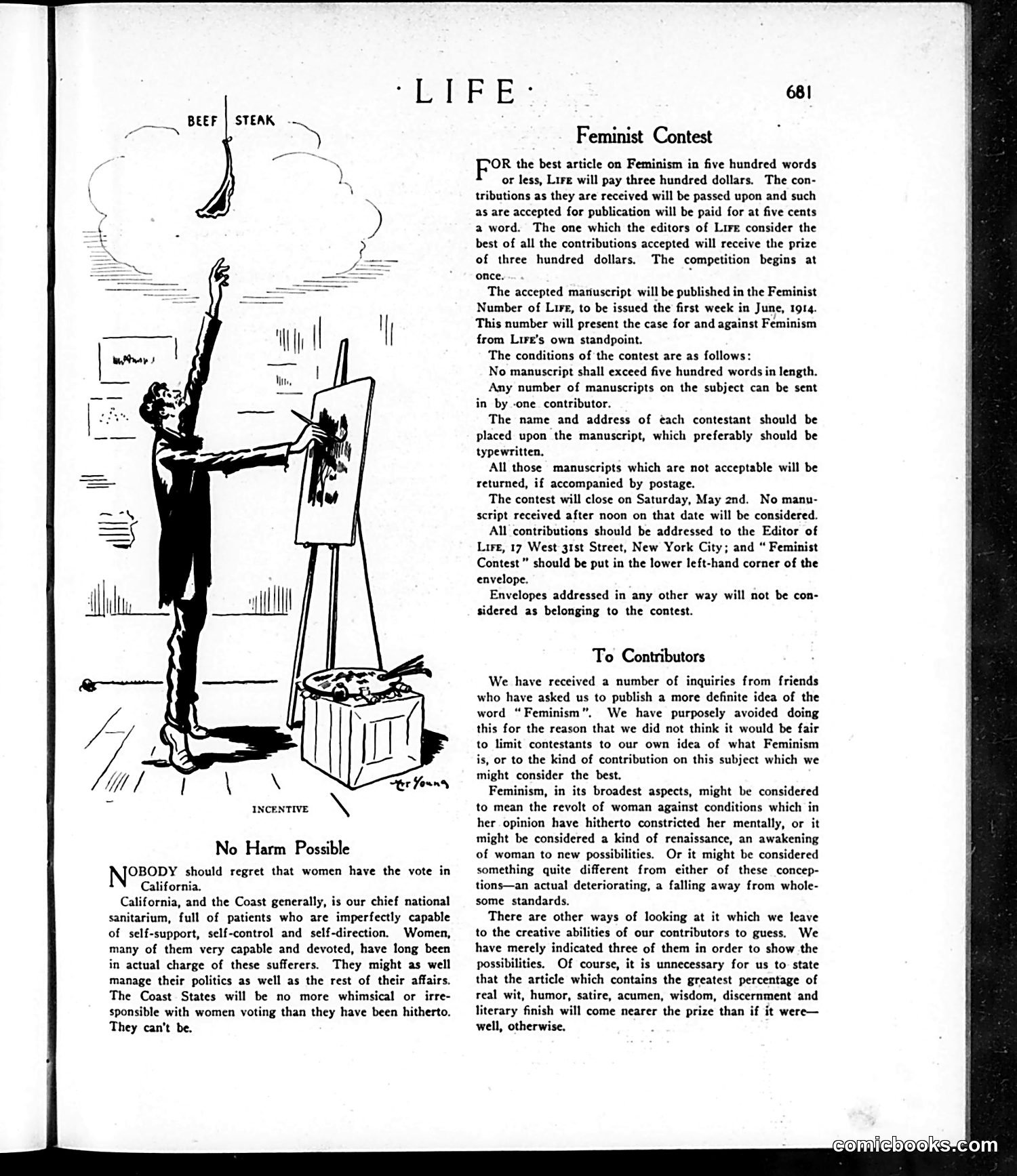
The page contains two distinct sections: **Left side - "No Harm Possible" cartoon:** A woman artist paints at an easel while holding a large beef steak as her "incentive." The satire mocks concerns about women's competence if granted voting rights in California. The text argues women voters pose no danger, noting women have long managed households and care for the sick—skills applicable to civic participation. The beef steak visual pun suggests women need basic motivation, a patronizing jab at anti-suffrage arguments. **Right side - "Feminist Contest":** Life announces a writing competition offering $300 for the best article defining "Feminism" (under 500 words). The announcement acknowledges confusion about feminism's meaning and invites contributors to clarify the movement's goals and philosophy, leaving interpretation intentionally open-ended to contributors.
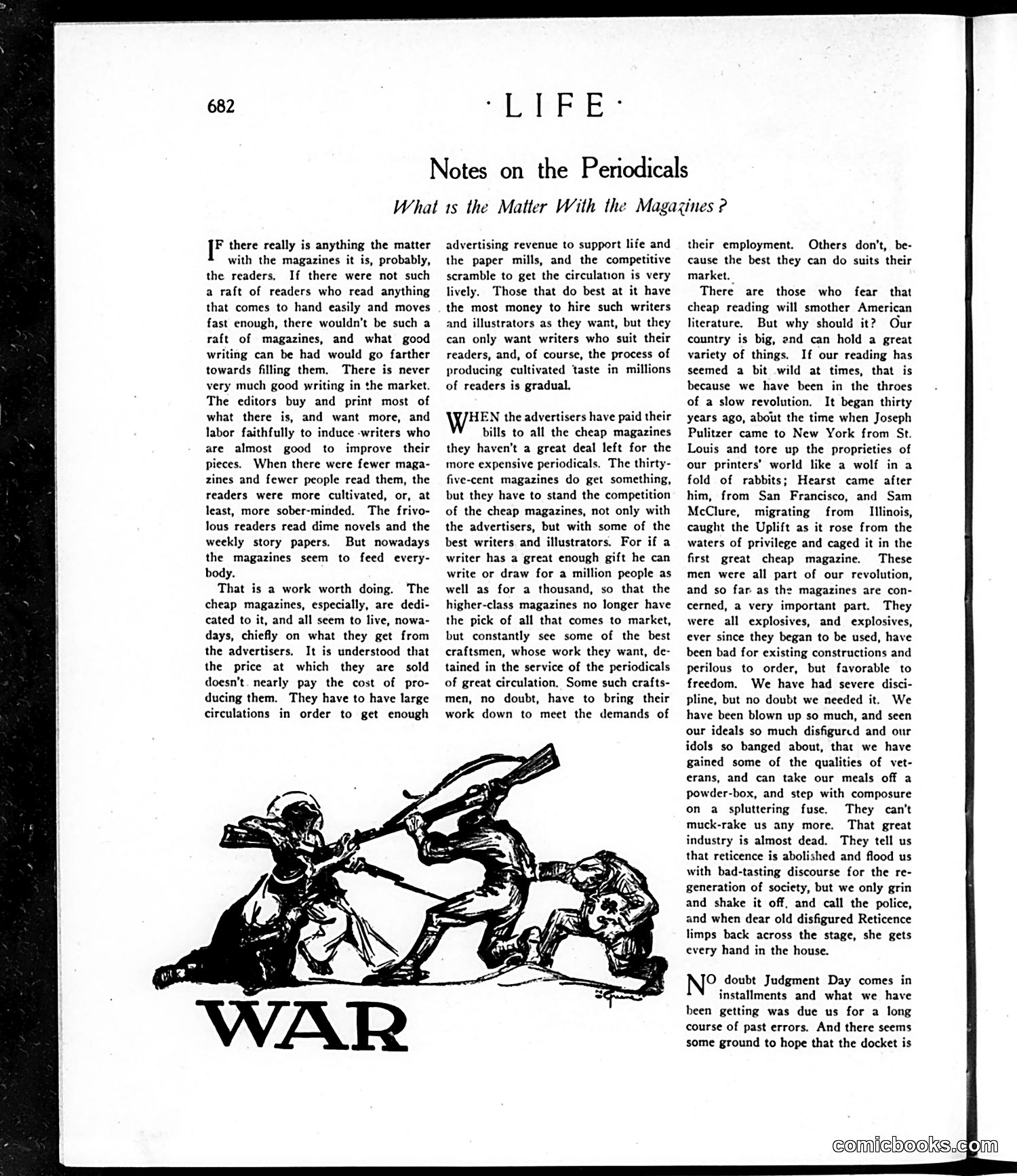
This political cartoon illustrates the article's critique of cheap magazines' decline. The large "WAR" illustration depicts a chaotic battle scene with soldiers fighting—a visual metaphor for the competitive struggle among magazines for survival and advertising revenue. The accompanying text discusses how higher-priced magazines maintain quality by attracting top writers and advertisers, while cheaper magazines ("the thirty-five-cent magazines") must compete fiercely but cannot afford the best talent. The "war" represents this brutal market competition that supposedly forces cheaper publications toward sensationalism and lower standards. The cartoon suggests the magazine industry's internal conflict is as destructive as literal warfare, emphasizing the author's concern that economic pressures undermine literary quality and American reading culture.
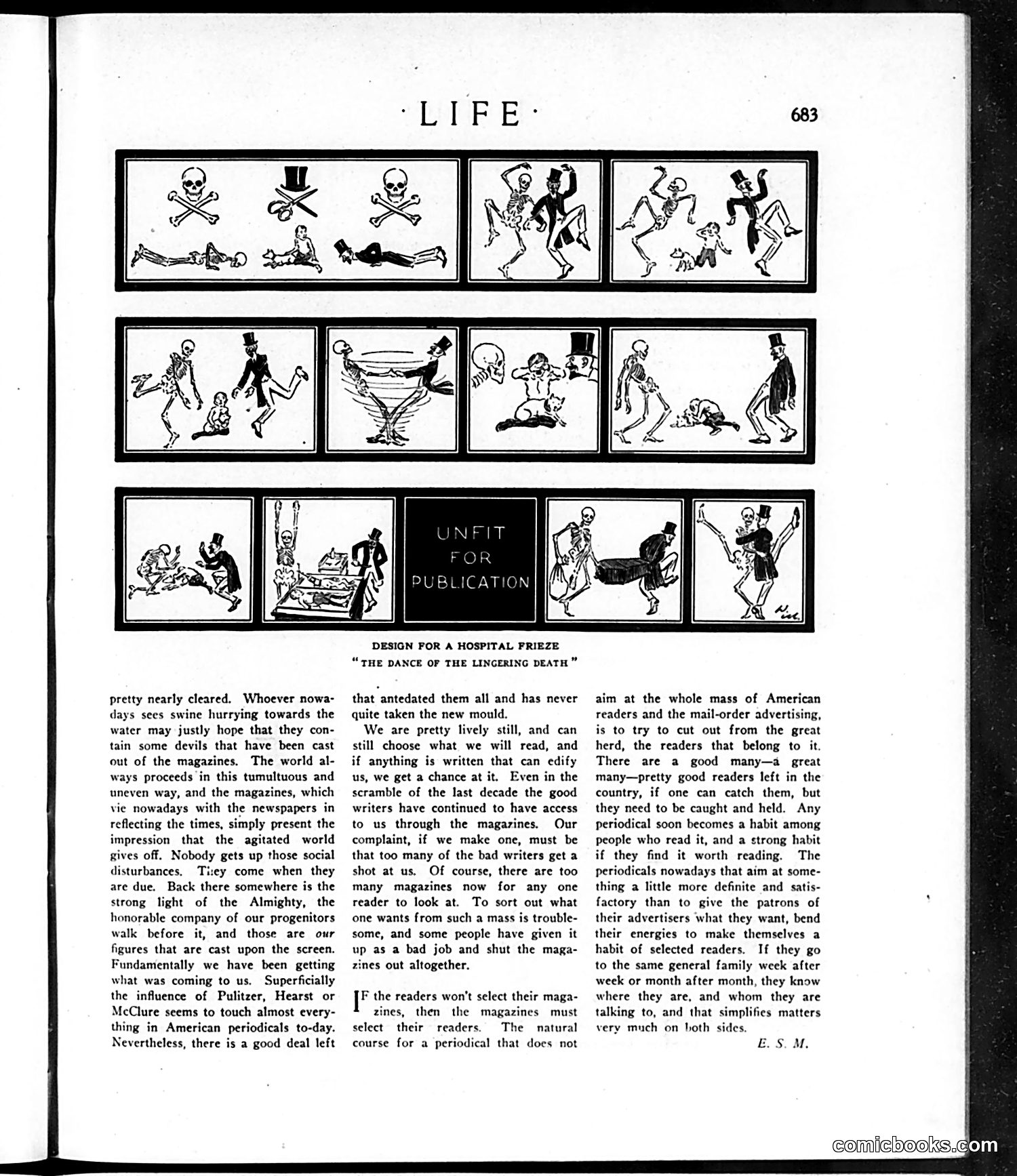
This page presents a macabre cartoon series titled "Design for a Hospital Prize," depicting skeleton figures in various scenes of death and chaos. The skeletal characters wear top hats and formal dress, personifying Death itself engaging in contemporary activities—dancing, drinking, chasing living people, and causing mayhem. The accompanying text discusses American periodicals and magazine quality. The satire appears to critique how magazines sensationalize death, disease, and social disturbance. By showing Death as an elegant, top-hatted gentleman actively participating in modern life, the cartoonist suggests that lurid magazine content treats death and suffering as entertainment rather than serious social concerns. The dark humor reflects early 20th-century anxieties about media influence and sensationalism.
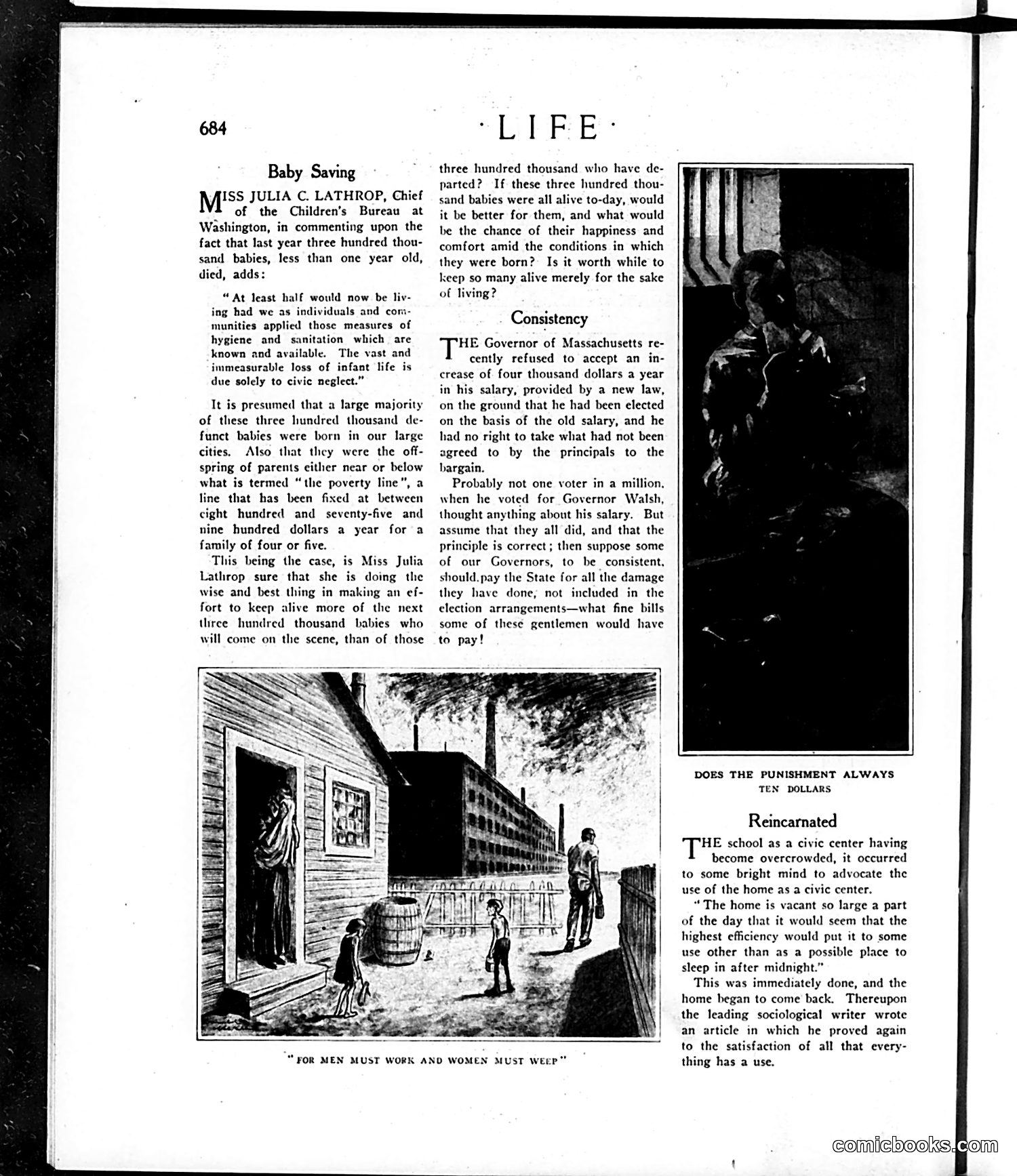
This page contains three separate pieces addressing social issues: **"Baby Saving"** discusses infant mortality among poor families living below the "poverty line" (set at $875-895 annually for families of 4-5). Miss Julia C. Lathrop of the Children's Bureau argues that 300,000 infant deaths annually could be prevented through hygiene and sanitation measures—a criticism of inadequate public health infrastructure. **"Consistency"** satirizes a Massachusetts Governor who refused a salary increase while claiming to have been "elected on the basis of the old salary." The piece mocks this selective consistency, suggesting if applied universally, governors should repay damage caused during their tenure. **"Reincarnated"** discusses schools becoming civic centers, proposing homes serve community functions when not in use—a Progressive-era idea about maximizing social utility.
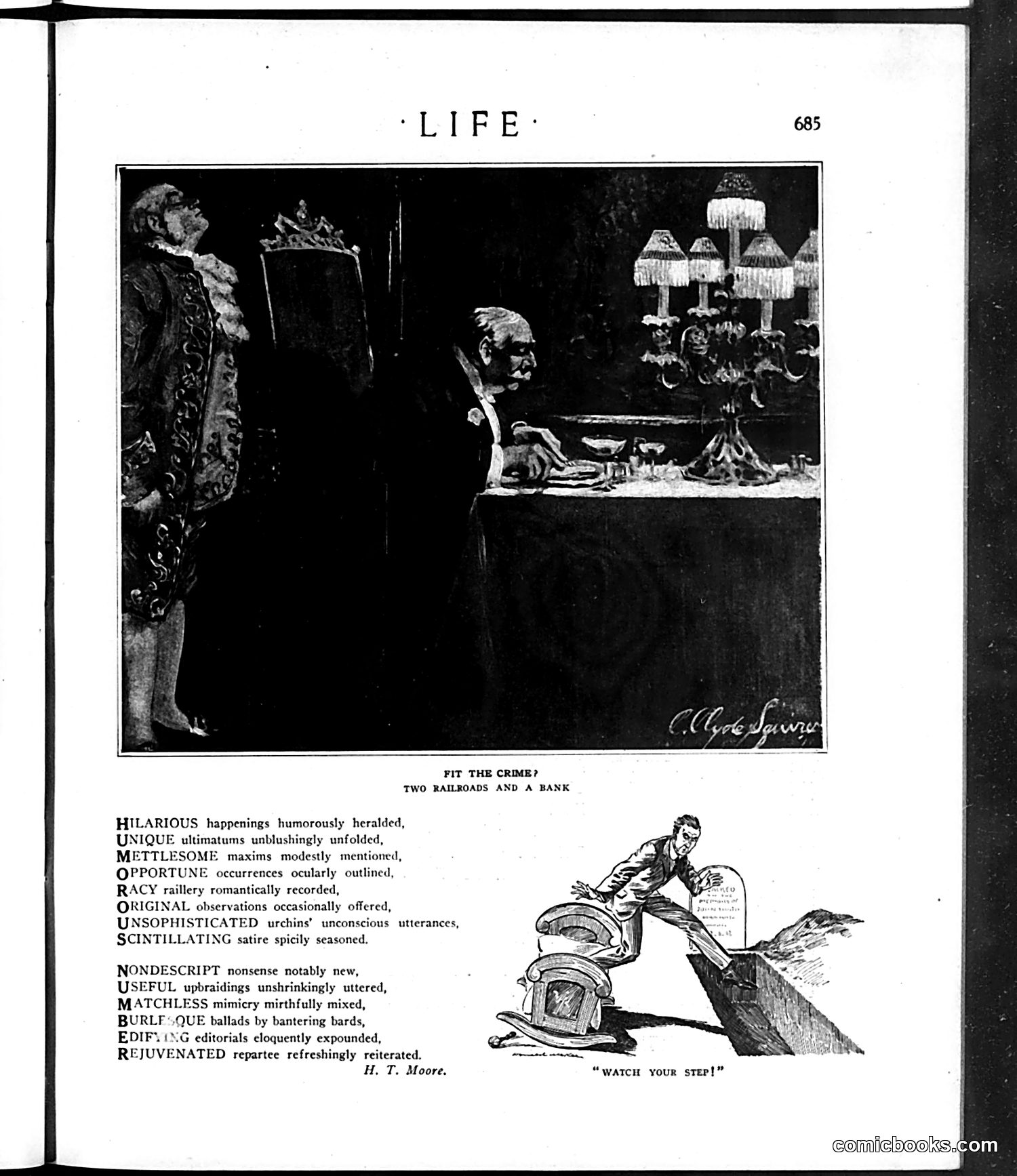
The top cartoon, titled "FIT THE CRIME? TWO RAILROADS AND A BANK," depicts a formal dinner scene where a well-dressed man sits at an elaborate table while another figure stands observing. The satire likely critiques wealthy industrialists or financiers—possibly referencing railroad barons and banking scandals of the era—suggesting that luxurious lifestyles and criminal behavior coexist among the elite. Below is a separate cartoon titled "WATCH YOUR STEP!" showing a man balancing precariously on what appears to be stacked luggage or containers, illustrating cautionary advice about maintaining one's footing—likely a metaphor for navigating treacherous business dealings or social circumstances. The page is primarily satirical commentary on wealth, power, and moral compromise among America's business class.
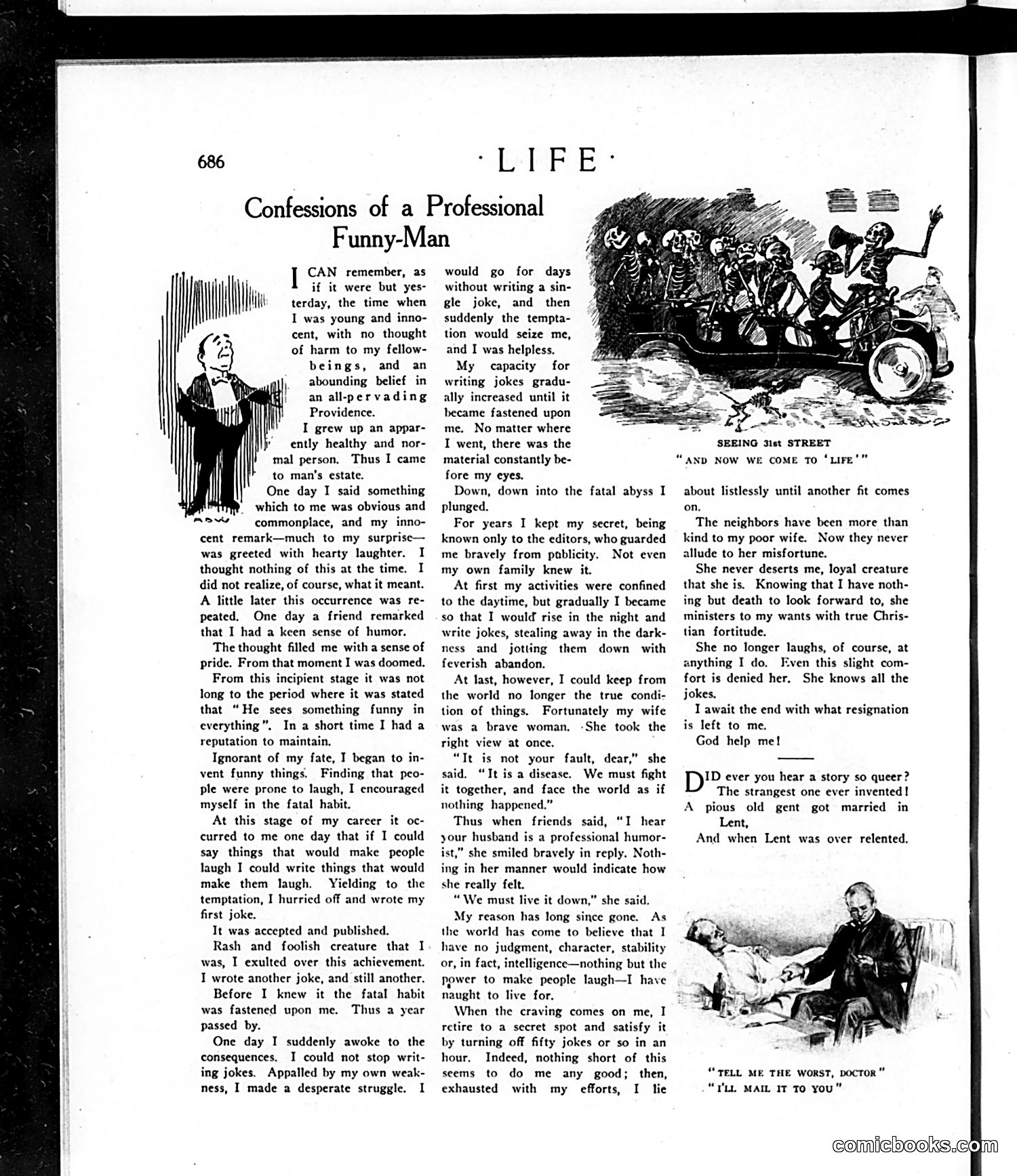
This is a confessional article where a humor writer describes how he became obsessed with making people laugh, to the detriment of his personal life and marriage. The piece appears autobiographical rather than political satire. The accompanying illustrations show: 1. **Top right**: A chaotic street scene labeled "Seeing 31st Street" and "And Now We Come to 'Life'"—depicting the author's comedic observations of urban life. 2. **Bottom right**: A sketch titled "Tell Me the Worst, Doctor / I'll Mail It to You"—showing a patient confessing troubles to a doctor, implying the author mines personal misfortune for comedic material. The satire targets the self-destructive nature of professional comedy writing and how comedians sacrifice genuine human connection for their craft.
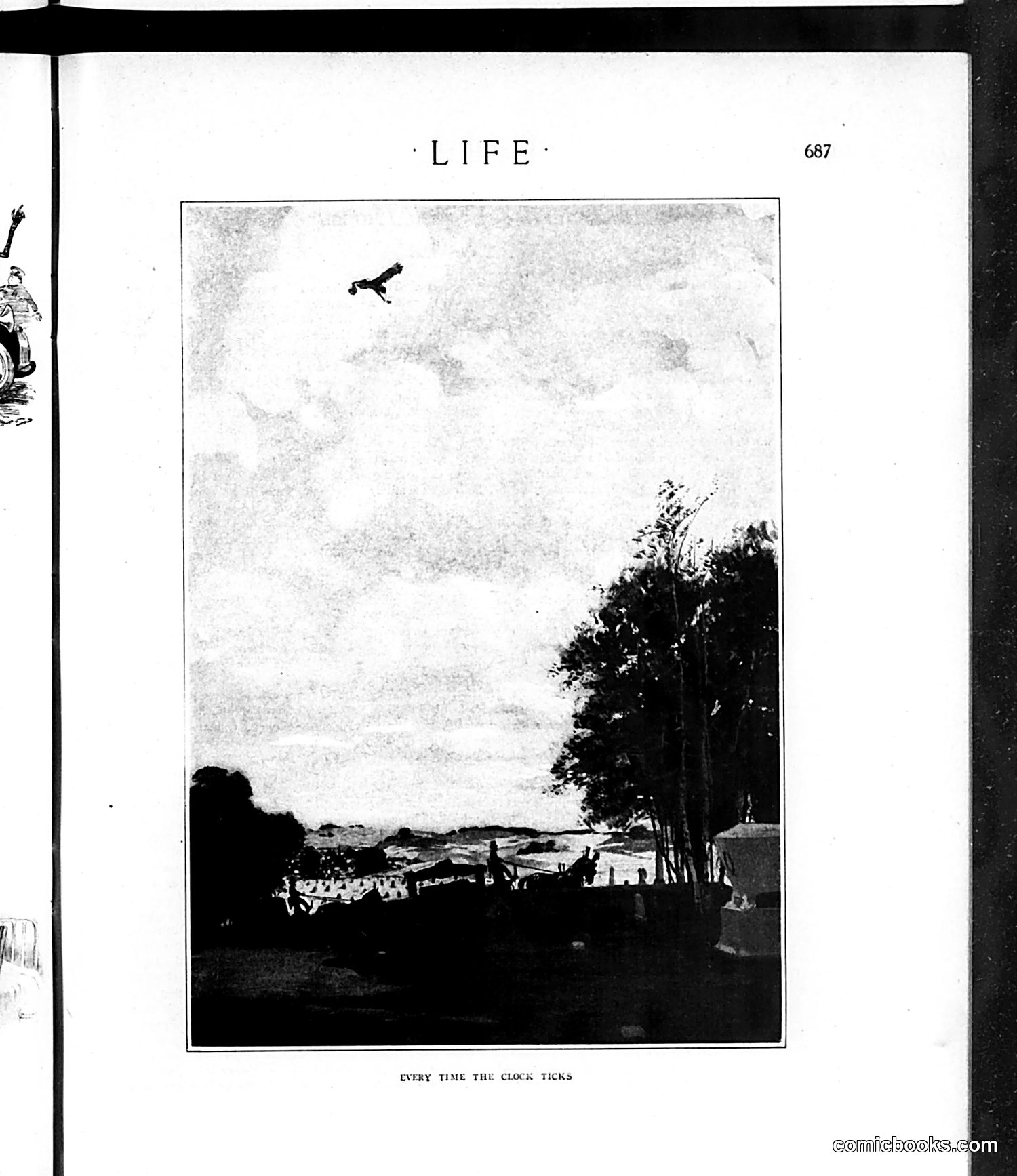
This Life magazine page features a pastoral landscape illustration with the caption "EVERY TIME THE CLOCK TICKS." The image shows a rural scene with trees, figures, and what appears to be farmland or countryside, with a bird flying overhead. The caption suggests a commentary on time's passage and its effects. Without additional context or visible text identifying specific figures or events, the satire appears to be making a broader social or philosophical point about how time continuously moves forward and affects the world depicted—possibly commenting on agricultural life, rural change, or the inexorable march of progress. The exact political or social reference remains unclear from the image alone.
This is an essay (not a cartoon), by famous British author G.K. Chesterton, examining differences between American and French humor. The page contains no illustrations. Chesterton argues that humor cannot be rationally analyzed without destroying it. He illustrates international misunderstanding through a dispute between an unnamed American humorist and French novelist: the Frenchman casually remarked that Americans don't know their grandfathers; the American responded that Frenchmen don't know their fathers. The Frenchman, interpreting this as an insult to French morality, nearly demanded a duel. The essay's satire is gentle: Chesterton mocks how nations misread each other's intent, each "calling the other all the colours of the rainbow except the right one." Americans have wit; Frenchmen have respectability. The humor lies in how easily casual international banter escalates through mutual misunderstanding.
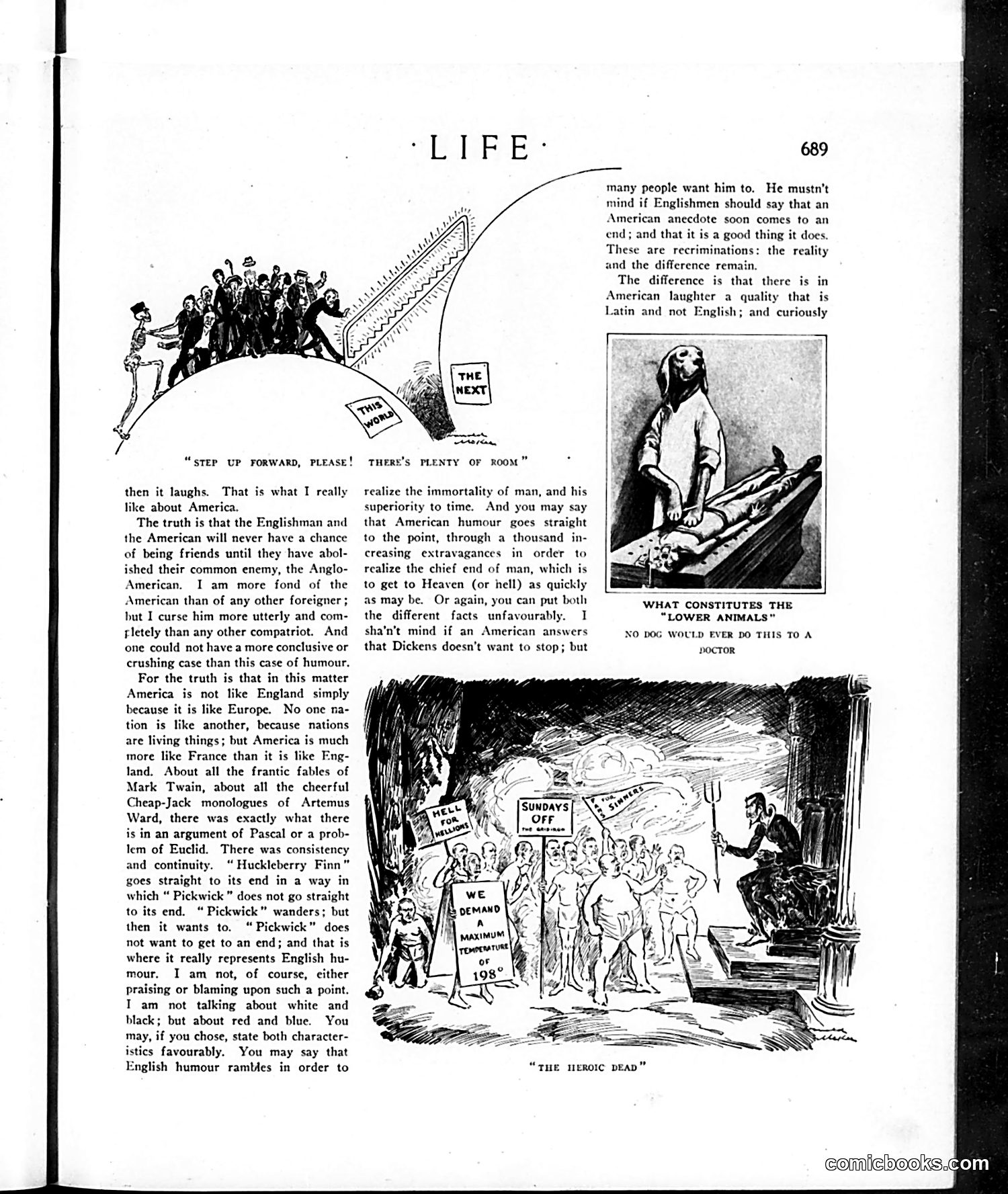
This page contains an essay on Anglo-American humor differences, accompanied by three satirical cartoons. **Top cartoon:** Depicts a crowded staircase labeled "THIS WORLD" and "THE NEXT," with figures climbing upward—satirizing American optimism and forward momentum versus English wandering humor. **Middle cartoon:** Shows a person examining an animal, captioned "What Constitutes the 'Lower Animals'—No Dog Would Ever Do This to a Doctor," mocking the pretensions of medical professionals or suggesting humans behave worse than animals. **Bottom cartoon:** "The Heroic Dead" depicts workers demanding "Sundays Off" and "Maximum Temperature of 108°"—satirizing labor disputes and working conditions, possibly during a heat wave, while management ignores their suffering. The essay argues American humor is direct and Latin-influenced, while English humor (exemplified by Dickens's *Pickwick Papers*) meanders purposefully. The cartoons illustrate this distinction through class commentary and social criticism typical of early 20th-century satire.
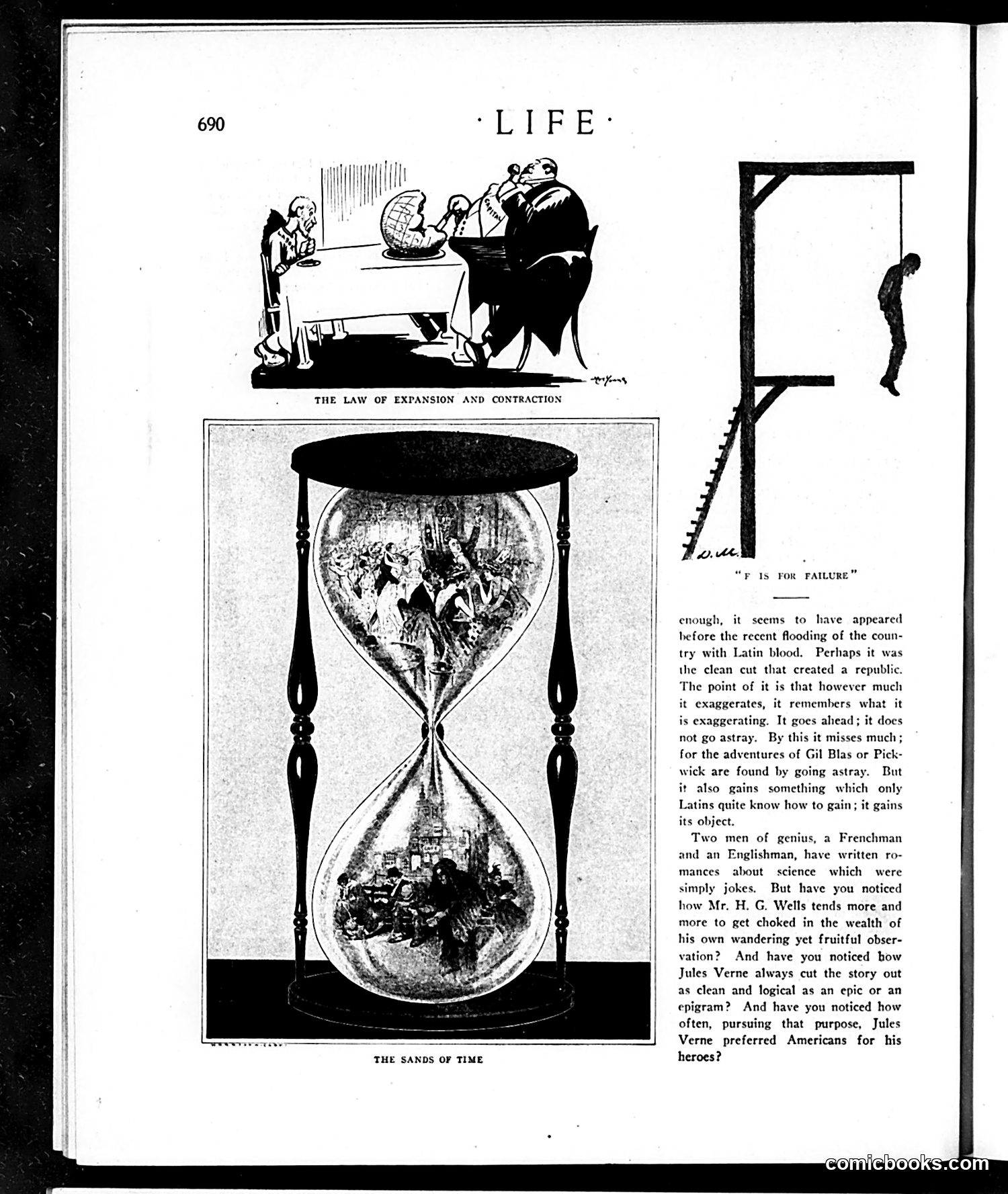
This page contains three distinct images satirizing different subjects: **"The Law of Expansion and Contraction"** (top): Shows a thin woman and portly men at a dining table with a globe-shaped dish, satirizing how wealth/resources distribute unevenly—the rich expand while others contract. **"The Sands of Time"** (center): An hourglass symbolizing mortality, with crowds of people in each chamber, representing how time passes and civilizations rise and fall. **"F is for Failure"** (right): A figure hanging from a gallows, representing failure or defeat. The accompanying text discusses literary giants H.G. Wells and Jules Verne, praising Verne's logical storytelling and noting his preference for American heroes. The passage also contains a now-offensive reference to "flooding of the country with Latin blood," reflecting period anxieties about immigration. The overall theme appears to critique both artistic excess and societal concerns about change and decline.
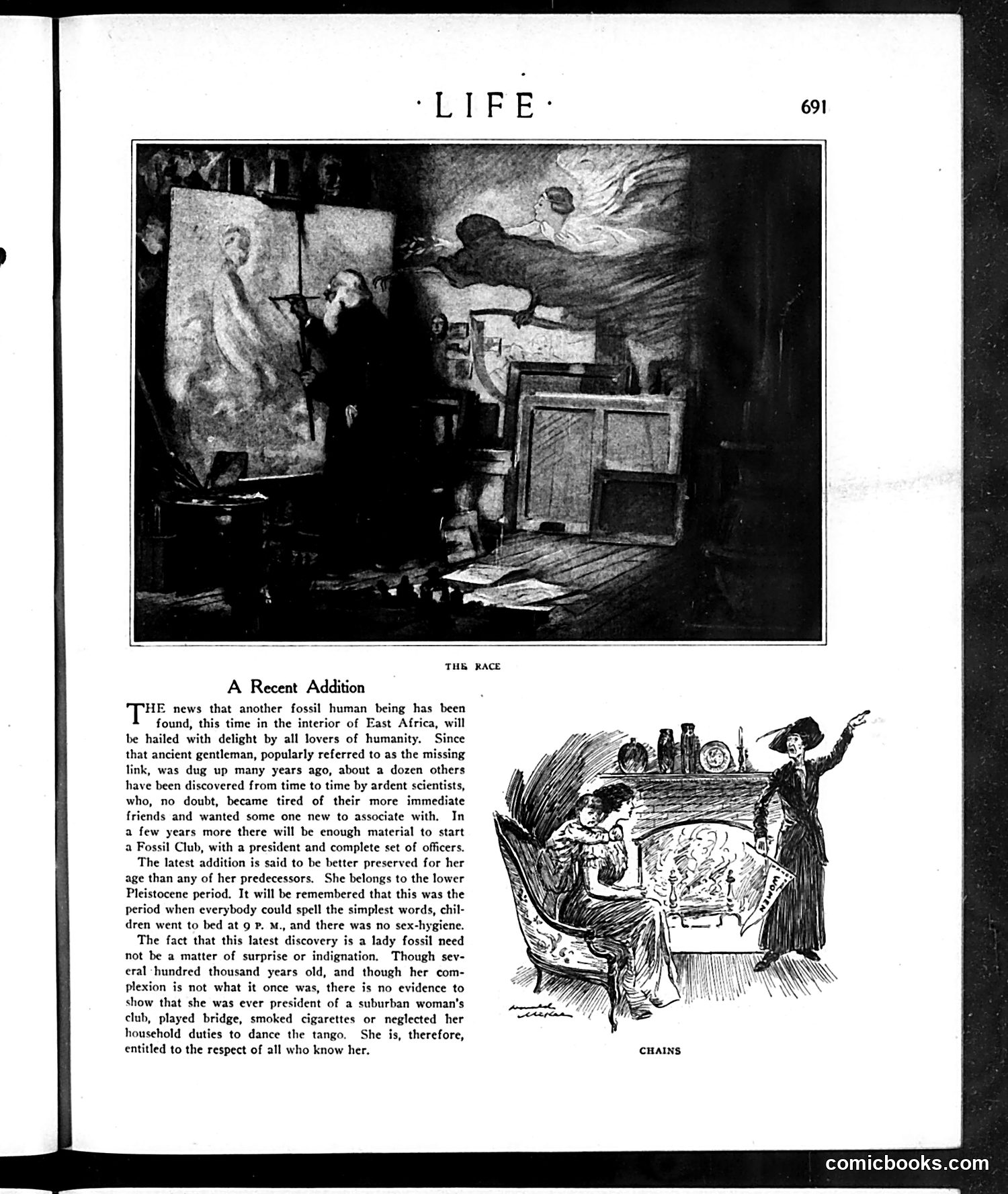
This page contains satirical commentary on the discovery of a female fossil human in East Africa. The text mocks both paleontological enthusiasm and contemporary women's behavior. The main satire operates on two levels: First, it humorously suggests scientists are collecting fossils like club members seeking new social companions. Second, and more pointedly, it contrasts the "primitive" fossil woman favorably with modern women by listing their perceived failings—playing bridge, smoking cigarettes, neglecting household duties, dancing the tango, and serving as suburban club presidents. The backhanded compliment is the joke: the ancient fossil "deserves respect" *precisely because* she allegedly avoided these modern female behaviors. This reflects early 20th-century anxieties about women's changing roles and independence. The cartoon titled "Chains" (right) likely illustrates related themes about women's constraints or choices. The piece is fundamentally satirizing both scientific fads and contemporary debates about proper womanhood.
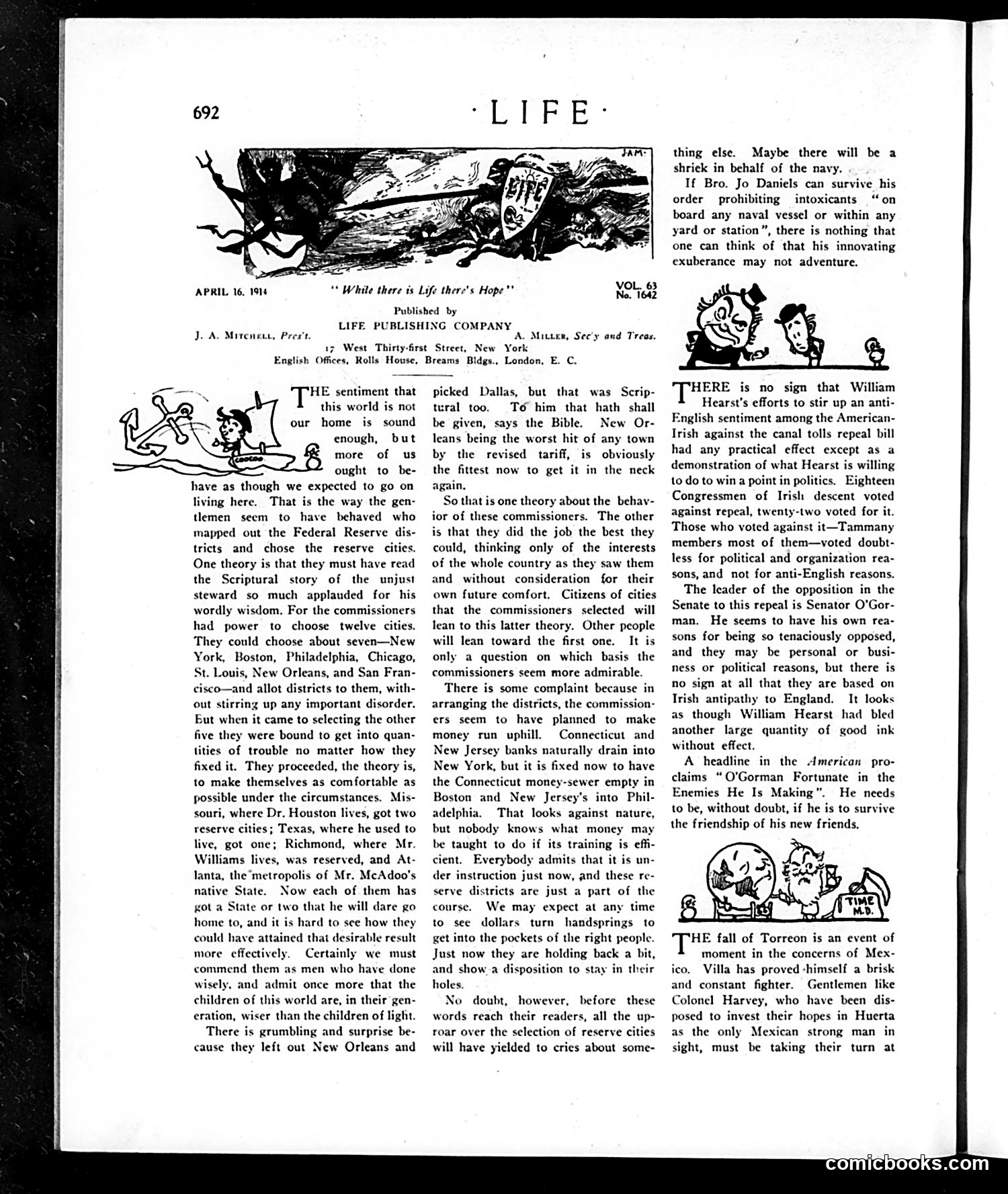
This page satirizes the Federal Reserve commissioners' selection of reserve cities (financial centers) established under the 1913 Federal Reserve Act. The article argues the commissioners chose cities suspiciously aligned with where they personally lived or had ties—Dr. Houston (Missouri), Mr. Williams (Richmond), Mr. McAdoo (Atlanta)—suggesting self-interested rather than impartial decision-making. The piece sardonically praises them as "children of this world" wise in worldly concerns, contrasting them with "children of light" (the genuinely virtuous). The satire also mocks the artificial rerouting of financial flows (Connecticut and New Jersey funds diverted from New York to Boston and Philadelphia), suggesting money can be "trained" like an obedient subject if given proper instruction. A separate item jokes about Secretary of the Navy Josephus Daniels's temperance order banning alcohol aboard naval vessels—questioning whether anything could be more controversial than such a radical innovation.
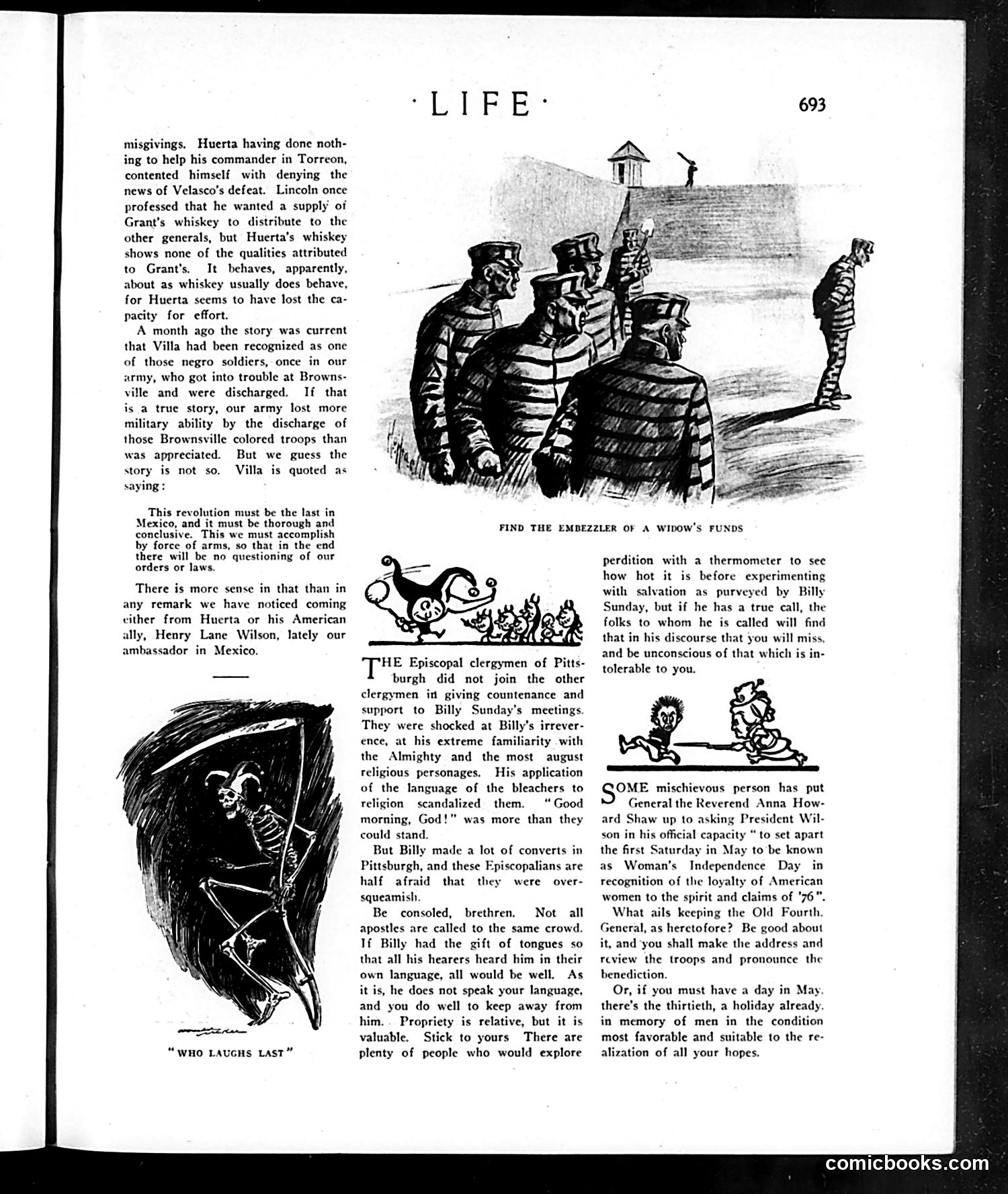
This page contains three separate satirical pieces: **Mexican Revolution Commentary**: The top text mocks General Victoriano Huerta's ineffectiveness during Mexico's revolution, contrasting him unfavorably with Pancho Villa. It references the 1906 Brownsville Incident (when Black U.S. soldiers were discharged), suggesting Villa possessed greater military competence than American military leadership recognized. **Billy Sunday Critique**: The middle section ridicules Episcopal clergymen for being prudish about evangelist Billy Sunday's informal, colloquial preaching style ("Good morning, God!"). Life defends Sunday's methods as appropriate for his audience, suggesting the Episcopalians' objections reflect their own stuffiness rather than genuine impropriety. **Woman's Independence Day Mockery**: The final piece sarcastically responds to General Anna Howard Shaw's request that President Wilson declare the first Saturday in May as "Woman's Independence Day." Life suggests keeping Memorial Day (May 30th) instead—darkly implying women's liberation aspirations would only be "realized" through death.
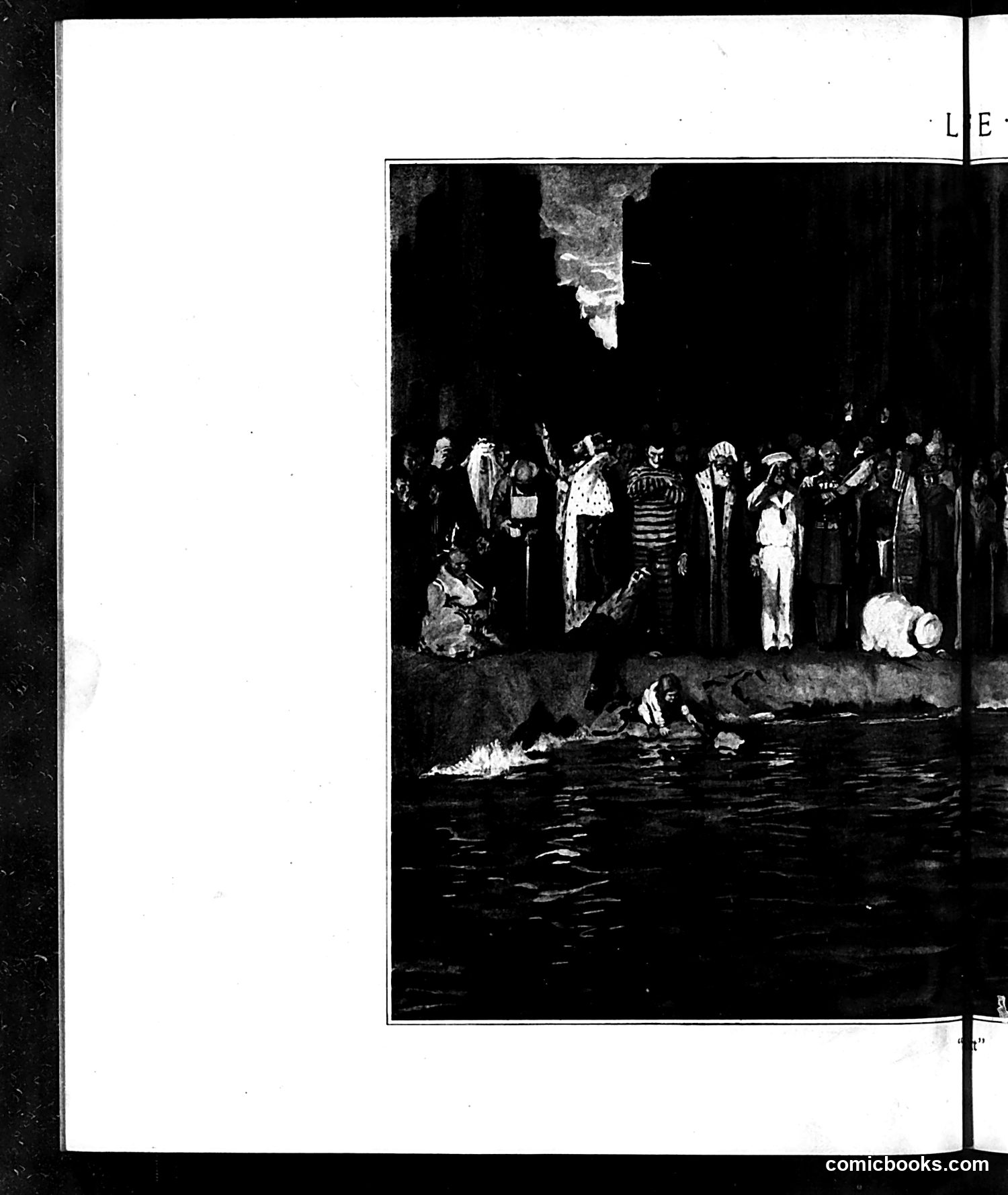
The OCR text is largely illegible and doesn't provide meaningful context. The image shows a theatrical or operatic scene: a group of elaborately costumed figures (appearing to wear royal or noble dress, some with crowns and ornate garments) stand on an elevated stage or platform beside water. One figure appears to be in the water below. The dramatic lighting and staging suggest this depicts a scene from classical opera or theater—possibly a drowning scene or mythological narrative. Without legible caption text, I cannot identify which specific opera, play, or political figures are being satirized. Life magazine frequently used such theatrical imagery for social commentary, but the exact meaning of this particular cartoon remains unclear without the accompanying text.
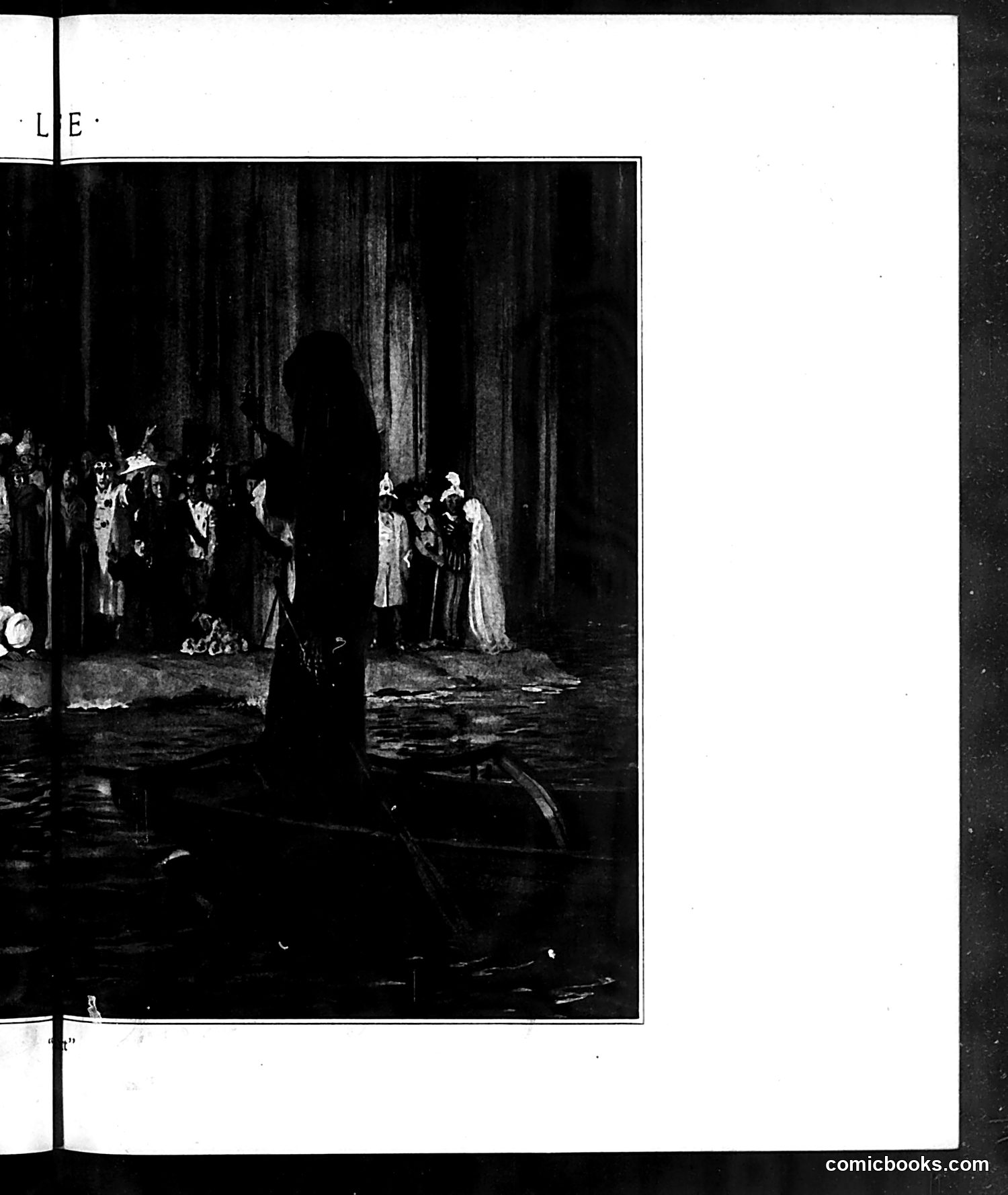
This appears to be a theatrical or operatic scene from an early Life magazine illustration. The image shows a silhouetted figure in the foreground (likely a conductor or performer) facing an elaborate staged scene with multiple costumed figures against a tall backdrop suggesting a grand hall or cathedral interior. Without clear OCR text identifying the specific work being referenced, I cannot definitively state which opera, play, or political satire this depicts. The dramatic lighting, formal costumes, and theatrical composition suggest this may be satirizing either a famous operatic production or a contemporary political event staged as theatrical spectacle. The watermark indicates this is from comicbooks.com's archive. More context would be needed to identify the specific satire's target.
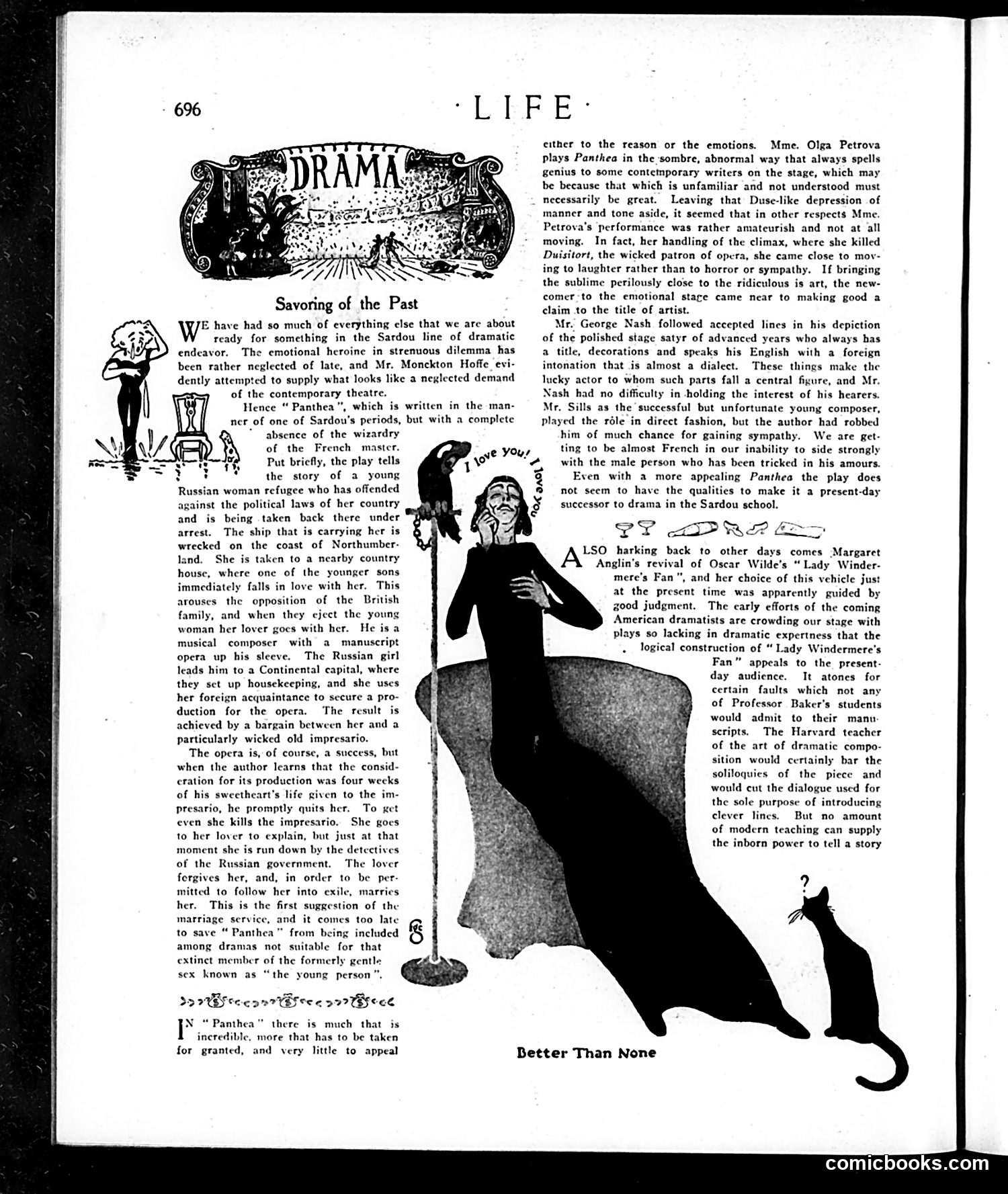
This page reviews the play "Panthea," a melodrama written by Monckton Hoffe in the style of 19th-century French playwright Victorien Sardou. The critic argues the play imitates Sardou's *manner* but lacks his theatrical genius. **The Plot's Absurdity:** A Russian refugee woman falls in love with a British composer. She secures production of his opera by becoming the mistress of a corrupt impresario for four weeks. When the composer learns this, he abandons her. She kills the impresario and is arrested by Russian agents—but the composer marries her so he can follow her into exile. **The Satire:** The critic mocks both the implausible plot contrivances and the lead actress Olga Petrova's pretentiously "abnormal" performance style. He suggests that contemporary critics confuse the unfamiliar with genius, comparing her to the great actress Eleonora Duse. The review ridicules American theatre's desperate imitation of European dramatic forms and the melodramatic absurdities audiences will accept. The illustration labeled "Better Than None" appears to satirize the play's emotional manipulations through silhouetted figures.
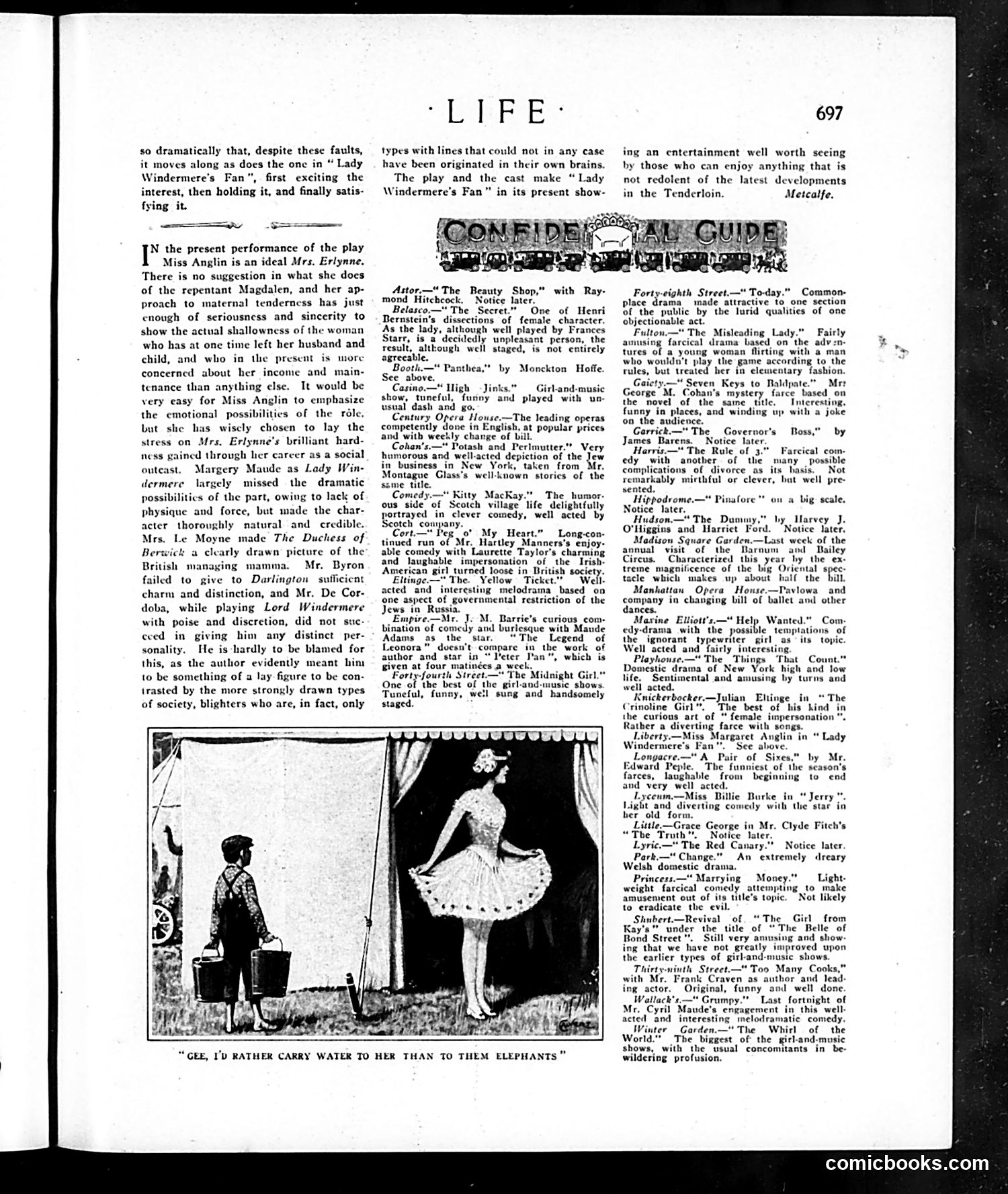
This page reviews theatrical productions, primarily Oscar Wilde's "Lady Windermere's Fan." The review praises actress Margaret Anglin's performance as Mrs. Erlynne, a morally compromised woman, noting she wisely emphasizes the character's "brilliant hardness" gained through her career as a "social outcast" rather than playing her as emotionally vulnerable. The cartoon depicts a man carrying water buckets, saying he'd "rather carry water to her than to them elephants"—likely a visual gag about preferring menial labor for an attractive woman (shown in theatrical costume) over working with actual elephants. This reflects early 1900s humor about masculine preference and workplace hierarchies. The page also lists other Broadway productions: comedies, musicals, and melodramas popular at the time, with brief critical assessments of their merit and casts.
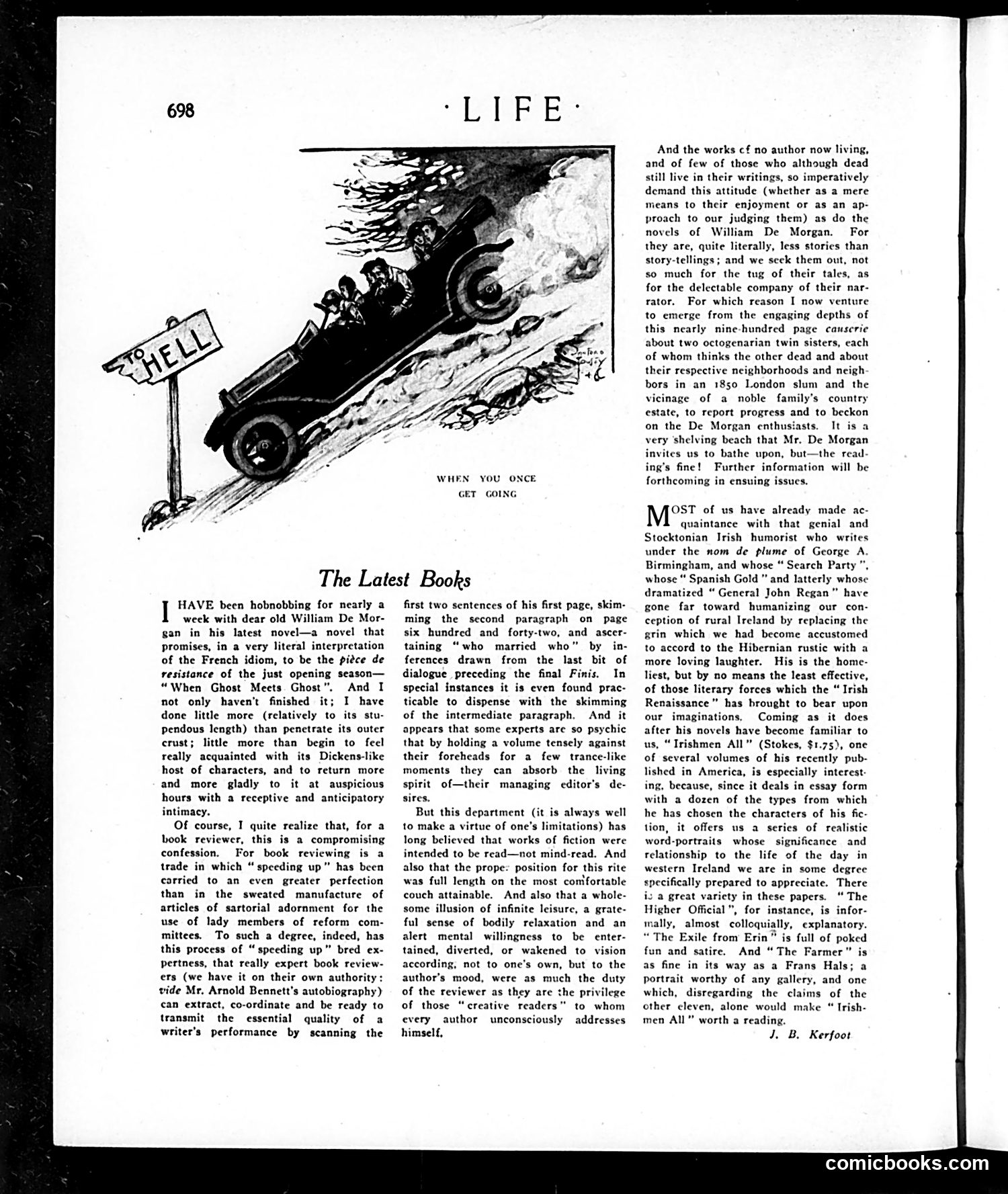
This page from *Life* magazine consists primarily of a book review by J. D. Kerfoot discussing William De Morgan's novel *When Ghost Meets Ghost*. **The Cartoon:** The small illustration labeled "WHEN YOU ONCE GET GOING" depicts a car careening down a slope toward a "HELL" sign—a visual joke about speed and momentum that satirizes book reviewers' rush to finish books. This complements Kerfoot's critique of the publishing industry's "speeding up" culture. **The Satire's Point:** Kerfoot mocks expert reviewers (particularly naming Arnold Bennett) who claim they can extract a book's essence by skimming mere fragments—reading opening sentences, scattered pages, or allegedly absorbing books psychically by holding them to their foreheads. He contrasts this with proper reading: leisurely, on a comfortable couch, allowing the author to set the mood. **De Morgan Context:** The review praises De Morgan's novels as "story-tellings" rather than mere stories, valuing the narrator's voice over plot—requiring patient, attentive reading. This positions De Morgan as the antidote to rushed reviewing culture.
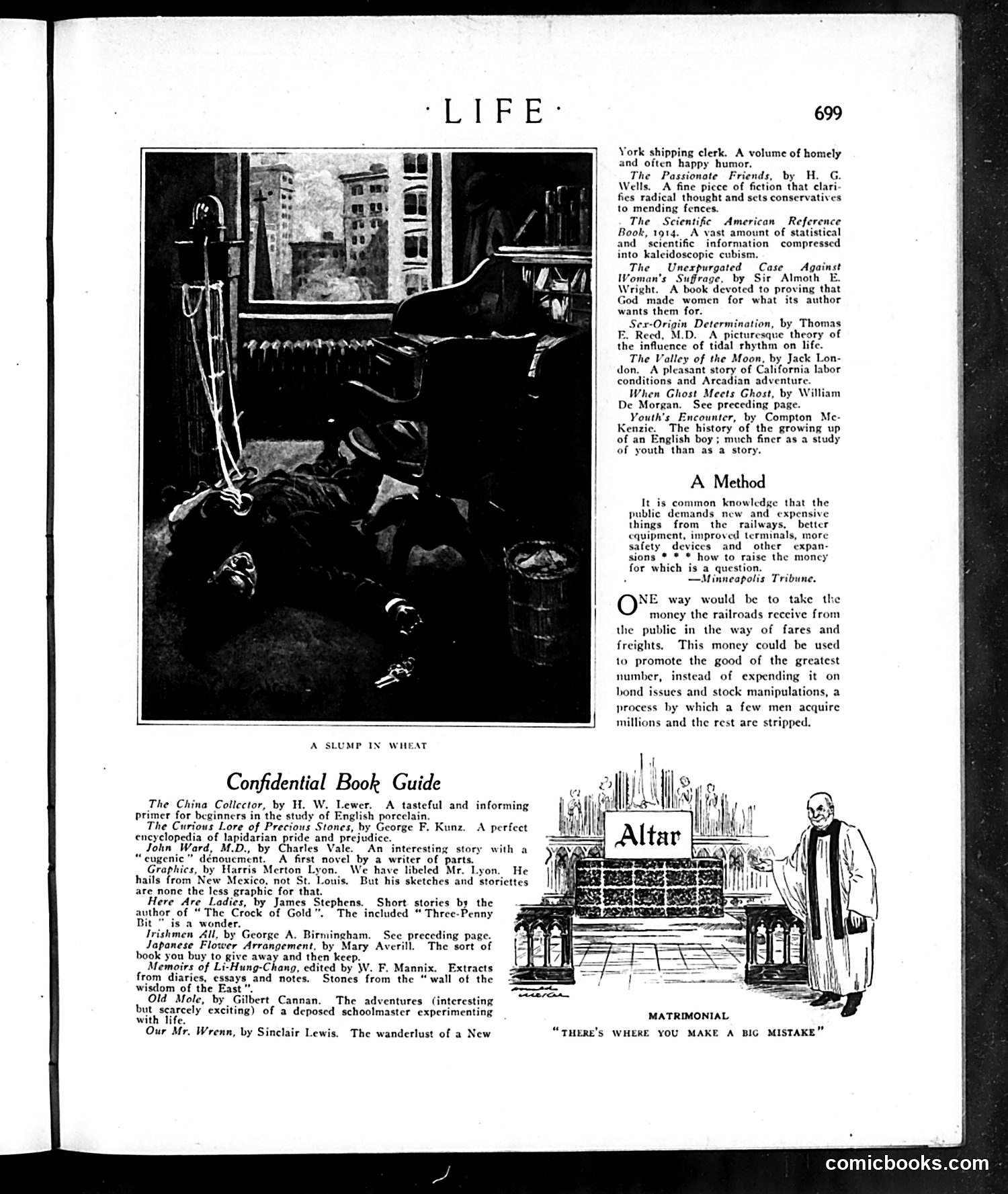
This page combines book reviews with social commentary and advertising. The main editorial content critiques railroads' financial practices, arguing they should reinvest passenger fares into public infrastructure rather than use profits for "bond issues and stock manipulations" that enrich a few wealthy men. This reflects Progressive Era concerns about corporate monopolies and wealth inequality. The "Confidential Book Guide" section reviews contemporary literature, including H.G. Wells's *The Passionate Friends* (praised for its radical ideas) and Almoth Wright's *Case Against Woman's Suffrage* (sarcastically noted as claiming God made women for specific purposes). The matrimonial cartoon at bottom right depicts an altar scene with the caption "THERE'S WHERE YOU MAKE A BIG MISTAKE"—a cynical joke about marriage, likely aimed at male readers. The overall page reflects 1914 anxieties about capitalism, women's rights, and social reform.
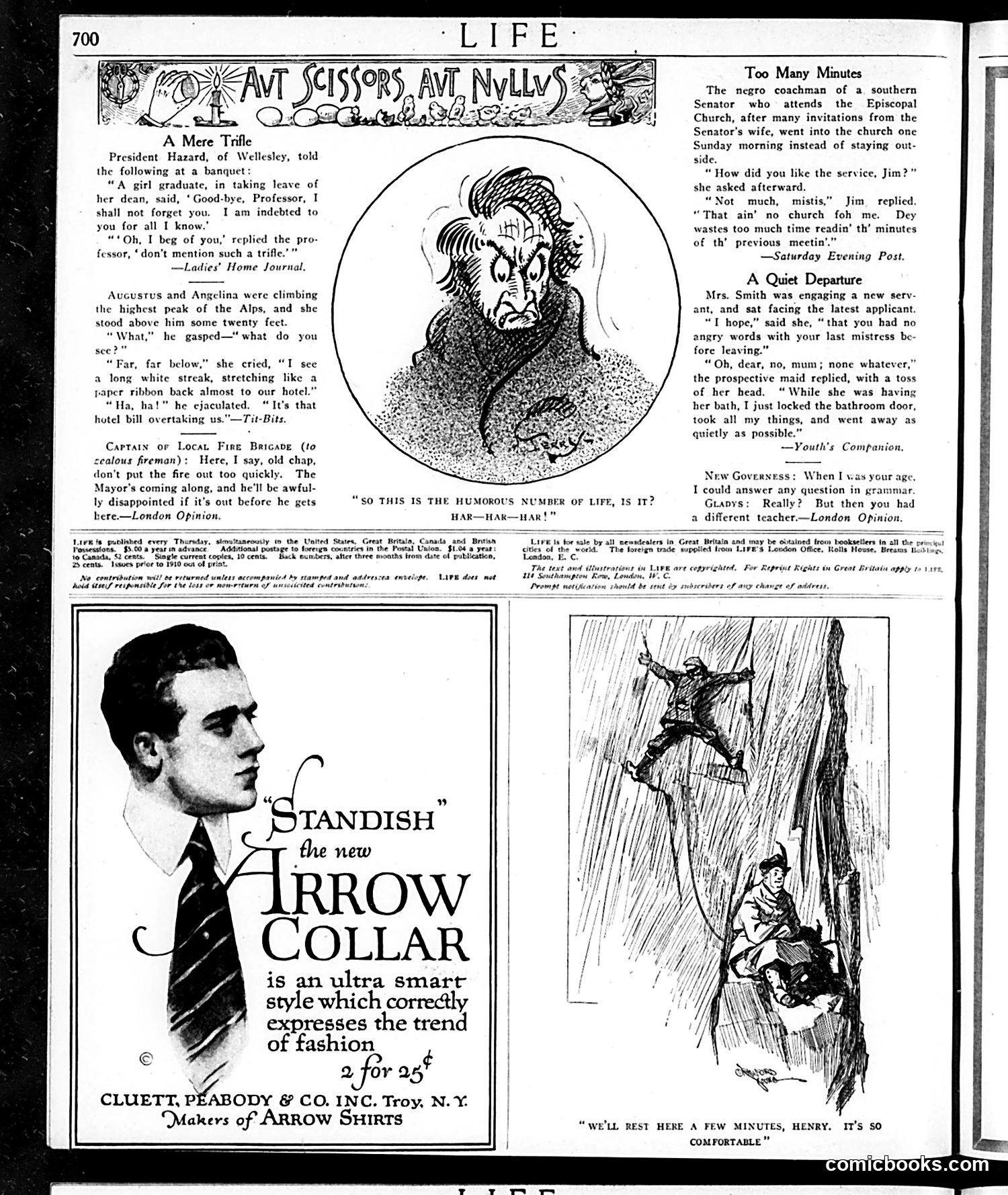
This page from *Life* magazine contains several brief humorous anecdotes typical of early 20th-century satirical publications: **Main cartoons/jokes:** 1. **"A Mere Trifle"** — A Wellesley College president's joke about a graduate claiming she owes all her knowledge to her dean, with the dean's mock-modest deflection. 2. **Alpine climbers** — A couple ascending a mountain; the woman spots a "long white streak" below, which the man identifies as their hotel bill "overtaking" them—a joke about mounting expenses. 3. **Fire brigade captain** — A local fire captain tells firefighters not to extinguish a fire too quickly because the Mayor is coming and would be disappointed to miss it—satirizing bureaucratic inefficiency. 4. **"Too Many Minutes"** — A Black coachman dislikes church because they "waste time readin' th' minutes of th' previous meetin'"—stereotypical dialect humor. 5. **"A Quiet Departure"** — A prospective servant tells her prospective employer she left her last job peacefully, but the cartoon shows she stole everything and fled while the mistress bathed. The page also contains an Arrow Collar advertisement. The humor relies on wordplay, irony, and character misunderstandings typical of period satire.
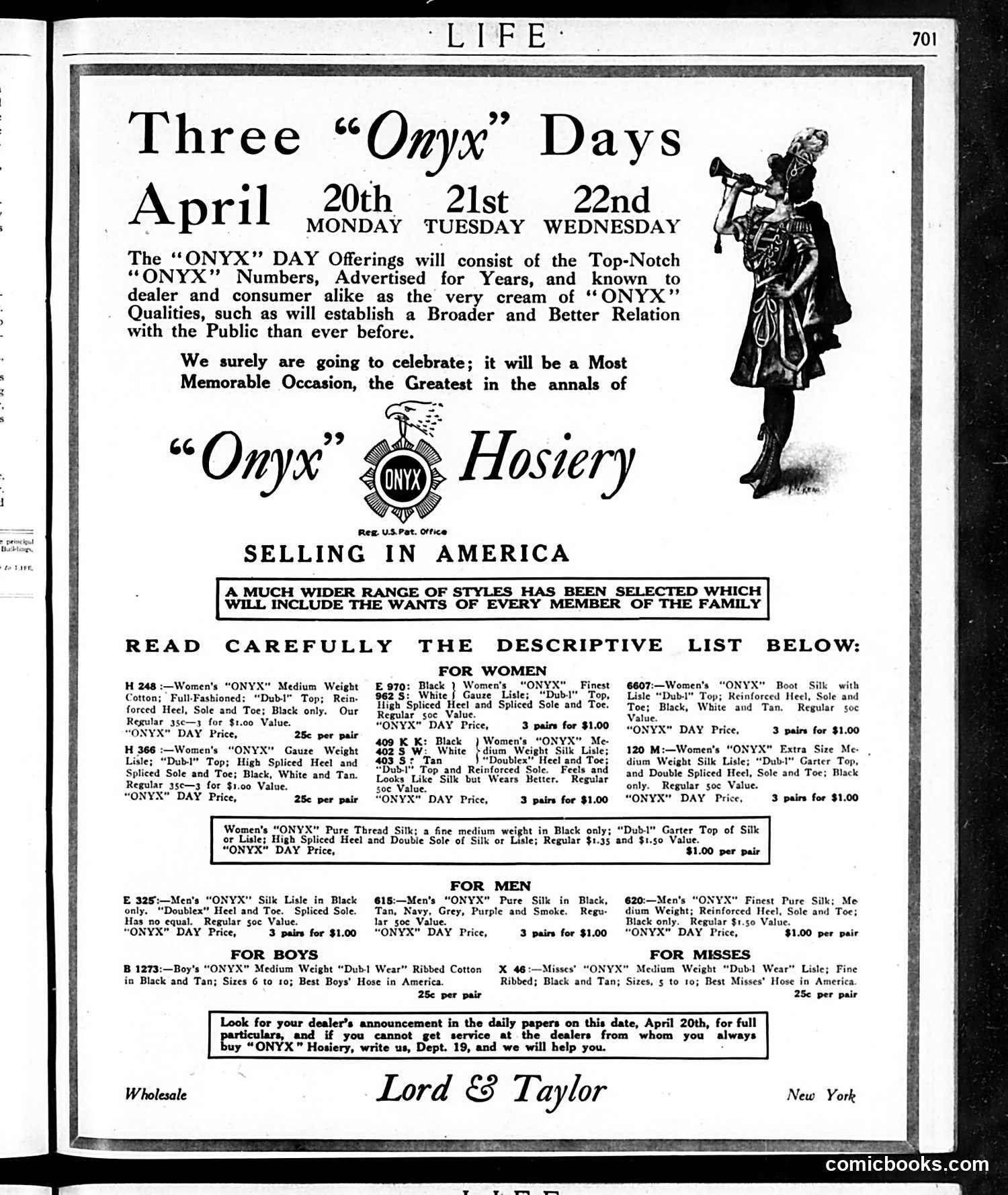
This is a **full-page advertisement**, not a cartoon or satirical content. It announces a promotional sales event for Onyx brand hosiery (socks and stockings) by Lord & Taylor, a major New York department store. The "Three Onyx Days" refers to April 20-22, when the store will offer discounted hosiery across multiple product lines for women, men, boys, and misses. The illustration shows a fashionably dressed woman in 1920s attire, reinforcing the era's style focus. The text emphasizes quality ("cream of ONYX Qualities") and variety ("broader and better relation with the Public"). Prices are advertised as special promotional rates—multiple pairs for $1.00, for example—suggesting this was a significant discount for the period. This represents typical early 20th-century retail advertising: emphasizing established brand reputation, product variety for family members, and time-limited sales to drive store traffic.
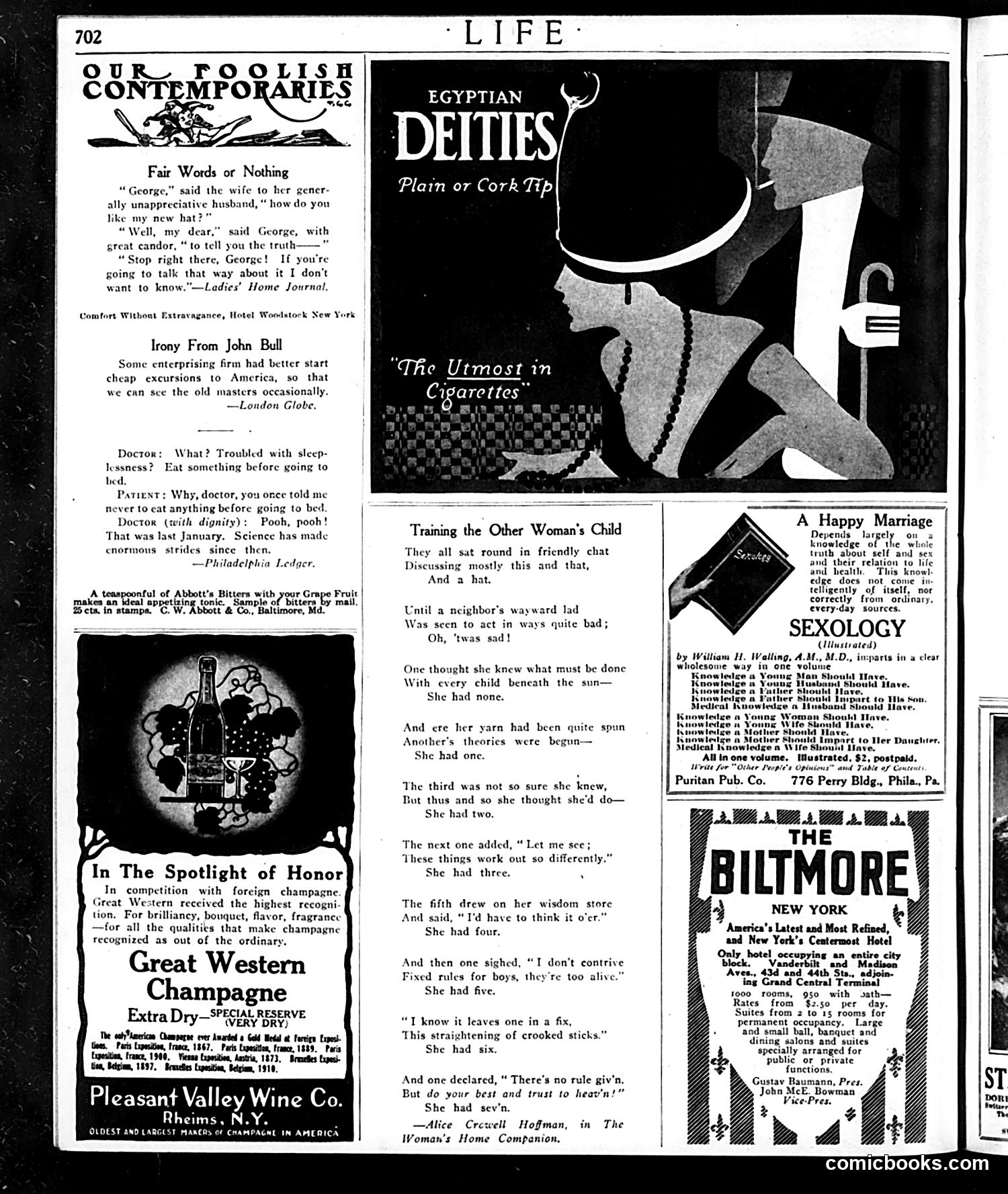
This verse-poem satirizes a common social dynamic: women gathered in conversation, each confidently offering child-rearing advice despite having little or no experience themselves. The joke's escalating structure reveals the irony: - A woman with **no children** insists she knows exactly how to discipline all children - One with **one child** contradicts her with different theories - The pattern continues through women with two, three, four, five, and six children - **The seventh woman**, with the most actual parenting experience, is the only one humble enough to admit uncertainty—she simply says "do your best and trust to heaven" The satire mocks how confidence in parenting advice is **inversely proportional to actual parenting experience**. Those with no children pontificate most authoritatively; those with the most children are most cautious. It's a gentle critique of unsolicited expertise and the performative nature of social conversation among women of the era.
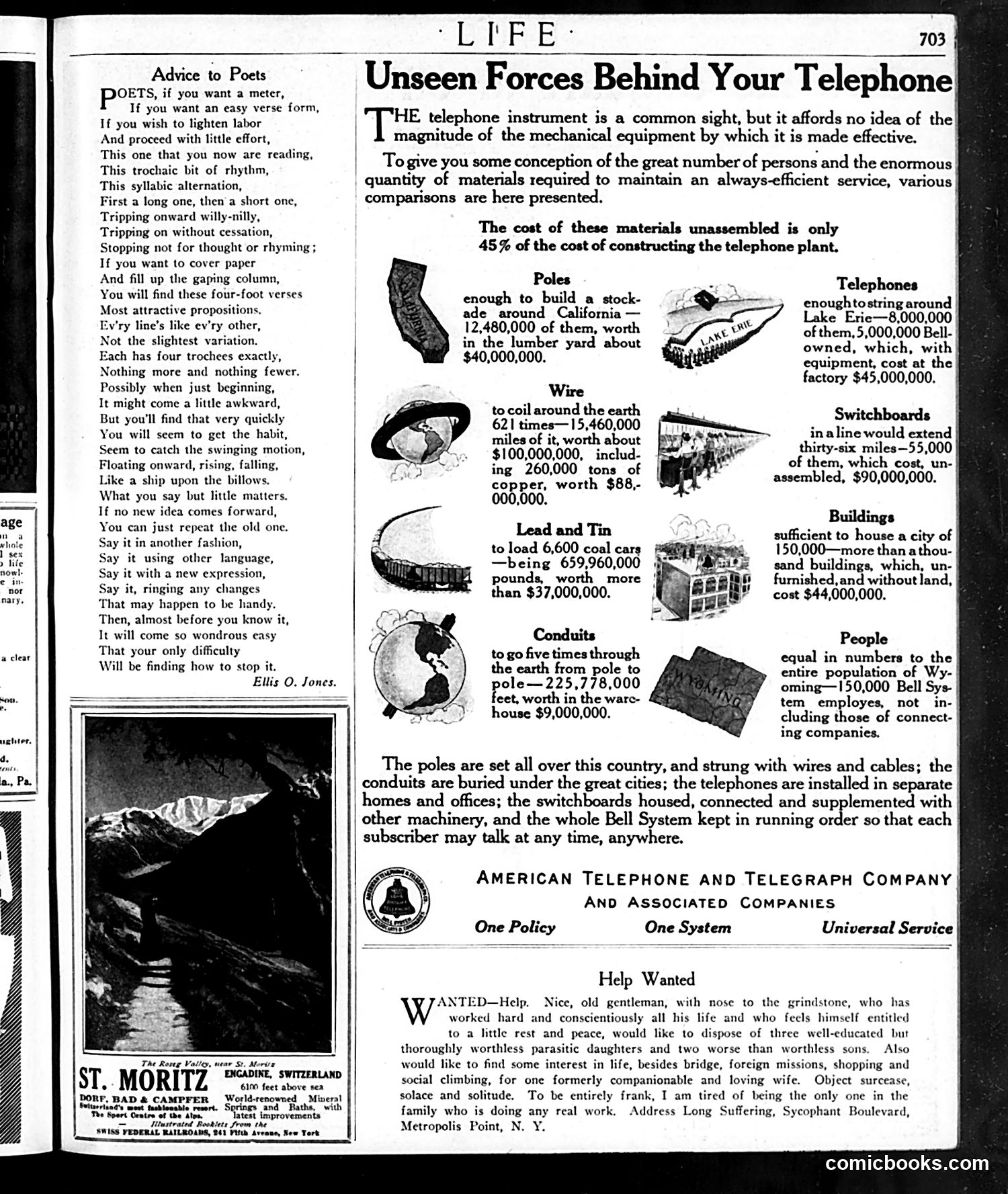
This page contains two distinct sections: poetry advice and corporate advertising. **"Advice to Poets"** (left column) is satire mocking lazy, formulaic verse-writing. Ellis O. Jones ridicules poets who use simple, repetitive trochaic meter as an easy way to fill space without genuine thought or innovation. The poem itself demonstrates the monotonous pattern it criticizes—endless four-foot lines with mechanical rhythm "Like a ship upon the billows." It's self-aware satire: the advice itself exemplifies the hollow, effortless writing it warns against. **"Unseen Forces Behind Your Telephone"** (main content) is a Bell System advertisement presenting infrastructure statistics as impressive comparisons—poles stretching around California, wire circling Earth 621 times, copper and materials worth hundreds of millions. It emphasizes the hidden mechanical complexity supporting everyday service, positioning the Bell System as an engineering marvel serving 150,000 employees and universal connectivity. The "Help Wanted" notice (bottom) appears unrelated—a personal ad seeking a rest-home placement for an elderly gentleman with "worthless parasitic daughters."
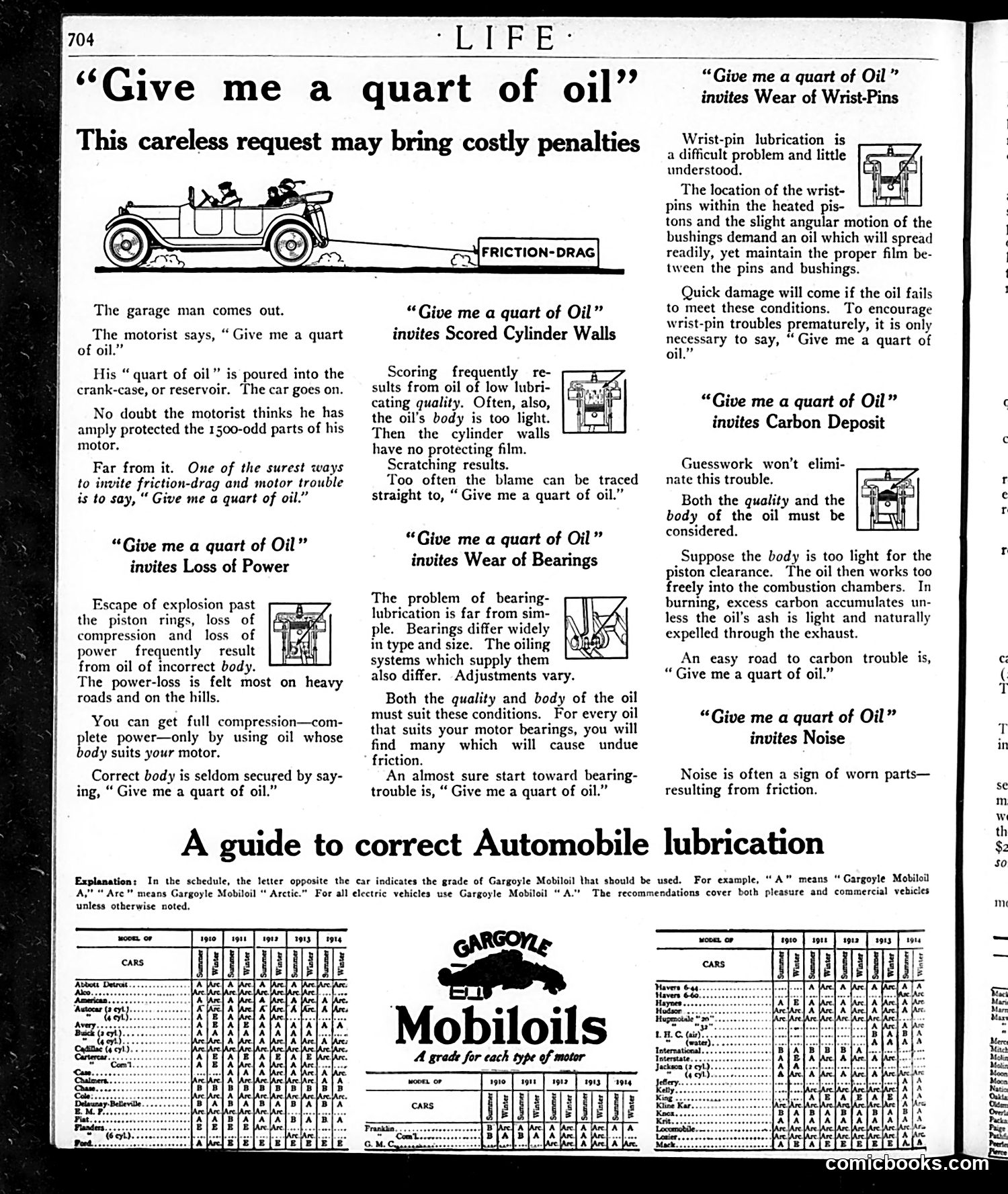
This is primarily a **Gargoyle Mobiloil advertisement** disguised as educational content—not political satire. The "cartoon" is the repeated scenario of a motorist casually asking a garage attendant for "a quart of oil" without specifying the correct grade. The satire targets **consumer ignorance about motor lubrication**. The page warns that indiscriminately pouring any oil into a car invites multiple mechanical failures: friction-drag, power loss, cylinder scoring, bearing wear, wrist-pin damage, carbon deposits, and noise. Each problem is illustrated with small engine diagrams. The joke is that early motorists treated oil selection casually, not understanding that different engine components required different oil viscosities and qualities. The solution: consult Gargoyle Mobiloil's detailed compatibility chart (shown below) to select the correct grade for your specific vehicle. This reflects the **early automotive era** (appears to be 1910s) when car maintenance was poorly understood and standardization was just developing.
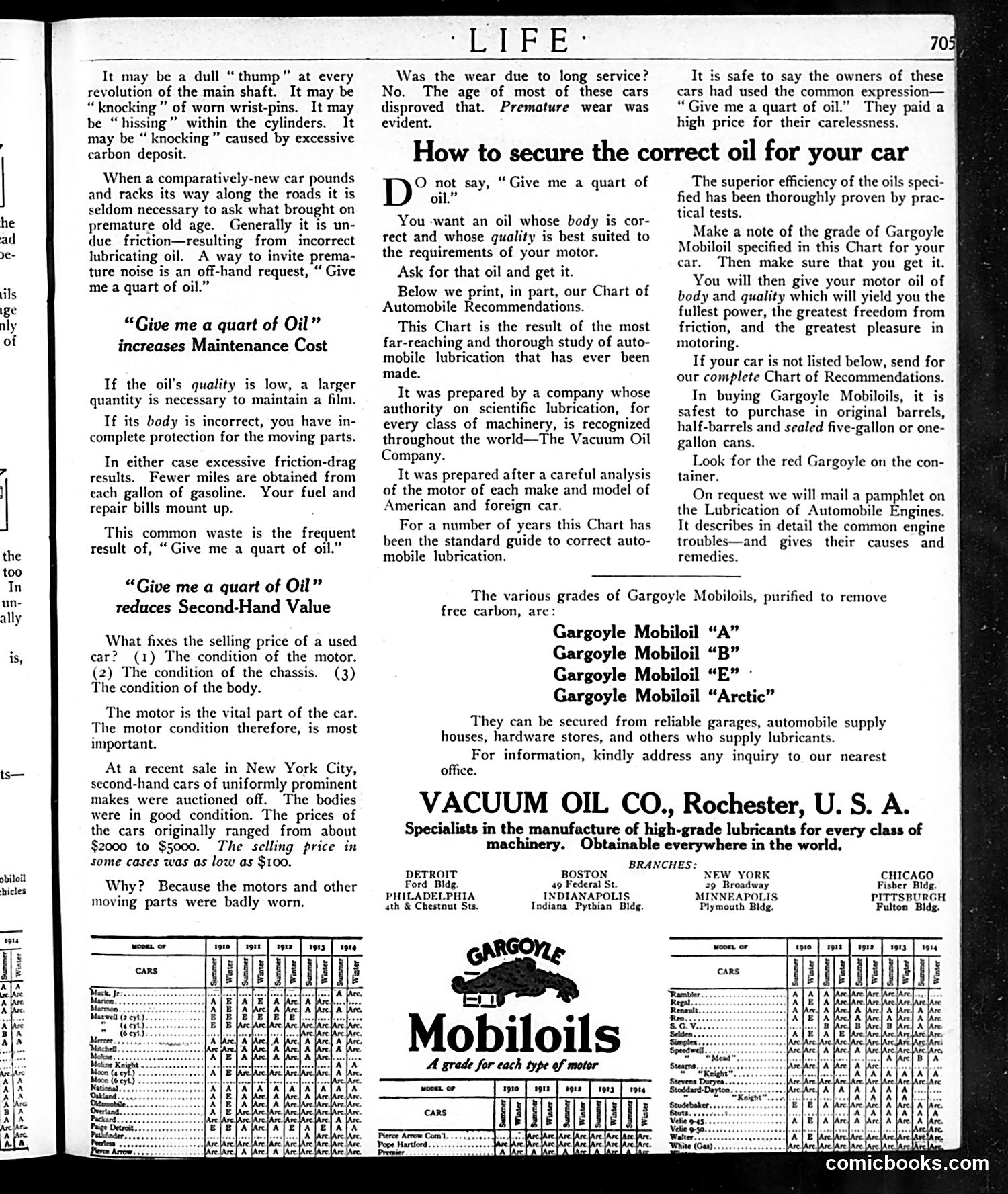
This page is primarily **advertising for Gargoyle Mobiloil**, a motor oil product by the Vacuum Oil Company. Rather than traditional cartoons, it uses persuasive messaging disguised as consumer advice. The "satire" targets **careless car owners** who casually request "a quart of oil" without specifying quality or type. The ad warns that this casual approach causes: - Excessive engine wear and premature aging - Poor resale value (citing an auction where $2000-$5000 cars sold for as low as $100 due to motor damage) - Higher maintenance costs The message is essentially: **your negligence is expensive**. By framing proper oil selection as technical expertise requiring a detailed "Chart of Automobile Recommendations," the ad positions Gargoyle Mobiloil as the solution for responsible car owners. The social commentary is subtle: it mocks working-class carelessness while appealing to middle-class aspirations for proper maintenance and vehicle value preservation. For 1914 readers, this represented emerging consumer culture anxieties about new automobile technology.
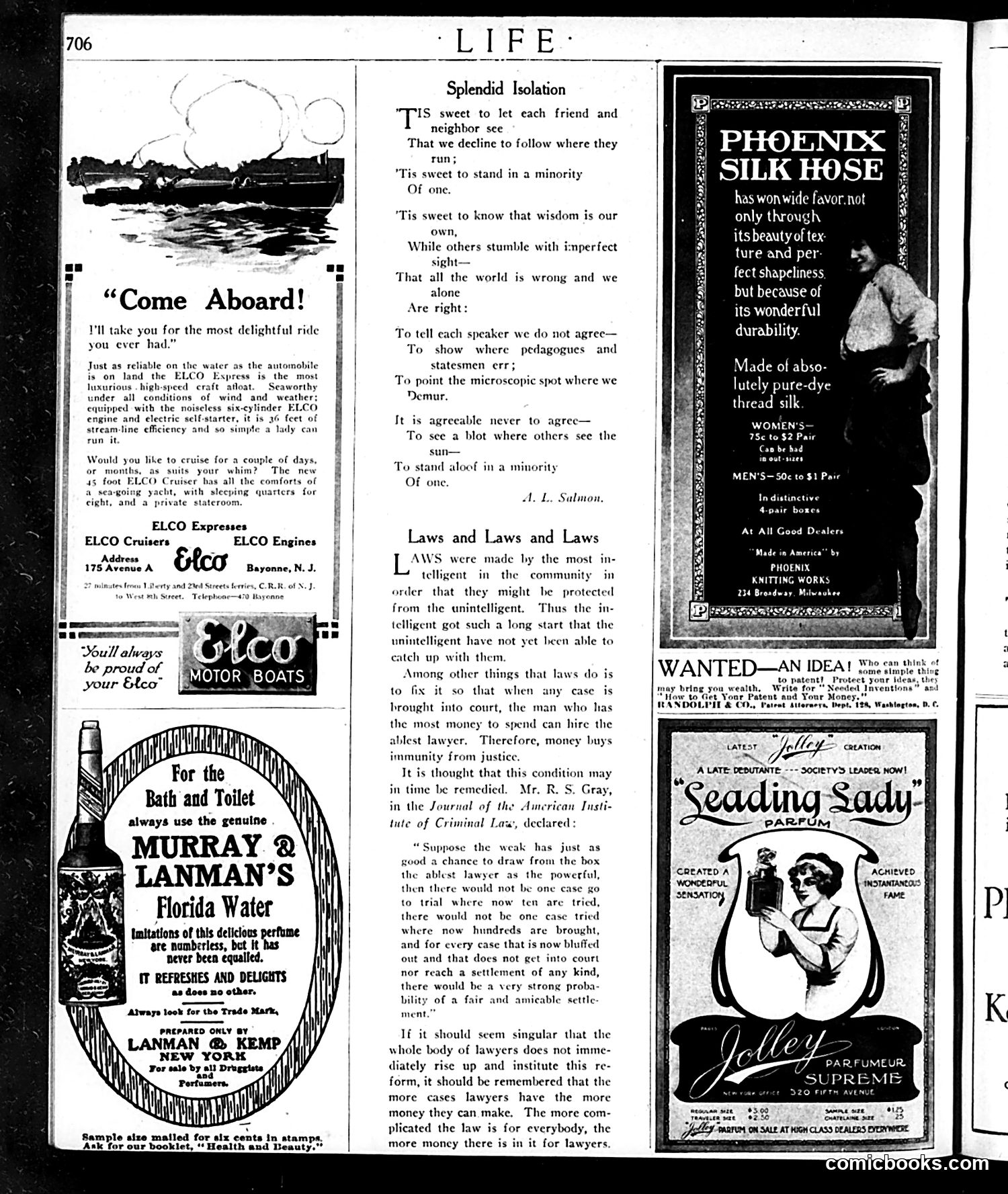
This page mixes advertisements with social commentary. The main editorial content is two poems and an article critiquing American law and society. **"Splendid Isolation"** (attributed to A.L. Salmon) satirizes smug contrarianism—the pleasure some take in disagreeing with everyone else and believing themselves uniquely right while "all the world is wrong." **"Laws and Laws and Laws"** offers sharper social criticism. It argues that laws, originally created by the intelligent to protect themselves from the unintelligent, now serve wealthy defendants. The article quotes R.S. Gray's observation that wealthy people can afford better lawyers, creating a two-tiered justice system where the poor cannot afford adequate legal representation. It concludes cynically that lawyers themselves benefit from legal complexity and won't reform the system. The **advertisements** (ELCO boats, Phoenix silk hose, Murray & Lanman Florida Water, patent services, "Reading Lady" perfume) represent typical early-20th-century magazine marketing, contrasting sharply with the page's critique of inequality.
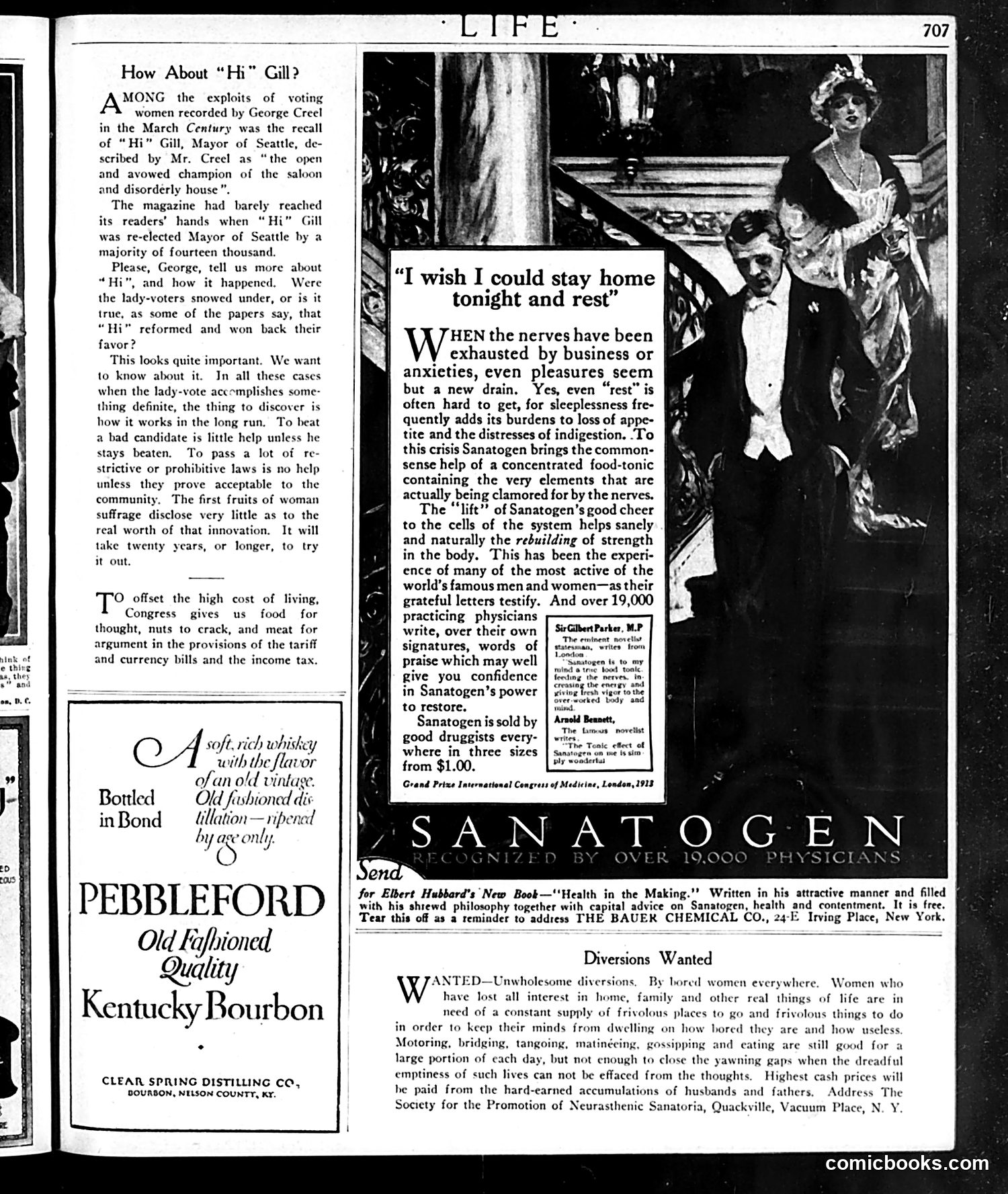
This page satirizes the unexpected outcome of women's newly gained voting power in Seattle. George Creel had written in *Century* magazine that Mayor "Hi" Gill was a corrupt "champion of the saloon and disorderly house" who should be recalled. Yet after women voters gained the franchise, Gill was *re-elected* by 14,000 votes—the opposite of the reform outcome Creel predicted. Life's satire cuts two ways: it mocks Creel's naive assumption that female voters would automatically support moral reform, while also questioning whether women's suffrage would truly transform politics. The article notes skeptically that determining "how it works in the long run" will take "twenty years, or longer to try it out." The surrounding advertisements (Sanatogen tonic, whiskey, frivolous "diversions for bored women") reinforce the satirical tone—suggesting women voters weren't the moral crusaders reformers expected.
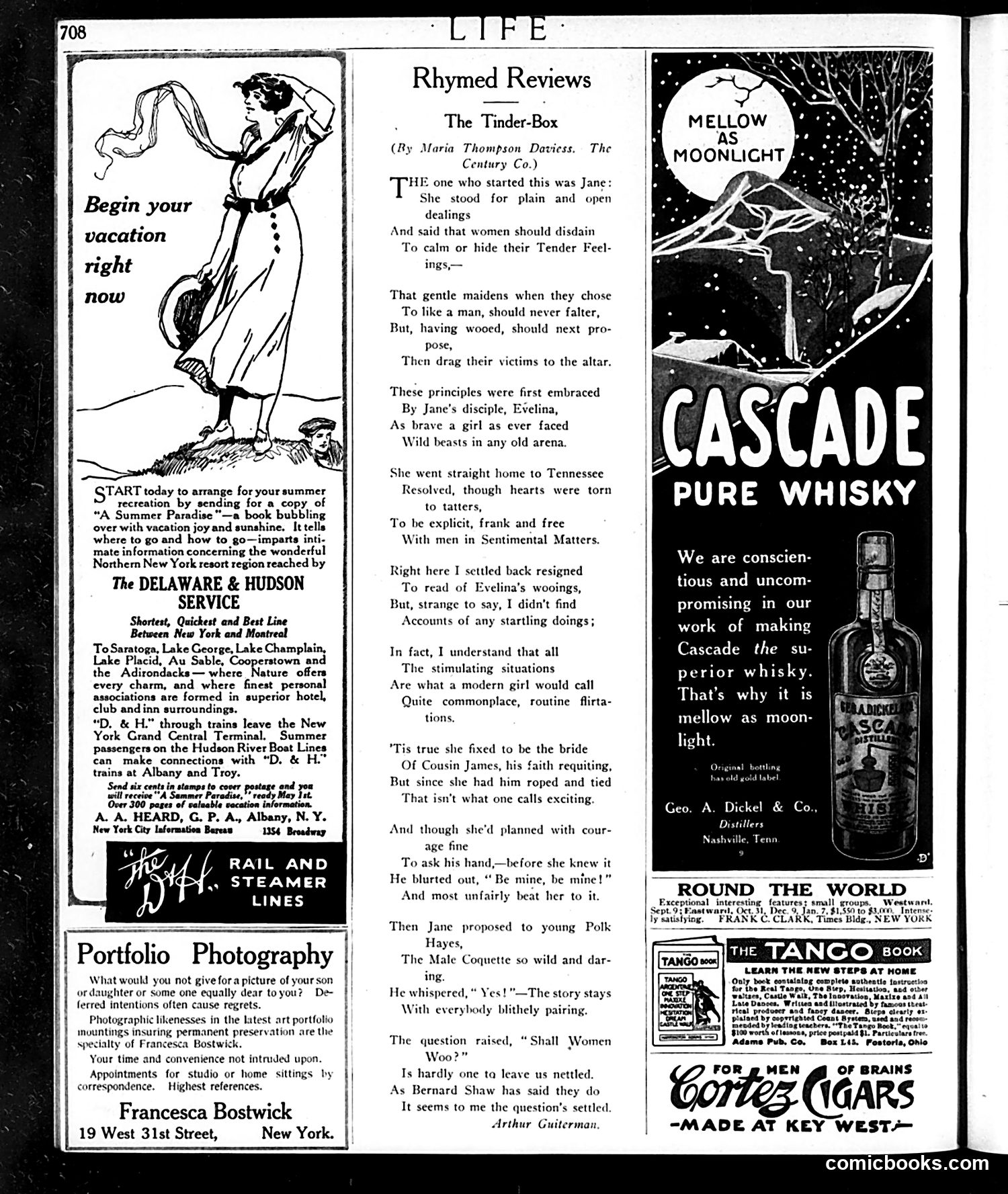
This page combines advertisements with a literary review. The main content is a rhymed book review of *The Tinder-Box* by Maria Thompson Daviess, satirizing early 20th-century debates about women's social roles. The reviewer mocks a novel premise where women are encouraged to openly pursue romantic interests and propose marriage to men—radical ideas for the era. The satire highlights the contradiction: the heroine Evelina is positioned as "brave" for embracing forward female behavior, yet the actual plot proves disappointingly conventional. When she finally attempts to propose to her cousin, he beats her to it by proposing first, undermining her agency. The reviewer's tone—resigned, slightly dismissive—suggests the book's progressive gender politics are more talk than substance. The ending question, "Shall Women Woo?" poses the central cultural anxiety: should women take active romantic roles, or maintain traditional passivity? The surrounding ads (vacations, whisky, photography, tango lessons) represent typical 1910s-era advertising, unrelated to the review's social commentary.
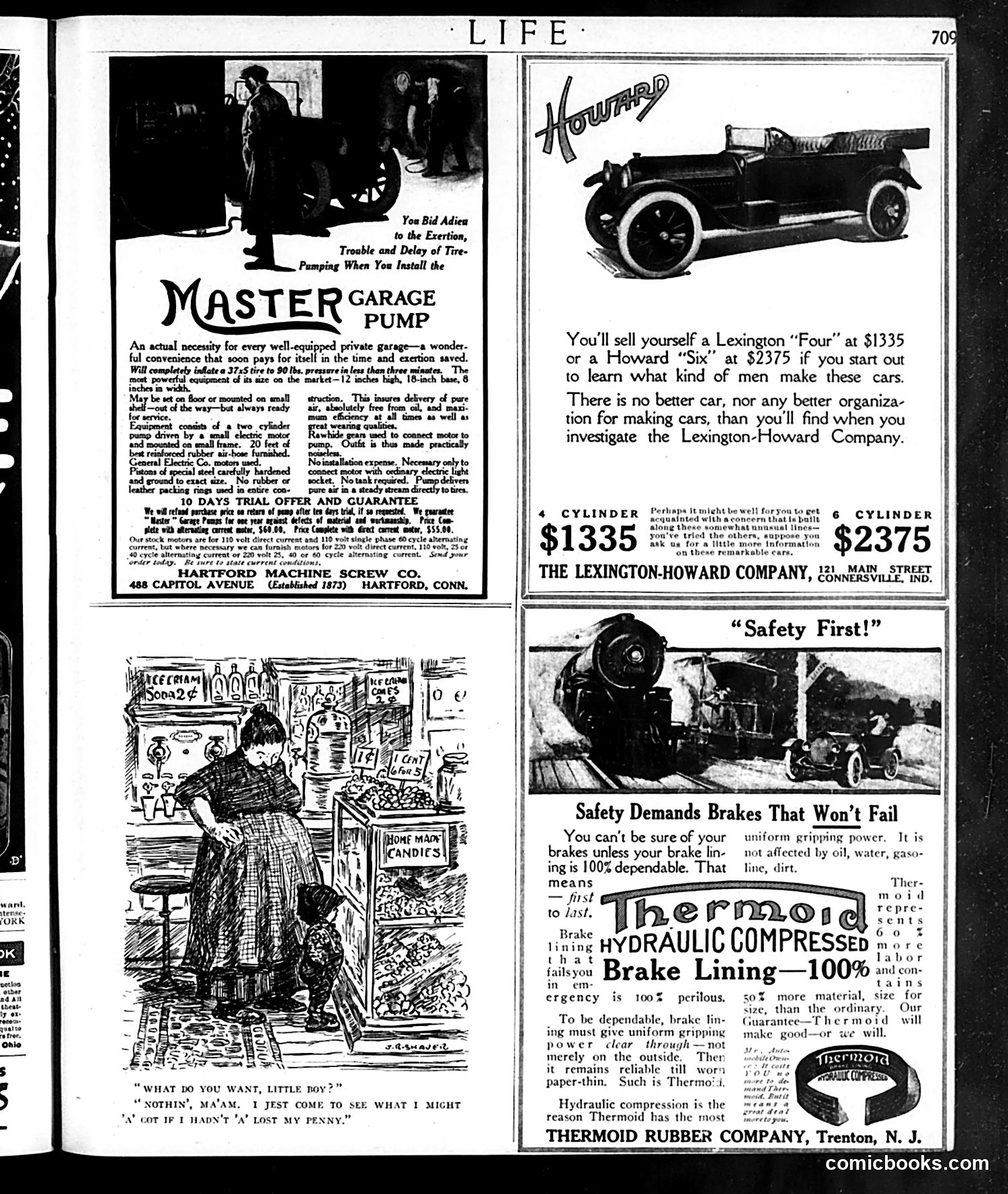
This page is primarily **advertising content** for automobiles and automotive parts, with one small satirical cartoon. **The Cartoon:** The sketch at bottom left shows a poor boy telling a woman he came to see "what I might get if I hadn't lost my penny"—a gentle joke about childhood poverty and wishful thinking. It's sentimental rather than political satire. **The Advertisements:** The page features car and garage equipment ads typical of the 1920s automobile boom: Master Garage Pumps, Lexington-Howard vehicles ($1335-$2375 price range), and Thermoid brake lining. These ads reflect the era's excitement about car ownership becoming middle-class accessible. **Historical Context:** The "Safety First" section promoting reliable brake lining reflects 1920s concerns about automobile safety as cars became commonplace. The ads suggest selling points to car salesmen, indicating Life's audience included businesspeople and entrepreneurs. The page has no obvious political content—it's a commercial/lifestyle snapshot of prosperous interwar America.
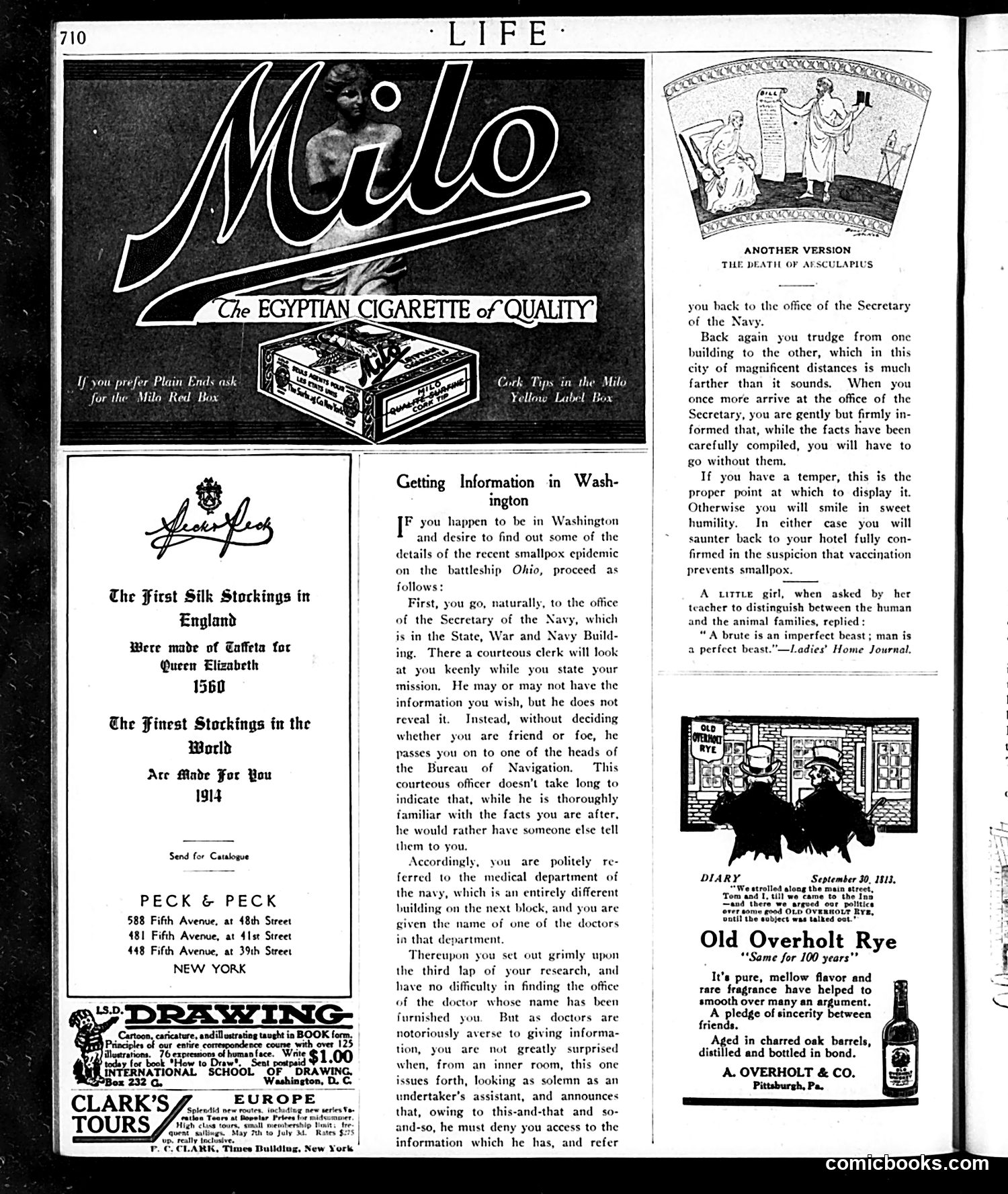
This page combines advertisements with satirical content mocking Washington bureaucracy. **The Main Satire:** "Getting Information in Washington" ridicules the impenetrable federal government. It depicts someone trying to obtain basic information about a smallpox epidemic on the USS Ohio. The narrator is shuffled between the Navy Secretary's office, the Bureau of Navigation, and the medical department—each official claims to have the information but refuses to share it, sending the inquirer elsewhere. After exhausting rounds between buildings, the person returns to where they started, learning nothing. **The Joke:** The article concludes with dark irony: the frustrated visitor leaves "confirmed in the suspicion that vaccination prevents smallpox"—implying the government's obstruction is so complete it becomes absurd. **Historical Context:** This reflects early 20th-century frustration with government opacity and bureaucratic runaround—a common satirical target in *Life* magazine during this era. The page also includes period advertisements for silk stockings, drawing schools, and whiskey.
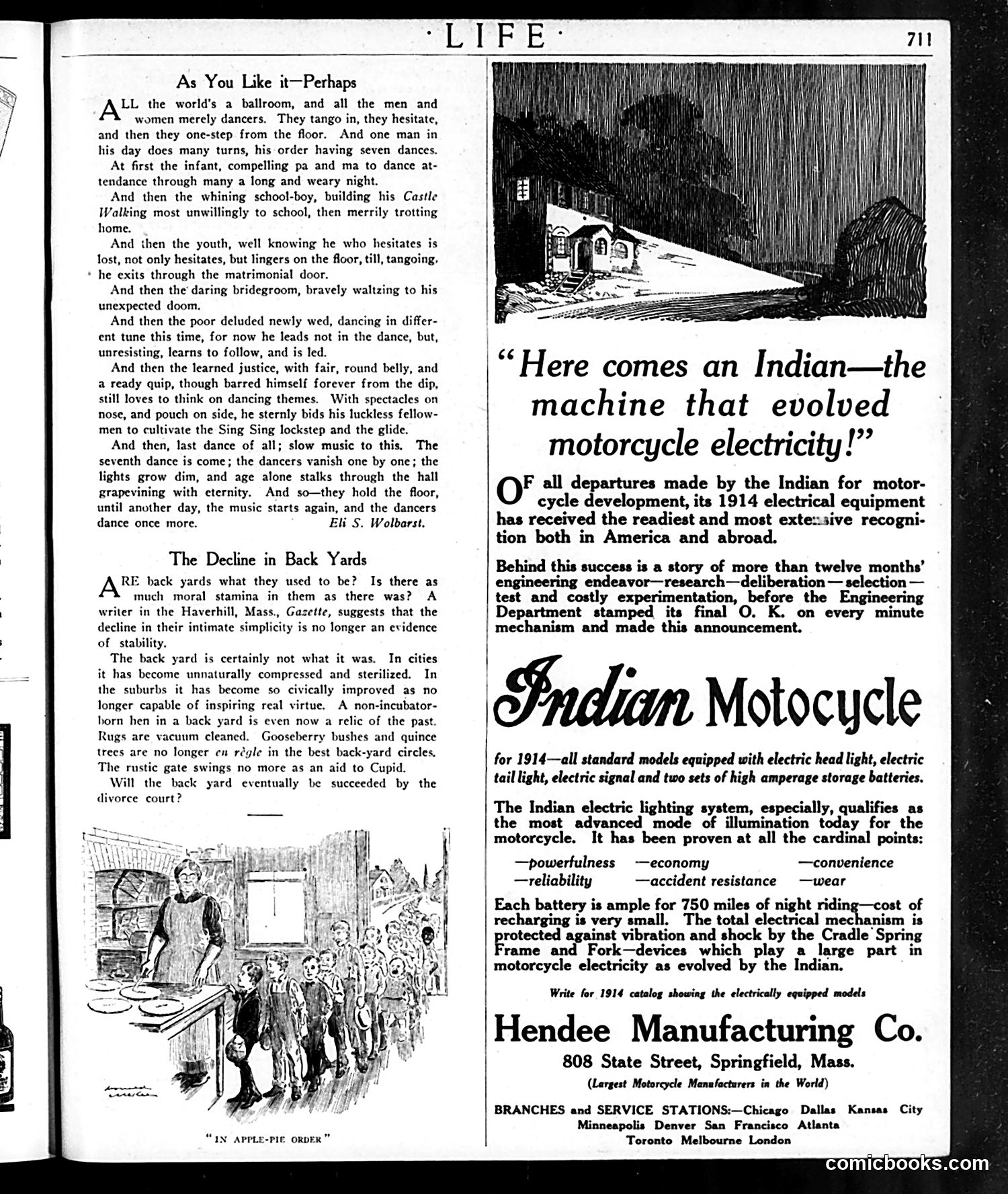
This page contains two distinct elements: **Left side:** A humorous essay titled "As You Like It—Perhaps" (by Eli S. Wolbarst) applies Shakespeare's "seven ages of man" metaphor to dancing and ballroom culture. It traces a man's life stages through different dance styles—from infants requiring parental attendance, through courtship (tangos and one-steps), marriage (where the man "learns to follow"), to old age ("grapevining with eternity"). The satire mocks social conventions and gender dynamics, particularly the shift in power dynamics after marriage. Below this is "The Decline in Back Yards," lamenting how modern urban/suburban life has eliminated the rustic charm of backyards—no more gooseberry bushes, quince trees, or romantic gate-swinging. The concluding joke asks whether the backyard will be "succeeded by the divorce court," suggesting modernization undermines family stability. **Right side:** A full-page advertisement for Indian Motorcycles' 1914 electrical equipment—not satirical content. The ad emphasizes the motorcycle's advanced electrical lighting system and 750-mile battery capacity.
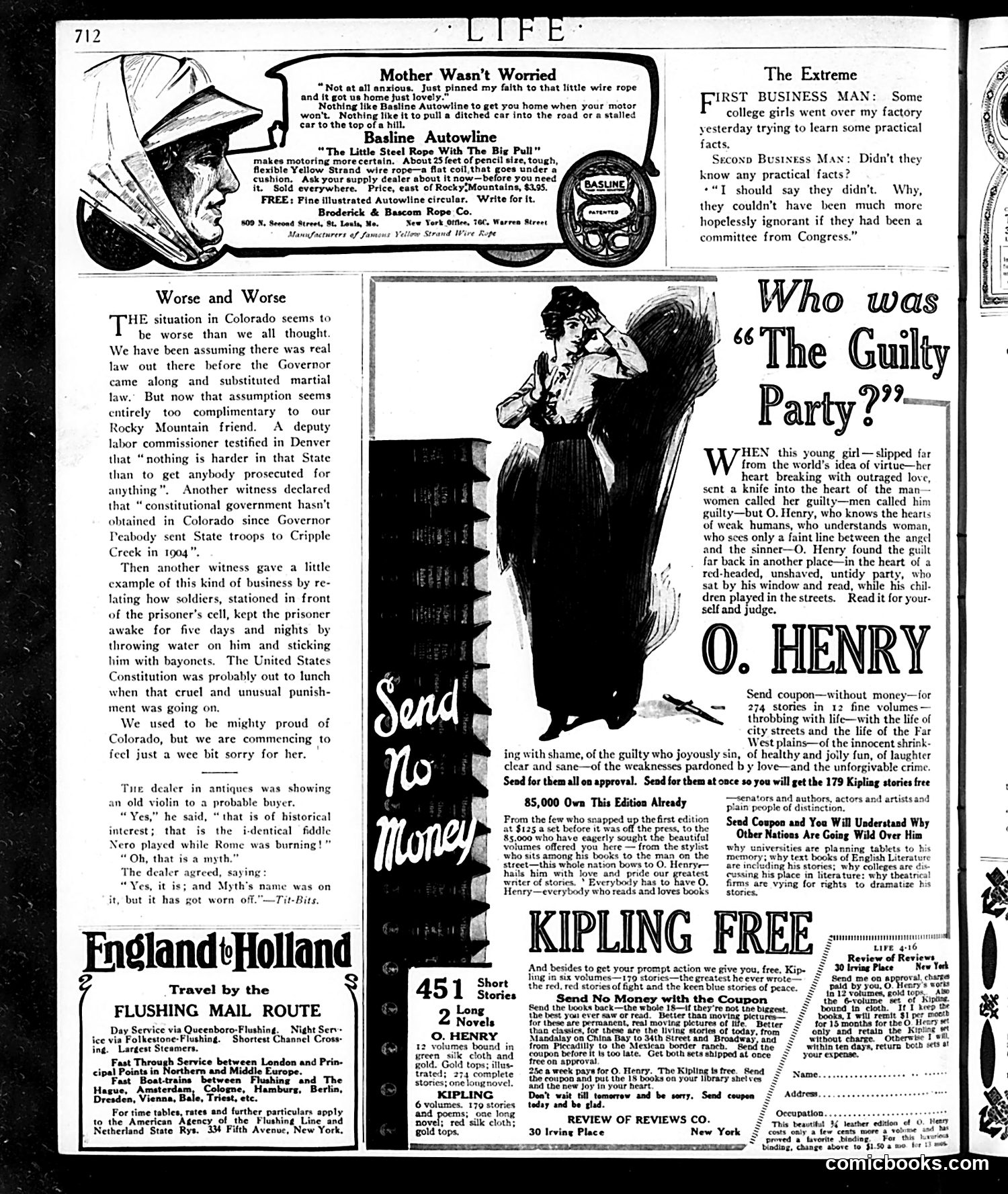
This page mixes **advertisements with social commentary**: **"Worse and Worse"** (left column) satirizes **Colorado's labor strife**, specifically referencing Governor Peabody's 1904 militarization of Cripple Creek during mining strikes. Life attacks the state's collapse of constitutional law, citing testimony that prosecution is impossible and soldiers tortured prisoners with water and bayonets. The satire suggests Colorado has abandoned democracy entirely. **"The Extreme"** (right) mocks **college education's impracticality**. Two businessmen joke that young women touring a factory were as ignorant as if they'd been "a committee from Congress"—implying both are uselessly disconnected from real-world factory work. **O. Henry promotion** advertises the author's short-story collection, using a melodramatic example about a woman who murders her lover, arguing Henry uniquely understands moral complexity invisible to simple judgment. The remaining content is **travel and automotive advertising** (Basline Autowire rope, England-Holland steamship service).
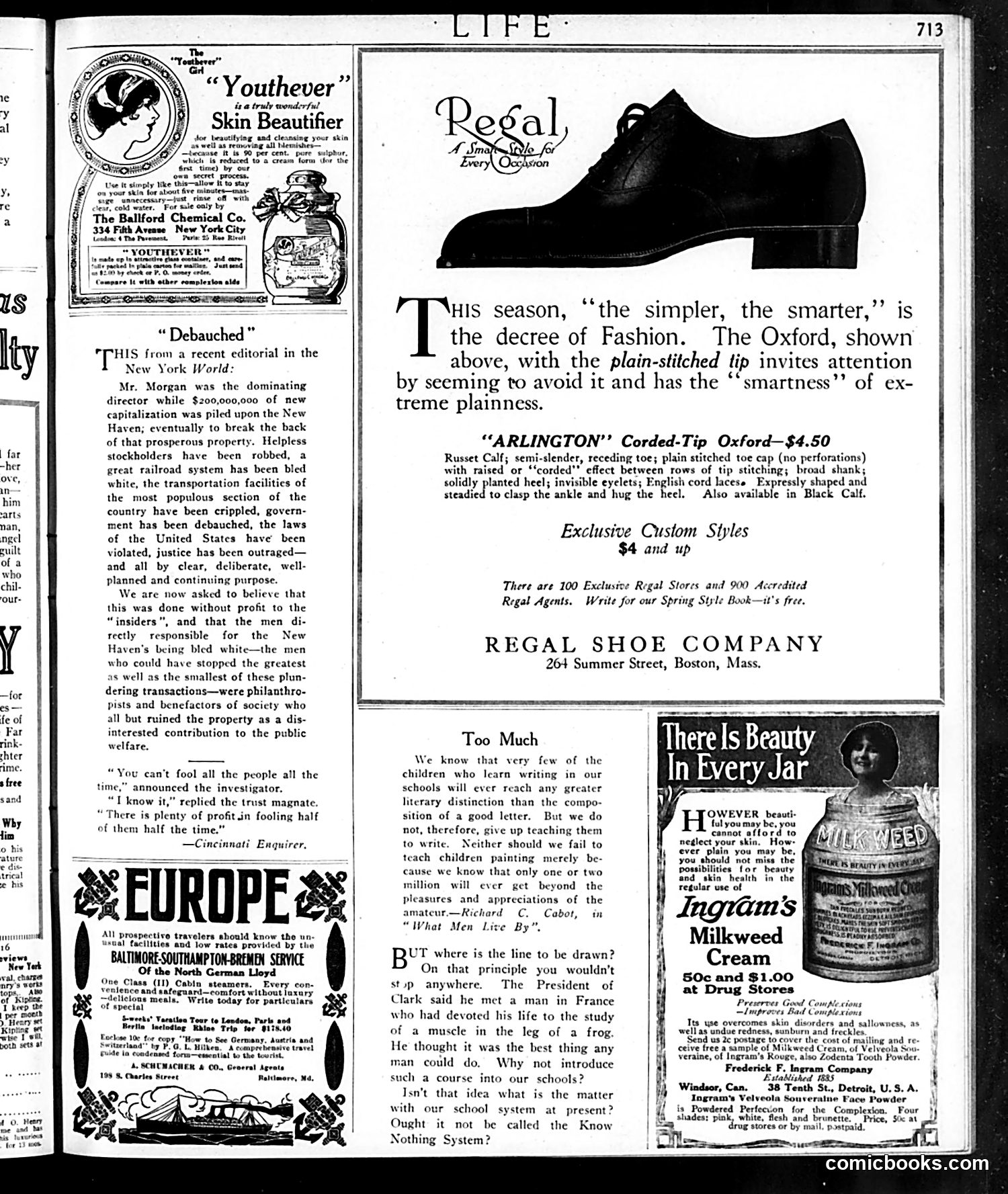
This page is primarily **advertising content** rather than political satire. The main elements include: **Editorial Content:** A brief piece titled "Debauched" critiques J.P. Morgan's financial manipulation of the New Haven railroad. It alleges Morgan and associates deliberately looted the railroad through inflated capitalization ($20 million), crippling a once-prosperous system and damaging regional transportation. The text argues these "insiders" acted with clear deliberate intent to defraud stockholders and the public while presenting themselves as philanthropists. **The Satirical Framing:** A quote from the Cincinnati Enquirer mocks the investigator's naive surprise: "There is plenty of profit in fooling half of them half the time"—suggesting widespread acceptance of corporate fraud as normal business practice. **Advertisements:** The page features shoe ads (Regal), beauty products (Youthever skin cream, Ingram's Milkweed Cream), and travel services. These occupy most space. **Context for Modern Readers:** This reflects the Progressive Era's outrage over railroad magnate corruption—a major political issue of the early 1900s. Morgan was a real, controversial figure known for aggressive business consolidation.
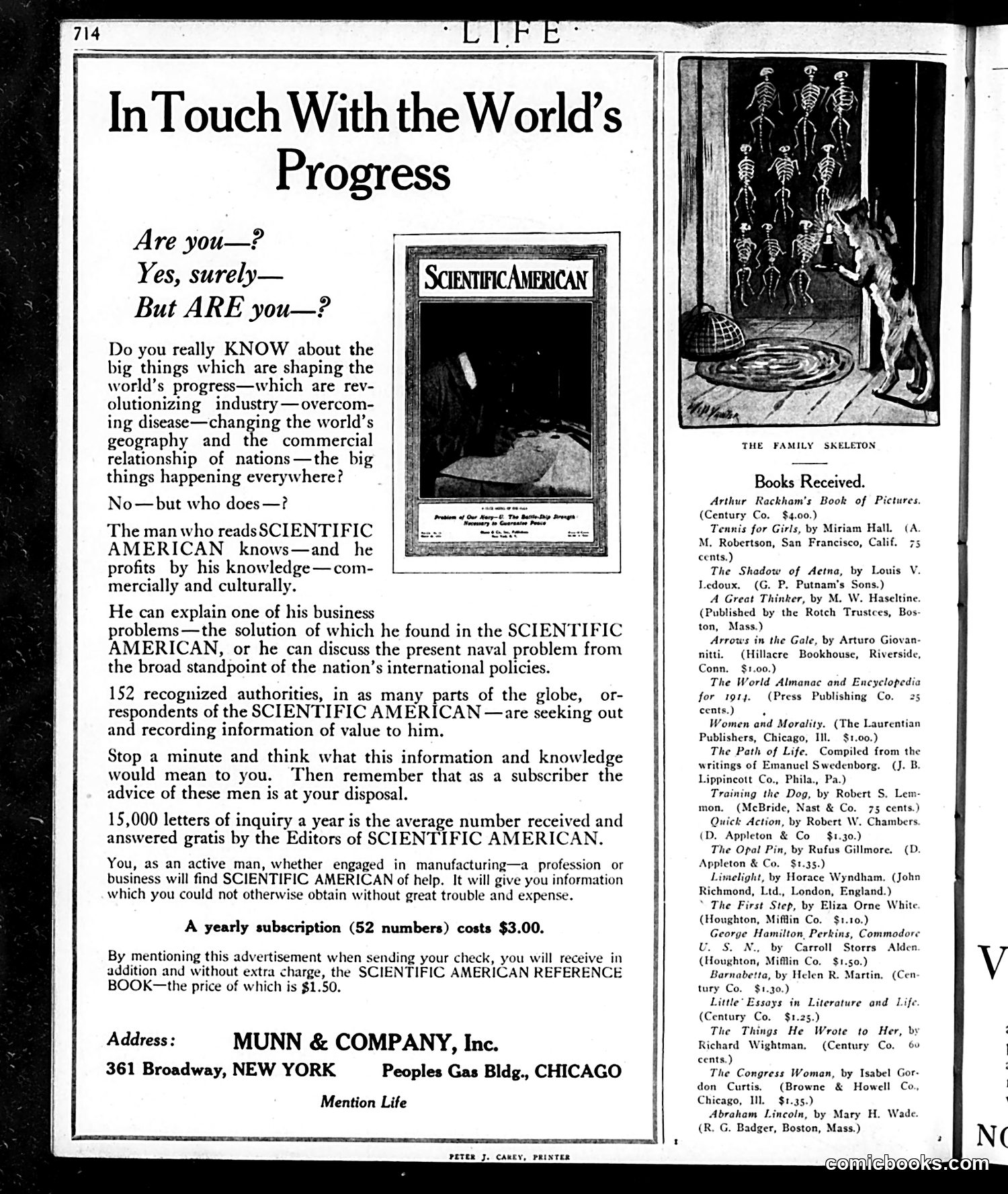
This page is primarily a **Scientific American subscription advertisement** occupying the left two-thirds, with a small cartoon and book reviews on the right. ## The Cartoon ("The Family Skeleton") The cartoon depicts skeletons emerging from a doorway or closet, illustrating the common idiom "skeleton in the closet"—a hidden family shame or embarrassing secret. The image uses this visual metaphor without apparent satirical commentary; it simply illustrates the phrase literally. ## The Advertisement The Scientific American ad uses rhetorical questions to persuade readers (particularly businessmen) that subscription is essential for staying informed about industrial progress, naval policy, and global developments. It emphasizes that 152 international correspondents gather exclusive information unavailable elsewhere, and that editors answer 15,000 inquiry letters annually—positioning knowledge as commercially valuable. ## Books Reviewed The right column lists newly published books, ranging from children's literature (Arthur Rackham illustrations) to biography (George Hamilton Perkins) to fiction, reflecting early 20th-century publishing output. The page represents typical Life magazine content: satirical advertising mixed with cultural notices.
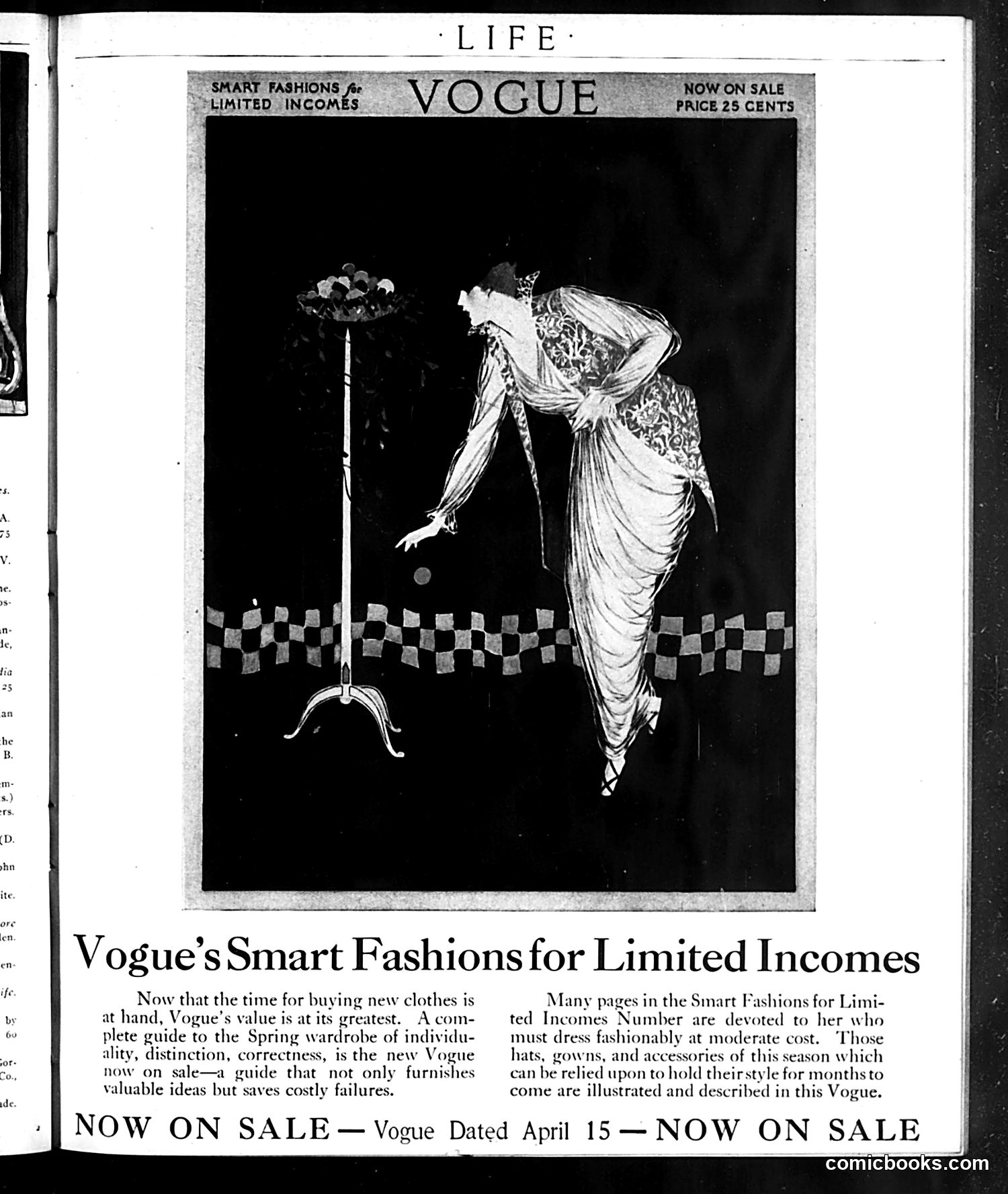
This is primarily a **Vogue magazine advertisement**, not a political cartoon. It appears in Life magazine promoting a special "Smart Fashions for Limited Incomes" issue of Vogue (dated April 15, priced 25 cents). The illustration depicts an elegantly dressed woman in fashionable draped clothing, bending gracefully toward a potted flower stand. The art style is typical of 1920s fashion illustration—stylized and refined. The advertisement's message targets **economically conscious readers during what appears to be the post-WWI era**. It promises that Vogue's new issue offers fashionable clothing guidance for people with modest budgets—emphasizing that quality pieces will "hold their style for months," suggesting value and durability matter to this audience. The satire (if any) is subtle: Life is ironically running this ad claiming fashion *can* be affordable, while Vogue traditionally served affluent readers. This reflects broader 1920s democratization of consumer culture and aspirational marketing to middle-income Americans.
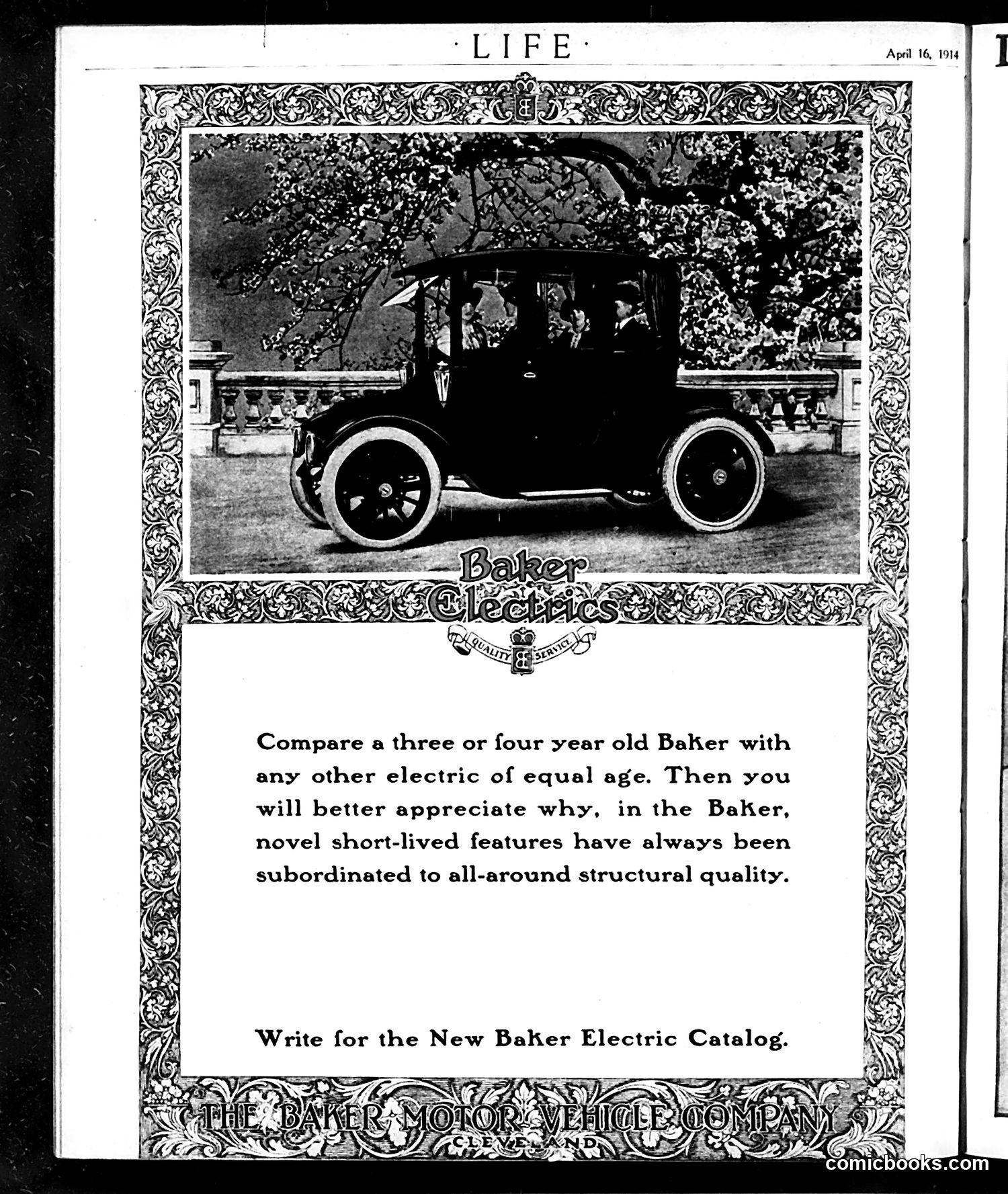
This is a **Baker Motor Vehicle Company advertisement**, not satire or political commentary. The page shows a black early electric automobile from the side, photographed in front of flowering trees. The text argues that Baker electric cars maintain structural quality better than competitors over time—that three- or four-year-old Bakers hold up better than other electric vehicles of the same age. The ad's logic is that Baker prioritizes durability ("structural quality") over trendy but short-lived features. This was a legitimate selling point in 1914, when electric vehicles competed with gasoline cars and reliability mattered greatly. The "novel short-lived features" phrase likely refers to other manufacturers' gimmicky add-ons that would fail quickly. This represents early automotive advertising emphasizing longevity and quality as competitive advantages.