
Life, 1914-04-16 · page 16 of 44
Life — April 16, 1914 — page 16: what you’re looking at
What you’re looking at
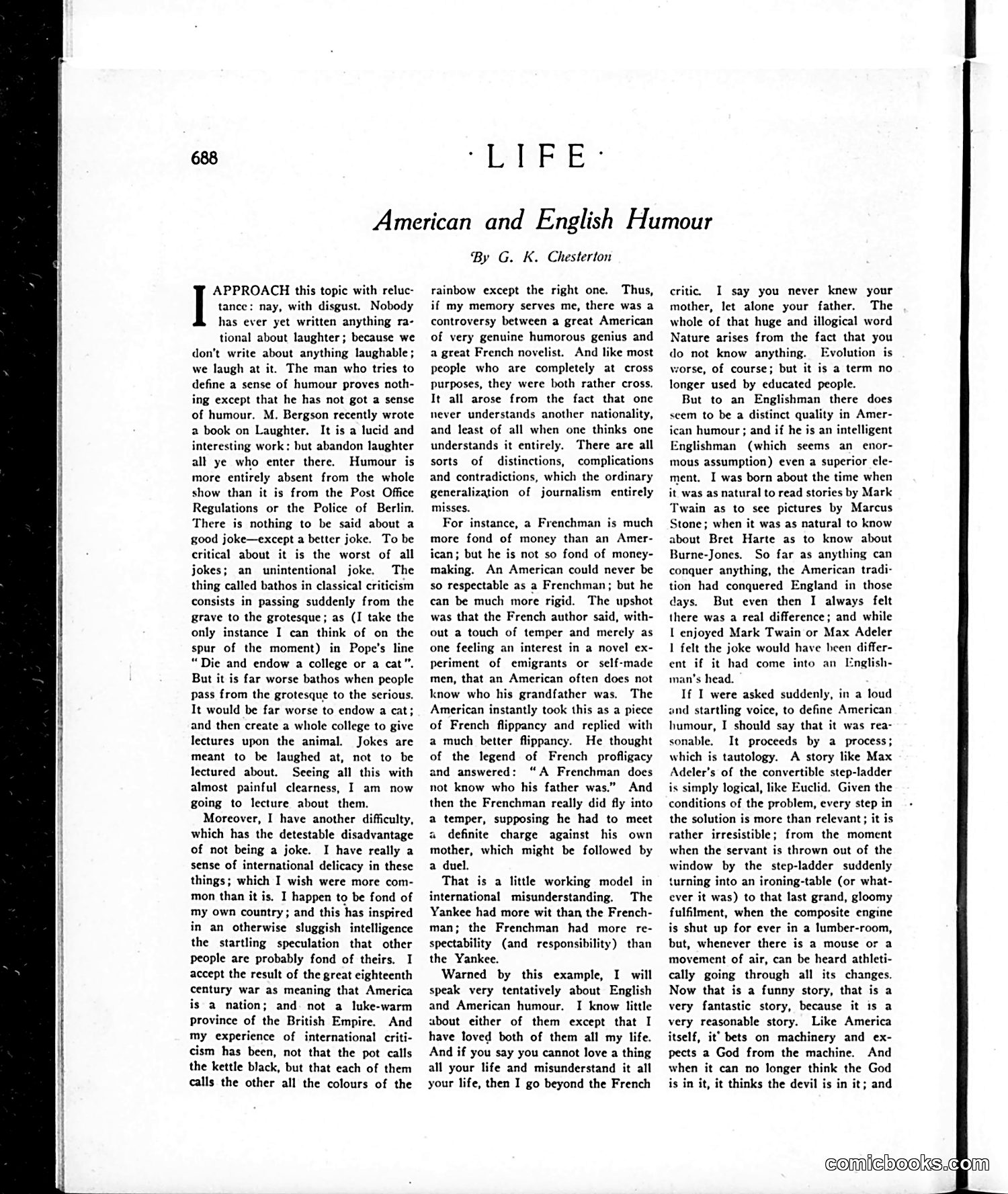
This is an essay (not a cartoon), by famous British author G.K. Chesterton, examining differences between American and French humor. The page contains no illustrations. Chesterton argues that humor cannot be rationally analyzed without destroying it. He illustrates international misunderstanding through a dispute between an unnamed American humorist and French novelist: the Frenchman casually remarked that Americans don't know their grandfathers; the American responded that Frenchmen don't know their fathers. The Frenchman, interpreting this as an insult to French morality, nearly demanded a duel. The essay's satire is gentle: Chesterton mocks how nations misread each other's intent, each "calling the other all the colours of the rainbow except the right one." Americans have wit; Frenchmen have respectability. The humor lies in how easily casual international banter escalates through mutual misunderstanding.
📄 Transcribed text from this page (OCR, searchable)
Machine-transcribed from the original scan — historical spelling and the odd misread are preserved.
688 “SRE * American and English Humour tance: nay, with disgust. Nobody has ever yet written anything ra- tional about laughter; because we don’t write about anything laughable; we laugh at it. The man who tries to define a sense of humour proves noth- ing except that he has not got a sense of humour. M. Bergson recently wrote a book on Laughter. It is a lucid and interesting work: but abandon laughter all ye who enter there. Humour is more entirely absent from the whole show than it is from the Post Office Regulations or the Police of Berlin. There is nothing to be said about a good joke—except a better joke. To be critical about it is the worst of all jokes; an unintentional joke. The thing called bathos in classical criticism consists in passing suddenly from the grave to the grotesque; as (I take the only instance I can think of on the spur of the moment) in Pope's line “Die and endow a college or a cat”. But it is far worse bathos when people pass from the grotesque to the serious. It would be far worse to endow a cat; and then create a whole college to give lectures upon the animal. Jokes are meant to be laughed at, not to be lectured about. Seeing all this with almost painful clearness, I am now going to lecture about them. Moreover, I have another difficulty, which has the detestable disadvantage of not being a joke. I have really a sense of international delicacy in these things; which I wish were more com- mon than it is. I happen to be fond of my own country; and this has inspired in an otherwise sluggish intelligence the startling speculation that other People are probably fond of theirs. I accept the result of the great eighteenth century war as meaning that America is a nation; and not a luke-warm Province of the British Empire. And my experience of international criti- cism has been, not that the pot calls the kettle black, but that each of them calls the other all the colours of the I APPROACH this topic with reluc- By G. K. Chesterton rainbow except the right one. Thus, if my memory serves me, there was a controversy between a great American of very genuine humorous genius and a great French novelist. And like most people who are completely at cross purposes, they were both rather cross. It all arose from the fact that one never understands another nationality, and least of all when one thinks one understands it entirely. There are all sorts of distinctions, complications and contradictions, which the ordinary generalization of journalism entirely misses. For instance, a Frenchman is much more fond of money than an Amer- ican; but he is not so fond of money- making. An American could never be so respectable as a Frenchman; but he can be much more rigid. The upshot was that the French author said, with- out a touch of temper and merely as one feeling an interest in a novel ex- periment of emigrants or self-made men, that an American often does not know who his grandfather was. The American instantly took this as a piece of French flippancy and replied with a much better flippancy. He thought of the legend of French profligacy and answered: “A Frenchman does not know who his father was.” And then the Frenchman really did fly into a temper, supposing he had to meet a definite charge against his own mother, which might be followed by a duel. That is a little working model in international misunderstanding. The Yankee had more wit than the French- man; the Frenchman had more re- spectability (and responsibility) than the Yankee. Warned by this example, I will speak very tentatively about English and American humour. I know little about either of them except that I have loved both of them all my life. And if you say you cannot love a thing all your life and misunderstand it all your life, then I go beyond the French critic I say you never knew your mother, let alone your father. The whole of that huge and illogical word Nature arises from the fact that you do not know anything. Evolution is worse, of course; but it is a term no longer used by educated people. But to an Englishman there does scem to be a distinct quality in Amer- ican humour ; and if he is an intelligent Englishman (which seems an enor- mous assumption) even a superior ele- ment. I was born about the time when it was as natural to read stories by Mark Twain as to see pictures by Marcus Stone; when it was as natural to know about Bret Harte as to know about Burne-Jones. So far as anything can conquer anything, the American tradi- tion had conquered England in those days. But even then I always felt there was a real difference; and while I enjoyed Mark Twain or Max Adeler 1 felt the joke would have heen differ- ent if it had come into an English- man's head. If I were asked suddenly, in a loud and startling voice, to define American humour, I should say that it was rea- sonable. It proceeds by a process; which is tautology. A story like Max Adeler’s of the convertible step-ladder is simply logical, like Euclid. Given the conditions of the problem, every step in the solution is more than relevant ; it is rather irresistible; from the moment when the servant is thrown out of the window by the step-ladder suddenly turning into an ironing-table (or what- ever it was) to that last grand, gloomy fulfilment, when the composite engine is shut up for ever in a lumber-room, but, whenever there is a mouse or a movement of air, can be heard athleti- cally going through all its changes. Now that is a funny story, that is a very fantastic story, because it is a very reasonable story. Like America itself, it’ bets on machinery and ex- pects a God from the machine. And when it can no longer think the God is in it, it thinks the devil is in it; and comichooks.