
Life, 1914-04-16 · page 24 of 44
Life — April 16, 1914 — page 24: what you’re looking at
What you’re looking at
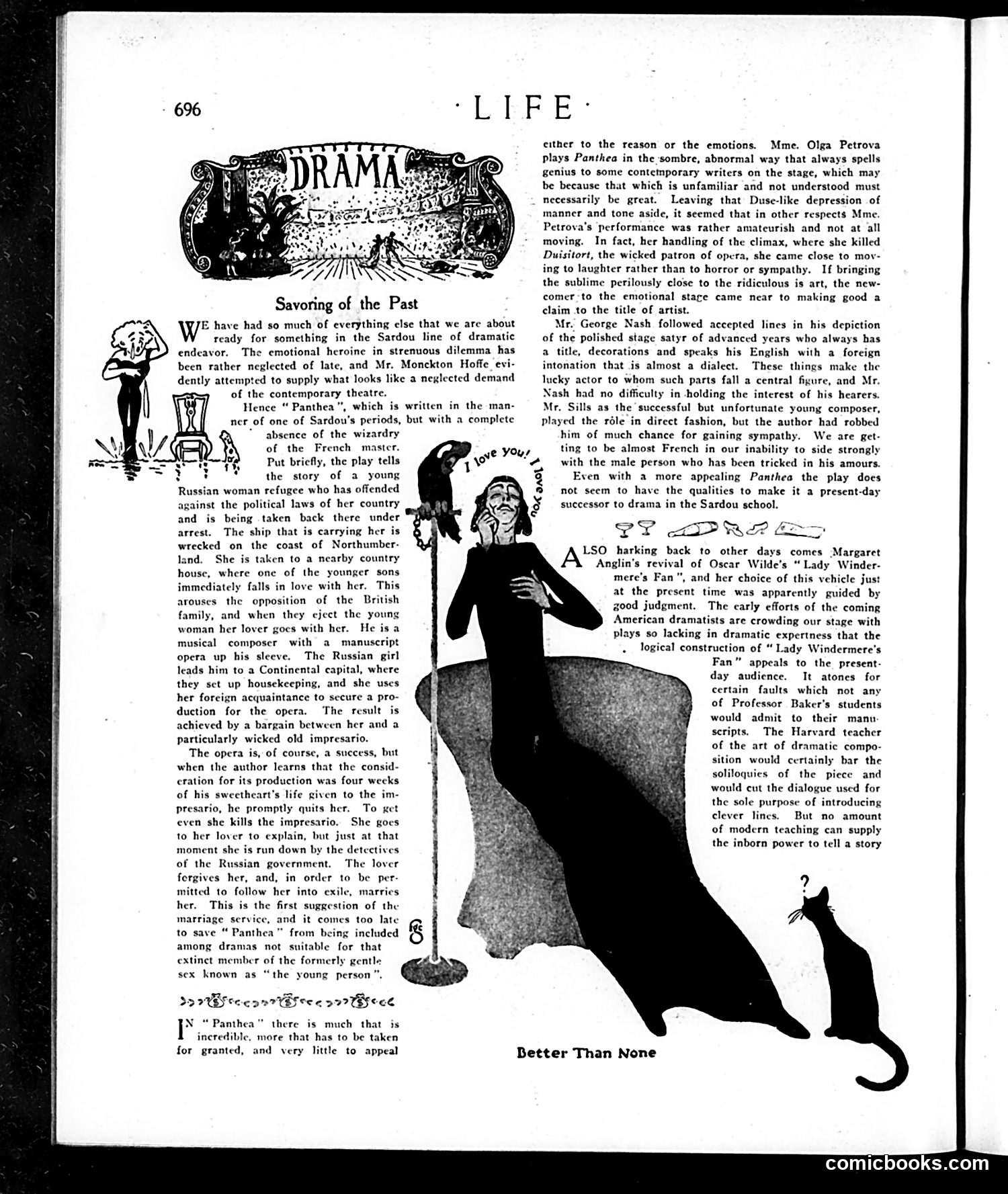
This page reviews the play "Panthea," a melodrama written by Monckton Hoffe in the style of 19th-century French playwright Victorien Sardou. The critic argues the play imitates Sardou's *manner* but lacks his theatrical genius. **The Plot's Absurdity:** A Russian refugee woman falls in love with a British composer. She secures production of his opera by becoming the mistress of a corrupt impresario for four weeks. When the composer learns this, he abandons her. She kills the impresario and is arrested by Russian agents—but the composer marries her so he can follow her into exile. **The Satire:** The critic mocks both the implausible plot contrivances and the lead actress Olga Petrova's pretentiously "abnormal" performance style. He suggests that contemporary critics confuse the unfamiliar with genius, comparing her to the great actress Eleonora Duse. The review ridicules American theatre's desperate imitation of European dramatic forms and the melodramatic absurdities audiences will accept. The illustration labeled "Better Than None" appears to satirize the play's emotional manipulations through silhouetted figures.
📄 Transcribed text from this page (OCR, searchable)
Machine-transcribed from the original scan — historical spelling and the odd misread are preserved.
*LEFE - Savoring of the Past have had so much of everything clse that we are about ready for something in the Sardou line of dramatic endeavor. The emotional heroine in strenuous dilemma has been rather neglected of late, and Mr. Monckton Hoffe evi- dently attempted to supply what looks like a neglected demand of the contemporary theatre. Hence “ Panthea”, which is written in the man- ner of one of Sardou's periods, but with a complete “absence of the wizardry a of the French master. Th Put briefly, the play tells 2 T ' 8 the story of a young Russian woman refugee who has offended against the political laws of her country and is being taken back there under arrest. The ship that is carrying her is wrecked on the coast of Northumber- land. She is taken to a nearby country house, where one of the younger sons immediately falls in love with her. This arouses the opposition of the British family, and when they eject the you woman her lover goes with her. He isa musical composer with a manuscript opera up his sleeve, The Russian girl leads him to a Continental capital, where they set up housekeeping, and she uscs her foreign acquaintance to secure a pro- duction for the opera. The result is achieved by a bargain between her and a particularly wicked old impresari The opera is, of course, a success, but when the author learns that the consid- cration for its production was four weeks of his sweetheart’s life given to the im- presario, he promptly quits her. To get even she kills the impresario. She gocs to her lover to explain, but just at that moment she is run down by the detectives of the Russian government. The lover forgives her, and, in order to be per- mitted to follow her into exile, marries her. This is the first suggestion of the marriage service, and it comes too late to save “ Panthea” from being included among dramas not suitable for that extinct member of the formerly gentle sex known as “the young person”. 32 27UES ceca er TES ee ¢ 277TH E iy Panthea” there is much that is incredible, more that has to be taken for granted, and very little to appeal see y od Yous either to the reason or the emotions. Mme. Olga Petrova plays Panthea in the sombre, abnormal way that always spells genius to some contemporary writers on the stage, which may be because that which is unfamiliar and not understood must necessarily be great. Leaving that Duse-like depression of manner and tone aside, it seemed that in other respects Mme. Petrova's performance was rather amateurish and not at all moving. In fact, her handling of the climax, where she killed Duisitort, the wicked patron of opera, she came close to mov- ing to laughter rather than to horror or sympathy. If bringing the sublime perilously close to the ridiculous is art, the new- comer to the emotional stage came near to making good a claim to the title of artist. Mr. George Nash followed accepted lines in his depiction of the polished stage satyr of advanced years who always has a title, decorations and speaks his English with a foreign intonation that is almost a dialect. These things make the lucky actor to whom such parts fall a central figure, and Mr. Nash had no difficulty in holding the interest of his hearers. Mr, Sills as the ‘successful but unfortunate young composer, played the réle in direct fashion, but the author had robbed him of much chance for gaining sympathy. We are get- ting to be almost French in our inability to side strongly ae with the male person who has been tricked in his amours. 3 Even with a more appealing Panthea the play does ® not seem to have the qualities to make it a present-day é successor to drama in the Sardou school. LSO harking back to other days comes Margaret Anglin's revival of Oscar Wilde's “Lady Winder- mere’s Fan", and her choice of this vehicle just at the present time was apparently guided by good judgment. The carly efforts of the coming American dramatists are crowding our stage with plays so lacking in drama expertness that the logical construction of “ Lady Windermere’s Fan” appeals to the present- day audience. It atones for certain faults which not any of Professor Baker's students would admit to their manu scripts. The Harvard teacher of the art of dramatic compo- sition would certainly bar the soliloquies of the piece and would cut the dialogue used for the sole purpose of introducing clever lines. But no amount of modern teaching can supply the inborn power to tell a story 9 Better Than None comicbooks.com