
Life, 1914-04-16 · page 14 of 44
Life — April 16, 1914 — page 14: what you’re looking at
What you’re looking at
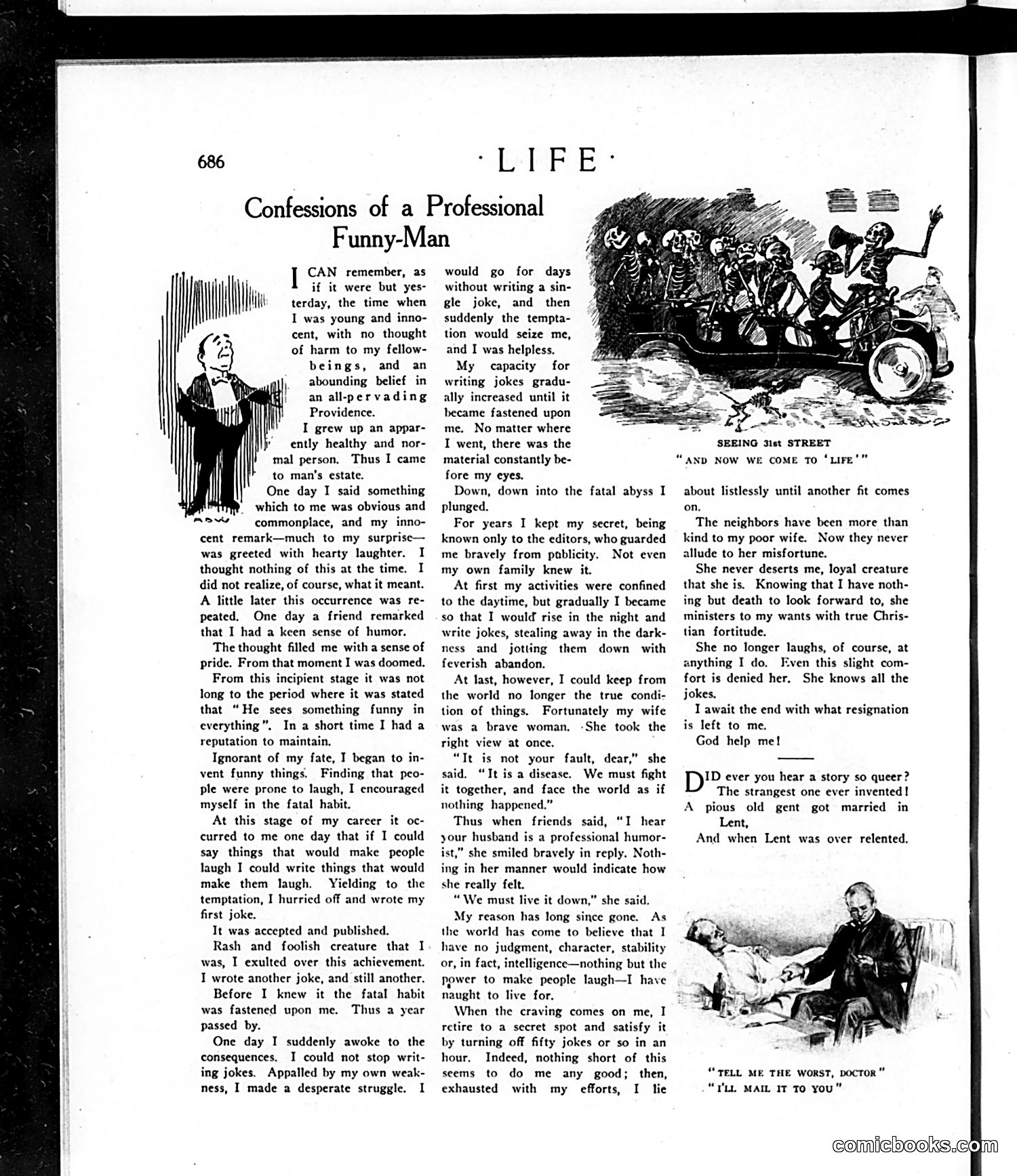
This is a confessional article where a humor writer describes how he became obsessed with making people laugh, to the detriment of his personal life and marriage. The piece appears autobiographical rather than political satire. The accompanying illustrations show: 1. **Top right**: A chaotic street scene labeled "Seeing 31st Street" and "And Now We Come to 'Life'"—depicting the author's comedic observations of urban life. 2. **Bottom right**: A sketch titled "Tell Me the Worst, Doctor / I'll Mail It to You"—showing a patient confessing troubles to a doctor, implying the author mines personal misfortune for comedic material. The satire targets the self-destructive nature of professional comedy writing and how comedians sacrifice genuine human connection for their craft.
📄 Transcribed text from this page (OCR, searchable)
Machine-transcribed from the original scan — historical spelling and the odd misread are preserved.
‘fe NELE * Confessions of a Professional Funny-Man CAN remember, as if it were but yes- terday, the time when I was young and inno- cent, with no thought of harm to my fellow- beings, and an abounding belief in an all-pervading Providence. I grew up an appar- ently healthy and nor- mal person. Thus I came to man's estate. One day I said something which to me was obvious and commonplace, and my inno- cent remark—much to my surprisc— was greeted with hearty laughter. I thought nothing of this at the time. I did not realize, of course, what it meant. A little later this occurrence was re- peated, One day a friend remarked that I had a keen sense of humor, The thought filled me with a sense of pride. From that moment I was doomed. From this incipient stage it was not long to the period where it was stated that “He sees something funny in everything”, In a short time I had a reputation to maintain, Ignorant of my fate, I began to in- vent funny things. Finding that peo- ple were prone to laugh, I encouraged myself in the fatal habit. At this stage of my career it oc- curred to me one day that if I could say things that would make people laugh I could write things that would make them laugh. Yielding to the temptation, I hurried off and wrote my first joke. It was accepted and published. Rash and foolish creature that I was, I exulted over this achievement. I wrote another joke, and still another. Before I knew it the fatal habit was fastened upon me. Thus a year passed by. One day I suddenly awoke to the consequences. I could not stop writ- ing jokes. Appalled by my own weak- ness, I made a desperate struggle. 1 would go for days without writing a sin- gle joke, and then suddenly the tempta- tion would seize me, and I was helpless. My capacity for writing jokes gradu- ally increased until it became fastened upon me. No matter where I went, there was the material constantly be- fore my eyes. Down, down into the fatal abyss I plunged. For years I kept my secret, being known only to the editors, who guarded me bravely from pnblicity. Not even my own family knew it. At first my activities were confined to the daytime, but gradually I became so that I would rise in the night and write jokes, stealing away in the dark- ness and jotting them down with feverish abandon. At last, however, I could keep from the world no longer the true condi- tion of things. Fortunately my wife was a brave woman, -She took the right view at once, “Tt is not your fault, dear,” she said. “It is a disease. We must fight it together, and face the world as if nothing happened.” Thus when friends said, “I hear your husband is a professional humor- ist,” she smiled bravely in reply. Noth- ing in her manner would indicate how she really felt. “We must live it down,” she said. My reason has long since gone. As the world has come to believe that I have no judgment, character, stability or, in fact, intelligence—nothing but the Ppwer to make people laugh—I have naught to live for. When the craving comes on me, I retire to a secret spot and satisfy it by turning off fifty jokes or so in an hour. Indeed, nothing short of this seems to do me any good; then, exhausted with my efforts, I lie SEEING 3ist STREET “AND NOW WE COME TO ‘LIFE'” about listlessly until another fit comes on, The neighbors have been more than kind to my poor wife. Now they never allude to her misfortune. She never deserts me, loyal creature that she is. Knowing that I have noth- ing but death to look forward to, she ministers to my wants with true Chris- tian fortitude. She no longer laughs, of course, at anything I do. Even this slight com- fort is denied her. She knows all the jokes. I await the end with what resignation is left to me. God help me! ID ever you hear a story so queer? The strangest one ever invented! A pious old gent got married in Lent, And when Lent was over relented. “TELL ME THE WORST, DOCTOR” “TLL MAIL IT To You” comichooks.