
Life, 1914-04-16 · page 39 of 44
Life — April 16, 1914 — page 39: what you’re looking at
What you’re looking at
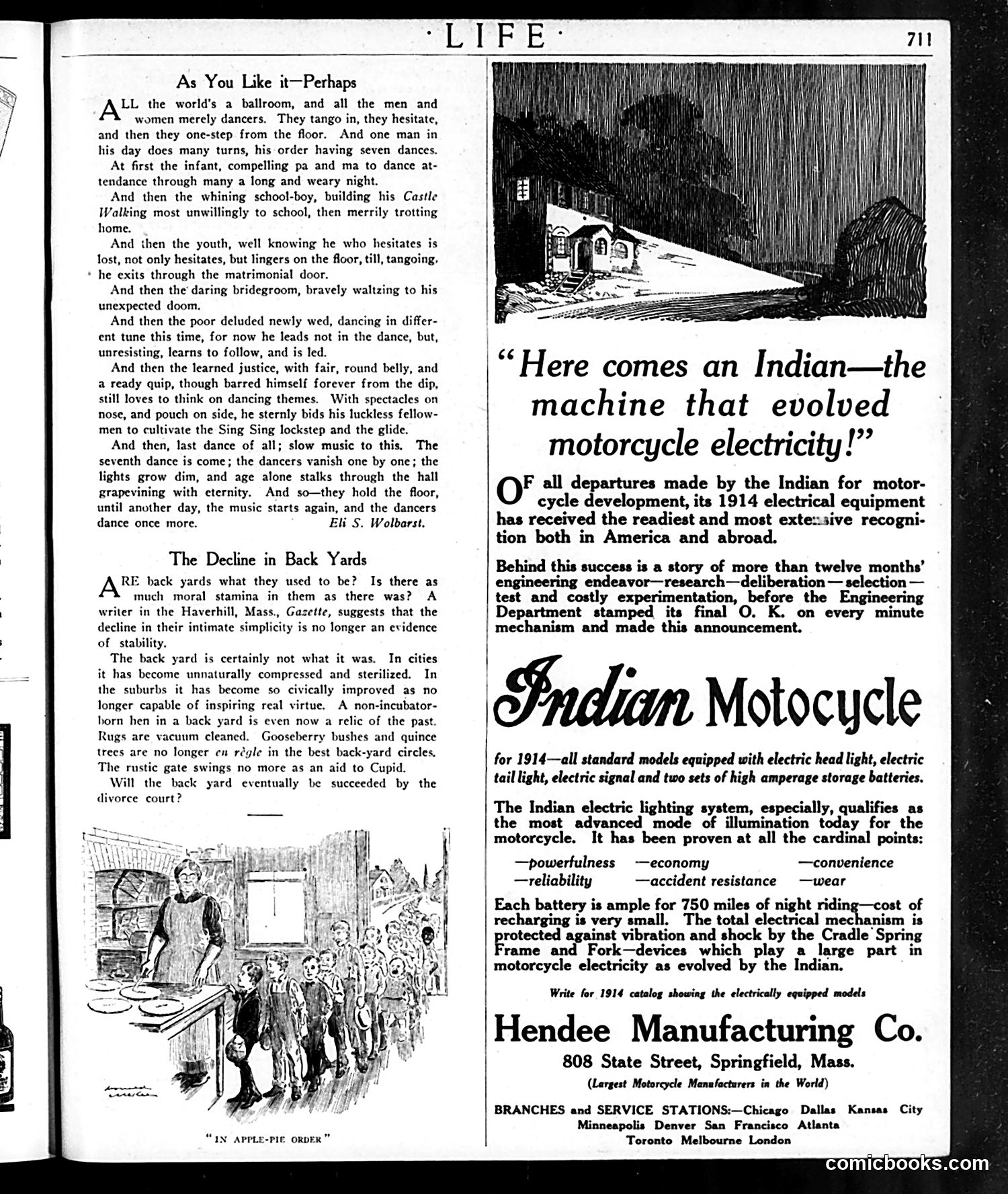
This page contains two distinct elements: **Left side:** A humorous essay titled "As You Like It—Perhaps" (by Eli S. Wolbarst) applies Shakespeare's "seven ages of man" metaphor to dancing and ballroom culture. It traces a man's life stages through different dance styles—from infants requiring parental attendance, through courtship (tangos and one-steps), marriage (where the man "learns to follow"), to old age ("grapevining with eternity"). The satire mocks social conventions and gender dynamics, particularly the shift in power dynamics after marriage. Below this is "The Decline in Back Yards," lamenting how modern urban/suburban life has eliminated the rustic charm of backyards—no more gooseberry bushes, quince trees, or romantic gate-swinging. The concluding joke asks whether the backyard will be "succeeded by the divorce court," suggesting modernization undermines family stability. **Right side:** A full-page advertisement for Indian Motorcycles' 1914 electrical equipment—not satirical content. The ad emphasizes the motorcycle's advanced electrical lighting system and 750-mile battery capacity.
📄 Transcribed text from this page (OCR, searchable)
Machine-transcribed from the original scan — historical spelling and the odd misread are preserved.
4 As You Like it—Perhaps LL the world's a ballroom, and all the men and women merely dancers. They tango in, they hesitate, and then they one-step from the floor. And one man in his day does many turns, his order having seven dances. At first the infant, compelling pa and ma to dance at- tendance through many a long and weary night. And then the whining school-boy, building his Castle Walking most unwillingly to school, then merrily trotting home. And then the youth, well knowing he who hesitates is lost, not only hesitates, but lingers on the floor, till, tangoing, * he exits through the matrimonial door. And then the’ daring bridegroom, bravely waltzing to his unexpected doom, And then the poor deluded newly wed, dancing in differ- ent tune this time, for now he leads not in the dance, but, unresisting, learns to follow, and is led. And then the learned justice, with fair, round belly, and a ready quip, though barred himself forever from the dip, still loves to think on dancing themes. With spectacles on nose, and pouch on side, he sternly bids his luckless fellow- men to cultivate the Sing Sing lockstep and the glide. And then, last dance of all; slow music to this. The seventh dance is come; the dancers vanish one by one; the lights grow dim, and age alone stalks through the hall grapevining with eternity. And so—they hold the floor, until another day, the music starts again, and the dancers dance once more. Eli S. Wolbarst, The Decline in Back Yards ARE back yards what they used to be? Is there as much moral stamina in them as there was? A writer in the Haverhill, Mass., Gazette, suggests that the decline in their intimate simplicity is no longer an evidence of stability. The back yard is certainly not what it was. In cities it has become unnaturally compressed and sterilized. In the suburbs it has become so civically improved as no longer capable of inspiring real virtue. A non-incubator- horn hen in a back yard is even now a relic of the past. Rugs are vacuum cleaned. Gooseberry bushes and quince trees are no longer en régle in the best back-yard circles, The rustic gate swings no more as an aid to Cupid. Will the back yard eventually be succeeded by the divorce court? “IN APPLE-PIC ORDER” ‘Here comes an Indian—the machine that evolved p?? motorcycle electricity! OF all departures made by the Indian for motor- cycle development, its 1914 electrical equipment has received the readiest and most extexsive recogni- tion both in America and abroad. Behind this success is a story of more than twelve months’ engineering endeavor—research—deliberation — selection — test and costly experimentation, before the Engineering Department stamped its final O. K. on every minute mechanism and made this announcement. Sudan Motocycle for 1914—all standard models equipped with electric head light, electric tail light, electric signal and two sets of high amperage storage batteries. The Indian electric lighting system, especially, qualifies as the most advanced mode of illumination today for the motorcycle. It has been proven at all the cardinal points: —powerfulness —economy —convenience —teliability —accident resistance —wear Each battery i is ample for 750 miles of night ridin; recharging is very small. The total electrical mec rotected against vibration and shock by the Cradle’ seria rame Fork—devices wi! play a large part in motorcycle electricity as evolved by the Indian. Write for 1914 catalog showing the electrically equipped models Hendee Manufacturing Co. 808 State Street, Springfield, Mass. (Largest Motorcycle Manufacturers in the World) BRANCHES and SERVICE STATIONS:—Chicago Dallas Kansas City Minneapolis Denver San Francisco Atlanta Toronto Melbourne London comicbooks.com